TE MANAWA TAKI REGIONAL EQUITY PLAN 2020-2023 - TE MANAWA TAKI - Waikato District Health Board
←
→
Page content transcription
If your browser does not render page correctly, please read the page content below

TE MANAWA TAKI

TE MANAWA TAKI
REGIONAL EQUITY PLAN 2020-2023

        Version: Final
        Date: 16 October 2020
TE MANAWA TAKI – REGIONAL EQUITY PLAN 2020-2023

              Piki mai kake mai rā, hōmai te waiora,
      Kia a ahau e tūtehu ana, koia te moe a te kuia i te pō,
                      Te pō i raru ai a Wairaka.
Papaki tū ana ngā tai ki te paepae o Aotea, rere kau ana te tangi
                       ki te puia o Whakaari,
Ki a koutou i hinga i taua parekura, e moe mai rā, e moe mai rā, e
                           moe okioki ana.

   To those who lost their lives on Whakaari and to their whānau
                  who grieve for them, you have
                    enduring love and support.

Acknowledgements: Te Manawa Taki Governance Group wishes to acknowledge the previous
regional (Midlands) Chairs group for setting the pathway toward this Regional Equity Plan. We also
thank Shea Pita & Associates for the contribution to this Regional Equity Plan.

                          Logo Designed by Denise Morgan-Koia | Nativei Creative
                          The logo in this document has been designed for the Regional Equity Plan
                          2020-2023. A process is currently underway to determine a logo to be
                          used on behalf of all iwi and DHBs in the region.

                          Logo Explanation

                          Main Shape: Manawa/Heart
                          Represents and more specifically, embodies the vision and values of Te Manawa Taki.

                          Right Side: 5 “Pulsating” Hearts
                          5 separate hearts (3 white, 2 grey or implied) sit inside each other to depict each
                          DHB who make up Te Manawa Taki. Together they make up one heart, to reflect the
                          vision and values of Te Manawa Taki.

                          Left Side: Ngā Pou o Te Manawa Taki
                          Pouwhenua: used by Māori to mark territiorial boundaries or places of significance.
                          Used here to represent an association between the people and the land. Specifically
                          pouwhenua reflect the relationship between the ancestors, environment and the
                          reputation or standing of the tangata whenua.

                          Within this logo 5 pouwhenua depict Te Manawa Taki - working together - He kapa
                          kī tahi.

COVER AND BACK PAGE IMAGES: Maunga Hikurangi is the highest non-volcanic mountain in the North
Island, and the first place on the New Zealand mainland to see the sun each morning.

                                                                                                                ii
TE MANAWA TAKI – REGIONAL EQUITY PLAN 2020-2023

MIHI WHAKATAUKĪ

        Ko te hā te tūmanako o te ora		          Hope is the breath of life
        Ko te ora te kikokiko o te Ao		          life is the sustenance of creation
        Ko te Ao te whakaruruhau		               Creation is the shelter
        Mō te tangata				                        of the people
        Ko te Manawa Taki			                     Manawa Taki the heart beat
        O te oranga				                          of wellbeing
        Tihei mauri ora!				                     The essence of life!

        I te tīmatanga o te kupu			              In the beginning is the Word
        Ko te Atua te kupu 			                   and the Word is God
        Ko te Atua anō taua kupu		               and God is the Word
        ko ia te tīmata 				                     for God is the beginning
        Me te whakaotinga o ngā mea katoa        and the end of all creation

        E mihi kau ana				                       Greetings and salutations
        ki te Kīngi Māori a Tuheitia 		          to the Māori king Tuheitia
        Potatau Te Wherowhero te tuawhitu        Potatau Te Wherowhero the seventh
        O te whare o Potatau			                  of the house of Potatau
        Paimarire.				                           Peace.

        Ka huri hoki ki te whare tapu		          Salutations to the sacred house
        O Te Heuheu				                          of Te Heuheu
        Te Ariki					                            the paramount chief
        O Ngāti Tūwharetoa			                    of Ngāti Tūwharetoa

        E mihi ana ki ngā tini aituā 		          We acknowledge those who have passed
        Kua wehe ki a Rangiwhetu mā		            to Rangiwhetu ma / the heavens
        Kia pīataata koutou i te rangi 		        to be seen like a shining light
        Ki tua o te ārai a Rehua			              upon the veil of Rehua
        Haere, haere, haere atu rā 		            travel, travel farewell

He mihi maioha tēnei ki a koutou katoa e ngā rangatira, e ngā iwi whānui o te takiwā o Te Manawa
Taki mai i Tauranga moana ki Te Arawa, peka atu ki Te Tairāwhiti, whakawhiti ki Te Tai Hauāuru i
Taranaki tae noa ki Waikato / Tainui. Ko tā mātou e whai nei he hāpai ake i te oranga o tō tātou iwi
mā te ara hauora. Ko tā mātou whāinga kia mahi tahi ngā rōpū e rima i runga i te whakaaro he pai
ake ngā upoko tokorima tērā i te upoko takitahi. Arā, ko tō mātou tirohanga whakamua “He Kapa Kī
Tahi”. Nō reira, ki a koutou rau rangatira mā, nō mātou te hōnore ki te āwhina i a koutou. Mā te Atua
koutou e manaaki, e tiaki. Pai mārire.

Greetings and a warm welcome to you our esteemed elders and people within our various rohe
of Te Manawa Taki. From Tauranga to Te Arawa, and on to Te Tairāwhiti; from there across to the
western coast to Taranaki, and up to Waikato / Tainui. It is our intention and desire to up-lift the
standard of wellbeing for our people, through health. Our goal, of course, is to work as one, now
that we are a collective of five rōpū, and five heads have to be better than one. Thus, the vision “He
Kapa Kī Tahi”. Therefore, to you our most esteemed people, it is our humble honor to serve. May
God look after you and keep you all safe and well. Peace.

                                                                                                         iii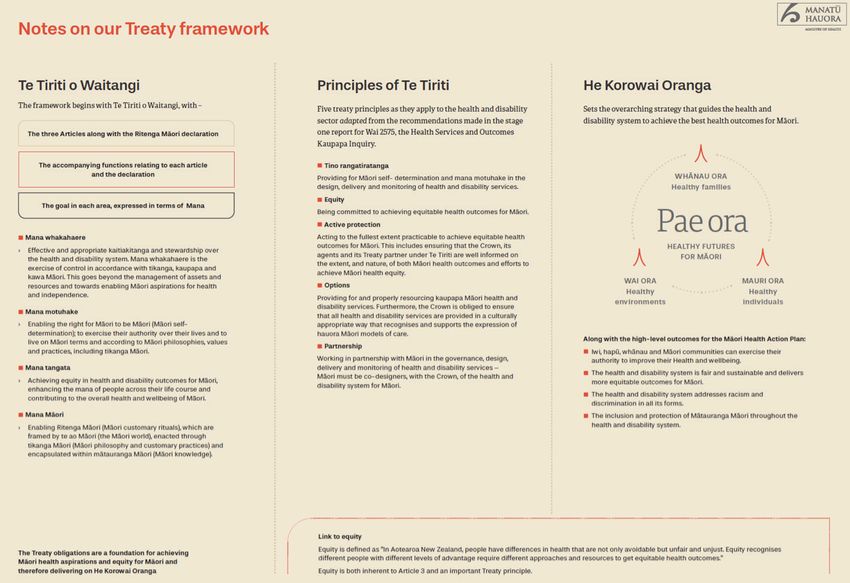
TE MANAWA TAKI – REGIONAL EQUITY PLAN 2020-2023

ENDORSEMENT WHAKAMANA

     16 October 2020

     Nick Saville-Wood
     Lead Chief Executive for
     Midland Region District Health Boards
     nick.saville-wood@lakesdhb.govt.nz

     Dear Nick

     Te Manawa Taki Regional Equity Plan 2020/21

     This letter is to advise you that I have agreed the Te Manawa Taki Regional Equity Plan.
     Your region has produced a Regional Equity Plan this year which demonstrates an excellent
     collaborative approach between Māori and Iwi leaders working in unison with DHBs. I
     acknowledge that this is a significant milestone for the region and is the direct result of an
     enhanced Te Tiriti o Waitangi based partnership between Iwi and the five DHBs. In addition
     to this, the COVID-19 pandemic has presented extraordinary challenges to the health
     system, and your region has responded well with rapid escalation and early engagement in
     the early stages, laying the foundation for recovery and a transition to the “new normal”.
     My approval of your plan does not constitute acceptance of proposals for service changes
     that have not undergone review and agreement by the Ministry of Health (Ministry). Please
     ensure that you advise the Ministry as early as possible of any proposals for service change
     that may require Ministerial approval. Approval of the Plan also does not constitute approval
     of any capital business cases that have not been approved through the normal process.
     I would like to thank you and your staff for your valuable contribution and continued
     commitment to delivering quality health care to your population and wish you every success
     with the implementation of the 2020/21 plan.
     Please ensure that a copy of this letter is attached to the copy of your signed plan held by
     each DHB Board and to all copies that are made available to the public.
     Ngā mihi nui

     Chris Hipkins
     Minister of Health

                                                                                                      iv
TE MANAWA TAKI – REGIONAL EQUITY PLAN 2020-2023

        Agreed by Te Manawa Taki Governance
        DHB BOARD CHAIRS AND IWI GOVERNANCE

SHARON              POUROTO             KIM                 NA                  DR JIM
SHEA, MNZM          NGAROPO, MNZM       NGĀRIMU             RAIHANIA            MATHER
                    Māori Health                            Te Waiora o
                    Runanga                                 Nukutaimemeha
Bay of Plenty DHB   Bay of Plenty DHB   Hauora Tairāwhiti   Hauora Tairāwhiti   Lakes DHB

AROHA               CASSANDRA           TE PAHUNGA          DAME DR KAREN       TE PORA
MORGAN              CROWLEY             (MARTY) DAVIS       POUTASI, DNZM       THOMPSON-EVANS
Te Rōpu Hauora o                        Te Whare Pūnanga    Commissioner        Iwi Māori Council
Te Arawa                                Kōrero Trust
Lakes DHB           Taranaki DHB        Taranaki DHB        Waikato DHB         Waikato DHB

                                                                                                    v
TE MANAWA TAKI – REGIONAL EQUITY PLAN 2020-2023

                           TE MANAWA TAKI DHB CHIEF EXECUTIVES

PETE                JIM                 NICK             ROSEMARY            DR KEVIN
CHANDLER            GREEN               SAVILLE-WOOD     CLEMENTS            SNEE

Bay of Plenty DHB   Hauora Tairāwhiti   Lakes DHB        Taranaki DHB        Waikato DHB

                                                                        I Ko Ngongotahā te maunga

                                                                                            vi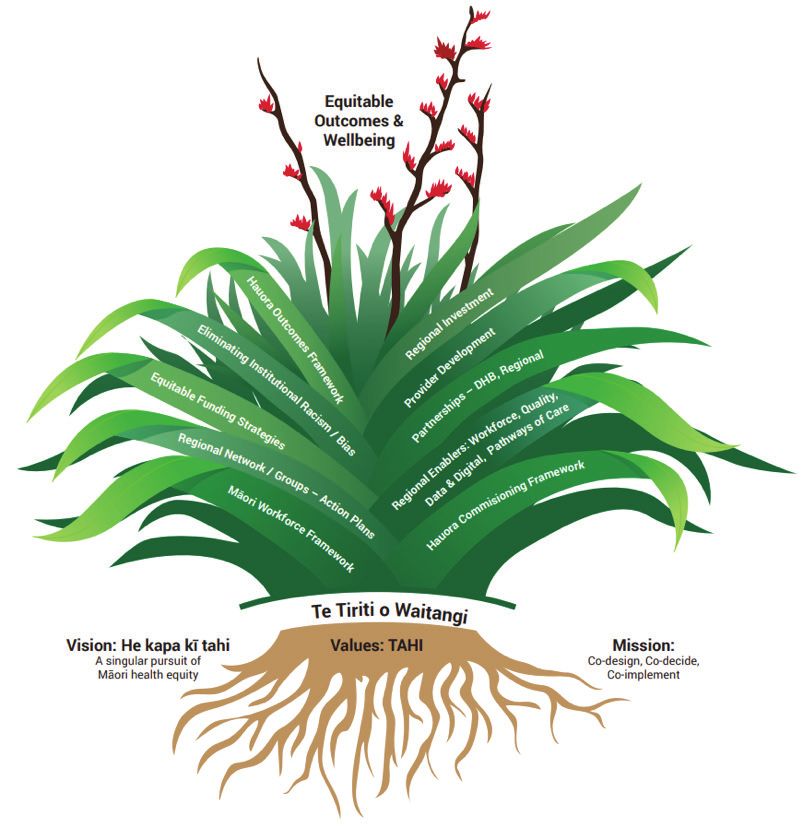
TE MANAWA TAKI – REGIONAL EQUITY PLAN 2020-2023

CONTENTS

 INTRODUCTION | WHAKATAKINGA						01

           1.1   Our Definition of  ‘Equity’:                                 02

    THE ASPIRATIONS OF WHĀNAU | NGĀ WAWATA O NGĀ WHĀNAU		                     03

    WORKING IN UNISON | TE MAHI TUKUTAHI					05

		3.1            Our Values								05
  3.2            Our Vision                                            06
  3.3            Our Mission - C3 - Co-design, Co-decide, Co-implement 08
  3.4            Te Tiriti o Waitangi                                  08
  3.5            Māori Health Equity                                   09
  3.6            Line of Sight                                         13
  3.7            Governance Structures                                 16

    WORKING TOGETHER | TE MAHI NGĀTAHI                                        18

  4.1            Three-Year Strategic Plan                                    18
		4.2            Relationship Between Regional Strategic Priority
                 Work and Annual Workplan Activity/Implementation             21
           4.3   Connections and Partnerships                                 22
           4.4   COVID-19 Response                                            23

    APPENDICIES | NGĀ TĀPIRITANGA                                             25

                                                                                    vii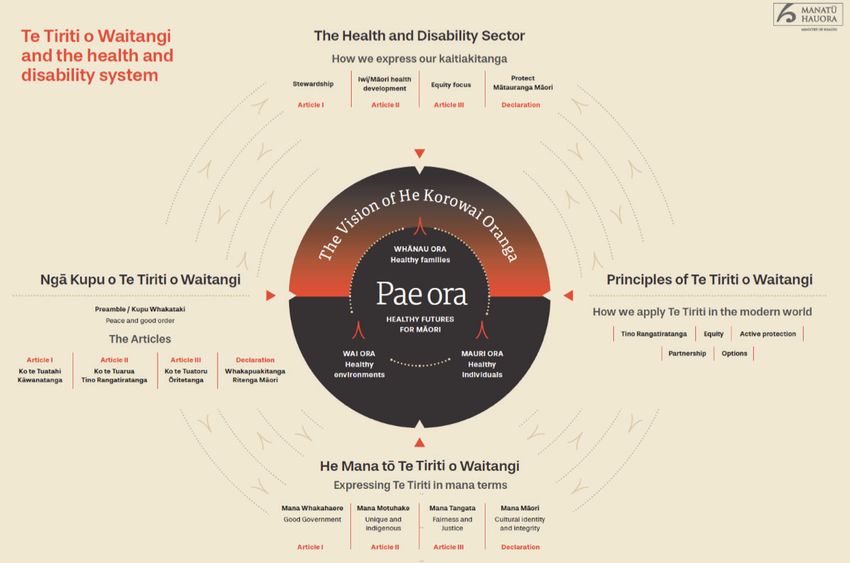
TE MANAWA TAKI – REGIONAL EQUITY PLAN 2020-2023

                                                            27% of people in the region are Māori

1
                                             (approx. 265,360 of 985,285 people; 2020/21 projections)
       INTRODUCTION
       WHAKATAKINGA
    Te Manawa Taki Governance Group acknowledges the support of former Governance leads in
    the development of this Regional Equity Plan. The equity priorities of previous Regional
    Services Plans and the 2019 Memorandum of Understanding between Te Manawa Taki DHBs
    Region Governance Group and Te Manawa Taki Iwi Relationship Board are the foundations of
    this Plan. The vision of Te Manawa Taki is:

    He kapa kī tahi - a singular pursuit of Māori health equity.

    This vision reflects that we will work in unison to achieve equity of Māori health outcomes and
    wellbeing through multiple means. ‘Te Manawa Taki’ (‘the heartbeat’) represents that we are
    always ‘ready to go’ and that we are willing to lead change that works, so that others may follow
    a proven path. To be effective regional change catalysts, we need a strong ‘heartbeat’ and this
    plan represents our next three-year journey.

    This Regional Equity Plan is a significant milestone. It is the direct result of an enhanced, Te Tiriti
    o Waitangi based partnership between Iwi and five DHBs. It epitomises the value of DHBs and
    Iwi engaging in respectful ways, not only to embed Te Tiriti in our health and disability system
    but also to do what is tika/right with regard to tackling one of New Zealand’s most persistent
    problems: Māori health inequity. Improving equity for Māori is an imperative of Article III and the
    Equity Principle of Te Tiriti o Waitangi.

    The Regional Equity Plan also acknowledges that Iwi have their own aspirations over and above
    this plan; and DHBs have numerous accountabilities they need to meet. Within this reality,
    DHBs and Iwi will seek mutual ways to support each other’s aspirations and accountabilities.

    As a collaborative of Māori and Iwi leaders working in unison with DHBs, we are committed to
    building a credible, culturally safe, and competent Te Manawa Taki system. We will build upon
    our current strengths, prioritise kaupapa Māori and mātauranga Māori solutions and models of
    care, continue to build a committed workforce, challenge ourselves in terms of what we can
    do better and solve issues that we all know we need to work on including; continuous quality
    improvement, prioritising consumer/whānau voice, continuing to invest in workforce wellbeing
    and building a system infrastructure that is fit for purpose and agile.

    We will prioritise our collective effort towards enabling people who need our support the most,
    to flourish, to meet their self-determined aspirations and to achieve equitable health status (as
    a minimum). We are clear that Māori are our priority population for this plan as they are affected
    by inequities the most in our region. However, we also know that we have other populations or
    cohorts with high needs, such as people with low socio-economic status, Pacific peoples, some
    rural populations, people with disabilities, and others. We will continue to support all people
    with high needs however, we are determined to ‘shift the dial’ for our valued Māori population
    and believe that if we can make traction for Māori, we will learn valuable lessons along the way
    that will support equity for all populations.
                                                                                                              1
TE MANAWA TAKI – REGIONAL EQUITY PLAN 2020-2023

    1.1        OUR DEFINITION OF ‘EQUITY’ | MANA ŌRITE

          Our definition of Equity is aligned with all Articles and Principles in Te Tiriti o Waitangi, in
          particular Article III (which has an Equity focus) and the Principle of Equity1 . It is also aligned
          with the United Nations Declaration on the Rights of Indigenous Peoples, which affirms the
          rights of Māori to determine, develop, maintain, access and administer their own institutions,
          programmes, medicines and practices that support optimal health and wellbeing2 . Finally, it
          incorporates and enhances the Ministry of Health’s definition3 .

          Te Manawa Taki’s definition of Equity is focused on ensuring all people have a fair
          opportunity to attain their full health potential. In Te Manawa Taki, this means prioritising
          service delivery to achieve equity of access, equity of quality and equity of outcomes for
          Māori that reflects their own aspirations and needs in the context of advancing overall health
          outcomes. This is an urgent priority if we are to demonstrate good faith in our Te Tiriti o
          Waitangi-based partnership, given the status of Māori health compared with other
          populations:

          “Equity is purposeful investment of resources that transforms pathways of disadvantage to
          advantage:

          1.   Supports rectifying differences that are avoidable, unfair, and unjust:
               It recognises that avoidable, unfair, and unjust differences in health are unacceptable.
          2.   Proportionate investment of resources based on rights and needs:
               It requires that people with different levels of advantage, receive proportionate investment of
               resources and approaches based on rights and need.
          3.   Implements Te Tiriti o Waitangi in contemporary ways at system and service levels:
               It demands a health and disability system that is committed to implementing Te Tiriti o Waitangi
               in contemporary ways as a catalyst for success; that our system is culturally safe, competent, and
               enabling of wellbeing.
          4.   Success is measured by equity of access, quality and/or outcomes:
               We will know we have achieved Equity when we see equity of access, quality and outcomes
               in the region; particularly for Māori and then for all others who are affected unnecessarily by
               disadvantage.”

          Equity for Māori recognises the value of tikanga (values and practices) and mātauranga
          Māori (worldview/traditional knowledge). We will integrate te Ao Māori into systems design,
          health policy, models of care and delivery of all health services. This includes recognition
          that patients and whānau are experts in their own right, and should have more control over
          their own wellbeing, and consequently, over the care they receive.

1
 This definition also aligns with the equity principles described in the Hauora Report on Stage One of the (Wai 2575)
Health Services and Outcomes Kaupapa Inquiry - https://www.health.govt.nz/our-work/populations/Māori-health/wai-
2575-health-services-and-outcomes-kaupapa-inquiry

2 United Nations Declaration on the Rights of Indigenous Peoples, Articles 23 & 24 - https://www.un.org/development/desa/
indigenouspeoples/wp-content/uploads/sites/19/2018/11/UNDRIP_E_web.pdf
3
  The MOH definition is “In Aotearoa New Zealand, people have differences in health that are not only avoidable but unfair and
unjust. Equity recognises different people with different levels of advantage require different approaches and resources to get
equitable health outcomes (italics added for emphasis).”                                                                      2
TE MANAWA TAKI – REGIONAL EQUITY PLAN 2020-2023
2 ASPIRATIONS OF WHANAU
NGĀ WAWATA O NGĀ WHĀNAU
Establishing a foundation for the Regional Equity Plan begins by reflecting the
aspirations and expectations of Māori. The word cloud below is from the DHB Māori
Health plans, which have been developed in partnership with iwi.
Improve Access
Flourishing Wellbeing
Life Course
Early Intervention
Mana He Korowai Oranga
Fell Valued
Māori Capacity
Motuhake
Kaupapa
Workforce Collective Resources
Appropriate Services
Culturally Environmental Autonomy Quality
Manaakitanga
Appropriate Sustainability Outcomes Of Life
Healthy
Good Health Kaitiakitanga
Equity Live Longer
Aroha
Te Tiriti o Waitangi
Environmental Health
Whakawhanaungatanga
futures
Environments Manaakitanga
Kotahitanga
Access
Capacity
Aspirations
Balanced Services
Diverse Needs
Quality Of Life
Whakapakari Mahi Tahi
Māramatanga Toiora
Values Empower Whānau Decision Making
People Focused
Participation Rangatira
Destinies
Innovation Deliberate
Capable
Whakamana
Whānau Support
Lifestyle Choices
Protection
Workforce
Māori Challenge Status Quo
Kaupapa
Determinants
Health Equity
Tautoko
Outcomes
Primary Care
Healthy futures Gain Commitment
Collaborative
Mauri Ora
Competence
Protection He Korowai Oranga
Planned Care Coordinated Pae Ora Whānau Focus
Child Wellbeing Ngā Manukura Kaupapa
Partnership Connected Iwi Whānau Ora
Wellbeing
Ngā Tikangā Capability
Hapū
Wai Ora
Culture Mental Health
Iwi Partnership
Whakarongo
Purpose Driven
Strategic Relationships
Control
Whānau Roopu Whakapāmautia
Kaupapa Māori
Rural
Flourishing Health
Accountability Te Mana Whakahaere
Pae Ora Communities
Stay well
Prevention
Smokefree 2025
Involve Communities
Priorities
Relationships Inter-sectoral
Rangatiratanga Public Health
Managing Illness & Behaviour
Te Tiriti o Waitangi
3TE MANAWA TAKI – REGIONAL EQUITY PLAN 2020-2023
About | Te Manawa Taki
21% 5
DHBs
Te Manawa Taki Stretches from Five District Health Includes major 985,285 people
covers an area of Cape Egmont in the Boards: Bay of population centres (2020/21 population
56,728 km2, or 21% West to East Cape Plenty, Lakes, of Tauranga, projections),
of New Zealand’s and is located in the Hauora Tairāwhiti, Rotorua, Gisborne, including 265,360
land mass. middle of the North Taranaki, and New Plymouth and Māori (27%) and 43
Island. Waikato. Hamilton. local iwi groups.
Te Manawa Taki Iwi
Bay of Plenty DHB
Ngai Te Rangi, Ngāti Ranginui, Te Whānau ā Te Ēhutu, Ngāti
Rangitihi, Te Whānau ā Apanui, Ngāti Awa, Tūhoe, Ngāti 26%
Mākino, Ngāti Whakaue ki Maketū, Ngāti Manawa, Ngāti
Whare, Waitahā, Tapuika, Whakatōhea, Ngāti Pūkenga, Ngai
Tai, Ngāti Whakahemo, Tūwharetoa ki Kawerau
Lakes DHB 37%
Te Arawa, Ngāti Tuwharetoa, Ngati Kahungunu ki Wairarapa
Hauora Tairāwhiti
Ngāti Porou, Ngāi Tamanuhiri, Rongowhakaata, Te 53%
Aitanga-a-Mahaki, Ngāti Kahungunu, Ngā Ariki Kaiputahi,
Te Aitanga-a-Hauiti
Key
Taranaki DHB 20% Bay of Plenty DHB
Ngāti Tama, Ngāti Mutunga, Te Atiawa, Ngāti Maru,
Taranaki, Ngāruahine, Ngāti Ruanui, Ngā Rauru Kiitahi Lakes DHB
Hauora Tairāwhiti
Waikato DHB 24% Taranaki DHB
Hauraki, Ngāti Maniapoto, Ngāti Raukawa, Waikato, Waikato DHB
Tuwharetoa, Whanganui, Maata Waka
4TE MANAWA TAKI – REGIONAL EQUITY PLAN 2020-2023
3 WORKING IN UNISON
TE MAHI TUKUTAHI
In June 2019, Te Manawa Taki DHBs Region Governance Group and Te Manawa Taki Iwi
Relationship Board signed a Memorandum of Understanding at Te Papaiouru Marae,
Rotorua, to advance our working together.
3.1 OUR VALUES | Ō MĀTAU UARA
The Values of Te Manawa Taki are represented by the acronym T.A.H.I, which is also the
Māori kupu (word) for the number 1. T.A.H.I reflects our commitment to achieve Equity,
Māori health gain and a successful Te Tiriti embedded Partnership. These issues and
those in this plan are our combined #1 priority.
Tautoko (mutual support) – of each other; supported by our commitment to
T
mahi tahi (a united cause).
Auahatanga (innovation) – is at the centre of what we want to do; supported
A
by our kaitiakitanga (shared guardianship of our mahi/work) role.
Hauora (Māori health and wellbeing) – is our priority; supported by our
H
commitment to equity and rangatiratanga (partnered leadership) role.
Ihi – the power of our integrity towards each other and what we do;
I supported by manākitanga (mutual support), whakawhānaungatanga
(working together) and whakapakari (strengthening each other).
It is through these values that we can continue to improve outcomes for Māori, where
Māori have at least the same health outcomes as Non-Māori. T.A.H.I also aligns with our
Vision statement, which reflects our singular commitment.
5TE MANAWA TAKI – REGIONAL EQUITY PLAN 2020-2023
| Ko Taranaki te maunga
3.2 OUR VISION | TŌ MĀTAU TIROHANGA WHAKAMUA
Te Manawa Taki’s vision is He kapa kī tahi - a singular pursuit of Māori health equity. It
reflects that, as a region, we will work in unison in a Tiriti o Waitangi based partnership to
achieve equity of Māori health outcomes and wellbeing through multiple means,
including:
- A regional health system that actively prioritises achieving Māori health equity.
- Mutual respect for braiding the best of kaupapa Māori and western science best
practice evidence, thinking and worldviews to benefit Māori health equity.
- Shared accountability for measuring and achieving success.
- Shared decision-making and authority.
- Shared resources (financial, technical, human, other).
- Working in partnership to create a system that enables Māori to lead solutions
that are based on kaupapa Māori and mātauranga Māori.
- Creating and enabling champions to lead solutions that drive equitable
outcomes for Māori.
6TE MANAWA TAKI – REGIONAL EQUITY PLAN 2020-2023
T Tautoko Auahatanga A
Even through sickness and illness We should bring
people just kept coming [to the services together
programme] and retaining it because My whānau, support – we should be
they had that sense of ownership, people and I need working together
that real connection that it was more of this as one.
something that they wanted and education to lessen
it worked for them. my stress and help me Care in the
recover. Community
Chae Simpson – He Pikinga Waiora wānanga (Te
Coordinator Kia ora e te iwi Kuiti) participant
programme
participant.
It’s not us doing We need to be
unto them, I think acknowledged and
that’s what we have supported as we hold a As in life, the most important
to really keep in key role in the care thing is people, working with
mind. It is how of our whānaunga people, engaging with people,
do we partner, whaiora. constantly asking and just being
how do we work in flexible enough to change things
Let’s Talk – Me
a way that actually when it doesn’t work how you
Kōrero Tātou
facilitates the thought it would.
participant
continued care of Chae Simpson – He Pikinga
the person in the Waiora Coordinator
community.
Waikato DHB
staff member
He kapa ki tahi
A singular pursuit of
Māori health equity
We want to go back to the basics
of spending time together and
celebrating each other as a
whole whānau; so, we need
My whānau... gathered the system to support and
together with my extended respect us through a wellbeing
whānau. They were thrust approach.
into all night and daily vigils
Let’s Talk – Me Kōrero Tātou
of karakia and a lava flow of
participant
aroha.
Colleen Prentice
They accepted and acknowledged
Knowing that I have been given a waka my Māoritanga, Ringatū faith and
to be able to row with, now with this whānaungatanga. Having my whānau and
programme I am quite rapt with it. friends at my bedside gave me strength. For
me, that was everything and a key part of
Vic - He Pikinga Waiora participant my recovery.
Thomas Mitai
As Māori, we need to exercise our
guardianship over our people.
We need to have a sense of belonging
Let’s Talk – Me Kōrero Tātou participant within our whānau and be supported to
always have this.”
Let’s Talk – Me Kōrero Tātou
participant
H Hauora Ihi I
7TE MANAWA TAKI – REGIONAL EQUITY PLAN 2020-2023
3.3 OUR MISSION - C3 - Co-design, Co-decide, Co-implement | TŌ MĀTAU WHĀINGA
Our Mission reflects the way we will work together to implement true Te Tiriti o Waitangi
based relationships to effect sustainable and positive partnered change over time.
3.4 TE TIRITI O WAITANGI
Te Tiriti o Waitangi is the foundation of our partnership. The partnership of Te Manawa Taki
iwi is realised through our governance and management structures as well as our ongoing
dialogue with communities around the region. Patients and whānau have their own thoughts,
feelings and desires for a health system that works for them, and it is through that
conversation that we can deliver a system that people can fully engage with.
The Waitangi Tribunal4 recommends the following principles (the recommendations below
were provided in the context of primary health care delivery), which reflects the evolution in
the interpretation of giving proper and full effect to Te Tiriti:
(a) The guarantee of tino rangatiratanga, which provides for Māori
self-determination and mana motuhake in the design, delivery, and monitoring of
primary health care.
(b) The principle of equity, which requires the Crown to commit to achieving equitable
health outcomes for Māori.
(c) The principle of active protection, which requires the Crown to act, to the fullest
extent practicable, to achieve equitable health outcomes for Māori. This includes
ensuring that it, its agents, and its Treaty partner are well informed on the extent,
and nature, of both Māori health outcomes and efforts to achieve Māori health
equity.
(d) The principle of options, which requires the Crown to provide for and properly
resource kaupapa Māori primary health services. Furthermore, the Crown is obliged to
ensure that all [primary health care] services are provided in a culturally appropriate
way that recognises and supports the expression of hauora Māori models of care.
(e) The principle of partnership, which requires the Crown to work in partnership with
Māori in the governance, design, delivery, and monitoring of primary health services.
Māori must be co-designers, with the Crown, of the [primary health] system for Māori.
4
Hauora: Report on Stage One of the Health Services and Outcomes Kaupapa Inquiry – pages 163-164. https://www.health.
govt.nz/our-work/populations/maori-health/wai-2575-health-services-and-outcomes-kaupapa-inquiry
8TE MANAWA TAKI – REGIONAL EQUITY PLAN 2020-2023
The Ministry of Health’s draft Te Tiriti o Waitangi framework acknowledges the text of Te
Tiriti, including the preamble and the three articles, along with the Ritenga Māori
declaration5 – as the foundation for achieving the following four goals, each expressed in
terms of mana6 :
• Mana whakahaere: effective and appropriate stewardship or kaitiakitanga over the
health and disability system. This goes beyond the management of assets or resources.
• Mana motuhake: enabling the right for Māori to be Māori (Māori self-determination),
to exercise their authority over their lives, and to live on Māori terms and according to
Māori philosophies, values and practices, including tikanga Māori.
• Mana tangata: achieving equity in health and disability outcomes for Māori
across the life course and contributing to Māori wellness.
• Mana Māori: enabling ritenga Māori (Māori customary rituals), which are framed by te ao
Māori (the Māori world), enacted through tikanga Māori (Māori philosophy and
customary practices) and encapsulated within mātauranga Māori (Māori knowledge).
Appendix 1 is an infographic of the Ministry of Health’s draft Te Tiriti o Waitangi framework. This
position on Te Tiriti o Waitangi was endorsed by the Director-General of Health on 9 January 20207.
3.5 MĀORI HEALTH EQUITY | MANA HAUORA ŌRITE
Within Te Manawa Taki, as across the nation, there are persistent inequities within different
populations, especially for Māori. Key to our regional strategy is achieving Māori health
equity, as well as identifying and addressing equity gaps in other populations. Many
complex factors lead to poor health status. However, as a population group, Māori have on
average the poorest health status of any group in New Zealand. This is unacceptable to us.
Factors such as income, employment status, housing and education can have both direct
and indirect impacts on health. These impacts can be cumulative over lifetimes, and
disproportionately affect Māori. It is important for the health sector to partner and provide
leadership to improve the social context of health outcomes.
Based upon evidence of inequities, we will prioritise our effort in three key areas:
Child Health, Cancer, and Mental Health.
5
Often referred to as the ‘fourth article’ or the ‘verbal article’.
6
Mana is a uniquely Māori concept that is complex and covers multiple dimensions.
7
Further detail can be found in the Cabinet Officer circular CO (19) 5: Te Tiriti o Waitangi/Treaty of Waitangi Guidance 22 Octo-
ber 2019. https://dpmc.govt.nz/publications/co-19-5-te-tiriti-o-waitangi-treaty-waitangi-guidance
9TE MANAWA TAKI – REGIONAL EQUITY PLAN 2020-2023
Statistics for Māori
In Te Manawa Taki
Child health
Vaccination rates
5x higher PHO enrolment rates
At six months of age percentage of Māori pregnant women At six weeks of age
who identify as smokers than Non-Māori
women
63% 83% 57% 83%
Māori Non-Māori 40% 8% Māori Non-Māori
Māori Non-Māori At three months of age
At twelve months of age
75% 83%
91% 94%
Māori Non-Māori
Māori Non-Māori
At five years of age
86% 89%
1.2x
as many decayed, missing
Māori Non-Māori and filled teeth than Non Maori
children at five years of age
(on average)
Infants exclusively or fully
breastfed at three months Percentage of caries free
children at 5 years
45.7% of Māori
children
Maori obesity rates in
before school checks
36% 67%
61.8% of Non-Māori
children
2.2x higher Māori Non-Māori
than Non-Māori obesity rates
Trauma for children 14 years and under
from 2012 -2018 in the Midland region
Risk of Risk of hospitalisation Risk ratio for
Total injury risk hospitalization from contact with severe injury
for Māori children is from burns sharp objects and (ISS = 25+) in
Māori children was
1.1x in Māori children is from injury related to
that of Non-Māori 1.8x
bicycles
in Māori children are both 1.8x
that of Non-Māori 1.7x that of Non-Māori
that of Non-Māori
10TE MANAWA TAKI – REGIONAL EQUITY PLAN 2020-2023
Cancer
Cancer incidence rate is Lung cancer Lung cancer Cancer mortality rate is
incidence rate mortality rate
1.3x 3.3x 3.4x 1.8x
higher higher higher higher
than for Non-Māori than for Non-Māori
than for Non-Māori
Of all cancers, the highest Breast cancer Breast cancer
incidence for Māori are; incidence rate mortality rate
19% 19% 16%
1.7x 1.6x
Lung Breast Urological
higher higher
than for Non-Māori
Liver cancer Liver cancer
incidence rate mortality rate
2.6x 3.4x
higher higher 31.1% 21.4%
than for Non-Māori
Māori Non-Māori
Have their cancer first diagnosed
Colorectal Cancer
Incidence Rate
Prostate cancer 5 year following an emergency department
presentation.
per 100,000
mortality rate is
1.4x survival There is evidence that if cancer is
for Māori with colorectal diagnosed through an acute pathway
38.9 40.7 higher cancer is lower by
11.7% compared to
via the emergency department, one
year survival is poorer than for the
than for Non-Māori. elective referral pathway.
Māori Non-Māori Non-Māori.
Breast cancer survival Faster Cancer Treatment Indicators:
(all cause mortality)
2013/14 2018/19
One-year 96% 96% 31 day 81% 78% 90% 87%
survival indicator
Māori Non-Māori Māori Non-Māori Māori Non-Māori
83% 84% 49% 53% 93% 91%
Five-year 62 day
survival indicator
Māori Non-Māori Māori Non-Māori Māori Non-Māori
Maori achievement against FCT targets better than Non-Maori.
11TE MANAWA TAKI – REGIONAL EQUITY PLAN 2020-2023
Mental health
Māori adults are
1.7x more likely to have experienced
psychological distress as 1.5x more likely to report a high or very high
probability of having an anxiety or
Non-Māori depressive disorder.
Mental Health Contacts
Whānau support
Increase in contacts last All services and all ages All services 20-50 year olds
5 years % of population % of population
30% 17% 7% 4% 12% 6%
Māori Non-Māori Māori Non-Māori Māori Non-Māori
Alcohol & Drug
Seclusions Contacts
per 100,000 population
All ages% of population
14.5 1.12
6% 2%
Māori Non-Māori
Māori Non-Māori
Number of clients under section 29 (compulsory community
Suicide rates
treatment order) per 100,000 people per year per 100,000 population
All ages
291.4 Māori 85.4 Non-Māori
16.9 9.1
Māori Non-Māori
Individuals on MH section 29 per 100k population Males 15-24yo
140 5.0
No of Individuals per 100k population
4.5
120 52.4 23.5
4.0
100 3.5 Māori Non-Māori
Maori/Non-Maori
3.0
80
2.5
60
2.0
40 1.5
1.0
20 Māori have the highest
0.5
0 0.0 rate of mental health
and addiction service
2013 - Q1
2013 - Q2
2013 - Q3
2013 - Q4
2014 - Q1
2014 - Q2
2014 - Q3
2014 - Q4
2015 - Q1
2015 - Q2
2015 - Q3
2015 - Q4
2016 - Q1
2016 - Q2
2016 - Q3
2016 - Q4
2017 - Q1
2017 - Q2
2017 - Q3
2017 - Q4
2018 - Q1
2018 - Q2
2018 - Q3
2018 - Q4
2019 - Q1
2019 - Q2
2019 - Q3
2019 - Q4
use
Maori s2 9 p er 100k popu lation Non Maori s29 per 100k population
Ratio Maori to Non Maori Maori/Non-Maori trendline
12TE MANAWA TAKI – REGIONAL EQUITY PLAN 2020-2023
3.6 LINE OF SIGHT | TIROHANGA TŌTIKA
National
Health and
Te Tiriti o Government Government Health System Minister of Health
Disability
Waitangi Goal Priority outcomes Vision system priorities
priority areas
• Partnership Improving the • Ensure everyone • Pae Ora Healthy • Governance • A strong and
wellbeing of New who is able Futures. equitable system
• Tino • Sustainability
Zealanders and their to, is earning,
rangatiratanga • Support wellbeing
families. learning, caring or • Service
through prevention
• Active protection volunteering. performance
• Primary care
• Options • Support healthier, • Embed Te Tiriti
support
safer and more o Waitangi and
• Equity connected achieve pae ora • Child wellbeing
communities. (healthy futures) activities
for Māori.
• Make New Zealand • Mental wellbeing
the best place in • Achieving equity activities
the world to be a
child. • Financial • Areas of high
performance and inequity, and
responsibility priority equity
measures/targets
• Capital investment
• National Asset
Management Plan
• Service user
councils
Te Manawa Taki
Three-year Action
Values Vision Mission Settings
Plan
Tautoko He kapa kī tahi – C3 Governance Regional Equity Action Plan
mutual support A singular pursuit of Māori structures (REAP)
Co-design
health equity.
Auahatanga
Co-decide
innovation
Co-implement
Hauora
Māori health & wellbeing
Ihi
power of our integrity
Connector Te Manawa Taki
Services
groups DHBs
Regional service areas & Networks, and shared services • Pathways of Care • Vision
• Cancer • Planned Care • Quality • Mission
• Cardiac • Public Health Network • Workforce • Values
• Child Health • Radiology • Data & Digital • Goals and aspirations
• Healthy Ageing • Renal • Strategic focus & priorities
• Hepatitis C • Stroke • Overarching outcomes
• Mental Health & Addictions • Trauma
13TE MANAWA TAKI – REGIONAL EQUITY PLAN 2020-2023
Line of sight – DHB region strategic vision, values and plans
Appendix 2 includes a description of the key regional Plans and Strategy documents in each DHB region.
Bay of Plenty
Bay of Plenty Live Well: Empower our populations to live healthy lives.
three Stay Well: Develop a smart, fully integrated system to provide care close to where people live, learn, work and play.
strategic Get Well: Evolve models of excellence across all our hospital services.
objectives
Working collaboratively, we will create healthy, thriving communities - Kia momoho, Te Hāpori Oranga, by proactively addressing the
needs of our family and whānau with services that are well-coordinated, holistic and provided as close to home as possible.
Te Toi Ahorangi Pou Ora, change principles that affirm our intent and determination towards Toi Ora – flourishing descendants of Toi – the shared vision
– Te Runanga of the seventeen iwi of Te Rūnanga.
Hauora Māori o
te moana ā Toi Tu te Kupu – Uphold our Word: Affirms we will uphold our word and aspirations as iwi and the Crown through an authentic Te Tiriti o
toi / Bay of Waitangi partnership.
Plenty DHB Toi Tu te Mana – Uphold our Power: Affirms He Pou Oranga, the sources of mana that lead to Toi Ora. Tangata whenua
self-determination, aspirations and worldview will be valued and invested in across Te Moana a Toi.
Toi Tu te Ora – Uphold our Vision: Guides our direction towards Toi Ora. Toi Ora drives a whole of system approach that enables
flourishing from preconception throughout the lifecourse.
Hauora Tairāwhiti
Hauora The Values form the acronym WAKA. They reflect our past while guiding us on our journey to create a healthier Tairāwhiti by working
Tairāwhiti together - Whāia te hauora i roto i te kotahitanga (the Tairāwhiti vision).
values Whakarangatira/enrich: Enriching the health of our community by doing our very best.
Awhi/support: Supporting our ruroro/patients and their whānau/families, our community partners and each other.
Kotahitanga/togetherness: Together we can achieve more.
Aroha/compassion: Empathy, we care for people and people want to be cared for by us.
Lakes
Te Manawa Vision: Healthy Communities – Mauriora! Values: Manaakitanga, Integrity, Accountability
Rahi Lakes
DHB Strategy Strengthen people, whānau & community wellbeing – Te whakareinga i to oranga o te tāngata, te whānau me te hapori.
Achieve equity in Māori health – Te taeatanga tika o te hauora Māori.
Build an integrated health system – Nga Herenga tika i roto i te pūnaha.
14TE MANAWA TAKI – REGIONAL EQUITY PLAN 2020-2023
Taranaki
Taranaki The Taranaki vision is Taranaki Whanui He Rohe Oranga – Taranaki Together, a Healthy Community. The Plan outlines the Taranaki goal
Health Plan of Kia tū rangatira ai ngāi Māori ki te ora kakariki – our journey from the red to the greens on our dashboard of Māori health priority
indicators.
Helping our people to live well, stay well and get well.
Integrating our care models through a one team, one system approach.
Using our community resources to support hospital capacity.
Using analytics to drive improvements in value.
Developing a capable, sustainable workforce matched with health need and models of care.
Improving access, efficiency, and quality of care through the manage uptake of new technologies.
Waikato
Waikato DHB Vision: Healthy people, excellent care. Values: People at heart – Te iwi Ngakaunui;Give and earn respect/Whakamana, Listen to me
Strategy talk to me/Whakarongo, Fair play/Mauri Pai, Grow the good/Whakapakari, Stronger together/Kotahitanga.
Mission: ‘Enable us all to manage our health and wellbeing. Provide excellent care through smarter, innovative delivery’
Whanaketanga – Productive partnerships
Pae taumata – A centre of excellence in learning, training, research and innovation
Ratonga a iwi – Effective and efficient care and services
Manaaki – People centred services
Haumaru – Safe, quality health services for all
Oranga – Health equity for high need populations
Waikato Health Putting the Waikato DHB Strategy and the Waikato DHB Iwi Māori Health Strategy, Ki te Taumata o Pae Ora, into action.
System Plan Vision for the future – a whānau and family focussed approach to health and wellbeing. Goals for the next ten years; Partner with Māori
– Te Korowai in the planning and delivery of health services, Empower whānau to achieve wellbeing, Support community aspirations to address
Waiora the determinants of health, Improve access to services, Enhance the capacity and capability of primary and community health care,
Strengthen intermediate care, Enhance the connectedness and sustainability of specialist care.
Supporting activities to achieve the goals; Leadership & partnerships, Commissioning, Workforce development, Technology &
information, Quality improvement.
Waikato DHB Ki te Taumata o Pae Ora
Iwi Māori Health A focus on the Whānau Ora approach to improving the wellbeing of whānau as a group and addressing individual needs within the
Strategy context of whānau and iwi.
15TE MANAWA TAKI – REGIONAL EQUITY PLAN 2020-2023
| Ko Taupiri te maunga
3.7 GOVERNANCE STRUCTURES | HANGANGA WHAKAHAERE
Te Manawa Taki Governance Group is the overarching governance group for the region,
overseeing and holding accountability for regional direction, strategy, and key programmes
of change. Membership is the five Chairs of Te Manawa Taki DHBs and five Chairs of Te
Manawa Taki Iwi Relationship Board. This 50:50 composition reflects a Te Tiriti of
Waitangi-based partnership.
Each DHB Chair is accountable to their DHB Board and is responsible for informing their DHB
of matters of significance, including risk and mitigation strategies, for matters
arising from the group’s deliberations.
Te Manawa Taki Iwi Relationship Board comprises the five Chairs and Deputy Chairs of each
mandated DHB iwi group collective: Bay of Plenty – Te Rūnanga Hauora Māori o te Moana
Ā Toi; Lakes – Te Rōpu Hauora o Te Arawa and Ngāti Tūwharetoa; Hauora Tairāwhiti – Te
Waiora o Nukutaimemeha; Taranaki – Te Whare Pūnanga Kōrero Trust; Waikato – Iwi Māori
Council.
The Te Manawa Taki Chief Executive (CE) Group oversees regional collaboration. The five
DHBs of Te Manawa Taki - Bay of Plenty, Lakes, Hauora Tairāwhiti, Taranaki and Waikato –
have a history of co-operating on issues of regional importance and on new programmes of
change. Regional clinical networks and forums, executive forums, and workforce are linked
to Te Manawa Taki CE Group through a DHB CE lead (as sponsor) and through regular
reporting to the Te Manawa Taki CE Group.
HealthShare Ltd is the shared services agency for Te Manawa Taki DHBs and is a
limited liability company with the five DHBs holding equal shares.
16TE MANAWA TAKI – REGIONAL EQUITY PLAN 2020-2023
| Ko Mauao te maunga
17TE MANAWA TAKI – REGIONAL EQUITY PLAN 2020-2023
4 WORKING TOGETHER
TE MAHI NGĀTAHI
4.1 THREE-YEAR STRATEGIC PLAN | MAHERE RAUTAKI TORU TAU
The table below shows a three-year plan which sets out the region’s priorities and
direction8 . Part of this work is the Regional Equity Plan (this document), which describes
the region’s annual operational plan to achieve equity.
Through the ‘Settings’ work, Te Manawa Taki’s Te Tiriti inspired governance group
(Te Manawa Taki Governance Group) demonstrates shared leadership and
decision-making which contributes to Māori health equity.
‘Services’ relates to the Governance-level oversight of activity undertaken by regional
Networks and Groups (as per regional annual workplans). Te Manawa Taki Governance
Group have identified three priority Service areas for achieving equitable health
outcomes for Māori: mental health, child health and cancer.
‘Collaboration’ describes Governance-level oversight of activity that achieves equitable
systems and connectivity within the regional health sector. This work is in alignment
with the annual workplans of the relevant regional groups – such as regional HR and
workforce leads for activity relating to workforce development and institutional
racism/bias.
8
A programme plan will be developed Q1 20/21. Individualised project plans will include milestones, timeframes & completion
dates.
18TE MANAWA TAKI – REGIONAL EQUITY PLAN 2020-2023
Priority work that will contribute to Māori health equity: What are the equity aims for this work?
Settings:
Hauora outcomes framework: Nga Toka Hauora (via - Prioritises a te ao Māori worldview and
CEOs) to work with colleagues and iwi to co-design and whānau voice, ensuring the
co-decide a hauora outcomes framework. framework and data is relevant and
is meaningful for Māori iwi, hapū and
- All regional action plans and data whānau.
collection/reporting to align.
- Clear and evident data supports
regional effort to measure
Equity strategies: Developed & incorporated into
achievement (or not) of Māori health
regional planning (Lead: Nga Toka Hauora)
equity.
- Ensure plans based on a common regional strategy and - Data is available and relevant to iwi in
definition of Māori health equity. Te Manawa Taki.
DHB Planning & Funding Managers (via CEOs) to work
with Nga Toka Hauora and iwi to co-develop a new and
innovative Hauora Commissioning Framework.
- CEOs to apply the framework to commission health
services using the optimal mix of cultural and clinical
specificity.
Data: Data is used to monitor and improve performance,
and to measure impact:
- All regional action plans to include Māori health needs
analysis, outputs and outcomes data, and Māori health
equity targets.
- Data sets to align with Māori health priorities and
include supporting information such as ethnicity and
iwi affiliation.
Equitable funding strategies: Funding strategies agreed, - Investment strategies to support
implemented, and monitored. equitable funding10, result in measurable
increased investment in services and/or
- CFOs (via CEOs) with GMs P&F and COOs to complete enablers for Māori health.
a current state analysis of existing investment in
kaupapa Māori9 health services, primary and - Enhanced ability of DHBs and the
community care and secondary/tertiary/quaternary regional system to invest equitably &
care. strategically (including based on
multi-year investment targets) in
services that prioritise Māori health
outcomes.
9
Kaupapa Māori health services are those that are delivered by Māori health providers and aligned with a te ao Māori
worldview.
10
Examples, ringfencing, top-slicing, disinvestment and reinvestments, formulaic analysis, etc.
19TE MANAWA TAKI – REGIONAL EQUITY PLAN 2020-2023
Services:
Action Plans: Oversight and monitoring to ensure action - Practical implementation of Te Tiriti o
plans are implemented on time: Waitangi obligations and opportunities.
- Plans to be explicit about how to improve Māori health - Clear and evident plans support
equity unless this requirement is formally excluded by collaborative regional effort to achieve
Te Manawa Taki Governance Group within the next Māori health equity.
three years.
- Implementation of wellbeing plans – with
- Plans to align with agreed Māori health priorities and agreed investment options – for priority
health priority indicators. Māori health equity areas of mental
health, child health and cancer.
Regional investment: Prioritised investment into agreed
services to improve outcomes.
- Collaborative development of regional wellbeing plans
(including aims, priorities, and investment options) for
priority areas of mental health, child health and cancer.
- Regional investment pool agreed.
Collaboration:
Māori workforce framework: Develop and implement the - Implementation of strategies to ensure a
national targets, at a regional level, for Māori workforce DHB workforce that reflects the needs
development. and aspirations of Māori communities11.
- Strategies identified based on current status and needs - Māori capacity built to meet whānau
assessment across the recruitment and retention Māori health needs and regional Māori
pipeline. population.
DHB Human Resources Managers (via CEOs) to work with - A culturally safe health system that
Nga Toka Hauora to co-develop a regional plan to elimi- optimises Māori health outcomes and
nate institutional racism/bias. equity, including equity as a KPI in
employment contracts.
- A shared regional plan with strategies from culture shift
through to workforce development and human - Reports show strategy targets are on
resource processes, provider development, service track for actual and continued reduction
delivery expectations, and contractual requirements. in perceived institutional racism.
Provider development: Purposefully build provider - Māori provider capacity built to meet
capacity and capability with the view to scale investment whānau Māori health needs.
and targeted growth.
- Māori providers are sustainable, and
- Common and unique Māori and Non-Māori health people have more choice to access
provider strategies identified and implemented based providers who deliver (amongst other
on current provider landscape, needs assessment, fiscal things) kaupapa Māori models of care.
and service implications.
- More opportunity for integrated care
and partnerships between Māori and
other healthcare providers in the system.
11
Note that, in time, we would like to expand this analysis and targets to the whole system, not just DHBs.
20TE MANAWA TAKI – REGIONAL EQUITY PLAN 2020-2023
4.2 RELATIONSHIP BETWEEN REGIONAL STRATEGIC PRIORITY WORK AND ANNUAL WORKPLAN ACTIVITY/IMPLEMENTATION
TE WHANAUNGATANGA I WAENGANUI I TE MAHI WHAKAAROTAU RAUTAKI Ā-ROHE ME TE WHAKATINANA I TE MAHERE MAHI Ā-TAU
Te Manawa Taki Regional groups Projects &
Governance Group & relationships initiative level
Monitor Set the
Services -
– –
Networks / Groups
& review direction (annual workplans)
Enabler
– –
DHBs groups
Oversee
(Annual Plan
activity)
(annual workplans -
own workplans
and supporting
–
activity Services)
Each project/initiative - life cycle
SETTINGS
Hauora outcomes framework Implement priority outcomes.
Ensures a common Hauora view and strategy. Interpret and define priorities.
Commissioning framework Apply optimal cultural/clinical mix.
Data Shared data definitions, targets, status view. Monitoring, collation/reporting, data-driven improvement Data collection and reporting.
Equitable funding strategies Shared strategy agreed, implemented, monitored. Prioritise available funding in line with Hauora frameworks. Implementation of agreed approach.
SERVICES
Action plans Ensure equity focus in all plans, & priority Services. Develop/align all action plans with Māori health priorities. Achieve tangible health outcomes.
Regional investment Monitor investment aligned with funding strategy. Responsible for implementation and reporting. Increase priority services/enablers.
COLLABORATION
Māori workforce framework Strategies to implement national targets. Establish approach across recruitment/retention pipeline. Attract & retain workforce.
Eliminate institutional racism/bias Agreement and implementation of workforce/other multi-year strategies for cultural change at all levels.
Provider development Sustainability, capacity development, integrated care &
Provider strategies Implement and localise strategies.
partnerships.
* Refer to the Addendum to the Regional Equity Plan for detail of priority annual workplan activity related to the REAP and Māori health equity.
21TE MANAWA TAKI – REGIONAL EQUITY PLAN 2020-2023
4.3 CONNECTIONS AND PARTNERSHIPS | HONONGA, RANGAPŪTANGA
A unified approach is critical to achieving health equity for our Māori populations, and hauora
(health and wellbeing) for everyone in Te Manawa Taki. The regional vision, values and
mission guide our common work, with Te Tiriti o Waitangi as the foundation of our
partnership with Māori iwi and whānau.
Through the Three-year Strategic Plan, Te Manawa Taki Governance Group sets the direction
and strategies we deliver through the annual workplans of our regional groups, networks,
and partnerships. The addendum to the REP includes the Māori health equity elements of
Network and regional group workplans for Te Manawa Taki.
22TE MANAWA TAKI – REGIONAL EQUITY PLAN 2020-2023
4.4 COVID-19 RESPONSE | URUPARE MATE KORONA
The COVID-19 response demonstrates Te Manawa Taki values and partnership in ac-
tion. This includes local solutions using kaupapa Māori models to enhance health and
wellbeing. A rapid escalation and engagement at the early stages of the COVID-19
response has laid the foundation for recovery and a transition to the ‘new normal’. Iwi,
health sector staff, other essential services and community, private and government
stakeholders continue to put in an exceptional effort to ensure the region is ready and
resilient, which includes the following activities:
T TAUTOKO AHUATANGA A
• Recovery planning, including • Māori health engagement with incident
electives and outpatient clinics. management to maintain an equity lens
on all activities.
• Risk mitigation.
• Recovery planning, including
electives and outpatient clinics and
• Governance relationships and stake-
operational & quality
holder engagement.
improvement.
• Expanding circles of influence through • Maintaining/transitioning activities to
coordination between iwi, DHBs, Council, telehealth and online
PHOs/primary care, local stakeholders. technology.
• Flexibility & focus on remote Māori
• Rapid, coordinated co-design
health through mobile
between DHBs and iwi.
Community Based Assessment Centres
• Blended and shared resources, facilities, (CBACs).
and teams. • Development of health and
wellbeing centres and outreach
services alongside CBACs.
HE KAPA KĪ TAHI - A singular pursuit of Māori health equity
• Strategic focus on Māori health. • Mutual support and readiness for any
• Supporting remote communities through future COVID-19 surge.
telehealth/online
connectivity and access. • Relationships, iwi partnerships and iwi-
led initiatives.
• Iwi and Māori community leaders as
connectors for health • DHB responsibility as a major employer
engagement with many and local economic driver.
communities.
• Use of localised Harti Hauora/whānau • An environment of trust at all levels.
ora models of care.
• Ongoing coordinated work broadens
• Service and programme and deepens relationships.
development that centres around
whānau, strengthening
Kaupapa Māori and Whānau ora
approaches.
H HAUORA IHI I
23TE MANAWA TAKI – REGIONAL EQUITY PLAN 2020-2023
NATIONAL COVID-19 GUIDANCE
The national and international response to the pandemic is quickly evolving. Te Mana-
wa Taki continues to respond to this event with a unified approach – sharing initiatives
and learnings, clarifying opportunities for shared preparedness and to assist each
other, and as well as monitoring the impact of this pandemic on our regional strategic
goals and annual workplans.
The COVID-19 Health and Disability System Response Plan12 identifies Māori as a pri-
ority for support, emphasises equity and active protection as central to the national
response, and reiterates the obligations of the Crown under Te Tiriti o Waitangi.
The Initial COVID-19 Māori Response Action Plan13 sets out a strategic approach and
suite of actions that the COVID-19 response can adopt to uphold Te Tiriti o Waitangi
and support the achievement of Māori health equity.
12
COVID-19 Health and Disability System Response Plan (2020). Wellington: Ministry of Health – first published online 15th April
2020 - https://www.health.govt.nz/publication/covid-19-health-and-disability-system-response-plan.
13
Initial COVID-19 Māori Response Action Plan (2020). Wellington: Ministry of Health – first published online 16th April 2020 -
https://www.health.govt.nz/publication/initial-covid-19-Māori-response-action-plan.
24TE MANAWA TAKI – REGIONAL EQUITY PLAN 2020-2023
APPENDIX 1
Ministry of Health’s draft Te Tiriti o Waitangi framework
25TE MANAWA TAKI – REGIONAL EQUITY PLAN 2020-2023
26TE MANAWA TAKI – REGIONAL EQUITY PLAN 2020-2023
APPENDIX 2 REGIONAL CONNECTIONS AND PARTNERSHIPS
2.1 DHB AND REGIONAL PARTNERSHIPS
The annual Service-level workplans of regional Networks and Groups align with the priorities and
initiatives in DHB Annual Plans and Strategic Plans. DHBs identify significant individual DHB actions in
Annual Plans that contribute to the Ministry’s Regional Services Plan priorities1 .
Senior DHB management roles and groups confirm priorities and direction, endorse regional Network
and regional group workplans and strategy, define, review and agree on the scope of priority work,
provide funding, and support, resource, oversee and monitor the implementation of workplan activity as
appropriate.
Key DHB partners include DHB General Managers Strategy/Planning and Funding, Chief Operating
Officers and Chief Financial Officers. This regional partnership is also expressed through DHB
membership within regional Networks and Groups, including the role of DHB Chief Executive Leads and
clinical Chairs.
DHB Annual Plans outline the role and functions of DHBs, to::
• work with key stakeholders to plan the strategic direction for health and disability services,
• plan regional and national work in collaboration with the National Health Board and other DHBs,
• fund the provision of the majority of the public health and disability services in the district, through the
agreements with providers,
• provide hospital & specialist services primarily for our population and also for people referred from
other DHBs,
• promote, protect and improve our population’s health and wellbeing through health promotion,
health protection, health education and the provision of evidence-based public health initiatives.
The Regional Equity Plan priorities align with DHB Annual Plans and strategic planning, with a focus on
Māori health equity. This aligns with the Government’s expectations for DHBs and their subsidiary entities,
including ensuring that actions that DHBs commit to in plans “contribute to lasting equity and outcome
improvements for Māori and for your Pacific population, including a strong focus on prevention.”
1
Hon Dr David Clark – Letter of Expectations for district health boards and subsidiary entities for 2020/21, emailed 10/03/2020 - https://nsfl.
health.govt.nz/system/files/documents/pages/2020-21_ministers_letter_of_expectation.pdf
27You can also read


