ECONOMIC DEVELOPMENT FUNCTION SERVICE MODEL REVIEW - Neilson Strategies
←
→
Page content transcription
If your browser does not render page correctly, please read the page content below
ECONOMIC DEVELOPMENT FUNCTION
                      SERVICE MODEL REVIEW

                                           FINAL REPORT

This Final Report has been prepared by Neilson Strategies Inc. for the City of Nanaimo. The document is presented for
discussion with, and for the sole use of, the City. No representations of any kind are made by the consultants to any party
with whom the consultant does not have a contract.

Neilson Strategies Inc.
1-600 Sherwood Road, Kelowna, BC, V1W 5K1
neilsonstrategies.ca

August, 2019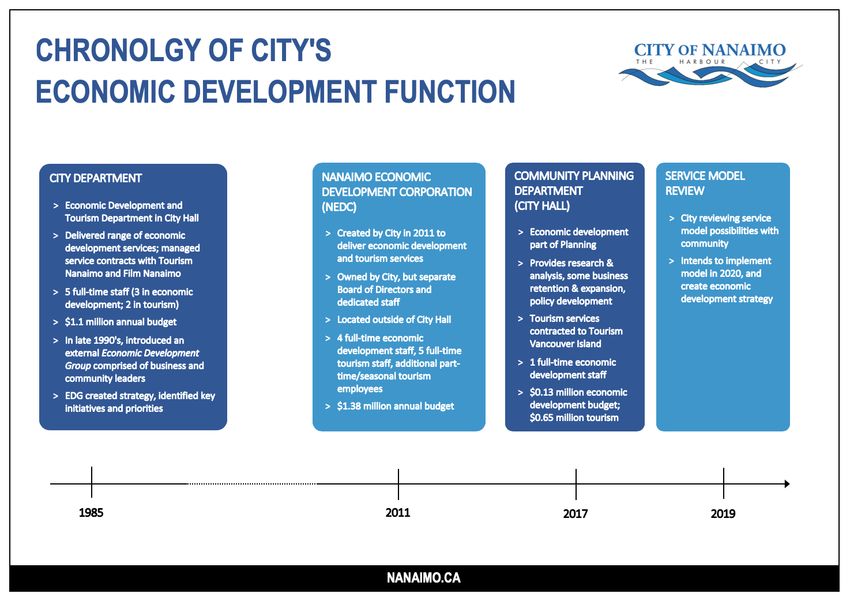
TABLE OF CONTENTS

                1. INTRODUCTION ................................................................................................1
                          City of Nanaimo ............................................................................................... 1
                          Service Review................................................................................................. 1
                                     Consultant's Approach ........................................................................ 2
                                     Final Report ......................................................................................... 2

                          Regional District Study .................................................................................... 3

                2. ECONOMIC DEVELOPMENT IN NANAIMO .........................................................5
                          City of Nanaimo Function ................................................................................ 5
                                     Economic Development and Tourism Department ............................ 5
                                     Nanaimo Economic Development Corporation .................................. 6
                                     Nanaimo Economic Development ...................................................... 7

                          Other Agencies ................................................................................................ 7
                          Summary of Services Provided ...................................................................... 13

                3. CITY OF NANAIMO SERVICE SCOPE .................................................................15
                          Gaps and Opportunities ................................................................................ 15

                4. CITY OF NANAIMO SERVICE MODEL ................................................................19
                          Service Model Options .................................................................................. 19
                          City of Nanaimo Service Model Scenarios ..................................................... 19
                                     Scenario 1: Economic Development Department ............................. 20
                                     Scenario 2: Nanaimo Prosperity Agency Model ................................ 21
                                     Scenario 3: Economic Development Contract Model ....................... 22
                                     Scenario 4: In-House/City-Owned Agency Hybrid Model ................. 24
                                     Scenario 5: In-House/Contract Hybrid Model ................................... 25

  ECONOMIC                Assessing the Service Model ......................................................................... 26
DEVELOPMENT
SERVICE MODEL
                                     Assessment Matrix ............................................................................ 28

                          Review with Governance and Priorities Committee ..................................... 29
FINAL REPORT
                5. RECOMMENDATIONS .....................................................................................33
                          Recommendations ........................................................................................ 33
                                     Scope of Services .............................................................................. 33
                                     Service Delivery Model ..................................................................... 34
 AUGUST 2019
   PAGE i
APPENDICES

                   Appendix I     Summary of Interview Findings
                   Appendix II    Open House Poster Boards
                   Appendix III   Models Used in Other Centres

  ECONOMIC
DEVELOPMENT
SERVICE MODEL

FINAL REPORT

 AUGUST 2019
   PAGE ii
CHAPTER 1
INTRODUCTION
In broad terms, economic development can be described as the services provided,
investments made, activities performed, and efforts taken to increase the level of
prosperity enjoyed by people in the community. Economic development is about
generating wealth; it is also about providing opportunities for people of all
backgrounds and socio-economic groups to participate in the economy and achieve
a high quality of life. Prosperity and quality of life for all are necessary components
of a healthy community.
In many centres, different agencies in the public, private, and non-profit sectors
undertake important activities, and provide key services, designed to advance the
community's level of economic development. Local governments in these centres
often play important economic development roles in the delivery of basic services
and infrastructure, but also in leading the creation of economic development
strategies, and in establishing formal economic development functions to provide
specific economic development services.
CITY OF NANAIMO
The situation in Nanaimo is similar to that of other places. Numerous agencies
provide services that contribute towards the community's economic development,
and that comprise parts of the broader economic development service landscape.
The City of Nanaimo is active through its important local government services, but
also directly through the services provided under its economic development
function.
The City has had its own economic development function in place since the mid-
1980s. For several years, the function was provided in-house by City staff through a
separate Economic Development Department. In 2010, however, the City took a
different approach. In that year, Council decided to combine economic
development with tourism and deliver the service through a separate, municipal
corporation with its own Board of Directors. This corporation, called the Nanaimo
Economic Development Corporation (NEDC), was established in 2011.
ECONOMIC
DEVELOPMENT In the fall of 2016, Council gave direction to cease operations at the NEDC and
SERVICE MODEL
dissolve the corporation. Tourism development and promotion services were
contracted to Tourism Vancouver Island (Tourism VI); economic development was
FINAL REPORT streamlined and moved back in-house under the City's Community Planning
Department, where it exists today.
SERVICE REVIEW
City Council wishes to increase the level of support for the City's economic
development function, effective 2020. Council wishes, as well, however, to examine
AUGUST 2019
PAGE 1new funding levels in the context of a broader review that determines:
• the specific scope of services that should be included in an enhanced
economic development function
• the preferred service model through which the function should be delivered
Neilson Strategies Inc. (the consultant) was retained in late May, 2019, to conduct a
review of the City's economic development function focused on these points.
Consultant's Approach
The consultant conducted the review using a five-stage approach:
• Stage One: Background Research — The consultant undertook background
research to identify the various agencies involved in different facets of
economic development in Nanaimo. Research was also conducted to
identify and fully understand the local government economic development
service models in place in Canada today.
• Stage Two: Interviews — Over a three-week period in June, 2019, twenty
interviews were held with representatives of all sectors, as well as the
Snuneymuxw First Nation, to discuss existing economic development efforts
in the community, and to understand the views of community leaders on the
preferred scope of, and service delivery model for, the City's economic
development function. Interviewees were brought together at the end of
June for a two-hour workshop discussion on these points.1
• Stage Three: Community Engagement — A public open house was held to
introduce economic development and to highlight service delivery models to
consider.2 An online public survey was published on the City's website.
• Stage Four: Interim Report — The findings from the research, interviews,
group discussion, and public feedback were used to produce an Interim
Report. The Interim Report set out options for consideration but did not
provide recommendations. It was presented to Council's Governance and
Priorities Committee for discussion in a workshop setting on July 29, 2019.3
ECONOMIC
DEVELOPMENT • Stage Five: Final Report — Based on the July 29 discussion with Committee
SERVICE MODEL members, the consultant produced this Final Report for presentation to the
Governance and Priorities Committee on August 26, 2019. The Final Report,
FINAL REPORT it is expected, will inform the development of the City's 2020-2024 Financial
Plan.
1
Appendix I provides a summary of the interview findings as they relate to preferred scope and
model.
2
Appendix II presents copies of the poster boards used at the public open house.
3
The Committee is comprised of all members of Council.
AUGUST 2019
PAGE 2Final Report
This document constitutes the Final Report that was presented to the Governance
and Priorities Committee at the end of August. Similar to the earlier Interim Report,
the Final Report begins with an overview of the various economic development
services, and the agencies involved, in Nanaimo today. The City's own economic
development function is included in this overview. The report then identifies a set
of economic development services in which the City may wish to consider playing a
role. This suggested scope of services emerged from the various interviews and
group discussion with community leaders, and was reviewed with Council's
Committee in July, 2019. Alternative service models through which an enhanced
City function could be delivered are outlined and assessed. Recommendations on a
preferred scope of services and service delivery model are presented for the City's
consideration.
The overview of current economic development agencies and the City's own existing
function in this Final Report is largely unchanged from the information presented in
the Interim Report. The discussion on potential economic development services for
the City's new function, and the assessment of alternative service delivery models,
are also largely unchanged. Where the Final Report departs from the interim
version begins at the end of Chapter 4 with commentary from the review of the
interim document with the Governance and Priorities Committee. The
recommendations presented in the report's final chapter were informed by the
Committee's review.
REGIONAL DISTRICT STUDY
Before turning to the body of the report, it should be noted that the Regional
District of Nanaimo (RDN) recently undertook a study to explore the level of interest
throughout the RDN — including in the City of Nanaimo — in establishing some type
of regional economic development function. In order to minimize any confusion on
the part of economic development stakeholders and others in Nanaimo, the
Regional District has postponed completion of its study until after the City's Service
Model Review.
During the consultation for the City's Service Model Review, interviewees were
asked to comment on the possibility of adopting a regional approach to economic
ECONOMIC development, through the establishment of a regional district service, in place of an
DEVELOPMENT expanded City function. Interviewees responded, almost unanimously, that:
SERVICE MODEL
• coordination of local efforts under a broad regional (or mid-Island) economic
FINAL REPORT development strategy is important
• before considering any development of a regional (or super-regional)
approach, the City should deal with the need for a new City-based economic
development function
• the City's function that emerges from the City's Service Model Review can be
incorporated into a broader regional framework
AUGUST 2019
PAGE 3Given these views, and the RDN's decision to postpone the completion of its own
study, this Interim Report focuses on the City of Nanaimo, and does not comment on
the potential for a regional approach.
ECONOMIC
DEVELOPMENT
SERVICE MODEL
FINAL REPORT
AUGUST 2019
PAGE 4CHAPTER 2
ECONOMIC DEVELOPMENT IN NANAIMO
In Nanaimo, various agencies and organizations in the public, private, and non-profit
sectors are active in economic development. Over the course of the assignment,
the consultant interviewed leaders in a number of these agencies to:
• fully understand the economic development services provided, or roles
played, by agencies
• identify how agencies complement and/or overlap with one another
• identify economic development service gaps that may exist
• understand individuals' perspectives regarding the possible roles for the City
in economic development, and the preferred service model
The possible roles and preferred service model for the City are explored later in the
report (see Chapters 3 and 4). This chapter profiles the various agencies and
organizations that are active in the community today, and identifies their economic
development activities. The chapter begins, however, by profiling the City's own
economic function as it has evolved over the past three decades.
CITY OF NANAIMO FUNCTION
As noted earlier, the City of Nanaimo first established a formal economic
development function in the mid-1980s. The scope of the function and the model
through which it has been delivered have changed since that time.
Economic Development & Tourism Department
For several years beginning in the 1980s, the function was provided in-house by City
staff in an Economic Development and Tourism Department. The department
provided a range of economic development services, including:
• research and analysis on economic factors, trends, and opportunities to
support and grow the City's business sector
• development of relationships and partnerships with other local
organizations involved in building the economy
ECONOMIC • business retention and expansion programs
DEVELOPMENT • support for entrepreneurs and start-ups seeking to build businesses in
SERVICE MODEL
Nanaimo
• business attraction activities, including marketing and promotion
FINAL REPORT • development of tax and other local government incentives to promote
economic growth
Staff undertook, as well, various destination development activities to promote
Nanaimo as a tourism destination; however, other tourism-related activities were
contracted by the City to the Tourism Nanaimo Society. Through a separate fee-for-
AUGUST 2019
PAGE 5service contract with Film Nanaimo, the department also supported efforts to
promote Nanaimo to the film industry.
At its height, the department had an annual budget of $1.1 million, was headed by a
senior manager (Director), and was staffed by a total of five (5) full-time employees,
(including the Director). Three (3) of the employees were identified and funded as
economic development staff; two (2) were dedicated to tourism destination
development.
In the late 1990s and early 2000s, the Economic Development Department
developed and provided support to an external economic development stakeholder
forum, known as the Economic Development Group, or "EDGe". EDGe brought
together leaders from all sectors in the community to identify economic
development priorities intended to guide the City's efforts. It provided strategic
advice to the City, and also served as a sounding board for the Economic
Development Department. The City's Director of Economic Development
participated in EDGe discussions.
Nanaimo Economic Development Corporation
In 2010, the City moved its economic development function from the in-house
department to a separate City-owned corporation. The Nanaimo Economic
Development Corporation (NEDC) was incorporated in June, 2011, as a not-for-profit
corporation, wholly-owned and largely-funded by the City.4 It was governed by its
own Board of Directors that consisted of seventeen members to represent key
businesses, the post-secondary sector, First Nations and other groups. All members
were appointed by Council; Council, itself, was not represented on the Board.
NEDC was developed as a multi-service economic development and tourism
corporation. Under economic development, the corporation provided a diverse set
of services that included:
• research and analysis on economic issues to support and grow the City's
business sector
• marketing and promotion efforts designed to attract new businesses and
investment to Nanaimo
ECONOMIC • support for new arrivals to Nanaimo
DEVELOPMENT • programs, workshops and other efforts aimed at helping existing businesses
SERVICE MODEL succeed and expand
• support for entrepreneurs and start-ups (sector specific and general)
FINAL REPORT • efforts to develop and foster relationships with other service providers
Tourism services were equally diverse, and included marketing campaigns, media
relations and familiarization ("fam") trips, the operation of the visitor centre, the
4
The NEDC received $164,000 each year from the Regional District of Nanaimo to provide economic
development and tourism services to Electoral Areas A, B, and C.
AUGUST 2019
PAGE 6development of publications and brochures, and support for cruise ships, events,
and conferences.
NEDC operated from office space outside of City Hall in Downtown Nanaimo. The
corporation had four (4) full-time economic development staff, five (5) full-time
tourism staff, and additional part-time and seasonal tourism employees. City
funding for NEDC was $1.385 million in 2016.
Nanaimo Economic Development
In late 2016, Council decided to dissolve the NEDC. Council contracted the delivery
of key tourism-related services to Tourism Vancouver Island (Tourism VI) under a
fee-for-service agreement that was recently extended until 2024. The City's
economic development function was brought back in-house for delivery by City
staff. The earlier Economic Development Department was not re-established as the
delivery vehicle; instead, a smaller, streamlined economic development office —
presented under the brand "Nanaimo Economic Development" — was developed
within the City's Community Planning Department.
Nanaimo Economic Development has limited resources available to provide
economic development services — the office is staffed by a single Economic
Development Officer. Within its reduced scope of services, the office works to:
• collect and assess various economic, demographic, labour force and related
data
• produce a range of reports and materials using key data to highlight
Nanaimo's competitive advantages as a centre for business and investment
• provide referrals to existing businesses, start-ups and prospective businesses
to address information requests, obtain assistance (e.g., in developing
business plans), or access funding
• assist existing and prospective businesses in accessing City services
• initiate and assist with the development of incentives and other City polices
aimed at strengthening the business environment
The 2019 budget for Nanaimo Economic Development is a modest $0.13 million.
ECONOMIC OTHER AGENCIES
DEVELOPMENT Key agencies and organizations that are involved in economic development in
SERVICE MODEL Nanaimo today are profiled in Figure 2.1 (agencies are listed in alphabetical order).
The roles played and services provided by each agency are explained. It is important
FINAL REPORT to note that the agencies in the figure do not represent the full set of organizations
involved in some way in the community's economic development. Figure 2.1 does,
however, capture most of the key agencies that are active today.
AUGUST 2019
PAGE 7Figure 2.1
Economic Development Agencies in Nanaimo
Agency Role in Economic Development
Central Vancouver The Central Vancouver Island Multicultural Society (CVIMS) works
Island Multicultural to help newcomers join and succeed in the local economy.
Society CVIMS provides language, employment, and other services to
newcomers who wish to settle in Nanaimo (or in another Central
Vancouver Island community), including newcomers who wish to
start businesses. The Society also offers programs and supports
to help local employers connect with skilled and qualified
newcomers.
One group of newcomers that works with CVIMS is international
students who have completed their training at local post-
secondary institutions (in particular, Vancouver Island
University), and who wish to remain in the community, start
businesses, and enter the workforce.
CVIMS belongs to the Local Immigrant Partnership — a
consortium of organizations committed to making Nanaimo
welcoming to newcomers. Advice and programs are offered to
address newcomers' training and skill development needs, health
care needs, and others.
Coast Community Coastal Community Credit Union (CCCU), headquartered in
Credit Union Downtown Nanaimo, is the largest Vancouver Island-based
financial services organization, and the largest private-sector
employer in the city. It provides various types of financing to
new and established businesses in Nanaimo and throughout the
Credit Union's service area.
CCCU is an active supporter of various local economic
development organizations and their efforts. It is a sponsor, for
example, of the Local Entrepreneur Accelerator Program (LEAP)
provided by Community Futures Central Island (see below). It
was active in the Nanaimo Economic Development Corporation,
and participates today in the Mid-Island Business Initiative.
ECONOMIC
DEVELOPMENT Community Futures Community Futures helps local entrepreneurs start businesses
SERVICE MODEL Central Island (i.e., start-ups), and works with existing business owners to
strengthen and expand established small-to-medium businesses.
Business succession plans for existing businesses are an
FINAL REPORT additional focus of Community Futures.
Community Futures' efforts are aimed at diversifying local
economies, creating and maintaining employment, and building
the entrepreneurial ecosystem. Community Futures also aims to
support "business drivers" — that is, businesses that produce
AUGUST 2019
PAGE 8Agency Role in Economic Development
goods and services for sale to markets outside of Central
Vancouver Island.
One program offered by Community Futures is the "Entrepreneur
in Residence". This program gives entrepreneurs and existing
business owners the opportunity to get advice from a successful
entrepreneur. Another program is the Local Entrepreneur
Accelerator Program (LEAP). LEAP is an eight-week program
aimed at helping small groups of entrepreneurs launch new
businesses. It is described as "boot camp for early-stage
ventures".
As part of its business development services, Community Futures
helps start-ups and existing businesses secure financing.
Community Futures is the steward of a $6 million loan fund,
which the organization uses to provide repayable funding to
businesses for working capital, equipment purchase or lease, and
business purchase or expansion. The organization specializes in
business loans with customized re-payment schedules. It helps
to fill the funding gap, but also works to leverage funds with
other community lenders (e.g., Coast Community Credit Union).
Community Futures' programs are, to some degree, targeted to
reflect priorities identified by the job creation and diversification
goals of Western Economic Diversification Canada (WEDC), which
provides 60% of Community Futures' funding. The programs are
primarily targeted, however, to meet local economic
development goals and community needs.
Community Futures' service area includes all of Central
Vancouver Island.
Innovation Island Innovation Island exists to "support entrepreneurs to start and
Technology grow technology companies by providing them with programs
Association and resources they need to succeed." Innovation Island bills
itself as a "Startup Accelerator". It delivers Innovate BC's Venture
Acceleration Program, which gives tech entrepreneurs who wish
ECONOMIC to commercialize their technology access to business and
DEVELOPMENT technology experts known as "Executives in Residence".
SERVICE MODEL
Innovation Island's service area includes the whole of Vancouver
FINAL REPORT Island north of Greater Victoria.
Mid-Island Business The Mid-Island Business Initiative (MIBI) is a member-funded,
Initiative not-for-profit organization that works to attract businesses to the
Mid-Island region, help interested businesses to learn about the
region and its advantages, and help new businesses that choose
to relocate to the area get connected to the region's business
community.
AUGUST 2019
PAGE 9Agency Role in Economic Development
MIBI was formed following the dissolution of the Nanaimo
Economic Development Corporation to fill the resulting gap in
business attraction efforts. MIBI also serves as a forum for its
members from the private sector, post-secondary sector, First
Nations, and others (e.g., Nanaimo Port Authority, Nanaimo
Airport) to exchange information and identify economic
development needs, opportunities, and priorities.
In the spring of 2019, MIBI developed the Manufacturers
Technology Entrepreneurship Council (MTEC) — also known as
Tech Nanaimo — to promote the development of the technology
sector in Nanaimo. In response to a request from MIBI, the City
provided $48,000 in funds to support the work of MTEC for a six
month term.
Nanaimo Chamber of The Nanaimo Chamber of Commerce provides various business
Commerce retention and expansion services to its members — that is,
services aimed at helping existing business to succeed and grow.
Networking events and educational programs for Chamber
members (and prospective members) are key examples. The
Chamber also:
– advocates on behalf of its members for public policy
changes to improve the business environment
– organizes, in partnership with the City, the Commercial
Street Night Market to promote Downtown Nanaimo
and its businesses
– publishes a business resource and relocation guide titled
Nanaimo Business Resource
– assists new businesses (i.e., new arrivals) access City Hall
departments and other resources
Nanaimo Hospitality The Nanaimo Hospitality Association (NHA) is a not-for-profit
Association industry group that works with other tourism stakeholders to
promote Nanaimo as a tourism destination. The organization is
the designated recipient through Destination BC of Municipal and
Regional District Tax (MRDT) revenues that are generated from
ECONOMIC the sale of overnight accommodation in Nanaimo. Spending
DEVELOPMENT priorities for the funds are identified by the NHA in collaboration
SERVICE MODEL with Tourism VI and others.
Nanaimo Airport YCD Nanaimo Airport YCD promotes and facilitates the movement of
FINAL REPORT people and goods to and from Nanaimo. It both generates and
contributes to economic growth through its operations and its
investments in airport capacity. YCD participates in the Mid-
Island Business Initiative.
Nanaimo Port The Nanaimo Port Authority (NPA) is the federal agency
Authority responsible for growing and operating the Port of Nanaimo. The
AUGUST 2019
PAGE 10Agency Role in Economic Development
NPA is a major economic generator in the community, both
through its efforts to facilitate the movement of goods and
people, and through its strategic investments in new economic
initiatives.
The NPA recently opened a vehicle processing centre as a facility
to prepare imported vehicles for the Canadian market. The
agency is pursuing short-sea shipping opportunities, as well as
the expansion of its Duke Point facility, the further development
of logistics hubs, and growth in the export of value-added
products. The NPA is a member of the Mid-Island Business
Initiative.
Petroglyph The Petroglyph Development Group (PDG) is the economic
Development Group development arm of the Snuneymuxw First Nation (SFN). PDG is
a separate corporation, owned by the SFN, that establishes and
oversees the management of SFN companies, including:
– Petroglyph Forestry
– Saysutshun / Newcastle Island
– Saysutshun Ferry Service
– Petroglyph Properties
– Snuneymuxw Market Gas Bar
– First Nations Canna Corporation
PDG works in collaboration with other business and economic
development groups to identify and pursue initiatives aimed at
building and sustaining wealth for the Snuneymuxw, creating
jobs, and developing skills — all within a broader context that
emphasizes the importance of sustainability for future
generations of Snuneymuxw Mustiyuwx. One of PDG's five
objectives focuses on building relationships.
Regional District of In the southern half of the Regional District, RDN provides an
Nanaimo economic development service in Area B (Gabriola Island)
through the Southern Communities Economic Development
service. The Gabriola Chamber of Commerce delivers the service,
ECONOMIC which focuses on tourism attraction. As noted earlier, RDN is
DEVELOPMENT exploring the potential of a new regional service.
SERVICE MODEL
Tourism Vancouver Tourism Vancouver Island (Tourism VI) is contracted by the City
Island to promote Nanaimo as a tourist destination, and to provide
FINAL REPORT professional development, digital readiness, networking, and
other programs aimed at strengthening the businesses that
comprise Nanaimo's tourism sector. All of Tourism VI's work for
the City is performed under the Tourism Nanaimo brand.
Tourism VI hosts a monthly tourism roundtable to discuss
tourism trends, challenges, and opportunities. The roundtable
AUGUST 2019
PAGE 11Agency Role in Economic Development
includes key stakeholders such as the Nanaimo Port Authority,
Snuneymuxw First Nation, Vancouver Island Conference Centre,
Nanaimo Airport, and the Nanaimo Hospitality Association. The
group was formed to assist in developing Tourism VI's response
to the City's tourism contract request for proposals — a response
that, once endorsed by the City, became the de facto tourism
strategy to guide efforts.
Tourism VI works closely with the Nanaimo Hospitality
Association on digital readiness, marketing, and other services
for the accommodation providers that belong to the NHA. The
NHA contracts Tourism VI, as well, to write the business plan
required by Destination BC to receive annual MRDT revenues for
use in tourism marketing and related programs.
Vancouver Island The Vancouver Island Conference Centre (VICC) is a City-owned
Conference Centre convention centre and event venue in Downtown Nanaimo. The
VICC notes that it "strives to create a positive economic impact"
and "stimulate growth for the City" by attracting convention
delegates and event participants to Nanaimo from across North
America. The VICC undertakes its marketing and promotion in
collaboration with other tourism industry stakeholders.
Vancouver Island The Vancouver Island Economic Alliance (VIEA) promotes
Economic Alliance5 collaboration among communities, First Nations, businesses and
other parties in the development of broad economic
development programs that benefit the Vancouver Island region.
The Alliance presents an annual "State of the Island Economic
Summit", and produces the "State of the Island Economic
Report". VIEA also undertakes a variety of other initiatives
related to its priority areas. One initiative, called "Capturing
Talent" brings together post-secondary institutions on the Island
with the business community to develop opportunities for
students who wish to stay in the region post-graduation.
In 2018, VIEA succeeded in obtaining a Foreign Trade Zone Point
ECONOMIC designation for Vancouver Island (FTZ-VI). VIEA is the designated
DEVELOPMENT FTZ-VI champion, engaged in marketing the Island's export goods,
SERVICE MODEL attracting foreign trade and investment, and providing a
streamlined, single-point of access to relevant federal
government international trade programs.
FINAL REPORT
The FTZ-VI designation is expected to help expand and diversify
the Island's advanced manufacturing sector, agri-food and
seafood industries, and the level of international trade.
5
Efforts to interview VIEA staff were not successful. The information provided here comes from
materials posted on the VIEA website.
AUGUST 2019
PAGE 12Agency Role in Economic Development
Vancouver Island The Vancouver Island North Film Commission (INFilm) works to
North Film attract new business to Vancouver Island (north of Victoria) —
Commission specifically, businesses in the domestic and international film
industries that are seeking locations for film, television and
commercial productions. INFilm provides information on, and
connects producers with, local crews, equipment, and services.
The organization also provides supports to production companies
once in the region, including assistance in navigating permitting
processes, and liaising with the public and media.
Vancouver Island Vancouver Island University (VIU) is a major Canadian post-
University secondary institution with close to 15,000 students. The
University plays significant economic development roles in:
– attracting students to the region from around the world
– creating a skilled workforce
– developing entrepreneurs through its MBA program
– helping to match students and employers through the
Centre for Experiential Learning, which hosts the
University's Co-operative Education, Internship, and
Indigenous Internship Programs
In 2018, VIU established the VIU Initiatives Trust, a for-profit
enterprise that invests in and develops income-generating
initiatives to benefit the University and the VIU Foundation. The
Trust expects to be active as an investor and partner in property
development, entrepreneurial ventures, First Nation economic
partnerships, social innovation enterprises, and other business
opportunities. Through its investment activities, the Trust will
allow VIU to play an even larger role than at present in Nanaimo's
economic development.
Young Professionals The Young Professionals of Nanaimo (YPN) is an organization, run
of Nanaimo by and for professionals under the age of 40, focused on helping
its members develop professionally, and connect to one another
and the broader community. One of the stated goals of the
organization is to attract young professionals to the Nanaimo
ECONOMIC region; another is to help them stay in the region. Professional
DEVELOPMENT development programs, networking events, community
SERVICE MODEL involvement, and social networking are the group's four pillars.
FINAL REPORT SUMMARY OF SERVICES PROVIDED
It is clear from the information presented in Figure 2.1, and the profile of the City's
own function, that there are many agencies in Nanaimo performing different
economic development services aimed at building prosperity in the community.
Figure 2.2 provides a simple matrix to summarize "who does what", as well as the
range of functions performed.
AUGUST 2019
PAGE 13An effort has been made in Figure 2.2 to highlight the main services provided by
each the different agencies. Several of the agencies' efforts may expand beyond the
services identified here into other service areas from time to time — lines between
services, and definitions of services, are not always clear or fixed. It is worth noting,
as well, that some agencies' efforts are targeted to businesses in specific industries
(e.g., tech, tourism, etc.) rather than to businesses in the broader economy.
Figure 2.2
Summary Matrix
Services
Bus. Retention
Priority-Setting
Business Start-
Hall Processes
Development
Navigate City
Labour Force
& Expansion
Investments
Up Support
Attraction
Forum for
Reporting
Economic
Financing
Strategic
Business
Agency
City of Nanaimo ü ü ü
Multicultural Soc. ü
Coast Community ü
Community Fut. ü ü ü
Innovation Island ü ü ü ü
MIBI ü ü
Nanaimo Chamber ü ü
INFilm ü ü
NHA ü
Nanaimo Airport ü ü
Nanaimo Port ü ü
Petroglyph (SFN) ü ü ü ü
ECONOMIC
DEVELOPMENT Regional District6 ü
SERVICE MODEL Tourism VI ü ü ü
VICC ü
FINAL REPORT
VIEA ü ü ü ü ü
VIU / VIU Trust ü ü
YPN ü
6
In the southern part of the Regional District, the RDN focuses on Gabriola Island.
AUGUST 2019
PAGE 14SECTION 3
CITY OF NANAIMO SERVICE SCOPE
The City of Nanaimo has expressed a desire to increase its level of support for
economic development. The City wishes, specifically, to invest resources into a new
economic development function, which would be introduced in 2020. A key
purpose of the Service Model Review is to advise the City on the preferred service
model, or structure, for the new function.
The structure for the function will be informed, to some degree, by the function's
proposed scope of services. This chapter of the report speaks to the issue of scope.
GAPS AND OPPORTUNITIES
The City does not seek to duplicate or displace the efforts of the existing economic
development agencies in Nanaimo. The City recognizes that, in many cases, existing
agencies have the expertise, and have made the investments needed, to fulfill their
respective mandates.
The City also recognizes, however, that there are certain service gaps in the
economic development landscape, as well as opportunities for enhanced service
provision. Not all of these gaps and opportunities are understood at this time;
however, enough can be identified to suggest a starting scope for the City to
consider.
Figure 3.1 identifies the gaps and opportunities that emerged from discussions with
economic development agencies and community leaders, from the review of
agencies presented in the previous section of the report, and from research
conducted for the assignment on economic development services in other cities.
Included in the figure are services already provided under the City's current
(modest) function, Nanaimo Economic Development. These gaps, opportunities,
and existing City services help to define a possible scope of service for the City's new
function moving forward.7
ECONOMIC
DEVELOPMENT
SERVICE MODEL
FINAL REPORT
7
It is important to note that scope of services presented in Figure 3.1 addresses the question of
"what" the City could provide in terms of economic development. The scope says nothing about
"how" the services should be delivered, or "who" should deliver them. These questions are
explored in Chapter 4 of the report in the discussion on service delivery model, and are addressed
further in the Chapter 5 recommendations.
AUGUST 2019
PAGE 15Figure 3.1
Possible Scope of Services
Gap/Opportunity Detail
Economic The lack of a current economic development strategy for
Development Nanaimo is the most serious gap to address; similarly, the
Strategy development of such a strategy represents the most important
need going forward. The City has a significant role to play in
addressing this need. The role will need to include:
– leadership on the part of Council to initiate, guide,
participate in, and ultimately endorse the strategy
– the provision of adequate funding for the process
– the engagement of community champions and
economic development leaders from a broad range of
interests (private sector, post-secondary sector, First
Nations, public agencies, non-profit agencies, others) in
the endeavour
Economic Reporting The City's existing function is well-regarded in the economic
development field for its economic reporting capacity. The City
has access to many sources of data, and a sophisticated
geographic information system database. The data and this tool
enable the City to produce a range of Nanaimo-specific reports
on economic activity, performance, trends, opportunities and
needs.
Navigating City Hall At present, the City and Chamber of Commerce provide advice
and assistance to existing and prospective business that need to
work with City departments to obtain permits, licenses, and
other permissions or information. INFilm also provides
assistance, specifically for film production companies. The City
should be the primary agency responsible for providing this
service; added capacity would enable the City to meet existing
and future needs.
Contract The City currently assigns management of the Tourism VI
Management contract to the Parks, Recreation and Culture Department. Given
the importance of tourism to the City's economic development, it
ECONOMIC
may make more sense to transfer contract management of the
DEVELOPMENT
existing contract, as well as any future service contracts, to the
SERVICE MODEL
City's economic development function.
Policy Development As the local government with regulatory authority for land use
FINAL REPORT
planning and development, and with responsibility for a broad
range of municipal services, the City has an important role to play
in formulating policies aimed at facilitating economic activity and
investment. Input by Economic Development staff into policy
discussions is needed to ensure that business and economic
considerations are taken into account in all key decisions.
AUGUST 2019
PAGE 16Gap/Opportunity Detail
Coordination of The various agencies and organizations profiled in Section 2 of
Efforts the report all have important roles to play in the community's
ongoing economic development, and all make positive
contributions to the overall economic development effort. To
some degree, however, the organizations function in isolation of
one another, without a full appreciation of what each other does,
or of how different agencies could collaborate. There is a clear
sense, expressed by many of the leaders interviewed, that
coordination of the organizations' priorities and efforts would
benefit both the organizations themselves and the community.
The development of a new economic development strategy
would help to achieve a high degree of coordination by setting
out agreed-upon priorities, and clearly identifying "who does
what". Also important for coordination would be the creation of
ongoing forums to bring together leaders for strategic discussions
on opportunities and needs as part of the strategy
implementation.
The Mid-Island Business Initiative, created upon the dissolution
of the Nanaimo Economic Development Corporation, has helped
in part to fill the need for an ongoing economic development
forum. Other groups, such as the Vancouver Island Economic
Alliance, have also brought groups together for strategic
discussions. What is needed, however, is an all-inclusive venue,
funded and supported by the broader community, to identify
opportunities to pursue and needs to address within the context
of an established strategy.
Business Attraction The City's previous function, both under the NEDC and before the
NEDC, focused on business retention and business expansion
efforts. The service also, however, promoted and marketed
Nanaimo to prospective businesses, and provided a single portal
for these businesses to learn about the community and its
opportunities. When the City dissolved the NEDC and re-
established a streamlined function in the Community Planning
Department, business attraction efforts were largely
ECONOMIC discontinued, and the single portal disappeared. MIBI was
DEVELOPMENT established by a consortium of business and community leaders
SERVICE MODEL in an attempt to fill the gap.
FINAL REPORT Business attraction programs are widely viewed as being less
important than strong business retention and expansion efforts.
Indeed, efforts aimed at retention and expansion actually help to
create the environment needed to attract new business and
investment to an area. This point notwithstanding, focused
attraction programs do need to be developed as part of a full
economic development approach.
AUGUST 2019
PAGE 17Gap/Opportunity Detail
Business attraction efforts may fit well into the City's new
function. Businesses that are interested in learning about
opportunities in a place, obtaining trusted economic and market
analyses, seeking information about local requirements, and
looking to identify connection points with local resources, tend to
turn first to the city government. The official economic
development function of the local government, regardless of its
structure, carries a certain degree of authority that an
organization without ties to the local government may not be
able to command.
Investment Fund A number of agencies interviewed for the study identified the
potential to invest in strategic initiatives and opportunities aimed
at facilitating economic development in Nanaimo. Such
initiatives would have broad community benefit, and would be
linked to priorities identified in a new economic development
strategy (e.g., transportation infrastructure, manufacturing
capacity, technology incubators, tourism infrastructure, etc.).
Economic investment funds in other centres are funded in large
part by public resources, and are developed as special programs
(often with their own governing body) within local government
economic development functions.
ECONOMIC
DEVELOPMENT
SERVICE MODEL
FINAL REPORT
AUGUST 2019
PAGE 18SECTION 4
CITY OF NANAIMO SERVICE MODEL
The previous chapter of the report highlighted, in Figure 3.1, some specific services
that the City may wish to include in any new economic development function.
These services may not represent the full scope; they do, however, build on the
elements and strengths of the City's existing function, while also addressing
important gaps and opportunities in the economic development landscape. Based
on discussions with existing agencies and leaders, there is support in the community
for the City to include these services in its new function.
This chapter of the report focuses on the issue of structure, also referred to as
service model. Five options are presented and assessed for the City's consideration.
SERVICE MODEL OPTIONS
A review of local government economic development functions across North
America highlights three basic service models for the City to consider:
• In-House Model — Under this model the City's new economic development
function would be based in, and provided by, the City administration. This
model is used by the City for its existing modest service; it was also used
prior to 2011 when the City had an Economic Development and Tourism
Department in place.
• City-Owned Agency Model — This model features the use of a separate
agency, incorporated and owned (wholly or primarily) by the City, but with
its own Board of Directors and staff.
• Service Contract Model — In this model, the City would contract the
operation of its economic development function to an independent
organization. The City uses this model to deliver tourism services through
Tourism VI under the terms of a five-year fee-for-service agreement.
Elements from two or more of the basic models may be combined to create a hybrid
ECONOMIC approach. Certain services in such a hybrid could be provided in-house by City staff
DEVELOPMENT in an economic development office or department. Other services could be
SERVICE MODEL
provided outside of City Hall by a City-owned entity, or by an independent
organization contracted by the City. Hybrid approaches, featuring a combination of
FINAL REPORT the in-house/agency models, and a combination of the in-house/contract models,
are presented as additional models for the City to consider. The total number of
options, including the two hybrid approaches, is five.
CITY OF NANAIMO SERVICE MODEL SCENARIOS
This section presents five scenarios to illustrate how the different service models
AUGUST 2019
PAGE 19could be used to deliver the City of Nanaimo's new economic development function.
All scenarios envision the same service scope, which would include the specific
services identified earlier in Chapter 3, Figure 3.1.
Scenario 1:
Economic Development Department
In this first scenario, the City would deliver the service through a new Economic
Development Department. Figure 4.1 provides additional detail.
Figure 4.1
Economic Development Department Model
Key Elements Description
Scope of The service scope would consist of the items identified in Figure 3.1:
Service
– the Department would oversee the development, through an
inclusive process, of a new Nanaimo Economic Development
Strategy, and would implement and maintain the Strategy
– staff would continue to undertake research and data analysis, as
they do today, to produce economic reports
– the Department would be the primary point of contact for new
and prospective businesses on City policies, processes and
requirements
– the Department would manage all service contracts with
external economic development and tourism agencies
– staff in the Department would initiate and liaise with other
departments and Council on the development of policies and
programs to promote business and economic development
– the Department would establish a broad-based economic
development committee as a forum for priority setting and
agency coordination, within the context of the strategy
– the Department would oversee targeted marketing and
promotion efforts to attract businesses; the Department would
serve as the first point of contact for prospective businesses
– the Department would oversee an investment fund, should such
a fund be desired
ECONOMIC Service City Council would provide funding sufficient for the Department to
DEVELOPMENT Funding provide its full scope of services, including starting capital for an
SERVICE MODEL investment fund. City funds would be leveraged, where possible, to
obtain grants from other governments and foundations for specific
initiatives.
FINAL REPORT
Service City Council would govern the function, as it does all other City
Governance functions. Council would be assisted by an advisory committee (e.g.,
economic development committee noted earlier).
Staff The Department would be headed by a senior manager (e.g., Director),
who would have access to senior management and Council (through the
AUGUST 2019
PAGE 20Key Elements Description
City Manager). All other staff in the service would be City staff, attached
to the Department. A complement of three (3) to four (4) FTEs is
envisioned.
Location The Department would be located within City Hall.
Scenario 2:
Nanaimo Prosperity Agency
In this scenario, the City would establish a separate, single-purpose Nanaimo
Prosperity Agency to deliver the City's economic development service. The Agency
would be owned, wholly or primarily, by the City. Figure 4.2 provides additional
detail.
Figure 4.2
Nanaimo Prosperity Agency Model
Key Elements Description
Scope of The service scope would consist of the Figure 3.1 items:
Service
– Council would assign to the Agency responsibility for leading the
development, through an inclusive process, of a new Nanaimo
Economic Development Strategy, and for implementing and
maintaining the Strategy
– staff in the Agency would undertake research and data analysis
to produce economic reports
– the Agency would be the primary point of contact for new and
prospective businesses on City policies, processes and
requirements
– staff would liaise with City departments and Council to advocate
for the development of policies and programs to promote
business and economic development
– the Agency's Board would serve as a forum for collaboration and
priority-setting; additional committees and forums would be
established by the Board as warranted
ECONOMIC – the Agency would undertake targeted marketing and promotion
DEVELOPMENT efforts to attract businesses; the Agency would be the economic
SERVICE MODEL development "brand" for Nanaimo
– the Agency could oversee an investment fund established by the
City, should such a fund be desired
FINAL REPORT
Note that management of contracts between the City and external
agencies (e.g., Tourism VI) would remain in-house with the City in the
Parks, Recreation and Culture Department.
Service City Council would guarantee core funding for the Agency to provide its
Funding full scope of services, including starting capital for an investment fund.
AUGUST 2019
PAGE 21Key Elements Description
The Agency would be expected, however, to leverage City funding to
raise additional funds from government, foundations, and the private
sector. Economic development agencies and other organizations in the
community would be expected to contribute funds in the form of share
purchases and/or membership payments. These payments would be
made in accordance with a schedule that differentiated among
organizations based on size, ability-to-pay, and other factors.
Service The Agency's Board of Directors would be the governing body. City
Governance Council would appoint all Directors, and would have the authority to
remove Directors. The Board, however, would act with considerable
autonomy from Council once appointed. Quarterly reports to Council
would provide for accountability. Included on the Board of Directors
would be one member of Council (e.g., Mayor) and one senior staff
member (e.g., City Manager).
Success factors in this model would include:
– a strong governance structure that clearly set out roles and
responsibilities
– a skilled Board of Directors that understands its job
– a Council and administration that respect the Board's
autonomy8
Staff The Agency would be headed by a Chief Executive Officer or Executive
Director. Initially, four (4) FTEs, including the head, would comprise the
full staffing complement (this number would be adjusted based on
need). All staff would be employees of the Agency.
Location The Agency would be located outside of City Hall.
Scenario 3:
Economic Development Service Contract
In this scenario, the City would contract the delivery of economic development to an
independent organization in Nanaimo. This scenario would be similar in approach
to that which the City has taken with its tourism service, which is contracted to
ECONOMIC Tourism VI. Figure 4.3 provides additional detail.
DEVELOPMENT
SERVICE MODEL
FINAL REPORT
8
These three features would be particularly important to put in place, given the difficulties
experienced under the Nanaimo Economic Development Corporation.
AUGUST 2019
PAGE 22Figure 4.3
Economic Development Service Contract Model
Key Elements Description
Scope of Through a fee-for-service contract, the City would assign responsibility to
Service an independent organization (i.e., the contractor) for the scope of
services identified in Figure 3.1. Specifically:
– Council would assign to the contractor responsibility for leading
the development, through an inclusive process, of a new
Nanaimo Economic Development Strategy, and for
implementing and maintaining the Strategy
– the contractor would commission and/or undertake research
and data analysis to produce economic reports
– the contractor would be the primary point of contact for new
and prospective businesses on City processes and requirements
– the contractor would liaise with City departments and Council to
advocate for the development of policies and programs to
promote business and economic development
– the contractor would convene forums, as necessary, for
collaboration and priority-setting
– the contractor would undertake targeted marketing and
promotion efforts to attract business; work would be conducted
under a Nanaimo economic development brand
– the contractor could oversee an investment fund, should such a
fund be desired
Management of contracts between the City and external organizations
(e.g., Tourism VI) would remain in-house with the City in the Parks,
Recreation and Culture Department.
Service City Council would provide core funding through a five-year contract for
Funding the contractor to provide the full scope of services. The contractor
would be expected to raise additional funds from government,
foundations, and the private sector for key initiatives.
Service Council would be the governing body for the function. Accountability to
Governance Council would be provided through the terms of the contract, which
ECONOMIC would include the requirement for quarterly performance reports.
DEVELOPMENT
Staff The contractor would provide all staff for the service. The fee-for-service
SERVICE MODEL
contract from the City would provide the funds for adequate staff, in
keeping with FTE numbers in the other scenarios.
FINAL REPORT
Location The service would be located at the contractor's premises.
AUGUST 2019
PAGE 23You can also read


