Emergence of Arboviruses in the United States: The Boom and Bust of Funding, Innovation, and Capacity - MDPI
←
→
Page content transcription
If your browser does not render page correctly, please read the page content below
Tropical Medicine and
            Infectious Disease

Perspective
Emergence of Arboviruses in the United States:
The Boom and Bust of Funding, Innovation,
and Capacity
Rebekah C. Kading 1, * , Lee W. Cohnstaedt 2 , Ken Fall 3 and Gabriel L. Hamer 4
 1    Department of Microbiology, Colorado State University, Immunology and Pathology,
      Fort Collins, CO 80523, USA
 2    United States Department of Agriculture, Arthropod-borne Animal Diseases Research Unit, Agricultural
      Research Service, Manhattan, KS 66502, USA; lee.cohnstaedt@usda.gov
 3    BioQuip Products, Rancho Dominguez, CA 90220, USA; ken@bioquip.com
 4    Department of Entomology, College of Agriculture and Life Sciences, Texas A&M University, College Station,
      TX 77843, USA; ghamer@tamu.edu
 *    Correspondence: rebekah.kading@colostate.edu

 Received: 29 April 2020; Accepted: 4 June 2020; Published: 6 June 2020

 Abstract: Mosquito-borne viruses will continue to emerge and generate a significant public health
 burden around the globe. Here, we provide a longitudinal perspective on how the emergence of
 mosquito-borne viruses in the Americas has triggered reactionary funding by sponsored agencies,
 stimulating a number of publications, innovative development of traps, and augmented capacity. We
 discuss the return on investment (ROI) from the oscillation in federal funding that influences demand
 for surveillance and control traps and leads to innovation and research productivity.

 Keywords: mosquito; emerging virus; outbreak; surveillance; trap; Aedes; Culex; Zika virus; West
 Nile virus

1. Introduction
     While outbreaks of infectious diseases are devastating to human and animal populations, surges in
private and public funding for outbreak pathogens have positively influenced research and innovation.
Contemporary outbreak response efforts now incorporate digital media; electronic surveillance
tools; mathematical modelling; sequencing; and teams of experts that include anthropologists, social
scientists, and other diverse disciplinarians [1]. Outbreak stimulus funding leads to increased scientific
productivity on outbreak pathogens, and incites innovation [2]. For example, an innovation workshop
convened after an anthrax bioterrorism attack in 2001, to discuss new surveillance and pathogen
detection approaches [3]. The Ebola Grand Challenge program, funded by the US Centers for
Disease Control and Prevention (CDC), United States Agency for International Development (USAID),
the United States Executive Office, and the Department of Defense, provided financial backing to 14
innovative projects to improve the response to Ebola outbreaks. These projects included protective
suits, health care and technology solutions, and decontaminants [4]. The USAID Zika Grand Challenge
program in 2016 received over 900 applications and provided 30 million dollars to innovative ideas
to address Zika virus transmission [5]. Currently, during the COVID-19 pandemic, innovations
are emerging such as new ventilators, drones delivering medical supplies, and the use of artificial
intelligence in medicine [6–9]. Ideally, these scientific advances will aid in combatting the current
epidemic as well as fuel innovation in preparedness for future emerging disease events, leading to
return on investment (ROI).

Trop. Med. Infect. Dis. 2020, 5, 96; doi:10.3390/tropicalmed5020096            www.mdpi.com/journal/tropicalmed
Trop. Med. Infect. Dis. 2020, 5, 96 2 of 10
The introduction and spread of numerous mosquito-borne viruses around the globe has also
shepherded a wave of innovation to improve upon industry-standard sampling techniques that more
efficiently capture the target vector species, physiological cohort, or virus-infected population of
vectors [10]. Ramirez et al. [10] recently reviewed traditional surveillance approaches in the context
of novel innovations that have advanced surveillance capacity, including pathogen surveillance
from sugar feeding vectors, next-generation sequencing (eDNA (environmental DNA) for presence
or absence of vectors in habitats), and xenosurveillance for vectors and pathogens. Additionally,
modernized sampling strategies have also been expanded to incorporate technical advancements in
such areas as infrared scanning, citizen science, and drones [11–14]. Driving the introduction and
incorporation of novel trapping approaches to surveillance programs is the persistent emergence of
mosquito-borne pathogens.
2. Arbovirus Emergence in the U.S.
Many arboviruses cause a significant disease burden to the public each year. West Nile virus
(WNV) (introduced in 1999), St. Louis encephalitis virus (SLEV), Jamestown Canyon virus (JCV),
La Crosse encephalitis virus (LACV), Eastern equine encephalitis virus (EEEV), and Powassan (POWV,
tick-borne) are tracked through the CDC database, ArboNET [15]. In the last several years, incidence
of JCV and POWV has been increasing [15–18]. Additionally, a multistate outbreak of EEEV occurred
in the northeastern US in 2019, in which the 34 reported cases far exceeded the historical average of
around eight cases/year [19]. Through the first half of the 20th century, Western equine encephalitis
virus (WEEV) was also widespread and caused significant morbidity and mortality in humans and
horses; however, this virus has largely disappeared from most areas over the past several decades for
unconfirmed reasons, with the last human case in the United States reported in 1999 [20,21].
In 2013, chikungunya (CHIKV) was first reported in the Americas, followed by Zika virus
(ZIKV) two years later [22,23]. These virus invasions came during a time of increasing dengue virus
(DENV) incidence, range expansion, and replacement of dominant serotypes in different geographic
areas [24–26]. The Pan American Health Organization (PAHO) reported a 30% increase in the number
of dengue cases, from 7,641,334 between 2001 and 2010 to 10,851,043 between 2011 and 2017 [26,27].
Intensive transmission of Aedes-borne viruses in the Americas coupled with the expanding range of
Ae. aegypti mosquitoes presents a continual threat of these viruses gaining a foothold in the United States
as well [28–30]. To date, cases of DENV, ZIKV, and CHIKV in the United States have predominately
been traveler-associated, with the exception of local transmission of ZIKV in Florida and Texas during
2017 [31,32].
3. Federal Funding and Publications in Response to Arboviral Emergence
When a mosquito-borne virus rapidly spreads around the world and becomes a public health
emergency of international concern, federal agencies allocate substantial funds to fight the virus. In the
U.S., Congress approves these funding packages, such as the $1.1 billion for Zika virus in September,
2016 [33]. This stimulus funding provides agencies such as the National Institutes of Health (NIH), the
Centers for Disease Control and Prevention (CDC), and the National Science Foundation the resources
to allocate funds to public health agencies and researchers to enhance outbreak surveillance and
response efforts. As a proxy for this federal spending allocated to different emerging arboviruses, we
used the NIH RePORTER search query to estimate the funding of projects related to the emergence
of WNV, CHIKV, and ZIKV. We used the key words of ‘’West Nile virus”, ‘’chikungunya virus”, and
‘’Zika virus” in the search feature which queries all project titles, abstracts, and scientific terms. To
compare these invasive mosquito-borne viruses to those endemic to the United States, we also included
three endemic mosquito-borne viruses that have resulted in continual transmission, including human
disease, in the last several decades. These additional virus searches were performed for ‘’Eastern
equine encephalitis virus”, ‘’St Louis encephalitis virus”, and ‘’La Crosse encephalitis virus”. The
search for St. Louis encephalitis virus returned more projects with ‘’St” than with ‘’Saint”. The search126 records for $41,122,419 in funding (Figure 2). The rise in NIH-funded projects for the invasive
arboviruses rose quickly following their introduction into the U.S., especially for ZIKV. The NIH-
funding for endemic arboviruses was steadier over the 35 time year period, especially for LACV.
In response to WNV and ZIKV, the CDC supports detection and response capacity to local
agencies by providing states Epidemiology and Laboratory Capacity (ELC) cooperative agreements
withInfect.
Trop. Med. all 50Dis.
states
2020,and
5, 96US territories. For the first five years following the introduction of WNV into3 of 10
the U.S., the CDC issued ELC funds which were reduced in 2004. A survey by the Council of State
and Territorial Epidemiologists in 2005 showed several enhancements to surveillance, laboratory,
was performed
and control on 16 May
capacity 2020,
that wereand
madewepossible
included all result
as the years offrom
ELC1985–2020 in each
funding [34]. search.
However, NIH-funded
after yearly
projects
reductions in ELC funds, a survey in 2013 revealed many of these programs had reduced or lost The
have a record for each fiscal year of a project (e.g., a 5-year NIH R01 has five records).
projects include international
surveillance and response and national
measures [35].investigators
Despite this and lack project locations.
of sustained fundingTheand
search for WNV
reduced
infrastructure,
resulted WNV continues
in 2803 records to have
for a total periodic large epidemics
of $1,493,811,562 in funding;[36]. The advent
CHIKV of CHIKV
matched 960andrecords
ZIKV for
to the Americas
$477,117,414 caught
in funding; many
and U.S matched
ZIKV local, state, andrecords
1332 federal agencies off guard with
for $1,164,293,217 a lack of knowledge
in funding (Figure 1). The
of, lack of surveillance of, or inability to control Aedes (Stegomyia) mosquitoes. Once again, along with
search for EEEV matched 310 records for a total of $165,906,376 in funding; SLEV matched 143 records
the NIH who spent over $400 million in 2016 on ZIKV-related projects, the CDC administered $97
for $59,372,038 in funding; and LACV matched 126 records for $41,122,419 in funding (Figure 2). The
million in supplementary Zika ELC stimulus funds to states to help programs re-bound and shift
rise infrom
NIH-funded projects for the invasive arboviruses rose quickly following their introduction into
a Culex-centric focus to Aedes [37]. This pulse in funding helped improve the surveillance and
the U.S., especially for ZIKV. The
control of Aedes mosquitoes, NIH-funding
although the fading forofendemic
Zika virusarboviruses was
in the national steadier
news over
and the the 35 time
reduction
year period, especially for LACV.
of these ELC funds [38] has resulted in many programs again reducing their capacity.
$450
WNV
$400
CHIKV
$350
ZIKV
Total funding ($Millions, US Dollars)
$300
$250
$200
$150
$100
$50
$0
85
86
87
88
89
90
91
92
93
94
95
96
97
98
99
00
01
02
03
04
05
06
07
08
09
10
11
12
13
14
15
16
17
18
19
20
19
19
19
19
19
19
19
19
19
19
19
19
19
19
19
20
20
20
20
20
20
20
20
20
20
20
20
20
20
20
20
20
20
20
20
20
Figure
Figure 1. Total
1. Total funding
funding byby
thethe NationalInstitutes
National Institutes of Health
Healthbased
basedononthethe
National Institutes
National of Health
Institutes of Health
(NIH)(NIH) Reporter
Reporter search
search queryquery of projects
of projects matching
matching West West Nile virus
Nile virus (WNV),(WNV), chikungunya
chikungunya virusvirus
(CHIKV),
(CHIKV),
and Zika virusand Zika from
(ZIKV), virus 1985
(ZIKV), from 1985
to 2020. to 2020. Expenditures
Expenditures in 2020 are incomplete
in 2020 are incomplete as search wasas search
conducted
on 16was
May conducted on 16 May
2020. Graphed 2020.were
values Graphed valuesfor
corrected were corrected
inflation by for
theinflation
Consumer by the Consumer
Price Price
Index referenced
Index referenced to 2019 provided by the U.S. Bureau of Labor Statistics.
to 2019 provided by the U.S. Bureau of Labor Statistics.
In response to WNV and ZIKV, the CDC supports detection and response capacity to local agencies
by providing states Epidemiology and Laboratory Capacity (ELC) cooperative agreements with all 50
states and US territories. For the first five years following the introduction of WNV into the U.S., the
CDC issued ELC funds which were reduced in 2004. A survey by the Council of State and Territorial
Epidemiologists in 2005 showed several enhancements to surveillance, laboratory, and control capacity
that were made possible as the result of ELC funding [34]. However, after yearly reductions in ELC
funds, a survey in 2013 revealed many of these programs had reduced or lost surveillance and response
measures [35]. Despite this lack of sustained funding and reduced infrastructure, WNV continues to
have periodic large epidemics [36]. The advent of CHIKV and ZIKV to the Americas caught many
U.S local, state, and federal agencies off guard with a lack of knowledge of, lack of surveillance of, or
inability to control Aedes (Stegomyia) mosquitoes. Once again, along with the NIH who spent over
$400 million in 2016 on ZIKV-related projects, the CDC administered $97 million in supplementary
Zika ELC stimulus funds to states to help programs re-bound and shift from a Culex-centric focus to
Aedes [37]. This pulse in funding helped improve the surveillance and control of Aedes mosquitoes,
although the fading of Zika virus in the national news and the reduction of these ELC funds [38] has
resulted in many programs again reducing their capacity.Trop. Med. Infect. Dis. 2020, 5, 96 4 of 10
Trop. Med. Infect. Dis. 2020, 5, x FOR PEER REVIEW 4 of 11
$35
EEEV
$30
SLEV
LACV
$25
Total funding ($Millions, US Dollars)
$20
$15
$10
$5
$0
85
86
87
88
89
90
91
92
93
94
95
96
97
98
99
00
01
02
03
04
05
06
07
08
09
10
11
12
13
14
15
16
17
18
19
20
19
19
19
19
19
19
19
19
19
19
19
19
19
19
19
20
20
20
20
20
20
20
20
20
20
20
20
20
20
20
20
20
20
20
20
20
Figure
Figure 2. Total
2. Total funding
funding by the
by the National
National InstitutesofofHealth
Institutes Health based
based on
on the
theNIH
NIHReporter
Reportersearch
searchquery
query of
of projects matching Eastern equine encephalitis virus (EEEV), St Louis encephalitis virus (SLEV),
projects matching Eastern equine encephalitis virus (EEEV), St Louis encephalitis virus (SLEV), and La and
Laencephalitis
Crosse Crosse encephalitis virus (LACV)
virus (LACV) from from
1985 1985 to 2020.
to 2020. Expenditures
Expenditures inin 2020are
2020 areincomplete
incomplete as
as search
search was
was conducted on 16 May 2020. Graphed values were corrected for inflation by the Consumer Price
conducted on 16 May 2020. Graphed values were corrected for inflation by the Consumer Price Index
Index referenced to 2019 provided by the US Bureau of Labor Statistics.
referenced to 2019 provided by the US Bureau of Labor Statistics.
Along with the pulse in funding and attention by media and the public, surges in peer-reviewed
Along with the pulse in funding and attention by media and the public, surges in peer-reviewed
publications occur following the emergences of arboviruses. To quantify these publications, we
publications occur following the emergences of arboviruses. To quantify these publications, we
performed a ‘’Basic Search’’ of the Web of Science Core Collection for the key words of ‘’West Nile
performed
virus’’, a‘’chikungunya
“Basic Search” of the
virus’’, andWeb of virus’’.
‘’Zika ScienceAsCorewithCollection for the key
the NIH RePORTER words
search, weof “West Nile
included
virus”, “chikungunya virus”, and “Zika virus”. As with the NIH RePORTER search, we
‘’Eastern equine encephalitis virus’’, ‘’St Louis encephalitis virus’’, and ‘’La Crosse encephalitis virus’’. included
“Eastern
The equine
search for encephalitis virus”, “Stvirus
St. Louis encephalitis Louis encephalitis
returned virus”, andwith
more publications “La ‘’St’’
Crossethanencephalitis virus”.
with ‘’Saint’’.
The year
The search forrange for the
St. Louis search was virus
encephalitis 1985 to 2020, and
returned the search
more was conducted
publications with “St”onthan
Maywith
16, 2020. The The
“Saint”.
resultsfor
year range yielded 11,868 records
the search was 1985 for to
WNV;
2020,5,088
andfortheCHIKV;
search8,074
was for ZIKV; 634on
conducted for16EEEV;
May 604 for The
2020. SLEV;results
and 238 for LACV (Figures 3,4). The yearly pattern in publications for these three arboviruses
yielded 11,868 records for WNV; 5088 for CHIKV; 8074 for ZIKV; 634 for EEEV; 604 for SLEV; and 238 for closely
matches the total funding by NIH, although publications reported on Web of Science include
LACV (Figures 3 and 4). The yearly pattern in publications for these three arboviruses closely matches
publications by international authors funded by different international sponsors. Publications
the total funding by NIH, although publications reported on Web of Science include publications by
including the endemic arboviruses as keyword searches have slowly increased over the last 35 years,
international authors funded by different international sponsors. Publications including the endemic
but the scale of the increase in publications for invasive arboviruses is much greater.
arboviruses as keyword searches have slowly increased over the last 35 years, but the scale of the
increase in publications for invasive arboviruses is much greater.Trop. Med. Infect. Dis. 2020, 5, 96 5 of 10
Trop. Med. Infect. Dis. 2020, 5, x FOR PEER REVIEW 5 of 11
2500
WNV
CHIKV
2000 ZIKV
Publications per year
1500
1000
500
0
85
86
87
88
89
90
91
92
93
94
95
96
97
98
99
00
01
02
03
04
05
06
07
08
09
10
11
12
13
14
15
16
17
18
19
20
19
19
19
19
19
19
19
19
19
19
19
19
19
19
19
20
20
20
20
20
20
20
20
20
20
20
20
20
20
20
20
20
20
20
20
20
Figure Results
3.Infect.
Figure
Trop. Med. of aof5,
3. Results
Dis. 2020, Basic Search
axBasic
FOR Search
PEER ofofthe
REVIEWtheWeb
Web of
of Science CoreCollection
Science Core Collectionforfor West
West NileNile
virusvirus (WNV),
(WNV), 6 of 11
chikungunya
chikungunya virus (CHIKV),
virus (CHIKV),and
andZika
Zikavirus
virus (ZIKV), from1985
(ZIKV), from 1985toto2020.
2020. Publications
Publications in 2020
in 2020 are are
incomplete
incomplete as search
as search waswas conductedon
conducted on16
May
May16,2020.
2020.
45
EEEV
40
SLEV
35
LACV
30
Publications per year
25
20
15
10
5
0
85
86
87
88
89
90
91
92
93
94
95
96
97
98
99
00
01
02
03
04
05
06
07
08
09
10
11
12
13
14
15
16
17
18
19
20
19
19
19
19
19
19
19
19
19
19
19
19
19
19
19
20
20
20
20
20
20
20
20
20
20
20
20
20
20
20
20
20
20
20
20
20
Figure 4. Results
Figure of a Basic
4. Results of a Search of the of
Basic Search Web theofWeb
Science Core Collection
of Science for eastern
Core Collection for equine
eastern encephalitis
equine
virusencephalitis
(EEEV), St. virus
Louis(EEEV),
encephalitis virus
St. Louis (SLEV), and
encephalitis La (SLEV),
virus Crosse encephalitis
and La Crosse virus (LACV) from
encephalitis virus 1985
(LACV)
to 2020. from 1985into2020
Publications 2020.are
Publications
incomplete in 2020 are incomplete
as search as search
was conducted onwas conducted
16 May 2020.on May 16,
2020.
4. Innovation of Mosquito Surveillance Tools
4. Innovation of Mosquito Surveillance Tools
The evolution of mosquito trapping tools targeting Culex and Aedes mosquitoes has followed suit,
The by
being driven evolution of mosquito
the emergence trapping
of these tools the
viruses, targeting Culex
resulting and Aedes
resources mosquitoes
generated byhas followed
federal agencies,
suit, being driven by the emergence of these viruses, the resulting resources generated by federal
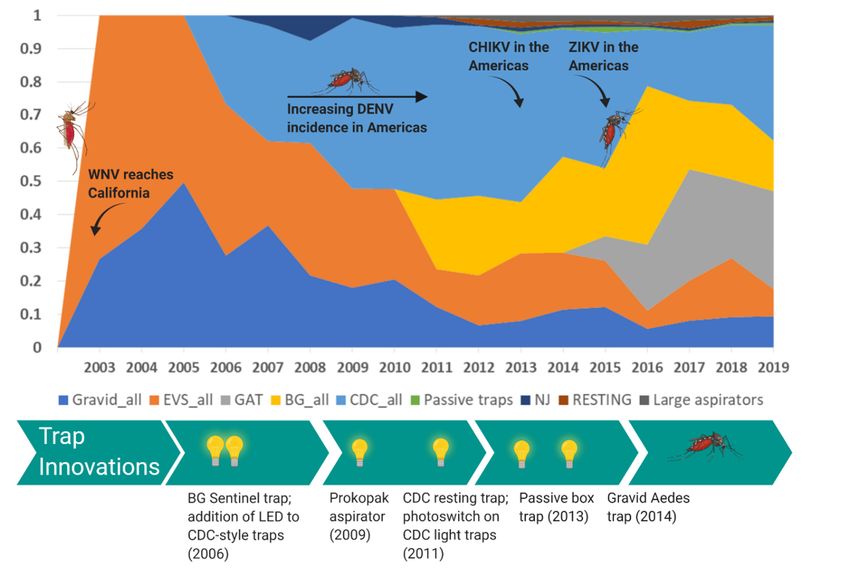
and consumer demand. To visualize trends in trap usage over time, we evaluated BioQuip Products
agencies, and consumer demand. To visualize trends in trap usage over time, we evaluated BioQuip
sales data in each main trap category between 2003 and 2019 (Figure 5). As the United States has
Products sales data in each main trap category between 2003 and 2019 (Figure 5). As the United States
experienced emergences and threats of first Culex and now also Aedes-borne viruses, innovations to
has experienced emergences and threats of first Culex and now also Aedes-borne viruses, innovations
traditional mosquito trapping
to traditional mosquito tools
trapping targeting
tools targetingthese
thesevector groupshave
vector groups havearisen,
arisen, with
with the proportion
the proportion
of sales in different
of sales categories
in different categories fluctuating
fluctuatingover
over time
time inin response
responsetotoarbovirus
arbovirus outbreak
outbreak and and funding
funding
availability (Figure
availability 1). 1).
(Figure The Thediversity
diversityofoftraps
traps sold
sold byby BioQuip
BioQuipProducts
Products also
also increased
increased substantially
substantially
from from
two two categories
categories in 2003
in 2003 to to ninecategories
nine categories by 2014
2014(Figure
(Figure3)3)
asas
new innovations
new camecame
innovations to market.
to market.
Undoubtedly, the surge of Aedes-borne viruses in particular during this time period
Undoubtedly, the surge of Aedes-borne viruses in particular during this time period has influenced thehas influenced
the development
development andofsales
and sales novelof novel
traps traps targeting
targeting Ae. Ae. aegypti
aegypti mosquitoes.
mosquitoes.
4.1. Culex-Borne Virus Surveillance
The CDC light trap has become an industry standard for collection of mosquitoes for the
purposes of arbovirus surveillance. The similar EVS (Encephalitis Vector Survey) trap [39] is also
routinely used for arbovirus surveillance and operates on a similar principle as the CDC light trap
using light and carbon dioxide (CO2) as attractants. Between 2003 and 2010, trap sales wereand ZIKV to the Americas (Figure 3). Similarly, gravid Aedes traps (GAT) [45,46] were introduced
between 2013 and 2014. Conceptually based on traditional gravid traps [47], these traps do not require
electricity to function. GAT sales quickly grew to approximately 30% of the traps sold by BioQuip in
2016 (Figure 5). The InsectaZooka© and the Prokopak aspirator [48] are lightweight, portable field
aspirators
Trop. Med. developed
Infect. Dis. 2020, 5, 96 as an alternative to backpack models. These devices facilitate the collection of
6 of 10
resting and engorged mosquitoes from indoor and outdoor resting sites.
5. Proportion
FigureFigure of traps
5. Proportion sold
of traps perper
sold year bybyBioQuip
year BioQuipProducts. Productnumbers
Products. Product numbers represented
represented
included: Gravid traps (2800, 2800S), BG traps (2880, 2883), NJ light trap (2856), EVS
included: Gravid traps (2800, 2800S), BG traps (2880, 2883), NJ light trap (2856), EVS traps (2801A, traps (2801A,
2780, 2780NS1, 2780NS2), Centers for Disease Control and Prevention (CDC) traps
2780, 2780NS1, 2780NS2), Centers for Disease Control and Prevention (CDC) traps (2848, 2770, (2848, 2770, 2836BQ,
2836BQX), resting
2836BQ, traps (2799),
2836BQX), resting Gravid Aedes
traps (2799), Traps
Gravid (2797),
Aedes passive
Traps (2797),traps (2887,
passive traps2887P), large aspirators
(2887, 2887P), large
aspirators (2888A, 2846). Inset: Proportion of trap types sold per year by BioQuip
(2888A, 2846). Inset: Proportion of trap types sold per year by BioQuip Products. Product numbers Products. Product
numbers
represented represented
included: included:
Gravid traps Gravid traps (2800,
(2800, 2800S), 2800S),
BG traps BG traps
(2880, 2883),(2880, 2883),trap
NJ light NJ light trap
(2856, (2856,
2857, 2858),
EVS traps (2801A, 2780, 2780NS1, 2780NS2), CDC traps (2848, 2770, 2836BQ, 2836BQX), resting traps
(2799), Gravid Aedes Traps (2797), passive traps (2887, 2887P), and large aspirators (2888A, 2846).
4.1. Culex-Borne Virus Surveillance
The CDC light trap has become an industry standard for collection of mosquitoes for the purposes
of arbovirus surveillance. The similar EVS (Encephalitis Vector Survey) trap [39] is also routinely used
for arbovirus surveillance and operates on a similar principle as the CDC light trap using light and
carbon dioxide (CO2 ) as attractants. Between 2003 and 2010, trap sales were dominated by suction
traps using light and CO2 as attractants, and gravid traps, largely for Culex vectors of WNV and SLEV.
Due to the sustained threat of WNV year after year [36], traps targeting Culex vectors are expected to
remain a mainstay in the industry.
Several specific innovations have either improved the functionality of the standard light trap or
targeted different physiological cohorts of mosquitoes. In 2006, BioQuip released the first commercially
available light-emitting-diode (LED) CDC-style light trap with customizable colors (Figure 3). Bayonet
mounted LED chips were also available to replace the white incandescent lights in existing CDC style
light traps. The passive box trap offered an alternative to CDC light traps, by providing a CO2 -baited
trap that was not reliant on a power source and could be used to sample arbovirus vectors in more
remote areas [40]. A collapsible passive trap was also developed to address portability issues [41]. A
photo switch option also added to light traps, allowing researchers the flexibility to set traps when
convenient and conserve battery power. Finally, the CDC resting trap was introduced in 2011 for
the purpose of collecting blood-engorged mosquitoes to determine vertebrate host utilization [42].
Passive and resting traps represent a smaller proportion of sales over the last several years, suggesting
their utility may be serving the research community as opposed to being integrated into large-scale
operational surveillance activities.Trop. Med. Infect. Dis. 2020, 5, 96 7 of 10
4.2. Aedes-Borne Virus Surveillance
Surveillance for viruses transmitted by Ae. aegypti mosquitoes requires very different tools and
strategies than for those used for Culex-borne viruses. These urbanized, day-biting, container-breeding
mosquitoes are generally not attracted to the suction and gravid traps that are so efficient at catching
Culex mosquitoes [43]. The growing need for traps that effectively collected Aedes mosquitoes led to
the innovation of the BG Sentinel Mosquito Trap in 2006 (Biogents AG, Regensburg, Germany) [44],
among others. BG sentinel traps began selling at BioQuip in 2011, and sales comprised approximately
50% of the total traps sold by BioQuip in 2016 following the introduction of CHIKV and ZIKV to the
Americas (Figure 3). Similarly, gravid Aedes traps (GAT) [45,46] were introduced between 2013 and 2014.
Conceptually based on traditional gravid traps [47], these traps do not require electricity to function.
GAT sales quickly grew to approximately 30% of the traps sold by BioQuip in 2016 (Figure 5). The
InsectaZooka© and the Prokopak aspirator [48] are lightweight, portable field aspirators developed
as an alternative to backpack models. These devices facilitate the collection of resting and engorged
mosquitoes from indoor and outdoor resting sites.
5. Conclusions
The emergence of mosquito-borne viruses has occurred repeatedly in recent decades, and studies
predict that these emergences will continue. Much of our response to these events is reactionary,
triggered by the increase in attention, funding, publication, innovation, and preventive measures
for public health. The long-term impact or return on investment of outbreak spending is evidenced
by scientific advancements (publications) and innovation, but we advocate for a more sustainable,
economical, and effective approach by minimizing the oscillations of boom and bust in funding
and capacity for mosquito-borne viruses. Our goal should be to optimize the cost-effectiveness of
budgetary spending by adopting resource allocation for biosecurity threats that maximize benefits
while minimizing the total cost given anticipated expenditures incurred in the event of mosquito-borne
viral outbreaks [49,50].
Author Contributions: Conceptualization, G.L.H., R.C.K., and L.W.C.; data curation, K.F.; writing—original draft
preparation, R.C.K.; writing—review and editing, R.C.K., G.L.H., L.W.C., and K.F.; visualization, R.C.K., G.L.H.,
and L.W.C.; project administration, G.L.H.; funding acquisition, G.L.H. All authors have read and agreed to the
published version of the manuscript.
Funding: This research was funded in part by the Department of Homeland Security (DHS) Science and Technology
Directorate (S&T) under agreement # HSHQDC-17-C-B0003.
Acknowledgments: The viewpoints described herein represent those of the authors and not necessarily their
institutions or funding agency.
Conflicts of Interest: The authors declare no conflict of interest. The funders had no role in the design of the
study; in the collection, analyses, or interpretation of data; in the writing of the manuscript; or in the decision to
publish the results.
References
1. Houlihan, C.F.; Whitworth, J.A. Outbreak science: Recent progress in the detection and response to outbreaks
of infectious diseases. Clin. Med. 2019, 19, 140–144. [CrossRef] [PubMed]
2. Jayabalisingham, B.; Hessen, M.; James, C. Infectious Disease Outbreak Research: Insights and Trends 2020
[Webinar] In Scopus Webinar Series. Available online: https://www.brighttalk.com/webcast/13703/391874.
(accessed on 1 April 2020).
3. Pavlin, J.A.; Mostashari, F.; Kortepeter, M.G.; Hynes, N.A.; Chotani, R.A.; Mikol, Y.B.; Ryan, M.A.K.;
Neville, J.S.; Gantz, D.T.; Writer, J.V.; et al. Innovative Surveillance Methods for Rapid Detection of Disease
Outbreaks and Bioterrorism: Results of an Interagency Workshop on Health Indicator Surveillance. Am. J.
Public Health 2003, 93, 1230–1235. [CrossRef] [PubMed]
4. USAID. Fighting Ebola: A Grand Challenge for Development. Available online: http://www.
ebolagrandchallenge.net (accessed on 7 April 2020).Trop. Med. Infect. Dis. 2020, 5, 96 8 of 10
5. USAID. Combating Zika | Grand Challenge for Development | U.S. Agency for International Development.
Available online: https://www.usaid.gov/grandchallenges/zika (accessed on 25 April 2020).
6. Bashir, N. James Dyson Designed a New Ventilator in 10 days. He’s Making 15,000 for the Pandemic Fight.
Available online: https://www.cnn.com/2020/03/26/tech/dyson-ventilators-coronavirus/index.html (accessed
on 7 April 2020).
7. Bhatt, K.; Pourmand, A.; Sikka, N. Targeted Applications of Unmanned Aerial Vehicles (Drones) in
Telemedicine. Telemed. E-Health 2018, 24, 833–838. [CrossRef] [PubMed]
8. Roblin, S. Will Blood-Bearing Delivery Drones Transform Disaster Relief and Battlefield Medicine?
Available online: https://www.forbes.com/sites/sebastienroblin/2019/10/22/will-blood-bearing-delivery-
drones--transform-disaster-relief-and-battlefield-medicine/ (accessed on 7 April 2020).
9. Shapiro, G. How Innovation Is Helping Mitigate the Coronavirus Threat; STAT: Boston, MA, USA, 2020.
10. Ramírez, A.; Meyer, D.; Ritchie, S. Searching for the proverbial needle in a haystack: Advances in
mosquito-borne arbovirus surveillance. Parasit. Vectors 2018, 11, 1–12. [CrossRef] [PubMed]
11. Cohnstaedt, L.; Ladner, J.; Campbell, L.; Busch, N.; Barrera, R. Determining Mosquito Distribution from Egg
Data: The Role of the Citizen Scientist. Am. Biol. Teach. 2016, 78, 317–322. [CrossRef]
12. Esperança, P.M.; Blagborough, A.M.; Da, D.F.; Dowell, F.E.; Churcher, T.S. Detection of Plasmodium berghei
infected Anopheles stephensi using near-infrared spectroscopy. Parasit. Vectors 2018, 11, 377. [CrossRef]
13. Fernandes, J.N.; Dos Santos, L.M.B.; Chouin-Carneiro, T.; Pavan, M.G.; Garcia, G.A.; David, M.R.; Beier, J.C.;
Dowell, F.E.; Maciel-De-Freitas, R.; Sikulu-Lord, M.T. Rapid, noninvasive detection of Zika virus in mosquitoes
by near-infrared spectroscopy. Sci. Adv. 2018, 4, eaat0496. [CrossRef]
14. Norris, D.; Ray, A.; Guda, T.; Keogh, E.; Singh, S.; Zhu, Y.; Debboun, M.; Reyna, M.; Vigilant, M.; Carpi, G.;
et al. Project premonition project: Field trials of a robotic smart trap for mosquito identification and bionomics.
Am. J. Trop. Med. Hyg. 2017, 97, 610–611.
15. Curren, E.J.; Lehman, J.; Kolsin, J.; Walker, W.L.; Martin, S.W.; Staples, J.E.; Hills, S.L.; Gould, C.V.; Rabe, I.B.;
Fischer, M.; et al. West Nile Virus and Other Nationally Notifiable Arboviral Diseases—United States, 2017.
MMWR Morb. Mortal. Wkly. Rep. 2018, 67, 1137–1142. [CrossRef]
16. Gaensbauer, J.T.; Lindsey, N.P.; Messacar, K.; Staples, J.E.; Fischer, M. Neuroinvasive arboviral disease in the
United States: 2003 to 2012. Pediatrics 2014, 134, e642–e650. [CrossRef]
17. Krow-Lucal, E.R.; Lindsey, N.P.; Fischer, M.; Hills, S.L. Powassan Virus Disease in the United States, 2006–2016.
Vector Borne Zoonotic Dis. 2018, 18, 286–290. [CrossRef] [PubMed]
18. Pastula, D.M.; Hoang Johnson, D.K.; White, J.L.; Dupuis, A.P.; Fischer, M.; Staples, J.E. Jamestown Canyon
Virus Disease in the United States-2000–2013. Am. J. Trop. Med. Hyg. 2015, 93, 384–389. [CrossRef] [PubMed]
19. Lindsey, N.P.; Martin, S.W.; Staples, J.E.; Fischer, M. Notes from the Field: Multistate Outbreak of Eastern
Equine Encephalitis Virus—United States, 2019. MMWR Morb. Mortal. Wkly. Rep. 2020, 69, 50–51. [CrossRef]
[PubMed]
20. Adams, D.; Gallagher, K.; Jajosky, R.A.; Ward, J.; Sharp, P.; Anderson, W.; Abellera, J.; Aranas, A.; Mayes, M.;
Wodajo, M.; et al. Summary of Notifiable Diseases—United States, 2010. Morb. Mortal. Wkly. Rep. 2010, 59,
1–111.
21. Robb, L.L.; Hartman, D.A.; Rice, L.; deMaria, J.; Bergren, N.A.; Borland, E.M.; Kading, R.C. Continued
Evidence of Decline in the Enzootic Activity of Western Equine Encephalitis Virus in Colorado. J. Med.
Entomol. 2019, 56, 584–588. [CrossRef]
22. Fischer, M.; Staples, J.E. Arboviral Diseases Branch, National Center for Emerging and Zoonotic Infectious
Diseases, CDC Notes from the field: Chikungunya virus spreads in the Americas—Caribbean and South
America, 2013–2014. MMWR Morb. Mortal. Wkly. Rep. 2014, 63, 500–501.
23. Zanluca, C.; de Melo, V.C.A.; Mosimann, A.L.P.; Santos, G.I.V.D.; Santos, C.N.D.D.; Luz, K. First report of
autochthonous transmission of Zika virus in Brazil. Mem. Inst. Oswaldo Cruz 2015, 110, 569–572. [CrossRef]
24. Balmaseda, A.; Standish, K.; Mercado, J.C.; Matute, J.C.; Tellez, Y.; Saborío, S.; Hammond, S.N.; Nuñez, A.;
Avilés, W.; Henn, M.R.; et al. Trends in patterns of dengue transmission over 4 years in a pediatric cohort
study in Nicaragua. J. Infect. Dis. 2010, 201, 5–14. [CrossRef]
25. Brathwaite, D.O.; San Martín, J.L.; Montoya, R.H.; del Diego, J.; Zambrano, B.; Dayan, G.H. The history of
dengue outbreaks in the Americas. Am. J. Trop. Med. Hyg. 2012, 87, 584–593. [CrossRef]Trop. Med. Infect. Dis. 2020, 5, 96 9 of 10
26. Salles, T.S.; da Encarnação Sá-Guimarães, T.; de Alvarenga, E.S.L.; Guimarães-Ribeiro, V.; de Meneses, M.D.F.;
de Castro-Salles, P.F.; Dos Santos, C.R.; do Amaral Melo, A.C.; Soares, M.R.; Ferreira, D.F.; et al. History,
epidemiology and diagnostics of dengue in the American and Brazilian contexts: A review. Parasit. Vectors
2018, 11, 264. [CrossRef]
27. PAHO. Number of Reported Cases of Dengue and Dengue Hemorrhagic Fever (DHF), Region of the Americas
(by Country and Subregion) 1980–2018. Available online: https://www.paho.org/data/index.php/en/mnu-
topics/indicadores-dengue-en/dengue-nacional-en/252-dengue-pais-ano-en.html (accessed on 7 April 2020).
28. Kraemer, M.U.G.; Reiner, R.C.; Brady, O.J.; Messina, J.P.; Gilbert, M.; Pigott, D.M.; Yi, D.; Johnson, K.; Earl, L.;
Marczak, L.B.; et al. Past and future spread of the arbovirus vectors Aedes aegypti and Aedes albopictus.
Nat. Microbiol. 2019, 4, 854–863. [CrossRef] [PubMed]
29. Pless, E.; Gloria-Soria, A.; Evans, B.R.; Kramer, V.; Bolling, B.G.; Tabachnick, W.J.; Powell, J.R. Multiple
introductions of the dengue vector, Aedes aegypti, into California. PLoS Negl. Trop. Dis. 2017, 11, e0005718.
[CrossRef] [PubMed]
30. Ryan, S.J.; Carlson, C.J.; Mordecai, E.A.; Johnson, L.R. Global expansion and redistribution of Aedes-borne
virus transmission risk with climate change. PLoS Negl. Trop. Dis. 2019, 13, e0007213. [CrossRef] [PubMed]
31. Castro, L.A.; Fox, S.J.; Chen, X.; Liu, K.; Bellan, S.E.; Dimitrov, N.B.; Galvani, A.P.; Meyers, L.A. Assessing
real-time Zika risk in the United States. BMC Infect. Dis. 2017, 17, 284. [CrossRef] [PubMed]
32. Florida State Health Department. Department of Health Daily Zika Update | Florida Department of Health.
Available online: http://www.floridahealth.gov/newsroom/2017/01/012717-zika-update.html (accessed on 18
April 2020).
33. Kaplan, S. Congress Approves $1.1 Billion in Zika Funding. Available online: https://www.scientificamerican.
com/article/congress-approves-1-1-billion-in-zika-funding/ (accessed on 15 April 2020).
34. MMWR. Assessing Capacity for Surveillance, Prevention, and Control of West Nile Virus Infection—United
States, 1999 and 2004. Available online: https://www.cdc.gov/mmwr/preview/mmwrhtml/mm5506a2.htm
(accessed on 15 April 2020).
35. Hadler, J.; Patel, D.; Bradley, K.; Hughes, J.; Blackmore, C.; Etkind, P.; Kan, L.; Getchell, J.; Blumenstock, J.;
Engel, J. National Capacity for Surveillance, Prevention, and Control of West Nile Virus and Other Arbovirus
Infections—United States, 2004 and 2012. MMWR Morb. Mortal. Wkly. Rep. 2014, 63, 281–284.
36. CDC. Statistics & Maps | West Nile Virus | CDC. Available online: https://www.cdc.gov/westnile/statsmaps/
index.html (accessed on 18 April 2020).
37. CDC. CDC Awards Nearly $184 Million to Continue the Fight against Zika. Available online: https:
//www.cdc.gov/media/releases/2016/p1222-zika-funding.html (accessed on 15 April 2020).
38. CDC. ELC 5-year Focus, Funding, and Impact | DPEI | CDC. Available online: https://www.cdc.gov/ncezid/
dpei/elc/history-of-elc.html (accessed on 25 April 2020).
39. Rohe, D.L.; Fall, R.P. A miniature Battery Powered CO2 Baited Light Trap for Mosquito Borne Encephalitis
Surveillance. Available online: https://eurekamag.com/research/000/583/000583985.php (accessed on 7 March
2019).
40. Ritchie, S.A.; Cortis, G.; Paton, C.; Townsend, M.; Shroyer, D.; Zborowski, P.; Hall-Mendelin, S.; Van Den
Hurk, A.F. A simple non-powered passive trap for the collection of mosquitoes for arbovirus surveillance. J.
Med. Entomol. 2013, 50, 185–194. [CrossRef]
41. Meyer, D.B.; Johnson, B.J.; Fall, K.; Buhagiar, T.S.; Townsend, M.; Ritchie, S.A. Development, Optimization,
and Field Evaluation of the Novel Collapsible Passive Trap for Collection of Mosquitoes. J. Med. Entomol.
2018, 55, 706–710. [CrossRef]
42. Panella, N.A.; Crockett, R.J.K.; Biggerstaff, B.J.; Komar, N. The Centers for Disease Control and Prevention
resting trap: A novel device for collecting resting mosquitoes. J. Am. Mosq. Control Assoc. 2011, 27, 323–325.
[CrossRef]
43. Service, M. Mosquito Ecology: Field Sampling Methods, 2nd ed.; Springer eBook Collection; Springer: Dordrecht,
The Netherland, 1993; ISBN 978-94-015-8113-4.
44. Maciel-de-Freitas, R.; Eiras, A.E.; Lourenço-de-Oliveira, R. Field evaluation of effectiveness of the BG-Sentinel,
a new trap for capturing adult Aedes aegypti (Diptera: Culicidae). Mem. Inst. Oswaldo Cruz 2006, 101,
321–325. [CrossRef]
45. Eiras, A.E.; Buhagiar, T.S.; Ritchie, S.A. Development of the gravid Aedes trap for the capture of adult female
container-exploiting mosquitoes (Diptera: Culicidae). J. Med. Entomol. 2014, 51, 200–209. [CrossRef]Trop. Med. Infect. Dis. 2020, 5, 96 10 of 10
46. Mackay, A.J.; Amador, M.; Barrera, R. An improved autocidal gravid ovitrap for the control and surveillance
of Aedes aegypti. Parasit. Vectors 2013, 6, 225. [CrossRef] [PubMed]
47. Reiter, P. A revised version of the CDC Gravid Mosquito Trap. J. Am. Mosq. Control Assoc. 1987, 3, 325–327.
[PubMed]
48. Vazquez-Prokopec, G.M.; Galvin, W.A.; Kelly, R.; Kitron, U. A new, cost-effective, battery-powered aspirator
for adult mosquito collections. J. Med. Entomol. 2009, 46, 1256–1259. [CrossRef] [PubMed]
49. Kompas, T.; Chu, L.; Pham, V.H.; Spring, D. Budgeting and portfolio allocation for biosecurity
measures—Kompas. Aust. J. Agric. Resour. Econ. 2019, 63, 412–438. [CrossRef]
50. Kompas, T.; Che, T.N.; Ha, P.V.; Chu, L. Cost–Benefit Analysis for Biosecurity Decisions. In Invasive Species:
Risk Assessment and Management; Cambridge University Press: Cambridge, UK, 2017.
© 2020 by the authors. Licensee MDPI, Basel, Switzerland. This article is an open access
article distributed under the terms and conditions of the Creative Commons Attribution
(CC BY) license (http://creativecommons.org/licenses/by/4.0/).You can also read


