Enabling Fibre to the Home and Business - electrorent.com
←
→
Page content transcription
If your browser does not render page correctly, please read the page content below

Enabling Fibre to the
Home and Business

electrorent.com

  1                     electrorent.com

Introduction

This paper looks at full fibre networks – Fibre-to-the-Home,        & Wireless, Talk Talk and Carphone Warehouse, which has
(FTTH) and Fibre-to-the Premises, (FTTP), reviewing how             been reduced through market consolidation to a small number,
broadband services in the UK have evolved to the current            including Vodafone.
point where FTTH/P networks are beginning to be rolled out.
The benefits of full-fibre networks are discussed and the UK        In 2011 Hyperoptic launched the first true fibre-to-the-home
deployment status is covered.                                       (FTTH) service in London, providing speeds of 1 Gbps, in
                                                                    comparison to Virgin Media’s flagship 100 Mbps service.
The imminent surge in FTTH/P installations will fuel a demand       This event marked the start of FTTH services in the UK with
for engineering manpower as well as the necessary tools             BT announcing plans in 2012 for full-fibre services. As with
and equipment. The most commonly used test equipment                broadband back in 2000 however, the roll-out has been slow,
for FTTH/P is reviewed and the benefits of an independent           with many false dawns following ambitious government
supply chain partner, such as Electro Rent and Electro Rent, are    commitments, (subsequently withdrawn), and complaints of
presented.                                                          BT stifling the market. In 2016 Ofcom finally ordered BT to
                                                                    devolve Openreach into a completely separate company and
Broadband, or “always on” services were first introduced to the     at the same time announced a series of measures, (see below),
UK in 2000 and were provided by the cable companies of the day      designed to accelerate the roll-out of full fibre networks.
(NTL, Telewest ) over their co-axial infrastructure and BT, using
ADSL technology over existing copper lines. Download speed          Whilst most high-speed broadband access today is still based
at that time was 512 kbps and broadband roll-out was slow at        on FTTC networks, full-fibre is the next evolution in broadband
first with only 9% of UK homes having a broadband connection        services promising 1Gbps (and higher) upload and download
by the end of 2001, compared with 30% in Germany and 40%            speeds. Roll-out of these services in the UK currently lags
in Sweden. It wasn’t until 2008 that UK broadband penetration       behind that of most of our European neighbours but, driven by
rose significantly with 1.5 million new customers added that        the potential threat to the UK economy caused by the lack of
year and 50% of the population having access by 2009.               a high-speed broadband infrastructure, the government has
                                                                    announced a package of measures designed to encourage the
Arguably the catalyst for this surge in penetration was the         supply side of the market.
introduction in 2008 of fibre-based broadband by Virgin Media,
who had by then consolidated all of the previously independent      A number of operators, led by BT Openreach, Virgin Media and
cable franchise assets into a UK wide network. Using their          Vodafone/City Fibre, have now announced ambitious roll-out
Fibre-to-the Curb (FTTC) based service Virgin Media were            plans for full-fibre networks which will increase the number of
able to offer download speeds of 50 Mbps, around twice that         homes passed from the current level of 1.2 million up to 25
of BT’s highest speed at that time. Ofcom, the UK regulator,        million or more by 2025.
also tried to stimulate broadband growth by first ordering BT
to separate their network’s operation into a separate operating
division, BT Openreach, and then by requiring BT Openreach
to offer unbundled Local Loop access, (LLU). LLU generated a
number of new market entrants, including AOL, Tiscali, Cable

  2                                                                                                              electrorent.com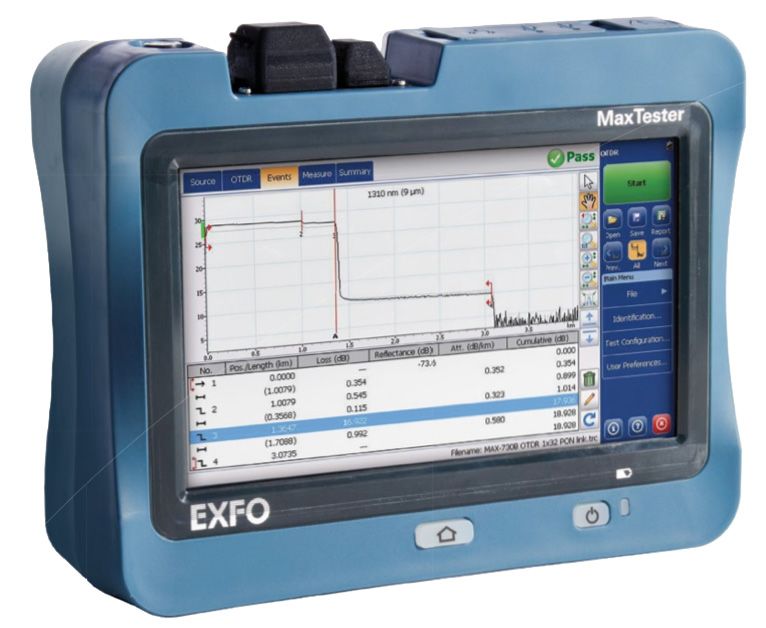
Operators have
announced ambitious
roll-out plans for full-
fibre networks to
increase the number
of homes passed from
1.2 million to 25 million
or more by 2025.

3                           electrorent.com
FTTH

As demand for high speed internet access continues to grow
exponentially, traditional access technologies such as ADSL
                                                                        CO/PO                                              Access Loop
are no longer fit for purpose and are being superseded by faster
access technologies. Over the last 10 years or so the main UK
network operators such as BT Openreach, Virgin Media and
                                                                          Fibre To The Curb (FTTC)
Vodafone have been rolling out super-fast networks, based on
“fibre to the curb” technology, (FTTC), which enable download
speeds up to 100 Mbps. FTTC networks use a mix of fibre and
copper cables, with the operator deploying fibre to the (usually          Fibre To The Distribution point (FTTDp)
green) street cabinet from where the connection to the home
is made over existing copper infrastructure, which may be
decades old. (Although Virgin Media use their existing coaxial
cable infrastructure instead of copper). The copper section
can limit the connection speed due to its age, its length or the    Current FTTC-based high speed broadband networks can offer
number of customers who may be sharing it.                          download speeds of up to 100 Mbps to the end user, whereas
                                                                    with today’s FTTH networks, download and upload speeds of
Fibre to the Home, or Fibre to the Premises (FTTH/P) networks       1 Gbps are achievable. Table 1 puts this into perspective by
eliminate the copper section and deliver fibre directly to          comparing upload and download speeds for popular home
the building, enabling faster download and upload speeds.           applications.
The different FTTC/FTTH/FTTP network configurations are
illustrated in Figure 1, right.                                     Table 1 below: Comparison of Upload and Download Speeds.
                                                                    (Source: Fibre to the Home Council Europe)

 Time taken for:               1 GB photo album                    4.7 GB standard video                         25 GB HD video

 1 Gbps download
                               9 sec                               39 sec                                        3 min 28 sec
 1 Gbps upload

 100 Mbps download
                               1 min 23 sec                        6 min 31 sec                                  34 min 40 sec
 100 Mbps upload

 50 Mbps download              2 min 46 sec                        13 min 2 sec                                  1 hr 9 min
 10 Mbps upload                13 min 52 sec                       1 hr 5 min                                    5 hr 47 min

 8 Mbps download               19 min 0 sec                        1 hr 29 min                                   7 hr 55 min
 1 Mbps upload                 2hr 32 min                          11 hr 54 min                                  -

  4                                                                                                                            electrorent.com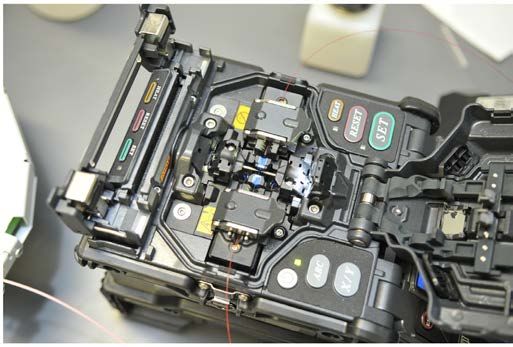
FTTH

There are two main architectures for FTTH networks, as shown                    Standards for PON networks are set by the International
in Figure 2, Point-to-Point and Point-to-MultiPoint, with the                   Telecommunication Union, (ITU), and are constantly evolving;
latter accounting for the largest number of deployments to                      today’s networks adhere to Gigabit PON, (GPON), but further
date. Point-to-MultiPoint or Passive Optical Networks (PON)                     evolutions of PON will enable operators to increase capacity,
save dramatically on fibre costs by aggregating multiple                        end users and bandwidth. Figure 3 shows the current variants
customer lines using a branching tree of fibres and passive                     of PON standards.
splitter/combiner units. The passive optical splitters enable
a single fibre to serve between 32 and 128 premises. The
                                                                                                                                    Recent progress in ITU-T PON standards
fibre section from the splitter is normally terminated on the
                                                                                                                                                                                          G.hsp.x
outside wall of a home, and a short fibre lead run inside to the                                                                                                                         Higher speed
                                                                                  Down-/Up-stream Data Rate (bps)

                                                                                                                                                                                         PON
fibre modem, which then offers an Ethernet connection to a                                                                                                                               Req, PMD, TC

broadband router. On PON networks, downstream or transmit
                                                                                                                                                                NG-PON2
light is transmitted at 1490 nm and upstream or receive at 1310                                                                                                 TWDM 4 /., 10G/10G
                                                                                                                                                                PtT WDM 8 /., 10G/10G
                                                                                                                                                                G.989.x
nm. For “triple play” systems where video is broadcast over the
network, wavelength-division multiplexing (WDM) is used to
                                                                                                                                                                              XGS-PON
add a further wavelength at 1550 nm to carry the video signals.                                                                                     XG-PON
                                                                                                                                                    10G/2.5G
                                                                                                                                                                              10G/10G
                                                                                                                                                                              G.9807.1
                                                                                                                                G-PON               G.987.x
                                                                                                                    B-PON       2.5G/1.25G
                                                                                                                    622M/155M   G.984.x
                                                                                                                    G.983.x

                  Point of Presence        Acces loop        Customer Premise                                            2000                2005        2010          2015                  2020

        PON          IP
         (P2MP)
                                                  Optical
                                                                                Figure 3: PON standards
                                                                                (Source: The International Telecommunications Union)
                            PON OLT               Splitter

                                   Fibre                     Fibre

       Ethernet      IP
         (P2MP)

                           Ethernet OLT
                             (switch)
                                                  Fibre

Figure 2: Different FTTH Architectures
(Source: Fibre to the Home Council Europe)

   5                                                                                                                                                                          electrorent.com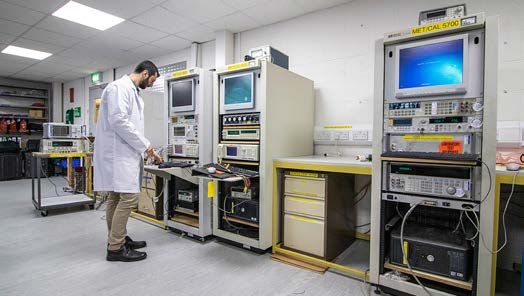
UK Roll-Out

As demand for high speed data services continues to grow            Additionally, the Government’s Future Telecoms Infrastructure
exponentially, governments in the developed world recognise         Review has issued a series of proposals including guaranteed
the importance to their economies of high speed broadband           fibre in new developments and providing operators with
infrastructure. A recent report published by the FTTH Council       a ‘right to entry’ to flats, business parks, office blocks and a
Europe shows that, with full-fibre broadband available to           unified approach to street works to reduce the cost and time of
around 4% of buildings, the UK is ranked 15th in the sample of      digging up roads. The review also proposes opening pipes and
European countries and, in terms of subscriber take-up, is well     sewers owned by power and water companies and allowing
behind countries like Sweden and Latvia, who have more than         unrestricted access to Openreach’s duct and pole network to
40% penetration.                                                    other telecoms companies. Rural areas where the government
                                                                    would need to stimulate investment have also been highlighted.
To address this, the UK government has committed to make
full fibre broadband available to at least 10 million homes         Within this environment a number of UK operators have
and businesses by 2022 and, over the last 18 months has             announced plans to invest in full-fibre networks. The
announced a package of measures to address this, including:         deployment business case for these operators has been
•	£67 million investment in the Nationwide Gigabit Broadband       positively impacted by the above government measures as well
   Voucher Scheme (GBVS) to help homes and small businesses         as the regulatory framework created by Ofcom. Additionally,
   with the cost of connection                                      new developments such as narrow trenching, overhead fibre,
                                                                    flat micro-ducting systems and pre-terminated cables have
•	Establishment of a £400 million Digital Infrastructure
                                                                    helped to further reduce costs.
   Investment Fund
•	Launch of the £200 million Local Full Fibre Networks (LFFN)      Table 2 summarises the plans announced by the main
   programme – providing targeted funding to stimulate              operators which indicates that, if all of the respective roll-outs
   demand and prove commercial models.                              are achieved, the number of households and business premises
• Introduction of 5-Year business rates relief for new fibre.       passed will rise from an estimated 1.2 million (April 2018) to
•	Creation of the Barrier Busting Taskforce who are working        over 25 million by 2025.
   closely with local authorities and suppliers on removing
   obstacles that are preventing the widespread commercial          Table 2: Summary of UK full-fibre roll-out plans
   deployment of full fibre connectivity.

      Operator                       2018 (Q1)                  2020                2022                   2025

      BT Openreach                   650,000                    3 million                                   10 million
      Virgin Media                   50,000                     2 million                                   5 million
      Vodafone/City Fibre            50,000                     1 million                                   5 million
      Gigaclear                      60,000                     150,000
      Hyperoptic                     350,000                                        2 million               5 million
      Other                          40,000
      Total                          1.2 million                                                            25 million +

  6                                                                                                                electrorent.com
UK Roll-Out

The 3 main players in the UK full-fibre market are currently BT
Openreach, Virgin Media and the recently announced joint-
venture between Vodafone and City Fibre. All three of these
operators have announced roll-out plans which concentrate
on major UK cities. BT Openreach have confirmed that
Birmingham, Bristol, Cardiff, Edinburgh, Leeds, Liverpool,
London and Manchester will be the first cities to have full-fibre.
Vodafone/CityFibre have confirmed that their roll-out will begin
in Milton Keynes with a further 11 cities to be targeted, still to
be confirmed but likely to include Edinburgh and Aberdeen.
Virgin Media have stated that, as well as targeting the UK’s
main cities, they will also deploy fibre to over 30 rural areas as
part of its £3bn Project Lightning network.
                                                                     In the UK the tier 1 operators – BT Openreach, Virgin Media,
Other significant players in the UK full-fibre market include        Vodafone/CityFibre, etc have working relationships with
Gigaclear and Hyperoptic. From its initial base in London,           a number of subcontractors, particularly for installation
Hyperoptic claims to have 350,000 premises passed, which             work. These subcontractors include organisations such as
presumable includes a number of large buildings and office           McNicholas, Kelly Communications, John Henry Group, M.J.
blocks in London, and has announced plans to roll out to 28          Quinn and Telent, who in turn will require to supplement their
towns and cities across the UK. Finally, Gigaclear have a            workforces with independent contractors to cope with the peak
strategy of targeting rural areas and have announced short-          workload during these planned roll-outs.
term plans to pass 150,000 premises by 2020.
                                                                     By any measure, the next 5 to 7 years will see a peak in demand
With an additional 24 million premises planned to have full-         for suitably skilled employees as well as for relevant skills
fibre access, the next 7 years will see a significant amount of      training and also the tools which will be required to support
deployment activity, calling for a temporary surge in installation   these installations.
and engineering headcount. BT Openreach have already
announced that they will be recruiting 3500 engineers to
support their plans whilst the other operators will certainly have
similar requirements.

  7                                                                                                               electrorent.com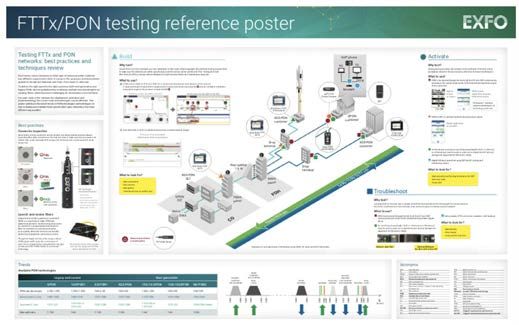
Best Practices and Essential Tools

During network construction and deployment there are two           Qualification of loss, optical return loss (ORL), and
main groups of testing activities which must be carried out:       distance of the link
                                                                   Qualification of the link following installation involves
Testing of connectors and connections
                                                                   measuring the end-to-end loss, made up of the losses from the
Connectors are key components in the network and also sources      connectors on each end, the fibre sections and losses within
of loss, particularly if they become contaminated, causing their   the splitter (connectors/splices and the splitter itself). Testing
loss to exceed budget. Contaminants can arise from a number        must be done in both directions, as the fibres are used bi-
of sources, including dust, oil from hands and mineral oils.       directionally, and using the appropriate wavelengths – 1310 nm
A dust particle on the fibre core surface will block the light,    for upstream digital data and 1490 nm for downstream digital
leading to unacceptable insertion loss and back reflection         data. (For “triple-play” networks where video is broadcast over
(return loss). Dust particles can also cause permanent damage      the network, downstream testing at 1550 nm may also be
to the glass interface, digging into the glass and leaving pits    required.)
that create further back reflection if mated.
                                                                   Two main items of test equipment are used to qualify loss, ORL
It is therefore crucially important to inspect connectors during   and distance, the Optical Time Domain Reflectometer, (ODTR)
installation to ensure their cleanliness. Because of their small   and the Loss Test Set/ORL Meter. Whilst the ODTR can result
size and safety considerations, (e.g. eye protection), proper      in faster testing requiring fewer test points and less man-
inspection requires a microscope specifically designed for         power, the outputs are more difficult to interpret, particularly on
the fibre-optic end face. A video microscope can magnify           complex networks and so skilled test technicians are required.
the connector end face image for viewing on either a laptop        Loss Test Sets/ORL Meters are simpler to use but two test
or portable display depending on the product used. Figure 3        technicians are required for testing using this equipment and
shows the P5000i Fibre Microscope from Viavi which enables         more test points must be accessed.
rapid inspect and certification of fibre end face quality at the
push of a button. The simple “pass/fail” output from the P5000i    The choice of test equipment therefore comes down to finding
does not require highly skilled technicians and the results        a balance between ease of use and cost. The equipment must
can also be delivered direct to Viavi test platforms, laptops or   also be approved for use aligned to the test strategy set by the
mobile devices.                                                    operator.

Figure 4: Viavi P5000i Fibre Microscope
(Source: Viavi Solutions)

   8                                                                                                               electrorent.com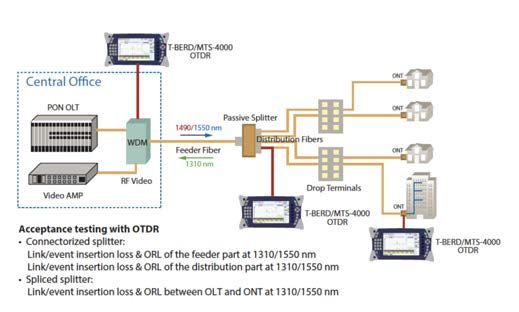
Best Practices and Essential Tools

Testing Using an ODTR                                                 premises but this requires a higher level of expertise and
                                                                      detailed knowledge of the network configuration to interpret
OTDRs work by injecting optical pulses into the fibre under test
                                                                      the trace results.
and measuring the light that is reflected back from various
points along the fibre. The reflected light is used to characterise
the fibre under test with the strength of the return pulses being
integrated against time and plotted as a function of fibre length.

By using an OTDR at various points in the network, as shown
in Figure 5, the feeder and distribution sections of the network
can be tested independently. The OTDR is able to identify and
locate each network component and can measure splice loss,
connector loss and reflectance along with total end-to-end loss
and ORL. The tests must be performed using two wavelengths,
enabling detection of bends on the link which give higher losses
at 1550 nm than at 1310 nm.

                                                                      Figure 6: Sample OTDR Output
                                                                      (Source: Viavi Solutions)

                                                                      In addition to using the OTDR as a qualification tool, it can also
                                                                      be used as a troubleshooting tool to pinpoint issues along the
                                                                      link.

                                                                      ODTR features such as accuracy, resolution, measurement
                                                                      range and measurement speed vary according to their cost
                                                                      and there is a wide range of OTDR models on the market,
                                                                      each addressing different test and measurement needs. The
Figure 5: Testing Options Using OTDR                                  suitability of an OTDR for a specific test scenario depends on
(Source: Viavi Solutions)                                             a number of factors, including type of network, type of fibre
                                                                      – single-mode or multi-mode, maximum test distance and
By changing the OTDR pulse duration, testing from the customer
                                                                      test types. Other factors to consider include size and weight,
end (ONT) can be used to qualify the network, both up to the
                                                                      display size, battery life, storage, connectivity, post-processing
splitter and through the splitter to the OLT. A sample output
                                                                      software and available upgrade modules.
from the latter of these tests is shown in Figure 6. OTDR tests
can also be run from the exchange, out towards the customer

   9                                                                                                                 electrorent.com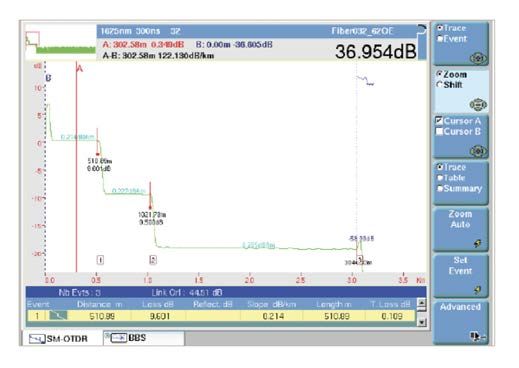
Best Practices and Essential Tools

                                                                    forward process and there are several options available,
                                                                    so it’s important to choose the right one for the task. This is
                                                                    particularly important when working on installations in the field.

                                                                    Physical connectors can be applied in the field, but these lead
                                                                    to reduced signal quality and can be unreliable as water or dirt
                                                                    often eventually make their way into the connection. Factory
                                                                    terminated or pre-connectorized cables are a more reliable
                                                                    alternative, however they must be carefully planned and set
                                                                    up in the factory beforehand, so are not a flexible option in the
                                                                    field. This means more cable is often used in practice than if
                                                                    the cables could be cut to length and joined on site.

                                                                    Fusion splicing provides an effective, flexible option for field-
                                                                    based installations. The process joins fibres by bringing the two
                                                                    ends together and heating them, usually with an electric arc, to
                                                                    make a strong, physical joint. As the fibres are physically joined
Figure 7: The MaxTester 730C PON/Metro OTDR tester from Exfo
                                                                    to form a single fibre, the amount of scattering and reflection at
(Source: EXFO)
                                                                    the joint is very low.

                                                                    There is a range of fusion splicers available to make the
                                                                    splicing process easier, faster and more effective. While these
                                                                    vary in complexity, the splicing process is similar across these
                                                                    devices. First, the fibre is cut, or cleaved, with a specialist tool.
                                                                    Both ends to be joined must be cleaved to ensure they can be
                                                                    joined cleanly. Next, the cores are placed into the fusion splicer
                                                                    using guides to ensure they are in the correct position and then
                                                                    the tool will then automatically align them and apply heat to
                                                                    join the fibres. Some systems can handle cables with multiple
                                                                    cores, joining all the cores in a single step, which can greatly
                                                                    improve efficiency when working on multi-core cables. Finally,
                                                                    the join is protected with an outer sheath to prevent physical
Figure 8: FFTx/PON Testing                                          damage to core from direct contact or stretching of the cable.
(Source: EXFO)                                                      As the fibres are physically joined, the resulting fibre is almost
                                                                    as strong as the initial fibre, but the sheath provides some extra
Joining Fibres with a Fusion Splicer                                protection. When the join has been completed, many modern
Even well-planned fibre installations usually require some          fusion splicers will analyse the joint to ensure it has been well
cables to be joined. Joining fibre optic cables is not a straight   made. If, for any reason, the quality of the joint is below the
                                                                    required standard, it can be cut and re-made.

  10                                                                                                                 electrorent.com
Best Practices and Essential Tools
Visual Fault Locator (VFL)
A VFL is a simple tool, usually handheld, which can be used
by fibre-testing crews to easily troubleshoot issues. The VFL
locates breakpoints, bends or cracks in the fibre by filling the
fibre core with light from its laser. VFLs are available in different
shapes and sizes, with many, such as VisiFault from Fluke. VFL
functionality can also be integrated into many types of OTDR.
The roll-out of FTTH networks planned over the coming 5
years is fuelling a demand for fibre-optic testing equipment
with a number of operators in the process of expanding their
installation capabilities. In this environment, it will be important
Figure 9: Fusion splicer with spliced fibre in place to secure timely and flexible supply of test equipment to
ensure the optimal balance between availability and capital
expenditure.
Testing Using a Loss Test Set/ORL Meter With over 50 years’ experience in test equipment management,
Optical Loss Test Sets, (OLTS), can be used, in pairs, to measure Electro Rent and Electro Rent have built in-depth experience
insertion loss, (IL), and optical return loss (ORL). Once the pair helping users deploy equipment when and where needed in the
of units have been referenced and calibrated they can be used most cost-effective way. With options covering rental, rent-to-
to take end-to-end measurements on any section of installed buy, leasing, finance or purchase, Electro Rent can help their
fibre, as shown in Figure 7. These tests enable verification customers minimise the cost of acquiring the right equipment
of the IL and ORL variables and can identify any transposed at the right time. Electro Rent also offer asset management
fibres. Testing using OLTS is simpler than with OTDRs but two services, enabling their customers to manage their test
test engineers are required, at different physical locations and, equipment throughout the lifecycle, tracking location, ensuring
if any problems are identified, an OTDR of VFL is required for compliance with relevant standards and also identifying when
more detailed analysis. equipment should be disposed of.
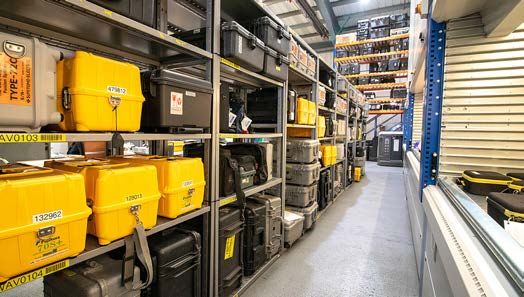
With almost $500 million invested in test equipment, Electro
Rent’s team of over 350 specialists keeps track of developments
in key segments to ensure that the company’s investments are
targeted at the equipment which will meet market needs.
This in-house expertise is supported by the strong relationships
that Electro Rent has built with the major Test Equipment
manufacturers, ensuring that the company has the right
products available in the right quantities.
Figure 10: Testing with ORL Meter
(Source: Fibre to the Home Council Europe)
11 electrorent.comConclusion
Seven years after its initial introduction and after many false This expected surge in installation activity and associated
dawns, full fibre, and (FTTH/P) broadband networks are on headcount will lead to a knock -on rise in demand for the
the verge of taking off in the UK. Recognising the link between equipment and tools required to support fibre installation. Key
strong economic growth and high speed broadband, the UK items of equipment will include OTDR units, Fibre Microscopes,
government has announced a series of measures aimed at Optical Loss Test Sets and Visual Fault Locators (VFL).
stimulating growth of full-fibre networks.
Given this anticipated rise in demand and the need for
At the same time a number of new techniques for deploying flexible and cost effective sourcing it will be important for any
fibre have reduced the required capital investment, further organisations involved in network roll-outs to have a secure
enhancing the business cases of the key market players. supply chain for this type of equipment.
Current plans by the main UK network operators would suggest With over 50 years’ experience in test equipment, along with
a surge in the number of homes passed, from an estimated a wide portfolio of available tools, strong relationships with
1.1 million, as of April 2018, to over 25 million by 2025. BT test equipment manufacturers and flexible financing services,
Openreach, Virgin Media and Vodafone/City Fibre are leading Electro Rent and Electro Rent well placed to be the ideal partner
the charge with Hyperoptic and Gigaclear also announcing for fibre optic test equipment.
ambitious plans. BT Openreach has announced that it will be
taking on an additional 3500 engineers to support its network
roll-out and it is to be expected that the other operators will
follow suit, either through direct hires, contractors or through
the existing network of subcontractor companies.
12 electrorent.comRent Financial
Solutions
...
...
Easy access to our large,
global inventory without the
high cost of ownership Cost effective equipment
solutions tailored to your
needs
Buy New
Asset
...
Over 200 high-quality brands Optimisation
from leading equipment
...
manufacturers
Get the most from your
inventory with our asset
management services
Buy Used
...
Low cost used & Certified
Pre Owned equipment you
can rely on
+44 (0) 20 84 200 200
info@electrorent.com
electrorent.com
13 electrorent.comYou can also read


