Evaluating the Effectiveness of NoteAid in a Community Hospital Setting: Randomized Trial of Electronic Health Record Note Comprehension ...
←
→
Page content transcription
If your browser does not render page correctly, please read the page content below
JOURNAL OF MEDICAL INTERNET RESEARCH                                                                                                          Lalor et al

     Original Paper

     Evaluating the Effectiveness of NoteAid in a Community Hospital
     Setting: Randomized Trial of Electronic Health Record Note
     Comprehension Interventions With Patients

     John P Lalor1, PhD; Wen Hu2, MSc; Matthew Tran2; Hao Wu3, PhD; Kathleen M Mazor4,5, EdD; Hong Yu2,5,6,7, PhD
     1
      Department of Information Technology, Analytics, and Operations, Mendoza College of Business, University of Notre Dame, Notre Dame, IN, United
     States
     2
      Department of Computer Science, University of Massachusetts Lowell, Lowell, MA, United States
     3
      Department of Psychology and Human Development, Peabody College, Vanderbilt University, Nashville, TN, United States
     4
      Meyers Primary Care Institute, University of Massachusetts Medical School/Reliant Medical Group/Fallon Health, Worcester, MA, United States
     5
      Department of Medicine, University of Massachusetts Medical School, Worcester, MA, United States
     6
      College of Information and Computer Sciences, University of Massachusetts Amherst, Amherst, MA, United States
     7
      Center for Healthcare Organization and Implementation Research, Bedford Veterans Affairs Medical Center, Bedford, MA, United States

     Corresponding Author:
     Hong Yu, PhD
     Department of Computer Science
     University of Massachusetts Lowell
     Dandeneau Hall
     1 University Avenue
     Lowell, MA, 01854
     United States
     Phone: 1 978 934 3620
     Email: hong.yu@umassmed.edu

     Abstract
     Background: Interventions to define medical jargon have been shown to improve electronic health record (EHR) note
     comprehension among crowdsourced participants on Amazon Mechanical Turk (AMT). However, AMT participants may not be
     representative of the general population or patients who are most at-risk for low health literacy.
     Objective: In this work, we assessed the efficacy of an intervention (NoteAid) for EHR note comprehension among participants
     in a community hospital setting.
     Methods: Participants were recruited from Lowell General Hospital (LGH), a community hospital in Massachusetts, to take
     the ComprehENotes test, a web-based test of EHR note comprehension. Participants were randomly assigned to control (n=85)
     or intervention (n=89) groups to take the test without or with NoteAid, respectively. For comparison, we used a sample of 200
     participants recruited from AMT to take the ComprehENotes test (100 in the control group and 100 in the intervention group).
     Results: A total of 174 participants were recruited from LGH, and 200 participants were recruited from AMT. Participants in
     both intervention groups (community hospital and AMT) scored significantly higher than participants in the control groups
     (P
JOURNAL OF MEDICAL INTERNET RESEARCH Lalor et al
that NoteAid leads to improved scores on the ComprehENotes
Introduction test for AMT participants [26]. However, overall scores for all
Access to and demand for heath information has led to a greater participants on AMT were relatively high, and the population
focus on patient-centered care [1,2]. Patient-centered care of AMT participants did not include groups typically at higher
“makes the patient and their loved ones an integral part of the risk for low health literacy. Therefore, we compared
care team who collaborate with health care professionals in performance on ComprehENotes between participants recruited
making clinical decisions” [2]. While prior work has shown from a community hospital and participants recruited from AMT
that more active involvement by patients can lead to better to identify differences. The second research question was as
outcomes [3,4] and that patients are more proactive than ever follows: “Are participants at a community hospital different
in seeking out health information [5,6], challenges remain for from AMT participants in terms of their EHR note
patients with low health literacy. The National Assessment of comprehension levels as measured by the ComprehENotes test?”
Adult Literacy estimates that approximately 36% of Americans (RQ2).
have health literacy levels rated as “basic” or “below basic” [7]. As a third goal, we sought to determine whether NoteAid is
This estimate, combined with the finding that physicians often equally effective for improving EHR note comprehension
overestimate the health literacy of their patients [8,9], shows between participants at a community hospital and participants
that there is a gap between patient desire for health information on the AMT platform. The third research question was as
and their ability to understand it. This gap can lead to adverse follows: “Is NoteAid equally effective or differentially effective
effects for patients as well as higher costs for health care centers for community hospital participants as for AMT participants in
[10-16]. Identifying low health literacy individuals and improving EHR note comprehension?” (RQ3).
providing resources to improve their understanding are two key
areas in population health research [17-20]. Finally, we investigated the performance of different
demographic groups on the ComprehENotes test, both with and
One aspect of health literacy that has become more critical in without NoteAid, to see if ComprehENotes scores vary across
recent years is eHealth literacy [21,22]. As increasing numbers subgroups, and whether NoteAid is equally effective across
of patients are able to view their medical records online via these subgroups. The fourth and fifth research questions were
patient portals (eg, the OpenNotes project) [23], there is a as follows: “Is EHR note comprehension consistent across
growing need for eHealth literacy tests and interventions to different demographic groups?” (RQ4) and “Is NoteAid equally
assess and improve eHealth literacy. One tool for assessing effective or differentially effective across different demographic
eHealth literacy is the ComprehENotes test [24], which tests groups?” (RQ5).
the ability of individuals to understand free-text notes in a
sample of electronic health records (EHRs). The Methods
ComprehENotes test consists of multiple-choice questions
generated by groups of physicians and medical researchers, and Overview
validated using item response theory (IRT). Research has shown The work in this study was approved by the Institutional Review
that providing access to NoteAid, an educational intervention Boards (IRBs) at the University of Massachusetts Medical
tool that automatically defines medical terms in lay terms School and LGH. All participants from LGH were shown an
[18,25], improves scores on ComprehENotes items [26]. information sheet describing the study, had the ability to ask
However, participants in these studies were recruited from the questions before participating, and provided verbal informed
Amazon Mechanical Turk (AMT) platform, and thus may not consent before participating. AMT participants provided
represent the typical patient population [27,28]. For example, electronic informed consent before participating.
the AMT participants’ self-reported demographic characteristics
revealed that these participants tended to be younger and better NoteAid
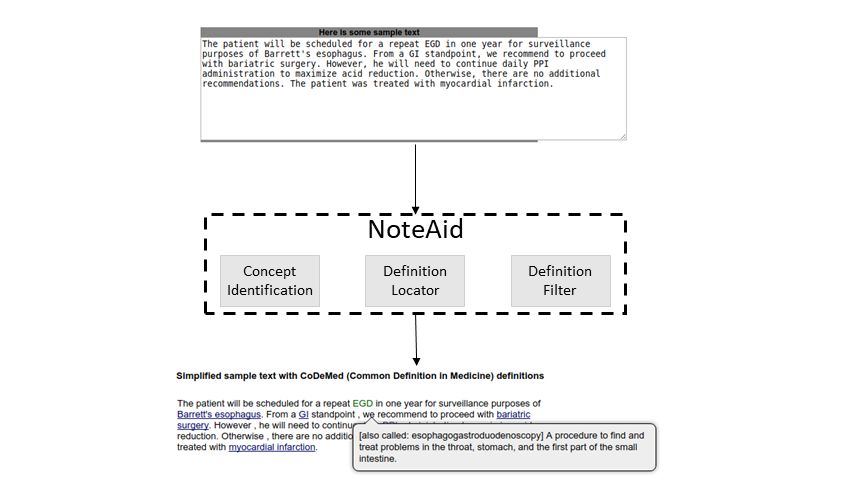
educated than patients at risk of low health literacy [7]. NoteAid is a web-based natural language processing (NLP)
This study examined the impact of NoteAid on participants system for linking medical jargon to lay-language definitions
recruited from Lowell General Hospital (LGH), a community [18,25]. The following two components are central to NoteAid:
hospital in Massachusetts, including diabetes patients and their a repository of lay definitions for medical terms (CoDeMed)
friends and family members. We sought to answer the following and the NLP system for linking medical concepts to these
research question: “Does NoteAid improve EHR note definitions (MedLink). NoteAid is implemented as a web
comprehension for participants recruited from a community application, where users can navigate to the NoteAid website
hospital?” (RQ1). and enter a snippet of text from their own EHR note. NoteAid
will then process the note text and display the note with terms
As a secondary goal, we sought to analyze the differences in defined via tooltip text. Defined terms are underlined, and users
performance between participants at the community hospital can display a term definition by moving the mouse cursor over
and participants on the AMT platform. Prior work has shown the term (Figure 1).
https://www.jmir.org/2021/5/e26354 J Med Internet Res 2021 | vol. 23 | iss. 5 | e26354 | p. 2
(page number not for citation purposes)
XSL• FO
RenderXJOURNAL OF MEDICAL INTERNET RESEARCH Lalor et al
Figure 1. An example of medical terminology definition using NoteAid (image source: [26]).
using the sentence verification technique [29]. Questions were
ComprehENotes administered to a sample of 660 English-speaking adults on
Overview AMT. The psychometric properties of the questions were
subsequently analyzed using the IRT method to confirm the
The ComprehENotes test is the first test to directly assess the
performance of the test questions [24,30].
ability of individuals to comprehend EHR notes. The
ComprehENotes test consists of 14 passages taken from Prior work [24] has shown that ComprehENotes test scores are
deidentified EHR notes. A section of the passage is presented consistent with demographic expectations with regard to health
in boldface, and the test takers are asked to select which of three literacy (ie, less educated respondents score lower than more
options is the closest in meaning to the bold text (Figure 2). As educated respondents). In addition, providing access to lay
detailed by Lalor et al [24], the ComprehENotes test was built definitions for medical terms via NoteAid is associated with
by a group of physicians and nonclinical medical researchers higher scores on ComprehENotes [26].
Figure 2. An example of a ComprehENotes test question with embedded NoteAid definitions as implemented on the web application. In this example,
the definition of “ferritin” (gray box) is useful in understanding that the bold text describes a blood iron test.
https://www.jmir.org/2021/5/e26354 J Med Internet Res 2021 | vol. 23 | iss. 5 | e26354 | p. 3
(page number not for citation purposes)
XSL• FO
RenderXJOURNAL OF MEDICAL INTERNET RESEARCH Lalor et al
ComprehENotes Administration at a Community information regarding time to complete, IRB approval, and
Hospital contact information. The staff also noted that the EHR notes in
the questionnaire were not from their own personal EHR notes.
For the community hospital participants, we implemented the
We informed participants that once the survey started, they
ComprehENotes test as a web application on a tablet, which
could discontinue participation at any time. Each participant
allowed for flexibility in terms of delivery and intervention
was given a US $10 gift certificate. Participants were randomly
modifications. The hardware used was one Microsoft Surface
assigned to the control or treatment group when they accessed
Pro and one Apple iPad Pro 11. When a participant loaded the
the web page to complete the test via a random number generator
application, he or she was randomly assigned to either the
implemented in Python.
control or intervention group. Participants provided demographic
information on the app, and then proceeded to take the test. The AMT Participant Recruitment
test was administered one question at a time. The order of the A total of 200 participants were recruited on AMT (100 in the
questions was randomized. Responses were directly collected control group and 100 in the intervention group). Task visibility
and stored on our server. Other than self-reported demographic on the AMT platform was restricted to AMT workers located
information, no user information was stored on the server. in the United States with prior task approval rates above 95%.
ComprehENotes Administration on AMT The prior task approval rate percentage was used as an indicator
of high-quality prior work, and selecting the United States as
For AMT participants, the ComprehENotes test was
the location was used as a proxy for English proficiency. We
implemented as a web application where quality control
did not collect any medical history information from
questions were additionally included to ensure that participants
participants. While the test administered to the AMT and
completed the task to the best of their ability. Specifically, the
community hospital participants was the same, there were
AMT participants were given three quality control “check
several differences in test administration. First, AMT
questions” interspersed throughout the ComprehENotes test.
participants completed the task remotely, while the community
These questions were included to ensure that the AMT
hospital participants completed the task locally and under the
participants were paying attention as they were completing the
supervision of research staff. Second, community hospital
task [31]. If participants answered a check question incorrectly,
participants were randomly assigned to either the control or
they were presented with a message indicating that they have
intervention group upon enrollment. On AMT, the task was
answered a check question incorrectly, and were given the
implemented as a parallel randomized study. We first collected
option to start the task over or exit the window without
responses from 100 AMT participants for the control task (ie,
completing the task.
no access to NoteAid). We then created and released a second
Integrating NoteAid With ComprehENotes AMT task with the intervention task. This intervention task was
For the intervention groups (community hospital and AMT), not available to AMT participants who participated in the control
each ComprehENotes question was preprocessed by NoteAid task. AMT participants were paid US $3 to complete the task.
and the results were embedded into the test web application In pilot studies, we observed that AMT participants typically
directly. Definitions for terms were added to the web application took between 15 and 20 minutes to complete the task; therefore,
as tooltip text. Terms were underlined to indicate that a a US $3 payment approximated a US $9 to $12 hourly wage.
definition was available, and when a participant hovered over Data Analysis
a defined term, the definition would automatically display
For our specific hypotheses regarding the effects of NoteAid in
(Figure 2). This behavior was also described in the introductory
the two participant recruitment sources (hereafter referred to as
text paragraph of the web application so that the participants
“source”) (RQ1-3), we ran a two-way analysis of variance
were aware of the definitions and knew how to access them.
(ANOVA) to compare the four groups in our data set, using the
Data Collection proportion of the passage-item pairs answered correctly as the
dependent variable and source (community hospital vs AMT)
Community Participant Recruitment and condition (control vs intervention) as two crossed factors.
With IRB approval, participant recruitment was conducted at Specifically, for our third research question, we tested the
LGH. Staff members of the research team (WH and MT) interaction effect between source and condition. An interaction
approached diabetes patients in the waiting room before or after would indicate that NoteAid’s effect on the test score differs
their appointments. Patients and persons accompanying patients between AMT participants and community hospital participants.
in the waiting room were eligible to participate if they were In this case, for our primary research question, we would
over 18 years old, able to speak and read English, and compare community hospital participants in the control and
comfortable using a tablet. In some cases, patients who started intervention groups to determine the effectiveness of NoteAid
the survey could not finish it before their appointments and among community hospital participants, and for our secondary
therefore were not included in the study. Partial responses were research question, we would compare the community hospital
not included in our analyses. participants and AMT participants separately under the
The staff approached a potential participant and asked whether intervention and control conditions. If the interaction is not
he/she would be interested in a short online English survey to significant, the two main effects would be tested to address the
see how he/she understands medical jargon terms in doctors’ primary and secondary research questions.
notes. Then, the staff explained the fact sheet, including
https://www.jmir.org/2021/5/e26354 J Med Internet Res 2021 | vol. 23 | iss. 5 | e26354 | p. 4
(page number not for citation purposes)
XSL• FO
RenderXJOURNAL OF MEDICAL INTERNET RESEARCH Lalor et al
To examine the effects of participant demographic beginning of March 2020. Results from 174 participants were
characteristics and possible variations in the effect of NoteAid included in the final analysis. Of the 174 participants, 141 were
on the test score among different demographic categories patients and 33 were persons accompanying patients. Fourteen
(RQ4-5), we further considered a model with three-way participants were recruited and began the task, but did not
interactions among condition, source, and each of the complete it as they were called to their appointments and
demographic variables (age, race, education, and gender) along therefore were not included in our final analyses.
with relevant lower order effects. The four effects concerning
Characteristics of the AMT participants and the community
the same demographic variables were treated as one family, and
hospital participants are presented in Table 1. The distribution
each of them was tested at level α’=.0125. If an interaction was
of age was very different between the groups. The AMT
detected and simple effects were examined, their tests were
participants were primarily younger, with the majority of AMT
further adjusted with Bonferroni correction. Pairwise
participants under 34 years old, while the majority of community
comparisons among demographic categories were also adjusted
hospital participants were over 55 years old. There were also
with the Bonferroni method.
differences in education. A majority of AMT participants had
Given the discrete nature of the dependent variable and the a bachelor’s or master’s degree, while fewer community hospital
likely ceiling effect due to the overall good performance, we participants had either degree. The majority of community
supplemented the ANOVA with generalized linear models hospital participants had at the most an associate’s degree.
(GLMs), treating the dependent variable as a binomial outcome
Within the community hospital sample, the age, education, race,
with possible overdispersion to account for individual
and gender profiles in the control group were similar to those
differences.
in the intervention group, as expected for a randomized
experiment. Chi-square independence tests for contingency
Results tables were not significant after multiplicity adjustment. The
Demographics same was true for the AMT sample.
We recruited a total of 188 participants at the community
hospital location from the end of December 2019 to the
https://www.jmir.org/2021/5/e26354 J Med Internet Res 2021 | vol. 23 | iss. 5 | e26354 | p. 5
(page number not for citation purposes)
XSL• FO
RenderXJOURNAL OF MEDICAL INTERNET RESEARCH Lalor et al
Table 1. Demographic information of the study participants.
Characteristic AMTa, n (%) Community hospital, n (%) Overall, n (%)
Baseline NoteAid Total (n=200) Baseline NoteAid Total (n=174) Total (N=374)
(n=100) (n=100) (n=85) (n=89)
Age
18-21 2 (2.0%) 1 (1.0%) 3 (1.5%) 2 (2.4%) 3 (3.4%) 5 (2.9%) 8 (2.1%)
21-34 54 (54.0%) 61 (61.0%) 115 (57.5%) 16 (18.8%) 7 (7.9%) 23 (13.2%) 138 (36.9%)
35-44 27 (27.0%) 25 (25.0%) 52 (26.0%) 12 (14.1%) 8 (9.0%) 20 (11.5%) 72 (19.3%)
45-54 11 (11.0%) 9 (9.0%) 20 (10.0%) 12 (14.1%) 18 (20.2%) 30 (17.2%) 50 (13.4%)
55-64 5 (5.0%) 3 (3.0%) 8 (4.0%) 14 (16.5%) 30 (33.7%) 44 (25.3%) 52 (13.9%)
≥65 1 (1.0%) 1 (1.0%) 2 (1.0%) 27 (31.8%) 18 (20.2%) 45 (25.9%) 47 (12.6%)
Unknown 0 (0.0%) 0 (0.0%) 0 (0.0%) 2 (2.4%) 5 (5.6%) 7 (4.0%) 7 (1.9%)
Education
Less than high school 0 (0.0%) 0 (0.0%) 0 (0.0%) 4 (4.7%) 6 (6.7%) 10 (5.7%) 10 (2.7%)
High school 24 (24.0%) 28 (28.0%) 52 (26.0%) 34 (40.0%) 34 (38.2%) 68 (39.1%) 120 (32.1%)
Associate’s degree 17 (17.0%) 22 (22.0%) 39 (19.5%) 15 (17.6%) 14 (15.7%) 29 (16.7%) 68 (18.2%)
Bachelor’s degree 53 (53.0%) 42 (42.0%) 95 (47.5%) 18 (21.2%) 16 (18%) 34 (19.5%) 129 (34.5%)
Master’s degree 6 (6.0%) 8 (8.0%) 14 (7.0%) 12 (14.1%) 14 (15.7%) 26 (14.9%) 40 (10.7%)
Unknown 0 (0.0%) 0 (0.0%) 0 (0.0%) 2 (2.4%) 5 (5.6%) 7 (4.0%) 7 (1.9%)
Race
African American 8 (8.0%) 9 (9.0%) 17 (8.5%) 3 (3.5%) 2 (2.2%) 5 (2.9%) 22 (5.9%)
American Indian 0 (0.0%) 0 (0.0%) 0 (0.0%) 0 (0.0%) 1 (1.1%) 1 (0.6%) 1 (0.3%)
Asian 8 (8.0%) 2 (2.0%) 10 (5.0%) 8 (9.4%) 10 (11.2%) 18 (10.3%) 28 (7.5%)
Hispanic 15 (15.0%) 6 (6.0%) 21 (10.5%) 11 (12.9%) 14 (15.7%) 25 (14.4%) 46 (12.3%)
White 69 (69.0%) 83 (83.0%) 152 (76.0%) 61 (71.8%) 57 (64.0%) 118 (67.8%) 270 (72.2%)
Unknown 0 (0.0%) 0 (0.0%) 0 (0.0%) 2 (2.4%) 5 (5.6%) 7 (4.0%) 7 (1.9%)
Gender
Female 39 (39.0%) 42 (42.0%) 81 (40.5%) 44 (51.8%) 43 (48.3%) 87 (50.0%) 168 (44.9%)
Male 61 (61.0%) 58 (58.0%) 119 (59.5%) 38 (44.7%) 40 (44.9%) 78 (44.8%) 197 (52.7%)
Refrain 0 (0.0%) 0 (0.0%) 0 (0.0%) 1 (1.2%) 1 (1.1%) 2 (1.1%) 2 (0.5%)
Unknown 0 (0.0%) 0 (0.0%) 0 (0.0%) 2 (2.4%) 5 (5.6%) 7 (4.0%) 7 (1.9%)
a
AMT: Amazon Mechanical Turk.
were significant. Participants who took the ComprehENotes
Effect of the Intervention and Participant Recruitment test on AMT on average scored higher than the community
Source hospital participants, and the difference was significant. In
Table 2 shows the descriptive statistics (proportion correct) of addition, participants who had access to NoteAid scored higher
the four groups. Results of the two-way ANOVA are presented than those who did not have access to NoteAid. The difference
in Table 3. Note the CIs in Table 3 are not simultaneous CIs, was again significant.
but one-at-a-time CIs.
Our analysis with GLMs yielded similar results. The main effect
The interaction effect in the ANOVA was not significant of condition was significant (odds ratio [OR] 1.23, 95% CI
(P=.89), suggesting no evidence that the effect of NoteAid was 1.10-1.38; PJOURNAL OF MEDICAL INTERNET RESEARCH Lalor et al
Table 2. Summary statistics for the source by condition contingency table in our analysis of variance.
Source Condition
Controla Interventiona
AMTb 0.756 (0.246), n=100 0.830 (0.201), n=100
Community hospital 0.646 (0.179), n=85 0.727 (0.191), n=89
a
Data are presented as mean proportion correct (SD), sample size.
b
AMT: Amazon Mechanical Turk.
Table 3. Analysis of variance table.
Variable df Sum squares Mean squares F Cohen d (95% CI)
Source 1 1.06 1.06 24.70a 0.52 (0.31 to 0.72)
Condition 1 0.56 0.56 13.06a 0.37 (0.17 to 0.58)
Source × condition 1 0.001 0.001 0.02 0.03 (−0.38 to 0.44)
Residuals 370 15.88 0.04 N/Ab N/A
a
PJOURNAL OF MEDICAL INTERNET RESEARCH Lalor et al
Results from both LGH and AMT confirmed prior research on the patient portal itself, without needing to search for definitions
the effectiveness of NoteAid for improving participant EHR outside of the platform. This aligns with a recent call for
note comprehension [18,26]. We showed that participants with “easy-to-understand information” as part of a proposal for
access to NoteAid achieved higher scores on average than those improving patient portals [41]. Further, NoteAid can be used
without access to NoteAid, consistent with both patient by anyone who assists in the management of a patient’s care.
self-reporting and empirical analyses in prior work [18,26]. If a patient chooses to share an EHR note with a family member,
However, this is the first study to test NoteAid empirically in the family member can use NoteAid to define medical jargon
participants recruited from a community hospital setting. While terms, so that he or she can better understand the note and better
the effectiveness of NoteAid was consistent across our assist with the patient’s care. In this case, even patients who
participant recruitment sources, participants from the two themselves might struggle to use NoteAid or read their notes
sources varied in terms of key characteristics (eg, age and can benefit from the tool.
education).
Limitations
Electronic patient portals are becoming more common, with as There are several limitations in this study. First, local
many as 44 million patients estimated to have access to their recruitment of individuals for our trial had to be halted due to
notes [32]. Notes are being made available as part of the COVID-19. While we were able to gather 174 responses from
OpenNotes initiative [33] and in a variety of other health care local participants and identify a significant effect of using
settings, from the US Department of Veterans Administration NoteAid, a larger sample size would allow for more fine-grained
[34,35] to private organizations [36]. As a result, more analysis of the results, for example, examination of scores
information about personal health is available to patients. In a according to various demographic characteristics. While this
recent study, surveyed patients reported that they understood might be seen as an argument in favor of moving such data
“most or all” of the content in their EHR notes [37]. However, collection efforts to crowdsourcing platforms, our results
all patients surveyed had previously read at least one of their indicate that local population scores are significantly lower than
notes, and most would be considered highly activated patients. the scores of users on crowdsourcing platforms (RQ2). In
Patients who can and do currently view and understand their addition, the demographic differences between individuals in
notes typically have high patient activation [3,38]. They are the local population and individuals on AMT indicate that
active in managing their health care, have lower likelihood of simply relying on AMT is not sufficient. We confirm prior work
outcomes, such as emergency department visits, and are more demonstrating the effect of NoteAid on EHR note
likely to engage in preventive care [3]. Individuals with low comprehension in AMT workers [26], but go one step further
patient activation typically do not understand their role in the to show that the tool is useful for local patients (a considerably
health care process and are less likely to participate in tasks different cohort).
associated with health care management (eg, viewing their
patient portal) [38]. For those surveyed patients with a high A second limitation is with regard to the NoteAid tool. Certain
school diploma or lower, self-reported note understanding was terms or acronyms in EHR notes can have more than one
significantly lower, consistent with our results [37]. In addition, meaning. The task of correctly identifying the appropriate
a common comment from survey respondents was that they had meaning of an ambiguous term is a well-studied problem in
difficulty understanding medical jargon in the note, with natural language processing called word sense disambiguation.
respondents requesting access to jargon definitions. Self-reported While a number of methods have been proposed to handle this
levels of understanding may not reflect actual understanding, problem [42-44], there is active research to improve these
as measured by validated instruments such as ComprehENotes models. A NoteAid system in a production environment would
[39,40]. Our results showed significant improvement in need to be able to disambiguate between possible definitions
comprehension regardless of education level, indicating that so that a patient would receive the definition for the correct term
NoteAid is an effective intervention. in his or her own note [25]. In the case of our study, NoteAid
definitions were manually inspected and added to the
There are two key challenges for ensuring that patients can ComprehENotes test as part of our web application
realize the benefits associated with accessing their own notes implementation. Therefore, we were able to confirm the correct
as follows: (1) defining medical jargon so that patients definitions for the terms in our EHR note snippets before
understand the content of their notes, and (2) motivating low running our tasks.
activation patients to view their notes and take an active role in
managing their health care. The NoteAid tool directly addresses Finally, our local subject group was restricted to diabetes
the first challenge, as demonstrated by this work and prior work. patients and those accompanying them to their appointments.
As more patients have access to their notes, providing access There is a risk that this local setting is too narrow in terms of
to definitions at the same time can reduce issues with patients scope for the results to be more generally applicable. However,
not understanding the content in their newly available notes. It the ComprehENotes test is not a test of diabetes EHR note
may also indirectly address motivation. If low activation patients comprehension. The test includes questions from EHR notes
struggle with medical jargon, having the jargon automatically related to a number of diseases, such as diabetes, cancer, heart
defined can reduce the barrier to entry for their participation in failure, and hypertension, in order to include a wide range of
care. Implementation of NoteAid directly into EHR software, subjects in the assessment [24]. Coupled with the fact that we
for example, via an application programming interface (API), saw similar results in the AMT participants, we believe that the
would allow for patients to have jargon terms defined within
https://www.jmir.org/2021/5/e26354 J Med Internet Res 2021 | vol. 23 | iss. 5 | e26354 | p. 8
(page number not for citation purposes)
XSL• FO
RenderXJOURNAL OF MEDICAL INTERNET RESEARCH Lalor et al
results could be generalized beyond diabetes patients to a wider and may be unnecessary for patients with high education. To
patient cohort. improve comprehension for low health literacy patients, other
mediums (eg, short animations and text definitions) may be
Conclusion and Future Work more effective. Operationally, making NoteAid jargon
The findings reported here provide evidence of the effectiveness definitions available for a patient’s own notes via an API would
of NoteAid for improving EHR note comprehension across two increase the ways in which researchers and EHR vendors can
different participant samples: patients from a community implement jargon definitions so that patients have access to
hospital and participants from a popular online crowdsourcing them.
platform. Despite the demographic and education differences
between the two samples, NoteAid improved scores on the Future work applying the NoteAid tool to other contexts is
ComprehENotes test for both, indicating that it is an effective another interesting direction. While NoteAid has been shown
intervention for improving EHR note comprehension. These to improve patient EHR note comprehension [25], the
results support broader use of ComprehENotes as an EHR note methodology of the tool is generalizable. The concept
comprehension test and NoteAid as an effective tool for identification-definition linking process can be applied to other
improving EHR note understanding. texts where complex jargon is common to improve readability
and understanding. If a lay-language dictionary is built for a
Future work should explore patient personalization in NoteAid. particular domain (eg, legal text), it would be possible to use
Providing lay definitions for all medical jargon in a note may NoteAid to identify and define those complex terms so that
lead to information overload for patients with low education individuals can more easily understand the text.
Acknowledgments
The authors thank the anonymous Amazon Mechanical Turk participants who participated in the Amazon Mechanical Turk tasks
and the subjects who participated in the community hospital tasks. The authors would like to thank Harmon Jordan for his helpful
conversations with regard to this work. This work was supported in part by grant I01HX001457 from the Health Services Research
& Development, US Department of Veterans Affairs and by grant R01LM012817 from the National Institutes of Health (NIH).
The content is solely the responsibility of the authors and does not represent the views of the NIH or the US Government.
Conflicts of Interest
None declared.
Multimedia Appendix 1
CONSORT-eHEALTH checklist (V 1.6.1).
[PDF File (Adobe PDF File), 985 KB-Multimedia Appendix 1]
References
1. Institute of Medicine. Crossing the Quality Chasm: A New Health System for the 21st Century. Washington DC: The
National Academies Press; 2001.
2. Cliff B. The evolution of patient-centered care. J Healthc Manag 2012;57(2):86-88. [Medline: 22530289]
3. Greene J, Hibbard JH. Why does patient activation matter? An examination of the relationships between patient activation
and health-related outcomes. J Gen Intern Med 2012 May;27(5):520-526 [FREE Full text] [doi: 10.1007/s11606-011-1931-2]
[Medline: 22127797]
4. Begum N, Donald M, Ozolins IZ, Dower J. Hospital admissions, emergency department utilisation and patient activation
for self-management among people with diabetes. Diabetes Res Clin Pract 2011 Aug;93(2):260-267. [doi:
10.1016/j.diabres.2011.05.031] [Medline: 21684030]
5. Cline RJ, Haynes KM. Consumer health information seeking on the Internet: the state of the art. Health Educ Res 2001
Dec;16(6):671-692. [doi: 10.1093/her/16.6.671] [Medline: 11780707]
6. Diviani N, van den Putte B, Giani S, van Weert JC. Low health literacy and evaluation of online health information: a
systematic review of the literature. J Med Internet Res 2015 May 07;17(5):e112 [FREE Full text] [doi: 10.2196/jmir.4018]
[Medline: 25953147]
7. The Health Literacy of America’s Adults: Results from the 2003 National Assessment of Adult Literacy. National Center
for Education Statistics. 2006. URL: https://nces.ed.gov/pubsearch/pubsinfo.asp?pubid=2006483# [accessed 2021-05-06]
8. Bass PF, Wilson JF, Griffith CH, Barnett DR. Residents' ability to identify patients with poor literacy skills. Acad Med
2002 Oct;77(10):1039-1041. [doi: 10.1097/00001888-200210000-00021] [Medline: 12377684]
9. Lindau ST, Tomori C, Lyons T, Langseth L, Bennett CL, Garcia P. The association of health literacy with cervical cancer
prevention knowledge and health behaviors in a multiethnic cohort of women. Am J Obstet Gynecol 2002
May;186(5):938-943. [doi: 10.1067/mob.2002.122091] [Medline: 12015518]
https://www.jmir.org/2021/5/e26354 J Med Internet Res 2021 | vol. 23 | iss. 5 | e26354 | p. 9
(page number not for citation purposes)
XSL• FO
RenderXJOURNAL OF MEDICAL INTERNET RESEARCH Lalor et al
10. Vastag B. Low health literacy called a major problem. JAMA 2004 May 12;291(18):2181-2182. [doi:
10.1001/jama.291.18.2181] [Medline: 15138230]
11. Sudore RL, Yaffe K, Satterfield S, Harris TB, Mehta KM, Simonsick EM, et al. Limited literacy and mortality in the elderly:
the health, aging, and body composition study. J Gen Intern Med 2006 Aug;21(8):806-812 [FREE Full text] [doi:
10.1111/j.1525-1497.2006.00539.x] [Medline: 16881938]
12. Schapira MM, Fletcher KE, Hayes A, Eastwood D, Patterson L, Ertl K, et al. The development and validation of the
hypertension evaluation of lifestyle and management knowledge scale. J Clin Hypertens (Greenwich) 2012 Jul;14(7):461-466
[FREE Full text] [doi: 10.1111/j.1751-7176.2012.00619.x] [Medline: 22747619]
13. Chapman K, Abraham C, Jenkins V, Fallowfield L. Lay understanding of terms used in cancer consultations. Psychooncology
2003 Sep;12(6):557-566. [doi: 10.1002/pon.673] [Medline: 12923796]
14. Lerner EB, Jehle DV, Janicke DM, Moscati RM. Medical communication: do our patients understand? Am J Emerg Med
2000 Nov;18(7):764-766. [doi: 10.1053/ajem.2000.18040] [Medline: 11103725]
15. Reading SR, Go AS, Fang MC, Singer DE, Liu IA, Black MH, AnticoagulationRisk Factors in Atrial
Fibrillation–Cardiovascular Research Network (ATRIA‐CVRN) Investigators. Health Literacy and Awareness of Atrial
Fibrillation. J Am Heart Assoc 2017 Apr 11;6(4):1-10 [FREE Full text] [doi: 10.1161/JAHA.116.005128] [Medline:
28400367]
16. Halbach SM, Enders A, Kowalski C, Pförtner TK, Pfaff H, Wesselmann S, et al. Health literacy and fear of cancer progression
in elderly women newly diagnosed with breast cancer--A longitudinal analysis. Patient Educ Couns 2016 May;99(5):855-862.
[doi: 10.1016/j.pec.2015.12.012] [Medline: 26742608]
17. Jeppesen KM, Coyle JD, Miser WF. Screening questions to predict limited health literacy: a cross-sectional study of patients
with diabetes mellitus. Ann Fam Med 2009 Jan 01;7(1):24-31 [FREE Full text] [doi: 10.1370/afm.919] [Medline: 19139446]
18. Polepalli Ramesh B, Houston T, Brandt C, Fang H, Yu H. Improving patients' electronic health record comprehension with
NoteAid. Stud Health Technol Inform 2013;192:714-718. [Medline: 23920650]
19. Ylitalo KR, Meyer MRU, Lanning BA, During C, Laschober R, Griggs JO. Simple screening tools to identify limited health
literacy in a low-income patient population. Medicine (Baltimore) 2018 Mar;97(10):e0110 [FREE Full text] [doi:
10.1097/MD.0000000000010110] [Medline: 29517689]
20. Zheng J. Computational Approaches to Assisting Patients' Medical Comprehension from Electronic Health Records.
University of Massachusetts Amherst. 2020. URL: https://scholarworks.umass.edu/dissertations_2/1972/ [accessed
2021-05-06]
21. Noblin AM, Wan T, Fottler M. The impact of health literacy on a patient's decision to adopt a personal health record.
Perspect Health Inf Manag 2012;9:1-13 [FREE Full text] [Medline: 23209454]
22. Del Giudice P, Bravo G, Poletto M, De Odorico A, Conte A, Brunelli L, et al. Correlation Between eHealth Literacy and
Health Literacy Using the eHealth Literacy Scale and Real-Life Experiences in the Health Sector as a Proxy Measure of
Functional Health Literacy: Cross-Sectional Web-Based Survey. J Med Internet Res 2018 Oct 31;20(10):e281 [FREE Full
text] [doi: 10.2196/jmir.9401] [Medline: 30381283]
23. Walker J, Meltsner M, Delbanco T. US experience with doctors and patients sharing clinical notes. BMJ 2015 Feb
10;350:g7785. [doi: 10.1136/bmj.g7785] [Medline: 25670182]
24. Lalor JP, Wu H, Chen L, Mazor KM, Yu H. ComprehENotes, an Instrument to Assess Patient Reading Comprehension of
Electronic Health Record Notes: Development and Validation. J Med Internet Res 2018 Apr 25;20(4):e139 [FREE Full
text] [doi: 10.2196/jmir.9380] [Medline: 29695372]
25. Chen J, Druhl E, Polepalli Ramesh B, Houston TK, Brandt CA, Zulman DM, et al. A Natural Language Processing System
That Links Medical Terms in Electronic Health Record Notes to Lay Definitions: System Development Using Physician
Reviews. J Med Internet Res 2018 Jan 22;20(1):e26 [FREE Full text] [doi: 10.2196/jmir.8669] [Medline: 29358159]
26. Lalor JP, Woolf B, Yu H. Improving Electronic Health Record Note Comprehension With NoteAid: Randomized Trial of
Electronic Health Record Note Comprehension Interventions With Crowdsourced Workers. J Med Internet Res 2019 Jan
16;21(1):e10793 [FREE Full text] [doi: 10.2196/10793] [Medline: 30664453]
27. Ross J, Irani L, Silberman MS, Zaldivar A, Tomlinson B. Who are the crowdworkers? Shifting demographics in Mechanical
Turk. In: CHI '10 Extended Abstracts on Human Factors in Computing Systems. 2010 Presented at: CHI '10: CHI Conference
on Human Factors in Computing Systems; April 2010; Atlanta, GA, USA p. 2863-2872. [doi: 10.1145/1753846.1753873]
28. Difallah D, Filatova E, Ipeirotis P. Demographics and Dynamics of Mechanical Turk Workers. In: Proceedings of the
Eleventh ACM International Conference on Web Search and Data Mining. 2018 Presented at: Eleventh ACM International
Conference on Web Search and Data Mining; February 2018; Marina Del Rey, CA, USA p. 135-143. [doi:
10.1145/3159652.3159661]
29. Royer JM, Hastings CN, Hook C. A Sentence Verification Technique for Measuring Reading Comprehension. Journal of
Reading Behavior 2016 Sep 11;11(4):355-363. [doi: 10.1080/10862967909547341]
30. Baker FB, Kim SH. Item Response Theory: Parameter Estimation Techniques, Second Edition. Boca Raton, FL: CRC
Press; 2004.
31. Mellis AM, Bickel WK. Mechanical Turk data collection in addiction research: utility, concerns and best practices. Addiction
2020 Oct 24;115(10):1960-1968. [doi: 10.1111/add.15032] [Medline: 32135574]
https://www.jmir.org/2021/5/e26354 J Med Internet Res 2021 | vol. 23 | iss. 5 | e26354 | p. 10
(page number not for citation purposes)
XSL• FO
RenderXJOURNAL OF MEDICAL INTERNET RESEARCH Lalor et al
32. DesRoches CM, Leveille S, Bell SK, Dong ZJ, Elmore JG, Fernandez L, et al. The Views and Experiences of Clinicians
Sharing Medical Record Notes With Patients. JAMA Netw Open 2020 Mar 02;3(3):e201753 [FREE Full text] [doi:
10.1001/jamanetworkopen.2020.1753] [Medline: 32219406]
33. Walker J, Leveille S, Bell S, Chimowitz H, Dong Z, Elmore JG, et al. OpenNotes After 7 Years: Patient Experiences With
Ongoing Access to Their Clinicians’ Outpatient Visit Notes. J Med Internet Res 2019 May 06;21(5):e13876 [FREE Full
text] [doi: 10.2196/13876] [Medline: 31066717]
34. Woods SS, Schwartz E, Tuepker A, Press NA, Nazi KM, Turvey CL, et al. Patient experiences with full electronic access
to health records and clinical notes through the My HealtheVet Personal Health Record Pilot: qualitative study. J Med
Internet Res 2013 Mar 27;15(3):e65 [FREE Full text] [doi: 10.2196/jmir.2356] [Medline: 23535584]
35. Dobscha SK, Denneson LM, Jacobson LE, Williams HB, Cromer R, Woods S. VA mental health clinician experiences and
attitudes toward OpenNotes. Gen Hosp Psychiatry 2016;38:89-93. [doi: 10.1016/j.genhosppsych.2015.08.001] [Medline:
26380876]
36. Huang JS, Yueh R, Ma S, Cruz R, Bauman L, Choi LJ. Adolescents' and Young Adults' Satisfaction with and Understanding
of Medical Notes from a Pediatric Gastroenterology Practice: A Cross-Sectional Cohort Study. J Pediatr 2019
Dec;215:264-266. [doi: 10.1016/j.jpeds.2019.06.052] [Medline: 31377044]
37. Leveille SG, Fitzgerald P, Harcourt K, Dong Z, Bell S, O'Neill S, et al. Patients Evaluate Visit Notes Written by Their
Clinicians: a Mixed Methods Investigation. J Gen Intern Med 2020 Dec 15;35(12):3510-3516. [doi:
10.1007/s11606-020-06014-7] [Medline: 32671721]
38. Hibbard JH. Patient activation and the use of information to support informed health decisions. Patient Educ Couns 2017
Jan;100(1):5-7. [doi: 10.1016/j.pec.2016.07.006] [Medline: 27432014]
39. Prince SA, Adamo KB, Hamel ME, Hardt J, Connor Gorber S, Tremblay M. A comparison of direct versus self-report
measures for assessing physical activity in adults: a systematic review. Int J Behav Nutr Phys Act 2008 Nov 06;5:56 [FREE
Full text] [doi: 10.1186/1479-5868-5-56] [Medline: 18990237]
40. Snibsøer AK, Ciliska D, Yost J, Graverholt B, Nortvedt MW, Riise T, et al. Self-reported and objectively assessed knowledge
of evidence-based practice terminology among healthcare students: A cross-sectional study. PLoS One 2018 Jul
12;13(7):e0200313 [FREE Full text] [doi: 10.1371/journal.pone.0200313] [Medline: 30001380]
41. DesRoches CM, Walker J, Delbanco T. Care Partners and Patient Portals-Faulty Access, Threats to Privacy, and Ample
Opportunity. JAMA Intern Med 2020 Jun 01;180(6):850-851. [doi: 10.1001/jamainternmed.2020.0514] [Medline: 32364559]
42. Savova GK, Coden AR, Sominsky IL, Johnson R, Ogren PV, de Groen PC, et al. Word sense disambiguation across two
domains: biomedical literature and clinical notes. J Biomed Inform 2008 Dec;41(6):1088-1100 [FREE Full text] [doi:
10.1016/j.jbi.2008.02.003] [Medline: 18375190]
43. Stevenson M, Guo Y. Disambiguation of ambiguous biomedical terms using examples generated from the UMLS
Metathesaurus. J Biomed Inform 2010 Oct;43(5):762-773 [FREE Full text] [doi: 10.1016/j.jbi.2010.06.001] [Medline:
20541624]
44. Wu Y, Xu J, Zhang Y, Xu H. Clinical Abbreviation Disambiguation Using Neural Word Embeddings. In: Proceedings of
BioNLP 2015. 2015 Presented at: BioNLP 2015; July 2015; Beijing, China p. 171-176. [doi: 10.18653/v1/w15-3822]
Abbreviations
AMT: Amazon Mechanical Turk
ANOVA: analysis of variance
API: application programming interface
EHR: electronic health record
GLM: generalized linear model
IRB: Institutional Review Board
IRT: item response theory
LGH: Lowell General Hospital
NLP: natural language processing
OR: odds ratio
https://www.jmir.org/2021/5/e26354 J Med Internet Res 2021 | vol. 23 | iss. 5 | e26354 | p. 11
(page number not for citation purposes)
XSL• FO
RenderXJOURNAL OF MEDICAL INTERNET RESEARCH Lalor et al
Edited by G Eysenbach; submitted 09.12.20; peer-reviewed by H Imeri, D Cebo; comments to author 04.01.21; revised version received
07.01.21; accepted 06.04.21; published 13.05.21
Please cite as:
Lalor JP, Hu W, Tran M, Wu H, Mazor KM, Yu H
Evaluating the Effectiveness of NoteAid in a Community Hospital Setting: Randomized Trial of Electronic Health Record Note
Comprehension Interventions With Patients
J Med Internet Res 2021;23(5):e26354
URL: https://www.jmir.org/2021/5/e26354
doi: 10.2196/26354
PMID:
©John P Lalor, Wen Hu, Matthew Tran, Hao Wu, Kathleen M Mazor, Hong Yu. Originally published in the Journal of Medical
Internet Research (https://www.jmir.org), 13.05.2021. This is an open-access article distributed under the terms of the Creative
Commons Attribution License (https://creativecommons.org/licenses/by/4.0/), which permits unrestricted use, distribution, and
reproduction in any medium, provided the original work, first published in the Journal of Medical Internet Research, is properly
cited. The complete bibliographic information, a link to the original publication on https://www.jmir.org/, as well as this copyright
and license information must be included.
https://www.jmir.org/2021/5/e26354 J Med Internet Res 2021 | vol. 23 | iss. 5 | e26354 | p. 12
(page number not for citation purposes)
XSL• FO
RenderXYou can also read


