Evaluation of extruded corn breakfast cereal enriched with whole peach palm - SciELO
←
→
Page content transcription
If your browser does not render page correctly, please read the page content below
a
ISSN 0101-2061 (Print)
ISSN 1678-457X (Online) Food Science and Technology
DDOI: https://doi.org/10.1590/fst.04019
Evaluation of extruded corn breakfast cereal enriched with whole peach palm
(Bactris gasipaes, Kunth) Flour
Ivone Lima SANTOS1, Marcio SCHMIELE2, Jaime Paiva Lopes AGUIAR3, Caroline Joy STEEL4,
Edson Pablo SILVA3, Francisca das Chagas do Amaral SOUZA3*
Abstract
The present study aimed to develop extruded corn breakfast cereal enriched with whole peach palm flour. A 22 central composite
rotatable design was used, and the cereal was processed in a ZKS-30 co-rotational twin-screw extruder (Werner and Pfleiderer),
followed by its physicochemical, technological and microbiological characterization. The technological analysis revealed higher
expansion and lower hardness as well as adequate lightness and water-absorption and water-solubility indices of the breakfast
cereal at low moisture and intermediate peach palm flour contents. Moreover, 3.84% moisture, 0.63% ash, 6.09% protein, 0.39%
lipids, 85.94% carbohydrates, 3.11% fiber and 246 RE of total carotenoids were found in the physicochemical analysis, and the
microbiological parameters were in accordance with the Brazilian legislation (Resolution RDC 12/01). These results show that
extruded corn breakfast cereal partially substituted with peach palm flour is an alternative product with good characteristics
and market potential. The most recommended operational conditions to obtain products with good technological characteristics
were a peach palm flour concentration of 25% and feed moisture of 16.2%.
Keywords: extrusion; new products; peach palm tree; substitution; characteristics.
Practical Application: The processing of an Amazonian fruit was studied to add value to breakfast cereals. The peach palm flour
presented a high content of bioavailable carotenoids, as well as carbohydrates, proteins and lipids, showing with an important
nutritional source.
1. Introduction
The genus Bactris constitutes one of the most diversified market for the fruit is much larger because of the nutritional,
palm groups in the New World, encompassing around 92 species, sensory properties and visual qualities, which can be explored
and its greatest diversity is found in the Amazon Basin, where for creating new products and markets.
at least 30 species are known to occur. The peach palm tree
(Bactris gasipaes, Kunth), from the palm family, is a multi-stem The consumption of breakfast cereals has increased
plant native to the wet tropics of the Amazon. It produces edible considerably in recent years because products that are quickly
fruits, the flavor of which is highly appreciated in the region, and prepared are in demand due to the lack of time characteristic
is definitely integrated into the eating habits of the Amazonian of modern life (Bolanho et al., 2014). These products can be
population (Nazário et al., 2017). The increasing demand of produced through thermoplastic extrusion. According to Fellows
the consumer market for new products stimulates the use of (2006), thermoplastic extrusion is a high-temperature‑short‑time
regional raw materials. (HTST) thermal treatment. The basic principle of this process
is the conversion of a solid material (usually in the form of
The preparation of peach palm flour (PF) is a way to avoid flour) into a fluid melt by applying heat and shear, and the
saturating the raw fruits market and to diversify the demand molten material is extruded through a die (Hirth et al., 2014).
for peach palm (Oliveira & Marinho, 2010). The fruit peel can The incorporation of dehydrated fruits into snacks and breakfast
also be processed to enrich the peach palm flour. In addition to cereals can improve the nutritional quality and attractiveness
avoiding waste, the inclusion of fruit peel increases the amount of these foods. The fruits and extracts are rich in bioactive
of fiber in the product. According to Nair et al. (2010), fibers
components, in addition to providing an acceptable sensory
comprise a group of components that are considered to be
properties quality (Potter et al., 2013).
functional. Moreover, the inclusion of fruit peel increases the
nutritional quality of peach palm by increasing the bioavailable Therefore, the present study aimed to develop extruded
beta-carotene. According to Silva et al. (2017) the potential corn breakfast cereal enriched with whole peach palm flour.
Received 04 Feb., 2019
Accepted 23 July, 2019
1
Programa de Pós-graduação em Ciência dos Alimentos, Universidade Federal do Amazonas – UFAM, Manaus, AM, Brasil
2
Instituto de Ciência e Tecnologia, Universidade Federal do Vale Jequitinhonha e Mucuri – UFVJM, Diamantina, MG, Brasil
3
Coordenação de Sociedade Ambiente e Saúde – COSAS, Laboratório de Fisico-química de Alimentos – LFQA, Instituto Nacional de Pesquisas na Amazônia – INPA, Manaus,
AM, Brasil
4
Departamento de Tecnologia de Alimentos, Escola de Engenharia de Alimentos, Universidade de Campinas – UNICAMP, Campinas, SP, Brasil
*Corresponding author: francisca.souza@inpa.gov.br
458 458/464 Food Sci. Technol, Campinas, 40(2): 458-464, Apr.-June 2020Santos et al.
2. Materials and methods The processing was performed in a co-rotable twin-screw
2.1 Materials extruder, model ZKS-30 (Werner and Pfleiderer, Ramsey,
USA), with screw speed at 180 rpm; feed rate at 11.88 kg.h-1;
The following raw materials were used in this study: corn and a circular die with 2 holes of 2.8 mm of opening. After
flour, provided by Mina Mercantil (Guaíra, SP, Brazil); and extrusion, the extrudates were dried in a 2068 continuous
peach palm flour processed with utilization of the whole fruit. rotary dryer (Inbramaq, Ribeirão Preto, BRA) at 125 °C until
The peach palm flour was obtained by dehydration at 60 °C/48h the moisture content was lower than 7%. They were then
and yours content evaluated in the Laboratory of Physical
packed in laminated flexible packaging and stored at room
Chemistry of Food (LFQA) – INPA, (Manaus, AM, Brazil).
temperature (±25 °C) until analyses for determining the
The chemical composition of commercial corn flour provide
by Mina Mercantil, showed the values respectively of 12.25% optimal point through characterization of the technological
moisture, 6.31% protein, 1.1% fat, 77.18% for carbohydrates, properties.
0.35% ash and 2.74% of fibers.
Technological characterization of the breakfast cereals
2.2 Methods The technological characterization of the breakfast cereals
Processing of the breakfast cereals included the determination of the expansion index (EI),
which is the ratio between the diameter of the extrudates and
The central composite rotatable design (Table 1) was used to the diameter of the die. Diameter measurements were made
analyze the effects of formulation (peach palm flour concentration)
with a Craftsman caliper and the calculations according to
and an important thermoplastic extrusion process parameter in
the methodology proposed by Mercier et al. (1998). Specific
the technological properties of extruded products. Processing was
carried out by setting the temperature within the four extrusion volume (SV) was determined according to Meng et al. (2010),
zones 70 °C, 100 °C, 130 °C and 150 °C for zones 1 through 4, determining volume through the volumetric displacement of
respectively. These variables were kept constant to guarantee the millet seeds. Texture was evaluated using a TA-XT2i – Texture
stability of beta-carotene, according to Cozzolino & Cominetti Analyser (Stable Micro Systems, Haslemere, GRA), measuring
(2013). The effects of the raw material moisture content 15-23% compression force, with a 25-kg load cell, equipped with the
and peach palm flour concentration 0-50% on the expansion Texture Expert® software to analyze the data according to
index (EI), specific volume (SV), compression force, instrumental Chang et al. (2001). A Warner Bratzler (HDP/WBV) probe was
color L*, a* and b* parameters, water-absorption index (WAI) used and the test parameters were: pre-test speed (4.0 mm/s), test
and water-solubility index (WSI) were analyzed. speed (1.0 mm/s), and post-test speed (5.0 mm/s); and distance
The samples were conditioned by adding distilled water with to rupture (1.0 mm). For instrumental color, a Mini Scan XE
a burette and using a planetary mixer, model K45SS (Kitchenaid, 45/0-L spectrophotometer (Hunterlab, Reston, USA) was used.
St. Joseph, USA). To obtain uniform moisture content, the The equipment was calibrated with a white and black plate with
conditioned material was placed in high density metallized illuminant D65 and observer angle at 10°. Water absorption
polyethylene bags and stored for 24h at room temperature index (WAI) and water solubility index (WSI) were determined
before processing. according to Anderson et al. (1969).
Table 1. Technological properties of the extrudates.
X1 X2 Technological properties
Trial Specific
Expansion Compression WSI WAI (g of gel/100g
Cv Rv Cv Rv volume L* a* b*
index force (N) (g.100g-1) of sample)
(mL.g-1)
1 –1 16.2 –1 7.3 4.07 81.00 10.02 62.34 6.70 41.13 5.86 902.08
2 +1 21.8 –1 7.3 3.79 60.00 10.23 61.31 5.81 42.46 30.59 863.36
3 –1 16.2 +1 42.7 3.38 55.67 6.07 57.16 10.34 41.92 12.86 628.78
4 +1 21.8 +1 42.7 2.65 33.67 17.03 52.50 12.49 45.13 7.24 566.60
5 –α 15 0 25 3.47 95.00 6.36 61.73 8.20 39.77 20.56 792.36
6 +α 23 0 25 2.43 48.67 12.38 57.42 9.38 44.57 14.94 728.87
7 0 19 –α 0 3.46 67.00 9.01 60.17 6.21 43.57 35.00 881.30
8 0 19 +α 50 2.60 50.67 9.46 54.73 11.89 43.32 10.31 567.85
9 0 19 0 25 3.68 57.33 10.04 57.27 8.59 40.32 20.78 818.34
10 0 19 0 25 3.69 58.67 9.44 56.24 8.96 44.14 19.00 815.84
11 0 19 0 25 3.65 55.00 11.60 59.10 8.54 43.69 18.76 785.62
12 0 19 0 25 3.69 57.00 10.01 57.79 8.93 41.92 17.59 761.25
X1: feed moisture (%); X2: peach palm flour concentration (%); Cv: coded value; Rv: real value; adial expansion index = Expansion index; (N) newton force; L*: lightness, a* coloration
value; b* coloration value; WAI: water-absorption index and WSI: water-solubility index.
Food Sci. Technol, Campinas, 40(2): 458-464, Apr.-June 2020 459/464 459Cereal enriched with whole peach palm
Chemical characterization of the optimal point and control were analyzed: total and thermotolerant coliforms, Escherichia
sample coli, Bacillus cereus, yeasts and molds.
The optimal point was elaborated in true triplicate. A control
sample (only corn flour) was produced in the same conditions. 2.3 Statistical analysis and choice of the optimal point
The chemical composition (moisture, lipids, ash, protein and The results were evaluated by the Surface Response Methodology
total dietary fiber) of the optimal cereal and control sample was at 10% significance level. The minimum regression coefficient
determined according the AACC methods (American Association (R2) adopted was 0.80 for the ANOVA to ensure the validity of
of Cereal Chemists, 2010). the predictions provided by the mathematical model (in codified
Iron, copper, calcium, magnesium, zinc, manganese, levels) and for the development of the contour plots. The choice
sodium and potassium were determined by atomic absorption of the optimal point was performed according to Derringer &
spectrometry, as defined by the Instituto Adolfo Lutz (2008), Suich (1980), using the desirability function.
where sample digestion was carried out by microwaves in a MARS
– Xpress CEM Corporation, MD – 2591 digester, mineralization 3 Results and discussion
of organic matter with concentrated nitric acid, followed by
The characterization for peach palm flours showing the
cooling and dilution with deionized water. Readings were carried
dates respectively, 4.45% moisture, 4.31% protein, 1.17% fat,
out directly in the diluted solutions in an atomic absorption
spectrophotometer (Spectra AA, model 220 FS, Varian, 2000), 77.18% carbohydrates, 0.35% ash and 13.21% fibers. As results
with specific lamps according to the supplier’s manual. For the of the food production flour, observed a significant content of
control of the analyses, certified reference materials (Peach leaves the food fiber variable, indicating your importance in the food
(NIST – SEM 1547)) were used. formulations. Similar values for food fiber content were found
by Tavares et al. (2016) when studies the stability of gluten
The total carotenoids were determined by extraction with free sweet biscuit elaborated with rice bran, broken rice and
hexane, isopropyl alcohol and distilled water at a ratio of 1:3:1, okara. For the results from the evaluation of the technological
in which the cereal was maintained until separation occurred. properties of the extrudates, including the expansion index,
The extracted orange color was quantified with a spectrophotometer specific volume, compression force, instrumental color, water
at 450 nm, according to the methodology described by AOAC solubility index and water absorption index are presented in
(Association of Official Agricultural Chemists, 2010). Table 1. The contour plots and mathematical models generated
using the Response Surface Methodology can be seen in Figure 1
Water activity and Table 2, respectively.
The water activity (Aw) was performed in each of the trials Regarding the radial expansion index, the extrudates showed
and the optimum point, in triplicates, using the AQUALAB - Dew values between 2.43 and 4.07. By increasing the peach palm flour
Point apparatus, Water Activity Meter 4TEV. and feed moisture of the blend within the studied ranges, the EI
decreased, and the greatest radial expansion was obtained with
Microbiological characterization of the optimal cereal low moisture and low peach palm flour contents in the blend
(Figure 1a). The mathematical model explains 80.51% of the
For the microbiological analyses of the optimal cereal, the experimental values by the ANOVA (Table 2).
samples were analyzed according to the standards for the food
category (extruded breakfast cereals) presented in Resolution Water acts as a plasticizer during the extrusion process,
RDC 12/01 by the National Health Surveillance Agency (Agência lowering the water vapor pressure formed in the extruder
Nacional de Vigilância Sanitária - ANVISA) (Brasil, 2001). barrel, reducing the EI (Oliveira et al., 2015). The influence of
The analytical methodologies adopted followed the Manual of the peach palm flour on the EI can be explained due to its fat
the Methods of Food Microbiological Analysis the methodology and fiber contents (Masuzaki et al., 2015), and also because in
proposed by ICMSF (International Commission on Microbiological the process used to obtain the flour, the fruits were first cooked,
Specifications for Foods, 1983), and the following microorganisms resulting in a pre-gelatinization of the starch. Pre-gelatinized
Table 2. Mathematical models obtained for the technological parameters and validation.
Relative
Predicted Experimental
Dependent variable Mathematical model R2 (%) p-value deviation
value value
(%)
Expansion index 3.68 – 0.31x1 – 0.38x2 – 0.24x12 – 0.20x22 80.51 0.012 3.26 3.42±0.11 4.68
Specific volume (mL.g-1) 56.19 – 13.58x1 – 9.36x2 + 5.70x12 88.80Santos et al.
Figure 1. Contour plots for dependent variables with statistical significance (P ≤ 0.10).
starch reduces mechanical shear in the extrusion process and produced with lower feed moisture resulted in lower hardness
promotes a significant impact on EI. values as a consequence of greater expansion. Even with lower
The specific volume of the extrudates ranged between influence, the use of peach palm flour promoted a texture with
33.67 and 95 mL.g-1 and was highly influenced by the feed lower compression force, probably due to the fragile gas cells
moisture, more than peach palm flour. The mathematical model produced, with weak cell walls. Onwulata et al. (2001), highlight
(Table 1) explains 88.80% of the experimental values. The increase that a reduction of expansion and an increase in hardness are
in EI with greater gas bubbles resulted in a product with higher characteristic of products with added fiber. However, Ferreira et al.
specific volume. (2012) found an opposite effect of fibers on compression force.
Wang et al. (2017), also found that moisture was the most
Regarding compression force, the extrudates had values significant factor affecting the hardness of expanded extruded
between 6.07 and 17.03 N as minimum and maximum values, rice cereals and that an increase in the moisture content resulted
respectively, and the results were explained by 88.13% through in an increase in compression force.
the mathematical model (Table 2). According to Anton & Luciano
(2007), the acceptance of expanded products by the consumer For the coloration results the lightness (L*) of the raw
is highly influenced by the texture of the product. Higher values materials, corn flour exhibited a lighter color with a higher L*
of EI and specific volume usually result in an extrudate with value (87.43) and a greater tendency towards yellowness than
lower compression force. Feed moisture showed a greater effect the peach palm flour, which presented a lower L* value (74.27),
on the texture characteristics (Figure 1c). The extruded cereals with a greater tendency towards an orange color. The use of peach
Food Sci. Technol, Campinas, 40(2): 458-464, Apr.-June 2020 461/464 461Cereal enriched with whole peach palm
palm flour showed a higher effect (Figure 1d). The increase in desirability function, the level of feed moisture was kept in the
L* values as a result of the lower feed moisture can be explained range studied, also as the results for L*, a* and WAI. So, the
by the higher EI, where the greater gas bubbles reduce the optimal point was defined by the use of 25 g.100 g-1 of peach palm
concentration of the raw material pigments. flour and 16.2 g.100 g-1 of feed moisture, which corresponded
to 0 and -1, in coded levels, resulting in a desirability of 0.71, as
The parameter a* was lower with the increase in feed moisture
shown in Table 2. All the mathematical models were validated,
and decrease in the levels of peach palm flour (Figure 1e), and
because the relative deviation was lower than 10%.
ranged between 5.81 and 12.49 (Table 1). The mathematical model
(Table 2) explains 98.00% of the experimental data. The effect The chemical composition of the cereal considered to be the
of the feed moisture could be the same as for L* values, and optimal point (Table 3), the values obtained were similar to those
the influence of peach palm flour can be explained due to the found by Leoro et al. (2009), who developed a breakfast cereal
higher a* value for this kind of flour (11.23) in relation to corn made with passion fruit flour containing 3.74% moisture, 8.91%
flour (7.48). The independent variables did not show significant protein, 0.54% lipids, 1.45% ashes and 85.37% carbohydrates.
influence on b* values.
The values of the cereal considered to be the optimal point
The data obtained for WAI can be explained by 97.04% approached those of the control cereal, with minimal variations.
through the mathematical model (Table 2). It can be observed Only the fiber (0.67%) and moisture (5.74%) contents had
in Figure 1e that the peach palm flour showed a higher influence greater variations in the cereal partially substituted with pupunha
than feed moisture on this parameter. WAI is a result of the flour. Although the moisture content is above that of the cereal
hydrogen bonds formed with the exposure of starch hydroxyl considered as optimal point, this value is still satisfactory because
groups by the extrusion process. With the increase in peach palm the desired moisture value is lower than 7% and was controlled
flour, the starch content was diluted in the sample, resulting by drying the cereal. The addition of whole pupunha flour to
in lower WAI levels. The increase in feed moisture results in the cereal led to the expected results in the incorporation of
a greater plasticizing effect in the extruder barrel, resulting in fiber (3.11%), which can be observed in the comparison with
lower dextrinization and lower hydroxyl groups exposure. the control (0.67%).
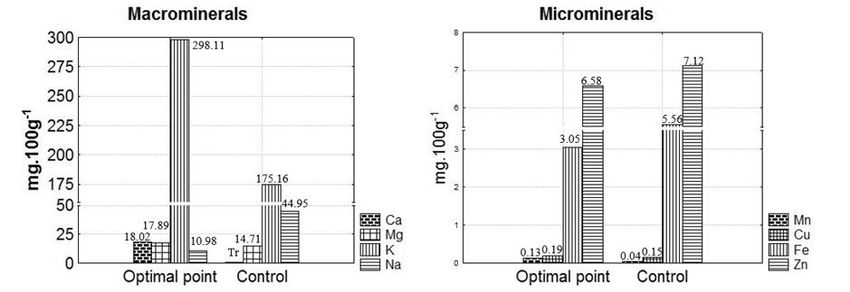
The optimal point was chosen in order to use at least 25 g.100 g-1 The minerals in the optimal point and control cereals
of peach palm flour, obtaining the maximum expansion index are presented in Figure 2. This information indicates that the
and specific volume and the minimum compression force. For the amounts of macro- and micro minerals in the cereal considered
Table 3. Proximate composition of the optimal point breakfast cereal enriched with whole peach palm (Bactris gasipaes, Kunth) flour compared
to the control and to a commercial product.
Component Optimal point Control Commercial
Moisture (%) 3.84b ± 0.54 5.74a ± 0.45 --
Ash (%) 0.63a ± 0.02 0.42a ± 0.04 --
Proteins (%) 6.09a ± 0.73 6.71a ± 0.81 1.2b ± 0.11
Lipids (%) 0.39a ± 0.02 0.08b ± 0.01 --
Digestible carbohydrates (%) 85.94b ± 2.21 86.38a ± 2.23 26c ± 1.23
Total dietary fiber (%) 3.11a ± 0.54 0.67b ± 0.01 0
Total carotenoids 246a ± 3.25 RE 16b ± 3.36 RE 144b ± 2.20 RE
Optimal point: 25% pupunha flour, 75% corn flour, 16.2% feed moisture; Control: 100% corn flour, 16.2% feed moisture; RE: Retinol equivalents; Means followed by the same letter
in the line does not differ (pSantos et al.
as the optimal point were higher than those in the control cereal. 4 Conclusions
However, the value for the Na macromineral remained lower
The most recommended operational conditions to obtain
than in the control, which is a desirable result considering that a
products with good technological characteristics were a peach palm
high Na content in industrialized products is harmful to health.
flour concentration of 25% and feed moisture of 16.2%. The results
The micromineral Fe also exhibited lower but similar demonstrated that these snacks have desirable characteristics
values to those of the control, a result that can be explained for consumers and a potential for future commercialization.
by the enrichment of corn flour with iron, in accordance with
resolution RDC 344/02 (Brasil, 2002). Nevertheless, in the cereal Acknowledgements
considered as the optimal oint, the mineral K was present at a
significant amount (298.11 mg.100 g-1 when compared to the The authors thank the CAPES and Amazon Research
remaining minerals). Foundation (FAPEAM – Fundação de Amparo à Pesquisa do
Estado do Amazonas) for financial support, Process 062.01725/2014
The caloric value of a 30-g portion of the pupunha-enriched – PAPAC and 062.00682/2015 Universal.
cereal considered as the optimal point is 111.52 kcal, calculated
from the proximate composition (Table 3). This value is similar
to the caloric value of breakfast cereals available in the market, References
which varies from 108.8 to 111.34 kcal.30 g-1. The macronutrients American Association of Cereal Chemists – AACC. (2010). Approved
of the cereal considered as the optimal point also presented values Methods of Analysis (11th ed.). St. Paul: AACC International.
similar to the commercial breakfast cereals, with carbohydrate Anderson, R., Conway, H., Pfeifer, V., & Griffin, E. L. (1969). Gelatinization
values ranging from 23 to 26 g, protein values from 1.2 to 2.16 g of corn grits by roll-and extrusion-cooking. Cereal Science Today,
and lipids from 0 to 1.4 g (for the 30-g portion). However, the 14(1), 1-4.
advantage of the cereal containing pupunha flour is in relation Anton, A. A., & Luciano, F. B. (2007). Instrumental texture evaluation
to the mineral K, which was present at a satisfactorily high value, of extruded snacks foods: a review. Food Science and Technology
and sodium, which was present in a reduced amount compared (Campinas), 5(4), 245-251.
to industrialized products, in addition to the benefits related to Association of Official Agricultural Chemists – AOAC. (2010). Official
the presence of fibers and carotenoids. Methods of the Association of the Agricultural Chemists. Washington:
The nutritional information revealed lower levels of minerals AOAC.
in the cereal considered as the optimal point compared to the Bolanho, B. C., Danesi, E. D. G., & Beleia, A. P. (2014). Characterization
commercial breakfast cereal brands, for which sodium ranged from of flours made from peach palm (Bactris gasipaes Kunth) by-
111mg to 196.5mg, iron ranged from 0.93 to 4.2mg, zinc ranged products s a new food ingrediente. Journal of Food and Nutrition
Research, 53(1), 51-59.
from 1.3 to 1.7 mg, and calcium ranged from 42.9 to 209 mg for
the 30-g portion. All of these minerals were present in higher Brasil. Agência Nacional Vigilância Sanitária – ANVISA. (2001).
amounts compared to the optimal point cereal that was developed. Aprova o regulamento técnico sobre padrões microbiológicos para
alimentos (Resolução RDC nº 12, de 02 de Janeiro de 2001). Diário
The higher calcium and vitamin A (RE) values in commercial
Oficial [da] República Federativa do Brasil. Retrieved from http://
cereals can be explained by the enrichment of these products
portal.anvisa.gov.br/wps/wcm/connect/a47bab8047458b909541d
with these vitamins and minerals. However, the lower Na value 53fbc4c6735/RDC_12_2001.pdf?MOD=AJPERES
(3.26 mg.30 g-1 for the optimal point cereal is a desirable result
Brasil. Agência Nacional Vigilância Sanitária – ANVISA. (2002, December
because the excess of sodium in industrialized foods can be
18). Resolução - RDC nº 344, de 13 de dezembro de 2002. Diário
harmful to health. Nevertheless, unlike other minerals, K was Oficial [da] República Federativa do Brasil.
present at higher levels in the cereal considered as the optimal
Chang, Y. K., Hashimoto, J. M., Acioli-Moura, R., Martínez-Flores, H.
point, with a significant difference from brand D 24.9%, and
E., & Martínez-Bustos, F. (2001). Influence of extrusion condition
therefore, the optimal point cereal can complement the daily on cassava starch and soybean protein concentrate blends. Acta
requirements for this mineral. The total carotenoid content Alimentaria, 30(2), 189-203.
was lower than the amount in brand A (144 RE), which can be
Cozzolino, S. M. F., & Cominetti, C. (2013). Bases bioquímicas e
explained by the instability of carotenoids to oxygen and light, fisiológicas da nutrição: nas diferentes fases da vida, na saúde e na
both of which affected the processing of the pupunha flour. doença barueri. São Paulo: Manole.
The results of the microbiological analyses indicated that Derringer, G. C., & Suich, R. (1980). Simultaneous optimization of
neither the cereal considered as the optimal point nor the several response variables. Journal of Quality Technology, 12(4),
control cereal presented contaminating microorganisms above 214-219. http://dx.doi.org/10.1080/00224065.1980.11980968.
the allowed limit for total and thermotolerant coliform levels Fellows, P. J. (2006). Tecnologia do processamento de alimentos: princípios
(0.0 NMP.g-1); both were negative for Escherichia coli and Bacillus e prática (2nd ed.). Porto Alegre: Artmed.
cereus, free of molds and yeast and negative for Salmonella sp, Ferreira, R. E., Chang, Y. K., & Steel, C. J. (2012). Influence of wheat
thus meeting the standards of the National Health Surveillance bran addition and of thermoplastic extrusion process parameters
Agency (Brasil, 2001). The negative result for microbial growth on physical properties of corn-based expanded extruded snacks.
can be explained by the low water activity in the optimal point Alimentos e Nutrição Araraquara, 22(4), 507-520.
(aw = 0.2292) and control (aw = 0.2464) cereals, as well as the Hirth, M., Leiter, A., Beck, S. M., & Schuchmann, H. P. (2014). Effect of
high temperatures applied during the process. extrusion cooking process parameters on the retention of bilberry
Food Sci. Technol, Campinas, 40(2): 458-464, Apr.-June 2020 463/464 463Cereal enriched with whole peach palm anthocyanins in starch based food. Journal of Food Engineering, Oliveira, A. M. & Marinho, H. A. (2010). Desenvolvimento de panetone 125, 139-146. http://dx.doi.org/10.1016/j.jfoodeng.2013.10.034. à Base de Farinha de pupunha (Bactris gasipaes Kunth). Revista de Instituto Adolfo Lutz – IAL. (2008). Normas analíticas do Instituto Adolf Alimentos e Nutição, 21(4), 595-605. Lutz: Métodos físicos e químicos para análise de alimentos (4th ed.). Oliveira, L. C., Schmiele, M., & Steel, C. J. (2015). Development of São Paulo: Métodos. whole grain wheat flour extruded cereal and process impacts on International Commission on Microbiological Specifications for Foods color, expansion, and dry and bowl-life texture. Lebensmittel- – ICMSF. (1983). Microrganisms in food (2nd ed., 436 p.). Toronto: Wissenschaft + Technologie, 75, 261-270. http://dx.doi.org/10.1016/j. University of Toronto. lwt.2016.08.064. Leoro, M. G. V., Chang, Y. K., & Steel, C. J. (2009). Efeito do teor de maracujá Onwulata, C. I., Konstance, R. P., Smith, P. W., & Holsinger, V. H. (2001). e da umidade e temperatura de extrusão no desenvolvimento de cereal Coextrusion of dietary fiber and milk proteins in expanded corn matinal funcional orgânico. Brazilian Journal of Food Technology, products. Lebensmittel Wissenschaft und Technologie (Zurich), 34(7), 12(2), 145-154. http://dx.doi.org/10.4260/BJFT2009800900007. 424-429. http://dx.doi.org/10.1006/fstl.2000.0742. Masuzaki, G., Schmiele, M., & Chang, Y. K. (2015). Defatted chia Potter, R., Stojceska, V., & Plunkett, A. (2013). The use of fruit powders flour as a fiber source in snacks: composition and technological in extruded snacks suitable for children’s diets. Lebensmittel- characteristics. In Proceedings of tye 6th International Dietary Fibre Wissenschaft + Technologie, 51(2), 537-544. http://dx.doi.org/10.1016/j. Conference 2015. USA: Nutrition Science Corner. lwt.2012.11.015. Meng, X., Threinen, D., Hansen, M., & Driedger, D. (2010). Effects of Silva, E. P., Abreu, W. C., Gonçalves, O. A., Damiani, C., & Vilas Boas, E. extrusion conditions on system parameters and physical properties V. (2017). Characterization of chemical and mineral composition of of a chickpea flour-based snack. Food Research International, 43(2), marolo (Annona crassiflora Mart) during physiological development. 650-658. http://dx.doi.org/10.1016/j.foodres.2009.07.016. Food Science and Technology (Campinas), 37(1), 13-18. http://dx.doi. Mercier, C., Linko, P., & Harper, J. (1998). Extrusion cooking (2nd ed.). org/10.1590/1678-457x.0107. St. Paul: American Association of Cereal Chemists. Tavares, B. O., Silva, E. P., Silva, V. S. N., Soares, M. S. Jr, Ida, E. I., & Nair, K., Kharb, S., & Thompkinson, D. K. (2010). Inulin dietary fiber with Damiani, C. (2016). Stability of gluten free sweet biscuit elaborated functional and health attributes - a review. Food Reviews International, with rice bran, broken rice and okara. Food Science and Technology, 26(2), 189-203. http://dx.doi.org/10.1080/87559121003590664. 36(2), 296-303. http://dx.doi.org/10.1590/1678-457X.0083. Nazário, P., Ferreira, S. A., & Borges, E. E. L. (2017). Embryonic Wang, P., Fu, Y., Wang, L., Saleh, A. S., Cao, H., & Xiao, Z. (2017). Effect dormancy in seeds of Bactris gasipaes Kunth (peach-palm). Journal of enrichment with stabilized rice bran and extrusion process on of Seed Science, 39(2), 106-113. http://dx.doi.org/10.1590/2317- gelatinization and retrogradation properties of rice starch. Starch 1545v39n2163507. Staerke, 69(7-8), 1600201. http://dx.doi.org/10.1002/star.201600201. 464 464/464 Food Sci. Technol, Campinas, 40(2): 458-464, Apr.-June 2020
You can also read


