Experimental Particle Physics AG Prof. K. Jakobs - and Emmy-Nother-Group Dr. S. Argyropoulos - Uni Freiburg
←
→
Page content transcription
If your browser does not render page correctly, please read the page content below
Experimental Particle Physics
                AG Prof. K. Jakobs
                           and
            Emmy-Nother-Group Dr. S. Argyropoulos

AG Jakobs                    11 March 2021          1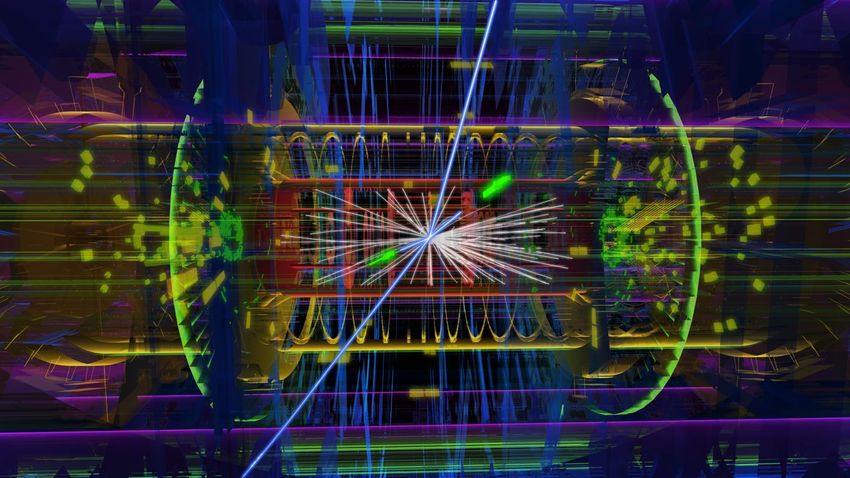
Particle Physics at the Large Hadron Collider (LHC)
            with the ATLAS experiment

LHC:   - the largest and most powerful particle accelerator ever built:
       - proton-proton-collisions at a centre-of-mass energy of 13 TeV
        Goal: Answer some of the most important questions of particle physics
              (the origin of mass, existence of Dark Matter, ....)
              Discovery (and subsequent measurements) of a Higgs boson

                                        N = L x σ (N: Event rate, L: Luminosity, σ: Cross section)

                                         Excellent Data Taking in Runs 1 and 2 (until 2018):
                                         ~120 million top-antitop-pairs produced
                                         ~ 8 million Higgs bosons produced

                                         à Excellent datasets for lots of interesting studies

                                        Bright future of the LHC:
                                        - Run 3 to start in 2022
                                        - Further upgrade of the LHC and the experiments for the
                                          High-Luminosity-LHC (start planned in 2027)
                                        à A lot more data still to come!

 AG Jakobs                           11 March 2021                                               2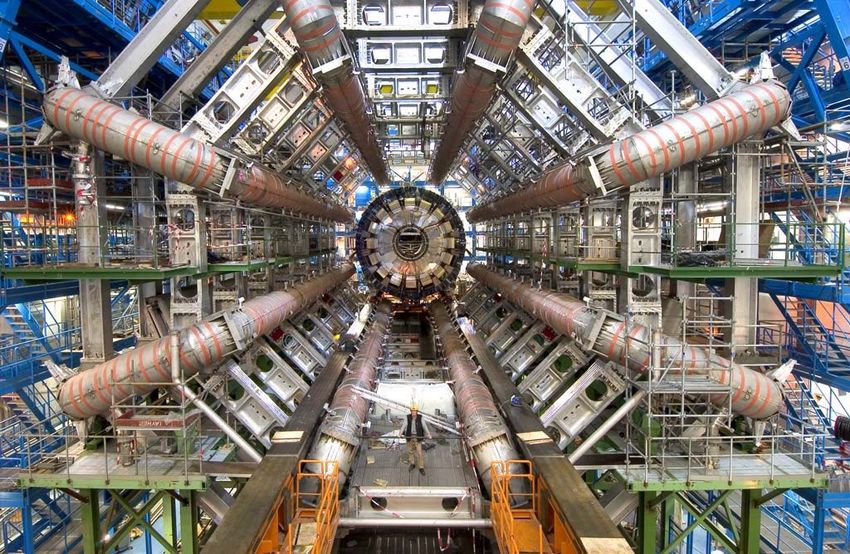
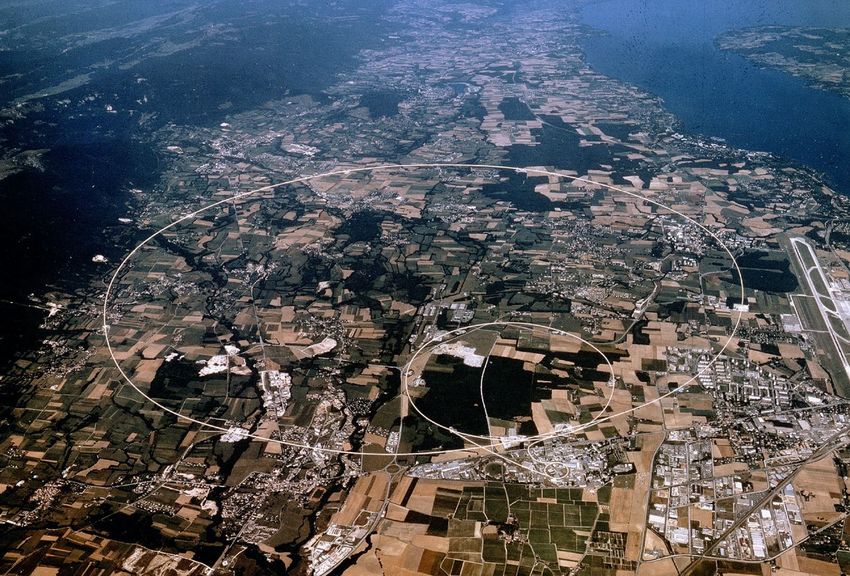
The Large Hadron Collider: LHC
                      Proton-Proton Accelerator
                      Circumference: 27 km
                      Beam Energy: 6.5 TeV
                      à Centre-of-Mass energy √s = 13TeV
                         (maybe increased to 14 TeV in the future)

                                   Atlas
                                              protons
            protons

AG Jakobs        11 March 2021                                       3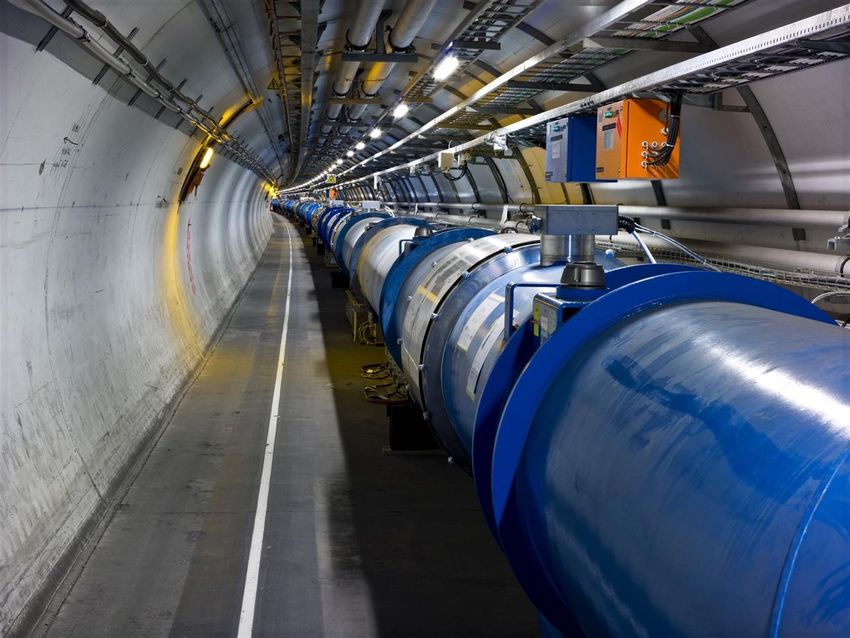
Dipole Magnets in the LHC Tunnel

AG Jakobs          11 March 2021   4
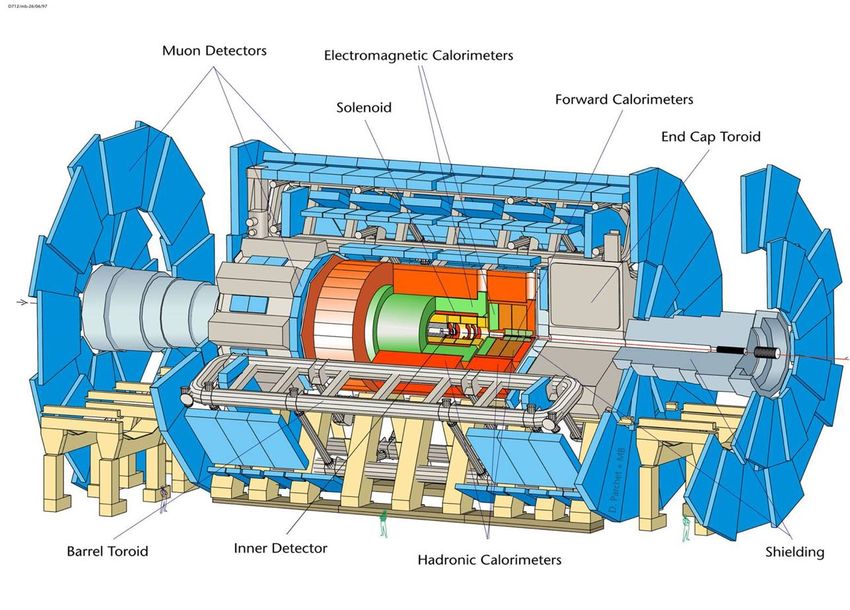
The ATLAS Experiment

                            Diameter 25 m
                            Length 46 m
                            Weight 7000 t
                            120 million
                                readout channels

AG Jakobs   11 March 2021                 5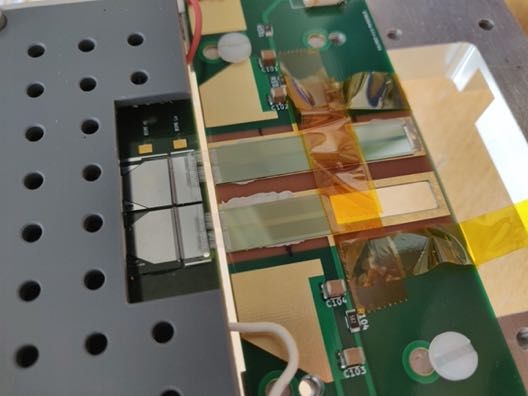
The ATLAS Experiment

AG Jakobs   11 March 2021   6
Research Activities
1) Analyses of data taken by ATLAS in the
   area of
                                                       2) Detector developments in the area
 i) Physics of the Higgs boson                            of silicon detectors

 ii) Searches for new physics beyond the                 i) Production of a new detector for the
     Standard Model, especially                             High-Luminosity phase of the LHC
     Supersymmetry and Dark Matter
                                                         ii) Research and Development for
                                                             radiation hard detectors

 Only a brief overview here, more details in the discussions in the ZOOM rooms and material provided

  AG Jakobs                              11 March 2021                                          7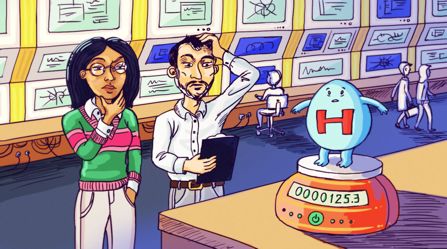
Physics Analyses
1) Analyses of data taken by ATLAS
                             Brout-Englert-Higgs mechanism to explain the masses of
                             fundamental force carrier particles (W, Z bosons;
                             later expanded for leptons and quarks via Yukawa couplings)

                             à Existence of the Higgs boson
                               (discovered by the ATLAS and CMS experiments in 2012)

                             Is it THE Higgs boson as predicted in the SM?

                             à Determine the properties of the Higgs boson as precisely as
                               possible

   The Standard Model (SM)   The mass of the Higgs boson
      of Particle Physics    is the only unknown parameter
                             à once it is known, everything
                                else can be computed,
                                e.g. production and decay properties,
                                coupling strengths to other particles

   AG Jakobs                           11 March 2021                                         8
Physics Analyses
Investigation of the decays of the Higgs boson into

 - a pair of b quarks
                                                          - a pair of W bosons

 - a pair of t leptons

    AG Jakobs                             11 March 2021                          9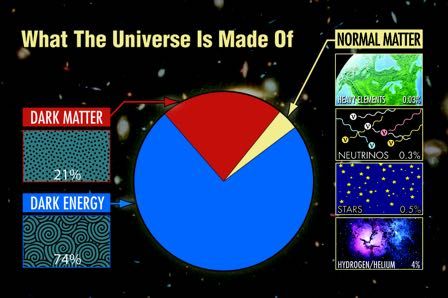
Physics Analyses
Search for new physics beyond the Standard Model:

                                                              Are there more particles than
 What is the Dark Matter?     Why is the Higgs so light?      those we know?

Look for new physics in events with a pair of top quarks:
Exciting opportunity for new discoveries in a wide range of
scenarios, including new SUSY and Dark Matter particles

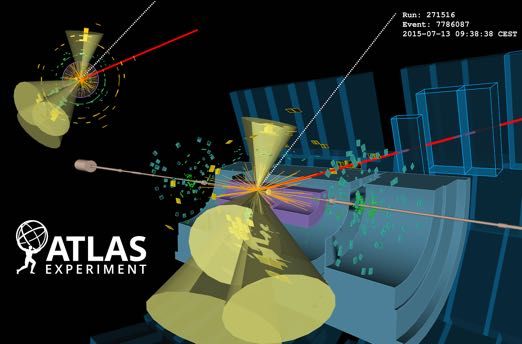
                                                                       Highly-energetic pair of top quarks
                                                                       decaying into a muon and jets
     AG Jakobs                             11 March 2021                                            10
Physics Analyses
A physics analysis involves many aspects and thus a wide variety of techniques
and tools is applied, e.g.:
- Application of Machine Learning Techniques like
Boosted Decision Trees, (Deep) Neural Networks
(applied in many of the analyses we are active)
- Statistical data analysis:
Hypothesis testing, determination
arbitrary units
ATLAS Simulation Preliminary
10− 1
of physical parameters, setting limits 10− 2
SM: σ = 30.097 pb
cHG = 1: σ = 872.21 pb
on models of new physics, .... 10− 3
1.40 50 100 150 200 250 300 350 400
rel. diff.
1.2
1
0.8
0.6
0.4
0.2
00 50 100 150 200 250 300 350 400
p H [GeV]
T
- Interpretation of measurements in the framework of Effective Field Theories
- Reconstrution of physics objects like t leptons, b jets, Higgs boson, top quarks ...
Several BSc and MSc thesis topics available, in different areas of Higgs boson physics and
searches for new physics beyond the Standard Model where typically such techniques are applied
AG Jakobs 11 March 2021 11Detector Development
2) Detector Development
(i) CMOS Silicon Detectors
- Current silicon detectors as e.g used in ATLAS
made in an expensive and complicated process
- The chip world market uses much cheaper
silicon made in many CMOS foundries, but chips
are much smaller than our sensors. Stitching of C2 CMOS sensors on test module in our Lab
sensors required.
- Stitched CMOS strip sensors produced in
cooperation between Bonn, DESY & Freiburg,
available in Freiburg for testing as particle
sensors.
Typical BSc/MSc project: Test CMOS sensor
performance before and after irradiation.
Cfirst results from CMOS test module
AG Jakobs 11 March 2021 12Detector Development
(ii) Ultra Fast Silicon Detectors
- Normal silicon detectors are already fast,
forming a signal in about 5 ns
- Reduction to ~ 0.1 ns could give
additional, valuable information to
reconstruct charged particles
- Launched project with dedicated “fast 3D
sensors” to arrive in autumn 2021
Typical BSc/MSc project: Test fast 3D
sensor performance before and after
Position-resolved signal scan in a 3D sensor.
irradiation. Signal varies strongly with position. The signal is
generated by an IR-Laser moved with X-Y stage
AG Jakobs 11 March 2021 13BSc and MSC Theses
For both research lines you should have a basic interest in elementary particle physics
For Physics Analysis a basic interest in analyzing data and programming is needed.
Knowing python (and/or C++) would be beneficial but is not a requirement!
For Detector Development you should have an interest on working with your hands
in a laboratory
You will
- be embedded in a (international) team of PhD students and Postdocs
- get a taste of working in an international big collaboration
- get a deeper understanding of particle physics, particle detectors, analysis of large data
sets, analysis techniques and tools
- get real hands-on experience when working on detectors in the laboratory
Learn more on Thursday, 11 March, in our ZOOM rooms!
An updated list of BSc/MSc topics will be provided here: http://www.particles.uni-freiburg.de/bachelor
Interested to join our group? Contact
karl.jakobs@uni-freiburg.de
Christian.Weiser@physik.uni-freiburg.de
Ulrich.Parzefall@physik.uni-freiburg.de (Detector development)
Spyridon.Argyropoulos@physik.uni-freiburg.de (Emmy-Noether)
AG Jakobs 11 March 2021 14You can also read


