Prototype tests for a highly granular scintillatorbased hadron calorimeter 18.01.18 - 6th Beam Telescopes and Test Beams Workshop 2018 JGU ...
←
→
Page content transcription
If your browser does not render page correctly, please read the page content below
Prototype tests for a highly granular scintillator-
based hadron calorimeter

  18.01.18 – 6th Beam Telescopes and Test Beams Workshop 2018
  JGU Mainz – Marisol Robles

    On behalf the CALICE collaboration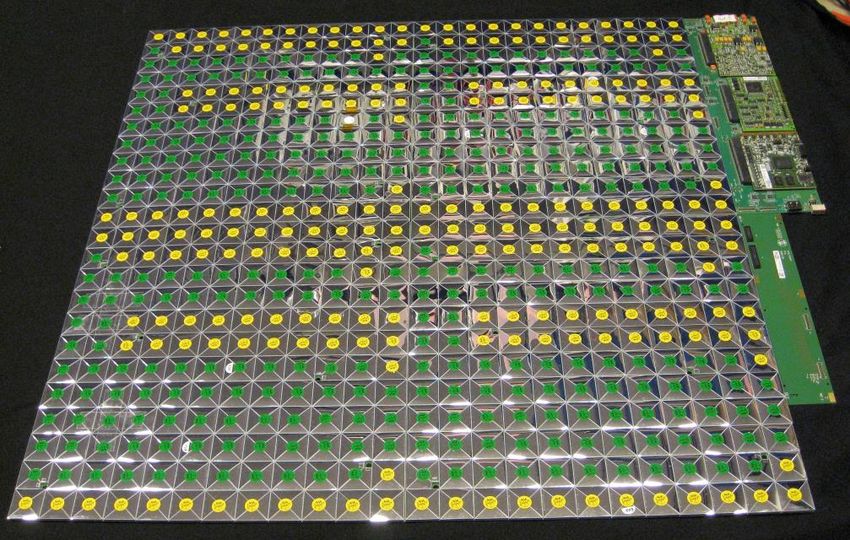
High Granular Calorimeters
• High granular calorimeters:
– Motivated by requirements from precision
physics programs at future lepton colliders
– Prerequisite for Particle Flow reconstruction
• Particle Flow Reconstruction
– Aim to improve the jet energy resolution
– Connecting information from all sub-
detectors
• Charged particles measured in Tracker
• Photons measured in Electromagnetic Calorimeter
(ECAL)
• Neutral hadrons measured in Hadronic Calorimeter
(HCAL)
– Separate energy depositions from close-by
particles: high granularity is essential
• International Linear Collider (ILC):
– Under discussion in Japan
– s to 250-500 GeV, upgradable to 1 TeV
– 31 km long, superconducting RF cavities
18.01.2018 | Johannes Gutenberg-Universität Mainz 2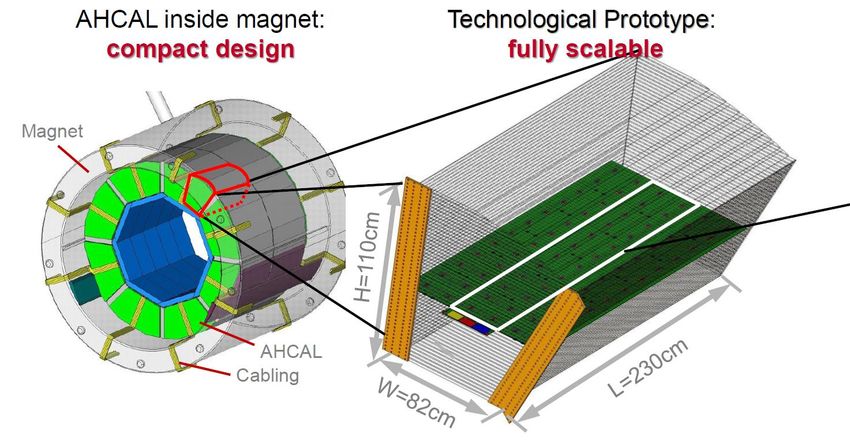
Scintillator based hadronic calorimeter (AHCAL)

 •     Steel sandwich calorimeter based on scintillator
       tiles (3 x 3 cm2) read out by Silicon
       Photomultipliers (SiPM)
 •     3.5 T magnetic filed
 •     Electronics fully integrated into active layers
 •     HCAL Base Unit (HBU): 144 channels (4 ASICs)
 •     High granularity: 8M channels in total
         –    Challenges for mass assembly and data
              concentration
18.01.2018 | Johannes Gutenberg-Universität Mainz           3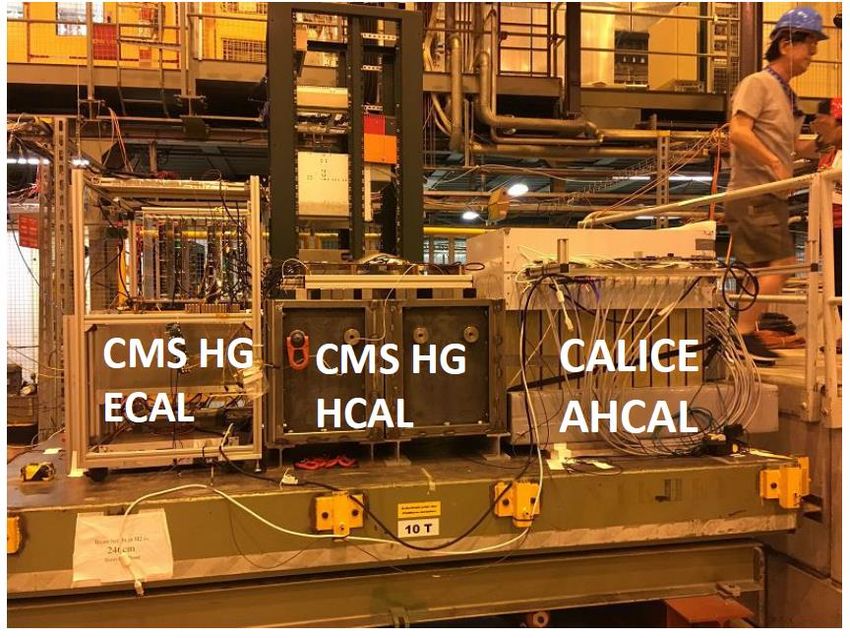
Readout electronics
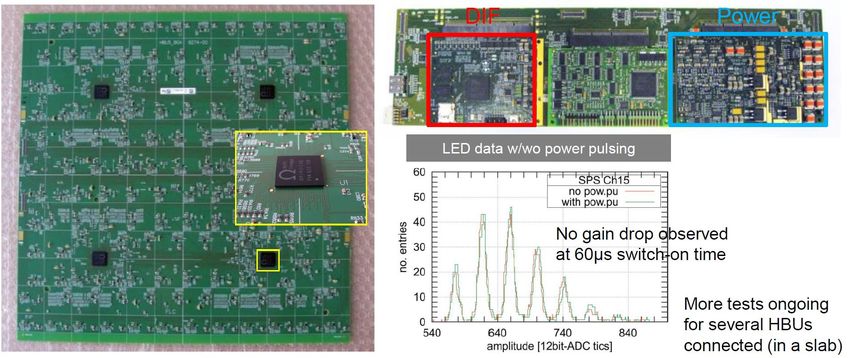
           •     AHCAL redout boards (HBUs)
                   –   With updated ASIC chips (SPIROC2E) in new packages (BGA)
                   –   Fully integrated for mass assembly
           •     Interface boards
                   –   Power: reduced heat dissipation, optimized for power-pulsing, etc.
                   –   Detector Interface (DIF): modern FPGA

18.01.2018 | Johannes Gutenberg-Universität Mainz                                           4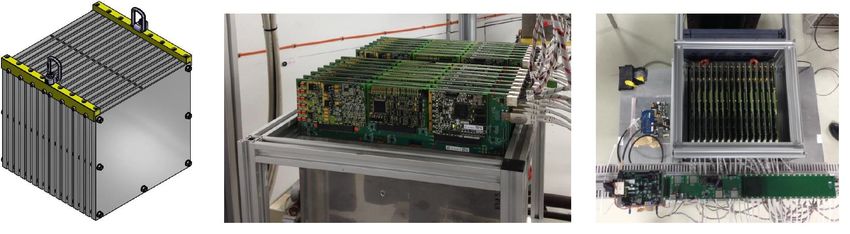
Tiles and SiPM for mass assembly

       Original tile with WLS

•     SiPM sensitive to blue light: no need for WLS
      fibers
•     Excellent uniformity (operating voltage, gain)
•     Main improvements on the new generation of
      industrial SiPMs:
        –    Dramatically reduced dark rate and increased photon
             detection efficiency
        –    Better S/N
•     SMD design
•     Cavity on the tile for placing over the SMD-
      SiPM
18.01.2018 | Johannes Gutenberg-Universität Mainz                  5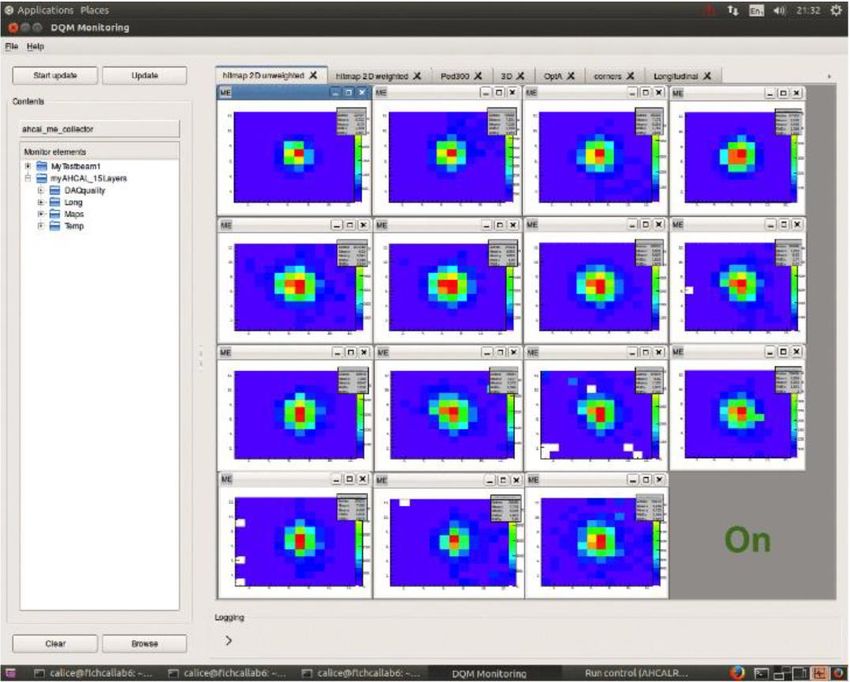
Detector calibration
Single Photon
Spectrum
LY of a HBU
Light Yield Mapping of a HBU
(144 channels)
Single photon spectrum for calibrating the detector Gain (pe/ADC channels)
Mapping the gain for each SiPM 3.7 % spread
18.01.2018 | Johannes Gutenberg-Universität Mainz 6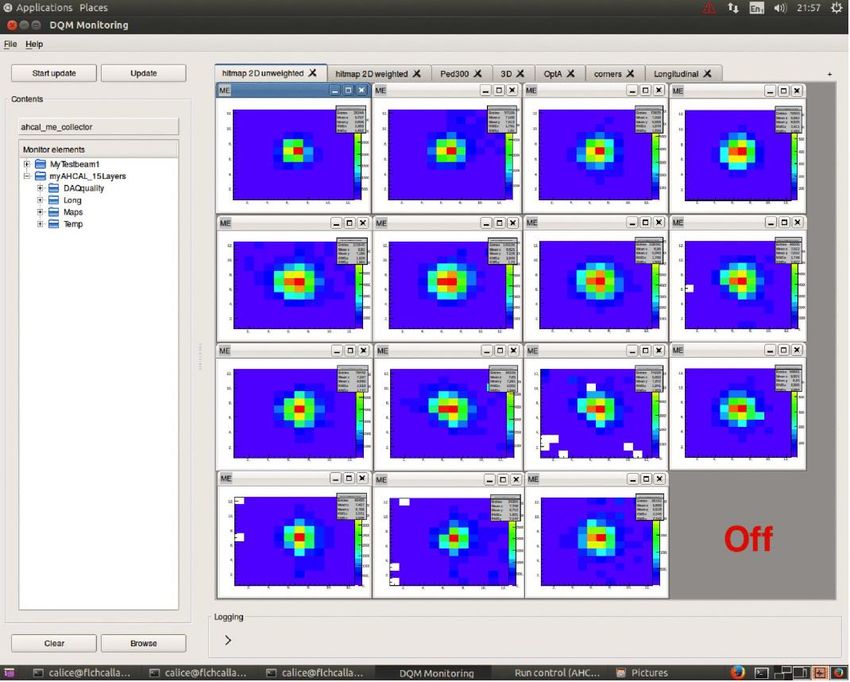
Detector calibration

                           Single Photon
                           Spectrum

                                                    Light Yield Mapping of a HBU         LY of a HBU
                                                        (SPS CERN 2015 July testbeam )   (144 channels)

                                                                                                  MIP Response [p.e.]

                         SiPM response to muons (MIPs)
                         Light Yield (Landau+Gaussian fit after gain calibration) for each HBU channel
                         LY uniformity (9.7 % spread)
18.01.2018 | Johannes Gutenberg-Universität Mainz                                                             7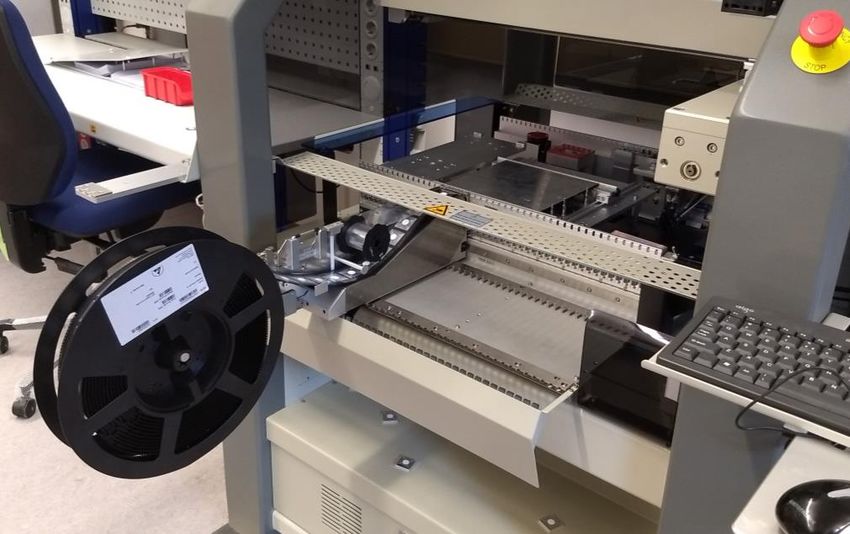
Timing analysis for showers
              •     Time reference (T0) from muon data
                     – Signal from trigger scintillators
              •     Few ns time resolution are needed
                     – Time of hits relative to T0
                     – Comparison to MC simulations
              •     Analysis of EM and hadronic showers in progress
                            Results obtained from the previous
                            prototype with the T3B setup

18.01.2018 | Johannes Gutenberg-Universität Mainz                     8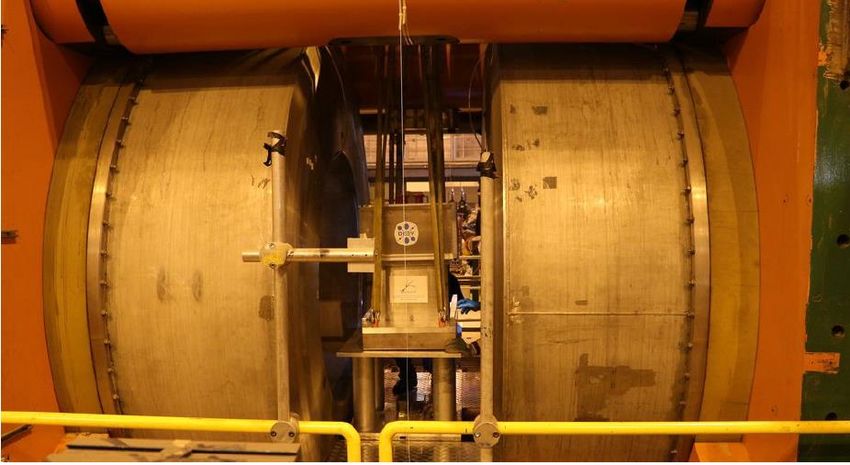
Small prototype: 2016-2017 testbeams
•       Setup
         – A small prototype with all high-quality SiPMs
         – 15 layers, single HBU per layer
              • 7 HBUs with SMD-SiPMs built via mass
                assembly: bottom coupling (baseline design)
              • 8 HBUs with high-quality SiPMs, side-surface
                coupling
•       Aims
         – Precision measurements of EM showers
         – Power-pulsing mode: crucial for linear colliders
         – Temperature compensation for SiPMs

    18.01.2018 | Johannes Gutenberg-Universität Mainz          9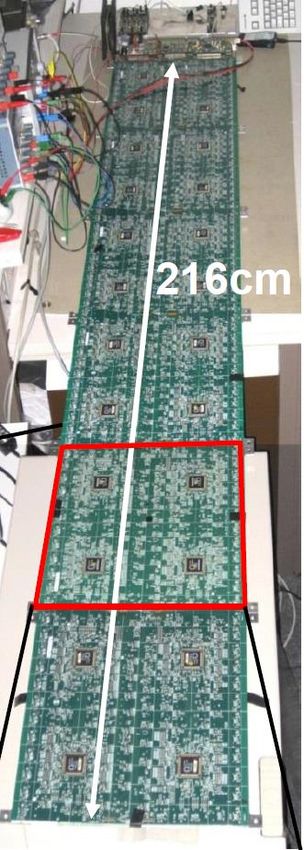
2016 testbeam results
 Energy spectra of 1-5 GeV electrons                         Testbeam at DESY
                                                    Comparison w/wo Power pulsing for layer 7 and layer 15

   Layer 7
     (SMD SiPM)

  Layer 15
(Side-surface SiPM)

18.01.2018 | Johannes Gutenberg-Universität Mainz                                                            10
2017 Testbeam in high magnetic field
• Test beam at SPS H2 CERN
– 1.5 T Magnetic field
• Technical purpose: power pulsing
working in a high magnetic field
• Physics: performance with
electrons
• Analysis in progress
MIP signal is increased by magnetic
layer 1 channel 0 field .The increased rate seems to
Magnet on be constant
off
CALICE work AHCAL muon response is 3-6 %
in progress increased by a 1.5T magnetic
field
ADC channels
18.01.2018 | Johannes Gutenberg-Universität Mainz 112017 Testbeam in high magnetic field
Online monitoring of the AHCAL prototype for 15 layers
20 GeV electrons magnet OFF
20 GeV electrons magnet ON
CALICE AHCAL
Work in progress
Energy sum of 10 and 20
GeV electrons w/wo magnet
18.01.2018 | Johannes Gutenberg-Universität Mainz 122017 CMS CALICE CommonTestbeam
• Testbeam at SPS CERN
• AHCAL prototype as a backing calorimeter of HGCAL modules
• 12 layers small stack (absorber thickness 74 mm)
• Successful data taking with CMS HGCAL prototype in synchronization with AHCAL (EUDAQ)
• Muon runs to test the temperature compensation
• 100-300 GeV pion runs Hit map of a 300 GeV pion run online monitor
CMS HGCAL
CALICE AHCAL
18.01.2018 | Johannes Gutenberg-Universität Mainz 13Temperature compensation
• Temperature dependence on Gain (results of 2016 campaign)
HV is tune to keep the overvoltage (V) constant
• July 2017 testbeam: muon runs specific for temperature compensation
measured in HBUs central channels
Temperature compensation works successfully!
18.01.2018 | Johannes Gutenberg-Universität Mainz 14New large prototype
• Mass assembly production of the new prototype (currently in production)
– Tiles placed by a Pick and Place machine
– Fully characterised in a Cosmic Ray test stand
• 40 layers (160 HBUs in total)
• 24000 channels
• Prove the scalability of the project
• Feasibility of the technical large prototype
• Future test beam at SPS CERN in 2018
Exciting results are expected!
18.01.2018 | Johannes Gutenberg-Universität Mainz 15Summary and outlook
• Scintillator-based hadron calorimeter (AHCAL)
– Baseline design suitable for mass assembly
– Promising performance in beam tests
• Latest beam tests
– Power-pulsed operation in magnetic filed and active temperature
compensation established
• Construction of a new AHCAL technological prototype in full swing towards
hadron beam tests in 2018
– 40 layers, 24000 channels
• R&D continues in parallel
– e.g. mega-tiles, ASICs
– Test in combination with new prototype being considered
18.01.2018 | Johannes Gutenberg-Universität Mainz 16Thank you for your attention !
Backup
Current Cosmic Ray test stand performance
• Cosmic ray test stand was used to measure                         Dark box
  the performance of the 6x last years                              (1.8×1.3×0.8 m³)
                                                                    with compressed
  assembled HBUs                                                    air lifting

   • 2x HBUs are measured in parallel
                                                                                          Trigger and
                                                                                          tracking
                                                                                          system (24 ch.)
   • Cosmic Ray test stand and the HBUs
      show very good performances
   • Performance of Cosmic Ray test stand is                        SMD-SiPM HBU board,
                                                                    more space for
      scalable to mass calibration rate                             additional boards

        • For the final calibration ~50x HBUs
           have to be measured in parallel
        • This Year: 160 new HBU boards
           have to be measured → Further
           parallelization useful (8-10 boards)!
          Yellow: Raw data
          Black: TDC cut data                        Spread: 5.5%
          Green: min 1 Hit per
          layer cut data

 18.01.2018 | Johannes Gutenberg-Universität Mainz                                           19
Light Yield results with cosmics
• Results for 5 boards:
• Mean light yield between 25 - 29 pe
• Excellent board light yield spread with
5 – 7.5 %
Landau
• Results after missing gain correction Gaussian fit on
just varies minimal cosmic data
• Results for all boards in backup slides
Spread: 5.5%
18.01.2018 | Johannes Gutenberg-Universität Mainz 20New Pick and Place Machine at Uni Mainz
Custom made reels (56 mm)
• 420 tiles stored in a reel
• Feeder for the pick and place machine.
• Test for placing the tiles stored in the reels in
progress.
18.01.2018 | Johannes Gutenberg-Universität Mainz 21You can also read


