Exploring icy satellites - for their Astrobiological potential from an astronomical point of view
←
→
Page content transcription
If your browser does not render page correctly, please read the page content below

Exploring icy satellites
for their Astrobiological potential
from an astronomical point of view
          Athena Coustenis

          LESIA, Paris-Meudon Observatory
                       France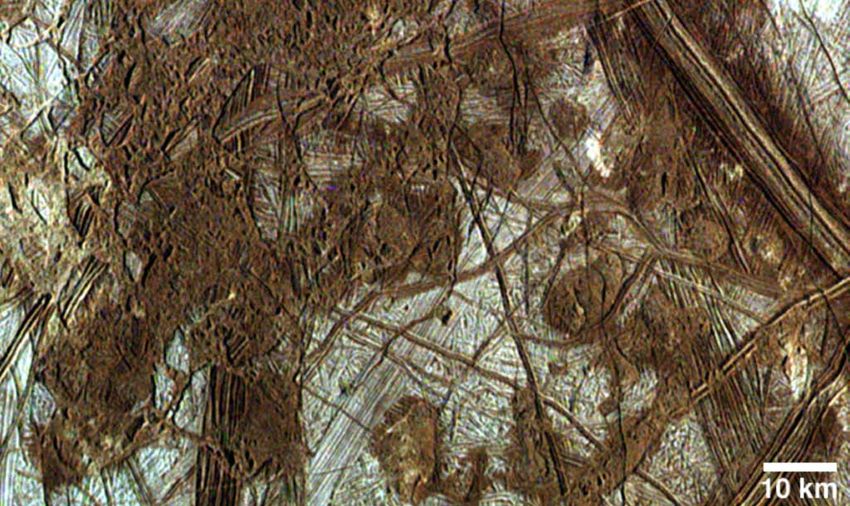
Galileo Cassini-Huygens

Quelques points de considération
Aspects astrobiologiques: chimie organique, eau
liquide (en surface ou à l’intérieur), sources d’énergie
(activité interne), stabilité

Les satellites de glace
        avec organiques : Titan, Encelade, Triton.
        avec une activité évidente : Encelade, Triton, Io, (Titan?)
        avec de l’eau liquide à l’intérieur (à confirmer): Europe,
Ganymède, Encelade, Titan

A l’exception de Titan, les satellites de glace avec des océans
subsurfaciques possibles (Europe, Ganymède, Callisto) ou une activité
cryovolcanique évidente (Encelade, Triton) résident à l’intérieur des
magnétosphères des planètes géantes, mais les deux derniers ne sont
pas dans la partie avec l’irradiation surfacique extrême et destructive
pour les organiques.

Quel est le potentiel astrobiologique de chacun de ces satellites?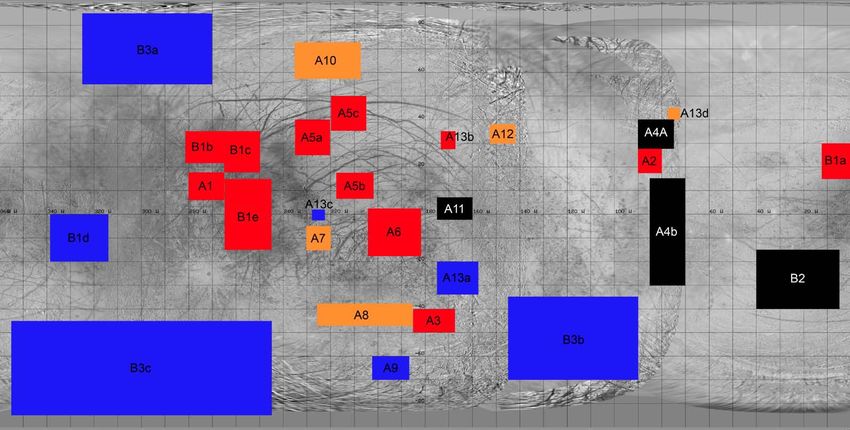
Exploring the Habitability of Icy Worlds:
The Europa Jupiter System Mission (JUICE)
The EJSM Science Study Team
2009 All rights reserved.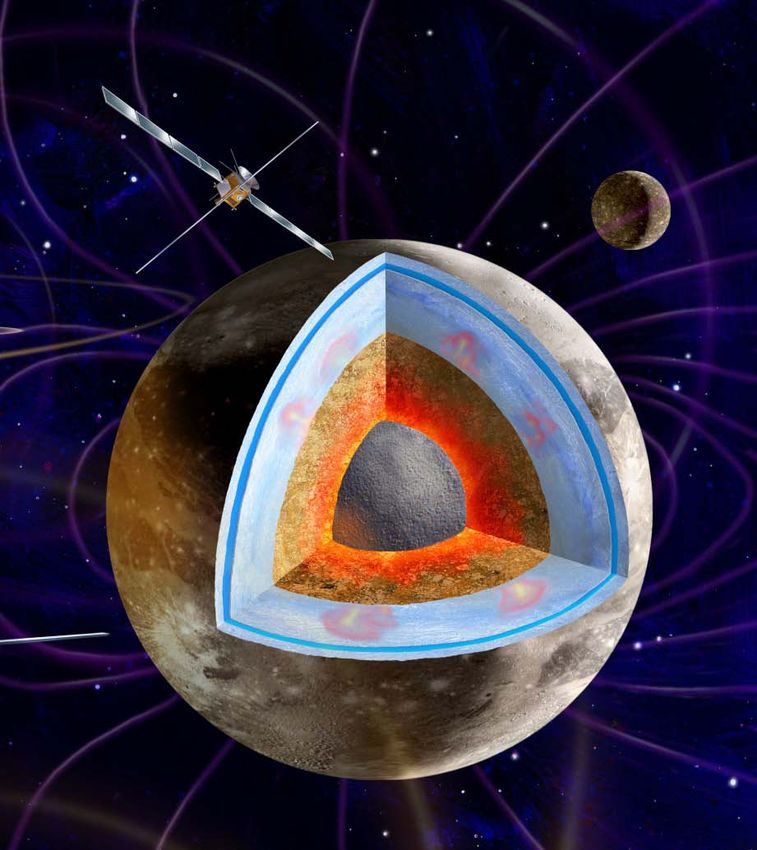
EJSM Theme:
    The Emergence of Habitable Worlds Around Gas Giants
• Goal 1: Determine if the Jupiter
  system harbors habitable worlds                • Goal 2: Characterize Jupiter
   – Ocean characteristics (for Europa and
                                                   system processes
     Ganymede and perhaps other satellites)         –   Satellite system
   – Ice shells and subsurface water                –   Jupiter atmosphere
   – Deep internal structure, and (for              –   Magnetodisk/magnetosphere
     Ganymede) intrinsic magnetic field             –   Jovian system Interactions
   – External environments                          –   Jovian system origin
   – Global surface compositions
   – Surface features and future landing sites

 Emphasis on icy moon habitability and Jupiter system processes
                                                                                     5
JGO Science: Overview
• Key JGO science phases
– Ganymede: Detailed orbital study
Elliptical orbit first, then circular orbit
– Jupiter system: In-depth exploration
From Jupiter orbit, synergistically with JEO
– Callisto: In-depth study and mapping
Multiple flybys using a resonant orbit
• Science Objectives:
– Ganymede: Characterize Ganymede as a
planetary object, including its potential
habitability
– Satellite System: Study the Jovian satellite
system
– Jupiter: Study the Jovian atmosphere
– Magnetosphere: Study the Jovian
magnetodisk / magnetosphere
– Jupiter system: Study the interactions
occurring in the Jovian system
6
Ganymede studies with JUICE
       Tidal deformation
                                                                                  Geology and Topography
                                     • Presence and extent of a subsurface
                                       ocean
                                     • Ice shell and subsurface water
                                     • Deep internal structure, dynamo,
                                       magnetic field
Deep Interior and Magnetic Field
                                     • Coupling among surface, exosphere,
                                       and magnetosphere
                                     • Surface composition and chemistry
                                     • Surface features, tectonic processes
                                     • Thermal evolution, geology, and the       Magnetosphere and
                                       Laplace resonance                         Environment

 Structure and topography of Mars' Polar Cap         Compositional Differences

                                                                                                           7
1. Why is Ganymede an habitable world
Theme 2: Habitability of the icy moons                                                              EJSM-Laplace
Why are Ganymede and Europa habitable worlds ?

                                                                                             Liquid water
  The habitable zone is not restricted to the Earth’s orbit…
                                                                                             Stable environment
                                                                                             Essential elements
                                                                                             Energy
                               Surface habitats       Deep habitats

                                                                                                  Deep habitats
Europa: Ocean • Ice • Chemistry • Geology
Determine global surface compositions and chemistry,
especially as related to habitability

   Composition is key to understanding ocean habitability
                                                            9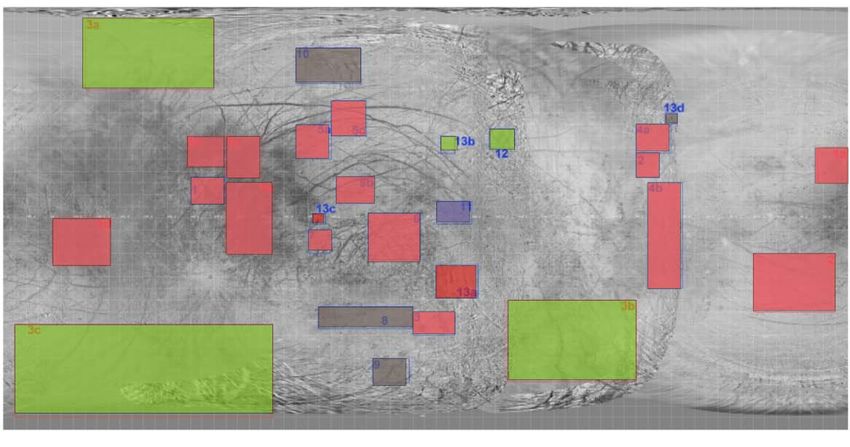
Europa: Ocean • Ice • Chemistry • Geology
Global surface composition
  & chemistry:
• Organic & inorganic chemistry
• Relation to geologic processes
• Radiation effects
• Exogenic materials

          Composition is key to understanding Europa’s habitability
  6/29/2011                                                           10
Europa: Ocean • Ice • Chemistry • Geology
Understand the formation of surface features, including
sites of recent or current activity, and identify and
characterize candidate sites for future in situ exploration
mosaic by Orion
11Europa: “Ingredients” for Life? e-, O+, S+, …
• Water:
– Warm salty H2O ocean. radiation-produced oxidants:
O2, H2O2, CH2O
• Essential elements:
– Accretion of CO2?
– Impactors.
– But radiation destroys organics in
upper ~10s cm of ice.
• Chemical energy:
– Radiation of H2O ⇒ oxidants.
– Mantle contact: serpentinization
and possible hydrothermal activity.
• Relatively stable environment: hydrothermally produced reductants:
H2S, H2, CH4, Fe
– Large satellite retains heat.
– But activity might not be
steady-state.
[after Stevenson, 2000]Europa: Ocean • Ice • Chemistry • Geology
Ice shell & subsurface water:
• Shallow water
• Ice-ocean interface
• Material exchange
• Heat flow variations
SHARAD, Mars north polar cap
[Seu, Phillips, and the SHARAD team]
Radar sounding can characterize the ice shell
6/29/2011 8Liquid water
Theme 2: Habitability of the icy moons LIQUID WATER EJSM-Laplace
Galileo evidence of liquid layers
Geologic activity Induced magnetic field
Production of a ±3˚ tilt of
internal dipole moment over
a 10 hour period.
marginally demonstrated but
more data needed
Credits: Kivelson
Thermal modelling
Science questions
- Existence of the liquid layer
- Spatial distribution
- Relationship with geology/surface
- Physical characteristics Credits: BlandLiquid water
Theme 2: Habitability of the icy moons LIQUID WATER EJSM-Laplace
Ganymede’s ocean: what EJSM-Laplace will do…
Induced magnetic field
at multiple frequencies
Magnetometer
Radio and Plasma
Waves
Tidal deformation of
the surface
Radio science
laser altimetry
MR and HR imaging
Libration amplitudes
Radio science
laser altimetry
Hydrostatic equilibrium
Radio science
laser altimetry
Jupiter System ~2.5 y Elliptical Circular 500 Circular 200
15 moon flybys 40 days 80 days 60 daysLiquid water
Theme 2: Habitability of the icy moons ESSENTIAL ELEMENTS EJSM-Laplace
Galileo evidences for an outstanding complexity
Complex chemistry Complex dynamics
Credits: Khurana
Specific albedo distribution
Brines and Alteration on open field lines
hydrates are
good
candidates
Water ice abundance – NIMS data
Science questions
• What are the non–water ice chemical compounds ?
• What is the endogeneous and the exogeneous repartition of this surface material ?
• What is the effect of radiation weathering on these materials ?
• How can we correlate the surface compounds with the sub-surface composition ?Essential elements
Theme 2: Habitability of the icy moons ESSENTIAL ELEMENTS EJSM-Laplace
Surface composition of the moons: what EJSM-Laplace will do…
What are the surface chemical compounds ? Exogeneous versus endogeneous ?
Volatiles
Near-IR imaging spectrometer Ion and Neutral mass spectrometry • Major volatiles
UV imaging spectrometer Particles and plasma instrument • Stable isotopes C,H,O
• Noble gases Ar, Kr, Xe
• Mapping of oxygen species
Ions and Neutrals
• Identification
• Surface 2D distribution
How does the surface relate to the subsurface ?
Subsurface radar sounding
Spatial coverage Sub-mm wave sounding
• > 80 % at a few km/pxl
• X 100 m/pxl on a few %
• X10 m/pxl if needed MARSIS: South Polar Deposits
Spectral coverage
• > 5 times better at regional scale
• Lab data quality when needed
Global scale Regional / Local scales
Jupiter System ~2.5 y Elliptical Circular 500 Circular 200
15 moon flybys 40 days 80 days 60 daysEnergy-Galileo
Theme 2: Habitability of the icy moons ENERGY EJSM-Laplace
What are the energy sources?
External sources Internal sources
Impactors Particles Tidal Radiogenic Secular
?
Science questions
- What is the evolution of the impactor population in the Jovian system through time?
- What is the amount of heat that is expelled through the surface of the moons?
- How much tidal heating is distributed within the moons?Enceladus
E-ring source
Old Faithful by Starlight
(Credit: Tyler Nordgren) Hidden Energy
Sources ?
Radiolytic
Chemistry vs Solar &
Tidal Heating
?
Triton cryovolcanism (dark streaks)Energy Fluxes
mW/m2
Mimas 2.5
Enceladus 0.73
Tethys 0.48
Dione 0.44
Rhea 0.29
Callisto 0.19
Ganymede 5.4
Europa 99
Triton ~5
Cooper et al., PSS, 2009Energy - external sources
Theme 2: Habitability of the icy moons ENERGY EJSM-Laplace
How much energy remains from the early stages ?
Impact cratering Surface heat flux
Ganymede possesses the widest range in crater morphology Thermal IR mapper
Low and High resolution imaging Subsurface radar sounding
Vis-IR spectro imaging Sub-mm wave instrument
Sub-surface radar sounding Credits:
Schenk
Distribution:
Nearly global coverage
at 200-400 m/px
resolutions + HR target
areas (5-50 m/px)
Present activity:
monitoring on a
timescale x 100 days
up to years to identify
potentially newly
formed craters
Buto Facula
Jupiter System ~2.5 y Elliptical Circular 500 Circular 200
15 moon flybys 40 days 80 days 60 daysEnergy - internal sources
Theme 2: Habitability of the icy moons ENERGY EJSM-Laplace
How much heat is available in the interior of the moons ?
Intrinsic magnetic field
Magnetometer
Radio and Plasma Waves
Constraints on the core size
and dynamics
Gravitational field
Radio science
Laser altimetry
Equilibrium state
Averaged density profiles
Mass anomalies
determination
Tidal deformation
Radio science
Laser altimetry
MR and HR imaging
Equilibrium state
Jupiter System ~2.5 y Elliptical Circular 500 Circular 200
15 moon flybys 40 days 80 days 60 daysStability - Galileo Theme 2: Habitability of the icy moons STABILITY EJSM-Laplace How stable are the present states? Geology as a witness of moon’s evolution Stability of the system Science questions -What do geologic features tell us about the past and present internal activity ? -How did the habitable zone evolve through time ?
Stability - resonnance
Theme 2: Habitability of the icy moons          STABILITY                                 EJSM-Laplace
Stability of the environments: orbital changes and tidal heating

  Orbital changes of the satellites             Tidal deformation
    Wide angle camera                              Laser altimetry
    Narrow angle camera                            Radio science
    Radio tracking

                               Global scale                                 Regional / Local scales

       Jupiter System ~2.5 y                  Elliptical                   Circular 500           Circular 200
       15 moon flybys                         40 days                      80 days                60 days
Stability - resonnance
Theme 2: Habitability of the icy moons STABILITY EJSM-Laplace
Stability of the environments: geology as a witness of moon’s activity
Imaging from medium
to high resolution
Wide angle camera
Narrow angle camera
Imaging spectroscopy
Vis-IR Imaging
x 50 spectrometer
Topography /
Morphology
Laser altimetry
Subsurface exploration
Radar sounding
Jupiter System ~2.5 y Elliptical Circular 500 Circular 200
15 moon flybys 40 days 80 days 60 daysSingle fly-by option of Europa – top-priority sites
for astrobiology and geology
CRITERIA
- Evidence for material mobility from the interior
of the satellite. It can support the connection
between the internal liquid water layers (the
potential habitable environment) and the surface.
- Concentration of non-ice components. These
A3: Chaos material with matrix showing materials can provide block elements or/and
pre‐existing structure, associated with dark plains, energy for the microorganisms. If they are salts,
possibly from emplacement of liquid material (e.g., they can be an evidence of internal aqueous
Fagents, JGR 108, 5139-5158, 2003). reservoirs.
- Relative youth, which increases the chances for
finding or preserving biosignatures due to less
time of exposure to the radiation environment.
- Textural roughness, because it can be useful for
shielding. This is not a good parameter if the area
is considered as a future landing site
- Stable or gradually changing environment, for
preserving the signatures coming from the
A1: Class of chaos material with matrix and rafts of interior.
pre‐existing ridged plains moved with respect to one -Searching for organics or the mechanisms of
another (e.g., Spaun et al., GRL 25, 4277-4280, 1998); their destruction (see following comment) and
far-reaching bright rays of crater Pwyll; right-angle furthermore for any signs of volcanism on Europa
intersection of complex ridges Asterius & Agave Linea
(also see attached comment)
north of Conamara Chaos.GEOLOGY ASTROBIOLOGY
Prioritization map Prioritization map
Low
Low
High
High
Highest
Highest
Medium
ModerateSingle fly-by option – trailing quadrant
Map from: R. Jaumann’s email to SST, 26-05-2011Conclusions • Liquid water, energy sources, elements and stability are needed for life as we know it, and may all be present on Ganymede and Europa • We need more extensive investigations at this stage to determine with precision all of these factors on Ganymede • Astrobiological challenge for Europa is to determine limits on organics and any cryovolcanic activity in a hostile surface irradiation and oxidation environment • The presence and characteristics of an interior liquid water ocean on Ganymede should be determined by JUICE and possibly some information can be gained also on Europa’s ocean through 1-2 well-targeted flybys.
Le processus de sélection de la missions L1
                                          (2)

       Janvier 2011: Publication ESA des « Yellow
       book »
        Février 2011: Présentation publique des missions L
                    Scénario jusqu’à récemment:
                    Sélection de (au plus) 2 missions L au SPC de février 2012.

                         Message de l’ESA du 14 mars :
                         Compte tenu de l’incapacité des partenaires à s’engager
                         sur aucun des trois missions:
                         - Nécessité de reporter toute décision jusqu’en 02/2012
                         - action auprès des consortiums pour étudier ces missions
                         maintenant essentiellement européennes (6 mois
                         environ)
                         - les nouvelles missions proposées repasseront devant les
  Processus d’évaluation instances d’évaluation début 2012
                                    Première analyse:
       évaluation

                                    - Besoin de conduire de nouvelles assessment
                                    phases
                                    - Un retard de L1 est à redouter                 30

2011                                  2012
Statut actuel des missions L
-Les Phase 0 pour toutes les missions L (à l’exception de LISA qui a été
reconduite depuis Horizon 2000 Plus) ont été commencées à la mi-2008.
- Début Février 2009 l’ESA et la NASA ont annoncé ensemble la décision de
donner la priorité au lancement de la mission EJSM-Laplace parmi les
candidates Outer Planets. A ce moment les études officielles ESA sur
TandEM/TSSM ont été terminées. Des études sur le ballon pour Titan ont été
poursuivies au CNES et au JPL.
- Après un appel en 2009, des études industrielles sur EJSM-Laplace et IXO ont
été conduites et terminées ainsi que le « Yellow Book » pour ces concepts vers
la fin 2010. Tous les candidats (EJSM-Laplace, IXO et LISA) ont été étudiés en
collaboration avec la NASA (et dans le cas de IXO, aussi avec JAXA).
- Les résultats des ces phases d’assessment et les objectifs scientifiques des
missions furent présentées à la communauté Scientifique Européenne le 3
Février 2011.
- Depuis, et en conséquence de l’évolution de la situation programmatique de la
NASA concernant les missions L (aucune des 3 missions L ne fut classée en
tant que priorité no 1 des Decadal Surveys), la NASA et la JAXA ont confirmé
qu’il était très improbable de pouvoir fournir la participation importante prévue
pour aucune des 3 missions candidates selon la planification de l’ESA (càd pour Folie 31
Cosmic Vision 2015 - 2025
un lancement tôt 2020).Statut actuel des missions L (suite)
- Par conséquent, l’Executif de l’ESA a terminé les Assessment Phase pour les 3
candidates L1 au lancement en 2020 et commença une reformulation rapide visant à
définir les candidates viables pour un lancement en 2022 en tant que large mission
menée par l’Europe (ou seulement Européenne) pour déterminer si les objectifs
scientifiques des missions candidates L (ou lesquels parmi ces objectifs) pourraient
être atteints suite à ces changements. Il s’en suit que cela permettrait de savoir
lesquelles de ces missions pourraient être implementées dans le contexte d’une
mission ESA.
- Les thèmes scientifiques principaux que les 3 missions originales couvraient étaient:
• Le système de Jupiter avec l’accent sur Ganymède et les satellites de glace pour
EJSM-Laplace (désormais JUICE);
• Des observations aux rayons X des sources cosmiques pour IXO (désormais
ATHENA), avec une grande surface collective et haute résolution spectrale;
• la détection et étude poussée des sources des ondes gravitationnelles
cosmiques pour LISA.
- Les activités en cours visent à établir si une ou plusieurs parmi les missions
candidates dans les 3 thèmes scientifiques ci-dessus peuvent être implémentées en
tant que European-only (or European-led) pour un lancement vers 2022. Cette activité
est menée tambour battant par l’Executif de l’ESA et les nouveaux Science Study
Teams des spécialistes des missions. Folie 32
Cosmic Vision 2015 - 2025You can also read


