Faculty of Health and Applied Sciences - Yearbook - Part 6 2021 - NUST
←
→
Page content transcription
If your browser does not render page correctly, please read the page content below
Office of the Registrar

Yearbook - Part 6
Faculty of Health and
Applied Sciences

                             2021
Faculty of Health and Applied Sciences - Yearbook 2021
YEARBOOK 2021
PART
6
FACULTY OF
HEALTH AND
APPLIED SCIENCES
(Note: The final interpretation of all regulations in this Yearbook for the Faculty of Health
and Applied Sciences shall be vested in Council).Faculty of Health and Applied Sciences - Yearbook 2021
NOTE
The Yearbook for the Faculty of Health and Applied Sciences is valid for 2021 only. Curricula and syllabi may be amended for 2022
It is obtainable free of charge from:
The Registrar
Namibia University of Science and Technology (NUST)
Private Bag 13388
Windhoek
NAMIBIA
Location: 13 Jackson Kaujeua Street, Windhoek
Telephone: (+264-61) 207 2008 / 2118
Fax: (+264-61) 207 9118
Website: www.nust.na
E-mail: registrar@nust.na
Although the information contained in this Yearbook has been compiled as accurately as possible, Council and Senate accept no
responsibility for any errors and omissions, which may occur. The University retains the right to amend regulations or conditions
without prior notice.
Due to the rapidly changing external environment that many programmes operate in, and the University’s desire to remain
constantly relevant in its offerings, some programmes may be significantly amended after publication of this Yearbook. Please
consult our website for the latest versions of our curricula, syllabi and academic regulations.
The fact that particulars of a specific programme, field of study, subject, or course have been included in this Yearbook does not
necessarily mean that such a programme, field of study, subject, or course will be offered in the academic year 2021.
© Namibia University of Science and Technology/Office of the Registrar.
[ ii ]Faculty of Health and Applied Sciences - Yearbook 2021
CONTACT DETAILS
Central Administration and Lecturers’ Offices
Postal Address: Private Bag 13388, Windhoek, NAMIBIA
Street Address: 13 Jackson Kaujeua Street Windhoek, NAMIBIA
Student post to: Private Bag 13388, Windhoek, NAMIBIA
Website: www.nust.na
Email: registrar@nust.na
CENTRE FOR OPEN AND LIFELONG LEARNING
Postal Address: Private Bag 13388, Windhoek, NAMIBIA
Street Address: 13 Jackson Kaujeua Street, Windhoek, NAMIBIA
Tel: 207 2081/2206
Fax: 207 9206
Website: www.nust.na/coll
E-mail: coll@nust.na
TELEPHONE NUMBERS
NUST Switchboard Operator: 207 9111
Office of the Vice Chancellor: Vice Chancellor 207 2000/1-3
Deputy Vice Chancellor: Administration and Finance 207 2004/5
Deputy Vice Chancellor: Academic Affairs 207 2280/1
Deputy Vice Chancellor: Research and Innovation 207 2181
Office of the Registrar: Registrar 207 2008/2118
Assistant Registrar: Academic Administration 207 2351/2667
Examinations Office 207 2027/2412
Student Enquiries, Registrations and Records 207 2056
Office of the Bursar: Bursar 207 2066
Department of Student Services: Director 207 2165
Student Councillor 207 2270
Cultural Department 207 2070
Sports Department 207 2298
Students Representative Council: 207 2457
Information & Communications
Technology: Director 207 2275
Library & Information Services: Library, Enquiries and Loan Counter 207 2022/2621
Hostels:
Men: Shangri-La Superintendent 207 2132
House Committee 207 2375
Call Office 229413/233130
Ladies: Mon Resa Superintendent 207 2131
House Committee 207 2127
Call Office 229405/234193/233100
Ladies: Höpker Superintendent 207 2131
House Committee 207 2130
NB: The international code in all numbers is +264-61
[ iii ]Faculty of Health and Applied Sciences - Yearbook 2021
CONTENTS
FACULTY OF HEALTH AND APPLIED SCIENCES CODE 400
Page
Note.....................................................................................................................................................................................................ii
Contact Details....................................................................................................................................................................................iii
Contents..............................................................................................................................................................................................iv
Staff.....................................................................................................................................................................................................1
UNDERGRADUATE PROGRAMMES
Department of Health Sciences...........................................................................................................................................................4
Bachelor of Medical Laboratory Science (Revised) (Phased in 2017)..................................................................................................4
Bachelor of Biomedical Sciences (Phasing out from 2017)...................................................................................................................9
Bachelor of Emergency Medical Care.................................................................................................................................................11
Bachelor of Environmental Health Sciences (Revised) (Phased in 2017)............................................................................................14
Bachelor of Science in Health Information Systems Management (Phased in 2016)..........................................................................17
Bachelor of Human Nutrition .............................................................................................................................................................19
Department of Mathematics and Statistics......................................................................................................................................22
Bachelor of Science in Applied Mathematics and Statistics (Revised) (Phased in from 2015)...........................................................22
Bachelor of Science in Applied Mathematics and Statistics (Phased out from 2015).........................................................................25
Department of Natural & Applied Sciences.......................................................................................................................................27
Bachelor of Science (Biology, Chemistry, Physics, Mathematics)...........................................................................................................27
POSTGRADUATE PROGRAMMES
Department of Health Sciences........................................................................................................................................................30
Postgraduate Diploma in Health Information Systems Management (Phased in 2017).....................................................................30
Bachelor of Emergency Medical Care Honours (New Programme) (Phasing in 2019)........................................................................32
Master of Health Sciences (Phased in 2017)......................................................................................................................................33
Doctor of Philosophy in Health Sciences (New Programme) (Phased in 2021)...................................................................................35
Department of Natural & Applied Sciences.......................................................................................................................................38
Postgraduate Diploma in Applied Radiation Science and Technology (Phased in 2016).....................................................................38
Bachelor of Science Honours (Phased in 2018)..................................................................................................................................40
Master of Science in Natural and Applied Science(Phased in 2021)..................................................................................................43
Department of Mathematics and Statistics.....................................................................................................................................45
Bachelor of Science Honours in Applied Mathematics (Revised) (Phased in 2015)............................................................................45
Master of Science in Applied Mathematics (Phased in 2016).............................................................................................................46
Bachelor of Science Honours in Applied Statistics (Revised Programme) (Phased in 2015)................................................................48
Master of Science in Applied Statistics (Phased in 2016)....................................................................................................................49
Doctor of Philosophy in Mathematics (Phased in 2021).....................................................................................................................51
[ iv ]Faculty of Health and Applied Sciences - Yearbook 2021
FACULTY OF HEALTH AND APPLIED SCIENCES CODE 400
OFFICE OF THE DEAN Code: 401
Dean : Dr Onesmus Shuungula, PhD Maths. (WITS), M.Sc. Maths. (UCT),B.Sc. Hons. Maths (UCT), B.Sc. Stats.
(UNAM)
Associate Dean: T&L : Dr Munyaradzi Mukesi, PhD: Micro, M.Sc.: Clinical Biochemistry (UZ), B.Sc.: Hons. Medical Lab Sci.
(UZ), Dip.: Med. Lab. Technology (UZ), pg Cert Higher Education (NUST)
Associate Dean: Research : Prof Omotayo Awofolu, PhD Chem. (Env. Studies) (Univ. of Fort Hare)
Faculty Officer : Mercia Richards, MLCM (NUST), B.Tech.: OMT (PoN)
Telephone Number : 061-207 2964
Fax Number : 061-207 9964
Email : mrichards@nust.na
Secretary : Muriel Mouton, HC: OMT (PoN)
Telephone Number : 061-207-2870
Fax Number : 061-207-9870
E-mail Address : mmouton@nust.na
DEPARTMENT OF HEALTH SCIENCES Code 57
Head of Department : Dr Larai Aku-Akai, MSc.: Public Health, M.: Public Health (West African College of Physicians), B.
Med.: B.: Surgery (MBBS) (Nigeria)
Programme Coordinator : Vanessa Tjijenda, M.Sc. Biomed. Sc. (Medical Microbiology), BTech: Med. Tech. (CPUT)
MEDICAL LABORATORY SCIENCES
Academic Staff : Prof Sylvester R Moyo, D.Phil.: Med. Microbiology (NTNU), Lic. Med. Sci. Med.
: Microbiology (Lund Univ.), HNC (Liverpool Polytechnic), Dip: Med. Lab. Tech. (Evelyn Hone)
: Dr Yapo Aboua, D. Tech.: Biomed Tech (CPUT), M.Tech.: Biomed. Tech. (CPUT), B.Tech.: Biomed. Tech.
(CPUT), B.Sc.: Biochem & Micro (UNISA)
: Elzabe van der Colf, PhD: Medical Virology, M.Sc.: Med. Sci. (Stell), B.Tech.: Biomed. Tech. (Pen.
Tech.), B. Med. Sci. (UFS), B. Med. Sci. Hons. (UFS)
: Fredrika Engelbrecht, M.Tech.: Biomed. Tech. (CPUT), ND: Biomed. Tech. (Cape Tech.), BTech: Med
Tech
: Edwig Hauwanga, B.Sc. Hons. Biomed. Sci. (PoN), Specialisation Cert.: Blood Transfusion,
: Maurice Nyambuya, MSc Biomed Tech (CPUT) Adv. PG Dip. Bus. Project Mgmt. (UCT)
: Roselin Tsauses, Postgraduate Diploma: HIV/AIDS Management (U. Stell.) B. Tech: Biomedical Tech
(CPUT), ND: Biomed.I Tech. (CPUT), Certificate: OHS (UCT)
Laboratory Staff : Cara-Mia Dunaiski, M.Sc. Biomed. Sci. (Bonn Rhein Sieg Univ. of Appl Sci.), B.Sc. Hons. Biomed. Sci.
(PoN)
: Marjory Hlasek, ND Med. Tech., Cert. Haematology, Cert.: Histology
: Ndeyapo O Udjombala, B.Tech.: Systems & Network (PoN), ICDL, Dipl: Comp.
: Hubert Shitaleni, B.Sc. Biomed Sci. (PON)
: Mutaleni Kamanja, B.Sc. Hone (UNAM), MOL. Biology & Biochemistry
Secretary : Christeline Januarie, B. BA (NUST), ND Info. Admin. (PON)
Telephone Number : 061-207 2970
E-mail Address : cjanuarie@nust.na
HEALTH INFORMATION SYSTEMS MANAGEMENT
Programme Coordinator : Roswitha Mahalie, PHD Public Health (UNAM), M. Public Health (Limpopo Univ.), BA Nursing
(UNAM), PGD Monitoring
& Evaluation (Stellenbosch University), (ND) Nursing (UNAM
Academic Staff : Erwin Nakafingo, M.: Public Health (Vrije Universitate, Amsterdam), Comprehensive Dip.: Nursing
(UNAM)
: Jomin George, MSc. Hospital and Health Information Administration (Mannipal Univ.India), Bsc.
Nursing (Rajiv Gandhi Univ. India), PG Cert Higher Education (Botho University
Secretary : Felicitas Tjandero
Telephone Number : 061-207 2899
Fax Number : 061-207 9899
E-mail Address : ftjandero@nust.na
[1]Faculty of Health and Applied Sciences - Yearbook 2021
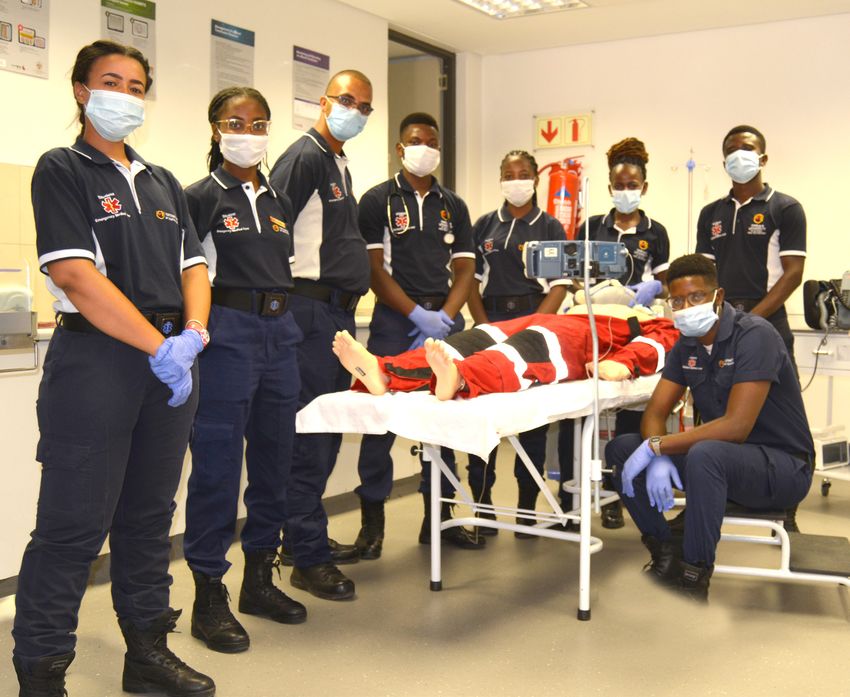
EMERGENCY MEDICAL CARE
Programme Coordinator : Carolie Cloete, M. HS (NUST), B.Tech.: EMC (DUT), ND: EMC (CPUT), MOHS (NUST)
Academic Staff : Cornelia Bauer, M. HS (NUST), B.Tech.: EMC (CPUT), ND: EMC (CPUT)
: Dillian Fredericks, BEMC (CPUT)
Clinical Laboratory
Technician : Charmaine Conradie (Lab Tech), B.Pre. Hosp, EMC (NUST)
Secretary : Christeline Januarie, B. BA (NUST)
Telephone Number : 061-207 2970
Fax Number : 061-207 9970
Email : cjanuarie@nust.na
ENVIRONMENTAL HEALTH SCIENCES
Programme Coordinator : Joshua Hidinwa, M. HS (NUST), B.Tech.: Environ. Health (CPUT), ND.: Environ. Health (Cape Tech)
Academic Staff : Prof Omotayo Awofolu, PhD Chem. (Environ. Studies) (Univ. of Fort Hare)
: Joshua Hidinwa, B.Tech.: Environ. Health (CPUT), ND.: Environ. Health (Cape Tech)
Tech. Haematology
: Dr Larai Aku-Akai, M.: Pub. Health (West African College of Physicians), B. Med.: Bachelor of Surgery
(MBBS) (Nigeria)
: Charmaine Jansen, M.: Pub. Health (Cardiff Univ.), B.Tech.: Environ. Health (Cape Tech.), ND: Environ.
Health (Pen. Tech.), PGD Dev. Studies (ZOU)
Immanuel Zeriapi, ND: Environ. Health (UJ), B.Tech.: Environ. Health (CPUT), Cert: Med.
: Buhlebenkosi Mpofu, M.Sc.: Env. Sci. (Botswana), B.Sc. Env. Health (Solusi Univ.), PGD Edu.
Laboratory Technologist : Rebecca Shooya, B. Env. Health Sci. (PoN)
Laboratory Assistant : Sekunda Hamunyela, NVC: Water Care Level III (Namwater, HR), Basic SHE Inspection (NOSA), Water
Reclamation & Adv. Water Treatment (Aqua Service & Engineering)
Secretary : Felicitas Tjandero
Telephone Number : 061-207 2899
Fax Number : 061-207 9899
E-mail : ftjandero@nust.na
HUMAN NUTRITION
Programme Coordinator : Waliomuzibu Mukisa, MSc Human Nutrition (Makerere University), BSc. Food Science and
Technology (Makerere University)
Secretary : Felicitas Tjandero
Telephone Number : 061-207 2899
Fax Number : 061-207 9899
E-mail : ftjandero@nust.na
DEPARTMENT OF MATHEMATICS & STATISTICS Code 51
Head of Department : Mr. Benson Obabueki, M.S.c.: Maths. (JOS), B.S.cHons: Maths. (Benin), NC:IT (PON)
Deputy Head of
Department : Dr Serge Neossi Nguetchue, PhD: Maths (WITS), M.Sc.: Maths. (UY1), B.Sc. Hons.: Maths.
Maths and Stats : Mr. Andrew Roux, M.Phill. (Stell), Dipl:Data Metrics (UNISA), PGCHE (NUST), Pr. Sc. Nat
Maths Programme
Coordinator : Dr Adetayo Eegunjobi, PhD Appl. Maths (CPUT), M.Sc.: Maths. (Ibadan), B.Tech. Hons.: Ind.
Maths (FUTA)
(PG)Stats Programme
Coordinator : Dr Dismas Ntirampeba, PhD Stats. (UNAM), M.Sc.: Stats. (UCT), B.Sc.: Hons. Stats. (UCT), B.
Sc.: Maths. & Stats. (UNAM), PG Dipl: Edu. Maths. & Phys. Sci.
Maths Tutoring Centre
Coordinator :
Secretary : Lidwina Newaka, BA Hons. Communication (NUST), Dipl.: PR (UNAM)
Telephone Number : 061-207 2913
Fax Number : 061-207 9913
E-mail : lnewaka@nust.na
Academic Staff Lecturer : Prof Immanuel Ajibola, PhD Maths. (Zaria), M.Sc.: Maths. (Ife), PGDC. Sci. (Lagos), B.Sc. Hons.
Physics/ Maths (Lagos)
: Jonas Amunyela, B.Sc.: Hons. Stats., B.Sc.: Maths. & Stats. (PoN)
: Prof Günter Heimbeck, Dr. rer. Nat. habil. Maths. (Würzburg), Dr. rer. Nat. Maths. (Würzburg), Dipl:
Maths. (Würzburg)
: Tobias Kaenandunge, B.Sc.: Hons. Applied Maths. (NUST), B.Sc.: Maths. & Stats. (UNAM)
: Dr Victor Katoma, PhD Maths. Modeling (UCT), M.Sc.: Comp. & Maths. Modeling (UCT),
B.Sc.: Pure & Comp. Maths. (Netherlands)
[2]Faculty of Health and Applied Sciences - Yearbook 2021
: Owen PL Mtambo, M.Sc.: Biostatistics (UNIMA), B.Sc.: Maths. Sci. (Comp. Sc., Maths. & Stats.)
(UNIMA), Dip. Edu.: Maths., Phys. Sci. & Chem. (UNIMA)
: Gabriel Mbokoma, B.Sc.: Hons. Maths, B.Sc.: Maths & Stats. (NUST)
: Rapikama Mumbuu, BSc.Hons.: Stas. (PON), B.Ed.Hons. (NWU), B.Sc.: Maths & Stats
: Etuhole-Moshili Mwahi, M.Sc.: Stats., B.Sc.: Maths. & Stats. (UNAM)
: Frans Ndinodiva, B.Sc.: Hons. Maths. B.Sc.: Maths. & Stats. (PoN), B.Tech.: Econ. (PoN)
: Prof Sunday A. Reju, PhD Computational Maths/Optimisatiion (Ilorin), M.Sc.: Applied Maths-
Continuum Mech. (Ibadan), B.Sc. Hons. Maths. (Jos)
: Aina Sakaria, B.Sc. Hons.: Maths. B.Sc.: Maths. & Stats. (PoN)
: Hilma Yvonne-Nkalle, B.S.c. Hons.: Maths. & Stats. (PoN)
: Jan Johannes Swartz, M.Sc.: Social Stats. (SOTON), Dipl: Stats. (EASTC)
: Gift Tapedzesa, M.Sc.: Maths. (UZ), B.Sc.: Applied Maths. (NUST, ZIM)
: Dr Dibaba Gemechu, PhD: Maths. & Stats. (UP), M.Sc.: Biostats. (AAU), B.Sc.: Stats. (AAU)
: Lutopu Khoa, B.Sc.: Hons.: Maths. & Stats. (UNAM)
: Dr Cliff Kikawa, D. Tech.: Stats. (TUT), M. Stats. (MUK), B.Sc.: Maths. & Physics (NUST)
: Ilenikemanya Ndadi, MSc.: Hons, Maths., B.Sc.: Maths & Stats (NUST)
DEPARTMENT OF NATURAL AND APPLIED SCIENCES Code 41
Head of Department : Prof Habauka Kwaambwa, PhD (Bristol), M.Sc. (Bristol), B.Sc. (UNZA)
Deputy Head of
Department : Prof Percy Chimwamurombe, PhD Genetics (UP), M.Sc.: Biotech. (Univ. of Zim.), B.Sc.
Hons.: Biochem. (Univ. of Zim.)
Secretary : Ester Vaino, Business Management Hons. (NUST), B.Tech.: OMT (NUST)
Telephone Number : 061-207-2012
Fax Number : 061-207-9012
E-mail Address : evaino@nust.na
Programme Coordinator : Dr Jeya Kennedy, PhD (Bharathiar), M.Sc. (Bharathidasan), B.Sc. (Bharathiar)
Academic Staff : Dr Sylvanus Onjefu, PhD Env. Physics, M.Sc.: Env. Physics (Nigeria), B.Sc.: Physics Hons. (Benue)
: Dr Euodia Hess, PhD: Chem. Sci. (UWC), M.Sc.
: Dr Dipti Sahu, PhD Physics (India), M.Sc. Physics (India), B.Sc. Hons. Physics (India)
: Dr Julien Lusilao, PhD Env. Anal. Chem. (Wits), M.Sc. Env. Analytical Chem. (Wits), B.Sc. Hons.: Chem.
(Univ. of Kinshasha)
: Dr Lamech Mwapagha, PhD Med. Biochem. (UCT), M.Sc. Med. Virology (Kenya), B.Sc. Med.
Biochem. (Kenya)
: Dr Edosa Omoregie, PhD Fisheries (Jos), M.Sc. Fisheries Mgmt. (UK), M.Sc. Applied Hydrobiology &
Fisheries (Jos), Zoology (Jos)
: Dr Munyaradzi Zivuku, PhD Physics (NWU), M.Sc. Applied Radiation Sc. & Tech. (NWU), B.Sc: Hons.
Applied Radiation Sc. & Tech. (NWU), B.Sc: Hons. Appl. Biol. & Chem. (NUST), City and Guilds Quality
: Dr Norman Muzhinji, PhD Plant Pathol (UP), M.Sc. Biotech (Univ. of Zim), B. Sc. Hons. Applied Bio &
Biochem (NUST, Zim)
: Vaino Indongo, B. Sc.: Maths. & Physics (UNAM), M. Phil.: Med. Physics (UG)
: Petrus T Paulus, MIWRM NUST), B.Sc. Hons.: Appl. Sc.: Water Utilisation (UP), B.Sc.: Molecular &
Physiological Biol. & Chem. (UNAM)
: Emmanuel Ejembi, B.Sc. Hons.: Physics (Nigeria), M.Sc.: Env. Phys. (Nigeria), M.Sc. Comp. Sci. (NUST)
Laboratory Staff : Marta Amuanyena, M. Sc.: Chemistry (UNAM), B.Tech: Sc. Chem. & Molecular Biology (UNAM),
B.Tech: Econ. (PoN),
: Tauno Nanhongo, B.Sc. Hons.: Physics & Comp. Sci.
: Mary Mutwa, B.Sc.: Chem. & Molecular & Phys. Biol. (UNAM)
: Elizabeth Nashidengo, B.Sc.: Chem. & Molecular & Phys. Biol. (UNAM)
: Natalia Shakela, B.Sc (Hon): Applied Chemistry (NUST)
: Tuwilika Tobias, B.Sc. (Hons): Applied Biotechnology (NUST)
: Pedro Tjakwanda, B.Sc.: Phys. Major & Chem. Minor (NUST)
: Markus Hitila, M.Sc. Environment Engineering (NUST), B. Sc (Hon) Physical/Geology (UNAM), PGRD:
Applied Radiation Science & Technology (NUST),
[3]Faculty of Health and Applied Sciences - Yearbook 2021
UNDERGRADUATE PROGAMMES
DEPARTMENT OF HEALTH SCIENCES Code 57
QUALIFICATIONS OFFERED
Bachelor of Medical Laboratory Sciences (Revised Programme) (Phased in 2017) 08BMLS
Bachelor of Biomedical Sciences (Phased out 2017) 50BBMS
Bachelor of Emergency Medical Care (Phased in 2018) 07BOMC
Bachelor of Environmental Health Sciences (Revised Programme) (Phased in 2019) 08BOHS
Bachelor of Science in Health Information Systems Management (Phased in 2019) 07BHIS
Bachelor of Human Nutrition (New programme) (Phased in 2019) 08BOHN
BACHELOR OF MEDICAL LABORATORY SCIENCES 08BMLS
(Revised Programme) (Phased in 2017)
NQF Level: 8 NQF Credits: 511 NQF Qualification ID: Q0991
Description
The Bachelor of Medical Laboratory Sciences is a professional degree, designed for registration at level 8 of the National
Qualifications Framework (NQF). The programme demands a high level of theoretical and practical engagement, as well as
intellectual independence and aims to foster deepened, comprehensive and systematic expertise in the major cognate area
of learning, i.e. Medical Laboratory Science. The programme further equips students with cognitive and intellectual skills, key
transferable skills and professional, technical and practical skills that would enable them to apply principles and techniques in
the routine and specialised analysis of biological specimens and other substances. Students will also be capacitated to organise
laboratory operations in clinical diagnostic laboratories in accordance with Good Laboratory Practice (GLP). Students will be able
to integrate laboratory tests and results with pathophysiological conditions and conduct supervised research based on sound
scientific principles. Overall, the programme aims to produce highly flexible and well-trained graduates who are able to adapt to a
changing environment and comply with statutory requirements in relation to quality, ethics and safety.
Successful completion of the Bachelor of Medical Laboratory Sciences and the industry examination will enable graduates to
register with the Health Professions Council of Namibia (HPCNA).
Admission Criteria
In addition to meeting the University’s minimum admission requirements as outlined in the general rules, candidates must have a
total of 18 points on the evaluation scale for Physical Science, Mathematics and Biology, in a combination of symbols on NSSC
Higher or Ordinary Level or both. No symbol for any one or more of the subjects may be lower than a “C” on Ordinary Level or a
4 on Higher
Level. Candidates must further have obtained at least a “D” on Ordinary Level for English.
For candidates seeking admission with NSSCO/NSSCAS results, requirements are as follows: in addition to meeting the University’s
minimum admission requirements as spelt out in the general rules, candidates must have a minimum of 24 points in Mathematics,
Chemistry, Biology and Physics on Ordinary Level or Advanced Subsidiary level (NSSCO/AS), provided that no symbol must be
below a “B” on Ordinary Level or a “D” on Advanced Subsidiary Level. Candidates must further have obtained at least an “E” on
Ordinary level in English.
The Head of Department or his/her nominee may admit candidates who do not have the required minimum symbol for one of the
above subjects, provided that such candidates have very strong symbols for the other two subjects and that the total point score
for the three subjects is not lower than 18.
Students who meet the above admission requirements will be subjected to a selection process using ranking of results for Biology,
Physical Science and Mathematics.
Articulation Arrangements
The transfer of credits will be dealt with according to NUST rules and regulations on Recognition of Prior Learning. These provide
for course by course credits as well as credit transfer by volume under certain academic conditions. Maximum credits that can be
granted are 50% of the credits for a qualification.
Graduates of this programme will under normal circumstances be able to pursue further studies in Medical Laboratory Science, or
a related cognate area of learning, at NQF Level 9.
Mode of Delivery
This programme will be offered on the full-time mode of study in accordance with NUST rules and regulations.
[4]Faculty of Health and Applied Sciences - Yearbook 2021
Requirements for Qualification Award
The Bachelor of Medical Laboratory Sciences designed for registration at NQF level 8, will be awarded to a student credited with
a minimum of 511 NQF credits, this total includes the courses making up the 465 cognitive credits and then the core institutional
courses which is 46 credits. In addition, students must meet the administrative and financial requirements as spelt out in Part 1 of
NUST Yearbook.
Teaching and learning strategies
The requirements of the NQF underline the acquisition of cognitive skills and competencies exceeding the knowledge and
understanding of subject specific knowledge items and professional and/or technical competencies. Thus, the programme focuses
on the engagement of students in an interactive learning process in order to provide for the development of generic cognitive and
intellectual skills, key transferable skills, and, as the case may be, subject specific and/or professional/technical practical skills.
This learning process will be facilitated both in and outside the classroom, requiring specific tasks to be carried out by the student.
This facilitation will make use of, inter alia, practical projects, tutorials, case studies, software demonstration, problem based
learning and individual and/or group work. The progress of learning embedded in such tasks will be monitored, recorded and
assessed.
Learning activities outside the classroom will include three components of Work Integrated Learning (WIL). Students will rotate
within the semester through clinical laboratories (e.g. Namibian Institute of Pathology and Namibian Blood Transfusion Services)
and will be incorporated into the routine diagnostic laboratory and will learn by doing.
Assessment Strategies
Students will be assessed through continuous and summative assessment. These assessments will focus on the achievement of
qualification outcomes and take the form of problem solving exercises, individual/group assignments and presentations, case
studies, report writing, practical application of skills and competencies, tutorials, practical projects and questioning (tests and/or
examinations). The use of validating end of term assessments may be minimised in order to free students’ intellectual capacity
for broader cognitive development. Assessment by means of tests and/or examinations will, therefore, be restricted to situations
where it is necessary to establish that a previous specific performance can be repeated or a specific skill can be transferred. In
accordance with NUST policy on diversified continuous assessment, each course will have a minimum of six assessment events.
Courses that are assessed using a combination of continuous assessment and a final end-of-term examination must have at least
three assessments.
In this programme, all courses will be assessed using a combination of continuous assessment and an end-of-semester examination
in the ratio 60% (continuous assessment) and 40% (examination).
Assessment of the Work Integrated Learning components will be dealt with by means of close cooperation between WIL clinical
instructors and NUST academics by means of a work manual in which students have to report on their activities in the simulation
laboratory and/or work place and signed-off by the instructors. The mini-thesis will be assessed in accordance with NUST rules for
studies at honours level.
Transition Arrangements
The Bachelor of Biomedical Sciences (old curriculum) will be phased out systematically until 2022 with minimum disruption to
existing students’ learning progression. The last intake of 1st year students for the out-phasing programme (old curriculum) was
in January 2016.
Students who were registered in 2016 for the 1st year of the old curriculum, and who do not meet the rules for progression to
the 2nd year at the end of 2016, will be required to change their registration to the revised programme (revised curriculum), and
will be granted credits on a course-by-course basis in accordance with information in Table 1, below. Similarly, students who are
registered in 2016 for the 1st year of the old curriculum, and who meet the minimum requirements for progression to the 2nd
year at the end of 2016, will also be required to transition to the revised programme (revised curriculum), but will be required
to do Cell and Molecular Biology. Such students, will be exempted from the newly introduced English communication courses,
and Information Competence, but will have to meet all other requirements of the revised programme (revised curriculum). Such
arrangements will be done in consultation with office of the Registrar to ensure that students do not lose credits.
Students who were registered in 2016 for the 2nd, 3rd or 4thyear of the old curriculum will be required to complete their studies,
based on the requirements of the old curriculum.
The revised Bachelor of Medical Laboratory Sciences (revised curriculum) has taken effect from January 2017 with the implementation
of the 1st and 2nd years. The revised programme will be fully implemented by 2019. Courses will only be offered based on the
new/revised syllabi in 2017 (1st and 2nd year), 2018 (3rd year), and 2019 (4th year). Students who fail any of the courses on the
old curriculum will be required to repeat such courses based on the syllabi of new/revised corresponding courses (please refer to
Table 2, below, for information on the new/revised corresponding courses to be done, if courses on the old curriculum are failed).
The deadline for complete phasing out of the Bachelor of Biomedical Sciences (old curriculum) is 2022 after which students must
automatically change registration to the revised programme (new curriculum) and fulfil all requirements of the new curriculum.
[5]Faculty of Health and Applied Sciences - Yearbook 2021
Table 1: Courses to be credited
Course Bachelor of Biomedical Sciences Course Bachelor of Medical Laboratory Science (New/
Code (Old Courses) Code Revised Corresponding Courses to be Done, if Failed)
CEM110S Medical Chemistry HSC511S Health Science Chemistry
MPH110S Medical Physics HSP511S Health Science Physics
BCL110S Biostatistics and Calculations HSS511S Health Science Statistics
CUS411S Computer User Skills CUS411S Computer User Skills
EAP511S English for Academic Purposes EAP511S English for Academic Purposes
LAP110S Laboratory Principles IML511S Introduction to Medical Laboratory Science
ALP120S Applied Laboratory Principles
BMB120S Molecular Biology CMB521S Cell and Molecular Biology
CEB210S Cell Biology
HPY110S Human Anatomy and Physiology A HPY511S Human Anatomy and Physiology 1A
IMY120S Immunology IMY521S Immunology
HPY120S Human Anatomy and Physiology B HPY521S Human Anatomy and Physiology 1B
BCH120S Biochemistry BIO521S Biochemistry
MMB210S Medical Microbiology 1 MMB611S Medical Microbiology 2A
HAM210S Haematology 1 HAM611S Haematology 2A
CLC210S Clinical Chemistry 1 CLC611S Clinical Chemistry 2A
MMB220S Medical Microbiology 2 MMB621S Medical Microbiology 2B
HAM220S Haematology 2 HAM621S Haematology 2B
CLC220S Clinical Chemistry 2 CLC621S Clinical Chemistry 2B
MOD310S Molecular Diagnostics MOD621S Molecular Diagnostics
MMB310S Medical Microbiology 3 MMB711S Medical Microbiology 3
HAM310S Haematology 3 HAM711S Haematology 3
CLC310S Clinical Chemistry 3 CLC711S Clinical Chemistry 3
RES310S Research Methodology RMA821S Research Methodology
BMT320S Experiential learning A WLB721S WIL 3
BMT410S Experiential learning B WLB811S WIL 4A
LAM320S Medical Laboratory Management A MLM711S Medical Laboratory Management
LAM420S Medical Laboratory Management B
ICP420S Integrated Clinical Pathology ICP811S Integrated Clinical Pathology
[6]Faculty of Health and Applied Sciences - Yearbook 2021
Table 2: Corresponding Courses (if Failed). This is not a credit table.
Course Bachelor of Biomedical Sciences Course Bachelor of Medical Laboratory Science (New/Revised
Code (Old Courses) Code Corresponding Courses to be Done, if Failed)
CEM110S Medical Chemistry HSC511S Health Science Chemistry
MPH110S Medical Physics HSP511S Health Science Physics
BCL110S Biostatistics and Calculations HSS511S Health Science Statistics
CUS411S Computer User Skills CUS411S Computer User Skills
LAP110S Laboratory Principles IML511S Introduction to Medical Laboratory Science
ALP120S Applied Laboratory Principles
BMB120S Molecular Biology CMB521S Cell and Molecular Biology
CEB210S Cell Biology
HPY110S Human Anatomy and Physiology A HPY511S Human Anatomy and Physiology 1A
IMY120S Immunology IMY521S Immunology
HPY120S Human Anatomy and Physiology B HPY521S Human Anatomy and Physiology 1B
BCH120S Biochemistry BIO521S Biochemistry
MMB210S Medical Microbiology 1 MMB611S Medical Microbiology 2A
HAM210S Haematology 1 HAM611S Haematology 2A
CLC210S Clinical Chemistry 1 CLC611S Clinical Chemistry 2A
MMB220S Medical Microbiology 2 MMB621S Medical Microbiology 2B
HAM220S Haematology 2 HAM621S Haematology 2B
CLC220S Clinical Chemistry 2 CLC621S Clinical Chemistry 2B
MOD310S Molecular Diagnostics MOD621S Molecular Diagnostics
MMB310S Medical Microbiology 3 MMB711S Medical Microbiology 3
HAM310S Haematology 3 HAM711S Haematology 3
CLC310S Clinical Chemistry 3 CLC711S Clinical Chemistry 3
RES310S Research Methodology RMA821S Research Methodology
BMT320S Experiential learning A WLB721S WIL 3
BMT410S Experiential learning B WLB811S WIL 4A
LAM320S Medical Laboratory Management A MLM711S Medical Laboratory Management
LAM420S Medical Laboratory Management B
ICP420S Integrated Clinical Pathology ICP811S Integrated Clinical Pathology
Please Note:
In cases where more than one course in the old curriculum is replaced by one course in the new programme, students who have
failed any one of the old courses must do the whole new course. Exemption cannot be granted for less than a whole course.
Table 2 only highlights new/revised core courses in Bachelor of Medical Laboratory Sciences that should be done if courses on the
old curriculum are failed. Service courses from other Departments are excluded, but the rules of relevant Departments apply to
this programme as well.
Such course will have to be offered until the programme completely phases out in 2022:
• Biology of Diseases
CURRICULUM
Year 1
Semester 1
Course Title Course Code Prerequisite NQF NQF
Level Credit
Human Anatomy and Physiology 1A HPY511S None 5 12
Introduction to Medical Laboratory Science IML511S None 5 12
Health Science Chemistry HSC511S None 5 10
Health Science Physics HSP511S None 5 10
Health Science Statistics HSS511S None 5 10
Computer User Skills CUS411S None 4 10
Principles of English Language Use PLU411S None 4 NCB
[7]Faculty of Health and Applied Sciences - Yearbook 2021
Semester 2
English in Practice EPR511S Principles of English Language Use 5 NCB
Information Competence ICT521S None 5 10
Human Anatomy and Physiology 1B HPY521S Human Anatomy and Physiology 1A 5 12
Immunology IMY521S Human Anatomy and Physiology 1A 5 12
Biochemistry BIO521S Health Science Chemistry 5 10
Cell and Molecular Biology CMB521S Human Anatomy and Physiology 1A 5 12
Year 2
Semester 3
English for Academic Purposes EAP511S English in Practice 5 14
Medical Microbiology 2A MMB611S Human Anatomy and Physiology 1B 6 13
Introduction to Medical
Laboratory Science
Haematology 2A HAM611S Human Anatomy and Physiology 1B 6 10
Immunology
Clinical Chemistry 2A CLC611S Biochemistry 6 12
Introduction to Medical
Laboratory Science
Anatomical Pathology 2A ANP611S Human Anatomy and Physiology 1A 6 14
Human Anatomy and Physiology
1B Cell andMolecular Biology
Semester 4
Medical Microbiology 2B MMB621S Medical Microbiology 2A 6 12
Haematology 2B HAM621S Haematology 2A 6 12
Clinical Chemistry 2B CLC621S Clinical Chemistry 2A 6 12
Anatomical Pathology 2B ANP621S Anatomical Pathology 2A 6 12
Immunohaematology IMH621S Human Anatomy and Physiology 1A 6 10
Human Anatomy and Physiology 1B
Molecular Diagnostics MOD621S Biochemistry Cell and Molecular 6 10
Biology
Year 3
Semester 5
Sustainability and Development SYD611S None 7 12
Medical Microbiology 3 MMB711S M edical Microbiology 2B 7 12
Haematology 3 HAM711S Haematology 2B 7 12
Clinical Chemistry 3 CLC711S Clinical Chemistry 2B 7 12
Medical Laboratory Management MLM711S Introduction to Medical
Laboratory Science 7 14
Semester 6
Research Methodology RMA821S Health Science Statistics 8 12
Work Integrated Learning 3 (WIL 3) WLB721S Medical Microbiology 3 7 50
Clinical Chemistry 3
Haematology 3
Molecular Diagnostics
Anatomical Pathology 2B
Year 4
Semester 7
Integrated Clinical Pathology ICP811S Work Integrated Learning 3 (WIL 3) 8 14
Work Integrated Learning 4A (WIL 4A) WLB811S Work Integrated Learning 3 (WIL 3) 8 50
Semester 8
Mini-Thesis MTB811S Research Methodology 8 30
Work Integrated Learning 4B (WIL 4B) WLB821S Work Integrated Learning 4A (WIL 4A) 8 40
[8]Faculty of Health and Applied Sciences - Yearbook 2021
BACHELOR OF BIOMEDICAL SCIENCES 50BBMS
(Phased out from 2017)
NQF Level: 8 NQF Credits: 515 NQF Qualification ID: Q0165
Description
The Bachelor of Biomedical Sciences is a professional degree at NQF Level 8. The degree incorporates a research component and
1 year of practical work-based learning. The programme is offered on full time mode only.
Admission Requirements
Grade 12 with minimum of 25 points as per the NUST general admission requirements. In addition, applicants must meet the
following specific admission requirements:
Mathematics – “B” on NSSC (O) or 4 on NSSC (H) or equivalent
English – “E” on NSSC (O) or 4 on NSSC (H) or equivalent
Biology or Physiology – “B” on NSSC (O) or 4 on NSSC (H) or equivalent
Physical Science – “B” on NSSC (O) or 4 on NSSC (H) or equivalent
Students meeting these requirements will be subjected to a selection process. Limited space is available in the programme.
Meeting admission requirements does not guarantee placement in the programme. No mature age entries will be considered.
CURRICULUM
Year 1
Semester 1
Course Title Course Code Prerequisite(s) NQF NQF
Level Credits
Human Anatomy & Physiology 1A HPY110S None 5 12
Medical Chemistry CEM110S None 5 10
Biostatistics and Calculations BCL110S None 5 8
Medical Physics MPH110S None 5 7
Laboratory Principles 1A LAP110S None 5 12
Computer User Skills CUS411S None 4 10
English for Academic Purposes EAP511S English in Practice, or Language 5 14
in Practice B, or Module 3
or Exemption
Semester 2
Human Anatomy and Physiology 1B HPY120S Human Anatomy and Physiology 1A 6 12
Molecular Biology BMB120S Medical Chemistry 1 6 10
Immunology IMY120S Human Anatomy and Physiology 1A 6 12
Biochemistry BCH120S Medical Chemistry 1 6 12
Applied Laboratory Principles 1B ALP120S Laboratory Principles 1A 6 15
Year 2
Semester 3
Medical Microbiology 1 MMB210S Human Anatomy and
Physiology 1A & 1B 6 15
Haematology 1 HAM210S Immunology 6 12
Clinical Chemistry 1 CLC210S Biochemistry 6 12
Cell Biology CEB210S Human Anatomy and 6 10
Physiology 1A & 1B
Semester 4
Medical Microbiology 2 MMB220S Medical Microbiology 1 7 20
Haematology 2 HAM220S Haematology 1 7 15
Biology of Diseases BOD220S Cell Biology 7 10
Clinical Chemistry 2 CLC220S Clinical Chemistry 1 7 15
[9]Faculty of Health and Applied Sciences - Yearbook 2021
Year 3
Semester 5
Medical Microbiology 3 MMB310S Medical Microbiology 2 7 15
Haematology 3 HAM310S Haematology 2 7 15
Clinical Chemistry 3 CLC310S Clinical Chemistry 2 7 15
Research Methodology A RES310S Biostatistics and Calculations 7 15
Medical Laboratory Management A LAM320S Applied Laboratory Principles 1B 7 10
Molecular Diagnostics MOD310S Clinical Chemistry 2 7 15
Semester 6
Experiential Learning A BMT320S All semester five courses 8 60
Year 4
Semester 7
Experiential Learning B BMT410S Experiential Learning A 8 60
Semester 8
Integrated Clinical Pathology ICP420S Experiential Learning A & B 8 27
Research Project RSP420S Research Methodology A 8 30
Medical Laboratory Management B LAM420S Medical Laboratory Management A 8 10
Progression Rule: Students must complete and have passed all clinical courses before they will be allowed to register for experiential
learning.
[ 10 ]Faculty of Health and Applied Sciences - Yearbook 2021
BACHELOR OF EMERGENCY MEDICAL CARE 07BOMC
NQF Level: 7 NQF Credits: 388 NQF Qualification ID: Q1109
Description
The Bachelor of Emergency Medical Care is a three-year full-time programme that is registered at a NQF level 7. Designed to
provide students with a systematic and coherent introduction to the broad knowledge, principles, concepts and problem-solving
techniques of emergency medical care. The programme will enable students to acquire cognitive/intellectual skills, practical/
clinical skills, and key transferable skills for a career in the profession of emergency medical care. Graduates of this programme will
be able to competently integrate and apply theoretical principles and practical clinical procedures and techniques to independently
provide emergency medical care to injured and/or ill patients in urban, peri-urban and rural areas within the scope of practice
stipulated by the Health Professions Council of Namibia (HPCNA).
The programme allows for an early exit with a Diploma in Emergency Medical Care after successful completion of the second year
of study. Students who exit with a Diploma will be able to find employment in industry as mid-level emergency care practitioners
and will be eligible to register with the HPCNA as Emergency Care Technicians (ECT’s). Successful completion of the Bachelor of
Emergency Medical Care degree will enable registration with the HPCNA as an Advanced Life Support (ALS) Practitioner, while
graduates will be able to find employment in more senior positions, typically as ALS practitioners (Paramedics).
Admission Requirements
Candidates may be considered for admission to this programme, if they meet the General Admission Requirements of the Namibia
University of Science and Technology (GI2.1 in Part 1 of the NUST Yearbook), and comply with the additional requirements below
(old curriculum)::
• A minimum “E” symbol in English as a Second Language at NSSC Ordinary Level or a 4 on Higher Level;
• A minimum “D” symbol in Mathematics and Biology, or Physical Science, at NSSC Ordinary Level or 4 on Higher Level.
For candidates seeking admission with NSSCO/NSSCAS results requirements are as follows: in addition to meeting the University’s
minimum admission requirements as spelt out in the general rules, candidates must have a minimum of 18 points in Mathematics,
Biology AND EITHER Physics OR Chemistry on NSSC Ordinary Level or Advanced Subsidiary level (NSSCO/AS), provided that no
symbol must be below “B” on Ordinary Level or a “D” on Advanced Subsidiary Level. Candidates must further have obtained at
least an “E” on Ordinary level in English. Candidates will also be required to go through a 3 day selection process involving a written
test, medical and physical fitness tests.
Mature age candidates will be considered provided they meet the requirements and pass the mature age entrance examinations
of the Namibia University of Science and Technology (GI2.2 in Part 1 of the NUST Yearbook). Students are required to obtain a
minimum final score of at least 60% in the language proficiency test and 50% in the mathematics proficiency test.
The final selection of candidates to this programme shall follow a three-step process as indicated below:
Step 1: Applicants, who meet or surpass the minimum admission requirements, as stated above, will be shortlisted based on
academic merit. Such candidates shall receive an invitation and information package for the selection assessments of the second
stage (Step Two).
Step 2: Candidates are to be assessed in terms of their physical, medical fitness/abilities and phobias, and will be required to do
a short-written placement test as well. Based on the outcome of these assessments, a shortlist shall be compiled and successful
candidates will be invited to participate in a selection interview (Step Three).
Step 3: Candidates shall undergo an interview by the programme staff after which the final selection for admission shall be made.
The results of the Selection Committee are final and no discussion or correspondence will be entered into.
If the final Grade 12 results of candidates, who were selected provisionally, do not meet the minimum requirements, then admission
to the programme will be withheld.
Holders of the National Higher Certificate in Emergency Medical Care may be considered for admission to this programme provided
they are registered with the Health Professions Council of Namibia as Emergency Care Technicians. These candidates, if admitted,
will be granted credits for the following courses:
• Language in Practice (Principles of English Language Use)
• Computer User Skills
• Basic Science
• Pre-hospital Emergency Medical Care I
• Human Anatomy and Physiology
• Clinical Practice I
• Basic Medical Rescue
• Clinical Practice II
• Primary Health Care and HIV/AIDS
[ 11 ]Faculty of Health and Applied Sciences - Yearbook 2021
Holders of the National Higher Certificate in Emergency Medical Care will not be awarded with the new Diploma in Emergency Care.
Emergency Care Technicians (National Higher Certificate) and Critical Care Assistants (CCA’s) are eligible to apply for Recognition of
Prior Learning (RPL) as established by the programme.
Mode of Delivery
This programme will be delivered on the full-time mode of study in accordance with NUST rules.
Requirements for Qualification Award
The Bachelor of Emergency Medical Care will be awarded to candidates credited with a minimum of 388 NQF credits while the
Diploma in Emergency Medical Care (Level 6) will be awarded to candidates credited with a minimum of 259 NQF credits. In
addition, students should meet the administrative and financial requirements as set out in Part 1 of the Namibia University of
Science and Technology Yearbook.
Progression Rules
Students will only have three opportunities to pass the following courses; Emergency Medical Care I, Clinical Practice I, Emergency
Medical Care II, Clinical Practice II, Emergency Medical Care III, and Clinical Practice III; due to the limited number of available
sites for clinical placement (Work Integrated Learning), and due to advice in placement of students by the HPCNA, particularly
pertaining to the ratio of student to lecturer in all practical classes. This will ensure that students are awarded a fair opportunity
to complete the programme successfully whilst adhering to the HPCNA requirements in terms of students to lecturer ratios in
theoretical and practical classes.
Teaching and Learning Strategies
The requirements of the NQF underline the acquisition of cognitive skills and competencies exceeding the knowledge and
understanding of subject specific knowledge items and professional/technical competencies.
Thus, the qualification focuses on the engagement of students in an interactive learning process in order to provide for the
development of generic cognitive and intellectual skills, key transferable skills, and, as the case may be, subject specific and/or
professional/technical practical skills.
This learning process will be facilitated both in and outside the classroom, requiring specific tasks to be carried out by the student.
This facilitation will make use of, inter alia, online lectures, practical projects, tutorials, case studies, problem based learning
and individual and/or group work. The progress of learning embedded in such tasks will be monitored, recorded and assessed.
In addition, courses will be facilitated and can be assessed through the MyNUST e-learning platform, where relevant course
materials will also be made available to students. The teaching and learning strategies for this programme are designed not only
to equip students with the necessary knowledge and expertise in emergency medical care, but also to enable them to present and
communicate academic and professional work effectively, conduct research, retrieve information efficiently and effectively, plan
effectively, and independently evaluate processes and results.
Assessment strategies
Learning and assessment will be integrated throughout the programme. All the courses in the main cognate area of learning will
be assessed by means of continuous assessment only. Assessments will focus on the achievement of course and qualification
outcomes and may take the form of problem solving exercises, individual/group assignments and presentations, case studies,
policy briefs, practicum workbooks, objectively structured clinical evaluations (OSCE), simulated patient scenarios, tutorials and
questioning through tests.
Lecturing staff shall discuss assessments of the various courses at monthly programme meetings and together with this, course
content and any assessments shall be passed through the course moderator in order to ensure quality and fairness of assessments
whilst ensuring students are not over-assessed or under-assessed.
Assessment of both cognitive and psychometric capabilities shall be performed through the various assessment methods as
discussed above. In accordance with NUST policy on continuous assessment, each course will have a minimum of four assessment
events.
Clinical Practice shall be assessed using the practicum workbook and a portfolio of evidence. In order for a student to be considered
for a pass they must obtain the minimum notional hours for the relevant course. The practicum workbook and the portfolio of
evidence shall carry a mark weight that, together, shall total 100% of the course mark.
[ 12 ]Faculty of Health and Applied Sciences - Yearbook 2021
CURRICULUM
Year 1
Semester 1
Course Title Course Code Prerequisite
Principles of English Language in Use PLU411S None
Computer User Skills CUS411S None
Basic Science BSC410S None
Semester 2
English in Practice EPR511S Principles of English Language Use
Information Competence ICT521S None
Basic Mathematics BMS411S None
Year Courses
Emergency Medical Care I EMC501Y None
Human Anatomy and Physiology HAP501Y None
Primary Health Care and HIV/AIDS PHC501Y None
Clinical Practice I CPR501Y None
Year 2
Semester 1
English for Academic Purposes EAP511S English in Practice
Medical Rescue 1A MRS511S None
Pathophysiology PPH611S Human Anatomy and Physiology
Semester 2
Medical Law and Ethics MLE512S None
Medical Rescue 1B MRS521S Medical Rescue 1A
Year Courses
Emergency Medical Care II EMC601Y Emergency Medical Care I, Human Anatomy and Physiology,
Clinical Practice I
Pharmacology PHA601Y Emergency Medical Care I, Human Anatomy and Physiology
Clinical Practice II CPR601Y Emergency Medical Care I, Clinical Practice I
Year 3
Semester 1
Sustainability and Development SYD611S None
Semester 2
Emergency Medical Service Administration EMS612S Emergency Medical Care II
Year Courses
Emergency Medical Care III EMC701Y Emergency Medical Care II and Clinical Practice II, Pharmacology
Clinical Practice III CPR701Y Emergency Medical Care II, Clinical Practice II, Pharmacology
ICU and Critical Care Transport ICU701Y Emergency Medical Care II, Clinical Practice II, Pharmacology
[ 13 ]Faculty of Health and Applied Sciences - Yearbook 2021
BACHELOR OF ENVIRONMENTAL HEALTH SCIENCES 08BOHS
(Revised Programme) (Phased in 2017)
NQF Level: 8 NQF Credits: 517 NQF Qualification ID: Q0310
Description
The Bachelor of Environmental Health Sciences is a professional degree, designed for registration at level 8 on the National
Qualifications Framework (NQF). The programme demands a high level of theoretical practical and field work engagement. It also
requires intellectual independence which aims at deepened, comprehensive and systematic expertise in the major cognate area
of learning, i.e. Environmental Health.
The current Bachelor of Environmental Health Sciences programme was reviewed in order to ensure full compliance with the NUST
Curriculum Framework and requirements of the NQF. The curriculum review is needed to ensure that students attain all the core
competencies to practice in different industries, and are equipped to deal with public health needs in a dynamic health system.
Admission Criteria
Candidates may be admitted to this programme if they meet the General Admission Requirements of the University. In addition,
candidates must have a minimum of 15 points in Physical Science, Mathematics and Biology at NSSC (H or O), provided that no
symbol must be below “C” on Ordinary Level.
For the candidates seeking admission with NSSCO/NSSCAS results, requirements are as follows: in addition to meeting the
University’s minimum admission requirements as outlined in the general rules, candidates must have a minimum of 20 points in
Mathematics, Chemistry, Biology and Physics on NSSC Ordinary Level or Advanced Subsidiary level (NSSCO/AS), provided that no
symbol must be below “C” on Ordinary Level or a “D” on Advanced Subsidiary Level. Candidates must further have obtained at
least an “E” on Ordinary level in English. Candidates might also be required to go through a selection process involving a written
test.
Articulation Arrangements
The transfer of credits will be dealt with according to the University’s rules and regulations on Recognition of Prior Learning. These
provide for course by course credits as well as credit transfer by volume under certain academic conditions. Maximum credits that
can be granted are 50% of the credits for a qualification.
Graduates of this programme will under normal circumstances be able to pursue further studies in Environmental Health Sciences,
or a related cognate area of learning, at NQF Level 9.
Mode of Delivery
The Bachelor of Environmental Health Sciences will be offered on the full-time mode in accordance with NUST rules and procedures.
Requirements for Qualification Award
The Bachelor of Environmental Health Sciences, designed for registration at NQF level 8, will be awarded to students credited
with a minimum of 517 NQF credits. All the courses are compulsory and in addition, students must meet the administrative and
financial requirements as spelt out in Part 1 of the NUST Yearbook.
Teaching and Learning Strategies
The requirements of the NQF underline the acquisition of cognitive skills and competencies exceeding the knowledge and
understanding of subject specific knowledge items and professional/technical competencies. Thus, the programme focuses on
the engagement of students in an interactive learning process in order to provide for the development of generic cognitive and
intellectual skills, key transferable skills, and, as the case may be, subject specific and/or professional/technical practical skills. This
learning process will be facilitated both in and outside the classroom, requiring specific tasks to be carried out by the student.
This facilitation will make use of, inter alia, practical projects, tutorials, case studies, field trips, software demonstration, problem
based learning and individual and/or group work. The progress of learning embedded in such tasks will be monitored, recorded
and assessed.
Learning activities outside the classroom will include two semesters of Work Integrated Learning at various institutions such as the
Ministry of Health and External Services, Municipalities, Abattoirs, Namport, Namwater, food processing industries, food storage
industries, mining companies, etc., to enable students to apply learnt competencies and conduct research of an applied nature (to
be published in a Mini-thesis). The department will identify industry supervisors who will work hand in hand with the department
in training and supervising the students learning activities during Work Integrated Learning.
The Work Integrated Learning experiences should be documented throughout the placement period, reports on the students’
performance will be provided outlining activities covered during WIL. At the end of the attachment, students need to provide
a detailed written report that will be presented to a panel of evaluators who will determine the mark to be awarded to the
student. This mark contributes towards the final semester mark for the course. External moderators will moderate the portfolios
for both semesters. Work Integrated Learning (Part 1) includes Meat Hygiene practicals and Environmental Health Services. Work
Integrated Learning (Part 2) includes Environmental Health Services while students are required at the same time to carry out their
[ 14 ]You can also read


