FOREIGN WITHHOLDING TAX RECOVERY - ECJ CLAIMS AND US TAX CONSEQUENCES - Morgan Lewis
←
→
Page content transcription
If your browser does not render page correctly, please read the page content below

FOREIGN WITHHOLDING
TAX RECOVERY
ECJ CLAIMS AND US TAX CONSEQUENCES
June 30, 2021
     Rich LaFalce, Partner, Morgan Lewis
     Adam Holmes, Associate, Morgan Lewis
     Julia Bricker, Managing Director, North America, WTax
     Jason Yule, Regional Director, North America, WTax
     Lelanie Marais, Head of Research and Development, WTax

                                                              © 2021 Morgan, Lewis & Bockius LLP
AGENDA
01. | Morgan Lewis and WTax Introduction
02. | Withholding Tax Landscape
03. | Additional ECJ Information
04. | US Tax Considerations – US RIC and Withholding Tax Refunds
05. | How WTax and Morgan Lewis Can Help

                                                                   2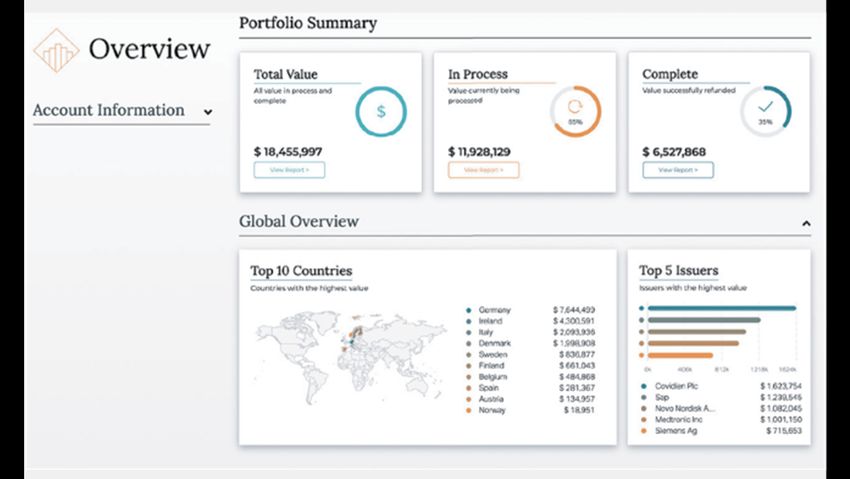
01. | Morgan Lewis and WTax
Introduction

                              3
BREADTH AND DEPTH OF OUR
                                                                                             Tax
                                                                                         Controversy
                                                                                         & Litigation

MORGAN LEWIS TAX PRACTICE
                                                                        Transactional
                                                                                                            Research &
                                                                       Tax Planning &
                                                                             Tax
                                                                                                           Development
                                                                         Structuring                        Tax Credit

                                                                                             TAX
      78              45             34              11               Transfer
                                                                       Pricing
                                                                                                                   Partnership
                                                                                                                    Taxation
   Total Number    Tax Partners   Non-Partner      Number of
  of Tax Lawyers                  Tax Lawyers     Offices with
                                                  Tax Lawyers

                                                                                  State &           Tax-Exempt
                                                                                 Local Tax         Organizations

WE WORK IN COLLABORATION AROUND THE WORLD

31 OFFICES
ACROSS 17                 700+                  180+             1100+                  450+
                                                 SENIOR                                 LEGAL
TIME ZONES                PARTNERS
                                                LAWYERS
                                                                 ASSOCIATES
                                                                                    PROFESSIONALS

                                                                                                                                 4
WTax                                    VAT IT GROUP

1 000+

                                                                                i
         Clients

4 500+   Funds serviced globally
                                           VAT                   VAT            Withholding           Importer     Meridian
                                                                                                                  VAT Reclaim
                                         Recovery             Compliance        Tax Recovery         of Records

  150+   Custodian Relationships

  30+    Foreign Reclaim Jurisdictions              Largest indirect tax recovery firm globally

    Fee – Success-based                             1 300+ employees located in 40 wholly owned offices

                                                    Servicing over 15 000 clients in 107 countries

                                                                                                                            5
02. | Withholding Tax Landscape

                                  6
What is withholding tax and                   How can you get relief from and reclaim
how can it be reclaimed?                      withholding tax?

Withholding tax is a tax deducted at source
by a local government on dividends and
interest paid to a non-resident domiciled       Relief at Source         Double Tax Treaties
outside that country.

                                                Domestic Tax             European Court
                                                Legislation Exemptions
                                                                         of Justice (ECJ)

                                                                                            7
Basis:                 Availability             Opportunity

                                             Legal precedent in        Specific vinvestors     Specific investment
                                                       v
                                                   favor of              in limited EU                funds
                                             anti-discrimination           countries            (EU and Non-EU)
                                             and the free flow of
                                              capital within the
                                              European Union

         European Court of Justice (ECJ) /      WHT incurred and generally fully recovered through ECJ mechanism
         Case Law Precedent Claims

Also referred to as Santander, Aberdeen,
Fokus Bank or EU claims

                                                                                         Dividends & Interest
                                                                                         DTT
                                                                                         ECJ

                                                                                                                   8
Comparability of foreign and domestic funds

                                  Based on precedent set in court cases

                                        Article 63 of the Treaty of the Functioning of the EU
 Challenges in                          and the free flow of capital

filing ECJ claims
                                      ECJ Rulings filter down to local authorities

                                Claim expiration

              Multiple rounds of queries and appeals

                                                                                            9
03. | Additional ECJ Information

                                   10
Actively Partly refunding Refunds under
ECJ refunding / refunds consideration
expected
territories
for US RICs
Finland France Denmark
v v v
Poland Sweden Germany
Spain Netherlands
Italy
* Please note there are additional territories where refunds were previously available and are now passed
statute as well as some additional territories where we do not believe claims are viable.
11Market
Update
The tax authorities are actively granting refunds to US RIC’s where
comparability is evidenced.
Finland only considers contractual investment funds comparable to Finnish
investment funds. Historically, both US RIC’s established as Delaware Trust and
Massachusetts trust have been considered comparable.
The Finnish Administrative court has also issued positive rulings regarding US
Finland RIC’s organized as Maryland corporations finding that these corporate funds
are comparable with Finnish contractual-based funds under EU law.
Following the Emerging Market case US RIC’s have been receiving successful
refunds from Poland for EU based claims. Albeit the success the reclaims are
administratively burdensome and complex.
Starting from 1 January 2021, all claims for WHT refunds in Poland are reviewed
by one entity – Lubelski Tax Office in Lublin (before 2021, depending on
Poland circumstances, other tax offices - e.g. in Warsaw - were responsible for such
proceedings).
While the requirements for these claims are now unified they are also
unfortunately stricter than before. 12Market
Update
During 2021 the French Tax Authorities (FTA) issued the first set of favorable
decisions and refunds on reclaims filed by US RIC’s on the basis of the free
movement of capital.
On August 12, 2020 the FTA published draft updated guidelines concerning
the documentation and application process for non-EU CIV’s seeking
domestic exemption on French equities
As a reminder - Article 119 bis 2 of the French tax code (FTC) provides for an
exemption from withholding tax on French dividends paid to certain
nonresident regulated CIV’s. This exemption was introduced following the
positive ruling by the CJEU in the Santander case in May 2012
France The updated guidelines provide clarity on the criteria that must be met by a
non-EU CIV to confirm its comparability to a French CIV to qualify for the
domestic exemption on French sourced dividend payments.
Currently, non-EU CIVs are required to submit a contentious litigation request
with supporting documentation to the FTA to obtain approval to qualify for
domestic exemption. If a positive decision is reached, the FTA issue an
approval for exemption which is valid until December 31 of the second year
following the approval date.
13Market
Update
In 2015 the Swedish Administrative Court of Appeal ruled that several US
funds were entitled to a refund based on EU law.
However, during 2016 the Swedish Tax Agency stated that it is of the opinion
that contractual funds and trust funds that are not considered as legal
entities, may be equivalent to a Swedish special fund but that legal entities
are not considered comparable. As a result US RIC’s started receiving
rejections.
On 11 February 2020 a ruling was given in case no. 3725—3727-18 concerning a
US RIC. The Court held that the fact that the foreign fund is a legal entity does
not prevent it from being in a situation that is comparable to a Swedish
investment fund, according to EU law. Thus it was found that a US RIC is
comparable to a Swedish investment fund.
Sweden
Since this ruling US RIC’s have again seen refunds being paid on their
Swedish EU claims. Notably these positive refund decisions have only been
made to open-ended US RIC’s established as Delaware Trusts.
The Swedish Tax authorities are currently contending that US RIC’s
established as Massachusetts Trust are not equivalent to Swedish Special
Funds given that the liability of investors is not limited.
14Market
Update
No repayments to date. Claims are assessed by tax office but mostly rejected.
Need to file Economic Administrative appeals.
On 13 November 2019 the Spanish Supreme Court (RJ 2019, 4791) (Rec.
3023/2018)) ruled that the current provisions of the Spanish legislation with
regards to the effective 1% final tax on dividends represents a violation of the free
movement of capital by denying the same treatment afforded to Spanish CIUs to
Non-EU funds.
Comparability analysis must be carried out in accordance with Directive
2009/65/EC of the European Parliament and of the Council of 13 July 2009 (“UCITS
Directive”) as opposed to Spanish internal source legislation on undertakings for
collective investment.
Spain
Exchange of information provision between the US and Spain is sufficient for the
Spanish tax authorities to gather the relevant information required to prove the
framework comparability between a US RIC and UCITS funds.
The Spanish National Court (Audiencia Nacional) has also issued two favourable
rulings regarding withholding refund claims on behalf of US RIC’s, dated July 9th
and July 12th , 2020
15Market
Update
No repayments to date. Claims are not assessed by tax office or rejected based on
High Court decision.
In June 2018 the CJEU ruled, in the Fidelity Funds case, that the Danish tax
regime for foreign investment funds is contrary to EU Law.
However, in April 2019 the Danish High Court found that the foreign investment
fund was not entitled to the exemption as the fund did not fulfil the
requirements for being qualified as an investment fund with minimum taxation
Denmark according to Danish Legislation (SKM.2019.383).
The decision of the Danish High Court was appealed to the Supreme Court on 7
May 2019. A Decision was issued by the Supreme Court on 24 June 2021.
Foreign investment institutions were not entitled to a refund of withheld dividend
tax. No basis for re-referral to the European Court of Justice (Case 59/2019).
16Market
Update
No repayments to date. Claims are not assessed by tax office.
Following the change in the WHT regime from 1 January 2018, both German and
foreign investment funds are subject to a 15% withholding tax.
Litigation has commenced for both European and US Investment funds.
During 2019 German Regional Tax Courts rejected test cases involving EU
investment funds, arguing that a different treatment of German and foreign
investment funds is justified by the coherence considering the taxation of
Germany holders of fund units and by the need to allocate taxing rights to the member
states (Finanzgericht Hessen, decision dated August 21, 2019 – 4 K 999/17, 4 K
2079/16). The need to preserve the balance in the distribution of taxing powers
between Member States has also been noted as reason for justification.
The decisions of the Regional Tax Court are currently under review at the Federal
Tax Court. It is expected that the Federal Tax Court will forward questions to the
CJEU to clarify whether section 11 German Investment Tax Act (“InvStG”) (old
version) conforms with EU law.
17Market
Update
Dutch Supreme court issued two key rulings – its ruling on the Köln Aktienfonds
Deka (KA DEKA) case on October 23, 2020 (dividends paid between 2002 and
2008) and on 9 April 2021 its ruling in ECLI:NL:HR:2021:506 on the post-2008
scheme (involving a US RIC).
Dutch Supreme Court denies the claim for a refund of Dutch dividend
withholding tax for the years as from 2008.
Netherlands No payments to date. Claims not currently viable.
No payments to date. Italian tax authorities has not been active with reclaims
In several judgements, Italian tax courts found the withholding tax framework
applicable towards non- Italian recipients of dividends paid by Italian-resident
companies as discriminatory, thus in violation of the principle of free movement
Italy of capital as depicted by the CJEU case-law. This line of reasoning has been
recently upheld by the Italian Supreme Court (Corte di cassazione).
Reclaims are expected to be subject to litigation
1804. | US Tax Considerations – US RIC
and Withholding Tax Refunds
19Legal Framework
• Foreign tax credit
– US taxpayers may take a credit (a “foreign tax credit” or “FTC”) or deduction for
creditable foreign taxes paid or accrued to a foreign country or US possession
• What about US RICs, which are typically unable to use the full value of an FTC?
– IRC Section 853 provides a solution to preserve, at the shareholder level, the tax
benefits associated with FTCs attributable to foreign taxes paid by US RICs
20Legal Framework
• IRC Section 853
– If more than 50% of the value of a US RIC’s asset at the close of its taxable year is
stock or securities of foreign corporations, the US RIC may elect to treat creditable
foreign taxes (including creditable ECJ withholding taxes) paid by the US RIC as paid by
its shareholders
• Effect of election
– The US RIC
– Forgoes an entity-level deduction or credit for the foreign taxes
– Increases its dividends-paid deduction by the amount of the foreign taxes
– Each shareholder
– Includes its share of the foreign taxes in income and can claim an FTC or take a
deduction (subject to generally applicable limitations)
21Treatment of Refunded Foreign Taxes
• IRC Section 905(c)
– A taxpayer that receives a refund of all or a portion of foreign taxes for which an FTC
was previously allowed is required to notify the IRS and the IRS re-determines the
taxpayer’s US federal income tax liability for the affected years
• How would a US RIC and its shareholders comply with this obligation?
– Amended tax information returns (e.g., Forms 1099)
– Shareholders would then determine their own Section 905(c) obligations (if any)
– Failure to comply?
• Notice 2016-10 issued to provide workable methods to comply with Section
905(c) for US RICs and their shareholders
22Notice 2016-10
• Notice 2016-10 provides two alternative methods a US RIC can use to satisfy its
own Section 905(c) obligations and its shareholders’ obligations
– the “Netting Method” and
– the “Closing Agreement Method”
• If a US RIC does not, or is not eligible, to use either the Netting Method or the
Closing Agreement Method, the general rules of Section 905(c) apply
23Notice 2016-10: The Netting Method
• Allows the foreign tax refund to be taken into account in the refund year
– The US RIC nets its “foreign tax adjustment” (or “FTA”) against the foreign taxes paid by
the US RIC and reported to its refund year shareholders
– FTA = the foreign tax refund + an interest component
• Simplified Example
– In Year 5, US RIC receives (a) $2,000,000 of foreign dividends from which $250,000 is
withheld and (b) $230,000 refund of ECJ withholding taxes paid in Year 1, plus $20,000
of interest on the ECJ refund
– Assume US RIC has no other income or expenses and distributes all available amounts
to its shareholders
– What are the results under the Netting Method?
24Notice 2016-10: The Netting Method
FTA: $250,000 ($230,000 ECJ refund + $20,000 of interest)
Distributable amount: $2,000,000 ($2,000,000 of foreign dividends + $230,000
ECJ refund + $20,000 of interest - $250,000 foreign withholding tax)
Foreign taxes passed through: $0
Amount included in Year 5 shareholder’s income: $2,020,000 ($2,000,000
distribution plus the $20,000 of interest)
25Notice 2016-10: The Netting Method
• A US RIC can only use the Netting Method if all of the following requirements
are satisfied in the refund year
1. The US RIC made a Section 853 election
2. The creditable foreign taxes paid by the US RIC is equal to or greater than the US
RIC’s FTA
3. The US RIC is not an insurance-dedicated RIC
4. The economic benefit of the refund primarily inures to the refund year shareholders
• A US RIC that utilizes the Netting Method must notify the IRS on a statement
attached to its tax return for the refund year
26Notice 2016-10: The Netting Method
• Pros
– Eliminates need to identify and locate shareholders from prior years
– No need to determine extent of FTCs taken by shareholders with respect to tax amounts
refunded
– Easy and does not require IRS consent
• Cons
– Can impose additional tax burden on shareholders who purchased shares in years after
the tax amount refunded was initially paid
– Strict eligibility requirements
– No carry forward of excess FTAs
– No guidance on “post-refund” interest
27Notice 2016-10: The Closing Agreement Method
• The US RIC seeks a closing agreement from the IRS to address the treatment of
foreign tax refunds
• Can be used only if:
1. The Netting Method is unavailable; and
2. The US RIC is able to provide information sufficient to establish a reasonable estimate
of the adjustments that would be due under IRC Section 905(c) with respect to the
foreign tax credits claimed by its shareholders (including former shareholders) who
were treated as paying the refunded tax
28Notice 2016-10: The Closing Agreement Method
• Process
– Legal counsel engages attorneys at the IRS to discuss a potential closing agreement
– $38,000 filing fee (at least for initial fund in a fund complex)
– Current status of requested closing agreements?
• IRS will take a universal approach in the closing agreements
– The US RIC pays a compliance fee plus a post-refund interest amount
– The compliance fee equals 85%* of the US RIC’s FTA multiplied by its “taxable
shareholder percentage”
*Anticipated percentage
29Notice 2016-10: The Closing Agreement Method
• Simplified Example
– In Year 5, US RIC receives (a) $2,000,000 of foreign dividends from which $250,000 is
withheld and (b) $230,000.01 refund of ECJ withholding taxes paid in Year 1, plus
$20,000 of interest on the refunded amount
– During the relevant period, US RIC’s taxable shareholder percentage was 46%
– Assume US RIC has no other income or expenses and distributes all available amounts
to its shareholders
• What are the results under the Closing Agreement Method?
30Notice 2016-10: The Closing Agreement Method
FTA: $250,000 ($230,000 ECJ refund + $20,000 of interest)
Compliance Fee: $98,000 (85% of the FTA multiplied by 46%)
Distributable amount: $1,852,000 ($2,000,000 of foreign dividends + $230,000
ECJ refund + $20,000 of interest - $250,000 foreign withholding tax - $98,000
compliance fee - $38,000 filing fee - $12,000 of estimated attorney fees)
Foreign taxes passed through: $250,000
Amount included in Year 5 shareholders’ income: $2,102,000 ($1,852,000
distribution + $250,000 foreign taxes passed through)
31Considerations
• The Netting Method provides an administrable method and does not require a
significant outlay of capital
– Strict eligibility criteria limits availability
– Industry calls for carryforwards
• The Closing Agreement Method can cause non-taxable shareholders to
economically bear the cost of compliance and can push compliance to a taxable
year after year the tax refund is received
– No mechanism to allow a US RIC to deposit funds to cut off running of interest
3205. | How WTax and Morgan Lewis
Can Help
33WTax Recovery Process Flow
01. 02. 03. 04. 05. 06. 07.
Client Acquisition of Claim preparation Claim processing Tax office Assistance Refund
on-boarding client data (incl. supporting and submission follow-up with all queries reconciliation
document (incl. detailed using pre- and appeals
requests) comparability determined
arguments by timelines
lawyers and CPAs)
34Withholding Tax Reporting
TRANSPARENT
ACCURATE
LIVE
DETAILED
USABLE
35How Morgan Lewis Can Help
Assist US RICs determine their eligibility for
the Netting Method or the Closing Method
Calculations for US RICs in terms of the
Netting Method
Representation of US RICs before the IRS to
pursue closing agreements
36Q&A
37WTax:
Julia Bricker CPA, CA
Managing Director: North America
juliab@wtax.co
Get in Touch
Jason Yule CA (SA)
Regional Director: North America
jasony@wtax.co
Lelanie Marais CA(SA), MCom Tax
Head of Research and Development
lelaniel@wtax.co
38Richard C. LaFalce
Partner
Washington, DC
richard.lafalce@morganlewis.com
+1.202.739.5506
Adam M. Holmes
Associate
Boston
adam.holmes@morganlewis.com
+1.617.951.8606
39© 2021 Morgan, Lewis & Bockius LLP
© 2021 Morgan Lewis Stamford LLC
© 2021 Morgan, Lewis & Bockius UK LLP
Morgan, Lewis & Bockius UK LLP is a limited liability partnership registered in England and Wales under number OC378797 and is
a law firm authorised and regulated by the Solicitors Regulation Authority. The SRA authorisation number is 615176.
Our Beijing and Shanghai offices operate as representative offices of Morgan, Lewis & Bockius LLP. In Hong Kong, Morgan Lewis operates through Morgan, Lewis & Bockius, which is a separate
Hong Kong general partnership registered with The Law Society of Hong Kong as a registered foreign law firm operating in Association with Luk & Partners. Morgan Lewis Stamford LLC is a
Singapore law corporation affiliated with Morgan, Lewis & Bockius LLP.
This material is provided for your convenience and does not constitute legal advice or create an attorney-client relationship. Prior results do not guarantee similar outcomes. Attorney Advertising.
40You can also read


