Freight Rail 2018 - Transnet
←
→
Page content transcription
If your browser does not render page correctly, please read the page content below
A
        A

U       D

        Freight Rail 2018
TRANSNET Freight Rail 2
Highlights
• Transnet Freight Rail has continued to actively seek
opportunities to service existing customers and new customers,
which has resulted in a 3,3% volume growth compared to 2,3% in
the previous financial year. This was despite the subdued
economic climate characterised by low GDP growth and lower
than expected commodity prices. This commendable
performance was accomplished through collaboration with
customers and value chain partners as well as dedication and a
continuous improvement culture embedded in accountability
among employees.
• Export coal line railed 77 mt against the target of 76 mt. This
reflects a historic tonnage performance achievement for this
corridor since its opening in 1977, and surpasses the record of
76,2 mt achieved in 2015.
• General freight tonnages recorded 3,1% growth against the
previous financial year (well above the national economic growth
rate). This is evidence of the successful implementation of the
road-to-rail strategy, which targets rail-friendly traffic in various
market segments to grow rail volumes and market share. General
freight commodities that contributed to this growth included
the following:
–– Non-ferrous metals achieved a 115% improvement, recording
volumes of 2,8 mt against the target of 1,3 mt.
–– The Manganese portfolio achieved a record throughput of
13,7 mt against a target of 11,1 mt. This represents an
improvement of 23,7% against target and growth of 13,5%
year on year (2017: 12,1 mt).
–– The Containers and Automotive business unit exceeded the
volume target of 9,0 mt by railing 9,8 mt, reflecting an
improvement of 9,0% against target and growth of 7,4% year
on year (2017: 9,2 mt).
–– Improvements in containers moved on key national corridors
resulted in growth of 6% year on year, from 698 000 TEUs in
2017 to 740 000 TEUs in 2018 (representing an additional
42 000 TEUs railed).
–– The Agriculture and Bulk Liquids business unit reflected
growth of 16,3% in the grain sector by transporting 2,1 mt
of grain in 2018 (2017: 1,8 mt) against a target of 1,9 mt.
• A total of 215 new general freight locomotives were deployed
into operations.
• The coveted awards and certifications that Freight Rail received
during the 2018 financial year are in recognition of the
development of innovative rail solutions, successful strategic
partnerships and implementation of best practice. These include
the following four Logistics Achiever Awards (this is the first
time since 2002 that Freight Rail has been a recipient of these
highly prestigious and important industry awards):
–– Platinum awards:
Saldanha Offloading Terminal: for the implementation of a
logistics solution enabling the railing of manganese in
skiptainers on the export iron ore line to facilitate transfer
to the multi-purpose terminal at Saldanha for export.
Ceres Rail Development: for reconstruction of the branch
line in co-operation with a local private developer, the
introduction of a new train service for containerised fruit
exports to the Port of Cape Town and the launch of a steam
train tourism venture.
–– Gold Awards:
Postmasburg manganese common user facility: for the
development of a common user facility at Postmasburg to
enable access to rail for emerging miners to cost
effectively rail commodities to the port for export.
ArcelorMittal South Africa Steel Hub: for a rail-based
logistics solution partnership between ArcelorMittal,
Barloworld Logistics and Freight Rail, based in Isando for
the distribution of finished steel products.
TRANSNET Freight Rail           3

• Top Employer accreditation for the third consecutive year, proof           The table below details the beneficiaries assisted and health
  of collaborative efforts over the years to transform the                   services provided through the Phelophepa outreach programme:
  organisations culture.
• The certificate of accreditation for Track Technology Management                                                                 Number of
  in accordance with SANS-ISO/IEC 17025:2005.                                                                                    beneficiaries
• The ISO 9001:2015 Quality Management Systems accreditation                 Category                                               impacted
  certificate for Freight Rail’s Rehabilitation, Mmanagement and
  Emergencies unit.                                                          Total patients reached on board                            420 000
• In September 2018, Transnet Freight Rail hosted the 11th                   Total patients reached – outreach                          517 684
  International Heavy Haul Association (IHHA) Conference, which
  was declared the most successful conference in the 40-year                 Prescriptions/scripts                                         61 078
  history of IHHA, with a record of more than 1 200 delegates from           Eye Clinic – total patients                                   51 262
  over 39 countries across the world. Freight Rail’s General
  Manager: Capital Planning was elected the Global Chairperson               Eye Clinic – spectacles dispensed                             64 246
  of the IHHA’s Board of Directors, the first South African to be
                                                                             Dental Clinic – total patients                                22 768
  elected to this position. IHHA has 10 member countries that
  transport bulk freight with heavy and long trains, and is focused          Health Clinic – total patients                                74 030
  on promoting technical and operational excellence. Transnet is
  currently spearheading the development of a Global Heavy Haul              Edu-Clinic – number of trained
  Railway Vision 2030-Under the 4th Industrial Revolution, with all          community members                                              1 466
  the other IHHA member countries. The outcome of this study will            Students for experiential learning                             2 500
  be presented and discussed at the next IHHA Conference to be
  held in Norway, June 2019.                                                 Local labour                                                   5 390
• Risk and safety management highlights for the year included:
  –– Successful certification according to the new, stringent                By working with the National and District Department of Health,
     ISO 14001:2015 Environmental Management System,                         the programme has contributed to improving the quality of primary
     cementing the commitment to enhance Freight Rail’s                      healthcare and addressing the triple challenges of poverty,
     environmental and sustainability best practices.                        unemployment and inequality. From inception, the Phelophepa
  –– With Freight Rail’s development of a mobile risk app, the               programme has brought highly sought after relief to more than
     organisation launched into the digital sphere of risk management        23 million people. Transnet offers the services as a responsible
     in line with the digital thrust of the Transnet 4.0 Strategy. The       corporate citizen that cares for the communities in which the
     app facilitates the seamless process of undertaking risk                Company operates. In every station temporary employment is
     assessments, resulting in improved risk-based decision-making           offered to retired nursing staff and to local people for general
     in the operational areas and improved levels of safety.                 work services. Freight Rail also procures various supplies from
  –– The Business Continuity Institute recognised Freight Rail’s             local businesses to boost the local economy.
     Business Management Framework, processes and resilience
     in ensuring successful recovery in the event of a business              Phelophepa continues to make a modest contribution in offering
     interruption.                                                           experiential learning opportunities to healthcare students as
  –– The introduction of the Transnet Integrated Management                  part of their internship programme.
     Approach and the development of 18 related system
     procedures will ensure alignment of systems at Transnet level
     and improvement of operational efficiencies.                          Business overview
  –– The development of the risk management culture measuring              Freight Rail is Transnet’s largest Operating Division and strives
     tools to transition from the risk management maturity index           to be a ‘Top 5’ railway company globally by 2020. The division’s
     that is process driven to an enterprise approach that                 primary business is to provide rail transport of commodities for
     influences employee behaviour.                                        the export, regional and domestic markets. Freight Rail operates
  –– The successful launch of the Rail Occurrence Investigation            the world-class heavy haul coal and iron ore export lines and is
     Programme in partnership with the University of Pretoria.             developing the manganese export corridor to heavy haul standards.
     Twenty employees completed the programme and graduated                Freight Rail also transports a broad range of bulk general freight
     in May 2018. The objective of this programme is to create a           commodities and containerised freight. The division maintains a
     team of qualified experts who will assist in establishing the         complex rail network of approximately 31 000 track kilometres
     root causes of rail occurrences and thereby prevent injury,           (20 900 route kilometres) over which commodities are railed.
     loss of life and damage to assets.
• Outreach programme                                                       The diverse rail network comprises 1 500 kilometres heavy haul
  Through the two Phelophepa healthcare trains, Transnet has               lines, and also includes 3 928 kilometres of branch lines that serve
  provided primary healthcare services to rural communities                as feeders to main lines. The rail network service provides strategic
  along Transnet’s strategic rail corridors. In the last financial year,   links between ports, terminals and production hubs providing
  Transnet was able to touch the lives of more than 400 000 people         connectivity with Southern African railways to support regional
  in eight of South Africa’s nine provinces (excluding Gauteng).           integration. Infrastructure connectivity, coupled with close
  Each Phelophepa train has 19 coaches and offers services                 co-operation with the other Operating Divisions and collaboration
  through the following clinics: general health and education,             with key customers, enables the delivery of freight volumes across
  dental, eye, psychology and pharmacy. In addition, Phelophepa            value chains.
  provides oncology services that include education, screening,
  diagnosis, early management and prevention of cancer conditions.         Freight Rail is in transition from the final year of the seven-year
  The education, screening and management of common chronic                Market Demand Strategy (MDS) to the Transnet 4.0 Strategy. This
  conditions, such as diabetes and hypertension, are also included         new strategy will incorporate initiatives for improved operating
  in the services provided.                                                models, geographic expansion, and market and customer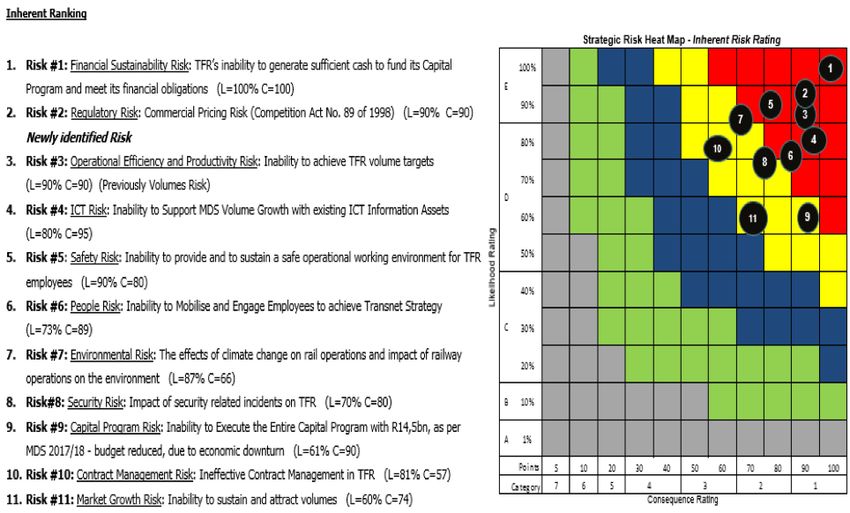
TRANSNET Freight Rail 4
development. These are intended to be supported by digital The business units operate across geographical operating channels
technologies that enable connectivity, visibility of data, assets and in an integrated network to improve train plan execution and
visibility of information for heightened real-time decision-making. service delivery to customers across the value chain. Commodities
Collaboration and strategic partnerships with customers and are transported across five operation channels, namely:
logistics service providers are being harnessed to develop • Cape channel
innovative integrated logistics solutions that generate improved • Coal channel
supply chain value.
• Natcor channel
• Phala channel
Freight Rail is a profitable and sustainable freight railway
business, which contributes to the competitiveness of the South • Thaba channel
African economy. The Operating Division provides rail services to
customers in key market segments through six business units: Freight Rail also provides the network for long distance passenger
rail services as well as haulage capacity for other private
• Agriculture and Bulk Liquids
passenger services. TFR continues to operate the prestigious
• Coal
luxury Blue Train.
• Containers and Automotive
• Iron Ore and Manganese
• Steel and Cement
• Mineral Mining and Chrome
Geographic spread
The network extends across South Africa and comprises the heavy haul coal and iron ore export lines, key national corridors over which general
freight traffic flows and branch lines.
Musina
Louis Trichardt
MOZAMBIQUE
Lephalale Groenbult
Phalaborwa
Polokwane
Vaalwater
Zebediela
Middelwit Steelpoort
BOTSWANA
Modimolle Marble Hall
Nelspruit Komatipoort
Witbank
Mafikeng Kaapmuiden
Vermaas SWAZILAND Freight Rail
Ermelo
Ottosdal
Vryburg Vereeniging
NAMIBIA Hotazel Klerksdorp
Pudimoe
Makwassie Vrede
Kroonstad Vryheid
Nakop Sishen Warden
Veertien Strome
Upington Virginia Harrismith
Bethlehem Key
Kimberley Ladysmith
Kakamas
Bloemfontein Richards Bay
Douglas
Core network
Belmont
Koffiefontein
LESOTHO
Pietermaritzburg
Durban Closed lines
Springfontein Franklin
Harding
De Aar Aliwal North
Sakrivier
Port Shepstone Lifted lines
Maclear
Noupoort
Calvinia Rosmead
Hutchinson Umtata Branch lines
Hofmeyer Queenstown
Beaufort West
Porterville Cookhouse
Saldanha
Klipplaat Blaney East London
Prince Alfred Hamlet Alicedale
Oudtshoorn
Worcester Port Alfred
Cape Town Ngqura
Knysna Port Elizabeth
Mosselbaai
Figure 1: Freight Rail networkTRANSNET Freight Rail 5
Regulatory environment The Draft Single Transport Economic Regulation Bill (version 4)
presents serious challenges for Freight Rail and Port Terminals’
Freight Rail is accountable to all stakeholders under the applicable future commercial sustainability in their current formats. Transnet
regulatory requirements and is committed to high standards of will therefore continue to request support from the DPE to lobby
integrity. In view of the importance of complying with the ever- for more equitable economic regulations between the public
increasing regulatory universe, and the increased emphasis placed entities and private sector companies that Transnet competes with
on the supervision thereof, Freight Rail continues to strive for and, in particular, between Freight Rail’s economic regulation
effective management of regulatory risks. versus the road freight industry’s self-regulation. A skewed system
of regulation will clearly benefit road transport even further, and
Ongoing transport economic regulation and rail policy developments preferably must be viewed in terms of a balanced modal approach
could result in substantive changes for the South African transport that is in the national interest.
industry. The Draft White Paper on National Rail Transport Policy has
signalled that the Department of Transport (DOT) has a renewed
focus on rolling out a high-performance standard gauge national Performance context
network, and has proposed several changes to the rail institutional
structure. These measures, should they become stated Government During the execution of the MDS, Freight Rail has sought to
policy in the final gazetted White Paper on National Rail Transport create capacity in the land freight transport task to enable the
Policy, will have a significant impact on Transnet, and could present transportation of greater tonnages. The year-on-year growth of
significant implementation challenges. rail tonnages transported in the 2018 financial year, in excess
ofGDP growth, reflects considerable success in the implementation
Transnet will continue to work with the Department of Public ofthe strategy.
Enterprises (DPE), DOT and other relevant departments to ensure
that the potentially negative impacts of the rail policy on Transnet Improvements in tonnages railed, coupled with stringent cost
are limited, and that the policy strives to support Freight Rail to management, contributed to a commendable financial
strategically grow rail services in the country. performance.
The DOT recently released the Draft Road Freight Strategy for However, the 2018 operational context was difficult and
engagement with critical stakeholders. This strategy could have a characterised by a number of challenges, including:
considerable impact on Freight Rail, because it encourages the • The downgrade of South Africa by the ratings agencies;
shift of freight from road to rail as the road situation could • Fluctuating and deteriorating commodity prices for chrome,
become increasingly unsustainable over the medium to long term. iron ore and manganese;
• Pollution management policies in China which affected some
Transnet will continue to work with the DOT and the DPE to ensure coal and low-grade magnetite;
that equitable outcomes are arrived at for the land freight • Incidents of community unrest impacting Freight Rail operations
transport system as a result of fair policy choices being made in in certain areas; and
these two policy documents. • Extreme weather conditions, including strong winds, heavy
rainfalls and washaways.
Operational performance
Overview of key performance indicators
2017 2018 2018 2019
Key performance area and indicator Unit of measure Actual Target Actual Target
Financial sustainability
EBITDA margin % 44,1 46,9 46,8 47,3
Operating profit margin % 22,8 21,5 27,6 29,3
Gearing % 54,6 53,4 52,2 51,5
Net debt to EBITDA times 4,0 3,3 3,4 3,3
Return on average total assets – excluding CWIP % 5,8 6,7 7,8 8,9
Asset turnover – excluding CWIP times 0,27 0,31 0,28 0,30
Cash interest cover times 2,7 2,8 2,9 2,8
Capacity creation and maintenance
Capital expenditure R million 15 746 14 540 17 598 16 387
Operational excellence
Asset utilisation
General freight business Gtkm/Ntkm1 1,62 1,70 1,402 1,392
Export coal Gtkm/Ntkm1 1,55 1,60 1,262 1,262
Export iron ore Gtkm/Ntkm1 1,38 1,40 1,202 1,202
Loco-utilisation
General freight business GTK’000/loco/month 5 509 5 605 4 9172 4 3272
Export coal GTK’000/loco/month 22 983 22 388 18 5472 17 7932
Export iron ore GTK’000/loco/month 57 809 61 322 40 4582 54 5942TRANSNET Freight Rail 6
2017 2018 2018 2019
Key performance area and indicator Unit of measure Actual Target Actual Target
Cycle time
Export coal hours 63 56 62,6 58
Iron ore hours 93 76 86,0 68
Export manganese hours 162 156 154,9 120
Wagon turnaround time
General freight business 10,1 9,9 10,0 8,5
Density
General freight GTK/Routekm 5,50 6,14 5,152 5,862
Natcor GTK/Routekm 6,33 11,1 9,802 11,112
Capecor GTK/Routekm 3,77 5,98 5,972 6,092
Southcor GTK/Routekm 3,32 5,27 5,752 5,852
Service delivery
On-time departure (average deviation
from scheduled times)
General freight business minutes (198) 163 (182,1) 152
Export coal minutes (40) 45 (58,6) 45
Export iron ore minutes (212) 60 (205,4) 60
On-time arrivals (average deviation
from scheduled times)
General freight business minutes (62) 185 (59,94) 180
Export coal minutes (83) 90 (137,27) 90
Export iron ore minutes (191,76) 190,0 (141,67) 190,0
Market segment competitiveness
Volume and revenue growth
Commodity classification
General freight business mt 88,1 98,0 90,77 104,2
Export coal mt 73,8 76,0 77,02 77,0
Export iron ore mt 57,2 60,0 58,52 60,0
Total volumes mt 219,1 234,0 226,3 241,2
Tariffs
Year-on-year weighted average R/ton change
– General freight business % 1,19 3,10 9,38 5,42
Human capital
Employment equity % 87 88 87,9 88,0
Training spend % of personnel cost 1,9 2,7 2,1 3,08
Employee turnover % 4,9 5,0 5,0 5,0
Employee headcount permanent 27 679 29 223 26 694 28 673
Risk, safety and health
Cost of risk % of revenue 5,8 5,5 5,8 5,5
Disabling injury frequency rate rate 0,8 1,0 0,91 1,0
Number of safety incidents number 372 294 386 259
Number of derailments – Mainline number 81 48 80 42
Number of derailments – Shunting number 159 158 158 139
1
GTK in Transnet excludes the weight of the locomotive and is thus equivalent to the American TrailingTonKm.
2
The key performance indicators which include distance and mass in their calculations have been rebased, therefore, the 2018 actual cannot be compared to prior
year actuals. The 2018 targets were determined before the rebase. The 2019 targets have also been rebased.TRANSNET Freight Rail 7
Financial sustainability
Financial initiatives
Initiatives implemented to achieve financial results included:
• New business developments and back-to-rail initiatives to improve revenue performance;
• Ongoing implementation of cost-containment initiatives (both capital and operational costs),
given the persistently tough economic conditions;
• Optimising yield through commodity mix; and
• Exploiting revenue diversification opportunities by developing value-added services,
optimising the property portfolio, telecoms infrastructure surplus capacity, and advertising.
Financial performance review
Year ended Year ended
31 March 31 March
2018 2017 %
Salient features R million R million change
Revenue 43 709 39 114 11,7
– General freight 23 586 20 834 13,2
– Export coal 12 022 11 430 5,2
– Export iron ore 6 314 5 838 8,1
– Other 1 788 1 012 76,7
Operating expenses (23 236) (21 851) 6,3
– Energy costs (4 991) (4 599) 8,5
– Maintenance (2 135) (2 473) (13,7)
– Materials ( 500) ( 596) (16,0)
– Personnel costs (12 573) (11 497) 9,4
– Other costs (3 037) (3 064) 0,9
Profit from operations before depreciation, derecognition,
amortisation and items listed below (EBITDA) 20 473 17 263 18,6
Depreciation, derecognition and amortisation (8 402) (8 728) (3,7)
Profit from operations before items listed below 12 071 8 535 41,4
Impairments and fair value adjustments (676) (1 298) (47,9)
Net finance costs (5 534) (5 712) (3,1)
Profit before taxation 5 861 1 525 284,3
Total assets (excluding CWIP) R million 161 088 148 548 8,4
Profitability measures
EBITDA margin1 % 46,8 44,1 2,7
Operating margin2 % 27,6 21,8 5,8
Return on average total assets (excluding CWIP)3 % 7,8 5,8 2,0
Asset turnover (excluding CWIP)4 times 0,28 0,27 0,01
Capital investments5 R million 17 598 15 746 11,8
Capitalised maintenance expenditure R million 6 784 6 232 8,9
Employees
Number of employees (permanent) number 26 694 27 678 (3,6)
Revenue per employee Rand 1,64 1,41 15,9
1
EBITDA expressed as a percentage of revenue.
2
Profit from operations before impairment of assets, fair value adjustments, net finance costs and taxation expressed as a percentage of revenue.
3
Profit from operations before impairment of assets, fair value adjustments, net finance costs and taxation expressed as a percentage of average total assets
excluding capital work in progress.
4
Revenue divided by average total assets excluding capital work in progress.
5
Actual capital expenditure (replacement + expansion) excluding borrowing costs and including capitalised finance leases.TRANSNET Freight Rail 8 Financial performance Revenue Revenue for the period under review increased by 11,7% to R43,7 billion (2017: R39,1 billion). This is mainly attributable to the 3,3% increase in volumes, complemented by a fair increase in the average R/ton (R186,75 in 2018 compared to R174,95 in 2017). The average 6,7% increase in R/ton was slightly higher than the average CPI (averaged 4,64% over the reporting period), which was mainly attributable to the prioritisation of a high yield commodity mix. Operating expenses The year-on year-increase in operating expenses was 6,3%, with costs rising to R23 236 million (2017: R21 851 million). This was achieved despite some above-inflation increases in operating expenses such as fuel and electricity. Freight Rail’s general cost-containment mindset and consequent actions resulted in significant savings in discretionary spend (i.e. consultancy costs, telecommunication costs, advertising and promotion costs, periodicals and printing costs, travel, accommodation and refreshments) as well as other operating expenses. EBITDA and operating margins The EBITDA margin for the year increased to 46,8% (2017: 44,1%) while Freight Rail’s operating margin rose to 27,6% (2017: 21,8%), reflecting increases of 6,1% and 26,6% respectively. Improvement in these margins is attributable to a significant increase in revenue, while year-on-year operating costs increased to a much lesser extent. In addition, the reduction in depreciation charge following the continued review of useful life of Freight Rail assets impacted positively on the operating margin. In response to a lower-than- budgeted volume performance, Freight Rail continued to implement cost-savings initiatives and reduce discretionary costs, which to some extent mitigated the negative impact of lower revenue on the budgeted profitability margins. Gearing Financial gearing improved to 52,2% (2017: 54,5%). The improvement of this metric over the two comparative periods is attributable to the slowdown in capital expenditure, resulting in lower long-term borrowings on the back of a 10,8% increase in reserves. Asset turnover (excluding CWIP) Asset turnover increased to 0,28 times (2017: 0,27 times), despite an 8,4% increase in total assets (excluding capital work-in-progress or CWIP). This is due to the increase in revenue which was higher than the increase in asset base, resulting in a 6,2% improvement in the performance of this measure of asset productivity. Return on average total assets (excluding CWIP) Return on average total assets increased to 7,8% (2017: 5,8%). Improved performance of this KPI is attributable to an increase in operating profit offsetting the impact of an increase in asset base. Net debt to EBITDA As a result of a slight reduction in total long-term borrowings to R69 486 million (2017: R70 871 million) and an increase of 18,6% in EBITDA to R20 472 million (2017: 17 262 million), the net debt to EBITDA ratio improved to 3,4 times (2017: 4,2 times).
TRANSNET Freight Rail        9

Cash interest cover                                                    • Additional work undertaken by original equipment manufacturers on
                                                                         the new locomotive programmes of R572 million against the budget.
Cash interest cover increased to 2,9 times (2017: 2,7 times). The
                                                                       • A total of 450 new CR (general purpose mining commodities) and
improved performance of this ratio was mainly due to an increase
                                                                         SCL (automotive) wagons for the general freight business as well
in cash generated from operations after working capital changes,
                                                                         as 232 new CR13 wagons for the iron ore line were built, costing
complementing the impact of a 3,1% decrease in finance costs.
                                                                         R889 million. While these were required and assisted in the
                                                                         improvements reflected, they were not originally budgeted for.
Revenue per employee
                                                                       As part of the new locomotive programme, Freight Rail received
Revenue per employee increased 15,9% to R1,64 million compared         1 036 locomotives (110 x 19E; 76 x 15E; 50 x 39 200; 203 x 43D;
to prior year results (R1,41 million). The significant improvement     95 x 20E; 100 x 21E and 402 of the 1 064) as at 31 March 2018.
on this measure was mainly attributable to the year-on-year            An additional 216 locomotives are due to be delivered in the
revenue increase of 11,7%, complemented by a decrease in               next financial year.
headcount of permanent employees from 27 678 in the prior year
to 26 694 for the year under review. The significant reduction in      Approximately 11 000 wagons have been received since the
headcount was partly attributable to the impact of the voluntary       inception of the MDS and 3 300 additional wagons are scheduled
severance packages offered in the 2017/18 financial year as well       to be received over the next five years.
as natural attrition.

                                                                       Export coal
Looking ahead
                                                                       • The total investment in infrastructure for the year amounted
As the business prepares to transition to the Transnet 4.0 Strategy,     to R172 million, of which R113 million was for export coal from
Freight Rail will strive to improve revenue and overall business         Waterberg and R59 million was for the Coal 81 programme.
performance by:
                                                                       • The export coal line expansion to 81 mtpa was 80,1% complete
• Accelerating new business development and back-to-rail                 at 31 March 2018.
  initiatives to improve revenue performance;
                                                                       • Coal line expansion and sustaining programmes that have been
• Implementing initiatives to reshape the core of the business           completed, or are nearing completion, include the Coal 81
  through cost optimisation of both capital and operational costs        programme (nearing completion); Continuous Welded Rail
  in view of persistent tough economic conditions;                       Maintenance predictor; and the installation of the ‘On the Fly’
• Employing initiatives to optimise yield through commodity mix;         system at the Ermelo Yard Balloon.
• Optimising cash and working capital management;                      • The Waterberg programme is considering infrastructure
• Implementing initiatives to improve diversified revenue                development to facilitate export coal from Waterberg
  opportunities, including value–added services such as clearing         (Lephalale area) to Richards Bay.
  last mile and warehousing, optimising the property portfolio,
  telecoms infrastructure surplus capacity, and advertising; and
• Effecting product and market development for future
                                                                       Export iron ore
  positioning in the logistics markets.                                • Total fixed infrastructure investment for the export iron ore
                                                                         corridor amounted to R57 million in 2018.
                                                                       • The construction of the third tippler at the Port of Saldanha is
Capacity creation
                                                                         under way and is due for completion in early 2020.
Initiatives                                                            • The upgrading of power supply infrastructure on the ore line is in
Continued implementation of approved capital programmes to               progress. This involves upgrades to four Eskom substations as
sustain and create capacity. Investment was made in key                  well as new distribution lines and related infrastructure. The
programmes:                                                              work will be completed in early 2020.
• Coal 81 mt expansion                                                 • The construction of a fourth manganese offloading facility at
                                                                         Saldanha will be completed in July 2018, with operations due to
• Overvaal Tunnel doubling
                                                                         commence in August 2018.
• Manganese expansion
• New 1 064 locomotive acquisition, commissioning and
  deployment                                                           General freight
• Wagon build in accordance with customer demand                       • Total investment in the general freight business’ compliance and
• Infrastructure maintenance plan to assure volumes on identified        enabling works amounted to R322 million in 2018.
  corridors                                                            • Significant works or programmes in progress include:
                                                                         –– Electrical upgrade works on Natcor;
Performance commentary                                                   –– Roll out of electronic interlocking systems in Bellville; and
                                                                         –– Automating yard points countrywide.
Freight Rail invested R17,6 billion in the year under review against
the original budget of R14,5 billion. This original budget was         Locomotives
revised to include additional capex spend, which was primarily due
to the following:                                                      • Transnet acquired 219 new locomotives (215 deployed to
• Additional maintenance work on the wagon fleet (additional             operations in the financial year) for the general freight business.
  spend of R1 085 million) and infrastructure (additional spend        • R7,3 billion was spent on locomotive contracts for the period
  of R1 024 million) to ensure the availability and reliability of       under review.
  the necessary rolling stock fleet and network to support the         • In total R1,8 billion was spent during the 2018 financial year to
  achievement of volume targets while complying with safety              maintain a fleet of 2 600 locomotives:
  standards. This was partially offset by underspending                  –– Minor overhaul programmes were performed on 169
  R425 million on the locomotive maintenance programmes,                    locomotives (15E, 19E and 18E ) at R392,9 million;
  which was largely attributable to the introduction of the new          –– 59 derailed locomotives were repaired at a cost of
  fleet and removal of the obsolete and unreliable older fleets.            R208,5 million;
TRANSNET Freight Rail 10
–– General overhaul maintenance programmes were performed is under way before retiring the older locomotives. This does
on 34 diesel locomotives (35GM and GE, 36GM and GE class however result in a negative impact on locomotive utilisation
locomotives) at R121,8 million; performance results.
–– R53,3 million was spent on maintenance of coaches
(Phelophepa 1 and 2 and The Blue Train); Freight Rail envisages an improvement in the targeted performance
–– Planned and unplanned maintenance of R801 million was of locomotives in the future due to the gradual retirement of old
spent on locomotives; locomotives from the system. Significant improvement of
efficiencies will be realised over the next two to three years,
–– The remaining R197 million was spent on maintenance and
following the full deployment of the new 1 064 locomotives and
repairs required due to incidents including pantograph
as the old locomotives are retired.
hook-ups; minor vandalism (cable theft): third-party claims;
minor modifications; and minor component change-outs on
Export coal achieved a historical record of 77 mt, exceeding volume
various locomotives.
projections. It is projected that similar coal tonnages will be railed
Wagons in 2019. Additional and new locomotives are scheduled to be
deployed, resulting in the 2019 target being lower than 2018
Transnet Freight Rail and Transnet Engineering embarked on a actual. The 2018 actual for locomotive utilisation cannot be
programme to build the following wagons: compared to prior year actuals because the mass and distance
• 2 500 coal containers to service Eskom power stations; measurements have been rebased. The locomotive efficiency will
• 300 new CR-13/14 wagons for the iron ore business to service be improved in subsequent years as old locomotives are expected
the shortfall caused by longer turnaround times on trains to be phased out.
servicing junior miners that load ore using front-end loaders;
• 86 new SCL wagons for the automotive business; and The export iron ore line locomotive utilisation was impacted by lower
• 364 CR wagons to be used within the mining sectors to transport than projected tonnages recorded due to unforeseen customer
ore from shafts to processing plants, and for servicing the cancellations; tippler off-loading challenges; and derailments.
automotive market. The 2018 actual cannot be compared to the prior year actual due to
the mass and distance calculations being rebased. A greater target
For the 2018 financial year, 1 250 coal containers and 682 wagons has been set for 2019 to accommodate the new manganese service
were built and received by Freight Rail resulting in a capital on the iron ore line, which will further improve locomotive utilisation
investment of R1 billion. on this corridor.
Cycle times and wagon turnaround times
Looking ahead
The improvement in the export coal cycle time from 63 hours
• Continuation of capital programmes in progress, include the (2017) to 62,6 hours in 2018 is significant considering that coal
Coal 81 mt expansion and the Overvaal Tunnel doubling. was sourced from much further (i.e. Waterberg). This longer
• Wagon-build programme in accordance with market conditions distance also explains the deviation from the target of 56 hours.
and validated customer demand.
• Continue with the commissioning and deployment of the The actual cycle time for the iron ore line of 86,8 hours in 2018
remainder of the 1 064 new locomotives. reflected a significant improvement on prior year (2017: 93 hours).
• Implement infrastructure maintenance plans to sustain volumes However, the 2018 target of reducing cycle time to 76 hours was
on identified sections. not met. The performance for iron ore exceeded the target by a
margin of 14,2%. Service disruptions as a result of derailments
contributed to resources not being able to turn around as
Operational excellence scheduled. This was exacerbated by tippler failures at the Port of
Saldanha, as well as customer loading challenges that added to
Initiatives in 2018 delays at both ends of the supply chain. The 2019 financial year will
• Implement refining phases of the channel operations philosophy see heightened focus on continuous improvement and efficiency
to improve end-to-end and pit-to-port flows of freight. initiatives to minimise disruptions throughout the channel.
• Continuous improvement programmes to improve efficiencies
and reduce waste. Export manganese
• Deployment of On Board Computers (OBCs) on locomotives. Cycle time performance on the Port Elizabeth (PE) manganese
• Automation of points in identified yards. corridor continued its performance trajectory from the previous
• Concentrated monitoring of trains and deviation management. financial year, recording an improvement of 4,4% against the 2017
actual and 0,74% against the 2018 target. The inflow of 23E
locomotive sets contributed to the more efficient turnaround of
Performance commentary resources on the corridor. Further improvements are anticipated as
Continuous improvement efforts on operational efficiencies have more 23E sets are allocated to this flow. Cycle time performance
yielded positive results on operational excellence performance was enhanced by an improvement in the offloading performance of
indicators. the offloading facilities in PE, which can be attributed to the
implementation of Lean Six Sigma (LSS) turnaround time projects
Locomotive utilisation at the PE bulk terminal and third-party offloader. An improvement
on running delays as well as a reduction in speed restrictions
The general freight locomotive utilisation performance was due to added to the lower target performance.
lower than projected volumes being railed due to customer train
cancellations as well as operational factors such as the poor General freight wagon turnaround did not achieve significant
reliability and failure of older locomotives. New locomotives were improvement year on year and the target of 9,9 days was not met.
commissioned into operation and were simultaneously operated The Productivity of Wagons programme for the improved
along with older locomotives. The operation of both old and new management of wagons, which includes encouraging customers
locomotives is a necessary practice to keep the system stable to load and offload according to service design times, aims to
while the process of commissioning new rolling stock into service contribute to wagon turnaround time improvements.TRANSNET Freight Rail 11
Density • Implementing and building on integrated planning, maintenance
and safety plans through joint operating centres with neighbouring
Density is a function of volumes transported over the rail route
countries.
network. General freight volumes, although reflecting 3% growth
on prior year, were below target due to economic, customer and
operational factors. General freight volume performance hindered Performance commentary
the achievement of the overall general freight density target.
Freight Rail railed a total of 226,3 mt in 2018, representing growth
Density performance on the key corridors was favourably impacted of 3,3% on prior year (2017: 219,1 mt). Despite good growth (above
by the growth in numbers of containers transported on these national GDP growth), the actual fell short of the target by 7,7 mt.
corridors. Container growth recorded was respectively: This was due to challenges experienced in the general freight and
iron ore businesses.
• NatCor – Additional 49 000 TEUs or 13%
• CapeCor – Additional 18 000 TEUs or 39% Sound operational execution in alignment with ports and the
• SouthCor – Additional 6 000 TEUs or 7% (includes TEUs through Richards Bay Coal Terminal (RBCT) contributed to an increase in
terminals at Port Elizabeth and Ngqura) export coal volumes resulting in the target being exceeded, and a
record historic annual tonnage of 77 mt being achieved.
On-time Departures (OTD) and Arrivals (OTA)
Freight Rail’s adherence to scheduled time performance, on a Iron ore export volumes fell short of the budget by 2,5%. Tonnages
year-by-year basis continues to improve and reflects management’s of 58,5 mt were actualised against a target of 60 mt. The export
commitment to improving the key metric as it directly impacts iron ore volume performance was impacted by a number of
customer service. The improvement is a culmination of operational unfortunate incidents, poor weather conditions that affected the
discipline; investment in new rolling stock and infrastructure; and quality of ore and hindered train plan execution, as well as tippler
the desire to operate to a schedule by all stakeholders. challenges at the Port of Saldanha.
Worldwide Class I railways have adopted network velocity as a key General freight tonnages reflected growth on prior year. The
operating metric that represents the outcome of cycle times, deployment of new locomotives for these services and the
on-time adherence and efficiency improvements. Freight Rail has implementation of initiatives for a shift of freight traffic to rail
also adopted this measure, which is a key driver of asset productivity began to show results. Record tonnages were achieved in the
and improved customer service. It measures the speed of trains on transportation of manganese (with significant tonnages railed for
the mainline and excludes yard dwell times. emerging miners through the common-user facilities at Postmasburg)
and chrome for export. Improvements were noted in containers
moved on key national corridors. Efforts to further penetrate the
Looking ahead automotive market are also reflecting positive signs.
Freight Rail will improve operational efficiencies by:
General freight volumes were challenged by issues such as customer
• Redesigning the operations philosophy, service execution across plant maintenance and breakdowns, as well as heavy rains that led to
channels and creating value across Transnet’s Operating Divisions; rail network washaways, which took time to repair. Initiatives to
• Developing and deploying technologies to improve reliability secure new rail-friendly volumes contributed to mitigating these
and predictability; volume challenges. Less than planned tonnages of coal conveyed for
• Embedding continuous improvement processes to improve domestic production, export through terminals other than RBCT and
efficiency and eliminate waste; to Eskom power stations, as well as bulk liquids, chemicals and
• Deploying commercial tools to enhance decision-making; cement, detracted from the general freight target achievement.
• Implementing approved capital programmes to sustain and
create capacity; and Freight Rail is placing significant focus on engaging and building
relationships with customers and industry. Transnet hosts a series
• Implementing safety systems to enhance operations reliability
of discussions countrywide, urging conversations around the impact
and achieve best practice safety standards.
of the 4th Industrial Revolution on the freight logistics industry.
Conversations address pertinent topics such as the digitisation in
Market segment competitiveness logistics, connectivity and intelligent transport and logistics
systems. Leadership summits feature global thought leaders as well
Initiatives in 2018 as CEOs of more than 150 customers representing mining;
A number of initiatives were pursued to improve volume growth agriculture; manufacturing and construction; petroleum; gas;
and thus market segment competitiveness: chemical; Fast Moving Consumable Goods; and automotive sectors.
• Developing and implementing marketing strategies, pricing and The first session was hosted by Freight Rail in Johannesburg.
contracting models to grow identified customers in the general
freight business segment; Freight Rail has also established a customer engagement room used
• Developing common-user facilities to enable customers to to facilitate in-depth discussions with key customers towards
access rail services; improving the overall customer experience of rail. Engagements
with customers has led to the redesign of certain Commercial
• Rolling out digital support tools, marketing tools, and logistics
processes to improve alignment to customer expectations.
skills to enhance customer value propositions, with a specific
focus on container growth;
• Implementing new operating models for terminals and Looking ahead
repositioning identified terminals by awarding Terminal
• New business development projects and refined operating
Operator Licences;
models to accelerate the road-to-rail shift in general freight
• Deploying new car wagons to automotive flows and pursuing
market sectors.
opportunities with car manufacturers;
• Develop and implement programmes that enable access to rail
• Collaborating with Eskom to increase coal volumes from mines
for general freight volumes.
to power stations;
• Develop and deploy technologies to support the business in
• Continued development of bi-modal technologies;
attracting volumes.TRANSNET Freight Rail 12
• Improve operating models and practices for regional volume Youth employment and development strategy
increase.
• Entrench a customer-centric culture and improvements to the
Employment/ Actual Target Actual
customer experience journey. development 2017 2018 2018
Youth employed as %
Human capital of total employees 42,3 No target 39,9
Initiatives in 2018 Youth developed as % 45,1 44,6 42,1
of all employees trained (17 651) (14 926)
• Embed the Productivity 2020 programme for improved
employee productivity, utilisation and efficiency.
• Develop and implement an operational performance framework
Looking ahead
to drive productive operational behaviour.
• Implement the Time and Attendance System. Improve people skills capacity and capabilities through the
• Develop skills and leadership capabilities through the Apprentice, establishment of a Rail Corporate University, Supervisory
Rail Operations Management, Customer Service and Coaching and Development Programme, High Potential Programme and
Mentorship programmes. performance management for bargaining unit employees.
• Promote the development of skills and competencies in the
infrastructure environment through the Engineer-in-Training, Health, safety and risk
Technician-in-Training and Engineering Empowerment programmes.
Initiatives for 2018
• Embed the Human Factor Management Standard (SANS 3000-4)
Performance commentary
• Implement OHSAS 18000-1
• Freight Rail ended the 2018 financial year with a permanent • Intensify Road Map to Safety initiatives
headcount of 26 694 employees. The lower than targeted
headcount of 29 223 was due to cost management measures,
such as only filling critical operational vacancies and the exits Performance commentary
of employees due to natural attrition and those who opted to
take the voluntary severance package. Cost of risk
• Freight Rail continued to maintain excellent employment equity The cost of risk remained constant at 5,8% and the target of 5,5%
results with black employees representing 87,9 % (target: 88%) was not met. Extraordinary incidents of heavy storms and flooding
of the total employee base, thus slightly exceeding the prior significantly contributed to an increased cost of risk (relative to
year’s representation (2017: 87%). Female employees revenue), occurring on two occasions May and October 2017), both
represented 29% and people with disabilities represented 2,7% in KwaZulu-Natal. The cost of risk is also impacted by the increased
of the total employee base value of modernised assets.
• Training spend in 2018 at 2,1% of personnel cost was higher
than the prior year (2017: 1,9%) and below the target of 2,7% Disabling injuries frequency rate (DIFR)
due to cost-containment measures with only essential
Freight Rail achieved a DIFR of 0,91, which is better than the global
functional, engineering and technical training being carried out.
industry benchmark of 1. Although the performance was within the
• Employee turnover remained relatively constant at 5% with a tolerance limit of 1 (one), the DIFR increase from 0,78 in 2017 to
slight increase on the prior year’s actual of 4,9% due to the exit 0,91 in 2018 was due to the 294 and 334 disabling injuries
of employees on the voluntary severance packages. experienced in the 2017 and 2018 financial years respectively.
Culture and employee engagement: During the 2018 financial year,
Number of safety incidents
various Culture Charter initiatives such as Diversity Dialogues and
Employee Engagement sessions were conducted in response to the The overall number of rail incidents increased by 4% year on year.
2015/16 Culture Charter survey results. Furthermore, an Employee There were 386 incidents in 2018 compared to 272 in 2017. The
Engagement Culture survey was conducted across the Group from tolerance limit of 294 was exceeded. The incidents related to
27 November 2017 to 28 February 2018. Freight Rail exceeded the ‘Signal Passed at Danger’ which is an area that will receive closer
targeted 40%, with a participation rate of 41,9% (compared to the focus.
Transnet average of 37,9%).
Number of mainline derailments
Skills development: Freight Rail continued to make excellent
The number of mainline derailments decreased from 81 in 2017 to
strides in skills development with the engineers and technicians on
80 in 2018. At 80, the number of incidents exceeded the tolerance
the Engineering Empowerment programme (EEP), and performance
target of 48 for 2018.
for youth employment and development. The progress of these
programmes is summarised in the tables below and reflects the
contribution of Freight Rail to this key organisational and national
Number of shunting derailments
objective. The number of shunting derailments remained constant at 158 for
2017 and 2018. This performance is an achievement of the
Number of engineers and technicians on the EEP tolerance limit that was set for the financial year.
Actual Target Actual
Training area 2017 2018 2018 Looking ahead
Technicians in training 67 200 202 In the main, 191 occurrences were caused by unsafe acts of
employees and 82 by unsafe conditions. The Annual Safety
Engineers in training 266 100 100 Improvement Plan will be aligned to address inadequate behavioural
Young professionals issues and strengthen compliance through supervision. The driving
in training 139 194 192 force to improve safety performance will focus on filling vacancies
and providing adequate resources for maintenance.TRANSNET Freight Rail 13
The significant number of level-crossing incidents is continuing due Freight Rail’s top 11 strategic risks and key
to motor vehicle drivers not adhering to stop signs at level crossings. mitigating activities
Freight Rail will continue to conduct awareness campaigns and
implement the new Railway Safety Regulator requirements. Effective enterprise risk management (ERM) plays an essential role
Technological interventions will also be considered to address this in ensuring the successful transformation of Transnet into a
global challenge within the rail industry. focused, high-performance rail business. ERM is an integrated
process of assessing and responding to all risks, including
organisational, project or systemic risks that impact an
Governance and ethics organisation’s ability to meet its objectives.
Effective governance, ethics and enterprise risk management are
critical in ensuring the successful transformation of a sustainable The top 11 risks are the most up-to-date identified risks, with
rail business. appropriate mitigating plans, and are plotted in a risk matrix.
Freight Rail’s top 11 risks are listed below, taking into account the
inherent risk rating.
No. Risk description Key mitigating activities
1. Financial sustainability risk: Freight • Evaluate obsolete inventory (older than 18 months) for disposal
Rail’s inability to generate sufficient • Implement the reverse logistics process
cash to fund its capital programme • Continue efforts on effective working capital management (early collection of debtors
and meet its financial obligations and negotiated payment of creditors)
• Develop and implement new controls and procedures to benchmark prices
• Implementation of real estate miscellaneous revenue strategy (including milestones)
• Develop and implement a process and framework for take or pay, including the penalty
clauses
2. Regulatory risk: Commercial Pricing • Full analysis of Freight Rail’s prices and pricing practices to be conducted
Risk (Competition Act, No 89 of • Full implementation of customer survey results and recommendations
1998) • Test Freight Rail’s historical pricing practices and establish potential risk exposure for
the Operating Division
• Design and implement optimal pricing practices and structure
• Establish business rules and processes to record all pricing-related correspondence
and decisions
• Evaluate the current repository and redesign to cater for all information requirements
to satisfy competition-related requirements
3. Operational efficiency and • Implement the Operational Command Centre model focusing on centralised planning,
productivity risk: Inability to achieve resourcing activities, updating processes and developing structures
volume targets • Implement the Productivity of Wagons Programme
• Integrate the capital operations expenditure business cases (rolling stock and
infrastructure)
• Allocate funding to the profitable flows to protect targeted volume performance
• Develop an Integrated Train Plan consistent with the volume mix to achieve the proposed
profitability levels
• Monitor the implementation of the Integrated Management System (i.e. symposium,
training, maintenance, inspection, task observation plan, speed monitoring, medical
surveillance, audit schedule, management review, human factors management plan,
incident investigation reports and action close out), and incorporation of safety
performance targets
• Proactively engage with key customers to decrease and manage customer train
cancellations
4. Information and communications • Full implementation of the ICT roadmap
technology (ICT) risk: Inability to • Rationalise the current systems available to reduce the duplication of systems
support MDS volume growth with • Assess network capacity and provide connectivity (bandwidth) to enable access to the
existing ICT assets business intelligence and analytics report
• Create a fully funded research and development department in IT and identify
opportunities for digitalisation
5. Safety risk: Inability to provide and • Implement and monitor the symposium, training, maintenance, inspection, task
to sustain a safe operational observation, speed monitoring, medical surveillance, audit schedule and management
working environment for employees review plans
• Implement and monitor the Human Factors Management Plan in relation to the human
factors in design, physical environmental factors, and the close out of Railway Safety
Regulator audit findings related to human factors management
• Incorporate safety performance targets in the Operating Division’s strategic performance
objectives
• Continue with the Road 2 Safety maintenance interventions plansTRANSNET Freight Rail 14
No. Risk description Key mitigating activities
6. People risk: Inability to mobilise • Customise health and wellness service offering to cater to the unique profile of the
and engage employees to achieve Freight Rail employees
the objectives of the Transnet 4.0 • Develop integrated systems for tracking and raising awareness on all available health
Strategy and wellness service offerings
• Develop and implement a Learning and Development Strategy
• Develop and implement an Integrated Career Development programme
• Implement inspirational leadership and iBELONG
7. Environmental risk: The effects of • Develop and implement Freight Rail’s Climate Change and Mitigation Strategy
climate change on rail operations • Issue extreme weather conditions warnings to the business and monitor implementation
and the impact of rail operations on of the Summer and Winter Preparedness Plans
the environment • Determine the rehabilitation quantum for unused quarries and borrow-pits
• Monitor compliance to regulatory requirements and the EMPs at high-risk leased facilities
at Iron Ore and Manganese, Agriculture and Bulk Liquids, Coal, Mineral Mining and Chrome,
Steel and Cement, and Container and Automotive
• Continue ad hoc clean-up of resurfacing asbestos and use derelict mines as disposal/
landfill sites
8. Security risk: Impact of security- • Full implementation of the Security Strategy
related incidents • Continuous identification of hot spot areas and allocation of resources
• Engage the local government, community policing forum structures and other law
enforcement agencies within the impacted areas
• Procure the services of a service provider to be deployed in the identified high-risk areas
when necessary
• Continuous enforcement of the Legal Succession Act (arrests) and weekly analysis of
crime trends
• Install intrusion detection systems along the rails
9. Capital programme risk: Inability to • Integrate the Copex business cases (rolling stock and infrastructure)
execute the entire capital • Revise the allocation of the R5,2 billion capitalised maintenance budget to wagons
programme with R14,5 billion as per (R2,3 billion), locomotives (R1,5 billion) and infrastructure (R1,7 billion) to ensure
the 2016/17 MDS targets – budget protection of profitable tonnages
reduced due to economic downturn • Prioritise maintenance activities of high-risk areas and introduce train speed restrictions
• Technology management laboratories to acquire the SANAS accreditation and develop and
implement a quality assurance process for perway material, which will be based on the
perway material specifications
• Adopt integrated quality forum for different 1 064 locomotive programmes
• Prioritise profit-yielding projects and safety and compliance business requirements
10. Contract management risk: • Review and ensure adherence to the Lease Management Framework
Ineffective contract management • Renegotiate historical leases
• Review/update annually and sign rates schedules by March of each year
• Review business agreements every three years
• Develop a regulatory universe applicable to each contract
• Develop a risk register for each contract management process
11. Market growth risk: Inability to • Continue with the implementation and maintenance of the Consolidation of Hubs Strategy
sustain and attract volumes (warehousing and other logistics services)
• New business development to explore options for credit facilities and to assist customers
during the on-boarding process, as and when required
• Develop action plans to address deviations from the integrated pricing model and follow
up on implementation thereof
• Establish a Demand Management Committee, on a quarterly basis, for a more accurate
forecast
• Track and monitor customer service action plans, addressing the customer satisfaction
survey results and complaintsYou can also read


