Google News: How User-Friendly is It for the Blind?
←
→
Page content transcription
If your browser does not render page correctly, please read the page content below
Google News: How User-Friendly is It for the Blind?
                                                                   Barbara Leporini
                                                                       ISTI – CNR
                                                                    Via G. Moruzzi, 1
                                                                    56124 – Pisa, Italy
                                                                    +39-050-3152034
                                                           barbara.leporini@isti.cnr.it
ABSTRACT                                                                          are important research subjects widely studied in the accessibility
Being able to read text, find out information and know about the                  and usability field for people who have difficulty in accessing the
latest news has always been a challenge for those who cannot                      printed version. To have books and documents in electronic
access the printed version, such as the visually-impaired. The                    format, as well as platforms for supporting distance education
advent of the Web has been a big step in the right direction for                  usable by all, is certainly a big step towards a more inclusive
blind people to obtain up-to-date information on the internet.                    community. Accessing information of any type is not only
Many portals and Web sites offer online services for up-to-date                   possible from reading books or using distance-learning systems,
news. In this paper our aim is to evaluate how easy and rewarding                 but it includes other opportunities such as obtaining information
it is for blind people to access this. For this purpose, we are                   on recent events or up-to-date news. Therefore, the information
focusing on the well-known online service provided by Google,                     services should not only be accessible, but especially simple to
i.e. Google News as a case study. In order to truly benefit from                  use, so that it possible to read the latest news with little effort. To
access to the information available on the Web, the page interface                ensure that all available resources, on the Web or for desktop
must be simple and easy to use by everyone, including people                      applications, are truly usable via assistive technologies (such as
who have to use assistive technologies. In this work we analyze                   screen readers), the interfaces should be designed according to
not only the accessibility of the service offered by Google for its               specific principles.
News, but also in particular the usability when interacting via                   In this paper we analyze blind user interaction with an
screen reader.                                                                    information service (on-line news) in order to understand the
                                                                                  main accessibility and usability issues related to it when using a
Categories and Subject Descriptors                                                screen reader. We consider the news pages offered by the well-
H.5.2 (User Interfaces): Auditory (non-speech) feedback,                          known Google service as a case study to identify the main issues
Evaluation/methodology, Graphical user interfaces (GUI),                          encountered by the blind when accessing the information. Google
Interaction styles, Screen design, Voice I/O.                                     News is a computer-generated news site that collects headlines
                                                                                  from more than 4,500 English-language news sources worldwide,
                                                                                  groups similar stories together and displays them according to
General Terms                                                                     each            reader's           personalized           interests
Design, Human Factors.                                                            (http://news.google.co.uk/intl/en_uk/about_google_news.html).
                                                                                  For this kind of service, we consider the accessibility and
Keywords                                                                          usability issues for the two main functionalities ”Reading the
News service, user interfaces, accessibility, usability, blind users,             news” and “News personalization”. Google has been considering
screen reader.                                                                    accessibility properties (http://www.google.com/accessibility/),
                                                                                  especially for its search engine. The aim of this study is to
                                                                                  understand the main accessibility and especially usability issues
1. INTRODUCTION                                                                   encountered by blind people when reading the news. The results
Being able to read text, find out information and know about the                  can be useful to focus on the most important functionalities
latest news has always been a challenge for those who cannot                      related to an information service in order to identify specific
access the printed version, such as the visually-impaired. The                    aspects to be considered when developing a similar portal for on-
advent of internet and advancements in User Interfaces (UIs) as                   line news.
well as in assistive technologies make this challenge increasingly
feasible. Reading and retrieving information from several sources                 This paper is organized as follows: after a short introduction to
                                                                                  other studies in the field, the main functionalities offered by
                                                                                  Google News are evaluated and discussed in section 3. A short
                                                                                  discussion and some possible suggestions based on the results
                                                                                  conclude the paper.

Permission to make digital or hard copies of all or part of this work             2. RELATED WORK
for personal or classroom use is granted without fee provided that
copies are not made or distributed for profit or commercial advantage             2.1 Screen Reader Interaction
and that copies bear this notice and the full citation on the first page.         A screen reader is a software that attempts to identify and
To copy otherwise, or republish, to post on servers or to redistribute            interpret what is being displayed on the screen. Then, the content
to lists, requires prior specific permission and/or a fee.                        reported on the screen can be presented to a blind user as speech
SIGDOC’11, October 3–5, 2011, Pisa, Italy.                                        through a voice synthesizer or as a braille display.
Copyright 2011 ACM 978-1-4503-0936-3/11/10...$10.00.

                                                                            241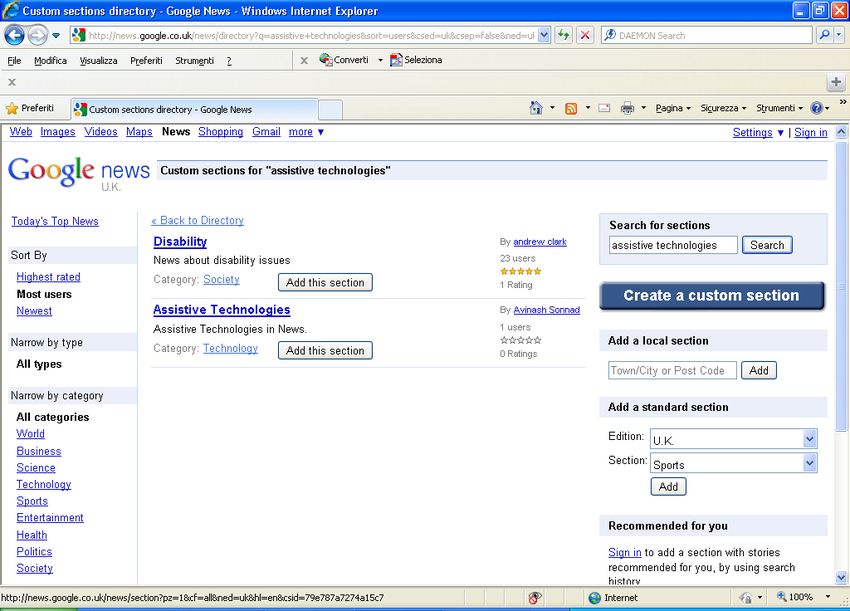
For the Web, as well as for some other applications, screen                     reference to services offered by Google, some accessibility and
readers are not reading the screen any more; instead, the screen                usability investigations have been conducted mainly for the blind
reader is using the DOM to provide a speech rendering of data                   [5]. The authors propose and evaluate a set of suggestions aimed
that is a web page. A screen reader must present the two-                       at improving Google search user interfaces when interacting via
dimensional graphical web page to a user who is blind as a one-                 screen reader. In this work we analyze the accessibility and
dimensional stream of characters, which is usually fed to a speech              especially usability aspects for the Google News service in order
synthesizer. It is very important to be aware that this screen-                 to identify the main issues for news services.
reading process is converting a twodimensional page to a one-
dimensional text string, whether spoken or displayed in Braille.                3. GOOGLE NEWS EVALUATION
Another way to picture the linearization process is to read the                 3.1 Method
page from left to right and from top to bottom. The resulting text              The Google News service has been selected as a case study of
file is the linearized version of the page. The screen reader JAWS              online news and information pages in order to analyze and
for Windows (http://www.freedomscientific.com/jaws-hq.asp)                      identify potential problems encountered by people with visual
uses the Virtual Cursor in Web pages, which allows the user to                  disabilities when reading the news. To evaluate the main aspects
read as if it is a word processing document. It seems that those                related to a news service, we consider the two activities mainly
users who are blind rarely listen to a page in full. Often, they                involved when accessing a news service:
navigate to the content and controls of the page. Tab and
Shift+Tab move forward and backward through the active                          Reading the news: the page is opened by clicking on “News” on
elements of the page—that is, through the links and form controls.              the Google home page (http://news.google.co.uk), which is
Screen readers have key commands to read by characters, by                      available for each Google local version (i.e. English, French,
words, by lines, and by sentences, as well as HTML features like                Spanish, Italian, etc.);
headings, paragraphs, tables, and lists. It is in this linearized
world that some of the accessibility and usability requirements                 News personalization: the “Add a new section”, “Remove a
begin to make better sense [9]. Thus, generally speaking, there are             section” as well as “section arrangement” features.
many different ways to use a screen reader [11]. Users can move                 For our purposes we considered the browsers IE (Ver. 8.0) and
to the next or previous lines, jump over a number of lines, or skip             Mozilla Firefox (Ver. 3.6), and the screen reader Jaws (version
to items of a certain type such as headings, links, or form fields.             11.0). The JAWS screen reader has been chosen based on the fact
There are also search commands which can be used to go directly                 that it is widely used by several blind people [3], [6] and [7]).
to a given phrase within a page. In [1] there is an overview of the
browsing strategies which screen reader users employ when faced                 In relation to the methodology, advanced familiarity with the
with challenges, which range from unfamiliar web sites and                      interaction with the UI of the system through a screen reader, as
complex web pages to dynamic and automatically-refreshed                        well as some specific principles and criteria proposed in the
content.                                                                        literature [6], especially when interacting via screen reader, were
                                                                                the basis for analyzing the main features offered by the news
In brief, the main problems for a blind person interacting through              service. Thus, to test the UI usability through a screen reader, an
screen reader are: (1) Lack of context, (2) Information overload,               inspection evaluation method by an expert in accessibility and
(3) Excessive sequencing in reading (4) Keyboard navigation, and                usability topics (the author of this paper, who is herself blind) has
(5) Screen reader interpretation. So, based on these key aspects,               been applied. In particular, we based our accessibility and
possible principles and criteria have been proposed to enhance the              usability evaluation on the principles such as “Content
interaction in terms of usability for people who use screen                     structuring” (e.g., Logical partition of interface elements, Number
readers. Several studies have already proposed a set of guidelines              of links, etc.), “Content appropriateness" (e.g., Proper link
or alternative solutions for the usability of accessible pages [6]              content, Proper names for tables and images, etc.), “interactivity”
and [10].                                                                       (e.g., operability via keyboard, Messages and dynamic data
                                                                                management, etc.) and so on. In brief we considered those aspects
2.2 Web accessibility                                                           which can greatly influence the pleasure of reading. The screen
In order to be truly satisfying and effective for users with                    reader interprets the Web contents sequentially. So, it is important
disabilities, a Web service or page must not only be well                       to understand whether the contents have been properly designed
organized and appealing but also accessible and usable.                         to evaluate the correctness of their linearity and operability via
Accessibility and usability are two important aspects that are                  screen reader and keyboard. The methodology herein used is
increasingly combined in order to improve user interfaces. In                   based on the simulation of exploration of the web page in
literature there are many studies that propose and discuss possible             sequence (arrows and Tab keys) or using advanced Jaws
principles, approaches and solutions aimed at simplifying                       commands (Insert + F6 for the list of headers, Insert + F7 for the
interaction for all users. In the context of the Web, several                   links, "h", “l” or "t" for navigating the content, etc.). The two
accessibility guidelines and recommendations have been                          sequential and advanced interaction modalities have been
proposed, such as the renowned W3C WCAG 1.0 and the new                         considered in order to simulate both beginner and skilled users,
version WCAG 2.0 [12]. Several investigations show that                         and to evaluate the perception and ease of interaction with the
focusing only on accessibility is not enough to ensure a                        interface via keyboard and screen reader. This method could
satisfactory user interaction when using a screen reader [6] and                therefore be used and applied by developers to test their Web
[10]. Usability plays a key role because even when pages meet                   pages.
accessibility standards, they can still be difficult to traverse [4]. A
study which evaluated 100 Websites with 51 users who had a                      3.2 Reading the News
disability [8] reports that 45% of difficulties encountered were on             While the Google News home page looks very accessible and
pages which complied with accessibility requirements. With                      simple to use, when interacting via screen reader some usability

                                                                          242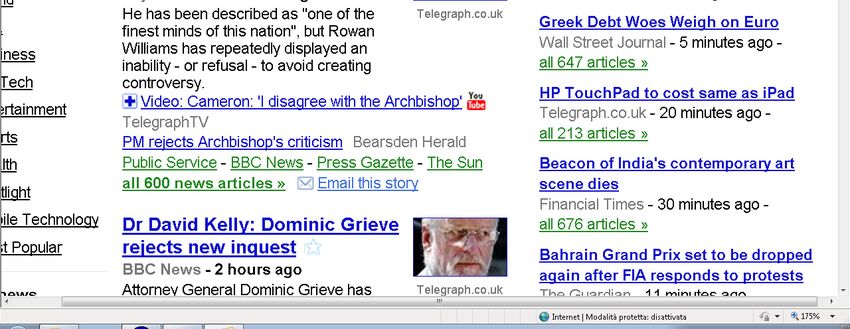
issues may be encountered. The main goal of the page is to
provide the latest news. Several different sources are made
available by the service for each news item. So, the user can read
part of the news item (i.e. just the headline and a small block)
and then choose the preferred source to read as the full article. In
this context, we analyze how a blind user perceives the content
and how they move from one news story to another.

                                                                                   Figure 2. Google news: list of headings captured by Jaws.
                                                                                                   Sources of Information (links).
                                                                                 For each news item several links related to various information
                                                                                 sources are available (i.e. more than one article for each specific
                                                                                 topic). The links can clearly affect the UI perception and
                                                                                 operability in terms of accessibility and usability. Here below are
                                                                                 some aspects related to the links which affect the user interaction
                                                                                 via screen reader:
                                                                                 Number of links - The page contains more than 350 links. This
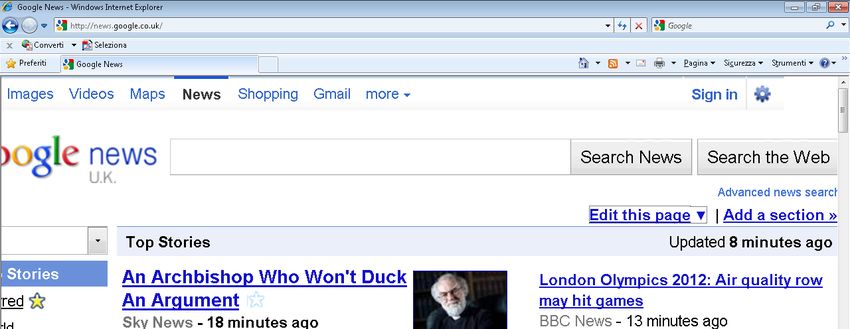
               Figure 1. Google News Home Page.                                  makes scrolling via Tab key or scrolling through the list of all the
                                                                                 links (Insert + F7 Jaws command) difficult and frustrating. The
According to the criteria mentioned in section 3.1, the main                     number of links or the negative effects derived from the
usability and accessibility issues observed are:                                 interaction via Tab key should be reduced (e.g. by removing the
                                                                                 links from the Tab key navigation order) (see below for more
Content structure and layout (columns and Sequential                             details). Using headings reduces only in part the undesired effects
Order).                                                                          when exploring the UI via screen reader. User interaction should
                                                                                 be enhanced also in terms of links.
The contents, including even those arranged on two or more
columns, are well sequenced. The screen reader first detects the                 Graphical links - The large number is not the only drawback
title of a section, it reads the items in the section, and afterwards it         regarding links. In fact, several graphical links have no alternative
moves on to the next section that may be in the other column.                    text, making it difficult to understand the associated content. The
                                                                                 Tab. 1 shows portions of the Google News page read by Jaws and
Sections and Articles (Headings).
                                                                                 highlights how the screen reader sequentially interprets the
A frequently observed strategy for “Logical partitioning of UI                   content via the virtual cursor. The links associated with section
elements” is to use landmarks for orientation and navigation                     titles in the table are an example of graphical links without
within the content [1] or headings obtained with the  tags                   alternative text. In particular, the links related to the titles of
[6], which offer several benefits [13] including being able to have              articles, which are identified by Jaws as "Void (0)” and
“on the fly” a specific table of contents (JAWS command Insert +                 graphically represented by the symbol “star”, could cause
F6). On the Google News home page, headings are associated                       confusion because neither its importance nor the resource linked
both to the sections and news headlines. All headings are at the                 by them is clear. The word "Void (0)" appears right next to each
same level “2” () and therefore no hierarchical arrangement                  news headline, as shown in Fig. 2, which reports the list of the
is used to structure topic sections and news items. As a result, the             headers associated with the news (See the list of news headlines).
user is not able to quickly understand the main sections (i.e.
                                                                                 Unclear references - Links to external resources that are
world, health, sports, etc.) since the list of headings (Jaws
                                                                                 associated with each title of the article (i.e. the link located on the
command F6) shows both sections and headlines (more than 40
                                                                                 left for each headline) are not detected by Jaws in the correct way
items). So the user has to read all the headings sequentially with
                                                                                 in relation to the sequenced content. In fact, as can be seen in Tab.
no distinction between sections and headlines.
                                                                                 1, the link pointing to the information resource seems to be
                                                                                 related to the previous article, because it is detected by the screen
                                                                                 reader before the news headline. Indeed since Jaws sequentially
                                                                                 interprets the content, the link related to the current news is
                                                                                 located near the links for the previous news (i.e., the content is not
                                                                                 appropriately linearized). Thus, in this way the user can notice
                                                                                 that the link is associated with the previous news and not the right
                                                                                 one.

                                                                           243
Section index - The list of links on the left of the page is a kind of ...
“table of content” for the sections available on the page. By
Link Edit this page
clicking on one section of these links the corresponding page is
opened. However, as the links are coded, the blind user might |
have some difficulty in perceiving correctly the content as a result
Link Add a section »
of: (1) the graphical links without alternative text (see above); (2)
the links are not local links within the page, but they point to Other News Editions
external resources, although they are labeled with the names of
Combobox U.K. 1 of 71
the sections available in the current page; (3) the links are listed in
a table without the summary attribute (see Tab. 1). table with 2 columns and 12 rows
News Updating (dynamic messages). Link img/cleardot
When the Google News Page is automatically updated with the Link Top Stories
latest news (every few minutes), this change is not notified to the
...
screen reader user. There is only a very short sound, but the user
needs to explore all the contents in order to perceive and find the Link img/cleardot
updates.
Link Sports
3.3 Content Personalization ...
Through Google personalization features it is possible to set up table end
the personal news page to show just the preferred stories. In this
perspective, the interface can be simplified by removing the Heading level 2 Updated 8 minutes ago
unwanted sections, thus reducing the page complexity. In Heading level 2 Top Stories
particular the personalization functionality offers the opportunity
to add and remove sections, as well as to rearrange the whole ...
News page by giving a preferred order to the news sections. In
Heading level 2 Link Sci/Tech »
this way, the interface should be more suitable for a screen
reading user. In this section we consider if the procedures used for Link msnbc.com
personalizing the page are truly accessible via keyboard and using
a screen reader.
Heading level 2 Link HP TouchPad to cost same as iPad
3.3.1 Removing a section.
Link void(0)
The procedure to delete a section highlights some accessibility
and usability issues related to the interaction via keyboard and to Telegraph.co.uk -
the feedback notification for dynamic messages. To remove the
Link Matt Warman
section “Sports”, for instance, it is necessary to click on the link
"Edit this page". As a consequence a small portion of the page - 35 minutes ago
changes and the message "Drag to rearrange page. Click to edit"
The TouchPad, HP's...
appears within the content, but it is not automatically announced
by the screen reader. The user might perceive that nothing has Link HP TouchPad to cost the same as the iPad 2 in the UK upon
changed. To find the new message, it is necessary to sequentially mid-July arrival
explore the page content with the arrow keys. This could take a
CNET UK
large amount of time and effort by the user. Then, to choose the
section to be removed, the user has to click on its name (e.g. Link HP TouchPad available in UK from mid-July
World, Business... Sports, etc.). Unfortunately the screen reader
Mobile News
detects each section name as a static text and no indication of the
clickable item is announced. This makes the action practically Link T3
inaccessible and the user cannot proceed. However, if the user
-
could select the section name, the next step (i.e. personalization
options) would be more feasible and accessible. To remove a Link Reuters
section, a specific checkbox needs to be selected and confirmed
with the “Save changes” button. Also in this case small portions -
are updated without reloading the entire page. The screen reader Link The Guardian (blog)
does not announce those changes, so exploration of the
surrounding area is needed. After clicking on the "Save Changes", -
a short confirmation message is displayed briefly, but the user Link BGR
does not have time to read it, because it almost immediately
disappears without notifying the screen reader. Thus this kind of Link all 219 news articles »
dynamic feedback is inaccessible to screen reader users. This Link Email this story
makes the procedure inaccessible for some required actions, and
unusable for other activities especially by beginner users. ...
Table 1. Google News: fragment read by Jaws.
2443.3.2 Adding a Standard or Personalized section. ...
Google News User Interfaces have different versions (e.g., Link graphic Google News
English, French, Spanish, Italian, etc.). However, generally
speaking, the procedure used to add a new section is in practice Custom sections for
feasible, although it is not particularly usable. After clicking the "assistive technologies"
link “Adding a section”, the next steps requested are basically
accessible. The main issues are related to usability aspects. The Link Today's Top News
main difficulties are related to the page focus, which does not Sort By
automatically highlight the main and appropriate content. The
user is asked to explore via arrow keys or Tab. list of 3 items
Just to give an example, Fig. 3 shows the page directory of the ...
news found by looking for the string "assistive technologies". The Link « Back to Directory
results are visualized using tables, one for each identified section,
according to the performed search (in our example the two table with 3 columns and 3 rows
sections "Disability" and "assistive technologies"). As shown in Link Disability
the portions interpreted by the screen reader (Tab. 2), the layout
of the results was obtained with tables without “summary” By
attribute and graphical links with no alternative description (i.e. Link andrew clark
two important accessibility properties are missing). After
confirming the addition of the new section, the user is redirected 23 users
to the page related to the section that has been just added. So, this 1 Rating
may confuse the blind user who does not understand what is
happening due to the lack of content overview. To go back to the News about disability issues
news page, the user needs to click on the link "Google News". So, Category:
in terms of usability, the risk is that the users become confused.
Link Society
However, despite some usability problems, the user can choose
the section to add. Therefore, we can conclude that the procedure Add this section Button
was successful, even though more steps were required of the user. table end
Moreover, for each section to be added, the entire procedure must
be repeated. table with 3 columns and 3 rows
Link Assistive Technologies
By
Link Avinash Sonnad
1 users
0 Ratings
Assistive Technologies in News.
Category:
Link Technology
Add this section Button
table end
Heading level 3 Search for sections
Edit assistive technologies
Figure 3 - Adding a new section: results found for “assistive
technologies”. Search Button
Link Create a custom section
Heading level 3 Add a local section
3.3.3 Rearranging the news sections.
To better personalize the contents of standard and customized Edit
sections in the personal News page, a Google function allows the
Add Button
user to move sections in any preferred order. To do it, it is
necessary to click on the link "Edit this page" and then work on
the available sections in a similar way as introduced in the
previous paragraphs. Unfortunately, this specific function cannot Table 2 . Portion of Google Personalization page.
245be performed via keyboard and screen reader because the drag- Simple layout and agile navigation: if numerous links related to
and-drop is required. The blind user cannot fully customize their several information sources or additional references are available
news page. So, this feature is fully inaccessible. for each news item, an agile sequential navigation via keyboard
should be made available (e.g. by excluding secondary links from
4. DISCUSSION and DESIGN the navigation order).
SUGGESTIONS Easy and flexible personalization: an accessible procedure for
In this study we analyzed the main aspects of interaction via layout and content personalization should be offered to simplify
screen reader with the Google News service. The choice of the user interface; removing, adding or rearranging sections
Google News is based on the identification of a case which has should be easily possible including via keyboard. Other advanced
the basic functionalities commonly available in an online news personalization features (e.g. saving preferred articles, organizing
service, such as “Reading the news” or “Service personalization”. by category, etc.) might greatly facilitate using the system and
In this perspective, the results reported in this study represent a user interaction as well.
starting point for identifying possible principles and guidelines for
For Web-based information systems, W3C ARIA (Accessible
developers of information and news services.
Rich Internet Applications) suite [2] could represent a valuable
On the whole we can say that the Google News service is solution to enhance user interaction through assistive
accessible for “reading news”. The main difficulties are related to technologies. In order to overcome the partitioning issues, for
usability issues, while severe accessibility problems result from example, ARIA “landmarks” roles could be used for sections; or,
some steps in the personalization procedure. In short, the main alternatively, each section could be embedded in a DIV block
issues observed by analyzing the Google News service can be included in a navigation order via Tab key. In this way a screen
summarized as follows: reader user could obtain the list of subject sections and choose
one of them, or can move from one section to the next using the
Unusable layout and messages: Unsuitable logical partitioning Tab key, and then it is possible to explore the section in a
of contents, pages with too many links and lack of appropriate sequential way or move between the headlines using the Jaws
feedback on updating and dynamic messages make the interaction command " H " (or Insert+F6 for the list of the News). In
difficult and frustrating. addition, ARIA could positively affect the interface regarding the
Inaccessible and non-flexible procedures: Personalization is usability issues for the links. The graphical links could be made
difficult and sometimes inapplicable. Adding or removing more available either by assigning the standard alternative content (i.e.
than one section implies repeating the whole procedure from the alt =""), or by assigning the role "link" to the images while
beginning for each section. maintaining the same look-and-feel. Moreover, for each article
there are a group of links pointing to other resources referred to
Inapplicable section rearrangement: Although the the same news (i.e. the links listed below the news). Those links
personalization page can be reached in just a few clicks, the contribute to making navigation frustrating. So, they could be
section reorganization in a preferred order is not in practice excluded from the order of keyboard navigation through specific
feasible via keyboard and screen reader. ARIA properties; so that those links are detected when exploring
According to usability principles, in order to have a satisfactory the page in a sequential way, but they are not reachable by the
interaction, it is necessary for the user to be able to achieve the focus when moving via Tab key. Consequently the user could
goal (i.e. easily reading the news) effectively and efficiently. move via Tab key article header by header, and they can explore
Indeed the user should be able to concentrate on the news without sequentially via arrow keys when reading a desired news story.
any type of technological interference. Thus the user should be
easily able to read (1) the latest news, (2) the available 5. CONCLUSION
information topics and (3) the listed news for a specific subject. In In conclusion, the user interaction could be made not only
addition, it would be important to avoid undesired information as accessible but especially satisfactory for those who use assistive
well as to arrange the news in a preferred order and position. In technologies. Using ARIA through roles and specific attributes,
short, a news service should offer a powerful personalization the user interface via screen reader could be made accessible and
function to allow the user to customize their preferences more usable, especially for those functions that are currently
independently of their abilities (i.e. including people with difficult or impossible to use. Currently ARIA-based solutions are
disabilities). partially supported. Just some ARIA roles or properties work well
with the screen readers and Web browsers. So, in order to have a
Based on the main issues herein identified as possible difficulties really simplified user interaction for people with disabilities, both
affecting the interaction via screen readers and keyboard, some Web designers as well as user agent and assistive technologies
first suggestions to keep in mind when designing an information should take into account and make practical use of the new
service can be identified: recommendations and indications.
Logical partitioning and clear structure for sections and Future work includes a prototype for evaluating possible ARIA-
headlines: the user should be able to quickly obtain an overview based solutions to enhance user interaction via screen reader when
of topics and to easily move between both sections (topics) and using News Google service. Guidelines for news and information
articles. services will be more refined. Also accessibility and usability of
Proper content for headlines and sources: the title of articles reading news from mobile devices will be considered.
should be descriptive and include a clear reference to the main
source the link points to.
2466. REFERENCES [7] Mankoff, J., Fait, H. and Tran, T. 2005. Is your web page
[1] Borodin, Y. P., Bigham, J., Dausch, G. and Ramakrishnan, I. accessible? a comparative study of methods for assessing
V. 2010. More than Meets the Eye:A Survey of Screen- web page accessibility for the blind. In Proc. of the SIGCHI
Reader Browsing Strategies. In Proc. of the 2010 Conf. on Human factors in Computing Systems, CHI ’05
international workshop on Web Accessibility (W4A), [8] Petrie, H., Hamilton, F. and King, N. 2004. Tension, what
Raleigh, NC (USA), April 26-27, 2010 tension?: Website accessibility and visual design. In the 2004
[2] Craig, J. and Cooper, M. 2011. Accessible Rich Internet international workshop W4A, pp. 13 – 18.
Applications (WAI-ARIA) 1.0, W3C Candidate [9] Tatcher, J. 2006. Assistive technology: screen readers and
Recommendation, 18 January 2011 at browsers. Chapter in the book "Web Accessibility: Web
http://www.w3.org/TR/wai-aria/ Standards and Regulatory Compliance", Rutter et al. (ED),
[3] Donker, H., Klante, P. and Gorny, P. 2002. The design of Springer, 2006. Pp. 103-124.
auditory user interfaces for blind users. In Proc. of the [10] Theofanos, M.F. and Redish, J. 2003. Bridging the gap:
second Nordic conference on Human-computer interaction, between accessibility and usability, ACM Interactions
ACM, New York, NY, USA, 2002 magazine, ACM Press, Nov.-Dec. 2003 issue, pp.36-51.
[4] Lazar, J., Allen, A., Kleinman, J., and Malarkey, C. 2007. [11] Trewin, S., John, B.E., Richards, J., Swart, C., Brezin, J.
What Frustrates Screen Reader Users on the Web: A Study Bellamy, R. and Thomas, J. 2010. Towards a tool for
of 100 Blind Users. International Journal of Human- keystroke level modeling of skilled screen reading. In Proc.
Computer Interaction, 22(3), 2007, pp. 247-269. of the 12th international ACM SIGACCESS conference on
[5] Leporini, B., Andronico, P., Buzzi, M. and Castillo, C. 2008. Computers and accessibility (ASSETS '10), Orlando, Florida
Evaluating a modified Google user interface via screen (USA), October 25-27, 2010
reader. In the Universal Access in the Information Society [12] W3C. Web Content Accessibility Guidelines (WCAG)
(UAIS), Vol. 7(3), 2008, pp. 155-175. available at http://www.w3.org/WAI/GL/
[6] Leporini, B. and Paternò, F. 2008. Applying web usability [13] Watanabe, T. 2007. Experimental evaluation of usability and
criteria for vision-impaired users: does it really improve task accessibility of heading elements. In Proc. of the 2007
performance? In "International Journal of Human-Computer international-disciplinary workshop on Web accessibility
Interaction" (IJHCI), Vol. 24, issue 1, January 2008, pp. 17- (W4A), Banff. New York, May 7-8, 2007. ACM Press; 2007
47. pp. 157-164.
247You can also read


