Grade 6 EVIDENCE STATEMENTS - Maryland State Department of Education
←
→
Page content transcription
If your browser does not render page correctly, please read the page content below
Grade 6
EVIDENCE STATEMENTS

 Maryland State Department of Education
MCAP Grade 6 Evidence Statements

Overview of the Maryland Comprehensive Assessment Program
The Maryland Comprehensive Assessment Program (MCAP) includes a coherent set of summative mathematics assessments aligned
to the Maryland College and Career Ready Mathematics Standards. Students are required to take a MCAP Mathematics assessment at
the end of grades 3-8 and at the end of Algebra I. Students may also take a MCAP Mathematics Assessment at the end of Geometry
and Algebra II.

The MCAP Mathematics assessment development process is based on Evidence -Centered Design (ECD). The Evidence-Centered
Design process begins by establishing the answer to “What skills and understandings should be assessed?” The MCCRMS describe
the skills and understandings that the MCAP Mathematics assessments assess. Assessments are then designed to gather evidence that
allows inferences to be made. Assessments can be designed to allow inferences of various grain sizes. The MCAP Mathematics
assessments are summative assessments and are therefore designed to provide evidence that allows only general inferences about a
student’s mathematical skills and understandings. The MCAP Mathematics Claims Structure describes the grain size of the evidence
that the MCAP Mathematics assessments will yield. Assessment items are designed to elicit evidence of a student’s level of
proficiency for each claim.

                                          MCAP Mathematics Claims Structure

   Master Claim

   The student is college and career ready or is “On-Track” to being college and career ready in mathematics.

   Sub-Claims

Maryland State Department of Education                     Page 2 of 45                                                03/02/2020
MCAP Grade 6 Evidence Statements
MCAP Mathematics Assessment Item Types
Number of
Item Type Description Sub Claim Scoring Method Operational
Items per Form
Type I items will assess conceptual understanding; • Content Machine scored
Type I procedural skills; reasoning and the ability to use • Reasoning 31
mathematics to solve real world problems. • Modeling
Type II items assess a student’s ability to reason • Reasoning Human-Scored
mathematically. Items may require students to but may also
Type II provide arguments or justifications; critique the include a machine 2
reasoning of others and to use precision when scored component
explaining their thinking related to mathematics.
Type III items assess a student’s ability to apply • Modeling Human-Scored
their understanding of mathematics when solving may also include
Type III real-world contextual problems. 2
a machine scored
component
Total 35
Calculators
A grade/course appropriate calculator will be provided through the computer-based delivery system for the MCAP Mathematics
Assessments for Grades 6-8 on items that allow the use of a calculator.
Grade/Course Description of the Provided Calculator
6-7 Four-function calculator with square root and percentage functions
8 Scientific calculator
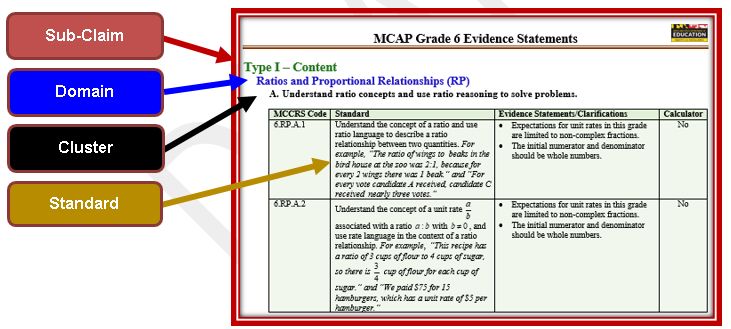
Maryland State Department of Education Page 3 of 45 03/02/2020MCAP Grade 6 Evidence Statements Overview of the Evidence Statements MCAP Mathematics Evidence Statements MCAP Mathematics Evidence Statements help teachers, curriculum developers, and administrators understand how the Maryland College and Career Ready Mathematics Standards will be assessed. Assessment items are designed to elicit the evidence described in the Evidence Statements. Organization of Evidence Statements The MCAP Mathematics Evidence Statements for the Content Sub-Claim are organized using the same structure and wording as the Maryland College and Career Ready (MCCR) standards. Each grade/course is organized by the mathematical domains for the grade/course followed by the cluster headings. The standards for each domain are listing under the appropriate cluster heading with an explanation explaining how evidence is being gathered for that standard (i.e., how the standard is being assessed.) Maryland State Department of Education Page 4 of 45 03/02/2020
MCAP Grade 6 Evidence Statements

   Content Sub-Claim
    Explanation of Types of Evidence Statements                Example of the Standard
    Assessing the Entire Standard                              6.RP.A.1: Understand the concept of a ratio and use ratio language
       • Standard code is the same as the MCCR                             to describe a ratio relationship between two quantities.
           standard.                                                       For example, “The ratio of wings to beaks in the bird
       • The exact language and intent of the entire                       house at the zoo was 2:1, because for every 2 wings
           standard is assessed, which includes examples                   there was 1 beak.” and “For every vote candidate A
           and “e.g.” parts of the standard.                               received, candidate C received nearly three votes.”

    Assessing Portions of a Standard with Multiple             6.NS.B.3-1: Fluently add, subtract, multiply, and divide multi-digit
    Operations                                                             decimals using the standard algorithm for each
       • The standard code is the same as the MCCR                         operation.
           standard with an addition of a dash and a
           sequential number, e.g. -1, -2, -3, …               6.NS.B.3-3: Fluently add, subtract, multiply, and divide multi-digit
       • The portion of the standard that is assessed will                 decimals using the standard algorithm for each
           appear in bold font.                                            operation.

    Assessing Portions of a Standard with Two or More          7.G.4-1:     Know the formulas for the area and circumference
    Concepts                                                                of a circle and use them to solve problems; give an
       • The standard code is the same as the MCCR                          informal derivation of the relationship between the
           standard with an addition of a dash and a                        circumference and area of a circle.
           sequential number, e.g. -1, -2, -3, …               7.G.4-2:     Know the formulas for the area and circumference of a
       • The portion of the standard that is being                          circle and use them to solve problems; give an informal
           assessed will appear in bold font.                               derivation of the relationship between the
                                                                            circumference and area of a circle.

Maryland State Department of Education                       Page 5 of 45                                                03/02/2020
MCAP Grade 6 Evidence Statements Reasoning Sub-Claim The MCAP Mathematics Evidence Statements for the Reasoning Sub-Claim have a different structure than the Content Evidence Statements. The codes for the Reasoning Evidence Statements begin with the corresponding grade level, 6, 7, or 8. The letter “R” appears after the grade level in the code to indicate that the statement is a Reasoning Evidence Statement. The Reasoning Evidence Statements may apply to both machine-scored and constructed response items, unless otherwise noted. The Reasoning Assessment items align to any of the major content standards from the given course. Maryland State Department of Education Page 6 of 45 03/02/2020
MCAP Grade 6 Evidence Statements

   Modeling Sub-Claim
   The MCAP Mathematics Evidence Statements for the Modeling Sub-Claim have a different structure than the Content Evidence
   Statements. The codes for the Modeling Evidence Statements begin with the corresponding grade level, 6, 7, or 8. The letter “M”
   appears after the course designation in the code to indicate that the statement is a Modeling Evidence Statement. The Modeling
   Evidence Statements may apply to both machine-scored and constructed response items, unless otherwise noted. The Modeling
   Assessment items may align to any of the content standards from the given course.

Maryland State Department of Education                     Page 7 of 45                                                 03/02/2020
MCAP Grade 6 Evidence Statements

   Standards for Mathematical Practice
   The Standards for Mathematical Practice describe varieties of expertise that mathematics educators at all levels should seek to
   develop in their students.

       1. Make sense of problems and persevere in solving them.
       2. Reason abstractly and quantitatively.
       3. Construct viable arguments and critique the reasoning of others.
       4. Model with mathematics.
       5. Use appropriate tools strategically.
       6. Attend to Precision
       7. Look for and make use of structure.
       8. Look for and express regularity in repeated reasoning.

   Definitions
   Defined below are some common terms used in the Evidence Statements.

   •   Context: The item involves a real-world situation or setting. The situation or setting influences the solution method.
   •   Minimal Context: A sentence or phrase that provides meaning for the quantity/quantities in the item and connects the
       quantity/quantities to a real world situation. The real world situation may or may not influence the solution method.
   •   No Context: The item has no real world situation or setting. The item contains only numbers and symbols, along with a
       direction prompt.

Maryland State Department of Education                      Page 8 of 45                                                   03/02/2020
MCAP Grade 6 Evidence Statements
Evidence Statements
Type I – Content
Ratios and Proportional Relationships (RP)
A. Understand ratio concepts and use ratio reasoning to solve problems.
MCCRS Code Standard Evidence Statements/Clarifications Calculator
6.RP.A.1 Understand the concept of a ratio and use • Expectations for ratios in this grade are No
ratio language to describe a ratio limited to non-complex fractions.
relationship between two quantities. For • The initial numerator and denominator
example, “The ratio of wings to beaks in the should be whole numbers.
bird house at the zoo was 2:1, because for
every 2 wings there was 1 beak.” and “For
every vote candidate A received, candidate C
received nearly three votes.”
6.RP.A.2 a • Expectations for unit rates in this grade No
Understand the concept of a unit rate
b are limited to non-complex fractions.
associated with a ratio a : b with b ≠ 0 , and • The initial numerator and denominator
use rate language in the context of a ratio should be whole numbers.
relationship. For example, “This recipe has
a ratio of 3 cups of flour to 4 cups of sugar,
3
so there is cup of flour for each cup of
4
sugar.” and “We paid $75 for 15
hamburgers, which is a rate of $5 per
hamburger.”
Maryland State Department of Education Page 9 of 45 03/02/2020MCAP Grade 6 Evidence Statements
MCCRS Code Standard Evidence Statements/Clarifications Calculator
6.RP.A.3a Use ratio and rate reasoning to solve real- • Expectations for unit rates in this grade Yes
world and mathematical problems, e.g., by are limited to non-complex fractions.
reasoning about tables of equivalent ratios, • The initial numerator and denominator
tape diagrams, double number line should be whole numbers.
diagrams, or equations.
a. Make tables of equivalent ratios
relating quantities with whole-
number measurements, find missing
values in the tables, and plot the pairs
of values on the coordinate plane.
Use tables to compare ratios.
6.RP.A.3b Use ratio and rate reasoning to solve real- • Expectations for unit rates in this grade Yes
world and mathematical problems, e.g., by are limited to non-complex fractions.
reasoning about tables of equivalent ratios, • The initial numerator and denominator
tape diagrams, double number line should be whole numbers.
diagrams, or equations. • Items may involve reasoning with any of
b. Solve unit rate problems including the strategies listed in the standard, e.g.,
those involving unit pricing and by reasoning about tables of equivalent
constant speed. For example, “If it ratios, tape diagrams, double number
took 7 hours to mow 4 lawns, then at line diagrams, or equations.
that rate, how many lawns could be
mowed in 35 hours? At what rate
were lawns being mowed?”
Maryland State Department of Education Page 10 of 45 03/02/2020MCAP Grade 6 Evidence Statements
MCCRS Code Standard Evidence Statements/Clarifications Calculator
6.RP.A.3c-1 Use ratio and rate reasoning to solve real- • Items focus on finding a percent of a Yes
world and mathematical problems, e.g., by quantity as a rate per 100.
reasoning about tables of equivalent ratios, • Items may or may not contain context.
tape diagrams, double number line • Expectations for ratios in this grade are
diagrams, or equations. limited to ratios of non-complex
c-1 Find a percent of a quantity as a fractions.
rate per 100 (e.g., 30% of a • The initial numerator and denominator
30 should be whole numbers.
quantity means times the
100 • Items may involve reasoning with any of
quantity); solve problems involving the strategies listed in the standard, e.g.,
finding the whole, given a part and by reasoning about tables of equivalent
the percent. ratios, tape diagrams, double number
line diagrams, or equations.
6.RP.A.3c-2 Use ratio and rate reasoning to solve real- • Items focus on solving problems Yes
world and mathematical problems, e.g., by involving finding the whole, given a part
reasoning about tables of equivalent ratios, and the percent.
tape diagrams, double number line • Items may or may not contain context.
diagrams, or equations. • Expectations for ratios in this grade are
c-2.Find a percent of a quantity as a rate limited to ratios of non-complex
per 100 (e.g., 30% of a quantity fractions.
30 • The initial numerator and denominator
means times the quantity);
100 should be whole numbers.
solve problems involving finding • Items may involve reasoning with any of
the whole, given a part and the the strategies listed in the standard, e.g.,
percent. by reasoning about tables of equivalent
ratios, tape diagrams, double number
line diagrams, or equations.
Maryland State Department of Education Page 11 of 45 03/02/2020MCAP Grade 6 Evidence Statements
MCCRS Code Standard Evidence Statements/Clarifications Calculator
6.RP.A.3d Use ratio and rate reasoning to solve real- • Items may or may not contain context. Yes
world and mathematical problems, e.g., by • Items require students to multiply and/or
reasoning about tables of equivalent ratios, divide dimensioned quantities (e.g.,
tape diagrams, double number line money, time, length, etc.).
diagrams, or equations. • Items may require students to correctly
d. Use ratio reasoning to convert express the units of the result.
measurement units; manipulate and • Expectations for ratios in this grade are
transform units appropriately when limited to ratios of non-complex
multiplying or dividing quantities. fractions.
• The initial numerator and denominator
should be whole numbers.
• Items may involve reasoning with any of
the strategies listed in the standard, e.g.,
by reasoning about tables of equivalent
ratios, tape diagrams, double number
line diagrams, or equations.
Maryland State Department of Education Page 12 of 45 03/02/2020MCAP Grade 6 Evidence Statements
The Number System (NS)
A. Apply and extend previous understandings of multiplication and division to divide fractions by
fractions.
MCCRS Code Standard Evidence Statements/Clarifications Calculator
6.NS.A.1 Interpret and compute quotients of fractions, • Items use visual models and/or No
and solve word problems involving division algorithmic methods to interpret,
of fractions by fractions, e.g., by using visual compute, and solve word problems. For
fraction models and equations to represent example, how many pounds of chocolate
the problem. For example, create a story will each person receive if 3 people
2 3 1
context for ÷ and use a visual share lb of chocolate equally?
3 4 2
fraction model to show the quotient; use the
relationship between multiplication and
2 3 8
division to explain that ÷ =
3 4 9
3 8 2
because of is . (In general,
4 9 3 • Items focus on using division of fractions
a c ad by fractions to solve word problems.
÷ =.) How much chocolate will
b d bc • Note that the italicized examples
1 correspond to three meanings/uses of
each person get if 3 people share lb of division: (1) equal sharing; (2)
2
3 measurement; (3) unknown factor. These
chocolate equally? How many -cup meanings/uses of division are assessed
4 equally.
2
servings are in of a cup of yogurt? How • Items may involve fractions and mixed
3 numbers but not decimals.
wide is a rectangular strip of land with
3 1
length mi and area square mi?
4 2
Maryland State Department of Education Page 13 of 45 03/02/2020MCAP Grade 6 Evidence Statements
B. Compute fluently with multi-digit numbers and find common factors and multiples.
MCCRS Code Standard Evidence Statements/Clarifications Calculator
6.NS.B.2 Fluently divide multi-digit numbers using • The given dividend and divisor require No
the standard algorithm. an efficient strategy, method or standard
algorithm (e.g. 40584 ÷ 76 ).
• Items do not have a context.
• Only the answer is required.
• Items have a maximum of five-digit
dividends and a maximum of two-digit
divisors.
• Items may or may not have a remainder.
Students understand that remainders can
be written as fractions or decimals.
6.NS.B.3-1 Fluently add, subtract, multiply, and divide • Items do not have a context. No
multi-digit decimals using the standard • Only the sum is required.
algorithm for each operation. • Simplification of the expression requires
the use of an efficient strategy, method or
standard algorithm.
• Items should be rigorous, but not tedious.
Assessment items should keep terms
within the expression between 0 and 100
with each term extending to no more
than three decimal places.
Maryland State Department of Education Page 14 of 45 03/02/2020MCAP Grade 6 Evidence Statements
MCCRS Code Standard Evidence Statements/Clarifications Calculator
6.NS.B.3-2 Fluently add, subtract, multiply, and divide • Items do not have a context. No
multi-digit decimals using the standard • Only the difference is required.
algorithm for each operation. • Positive differences only.
• Simplification of the expression requires
the use of an efficient strategy, method or
standard algorithm.
• Items should be rigorous, but not tedious.
Assessment items should keep terms
within the expression between 0 and 100
with each term extending to no more
than three decimal places.
6.NS.B.3-3 Fluently add, subtract, multiply, and divide • Items do not have a context. No
multi-digit decimals using the standard • Only the product is required.
algorithm for each operation. • Simplification of the expression requires
the use of an efficient strategy, method or
standard algorithm.
• Items should be rigorous, but not tedious.
For the purposes of assessment,
expressions involve one term of no more
than 5 digits multiplied by another term
of no more than 2 digits, with each term
extending to no more than three decimal
places.
Maryland State Department of Education Page 15 of 45 03/02/2020MCAP Grade 6 Evidence Statements
MCCRS Code Standard Evidence Statements/Clarifications Calculator
6.NS.B.3-4 Fluently add, subtract, multiply, and divide • Items do not have a context. No
multi-digit decimals using the standard • Only the quotient is required.
algorithm for each operation. • Simplification of the expression requires
the use of an efficient strategy, method or
standard algorithm.
• Items should be rigorous, but not tedious.
For the purposes of assessment,
expressions should involve a term of 4
digits divided by a term of 2 digits or 3
digits divided by 3 digits.
• Every quotient is a whole number or a
decimal terminating at the tenths,
hundredths, or thousandths place.
6.NS.B.4-1 Find the greatest common factor of two • Items do not have a context. No
whole numbers less than or equal to 100
and the least common multiple of two
whole numbers less than or equal to 12.
Use the distributive property to express a
sum of two whole numbers 1–100 with a
common factor as a multiple of a sum of two
whole numbers with no common factor. For
example, express 36 + 8 as 4 ( 9 + 2 ) .
Maryland State Department of Education Page 16 of 45 03/02/2020MCAP Grade 6 Evidence Statements
MCCRS Code Standard Evidence Statements/Clarifications Calculator
6.NS.B.4-2 Find the greatest common factor of two • Items may have minimal or no context. No
whole numbers less than or equal to 100 and • Items require writing or finding the
the least common multiple of two whole equivalent expression with the greatest
numbers less than or equal to 12. Use the common factor.
distributive property to express a sum of
two whole numbers 1–100 with a common
factor as a multiple of a sum of two whole
numbers with no common factor. For
example, express 36 + 8 as 4 ( 9 + 2 ) .
Maryland State Department of Education Page 17 of 45 03/02/2020MCAP Grade 6 Evidence Statements
C. Apply and extend previous understandings of numbers to the system of rational numbers.
MCCRS Code Standard Evidence Statements/Clarifications Calculator
6.NS.C.5 Understand that positive and negative • Items do not require students to perform No
numbers are used together to describe any computations.
quantities having opposite directions or • Students may be asked to recognize the
values (e.g., temperature above/below zero, meaning of zero in the situation, but will
elevation above/below sea level, not be asked to explain.
credits/debits, positive/negative electric
charge); use positive and negative numbers
to represent quantities in real-world contexts,
explaining the meaning of 0 in each
situation.
6.NS.C.6a Understand a rational number as a point on • Items have minimal or no context. No
the number line. Extend number line
diagrams and coordinate axes familiar from
previous grades to represent points on the
line and in the plane with negative number
coordinates.
a. Recognize opposite signs of numbers
as indicating locations on opposite
sides of 0 on the number line;
recognize that the opposite of the
opposite of a number is the number
itself, e.g., − ( −3) =3 , and that 0 is
its own opposite.
Maryland State Department of Education Page 18 of 45 03/02/2020MCAP Grade 6 Evidence Statements
MCCRS Code Standard Evidence Statements/Clarifications Calculator
6.NS.C.6b-1 Understand a rational number as a point on • Items have minimal or no context. No
the number line. Extend number line • Students may need to recognize or use
diagrams and coordinate axes familiar from traditional notation for quadrants (such
previous grades to represent points on the as I, II, III, IV).
line and in the plane with negative number • Coordinates are not limited to integers.
coordinates.
b-1. Understand signs of numbers in
ordered pairs as indicating
locations in quadrants of the
coordinate plane; recognize that
when two ordered pairs differ only by
signs, the locations of the points are
related by reflections across one or
both axes.
6.NS.C.6b-2 Understand a rational number as a point on • Items have minimal or no context. No
the number line. Extend number line • Students may need to recognize or use
diagrams and coordinate axes familiar from traditional notation for quadrants (such
previous grades to represent points on the as I, II, III, IV).
line and in the plane with negative number • Coordinates are not limited to integers.
coordinates.
b-2. Understand signs of numbers in
ordered pairs as indicating locations
in quadrants of the coordinate plane;
recognize that when two ordered
pairs differ only by signs, the
locations of the points are related
by reflections across one or both
axes.
Maryland State Department of Education Page 19 of 45 03/02/2020MCAP Grade 6 Evidence Statements
MCCRS Code Standard Evidence Statements/Clarifications Calculator
6.NS.C.6c-1 Understand a rational number as a point on • Items have minimal or no context. No
the number line. Extend number line • Coordinates are not limited to integers.
diagrams and coordinate axes familiar from
previous grades to represent points on the
line and in the plane with negative number
coordinates.
c-1. Find and position integers and
other rational numbers on a
horizontal or vertical number line
diagram; find and position pairs of
integers and other rational numbers
on a coordinate plane.
6.NS.C.6c-2 Understand a rational number as a point on • Items have minimal or no context. No
the number line. Extend number line • Students may need to recognize or use
diagrams and coordinate axes familiar from traditional notation for quadrants (such
previous grades to represent points on the as I, II, III, IV).
line and in the plane with negative number • Coordinates are not limited to integers.
coordinates.
c-2. Find and position integers and other
rational numbers on a horizontal or
vertical number line diagram; find
and position pairs of integers and
other rational numbers on a
coordinate plane.
Maryland State Department of Education Page 20 of 45 03/02/2020MCAP Grade 6 Evidence Statements
MCCRS Code Standard Evidence Statements/Clarifications Calculator
6.NS.C.7a Understand ordering and absolute value of • Items do not have a context. No
rational numbers. • Items are not limited to integers.
a. Interpret statements of inequality as
statements about the relative position
of two numbers on a number line
diagram. For example, interpret
−3 > −7 as a statement that −3 is
located to the right of −7 on a
number line oriented from left to
right.
6.NS.C.7b Understand ordering and absolute value of • Items are not limited to integers. No
rational numbers.
b. Write, interpret, and explain
statements of order for rational
numbers in real-world contexts. For
example, write −3°C > −7°C to
express the fact that −3°C is
warmer than −7°C .
6.NS.C.7c-1 Understand ordering and absolute value of • Items do not have a context. No
rational numbers. • Items are not limited to integers.
c-1. Understand the absolute value of a
rational number as its distance
from 0 on the number line. Interpret
absolute value as magnitude for a
positive or negative quantity in a real-
world situation. For example, for an
account balance of –30 dollars, write
−30 = 30 to describe the size of the
debt in dollars.
Maryland State Department of Education Page 21 of 45 03/02/2020MCAP Grade 6 Evidence Statements
MCCRS Code Standard Evidence Statements/Clarifications Calculator
6.NS.C.7c-2 Understand ordering and absolute value of • Items must have a context. No
rational numbers. • Items are not limited to integers.
c-2. Understand the absolute value of a
rational number as its distance from 0
on the number line; interpret
absolute value as magnitude for a
positive or negative quantity in a
real-world situation. For example,
for an account balance of –30
dollars, write −30 = 30 to describe
the size of the debt in dollars.
6.NS.C.7d Understand ordering and absolute value of • Items may or may not contain context. No
rational numbers. • Items are not limited to integers.
d. Distinguish comparisons of absolute • Prompts do not present students with a
value from statements about order. number line diagram, but students may
For example, recognize that an draw a number line diagram as a
account balance less than –30 strategy.
dollars represents a debt greater
than 30 dollars.
6.NS.C.8 Solve real-world and mathematical problems • Items may or may not contain context. No
by graphing points in all four quadrants of • Finding distances is limited to points
the coordinate plane. Include use of with integer coordinates.
coordinates and absolute value to find
distances between points with the same first
coordinate or the same second coordinate.
Maryland State Department of Education Page 22 of 45 03/02/2020MCAP Grade 6 Evidence Statements
Expressions and Equations (EE)
A. Apply and extend previous understandings of arithmetic to algebraic expressions.
MCCRS Code Standard Evidence Statements/Clarifications Calculator
6.EE.A.1-1 Write and evaluate numerical expressions • Items involve expressing b-fold products No
involving whole-number exponents. aa...a in the form a b , where a and b
are non-zero whole numbers.
• Items do not require use of the laws of
exponents.
6.EE.A.1-2 Write and evaluate numerical expressions • Items may involve simple fractions No
involving whole-number exponents. raised to whole-number powers of 5 or
3 2
1 2
less, e.g. , .
2 3
• Items may involve nonnegative decimals
raised to whole-number powers, limiting
multiplication to the assessment limits
clarified in 6.NS.B.3-3.
• Items do not have a context.
6.EE.A.2a Write, read, and evaluate expressions in • Items do not have a context. Yes
which letters stand for numbers. • Numerical values in these expressions
a. Write expressions that record may include whole numbers, fractions,
operations with numbers and with and decimals.
letters standing for numbers. For
example, express the calculation
"Subtract y from 5" as 5 − y .
Maryland State Department of Education Page 23 of 45 03/02/2020MCAP Grade 6 Evidence Statements
MCCRS Code Standard Evidence Statements/Clarifications Calculator
6.EE.A.2b Write, read, and evaluate expressions in • Items do not have a context. Yes
which letters stand for numbers. • Numerical values in these expressions
b. Identify parts of an expression using may include whole numbers, fractions,
mathematical terms (sum, term, and decimals.
product, factor, quotient, coefficient);
view one or more parts of an
expression as a single entity. For
example, describe the expression
2 ( 8 + 7 ) as a product of two factors;
view ( 8 + 7 ) as both a single entity
and a sum of two terms.
6.EE.A.2c-1 Write, read, and evaluate expressions in • For expressions not connected by Yes
which letters stand for numbers. authentic formulas, items do not need to
c-1. Evaluate expressions at specific have a context.
values of their variables. Include • Numerical values in these expressions
expressions that arise from formulas may include whole numbers, fractions,
used in real-world problems. and decimals.
Perform arithmetic operations, • Items will not require operations on
including those involving whole- negative numbers.
number exponents, in the
conventional order when there are
no parentheses to specify a
particular order (Order of
Operations). For example, use the
formulas V = s 3 and A = 6 s 2 to find
the volume and surface area of a
1
cube with sides of length s = .
2
Maryland State Department of Education Page 24 of 45 03/02/2020MCAP Grade 6 Evidence Statements
MCCRS Code Standard Evidence Statements/Clarifications Calculator
6.EE.A.2c-2 Write, read, and evaluate expressions in • Items are simple applications of formulas Yes
which letters stand for numbers. that are provided in the prompt.
c-2. Evaluate expressions at specific • Items do not require the student to
values of their variables. Include manipulate the formula or isolate
expressions that arise from variables to solve an equation.
formulas used in real-world • Items have minimal or no context.
problems. Perform arithmetic • Numerical values in these expressions
operations, including those involving may include whole numbers, fractions,
whole-number exponents, in the and decimals.
conventional order when there are no • Items will not require operations on
parentheses to specify a particular negative numbers.
order (Order of Operations). For
example, use the formulas V = s 3
and A = 6 s 2 to find the volume and
surface area of a cube with sides of
1
length s = .
2
6.EE.A.3 Apply the properties of operations to • Items will not require operations on Yes
generate equivalent expressions. For negative numbers.
example, apply the distributive property to • Items have minimal or no context.
the expression 3 ( 2 + x ) to produce the
equivalent expression 6 + 3x ; apply the
distributive property to the expression
24 x + 18 y to produce the equivalent
expression 6 ( 4 x + 3 y ) ; apply properties of
operations to y + y + y to produce the
equivalent expression 3y .
Maryland State Department of Education Page 25 of 45 03/02/2020MCAP Grade 6 Evidence Statements
MCCRS Code Standard Evidence Statements/Clarifications Calculator
6.EE.A.4 Identify when two expressions are equivalent • Items will not require operations on No
(i.e., when the two expressions name the negative numbers.
same number regardless of which value is • Items have minimal or no context.
substituted into them). For example, the
expressions y + y + y and 3y are equivalent
because they name the same number
regardless of which number y stands for.
Maryland State Department of Education Page 26 of 45 03/02/2020MCAP Grade 6 Evidence Statements
B. Reason about and solve one-variable equations and inequalities.
MCCRS Code Standard Evidence Statements/Clarifications Calculator
6.EE.B.5-1 Understand solving an equation or • Items may involve selecting or Yes
inequality as a process of answering a identifying values from an infinite set of
question: which values from a specified nonnegative numbers (e.g., even
set, if any, make the equation or numbers; whole numbers; fractions).
inequality true? Use substitution to • Items may involve selecting or
determine whether a given number in a identifying values from a finite set of
specified set makes an equation or nonnegative numbers (e.g., {2,5, 7,9} ).
inequality true.
Limit finite sets to no more than four
numbers.
6.EE.B.5-2 Understand solving an equation or • Items may involve selecting or Yes
inequality as a process of answering a identifying values from an infinite set of
question: which values from a specified nonnegative numbers (e.g., even
set, if any, make the equation or numbers; whole numbers; fractions).
inequality true? Use substitution to • Items may involve selecting or
determine whether a given number in a identifying values from a finite set of
specified set makes an equation or nonnegative numbers (e.g., {2,5, 7,9} ).
inequality true.
• Limit finite sets to no more than four
numbers.
6.EE.B.6 Use variables to represent numbers and write • Items may require students to write an No
expressions when solving a real-world or expression to represent a real-world or
mathematical problem; understand that a mathematical problem. Items do not
variable can represent an unknown number, require students to find a solution.
or, depending on the purpose at hand, any • Items may require students to interpret a
number in a specified set. variable as a specific unknown number,
or, as a number that could represent any
number in a specified set.
Maryland State Department of Education Page 27 of 45 03/02/2020MCAP Grade 6 Evidence Statements
MCCRS Code Standard Evidence Statements/Clarifications Calculator
6.EE.B.7 Solve real-world and mathematical problems • Items are algebraic, requiring solving for Yes
by writing and solving equations of the form a variable. Items are not simply
x+ p = q and px = q for cases in which p, q arithmetic.
and x are all nonnegative rational numbers. • Items involve whole-number, fraction, or
decimal values of p and q; fractions and
decimals should not appear together in
the same item.
• These items only involve equations with
addition and multiplication.
• Items must involve both writing the
equation and solving the equation. A
valid equation and the correct answer are
both required for full credit.
6.EE.B.8 Write an inequality of the form x > c or • Values of c can be rational, and are No
x < c to represent a constraint or condition therefore not limited to integers.
in a real-world or mathematical problem. • Items may involve ≤ and ≥ , as well as <
Recognize that inequalities of the form x > c and > .
or x < c have infinitely many solutions;
represent solutions of such inequalities on
number line diagrams.
Maryland State Department of Education Page 28 of 45 03/02/2020MCAP Grade 6 Evidence Statements
C. Represent and analyze quantitative relationships between dependent and independent variables.
MCCRS Code Standard Evidence Statements/Clarifications Calculator
6.EE.C.9 Use variables to represent two quantities in a • Items that involve writing an equation Yes
real-world problem that change in should not go beyond the equation types
relationship to one another; write an equation described in 6.EE.B.7.
to express one quantity, thought of as the
dependent variable, in terms of the other
quantity, thought of as the independent
variable. Analyze the relationship between
the dependent and independent variables
using graphs and tables, and relate these to
the equation. For example, in a problem
involving motion at constant speed, list and
graph ordered pairs of distances and times,
and write the equation d = 65t to represent
the relationship between distance and time.
Maryland State Department of Education Page 29 of 45 03/02/2020MCAP Grade 6 Evidence Statements
Geometry (G)
A. Solve real-world and mathematical problems involving area, surface area, and volume.
MCCRS Code Standard Evidence Statements/Clarifications Calculator
6.G.A.1 Find the area of right triangles, other N/A Yes
triangles, special quadrilaterals, and
polygons by composing into rectangles or
decomposing into triangles and other shapes;
apply these techniques in the context of
solving real-world and mathematical
problems.
6.G.A.2-1 Find the volume of a right rectangular • Items do not have a context. Yes
prism with fractional edge lengths by • Items require focusing on the connection
packing it with unit cubes of the between packing the solid figure and
appropriate unit fraction edge lengths, computing the volume
and show that the volume is the same as
would be found by multiplying the edge
lengths of the prism. Apply the formulas
V = lwh and V = Bh to find volumes of
right rectangular prisms with fractional edge
lengths in the context of solving real-world
and mathematical problems.
Maryland State Department of Education Page 30 of 45 03/02/2020MCAP Grade 6 Evidence Statements
MCCRS Code Standard Evidence Statements/Clarifications Calculator
6.G.A.2-2 Find the volume of a right rectangular prism • Items focus on using the formulas in Yes
with fractional edge lengths by packing it problem-solving contexts.
with unit cubes of the appropriate unit
fraction edge lengths, and show that the
volume is the same as would be found by
multiplying the edge lengths of the prism.
Apply the formulas V = lwh and V = Bh
to find volumes of right rectangular
prisms with fractional edge lengths in the
context of solving real-world and
mathematical problems.
6.G.A.3 Draw polygons in the coordinate plane given • Avoid operations with negative numbers. Yes
coordinates for the vertices; use coordinates
to find the length of a side joining points
with the same first coordinate or the same
second coordinate. Apply these techniques in
the context of solving real-world and
mathematical problems.
6.G.A.4 Represent three-dimensional figures using N/A Yes
nets made up of rectangles and triangles, and
use the nets to find the surface area of these
figures. Apply these techniques in the
context of solving real-world and
mathematical problems.
Maryland State Department of Education Page 31 of 45 03/02/2020MCAP Grade 6 Evidence Statements
Statistics and Probability (SP)
A. Develop understanding of statistical variability.
MCCRS Code Standard Evidence Statements/Clarifications Calculator
6.SP.A.1 Recognize a statistical question as one that • Items do not assess mode and range. No
anticipates variability in the data related to
the question and accounts for it in the
answers. For example, "How old am I?" is
not a statistical question, but "How old are
the students in my school?" is a statistical
question because one anticipates variability
in students' ages.
6.SP.A.2 Understand that a set of data collected to • Items might present several distributions No
answer a statistical question has a graphically and ask which two have
distribution which can be described by its nearly the same center, nearly the same
center, spread, and overall shape. spread, or nearly the same overall shape.
• Items do not assess mode and range.
6.SP.A.3 Recognize that a measure of center for a • Items do not assess mode. No
numerical data set summarizes all of its
values with a single number, while a
measure of variation describes how its values
vary with a single number.
Maryland State Department of Education Page 32 of 45 03/02/2020MCAP Grade 6 Evidence Statements
B. Summarize and describe distributions.
MCCRS Code Standard Evidence Statements/Clarifications Calculator
6.SP.B.4 Display numerical data in plots on a number • Items ask to identify which display Yes
line, including dot plots, histograms, and box corresponds to a given set of data.
plots. • Items do not assess mode and range.
6.SP.B.5 Summarize numerical data sets in relation to • Items have a text-based and a graphics- Yes
their context, such as by: based overview of a numerical data set.
6.SP.B.5.a • Items require students to identify/select
Reporting the number of observations. from unambiguously true or false
6.SP.B.5.b statements such as, “About half of the
Describing the nature of the attribute values are greater than the average”; “If
under investigation, including how it this point were deleted from the data set,
was measured and its units of the median would not change”; etc.
measurement. • Items do not assess mode and range.
6.SP.B.5.c • Items should go beyond simply counting
Giving quantitative measures of center the number of observations. Reporting
(median and/or mean) and variability should include statistical analysis of the
(interquartile range and/or mean observations.
absolute deviation), as well as
describing any overall pattern and any
striking deviations from the overall
pattern with reference to the context in
which the data were gathered.
6.SP.B.5.d
Relating the choice of measures of
center and variability to the shape of the
data distribution and the context in
which the data were gathered.
Maryland State Department of Education Page 33 of 45 03/02/2020MCAP Grade 6 Evidence Statements
Type – Reasoning (R)
Reasoning items require students to express grade level appropriate mathematical reasoning by
providing arguments or justifications, critiquing the reasoning of others, and using precision when
explaining their thinking related to mathematics.
Type I
• Machine Scored
• 1 – point per item
• Can be applied to the major content standards
• Calculators are allowed on all reasoning items
• Four items from this grouping will appear on each assessment
Type II
• Human Scored Constructed Response
• Items are 3 or 4 points per item
• Can be applied to the major content standards
• Calculators are allowed on all reasoning items
• Two items from this grouping will appear on each assessment
Maryland State Department of Education Page 34 of 45 03/02/2020MCAP Grade 6 Evidence Statements
Reasoning with Ratios and Proportional Relationships (R.1)
MCCRS Code Standard/Cluster Evidence Statements/Clarifications Calculator
6.R.1a Understand ratio concepts and use ratio • Evidence Statements Yes
reasoning to solve problems. (6.RP.A) o Present solutions to multi-step
problems in the form of valid chains
of reasoning, using symbols such as
the equal sign appropriately, or
identify or describe errors in
solutions to multi-step problems and
present corrected solutions.
• Clarification
o Items focus on the knowledge and
skills articulated in 6.RP.A
o Expectations for ratios in this grade
are limited to ratios of non-complex
fractions.
o The initial numerator and
denominator should be whole
numbers.
Maryland State Department of Education Page 35 of 45 03/02/2020MCAP Grade 6 Evidence Statements
Reasoning with Number Systems (R.2)
MCCRS Code Standard/Cluster Evidence Statements/Clarifications Calculator
6.R.2a Interpret and compute quotients of • Evidence Statements Yes
fractions, and solve word problems o Base arithmetic explanations and
involving division of fractions by reasoning on concrete referents such
fractions, e.g., by using visual fraction as diagrams, connecting the diagrams
models and equations to represent the to a written (symbolic) method.
problem. For example, create a story context For example, how many pounds of
2 3 chocolate will each person receive if
for ÷ and use a visual fraction 1
3 4 3 people share lb of chocolate
model to show the quotient; use the 2
relationship between multiplication and equally?
2 3 8
division to explain that ÷ =
3 4 9
3 8 2
because of is . (In general,
4 9 3
a c ad
÷ =.) How much chocolate will
b d bc
1
each person get if 3 people share lb of
2
3
chocolate equally? How many -cup
4
2
servings are in of a cup of yogurt? How
3
wide is a rectangular strip of land with
3 1
length mi and area square mi?
4 2
(6.NS.A.1)
Maryland State Department of Education Page 36 of 45 03/02/2020MCAP Grade 6 Evidence Statements
MCCRS Code Standard/Cluster Evidence Statements/Clarifications Calculator
6.R.2b Interpret and compute quotients of • Evidence Statements Yes
fractions, and solve word problems o Base explanations and reasoning on
involving division of fractions by the relationship between
fractions, e.g., by using visual fraction multiplication and division.
models and equations to represent the
problem. For example, create a story
2 3
context for ÷ and use a visual
3 4
fraction model to show the quotient; use the
relationship between multiplication and
2 3 8
division to explain that ÷ =
3 4 9
3 8 2
because of is . (In general,
4 9 3
a c ad
÷ =.) How much chocolate will
b d bc
1
each person get if 3 people share lb of
2
3
chocolate equally? How many -cup
4
2
servings are in of a cup of yogurt? How
3
wide is a rectangular strip of land with
3 1
length mi and area square mi?
4 2
(6.NS.A.1)
Maryland State Department of Education Page 37 of 45 03/02/2020MCAP Grade 6 Evidence Statements
MCCRS Code Standard/Cluster Evidence Statements/Clarifications Calculator
6.R.2c Understand ordering and absolute value of • Evidence Statements Yes
rational numbers. (6.NS.C.7) o Base explanations and reasoning on a
number line diagram.
• Clarification
o Connections to 6.NS.C.6 may be
made.
o Diagrams can be provided in the
prompt or in the response.
6.R.2d Solve real-world and mathematical problems • Evidence Statements Yes
by graphing points in all four quadrants of o Base explanations and reasoning on a
the coordinate plane. Include use of coordinate plane diagram.
coordinates and absolute value to find
distances between points with the same first • Clarification
coordinate or the same second coordinate. o Connections to 6.NS.C.6 may be
(6.NS.C.8) made.
o Diagrams can be provided in the
prompt or in the response.
Maryland State Department of Education Page 38 of 45 03/02/2020MCAP Grade 6 Evidence Statements
Reasoning with Expressions and Equations (R.3)
MCCRS Code Standard/Cluster Evidence Statements/Clarifications Calculator
6.R.3a Identify when two expressions are • Evidence Statements Yes
equivalent (i.e., when the two o Base explanations and reasoning on the
expressions name the same number properties of operations.
regardless of which value is
substituted into them). Apply the • Clarification
properties of operations to o Items should not require students to identify
generate equivalent expressions. or name properties.
For example, apply properties of
operations to y + y + y to produce
the equivalent expression 3y and
understand that the expressions
y + y + y and 3y are equivalent
because they name the same number
regardless of which number y stands
for; apply the distributive property
to the expression 3 ( 2 + x ) to
produce the equivalent expression
6 + 3x ; apply the distributive
property to the expression
24 x + 18 y to produce the equivalent
expression 6 ( 4 x + 3 y ) .
(6.EE.A.3, 6.EE.A.4)
Maryland State Department of Education Page 39 of 45 03/02/2020MCAP Grade 6 Evidence Statements
MCCRS Code Standard/Cluster Evidence Statements/Clarifications Calculator
6.R.3b Reason about and solve one-variable • Evidence Statements Yes
equations and inequalities. (6.EE.B) o Given an equation, present the solution steps
as a logical argument that concludes with a
solution.
• Clarification
o Items do not require students to write an
original equation or inequality.
o Items do not require students to solve an
inequality. Refer to the Evidence Statements
and Clarifications for 6.EE.B.5-2.
6.R.3c Identify when two expressions are • Evidence Statements Yes
equivalent (i.e., when the two o Form chains of reasoning that will justify or
expressions name the same number refute propositions or conjectures.
regardless of which value is
substituted into them). For example,
the expressions y + y + y and 3y
are equivalent because they name
the same number regardless of
which number y stands for.
(6.EE.A.4)
6.R.3d Represent and analyze quantitative • Evidence Statements Yes
relationships between dependent and o Present solutions to multi-step problems in the
independent variables. (6.EE.C.9) form of valid chains of reasoning, adhering to
precision.
o Identify or describe errors in solutions to
multi-step problems and present corrected
solutions.
• Clarification
o Items that involve writing an equation should
not go beyond the equation types described in
6.EE.B.7
Maryland State Department of Education Page 40 of 45 03/02/2020MCAP Grade 6 Evidence Statements
Type – Modeling (M)
Modeling items require students to solve multi-step contextual word problems with degree of
difficulty appropriate for Grade 6, requiring application of knowledge and skills articulated in all
of the Content Domains.
Type I
• Machine Scored
• 1 – point per item
• Can be applied to any of the content standards
• Calculators are allowed on all modeling items
• Four items from this grouping will appear on each assessment
Type III
• Human Scored Constructed Response
• Items are 3 or 4 points per item
• Can be applied to any of the content standards
• Calculators are allowed on all modeling items
• Two items from this grouping will appear on each assessment
Maryland State Department of Education Page 41 of 45 03/02/2020MCAP Grade 6 Evidence Statements
Modeling with Mathematics in Grade 6 (M.1)
MCCRS Code Standard/Cluster Evidence Statements/Clarifications Calculator
6.M.1 Choose and produce appropriate • Items require students to Yes
mathematics to model quantities and implement the modeling cycle
mathematical relationships in order to fully and completely in order to
analyze situations, make predictions, solve multi-step contextual word
solve multi-step problems, and draw problems.
conclusions. • Items require application of
knowledge and skills articulated in
any/all of the Content Domains.
6.M.1a Choose and produce appropriate • Items may require students to Yes
mathematics to model quantities and identify and describe the problem
mathematical relationships in order to that needs to be solved in their
analyze situations, make predictions, own words or that could be asked
solve multi-step problems, and draw based on the problem situation.
conclusions. • Items may require students to
a. Given a real world situation, justify the problem that needs to be
identify the problem that needs solved by identifying information
to be solved, make necessary from the problem.
assumptions, and identify • Items may include charts and/or
important information. graphs that could be analyzed for
information about the problem.
• Items may prompt students to
identify the information that is
needed to solve the problem.
• Items may have information that is
essential to solving the problem,
but is not given, and prompt
students to make assumptions.
• Items do not require a solution.
Maryland State Department of Education Page 42 of 45 03/02/2020MCAP Grade 6 Evidence Statements
MCCRS Code Standard/Cluster Evidence Statements/Clarifications Calculator
6.M.1b Choose and produce appropriate • Items allow for students to Yes
mathematics to model quantities and represent the given problem using
mathematical relationships in order to mathematical models, e.g. words,
analyze situations, make predictions, equations, functions, geometric
solve multi-step problems, and draw figures, statistical models, etc.
conclusions. • Responses should be
b. Given a real world situation, mathematically correct and
formulate a mathematical precise.
representation of the problem. • Items do not require a solution.
6.M.1c Choose and produce appropriate • Items may prompt the students to Yes
mathematics to model quantities and identify the mathematics or
mathematical relationships in order to mathematical model needed to
analyze situations, make predictions, solve the problem.
solve multi-step problems, and draw • Items require the students to use a
conclusions. model to compute a solution and
c. Given a real world situation, draw conclusions.
use mathematical models to • Responses should be
compute and draw mathematically correct and
conclusions. precise.
6.M.1d Choose and produce appropriate • Items involve students interpreting Yes
mathematics to model quantities and and concluding what a particular
mathematical relationships in order to solution means within the context
analyze situations, make predictions, of a problem.
solve multi-step problems, and draw • Items may require the students to
conclusions. provide the final solution to the
d. Given a real world situation, problem.
interpret what a solution
means within the context of
the situation.
Maryland State Department of Education Page 43 of 45 03/02/2020MCAP Grade 6 Evidence Statements
MCCRS Code Standard/Cluster Evidence Statements/Clarifications Calculator
6.M.1e Choose and produce appropriate • Items require students to analyze a Yes
mathematics to model quantities and given solution path (partial or
mathematical relationships in order to complete) to determine if it is a
analyze situations, make predictions, mathematically correct solution
solve multi-step problems, and draw path for the given real world
conclusions. situation, and to consider whether
e. Given a real world situation, the solution reasonably answers
evaluate and/or validate a the question.
partial or complete solution. • Items may ask students to improve
or refine a solution path at any
point in the modeling cycle.
• Items may require the students to
provide the final solution to the
problem.
Maryland State Department of Education Page 44 of 45 03/02/2020Maryland Comprehensive Assessment Program
Mathematics Assessment
Grade 6 Reference Sheet
Conversions
1 mile = 5280 feet 1 kilometer = 0.62 mile
1 mile = 1760 yards 1 meter = 39.37 inches
1 mile = 1.609 kilometers 1 inch = 2.54 centimeters
1 pound = 16 ounces 1 ton = 2000 pounds
1 pound = 0.454 kilograms 1 kilogram = 2.2 pounds
1 cup = 8 fluid ounces 1 gallon = 4 quarts
1 pint = 2 cups 1 gallon = 3.785 liters
1 quart = 2 pints 1 liter = 0.264 gallons
1 liter = 1000 cubic centimeters
Formulas
Area ( A ) Volume ( V ) and Surface Area ( SA )
Name Shape Formula Name Shape Formula
Square s A=s 2
Right V = lwh
h
s Rectangular or
Prism l
w
V = Bh
Rectangle A = lw
w h
l B SA =2lw + 2hw + 2lh
Parallelogra b A = bh Cube V = s3
s
m h
s
s SA = 6s 2
Triangle 1 General V = Bh
h A= bh Prism h
2 B
or SA = Sum of the
b areas of the faces
bh h
A=
2 B
Page 45 of 45 Maryland Comprehensive Assessment ProgramYou can also read


