Grant Writing for Graduate Students - Dr. Regina Werum, Department of Sociology University of Nebraska-Lincoln August 2021
←
→
Page content transcription
If your browser does not render page correctly, please read the page content below
Grant Writing for Graduate Students

 Dr. Regina Werum, Department of Sociology
       University of Nebraska-Lincoln
                  August 2021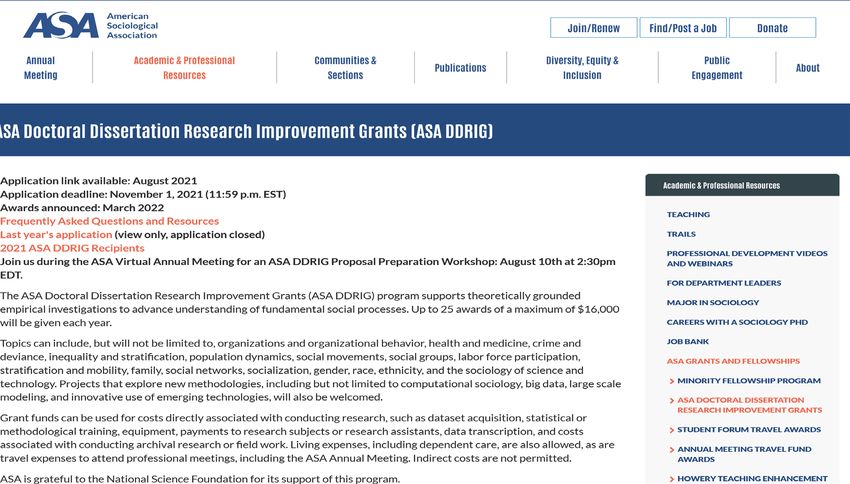
DAY ONE

              GEARING UP…

              Dave Brubeck, Take Five
    https://www.youtube.com/watch?v=vmDDOFXSgAs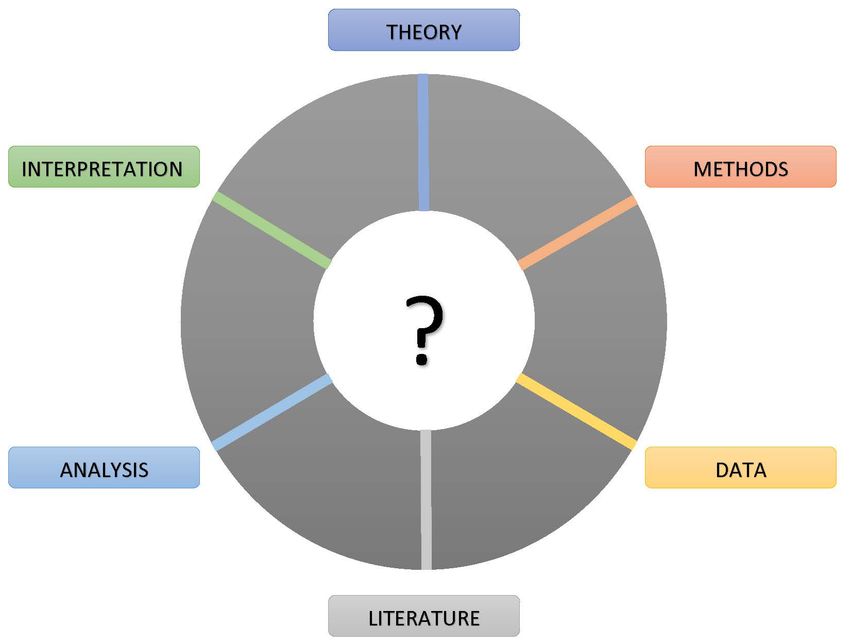
A. Grant-Writing Strategies and Process

You want to know how to write a successful
proposal, right?

I suggest you start by thinking about the
bigger picture…

(approx. 1 hr)

Why Build a Funding Portfolio?
                           FUNDING
                            LEVEL

                 SMALL               LARGE
                            MEDIUM

          LOW

 RISK   MEDIUM

          HIGH   (avoid)
Which Preliminary Steps To Take?
Planning your Project
•  Determine your long-term professional & research goals
    What is your professional goal? How does research figure into it?
    Why is your research important? How will it advance the field?
    If not research, how might grants/fellowships still be important?
• Develop your bright idea/topic into a Research Question
    Conduct search of extant research on the topic (outcomes & predictors)
    Read it!
    Contact researchers/mentors working on topic
    Contact Office of Research/Grad Studies for potential funding sources
• Develop your Research Question into an empirical project
    How will you do your research (data collection and analysis)?
    Prepare a brief description (“concept paper/white paper/summary
    page/quad chart,” depending on funding agency)
    Discuss drafts with colleagues/mentor
• Imagine your audience – proposal reviewers and program officers
Which Type(s) of Research Do You Do?
    Selecting a Funding Mechanism

THE BOWL OF WAX:
What differentiates
• grants from fellowships?
• basic from applied research vs. contracts?
• research from training grants?
• pilot/seed funding from a full-fledged
  project?
• PI-driven research from capacity- or
  institution-building grants?

Think of these categories as ideal types, even as the reality often involves
moving on a continuum. Where you “land” impacts the funding agency
and mechanism most appropriate for your project.
When To Do What: Timing Is Everything
    Before you write the actual proposal:
•   Start early: Plan one year in advance of submission (18+ months in advance of the
    time period for which you seek funding).
•   Read solicitations/Broad Agency Announcements/Calls for Proposals carefully.
•   Optimize the opportunity cost associated with writing a proposal: Identify 2+ potential
    funders; adapt the core of your proposal to meet their specifications and your needs;
    deconflict where possible.
•   Develop a realistic time plan to submit (retro-engineer from deadline); build in time to
    obtain and address mentors’ feedback; whatever the submission deadline is, YOUR
    DEADLINE is at least a week earlier!
•   Assess research-related financial and time needs realistically (talk to mentors).
•   Develop pilot/preliminary data – this is key, but what does it mean?
•   If relevant: Submit your Institutional Review Board (IRB) application early; at least
    have it pending at submission.
•   If relevant: Solicit letters of recommendation from mentors well in advance of the
    deadline (and share your proposal/statements).
How Do You Write a Proposal?
The Research (and Writing) Wheel
What To Do … About the Budget?
DON’T DO IT YOURSELF. ASK THE EXPERTS.

Remember that fellowships usually provide funding for the
researcher. Usually there are no budgets to create (except
sometimes for travel or living expenses).

If applying for a grant, calculate expenses for conducting
research per se. This may or may not include your time.
How much should you ask for?
• Assess how much is reasonable for the work; talk to advisors
• Make sure all budget items are well-justified
• Make sure requests are consistent with program guidelines
• Facilities & Administrative Costs - Talk to experts in sponsored
    programs early on
What Not To Do • Lack of focus and follow-through • Lack of attention to details • “Trust me” proposals • Ideological proposals • Rhetorical Questions • Gravy train proposals
BREAK! DANCE!
https://www.youtube.com/watch?v=5dhgWwGbpk0
       Cut to 11:00 Funky Monkey
B. The National Science Foundation
WRITING AN NSF PROPOSAL
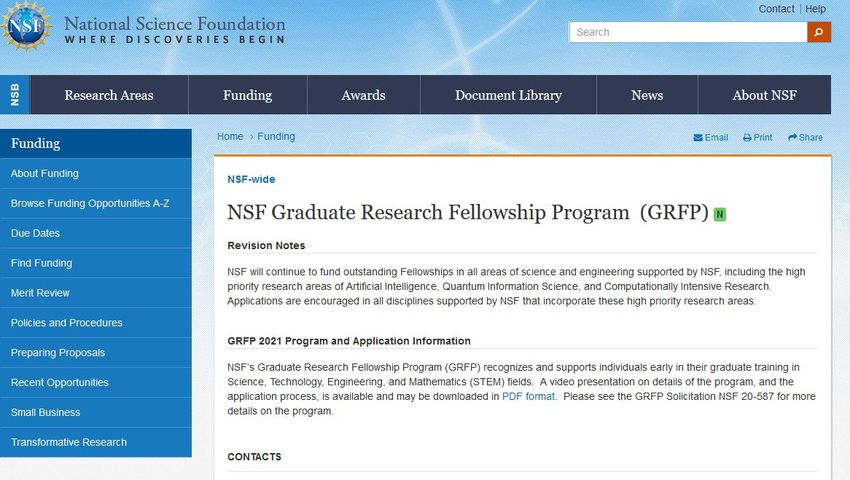
DISSERTATION RESEARCH IMPROVEMENT GRANT (DRIG)
GRADUATE RESEARCH FELLOWSHIP PROGRAM (GRFP)
(approx. 2 hrs total)NSF Dissertation Research Improvement Grants
The NSF is organized into seven directorates. The Social/Behavioral/Economic Sciences (SBE)
directorate is NSF’s smallest directorate in terms of funding.
NSF DRIGs (aka DDRIGs) are available in many programs located within the SBE directorate, and in a
few outside of the SBE (e.g., Polar Programs/Artic Science).
Some SBE programs manage their own DRIG competition, others have outsourced it (e.g., to
ASA, APSA, AERA).
No citizenship requirement.
EXAMPLES OF SBE Divisions and Programs (as of Fall 2021)
Division of Social & Econ. Sciences (SES) Division of Behav. & Cogn. Sciences (BCS)
Economics Archaeology
Sociology Biological Anthropology
Interdisciplinary Programs: Cultural Anthropology
Accountable Institutions & Behavior/AIB [Pol Sci] Cognitive Neuroscience
Decision, Risk & Management Science/DRMS Human-Environment and Geographical Sciences/HEGS
Human Networks & Data Science/HNDS Human Networks & Data Science/HNDS
Law & Science/LS Linguistics
Methodology, Measurement, & Statistics/MMS Interdisciplinary Programs:
Science of Organizations/SoO; Developmental Sciences/DS
Science Technology, & Society/STS Perception, Action, & Cognition/PAC
Secure & Trustworthy Cyberspace/SaTC Secure & Trustworthy Cyberspace/SaTC
Security & Preparedness/SAP [Pol Sci] Smart & Connected Communities/S&CC
Smart & Connected Communities/S&CC Social Psychology
Smart Health/AI & Advanced Data ScienceASA/NSF Dissertation Research Improvement Grant
• Visit the ASA Program Page https://www.asanet.org/ASADDRIG for their
description and excellent FAQ
• It addresses many issues: program goals are very similar to NSF’s mission statement.
Also addresses eligibility, funding, formatting, application components.
• Did you attend the virtual workshop at the 2021 ASA meetings? August 10 @ 2:30pm.Pay Close Attention To
• Eligibility Criteria: very broad - doctoral students enrolled at US-based institutions; you
do not need to be ABD, but research sponsor must attest to readiness, and you need to
make the case for feasibility.
• Deadlines 1 cycle per year (NSF program specific; late October/early Nov. for
ASA/Sociology); review process Nov-Feb; notification by March; R&R round till May.
• Funding levels (~25 awards/year; max $16k each)
Since 2020 administered by ASA, means significant changes in eligible
funding/expenses
Unlike with NSF-administered grants, there is no F&A/indirect cost; living expenses
permitted (effectively can function like fellowship)
• Application Formatting, Components, Submission:
Looks a lot like the other NSF DRIG applications; Unlike DRIGs for other NSF
programs (or actual NSF grants) must submit via ASA’s dedicated grants
submission platform Foundant! (https://www.asanet.org/ASADDRIG)
• Merit Criteria Intellectual Merit (IM) and Broader Impacts (BI)
IM and BI of the project must be addressed in the project description.
IM and BI of applicant may be woven strategically into specific segments of
project description.
Biosketch, departmental context, scholar/sponsor statements should also
demonstrate the applicant’s IM and BI (if applicable, tell your letter writers!)Key Elements of Your DRIG Proposal I recommend: Write/save each component in Word, for ease of editing. Upload when ready to submit. Cover Sheet – select a meaningful title!!!! Project Summary – 1 page (summary, intellectual merit, broader impacts) Project Description – 10 pages References Biographical Sketch(es) - 2 pg. Budget & Justification – 2 pg + 3 pg. Current and Pending Support (student +advisor/ faculty/research sponsor) Data Management Plan – 2 pg. Plus additional docs needed, listed at https://www.asanet.org/ASADDRIG
Sample Project Summary Page (first impressions!)
                            What is the issue/social problem? What do we and don’t
                            we know about it (e.g., its extent, causes and
                            consequences, meaning/impact)?

                            What puzzle does this generate for scientists?
                            What research question does this puzzle generate and why
                            is it important to answer it?

                            How will you answer it? Describe your empirical approach.
                            (Feasibility? Extrapolation potential?)

                             IM: How will your study contribute to Sociology/Social
                             Science…? What contributions will your study make
                             regarding (any aspect or combination of) theory, concepts,
                             methods, data generation and dissemination, substance?

                            BI: So what? Who Cares? Outside of your field, who
                            will be interested in your findings? How will the
                            public find out about those findings? What changes
                            in policies or practices, interventions or inventions
                            might your findings inspire?
How to Structure Your Project Description You have 10 pages. Write your draft in Word. Import when ready. Make sure you follow all the formatting guidelines. Suggested Structure: Overview/Goals & Objectives: 1 p (RQ? Why important?) Background & Significance: 2 pg (lit review) Research Plan: 6 pg (methods/data/analysis, timeline, feasibility) Broader Impacts: ½ p (so what, who cares?) Intellectual Merit: ½ (how will the project advance science?) Plus additional docs needed: references, biosketch, budget and justification, current & pending funding, facilities statement, ethics form, DMP (
What is a Proper Data Management Plan?
• Does the DMP address what kinds of data, metadata,
  software, and other materials the research will
  produce?
• Does the DMP address how those data and products
  will be managed (e.g., standards for documenting
  metadata)?
• Does the DMP address how third-party access to
  these data will be managed, while preserving IRB,
  confidentiality, security, intellectual property, and
  other concerns?
• Does the DMP address how the data will be archived
  and made publically available?
DMP Content Examples
• Data, samples, physical collections, software, curriculum
  materials, and other materials to be produced in the course of
  the project.
• The standards to be used for data and metadata format and
  content.
• Policies for access and sharing including provisions for
  appropriate protection of privacy, confidentiality, security,
  intellectual property
• Policies and provisions for re-use, re-distribution, and the
  production of derivatives.
• Plans for archiving data, samples, and other research products,
  and for preservation of access to them.

• I found these sources useful:
  https://www.icpsr.umich.edu/web/pages/datamanagement/dmp/i
  ndex.html and https://www.mbl.edu/osp/files/2014/07/OSP-
  NSF-Data-Management-Plan-Template.pdf
DRIG Merit Review Process
• The ASA’s review process likely differs from NSF’s.
At NSF, some programs hold stand-alone/separate DRIG review panels,
others review them alongside regular faculty proposals. At ASA they will be
stand-alone, of course.
At NSF, co-review by 2+ programs is not unusual and a benefit for
interdisciplinary proposals (e.g., Sociology & Geography for a GIS-based
study). This is moot with the new ASA-based arrangement.
Review-process details will emerge as the redesigned program goes
through several iterations. If ASA continues to follow NSF norms:
At NSF, they used multiple panel reviewers; usually no ad hoc reviewers (in
Soc); assigned as specialists/generalists in the field
At NSF and ASA, panelists submit written evaluations/scores in advance of
panel meeting; at NSF feedback is shared with applicants
At NSF, full panel discussed merits of & ranked each proposal
(high/med/low/no fund/R&R), made recommendations to program officers
At NSF, program officers took funding recommendations into account when
making final recommendations
Please track the status of your application on ASA site/in Fastlane (do not
contact program officers)
• If you don’t succeed, try, try againDRIG Final Submission Tips
• Familiarize yourself early with the ASA’s submission process/site (or Fastlane
if you are applying for a DRIG with another NSF program).
• DRIG: For the ASA/NSF program, you are the research scholar. Your faculty
advisor is considered the research sponsor. (If the program is administered by
NSF, the faculty advisor is the PI!)
• Whatever the submission deadline is, YOUR DEADLINE is at least a week
earlier; your institution will require internal routing! Involve your advisor and
the Office of Sponsored Programs early, submission process is complicated.
• If you need Institutional Review Board (IRB) approval, it should be pending at
submission.
• Take the DMP seriously (data management, archiving and dissemination).
• Need for letters of recommendation varies by program (none in Sociology) –
contact other Program Directors if you cannot find the information online.
• Monitor the progress of your proposal via ASA site (Sociology DRIG) or via
NSF Fastlane (other programs). Do not contact program directors.BREAK! DANCE? https://www.youtube.com/watch?v=p-rSdt0aFuw
Movin’ On….
NSF Graduate Research Fellowship Program
• Read the solicitation:
    https://www.nsf.gov/publications/pub_summ.jsp?WT.z_pims_id=6201&ods_key=nsf20587

•   Visit https://www.nsfgrfp.org/ and the NSF Program Page for their excellent
    FAQ https://www.nsf.gov/pubs/2020/nsf20114/nsf20114.jsp and PDF summary
    https://www.nsf.gov/funding/pgm_summ.jsp?pims_id=6201 .
Pay Close Attention To
• GRFP Eligibility Criteria (pp. 12-19, 25-29 in PDF summary)
4 “levels” or categories of applicants; Graduate students generally
get just one try; must be US citizen/PR.
• Deadlines (vary by fields; mid-October for social sciences)
• Funding levels (p. 9 of PDF summary; $34k+$12k tuition x 3yrs)
• Application Formatting and Components (p. 36)
Personal Statement/Goals (3 pages)
Research Statement (2 pages)
Transcripts
Reference Letters (min. 2, provide and rank 5 names)
Various forms
• Merit Criteria (pp. 37-47)
Intellectual Merit (IM) and Broader Impacts (BI)
IM and BI of both the project and of the applicant must be addressed
in each component (tell your letter writers!)Sample GRFP Research Statement: 2 pages max
Understanding the Effects of ******** on ********* Anticipated Results In addition to highlighting the effects of …soil
temperature on [phenomenon of interest], … . data collected will address the
Keywords: Humpty, Dumpty, S.O.T. Wall
long-term consequences of inequalities in ….. Preliminary data
Introduction xxx is a major, even ubiquitous social problem. Precisely for collected/analyzed to date/obtained as part of my advisor’s larger study
that reason, researchers have dedicated significant resources to identifying the described above suggests … This informs extant research on fillintheblank and
causes and consequences of this problem. …. Previous literature demonstrates S.O.T. Wall, conducted from the standpoint of …[some other set of theories or
the benefits of …, such as providing corrective feedback1 and preventing …., methods].
as well as the benefits of …. However, we know little about …. In this
Intellectual Merit: [summarize the project’s IM here: how will your study
project, I incorporate/examine….. ……. Empirically, this study’s main
inform and push forward your scientific field? Does it play an important role
intellectual merit lies in…..
in replication? Innovation? Explain.]
Theoretical Scope Much of the research regarding … has examined ……
In preparation for this multi-year study, I will receive exceptional training
Previous research finds that …. Research also shows that … Traditionally,
from some of the leading experts (e.g., Joan of Arc, Nero, Napoleon) in
research on fillintheblank and S.O.T. Wall has been conducted from the
quantitative methods (Adam, Eve, and t…). Additionally, an upcoming
standpoint of …[some other set of theories or methods]. Little work has
research assistantship will train me in … methods of data collection and
addressed these phenomena in… this setting. My project is an extension of the
analysis. In sum, the resources available to me will prepare me to produce …..
literature on …. S.O.T. Wall theorizes that ….. My study conceptualizes…..
Builds on extant theories/concepts….in terms of theory, this study’s main
intellectual merit lies in….. Broader Impacts: [summarize the project’s broader impacts here: how
Research Questions 1. How does race/gender/soil temperature… influence will your study inform stakeholders and practices outside of your scientific
[dependent variable or key concept tested] 2. How does [some other dynamic field? Does it play an important role in community interventions? Policies?
or phenomenon] affect/mediate/moderate the relationship between Public discourse? Explain.]
gender/race/social temperature and [your outcome of interest]? I plan to publish my findings in scholarly journals and present at national and
Hypotheses 1. …….2. ………...3………….. regional conferences. I also plan to write policy-related papers that would be
useful for government organizations, such as the …. My findings will also be
Methods I plan to conduct a comparative ethnography/collect survey
relevant to private sector organizations. Specifically, my research will provide
data/interview xx individuals… for my project. I will conduct a stratified
recommendations for effective policies that encourage constructive feedback
random sample of …. using …, a comprehensive national database containing
from …. Such policies mitigate …... As an instructor of undergraduate classes,
aggregate information about … I will …. in order to study how ….. moderates
I can teach the problematic nature of ….. In my teaching, I can encourage
the relationship between …. My survey, which I will distribute to …, will
future …. to help promote the adoption of gender-inclusive ….. policies,
include questions about …and ask respondents to indicate their level of
which will provide lasting benefits for .. Various stakeholder groups. In doing
agreement on a Likert Scale. I will use ….
so, my research will inform future …. Lastly, I will hire underrepresented
Upon completing and transcribing interviews, I will use coding software students as assistants to help with data analysis, transcription, and coding. This
(…XYZ software) to perform open and focused coding. Coding and analyzing will provide historically disadvantaged students with the opportunity to
the interview data will allow me to … Quantitative data analyses will involve develop as researchers and sociologists.
….[estimation procedures] best suited for the outcome under investigation
References [not required but a few are the smart thing to do] [1], [2] [3]
(using XYZ software)/ Methodologically, this study’s main intellectual merit
…[10]
lies in…..Sample GRFP Personal Statement: 3 pages max
Personal Statement and Previous Research Intellectual Merit: [describe your own IM here] … My academic record is a
Previous work/occupational experiences in …. motivate my intellectual testament to my dedication to scholarly research. I have shown the ability to
interest in …. As a freshman, at ACME University, I initially planned to formulate research questions and implement effective research methodologies
do/had no clue. …. However, one …….caught my attention. …… I first to answer those questions. Particularly, I have demonstrated my adeptness in
became aware of …..This experience made ….., I began to explore the survey design and quantitative data analysis. Importantly, my academic history
research on ….., coupled with my broader interest in … and inequalities …, is evidence of my ability to work both independently and collaboratively on
informed my decision to apply for graduate study in ….. Now, as a graduate scholarly research. I have continued to immerse myself in literature, which
student in the Department of ….., working with a research team/lab led by increased my familiarity with substantive areas such as organizational
Dr. … I am conducting research/learning how to …. This places me in a sociology and gender. As I continue as a graduate student ….., I am in a
prime position to conduct impactful research on ….. competitive position to receive training from renowned …, which will aid me
in conducting research examining fillintheblank.
Baccalaureate Research and Training: NAME OF UNIVERSITY (years)
At my undergraduate university, I began working on research projects in …. Broader Impacts:[describe your own BI here] … I have consistently
early in my academic career. I conducted both independent and collaborative demonstrated my commitment to understanding …. I will continue this
research projects, all of which involved survey design and primary data commitment during my fellowship years in several ways. First, I will provide
collection. Working on these projects provided me with valuable experiences underprivileged students with the opportunity to work as research assistants.
that have helped me mature as a researcher and methodologist. …(describe After graduating from college and before beginning my graduate study, I
how)…. Focusing on xxx topic, my first empirical research project involved worked as an academic tutor for underprivileged in …. This experience made
designing a survey (N=125) that allowed us to study …... I conducted a pilot apparent to me that all students have the capacity to succeed when provided
study using a preliminary version of the survey, in which I solicited feedback with the right opportunities. This understanding drives my desire to encourage
from participants regarding the clarity of questions. This allowed us to refine my students and provide them with the opportunities that will help them to
the instrument that was ultimately used for final data collection. I also develop as researchers and scholars. Second, I will disseminate my findings to
conducted all of the quantitative data analysis for our study. This included research groups and advocates for …... For instance, my findings will be of
performing ….analyses and chi-squared tests. I created visual representations particular relevance to the research initiative focused on ….. My research will
for aggregate data, such as contingency tables and regression scatterplots. also be of use for national advocacy groups including the ….. By disseminating
Additionally, I contributed to the literature review and theoretical framing of my findings to organizations that actively seek to …., my research has the
our final paper. Our findings were consistent with our hypotheses; we found potential to provide a realizable increase in the quality ….. will advance the
that … field by bolstering our understanding of ….. Little work has addressed …’,
particularly as it relates …. As such, my research would also contribute to the
The second undergraduate research project in which I was engaged dealt
literature on the ….. In addition to publication in scholarly journals and
with… (describe project empirically and in terms of its scientific merit) …
presentations at national and regional conferences, I plan to present my findings
Graduate Research and Training: NAME OF UNIVERSITY, if to private sector organizations. These presentations will provide practical
applicable. recommendations that encourage feedback from …. Thus, the presentation of
My current research project examines … [describe project empirically and my research to the non-academic community will provide significant benefits
in terms of its scientific merit] … for both organizations and employees.
References [1], [2], [3], …GRFP Final Submission Tips • I recommend: Draft/save each component in Word, for ease of editing. Upload when ready to submit. • Familiarize yourself early with the submission process and site: https://www.nsfgrfp.org/applicants/grfp_application_tutorial • GRFP: You are the PI. Involve your mentor/advisor and the Office of Sponsored Programs early, submission process is complicated. • Whatever the submission deadline is, YOUR DEADLINE is at least a week earlier; remember your institution might require internal routing! • If you need Institutional Review Board (IRB) approval, it should be pending at submission. • Think carefully about data management, archiving and dissemination. • Monitor the progress of your proposal through the GRFP site – do not contact program directors to that end.
GRFP Merit Review Process
•   Interdisciplinary panel reviews proposals from smaller fields (e.g.,
    Sociology, Geography, Urban Planning).
•   Larger fields (e.g., chemistry, biology) have their own review panels.
•   Typically 3 panel reviewers; no ad hoc reviewers.
•   Assigned as specialists and generalists in the field.
•   Panelists submit written evals/scores before (virtual) panel meeting.
•   Full panel meets, small groups discuss the merits of and assign
    individual scores to each proposal, make recommendations to full
    panel, program officers.
•   Usually, recommendations are in 3 groups: Fund, “Bubble”, Do Not
    Fund. The candidates on the bubble are revisited. Panelists can flag
    proposals.
•   Program officers take funding recommendations into account when
    making final recommendations.
•   Track the status of your application on the GRFP program site (do not
    contact program officers).

•   Grad students: If you don’t succeed, seek alternate funding
    source.
END OF DAY ONE
SEE YOU TOMORROW!
https://www.youtube.com/watch?v=0G383538qzQDAY TWO
LET’S GET CRACKING’!
https://www.youtube.com/watch?v=EaxhwO9iwmAA. Hands-On Session with Students All participants are expected to present their project idea verbally to the group - in 3 minutes or less: Sketch your Research Question, Methods, Intellectual Merit, Broader Impacts. Students who provided me with a 1-page Project Summary prior to this workshop will get a second round of feedback on their oral presentations from me and engage in Q&A with peers. Students who were not able to do so will get feedback and Q&A on the spot. 8:00AM-9:30AM
BREAK AGAIN … time to exhale

https://www.youtube.com/watch?v=I_p1S_NrnT0
B. Peers on the Panel – Your Experts!

      Organized by the Department of Sociology

9:30AM-10:30AM
ONE FINAL BREAK
..in the hope that you will find a funding opportunity that
you feel about this strongly…
https://www.youtube.com/watch?v=9wNPug7h1gQC. Plenty Of Fish In The Sea
SAMPLE OF
ADDITIONAL FUNDING OPPORTUNITIES
FOR SOCIOLOGISTS
11:00AM-12:30PMFederal Funding Opportunities:
Sociology Graduate Students At Large
CDC Centers for Disease Control No citizenship required.
https://www.cdc.gov/fellowships/ Funding and eligibility criteria vary. Broad range of areas include, e.g.,
statistics, public health , epidemiology, policy, health economics
NIH (R36 Dissertation Grants) Must be US citizen or PR.
https://grants.nih.gov/grants/guide/pa-files/par-18-894.html (mental health). $ varies, pegged to predoctoral
stipend levels plus dissertation-related research costs.
USDA (National Needs Fellowship Grants) your institution nominates you. No citizenship required.
https://nifa.usda.gov/program/national-needs-graduate-and-postgraduate-fellowship-grants-program-
funding-opportunity-nnf; stipend & tuition; also has excellent post-doc opportunities
EPA Fellowships Must be US citizen. (GRIP fellowship program on hold; internship program active)
https://www.epa.gov/research-fellowships; severely curtailed in recent years. EPA also partners to
advertise fellowships: https://www.epa.gov/careers/research-fellowships-and-scholarships#asph
Department of Defense Fellowships Must be US citizen.
https://www.ndsegfellowships.org/ and http://ndseg.sysplus.com/ 3 years of funding in cog/behav
sciences; stipend, tuition, health ins.
Department of Energy Programs Must be US citizen/PR.
http://orise.orau.gov/science-education/internships-scholarships-fellowships/default.aspx plus
https://science.osti.gov/wdts/scgsr and http://science.energy.gov/wdts/ for undergraduates!
HUD Grants $15k grants to ~15 awardees/yr; good for policy-relevant studies. No citizenship required.
http://portal.hud.gov/hudportal/HUD?src=/programdescription/ddrg
Department of State + Dept of Education = Fulbright-Hays Fellowships Must be US citizen.
http://eca.state.gov/fulbright/fulbright-programs/program-summaries/fulbright-hays-program
US Census Bureau Fellowships Must be US citizen. 10 fellowships, up to 50k;r projects in statistics, economics,
demography. https://www.census.gov/srd/DissertationFellowship.pdf
EPSCOR http://www.scepscoridea.org/ and http://www.scepscoridea.org/documents/Vision2025.pdfSample Funding Opportunities:
(Sociology of Education) Graduate Students
These three major governmental entities maintain complex funding opportunities – talk to your
mentors before you decide to get lost in the weeds as these target faculty PIs/teams…
National Science Foundation/NSF’s EHR Directorate
https://www.nsf.gov/funding/programs.jsp?org=EHR
U.S. Department of Education – Institute for Education Sciences/IES
https://ies.ed.gov/funding/
National Institutes of Health/National Institute of Child Health & Human Development/NICHD
https://www.nichd.nih.gov/grants-contracts/FOAs-notices
Professional organizations and foundations provide excellent funding opportunities, too:
AERA Dissertation Grants
https://www.aera.net/Professional-Opportunities-Funding/AERA-Funding-Opportunities/Grants-
Program/Dissertation-Grants
http://www.aera.net/Professional-Opportunities-Funding/AERA-Funding-Opportunities/AERA-
MET-Dissertation-Fellowship
http://www.aera.net/Professional-Opportunities-Funding/AERA-Funding-Opportunities/Minority-
Dissertation-Fellowship-Program
http://www.aera.net/Professional-Opportunities-Funding/AERA-Funding-Opportunities/Grants-
Program (also check other professional associations for seed grant programs)
NAEd/Spencer Foundation Dissertation Fellowships
https://www.spencer.org/grant_types/dissertation-fellowship No citizenship requirement.
https://www.spencer.org/why-we-grant (additional funding programs)Sample Funding Opportunities: Methodology Graduate Students NSF Mathematical Sciences Postdoctoral Research Fellowships (MSPRF) https://www.nsf.gov/funding/pgm_summ.jsp?pims_id=5301; ~ $ 150k per award; must be US citizen/PR NSF SBE DRIG in Methods, Measurement & Statistics Program (MMS) https://www.nsf.gov/publications/pub_summ.jsp?WT.z_pims_id=5421&ods_key=nsf19575; $ 18k max, no citizenship requirement US Census Bureau Fellowships https://www.census.gov/srd/DissertationFellowship.pdf; up to $ 50k per award; Must be US citizen Department of Energy Computational Science Graduate Fellowship https://www.krellinst.org/csgf/; $ 38k per award; must be US citizen/PR American Statistical Association’s Gertrude Cox Scholarship and Wray Jackson Smith Scholarship (for comprehensive list visit https://www.amstat.org/ASA/Your-Career/External-Funding-Sources.aspx) https://www.amstat.org/ASA/Your-Career/Awards/Gertrude-M-Cox-Scholarship.aspx For women in graduate school, entering statistical professions https://www.amstat.org/ASA/Your-Career/Awards/Government-Statistics-Section-Wray-Jackson-Smith- Scholarship.aspx For graduate students interested in a career involving the use of government statistics Each is $1k, great portfolio building blocks); no citizenship requirement
(Sample of) Additional Sources: Private Foundations
Excellent source of funding, make sure you understand the funding entity’s mission, which is key to your successful application!
  Guggenheim Foundation Dissertation and Postdoctoral Grants
  https://www.hfg.org/df/guidelines.htm $25k for dissertation fellowships; 15-40k for research grants/post-docs;
  Frequently focus on topics related to violence, conflict, aggression. No citizenship requirement.

  National Organization of Gay & Lesbian Scientists and Technical Professionals
  https://www.noglstp.org/programs-projects/scholarships/ academic scholarships including to graduate students in the
  sciences broadly defined. No citizenship requirement.

  American Association of University Women (AAUW)
  https://www.aauw.org/resources/programs/fellowships-grants/. $20k for American fellowship (dissertation). Other
  amounts vary by funding mechanism. No citizenship requirement.

  Institute for Citizens and Scholars (aka Woodrow Wilson Foundation; strong collaboration with Mellon Foundation)
  https://citizensandscholars.org/ various substantive areas, https://woodrow.org/fellowships/
  https://woodrow.org/fellowships/womens-studies/. No citizenship requirement.

  American Association for the Advancement of Science (AAAS)
  https://www.aaas.org/fellowships - gateway to multiple sources of support, check it out! No citizenship requirement.

  Charlotte W. Newcombe Fellowship
  https://woodrow.org/fellowships/newcombe/ Interested in religion, broadly defined? No citizenship requirement.

  Ford Foundation/National Academies
  https://sites.nationalacademies.org/PGA/FordFellowships/index.htm for links to classic graduate student and postdoc
  funding. Modified citizenship requirement (citizens, PR, NA/I, refugees, DACA).
  [Not to be confused with https://www.fordfoundation.org/work/investing-in-individuals/international-fellowships-program/ (fellowships, scholarships for highly
  visible/accomplished leaders (not suitable for dissertation stage), internships (for advanced undergraduates) – main goal is diversity & inclusion, social justice
  focus). No citizenship requirement.]
(Sample of) Postdoctoral Funding Opportunities
Spencer Foundation
http://www.spencer.org/postdoctoral-fellowships

Ford Foundation/National Academies
https://sites.nationalacademies.org/PGA/FordFellowships/PGA_171940

William T. Grant Foundation
http://wtgrantfoundation.org/grants/william-t-grant-scholars-program

DoE/IES Postdoctoral Research Training in Education Sciences
https://ies.ed.gov/funding/ncer_rfas/postdoc_training.asp

NSF/SBE Postdoctoral Research Fellowships
https://www.nsf.gov/publications/pub_summ.jsp?ods_key=nsf18584&org=NSF

NSF Mathematical Sciences Postdoctoral Research Fellowships (MSPRF)
https://www.nsf.gov/pubs/2016/nsf16558/nsf16558.pdf

NSF Career Grants
https://www.nsf.gov/publications/pub_summ.jsp?ods_key=nsf20525&org=NSF (not for novices)
Thank you.
            Please contact me at
             rwerum2@unl.edu

©2009 The Board of Regents of the University of Nebraska. All rights reserved.
You can also read


