Guide to Abundance Estimation Techniques for Rio Grande Wild Turkey
←
→
Page content transcription
If your browser does not render page correctly, please read the page content below

APRIL 2011

Guide to Abundance Estimation Techniques
              for Rio Grande Wild Turkey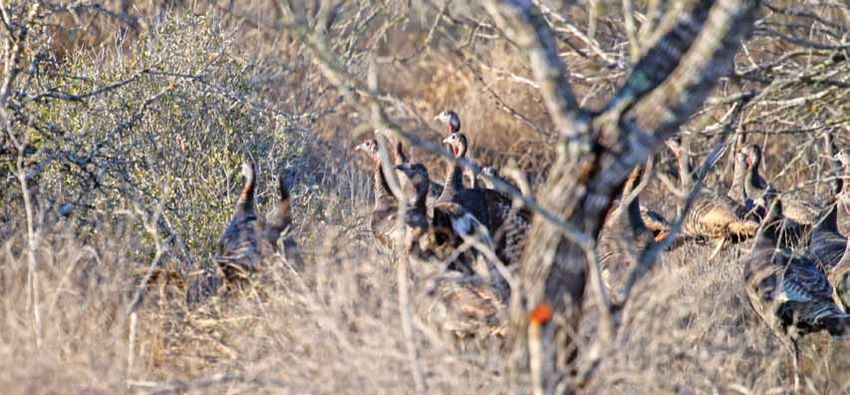
Interest in habitat and population
management for wild turkeys
(Meleagris gallopavo) has grown
in recent times, as landowners,
hunters, and wildlife viewers
recognize their actions have direct
impacts on natural resources and
wildlife populations.
1

Guide to Abundance Estimation Techniques
for Rio Grande Wild Turkey
Although there is a long tradition of managing          or growth potential (Miller and Wentworth 2000).
solely for livestock, active management by private      Thus, reliable and unbiased abundance estimates are
landowners to enhance wildlife habitat and              necessary for management purposes.
populations has gained momentum. Integrating                 Obtaining accurate and reliable estimates of
wildlife management with farm and ranch operations      abundance, however, can be difficult for species
is now common place. Interest in habitat and            that are highly mobile, wide ranging, and secretive
population management for wild turkeys (Meleagris       (Lewis 1967, Bull 1981, Williams and Austin 1988).
gallopavo) has grown in recent times, as landowners,    This is especially true of wild turkeys. Methods for
hunters, and wildlife viewers recognize their actions   accurately determining wild turkey abundance have
have direct impacts on natural resources and            long been desired (Cook 1973, DeYoung and Priebe
wildlife populations. Focus on intensive, local-scale   1987, Dickson 1992). Although several different
management of upland game birds in Texas has            methods have been examined the majority have had
renewed interest for private landowners managing        limited success (Weinstein et al. 1995, Cobb et al.
Rio Grande wild turkey (M. g. intermedia; RGWT)         2001) because of low observability and the difficulty in
populations and their habitat.                          obtaining an adequate sample size (Healy and Powell
     Management of most species requires accurate       1999). For the purpose of managing RGWTs at the
abundance estimates (Bowden et al. 2003), and a         ranch level though, a few methods may be satisfactory
survey is an important factor in determining the        and generate estimates upon which management
population size of a species, habitat requirements,     decisions can be soundly based.
reasons for species decline, whether habitat                 In this article, we discuss 3 methods for estimating
management has improved site conditions, or to          RGWT abundance at the local or ranch scale. Our
understand other aspects of population dynamics         goal is to provide landowners and managers with
(Sutherland 1996). Game populations are often           the information necessary to understand each of
managed at levels which provide a harvestable surplus   the methods, as well as incorporate an abundance
of animals without affecting the population’s health    estimation procedure into their management operation.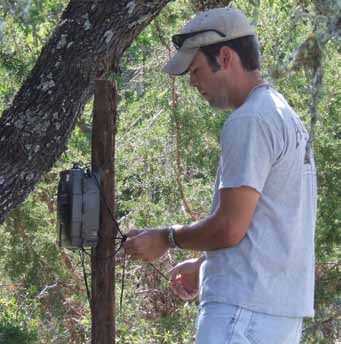
GUIDE TO ABUNDANCE ESTIMATION TECHNIQUES FOR RIO GRANDE WILD TURKEY

   Methods for Estimating Rio Grande Wild                       problem of double counting where turkey movements
   Turkey Population Size                                       are considerable (Weinrich et al. 1985, Healy and
                                                                Powell 1999). Smith (1975) also reported variable
   Overview                                                     roosting patterns of turkeys in south Texas decreased
   We must first point out that none of the methods             the reliability of roost counts. During boom years,
   discussed here are perfect. Each method has pros             roost counts may be less reliable due to the increased
   and cons which we attempt to make clear. However,            use of satellite roosts.
   providing annual estimates of turkey abundance on                More recently, Caveny (2009) evaluated
   your ranch is beneficial in determining the harvestable      independent, double observer roost counts for RGWTs
   surplus, impact of habitat management, and overall           in the south Texas Coastal Sand Plain. Using two
   health of the population.                                    independent observers at each roost site, Caveny
                                                                found roost counts to be an inexpensive and accurate
                                                                method for estimating RGWTs. Just as Smith (1975)
      A traditional roost site can be                           reported though, Caveny (2009) reported turkeys did
       defined as a location where                              not always return to the same roost each night.
     birds from many different flocks
     congregate on a regular interval
     during the fall and winter season
         as a mixed-group flock.

   Roost Counts
   A traditional roost site can be defined as a location
   where birds from many different flocks congregate on
   a regular interval during the fall and winter season
   as a mixed-group flock. A satellite roost site can be
   defined as a location that is occasionally used by a
   specific individual or specific group of birds at an
   irregular interval. Historically, traditional winter roost
   sites contained several hundred or even thousands
   of turkeys. Most landowners are aware of traditional
   roost site locations on their property where as satellite
   roosts are less known.                                       Roost counts should be conducted in February, while
         In 1966, Thomas et al. suggested that RGWTs            flocks are still congregating at traditional winter roost sites.
   may be successfully surveyed using roost counts
   because of their habit of forming large winter               Roost Count Protocol
   flocks and returning to traditional roost sites.             A roost count when done at the spatial scale of
   Cook (1973) evaluated this technique comparing               an individual ranch is an effective method for
   landowner and biologist roost counts in the Edwards          enumerating RGWTs. Roost counts should be
   Plateau ecoregion of Texas. Landowners tended to             conducted in February, while flocks are still
   overestimate turkey numbers where roost sites were           congregating at traditional winter roost sites. We do
   unstable, which suggested double counting due to             not encourage counting satellite roosts as they can be
   flock movement. However, where roost sites were              extremely unreliable. Winter roost sites are generally
   stable, landowner counts were similar to biologist           located around water where large trees exist and can
   counts (within 7%). Cook (1973) concluded that               be pinpointed at night using an owl call. Turkeys will
   estimates made by landowners can be used to estimate         typically respond to the owl call giving away their
   populations and determine RGWT trends where there            location. Roost site coordinates (latitude/longitude
   is little movement among roost sites. Using a short          or universal transverse mercator [UTM]) from a GPS
   survey period (less than a week) can minimize the            unit aids in locating areas on an annual basis.
3

                                                             Aerial Surveys
                                                             Helicopters have been used to survey several species of
                                                             wildlife including ground-dwelling birds such as quail,
                                                             grouse and turkeys (Shupe et al. 1987, Schroeder et al.
                                                             1992, Kubisiak et al. 1997, Butler et al. 2008). Shupe et
                                                             al. (1987) counted the number of northern bobwhite
                                                             (Colinus virginianus) within 110 yards of each side of
                                                             the helicopter in south Texas. Based on the distance of
                                                             transects flown, a density of birds/acre was calculated
                                                             and compared to ground transects which were similar.
                                                             More recently, DeMaso et al. (2010) established a
                                                             practical and efficient helicopter survey technique for
                                                             estimating bobwhite abundance on Texas rangelands.
                                                                  Kubisiak et al. (1997) compared helicopter
                                                             counts to ground counts of eastern wild turkeys (M.
                                                             g. sylvestris) in Wisconsin and found 84.1% of the
                                                             flock can be detected from helicopters. However,
                                                             surveys were conducted in the winter when flocks
                                                             had limited movement due to deep snow. Butler et
Conduct counts from a blind established near the roost
                                                             al. (2008) estimated turkey flock detectability from
site. A blind may be a box blind used for deer hunting,
a portable tent blind, or an area of dense brush cut to      a helicopter in the Texas panhandle and found that
conceal your presence.                                       near 100% were detectable. They also reported that
                                                             surveying 242,000-484,000 acres would be necessary
     Counts can be conducted in the mornings and             to provide sufficient power to detect a 10-25% change
evenings although research suggests morning counts           in abundance over a 4-5 year period. Most ranches in
may be better (Butler et al. 2006). Conduct counts           Texas are considerably smaller.
from a blind established near the roost site. A blind
may be a box blind used for deer hunting, a portable
tent blind, or an area of dense brush cut to conceal            Counting the same roost multiple
your presence. We suggest establishing the blind             times and taking the average of the
weeks even months prior to conducting a roost count
to allow turkeys to acclimate to it. The blind should
                                                               counts provides a good estimate
be positioned such that the observer has full view           because large numbers of birds are
of the roost site and take advantage of the terrain if           difficult to count accurately.
possible. For example, a high vantage point may help
to look down on turkeys or a low vantage point may
illuminate roosting turkeys in the sky. Binoculars can           Using helicopters to survey turkey abundance
aid in viewing and counting turkeys.                         can be expensive (~ $500/hour) and may only be
     Arrive in the blind at least an hour prior to turkeys   practical on large properties. However, in some parts
arriving or departing the roost. It is best to conduct       of Texas it is common to conduct white-tailed deer
counts within a short period of time (within one week)       (Odocoileus virginianus) surveys using transects
to prevent double counting. Counting the same roost          flown in helicopters. If conducted simultaneously,
multiple times and taking the average of the counts          deer and turkeys could be counted using helicopter
provides a good estimate because large numbers of            surveys. This would yield a density estimate for both
birds are difficult to count accurately. Appendix A          species, as well as yield a cost effective method for
provides an example data card for collecting roost           estimating turkeys. Cooperative landowner efforts
counts. Roost counts provide a near total enumeration        may be beneficial for smaller properties. Groups of
of the turkeys and make good indicators of population        landowners may opt to share the costs to conduct
trends and flock composition.                                aerial surveys for their collective properties.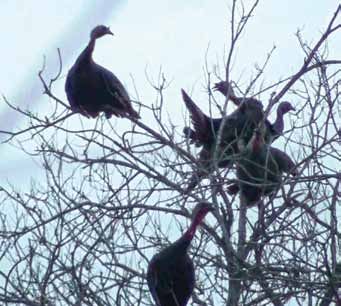
GUIDE TO ABUNDANCE ESTIMATION TECHNIQUES FOR RIO GRANDE WILD TURKEY

   In our experience, we feel traditional roost counts are the most efficient and cost effective method for estimating the number
   of RGWTs. Roost counts conducted annually provide a good indication of population trends and flock composition.

   Aerial Survey Protocol
   To conduct a helicopter survey, transects should be                                      EXAMPLE:
                                                                                 Transect length: 2 miles or 10,560 ft
   established approximately 0.25 miles apart from each
                                                                                 Transect width: 600 ft x 2 = 1,200 ft
   other and distributed evenly across the property. A                   Area surveyed = 10,560 ft x 1,200 ft = 12,672,000 ft2
   few long transects are better than numerous short                  Area surveyed = 12,672,000 ft2 ÷ 43,560 ft2 /ac = 291 acres
   ones so establish transects according to the shape of             Density = 30 turkeys counted ÷ 291 acres = 0.103 turkeys/ac
   the property. At least 2 observers in addition to the                 Density = 0.103 turkeys/ac x 10 = 1 turkey/10 acres
   pilot are necessary for counting. Each observer is
   responsible for one side of the aircraft out to 600 ft
   and turkeys are tallied as they are observed. Surveys            Trail Cameras/Bait Stations
   are typically flown at an altitude of 100–150 ft above           Trail cameras at bait stations are considered a derivative
   ground level and at a speed of 40–50 mph. Altitude               of a mark-resight method to estimate abundance, and
   and speed may vary depending on terrain and ground               has been used to estimate the population size of white-
   cover. Surveys should be conducted in the mornings               tailed deer (Jacobson et al. 1997), wild pigs (Sus scrofa;
   (8-10 am) when turkeys are active. Avoid doing                   Sweitzer et al. 2000), black bears (Ursus americanus;
   surveys late in the day when shadows are long and/or             Martorello et al. 2001), as well as wild turkeys (Cobb
   ambient temperatures are high.                                   et al. 1996, Cobb et al. 1997). However, there has
        Once data have been collected a density estimate            not been a well-designed, scientific study verifying
   is calculated. First, total the length of transect flown         the accuracy of this technique for Rio Grande wild
   for 1 survey in feet. Then, multiply transect length             turkeys; therefore, results of a trail camera, mark-
   (ft) by transect width (ft) to determine the total area          recapture estimates should be viewed with caution.
   surveyed (ft2). Area can then be converted to acres                   Nevertheless, trail cameras have become an
   dividing by 43,560 ft2/ac. Finally, divide the number            increasingly popular tool for viewing and scouting
   of turkey recorded by the acres surveyed and this is the         wildlife. Few recognize the power of trail cameras
   density estimate (turkeys/acre).                                 as a management tool for collecting biological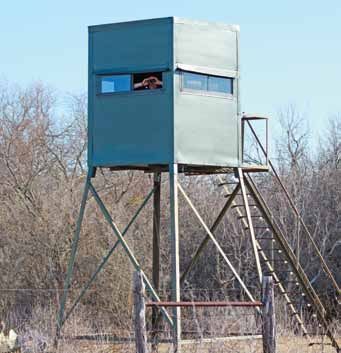
5

and population data that can lead to management                camera preventing an accurate count. After photos are
decisions (Dreibelbis et al. 2009). Trail cameras              acquired, counts can be made based on turkey visits,
established at bait stations near roost sites may be used      which can be established using the date and time
to estimate abundance of RGWTs and monitor annual              stamp of each photo. An average of turkeys counted
trends in abundance.                                           for each bait station can provide a reasonable estimate.
                                                                    Potential biases of this method include flock
                                                               mixing and multiple flocks visiting multiple bait
                                                               stations. Rio Grande wild turkey flocks are not fixed
                                                               in number of birds and birds will assimilate into
                                                               other flocks; therefore, flock size may vary over time.
                                                               Depending on the distance between roost sites, some
                                                               flocks may frequent the same bait station, thereby
                                                               causing some disparity in counts. An aerial photo
                                                               with roost sites mapped on it can provide the spatial
                                                               distribution of flocks and roosts and aid in placement
                                                               of bait stations to provide the most accurate counts.

Mount a trail camera to a post or tree approximately 6-10
feet off the ground and placed such that the line of bait is
completely visible within the camera’s field of view.

Trail Camera Survey Protocol
To conduct a trail camera survey, first locate roost sites
throughout the property. Surveys are best conducted            After photos are acquired, counts can be made based on
during the winter months (December–February)                   turkey visits, which can be established using the date and
                                                               time stamp of each photo.
to take advantage of the large congregations of
RGWTs. However, we suggest that the actual survey
be conducted over a shorter period of time such as a           Conclusions
week. Once roost sites are located, bait stations within       Estimating abundance of wildlife including RGWTs
proximity of each roost site can be established. Create        is difficult and each method is not without inherent
bait stations in an open area and place feed linearly to       biases. However, the 3 methods presented here offer
spread flock out when feeding; this will aid accurate          landowners and managers the opportunity to generate
counting. Several different models of trail cameras are        reasonable estimates of RGWTs on their property for
currently available; all which have different features         better management of the species. In our experience,
and settings (e.g., time delays, flash, camera speed).         we feel traditional roost counts are the most efficient
We suggest being consistent with your camera settings          and cost effective method for estimating the number
and keeping them the same for the purpose of these             of RGWTs. Roost counts conducted annually provide
counts annually. Mount a trail camera to a post or             a good indication of population trends and flock
tree approximately 6-10 feet off the ground and placed         composition.
such that the line of bait is completely visible within
the camera’s field of view. If the cameras are placed too
low, turkeys will be obscured by those closest to the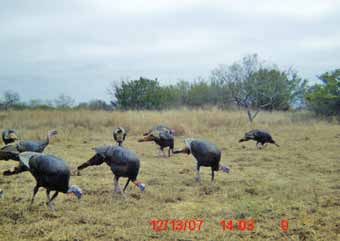
GUIDE TO ABUNDANCE ESTIMATION TECHNIQUES FOR RIO GRANDE WILD TURKEY

   Literature Cited
   Bowden, D. C., G. C. White, A. B. Franklin, and J. L. Ganey. 2003. Estimating population size with correlated
      sampling unit estimates. Journal of Wildlife Management 67:1–10.
   Bull, E. L. 1981. Indirect estimates of abundance of birds. Pages 76–80 in C. J. Ralph and J. M. Scott, editors.
      Estimating numbers of terrestrial birds. Studies in Avian Biology No. 6. Cooper Ornithological Society, Los
      Angeles, California, USA.
   Butler, M. J., W. B. Ballard, M. C. Wallace, S. J. DeMaso, and R. D. Applegate. 2006. Comparing techniques for
      counting Rio Grande wild turkeys at winter roosts. Managing Wildlife in the Southwest: New Challenges for
      the 21st Century 2006:112–117.
   Butler, M. J., W. B. Ballard, M. C. Wallace, and S. J. DeMaso. 2008. Wild turkey (Meleagris gallopavo) detectability
      from helicopters and ramifications for estimating abundance. European Journal of Wildlife Research 54:148–
      152.
   Caveny, R. J. 2009. Estimating distribution and abundance of Rio Grande wild turkeys in south Texas. Thesis,
      Texas A&M University, College Station, USA.
   Cobb, D. T., D. L. Francis, and R. W. Etters. 1996. Validating a wild turkey population survey using cameras and
      infrared sensors. Proceedings of the National Wild Turkey Symposium 7:213–218. Cobb, D. T., J. L. Kalso, and
      G. W. Tanner. 2001. Refining population estimation and survey techniques for wild turkeys. Proceedings of the
      National Wild Turkey Symposium 8:179–185.
   Cobb, D. T., R. S. Fuller, D. L. Francis, and G. L. Sprandel. 1997. Research priorities for monitoring wild turkeys
      using cameras and infrared sensors. Proceedings of the Annual Conference, Southeastern Association of Fish
      and Wildlife Agencies 51:362–372.
   Cook, R. L. 1973. A census technique for the Rio Grande turkey. Pages 279–283 in G. C. Sanderson and H. C.
      Schultz, editors. Wild turkey management: current problems and programs. Missouri Chapter of The Wildlife
      Society and University of Missouri Press, Columbia, Missouri, USA.
   DeMaso, S. J., M. J. Schnupp, E. J. Redeker, F. Hernandez, L. A. Brennan, J. P. Sands, T. W. Teinert, A. M.
      Fedynich, F. C. Bryant, R. M. Perez, and D. Rollins. 2010. A practical and efficient helicopter survey technique
      to estimate bobwhite abundance on Texas rangelands. Texas A&M University–Kingsville, Caesar Kleberg
      Wildlife Research Institute, Wildlife Technical Publication 2, Kingsville, USA.
   DeYoung, C. A., and J. C. Priebe. 1987. Comparison of inventory methods for wild turkeys in south Texas.
      Proceedings of the Annual Conference, Southeastern Association of Fish and Wildlife Agencies 41:294–298.
   Dickson, J. G. 1992. The future. Pages 408-415 in J. G. Dickson, editor. The wild turkey: biology and management.
      Stackpole Books, Mechanicsburg, Pennsylvania, USA.
   Dreibelbis, J. Z., S. L. Locke, J. C. Cathey, and B. Collier. 2009. Potential uses for trail cameras in wildlife
      management. Texas Agrilife Extension Service, Texas A&M University, College Station, USA.
   Healy, W. M., and S. M. Powell. 1999. Wild turkey harvest management: biology, strategies, and techniques. U.S.
      Fish and Wildlife Service, Biological Technical Publication, BTP-R5001-1999, Washington D.C., USA.
   Jacobson, H. A., J. C. Kroll, R. W. Browning, B. H. Koerth, and M. H. Conway. 1997. Infrared-triggered cameras
      for censusing white-tailed deer. Wildlife Society Bulletin 25:547–556.
   Kubisiak, J. F., R. N. Paisley, and R. G. Wright. 1997. Estimating the accuracy of counting eastern wild turkeys,
      Meleagris gallopavo silvestris, using helicopters in Wisconsin. Canadian Field-Naturalist 111:417–421.
   Lewis, J. B. 1967. Management of the eastern wild turkey in the Ozarks and bottomland hardwoods. Pages
      371–407 in O. H. Hewitt, editor. The wild turkey and its management. The Wildlife Society, Washington D. C.,
      Maryland, USA.
   Martorello, D. A., T. H. Eason, and M. R. Pelton. 2001. A sighting technique using cameras to estimate population
      size of black bears. Wildlife Society Bulletin 29:560–567.
   Miller, K. V., and J. M. Wentworth. 2000. Carrying capacity. Pages 140–155 in S. Demarais, and P. R. Krausman,
      editors. Ecology and management of large mammals in North America. Prentice-Hall, Inc., Upper Saddle
      River, New Jersey, USA.
7 Schroeder, M. A., K. M. Giesen, and C. E. Braun. 1992. Use of helicopters for estimating numbers of greater and lesser prairie-chicken leks in eastern Colorado. Wildlife Society Bulletin 20:106–113. Shupe, T. E., F. S. Guthery, and S. L. Beasom. 1987. Use of helicopters to survey northern bobwhite populations on rangeland. Wildlife Society Bulletin 15:458–462. Smith, D. M. 1975. Behavioral factors influencing variability of roost counts for Rio Grande turkeys. Proceedings of the National Wild Turkey Symposium 3:170–175. Sutherland W. J. 1996. Why census? Pages 1–10 in W. J. Sutherland editor. Ecological Census Techniques: a handbook. Cambridge University Press, New York, New York, USA. Sweitzer, R. A., D. V. Vuren, I. A. Gardner, W. M. Boyce, and J. D. Waithman. 2000. Estimating sizes of wild pig populations in the north and central coast regions of California. Journal of Wildlife Management 64:531–543. Thomas, J. W., C. V. Hoozer, and R. G. Marburger. 1966. Wintering concentrations and seasonal shifts in range in the Rio Grande turkey. Journal of Wildlife Management 30:34–49. Weinrich, J., E. E. Langenau, Jr., and T. Reis. 1985. Relationship between winter census and spring harvest of wild turkeys in northern lower Michigan. Proceedings of the National Wild Turkey Symposium 5:295–301. Weinstein, M., B. D. Leopold, and G. A. Hurst. 1995. Evaluation of wild turkey population estimation methods. Proceedings of the Annual Conference, Southeastern Association of Fish and Wildlife Agencies 49:476–487. Williams, L. E., Jr., and D. H. Austin. 1988. Studies of the wild turkey in Florida. Florida Game and Fresh Water Fish Commission. Division of Wildlife Technical Bulletin 10:1–210.
GUIDE TO ABUNDANCE ESTIMATION TECHNIQUES FOR RIO GRANDE WILD TURKEY

   Appendix A. Roost count survey example data card.

    Ranch:                                                     Date:

    Time:                                                      Weather:

    GPS Location:

    Roost Tree Species:

    Artificial Roost:

    Flock Composition                                                  Tally of Each                   Totals

    Adult Males

    Jakes

    Females

    Unknown

    Notes:

                                                       — FRONT —

                                      Roost Count Protocol
            • Locate roost site in the evening using an owl call or other call.
            • Be careful not to disturb roost by getting too close.
            • Record roost site location with a GPS unit.
            • Return to the roost at least an hour before sunrise the next morning.
            • Conceal yourself in a position to view turkeys in the roost.
            • Count turkeys within the roost or as they descend from roost.
            • Tally adult males, jakes, females and unknowns on the data card.
            • Allow turkeys to leave the area before showing yourself to prevent disturbing turkeys.

                                                        — BACK —
9 — NOTES —
Authors Contact Information:

Shawn L. Locke
Texas AgriLife Extension Service, Wildlife and Fisheries Sciences
Texas A&M University
College Station, TX 77843-2258, USA

James C. Cathey
Texas AgriLife Extension Service, Wildlife and Fisheries Sciences
Texas A&M University
College Station, TX 77843-2258, USA

Bret A. Collier
Texas A&M Institute of Renewable Natural Resources
College Station, TX 77843 USA

Jason B. Hardin
Texas Parks and Wildlife Department
Buffalo, TX 75831 USA

Acknowledgements

We thank Texas Parks and Wildlife Department, Upland Game Bird Program for providing funding for this resource. We thank Randy
Fugate (Texas Parks and Wildlife Department) and Gary Homerstad (Texas Parks and Wildlife Department, retired) for editorial review
of this manuscript. Photos were provided by Shawn Locke, James C. Cathey, Justin Dreibelbis and Jason Hardin. We thank the Temple
Ranch for their cooperation and assistance.
You can also read


