GUIDELINES FOR APPLICANTS - Narodowe Centrum Nauki
←
→
Page content transcription
If your browser does not render page correctly, please read the page content below
GUIDELINES FOR APPLICANTS
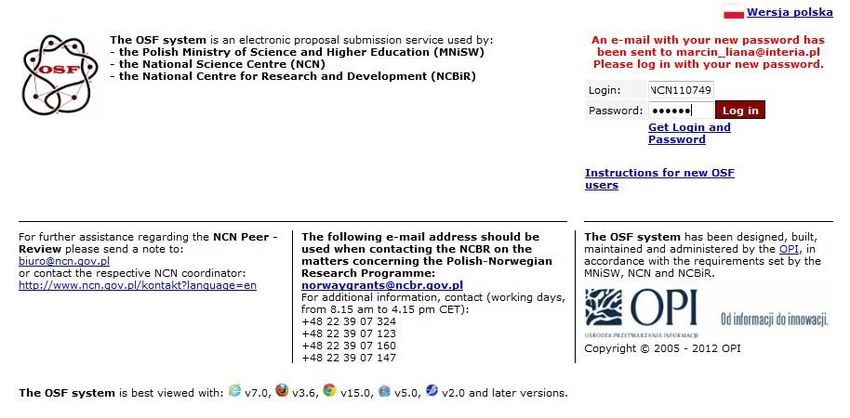
TABLE OF CONTENTS

  I. ABOUT POLONEZ .................................................................................................. 2

 II. APPLICANTS .......................................................................................................... 2

III. HOST INSTITUTION OF THE FELLOWSHIP ......................................................... 3

IV. FUNDING ................................................................................................................ 5

 V. HOW TO COMPLETE THE POLONEZ 1 APPLICATION FORM ............................ 5

VI. PROPOSAL EVALUATION ................................................................................... 31

VII. TRAINING PROGRAMME PROVIDED BY THE NCN……………………………...33

VIII. POLONEZ TIMEFRAME………………………………………………………………..33

IX. POLONEZ 1 CALL DOCUMENTS…………………………………………………….33

 X. CONTACT………………………………………………………………………………..33

Last update: 26.11.2015

                                                                                                                          1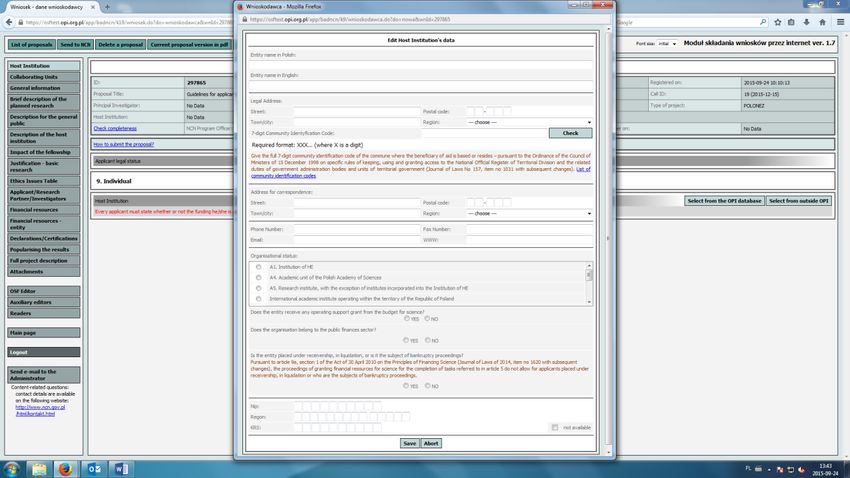
POLONEZ 1
funding opportunity for incoming researchers who want to carry out research
in host institutions in Poland
GUIDELINES FOR APPLICANTS
I. ABOUT POLONEZ
POLONEZ is an NCN fellowship programme, co-funded from the EU H2020 Marie Skłodowska-Curie
Actions, supporting international incoming researchers working in the broad field of basic research,
regardless of their nationality. It is targeted at researchers who may apply for 12- or 24-month fellowships
in host institutions in Poland, both academic and non-academic, public or private. Apart from living and
mobility allowances, amounting to € 4 350 gross per month (and a family allowance of € 300 gross per
month, which will be paid taking due account of the researcher's family situation), they are offered a grant to
cover the costs of the proposed research. The fellows are also given an opportunity to participate in a
variety of research and non-research training programmes provided by the NCN and the host institution.
II. APPLICANTS
The applicant is a researcher with a PhD degree or at least four years of full-time equivalent research
experience who has not resided or carried out their main activity (work, studies, etc.) in Poland for
th
more than 12 months in the 3 years immediately prior to the call announcement (15 of September
th th
2015), the timeframe is: 15 of September 2012 – 14 September 2015.
A researcher holding a PhD degree should provide a copy of the document certifying the
1
award of the PhD degree and its translation into English or Polish, if the language of the
original is neither English nor Polish; a scan of this document should be attached to the
electronic proposal (Please see also section V. 11: Attachment 1).
A researcher without a PhD should submit documents proving four years of full-time
equivalent research experience, e.g. a declaration signed by a representative of the
institution where research has been carried out or a dean of the institute or faculty or the
applicant's academic tutor and their translation into English of Polish, if the language of the
original is neither English nor Polish; a scan(s) of the document(s) should be attached to
the electronic proposal (Please see also section V. 11: Attachment 2).
All researchers should provide documents proving that between 15 of September 2012 and
th
th 2
14 of September 2015 they have not resided or carried out their main activity (work , studies,
etc.) in Poland. Such documents may be: a working contract, a residential permit/confirmation,
visa, health insurance, rental agreement, university enrolment certificate, proof of income tax
return, phone bills, etc. Please note that these documents do not have to be translated.
1
In the meaning of the law of country where the degree was awarded.
2
Work in Poland is understood as employment by an entity established in the Republic of Poland on the basis of
an employment contract, including part-time work.
2
The applicant must prepare a list of these documents and attach scans to the electronic
proposal (Please see also section V. 11: Attachment 3).
WHO MAY NOT APPLY:
th
researchers, who in the 3 years before the call announcement (15 September 2015) have had the
role of Principal Investigators in research projects carried out in Poland (including projects funded
by the NCN); a Principal Investigator (PI) is also a person whose project has been granted funding
but has not yet started; if he/she would like to apply for POLONEZ, he or she must resign from the
grant;
researchers, who have had the role of PI in the application submitted to the NCN in the September
2015 edition of the NCN calls for proposals (OPUS 10, PRELUDIUM 10, SONATA 10) or in the
application currently under evaluation or in the redress procedure. Results of OPUS 9,
PRELUDIUM 9, SONATA 9 will be announced in November 2015;
One researcher may act as an applicant in only a single proposal submitted under POLONEZ 1.
Researchers who submitted applications in NCN calls for proposals but were not granted funding may
apply within POLONEZ 1.
ALL RESEARCHERS, IRRESPECTIVE OF THEIR AGE AND NATIONALITY, MAY APPLY IF THEY
FULFILL THE ABOVE CRITERIA.
III. HOST INSTITUTION OF THE FELLOWSHIP
POLONEZ fellowships may be carried out in:
research organisations,
university research centres established within a single university structure,
scientific libraries,
enterprises with the status of research and development centres,
organisational institutions having legal personality status established in the Republic of
Poland,
enterprises other than those mentioned above
3
that are located in Poland .
Please keep in mind that the host institution must:
employ the fellow on a full time contract for the entire duration of the fellowship;
indicate a research partner of the fellow who supports the fellow’s integration within the
research community of the host institution (for more information please see paragraph V. 7. B);
provide the fellow with appropriate office/laboratory space, equipment, facilities and ensure
optimum working conditions;
3
Institutions for which the funds received from the NCN to finance the fellowship are classified as state aid may
be named in the application as the host institution, provided that the laws in force on the opening date of the call
for proposals allow NCN to award state aid.
3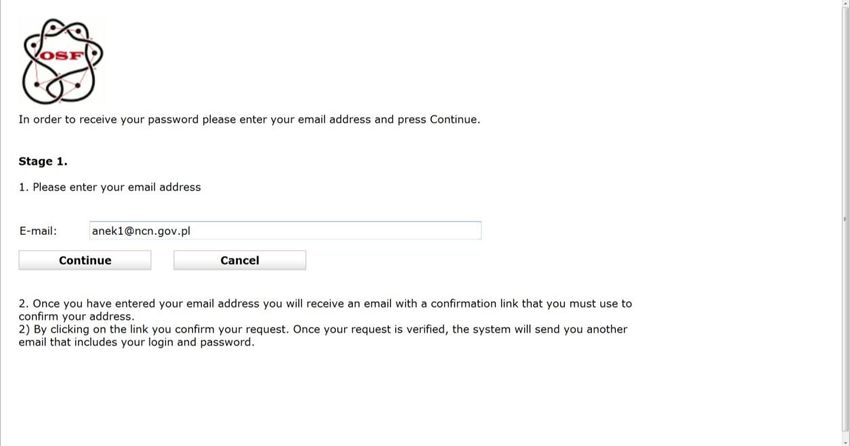
provide administrative and financial support (including issues connected with relocation) and
appoint an administrative officer responsible for these activities;
organise at least one study visit a year beneficial to the development of the fellow’s career (1-
10 days);
university organisation which is not a
research institute study visit(s) university nor a research
institute
Study visits may be organised in institutions located both in or outside of Poland and may not be
held in the institution where the fellow has been previously employed.
support the fellow in obtaining the required consents, opinions, authorisations or permits if
the research carried out within the fellowship requires formal certification with ethical
standards (For more information please see paragraph VI);
support the fellow in the popularisation of his/her research (for more information please see
paragraph V. 10. B);
abide by the rules included in the:
European Charter for Researchers:
http://ec.europa.eu/euraxess/index.cfm/rights/europeanCharter
Code of Conduct for the Recruitment of Researchers:
http://ec.europa.eu/euraxess/index.cfm/rights/codeOfConduct
The host institution should also engage in preparing the attachments to the proposal listed below:
Information on the research portfolio of the applicant’s research partner (please see paragraph
V. 7. B);
description of the host institution and the relevance of the fellowship for the development of
the fellow’s career (please see paragraph V. 6);
information on the commitment of the host institution to the fellowship (Attachment 4 to the
POLONEZ 1 Application Form);
information as whether the host institution receives or does not receive state aid, plus a
questionnaire (Attachment 5 to the POLONEZ 1 Application Form);
if the host institution does not receive statutory funding: information regarding research
realised in this institution in the last 2 years, together with a research publication list and
information on the research equipment that facilitates carrying out research (Attachment 6 to
the POLONEZ 1 Application Form).
4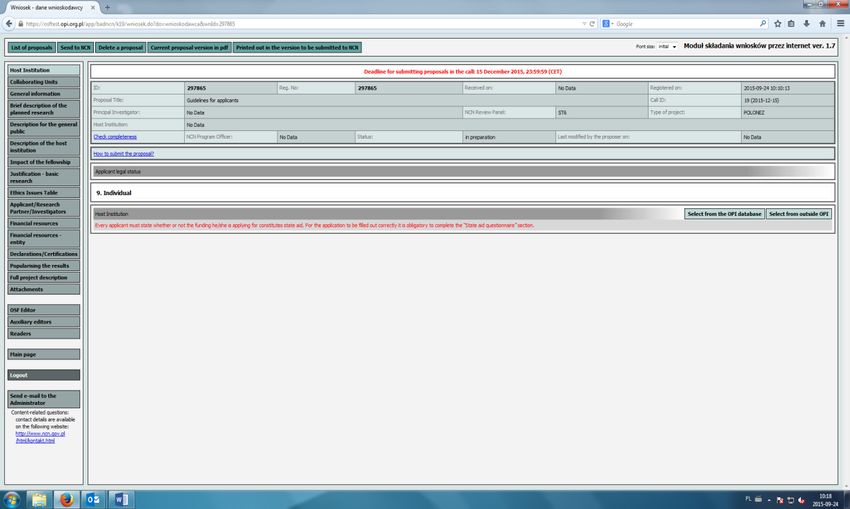
IV.         FUNDING

The FELLOW receives:
                                        4
           •    remuneration: EUR 4 350 gross (= PLN 17 443 gross)/month (salary + mobility allowance)
                = ca. 9 760 PLN net/month
           •    family allowance (for fellows whose families stay in Poland for at least 3 months during the
                fellowship period):
                EUR 300 gross (= PLN 1203 gross)/month = ca. 760 PLN net/month
           •    research grant:

                                                              12-month fellowship        24-month fellowship

Arts, Humanities and Social Sciences                             80 000 PLN             96 000 PLN per year

Life Sciences, Physical Sciences and Engineering                 112 000 PLN            160 000 PLN per year

HOST INSTITUTION receives overheads (indirect costs): 20% of direct costs.

     V.         HOW TO COMPLETE THE POLONEZ 1 APPLICATION FORM
All proposals must be submitted via the NCN electronic submission system OSF. Please consider that
there will be a substantial amount of information required in the application form, and a number of
attachments which you need to prepare in advance and convert into pdf files before uploading.
Therefore it is highly recommended to start working on your proposal in due time to meet the 15
December 2015 deadline for sending both the electronic and paper versions.
The amount of information we ask for may seem excessive, and some questions appear to be
redundant, but a more complex form at the initial stage helps us to process your application more
efficiently at the later stage, as well as ensuring we meet all necessary legal requirements and perform
a thorough analysis and evaluation of the program.
As POLONEZ 1 is a pilot call for international applicants, and we hope to gradually fine-tune the IT
tools that we use for this purpose, we kindly ask that you report all errors in the OSF system you may
come across during the application process by writing to polonez@ncn.gov.pl. We will do our best to
implement all necessary corrections as soon as possible.

           A. HOST INSTITUTION DATA
Before filling in your application, please ask the Host Institution for the following information. It
is necessary to complete the proposal.

I.             Host institution data (level 1)
               Entity name in Polish
               Entity name in English

4
    According to the POLONEZ 1 Call Text EUR exchange rate amounts to EUR=4.0101 PLN.

                                                                                                               5
Legal Address:
         Street:
         Town/city:
         Postal code:
         Region:
         7-digit Community Identification Code:
         Phone Number:
         Fax Number:
         Email address:
         WWW:
         Tax Id number:
         REGON:
         KRS (optional):

         Address for correspondence:
         Street:
         Town/city:
         Postal code:
         Region:

II.      Organisational status of the Host Institution chosen from the list:

                □ Institution of HE5
                □ Academic unit of the Polish Academy of Sciences
                □ Research institute, with the exception of institutes incorporated into the Institution of
                HE
                □ International academic institute operating within the territory of the Republic of
                Poland
               □ Polish Academy of Arts and Sciences
               □ Foundation
               □ Association
               □ Others entitled to apply on the basis of the Act of 30th of April 20106
               □ Enterprise
         Does the organisation belong to the public finances sector?
                                                                              □ Yes □          No

         Is the entity placed under receivership, in liquidation, or is it the
         subject of bankruptcy proceedings?
                                                                                 □   Yes   □   No

         Pursuant to article 9a, section 1 of the Act of 30 April 2010 on the

5
    Higher Education
6
    Act of 30th April 2010 on the Principles of Financing Science

                                                                                                              6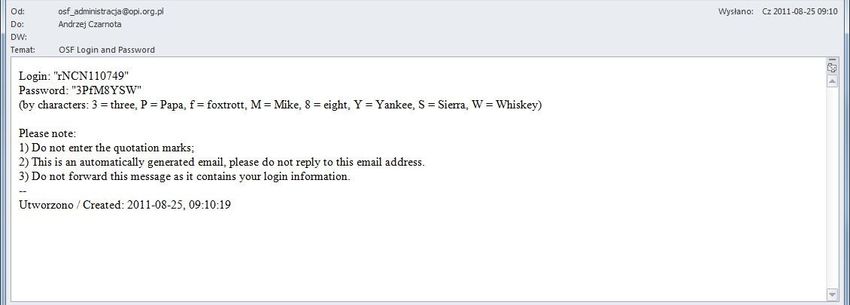
Principles of Financing Science (Journal of Laws of 2014, item
       no 1620 with subsequent changes), the proceedings of granting
       financial resources for science for the completion of tasks
       referred to in article 5 do not allow for applicants placed under
       receivership, in liquidation or who are the subjects of bankruptcy
       proceedings.
       Does the entity receive any operating support grants from the
                            7                                                      □   Yes   □   No
       budget for science ?

III.   Head of Unit:
       Academic Title in English:
       Name:
       Surname:
       Position/Title in English:

                                     8
IV.    Host Institution (level 2) :
       Entity name in Polish:
       Entity name in English:
       Street:
       Town/city:
       Postal code:
       Region:
       Phone Number:
       Fax Number:
       Email address:
       WWW:

                                                    9
V.     Classification by regulatory authority

              □      Institution of HE supervised by the Ministry of Science and Higher Education

                 □   Military institution of HE (in accordance with article 2.1 item 25)

                 □   State services institutions of HE (in accordance with article 2.1 item 25)

                 □   Arts institution of HE (in accordance with article 2.1 item 26)

              □      Medical institution of HE (in accordance with article 2.1 item 27)

7
  “Operating support grant” (in Polish: dotacja statutowa) is funds that the Host Institution receives in order to
    be able to perform the tasks defined in its statute, sustaining the continuity of research and development work
    undertaken in this institution.
8
  A department/division/office etc. within the Host Institution (if relevant), which will be responsible for the
    POLONEZ project.
9
  The articles cited in section V refer to the Law of Higher Education

                                                                                                                 7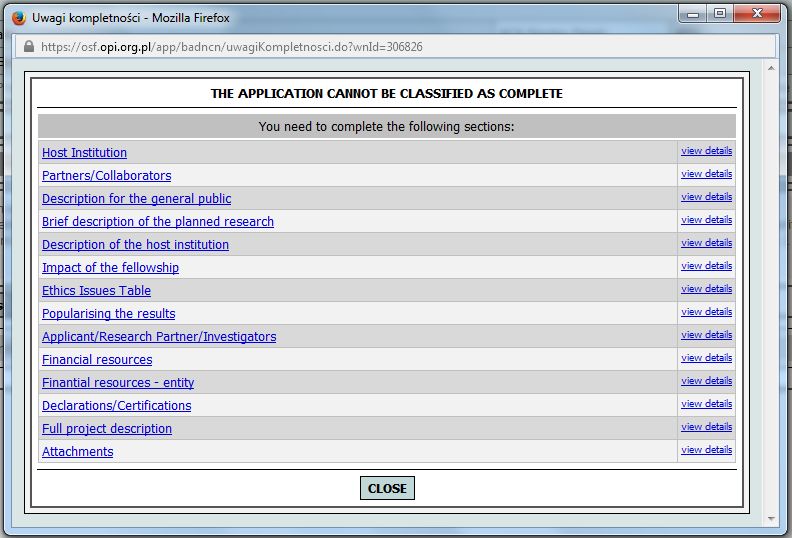
□   Maritime institution of HE (in accordance with article 2.1 item 28)

                 □   Institution of HE or a higher theological seminary run by a church or

                 denominational union

VI.       Charter status with respect to awarding titles and the activity profile of the
                      10
          institution :

                 □   AUU - university (in the understanding of article 3.1)

                 □   AUT - technical university (in the understanding of article 3.2)

                 □   AUPR - university with an agricultural academic profile (according to the criteria
                 enumerated in article 3.3, independently of the name used by the institution of HE)
                 □   AUPE - university of an economics profile (according to the criteria enumerated in
                 article 3.3, independently of the name used by the institution of HE)
                 □   AUPP - university of a teaching training profile (according to the criteria
                 enumerated in article 3.3, independently of the name used by the institution of HE)

                 University profile (please, fill in): ………………………………………..
                 □   AUPI - university of another profile (according to the criteria enumerated in article
                 3.3, independently of the name used by the institution of HE)

                 University profile (please, fill in): ………………………………………..
                 □ AP - school of technology (in the understanding of article 3.4)
                 □ AA - academy (in the understanding of article 3.5)
                 □ AS - institution of HE possessing the right to award PhD level degrees in a single
                 discipline
                 □   ZZ - vocational institution of HE (in the understanding of article 2.1.23)

                                     11
VII.      State aid questionnaire
          1. Does the entity run economic activity according to the
          meaning of EU competition law (e.g. does it provide services or
                                                                                    □   Yes   □   No

          offer goods on the market)?
          2. Will the requested funding for the fellowship be allocated only
          to the non-economic activity of the entity (i.e. the research does
                                                                                    □   Yes   □   No

          not involve engaging in economic activity, is not related to it and
          its results will not be used to run such activity)?
          3. If economic and non-economic activity is conducted, can both
          types of activity, their costs, financing and revenue, be
                                                                                    □   Yes   □   No

          separated? (Evidence of due allocation of costs, funding and

10
     The articles cited in section VI refer to the Law of Higher Education
11
     Applicants unfamiliar with the concept of “state aid” may look at the basic information provided by the
      European Commission http://ec.europa.eu/competition/state_aid/overview/index_en.html. Polish Host
      Institutions are encouraged to consult the NCN website dedicated to state aid (in Polish):
      https://www.ncn.gov.pl/finansowanie-nauki/pomoc-publiczna

                                                                                                               8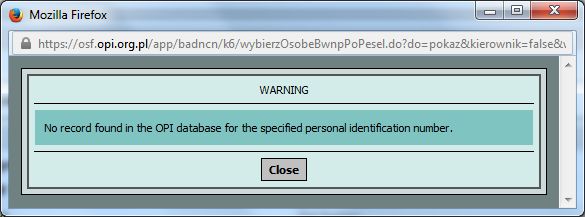
revenue can consist of the annual financial statements of the
          relevant entity).
          Additional questions ONLY for potential state-aid
          beneficiaries:
          1. Size of the enterprise*
          * A large enterprise is an enterprise which does not meet the
                                                                                      □   Micro   □    Small

          criteria referred to in Annex 1 to the Commission Regulation (EU)
          No. 651/2014 of 17 June 2014 declaring certain categories of aid
                                                                                      □   Medium      □    Large

          compatible with the internal market in application of Articles 107
          and 108 of the Treaty.
          2. Is the project carried out in cooperation with the research
          organisation referred to in Article 2(83) of the Commission
                                                                                      □   Yes     □   No

          Regulation (EU) No. 651/2014 of 17 June 2014 declaring certain
          categories of aid compatible with the internal market in
          application of Articles 107 and 108 of the Treaty?
                                  12
VIII.     Collaborating Units within Host Institution (optional)
          Entity name in English:
          Street:
          Town/city:
          Postal code:
          Region:
          Phone Number:
          Fax Number:
          Email:
          WWW
          Does the entity receive any operating support grants from the
          budget for science?
                                                                                      □   Yes     □   No

                           RESEARCH PARTNER'S AND INVESTIGATORS’ DATA
I.      Research Partner
        First Name:
        Second Name:
        Surname:
        Position/title:
                                                                            □   PhD/Dr
                                                                            □   MA/MSc
        Former surname:
        Phone Number:
        Fax Number:
        Email:

12
     Collaborating units are departments, divisions etc., which will be involved in the research project presented in
      your application (if there are any), other than the leading unit selected in section IV of this table.

                                                                                                                    9
PESEL:
If the Research Partner is a foreigner
Date of birth (yyyy-mm-dd):
Country:
Did the research partner, in the period of 5 years prior to
the date of submitting the proposal, have breaks in his/her
□ Yes □ No
research career, such as: parental leave, work outside of If “yes”, please specify the length
the research sector, military service, prolonged illness?
of the leave (months):
Type of employment in the project:
□ Full-time position
□ Non full-time position
□ No remuneration
Type of position:
(the POLONEZ 1 grant application includes several
□ PhD student type
sections which are shared with other National Science □ Other
Centre funding schemes, such as “type of position”. □ Student
However, in the case of POLONEZ “PhD student type” or
“Student” positions are not relevant, so you are kindly
asked to select “Other”)
Project-related remuneration period (months):
II. Co-Investigators’ data (separately for each investigator)
Role in the project (in English):
Type of employment in the project:
□ Full-time position
□ No full-time position
□ No remuneration
Type of position:
(the POLONEZ 1 grant application includes several
□ PhD student type
sections which are shared with other National Science □ Other
Centre funding schemes, such as “type of position”. □ Student
However, in the case of POLONEZ “PhD student type” or
“Student” positions are not relevant, so you are kindly
asked to select “Other”)
Project-related remuneration period (months):
We also strongly encourage consulting with the Host Institution on these parts of your
application:
1. Description of the Host Institution
Justifiability of choosing the Host Institution, adequate research and mentoring support,
research achievements of the Host Institution in the field of the planned research
2. Impact of the fellowship
Description of the expected outcome of the fellowship for the applicant’s career (including
activities other than research, e.g. teaching, if planned)
103. Description of the plan for popularising the results of the research
Types and frequency of actions, types of groups of audience and their expected size; the
description must include at least 2 forms of popularising actions, e.g. seminars and workshops
for university and secondary education students, participation in events promoting research,
articles in the general press
4. Ethics issues
The Host Institution should provide you with information about Polish legislation concerning
the ethics issues listed in the table.
Please remember however, that it is not enough to simply respect national regulations; you will
find more support on how to fill in this form in the European Commission document “Guidance
- How to complete your ethics self-assessment”
(http://ec.europa.eu/research/participants/data/ref/h2020/grants_manual/hi/ethics/h2020_hi_et
hics-self-assess_en.pdf )
5. Financial Resources/Financial resources - entity
You need to agree on the budget (including forms of employment concerning your co-
investigators and your research partner, and their salaries) with your Host Institution as they
should be familiar with their own internal regulations, tax regulations, and the like
6. Attachments
PLEASE, remember to enclose Attachment no. 4 – Declarations of the Host -
INFORMATION ON THE COMMITMENTS OF THE HOST INSTITUTION OF THE
FELLOWSHIP and Attachment no. 5: State Aid with your application or have them
sent directly to the National Science Centre by the Host Institution, before 15
December 2015.
B. HOW TO ACCESS THE OSF SUBMISSION SYSTEM
1. How to log in?
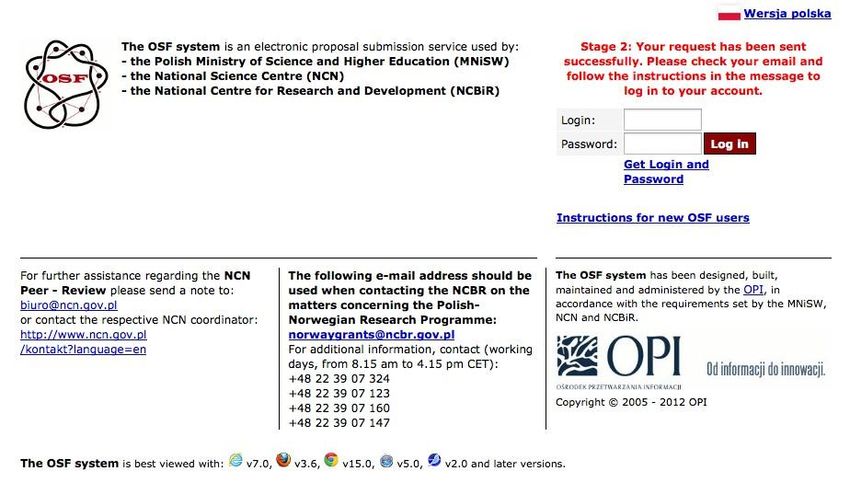
To log in to OSF please click on https://osf.opi.org.pl and select Get Login and Password.
When you click on the “Get Login and Password” link you will see the following screen:
11Once you provide your email address, you will see a message in
red:
Please note:
1) it may take a while for you to receive your confirmation email,
2) be sure to check your “spam” folder if you have not received a message from the OSF system.
The letter from the OSF system reads as follows (slight differences may occur depending on your
email programme):
12Once you have clicked on the link, you will get a confirmation email containing your login
and password details. Please log in with your new password.
2. The most common problems with the OSF account
13 My login username and/or password do not match!
There are three possible explanations:
a) you did not enter your username or password correctly;
b) your browser remembers your old username and password;
c) your password is no longer valid:
you may have logged into your account and changed your password. If you forget
your password, simply generate a new one following the procedure described above;
you may have requested a new password more than once. Please make sure that you
use your login details as stated in the last email generated by the system.
My automatic password is impossible to remember. How do I change it?
Log in and go to: “My personal details\Edit your Password.”
3. Optional step: change your password if you wish to
You may wish to change your password at any stage of the proposal preparation process.
To do so, follow the steps described below:
a) click on the Main page button,
b) select My personal data followed by Edit Password,
c) enter your new password and repeat it using the following box:
4. An auxiliary editor
There is also the possibility to set an auxiliary editor by clicking on the Auxiliary editors
button. You will find this button in the menu on the left side of the screen, once you have
introduced the title of your proposal and the relevant discipline panel in the dialogue box.
An auxiliary editor is a person who has the right to access the application and edit it, in order
to help with the preparation of the proposal. You can add as many auxiliary editors as you
want.
14An auxiliary editor may be added to the proposal in the following ways:
a) new auxiliary editor – this option should be chosen if the person you want to add has
not yet been registered in the system,
b) by using the option “my applications” you can add a person who has been already
registered in the OSF system, in your other applications, as an editor or a reader,
Registered OSF user – using his/her login, if he/she has already been registered in the OSF
system.
You can "remove" each of the added auxiliary editors at any time.
Please note: in order to enable the auxiliary editor to log into the system, you should inform
him/her about the login and password that you selected for him/her in the “auxiliary editors”
section of your proposal.
C. HOW TO CREATE YOUR PROJECT PROPOSAL IN THE OSF SYSTEM
Once logged in, click on the button New proposal and then from the list of proposals handled
by the National Science Centre please choose the option “POLONEZ-1 Proposal for a
research project carried out by an incoming researcher, co-financed with the Horizon 2020
framework programme within the Marie Skłodowska-Curie COFUND”
Fill in the project title and choose an appropriate discipline panel from the list by which the
proposal will be evaluated. The project title and the panel chosen will be later editable in the
“General information” section.
Then you will see the following screen:
15On the left side you will see 16 sections of your proposal, referring to the Host Institution, the
applicant, the project description, ethics issues and budget. Each of them should be filled out
to fulfil eligibility requirements.
PLEASE ALWAYS REMEMBER THAT
a) in order to provide the information required you need to click on the “edit” button,
usually in the right upper corner of each section’s main screen, which opens a window
with appropriate boxes to fill in;
b) you must save all data entered in the particular edit controls, by clicking the “save”
button;
c) the maximum number of pages or characters given for a particular section cannot be
exceeded;
d) a “standard type-written page” means: page size: A4, font: Times New Roman, size:
11 (12), single line spacing, margins: 2 (left & right), 1.5 (bottom);
e) all attachments must be PDF files only;
f) the maximum size of each pdf file attached is 17MB;
g) data in some sections (“Brief description of the planned research” and “Full project
description” ) may be submitted in either of the following ways:
by filling out the required sub-sections,
16 by uploading a file including the content, which covers the required sub-
sections;
h) you can edit and modify all information or change attachments up until the proposal is
sent to NCN;
i) you should check the proposal’s completeness before submission. In order to do this
please click on the “Check completeness ” blue hyperlink in the upper part of the
screen, and then, when the box appears with a list of all sections requiring
modification, click on “view details”.
D. HOW TO FILL IN YOUR PROJECT PROPOSAL.
Please start filling out the proposal from two sections: Host Institution and General
Information. This will make it possible for you (or your auxiliary editor – please see point B.4
above) to edit other sections, such as: Applicant/Research Partner/Investigator, Financial
resources, Financial resources – entity etc. Remember that at each stage you can always click
on the “check completeness” link, to see whether there is still some data missing in a
particular section that you are filling in.
171. HOST INSTITUTION
We strongly encourage consulting with the Host Institution for this part of your
application.
In order to complete the Polonez 1 application form you will need a lot of detailed information
referring to your Host Institution. Please see the table at the beginning of this chapter, which
includes a list of questions/data that should be provided by the Host Institution in each section.
Make sure the institution provides you with this information before the date you wish to submit
the application, or that it is introduced into the OSF system directly by an “auxiliary editor”
representing the institution.
Note that there are two options for providing the information in the “Host Institution” section of
the application:
Select from the OPI database – preferable for research institutions and organisations
This database created by the National Information Processing Institute (OPI) is a complex IT
system that gathers information about science and higher education architecture in Poland.
In order to select data from the OPI database, please enter your Host Institution’s name, town
or street. Then choose an appropriate institution (level 1) from the list and an appropriate
faculty/department/division/office, etc. within the Host Institution (level 2), if relevant.
If you see a „+” sign on the left, please click it and select a relevant faculty/department.
If you see a link to a “supervisory body” in a line below, please click the last
organisation (highest level) listed in this line and then select a relevant
faculty/department. Please note, that smaller units supervised by
faculties/departments, cannot be selected as host institutions.
18As soon as you select the institution some of the information required is automatically
imported from the database into your application form, some still needs to be chosen from
a drop-down menu or entered into a textbox. Please note that the only field in the “Host
Institution” section that you do not need to complete is the KRS (National Court Register
Number) – just tick “not available” if you do not know this number.
Select from outside the OPI – preferable for enterprises, associations and foundations
Choosing this option you will need to enter all the information by yourself (please remember
that the table provided at the beginning of this chapter, filled in in advance for you by a
representative of the Host Institution, would greatly facilitate this task) or ask an institutional
“auxiliary editor” to complete it for you. Please do not hesitate to contact your Host Institution if
you have any questions or doubts.
13
STATE AID QUESTIONNAIRE
In this section you are asked to complete the state aid questionnaire. Before you complete the
questionnaire, select the “declaration template” option and read the information on the rules
for applying for state aid. To fill in the questionnaire, select the “edit declaration” option and
answer (YES/NO) to the questions generated by the system. Depending on the answers, you
will need to answer one, two or three questions. To make sure your answers are correct, we
13
Applicants unfamiliar with the concept of “state aid” may look at the basic information provided by the
European Commission http://ec.europa.eu/competition/state_aid/overview/index_en.html. Polish Host
Institutions are encouraged to consult the NCN website dedicated to state aid (in Polish):
https://www.ncn.gov.pl/finansowanie-nauki/pomoc-publiczna
19recommend consulting competent staff from the administrative and financial departments of
the Host Institutions. If the financing is classified as state aid for the Host Institution, the
applicant should obtain information from the Host Institution on its size (large, medium, small
or micro) and cooperation of the Host Institution with a research organisation in implementing
the project.
Once the questionnaire is completed, select the “print declaration” option. The declaration on
state aid generated by the system and the completed questionnaire must be printed out, duly
signed by a person/persons authorised to represent the institution, and submitted, in paper, to
the NCN, either appended to the hard copy of the application sent by the POLONEZ
candidate, or sent directly by the Host Institution (since the questionnaire is considered an
integral part of the application it should be post stamped on 15 December 2015 at the latest).
2. COLLABORATING UNITS
In the “Host Institution” section, you had an opportunity to select the Host Institution (level 1)
and a key organisational unit within it (level 2), which will welcome you as a fellow if your
application is successful. In the “Collaborating units” section there is the possibility to add
other units (level 2) within your Host Institution (other departments, divisions etc., which will be
involved in the research project presented in your application), if there are any.
(The involvement of more than one unit in the project is not considered in the evaluation
criteria and it does not increase or decrease your chances of success.)
3. GENERAL INFORMATION
In this section you must include basic information about your proposal, such as:
a) the title of the proposal,
b) information on the topic of the proposal,
c) the duration (fellowship may last 12 or 24 months),
d) the start date of the fellowship (fellowships must start on the first day of a calendar
st st
month, not earlier than 1 September 2016 and not later than 1 January 2017)
e) the number of project investigators.
Make sure that the number includes yourself, your research partner, and all other co-
investigators that you plan to involve in your project, with the exception of “collective
investigators” i.e, groups of at least 5 individuals with a uniform scope of work, e.g. a team of
pollsters, respondents/subjects etc. (see point 10 “Financial Resources”, below)
The “Estimated budget” line will be filled in automatically once you have completed the
“Financial resources” and “Financial resources – entity” sections.
You must also state if the research will be carried out in international cooperation, i.e. whether
the research tasks will be completed in collaboration with researchers from foreign research
institutions. (The involvement of international researchers in the project is not considered in
20the evaluation criteria and it does not increase or decrease your chances of success.) In this
section you also choose a discipline panel that matches your proposal from the drop-down
menu, including the primary review panel and auxiliary review panels (at least one auxiliary
review panel specifying a sub-discipline within the selected primary review panel must be
selected. The two other review panels are optional and may be selected from other research
fields as well, which could be particularly helpful in the case of interdisciplinary projects).
Please click on the “Add” button to choose auxiliary discipline panels.
POLONEZ applications will be assessed by 3 groups of experts divided by broad research
fields – Humanities, Social Sciences and Arts; Life Sciences; Physical Sciences and
Engineering. Therefore, regardless of which panel you choose within one of the three research
fields above, it will be discussed by the same group of experts. However, you should strive to
select the matching panel to make sure that your proposal receives individual reviews by the
experts experienced in your specific research area.
4. BRIEF DESCRIPTION OF THE PLANNED RESEARCH
Here you should provide a short description of the research planned (up to 1 standard page).
It should include:
a) research objectives/hypothesis,
b) research methodology,
c) expected impact of the planned research on the development of science, civilization
and society.
Fill out the required sub-sections or upload a file whose content will be displayed in the sub-
sections. Please note that when you upload a file after having edited the content of the
individual sub-sections in the application form, the content will be automatically deleted.
5. DESCRIPTION FOR THE GENERAL PUBLIC
Describe the research planned within the POLONEZ fellowship in layman’s terms, which will
make your idea understandable – on a basic level – to the general public outside the research
community (up to 1 standard page). You may structure your contribution by answering the
following questions:
a) What is this all about?
b) Why should the public care?
c) What is happening now?
d) Where is it going? What is the goal of your research?
Please note in the event of your project being awarded funding the brief description of the
research aimed at the general public will be published both on the National Science Centre
and OPI website.
216. DESCRIPTION OF THE HOST INSTITUTION
We strongly encourage consulting with the Host Institution on this part of your
application.
In this section you should justify your choice of Host Institution, taking into consideration:
a) the compatibility of the Host Institution with your research interest,
b) the Host Institution’s research achievements in the field of the planned research,
c) adequate research and mentoring support.
7. IMPACT OF THE FELLOWSHIP
We strongly encourage consulting with the Host Institution on this part of your
application.
Here you should describe the expected impact of the fellowship on your career. Please include
also the activities other than research (e.g. teaching) which will contribute to the development
of your transferable skills, if such activities are planned within the scope of the project.
8. JUSTIFICATION – BASIC RESEARCH (OPTIONAL SECTION)
Please justify (up to 2,500 characters with spaces) that the research planned within this
proposal meets all basic research criterion. Basic research is defined as experimental or
theoretical endeavours undertaken to gain new knowledge of the foundations of phenomena
and observable facts, without any direct commercial use.
Filling out this field is not obligatory. It is, however, advisable to fill it in, if you expect that the
character of the project might suggest it is “commercially driven”, and raise concerns during
the review process.
9. ETHICS ISSUES TABLE
We strongly encourage consulting with the Host Institution on this part of your
application.
In this section you should answer a number of Yes/No questions referring to various ethics
issues of your research which you will find in 10 different sub-sections.
If you flagged any of the ethical issues included in the Ethics Issues Table at the end of this
section, please describe the measures taken to ensure that the research is carried out
conforming to the rules of good practice as well as national and EU regulations in the
respective domain/discipline. Please refer to each identified issue separately and provide a
relevant explanation. It is highly recommended that you consult the European Commission
document “Guidance - How to complete your ethics self assessment”
22(http://ec.europa.eu/research/participants/data/ref/h2020/grants_manual/hi/ethics/h2020_hi_et
hics-self-assess_en.pdf) while completing the table.
Please note that if an Expert Panel assessing the proposal on the first stage of the merit-
based evaluation states that ethics issues are evident, but have not yet been acknowledged
by the applicant, the proposal will be rejected
10. APPLICANT/RESEARCH PARTNER/INVESTIGATORS
Applicant’s personal data
Here you shall provide basic information about yourself, such as name, degree/title, date and
place of birth, address, affiliation.
The POLONEZ 1 grant application includes several sections which are shared with other
National Science Centre funding schemes, such as “type of position”. However, in the case of
POLONEZ, “PhD student type” or “Student” positions are not relevant, so you are kindly
asked to select “Other”.
You should also indicate any career breaks taken in the period of:
a) 5 years in the case of Life Sciences, Physical Sciences and Engineering;
b) 10 years in the case of Arts, Humanities and Social Sciences
before submitting the application.
Please describe the reasons for taking a break (e.g. parental leave, military service, work
outside of research sector, prolonged illness) and provide the total number of months.
In this section you shall also inform the NCN if your family will come to live in Poland during
your fellowship for at least 3 months. This entitles you to receive a family allowance (see
section IV FUNDING in the Guidelines, above). Please, note that if your family lives in Poland
already at the stage of your application, you will not be entitled to family allowance, as this is
dedicated to support the international mobility of families.
Research partner’s personal data
There are two options for providing the information in the “Research partner” section of the
application:
“Select from the OPI database” – this database, created by the National Information
Processing Institute (OPI), is a complex IT system that gathers information about
23science and higher education architecture in Poland. In order to find a researcher in
this database, please provide his/her PESEL (personal identification number).
“Select from outside OPI”.
Please note that if you decide to fill in your research partner’s data “from outside OPI” and
they have already been included in the OPI database, the system will recognise the PESEL
number and ask you to go back and select the partner from the OPI database.
It is best therefore to start by clicking on the “Select from the OPI database” and introducing the
PESEL number.
If your research partner is already included in the system – the form will fill up with some data
automatically, while others will still require editing. You will get access to the section of the
form where your research partner’s track record should be reported only after you
complete all personal information fields.
If your research partner is not in the OPI database – you will be informed by the system that
no record was found. Then click the “Select from outside OPI” button, and fill in the box as
required.
24Achievements of the applicant and his/her research partner
1) Questionnaire on the applicant’s achievements
Here you should include:
a) your academic track record,
b) a list of your publications, number of citations and the h-index, if relevant, (and
attach the 3 most notable publications) or – in the case of Arts – a list of your
most important research and artistic achievements,
c) realised research projects,
d) information about your research experience, as well as the most important prizes
and awards,
e) information on your professional achievements other than research (business,
industry, etc.).
For detailed instructions please see Attachment 1 APPLICATION FORM to the
POLONEZ 1 Call Text – D 2.
2) Questionnaire on the applicant’s research partner’s achievements
We strongly encourage consulting with the Host Institution and research partner
on this part of your application.
A research partner is the person indicated by the Host Institution (an employee of this
institution) responsible for supporting your integration with the research community of the
Host Institution, and willing to share with you his/her research experience and knowledge
to support the implementation of your research project. You may have several co-
investigators in the research team working on your project but only one research partner.
Your research partner must be included in your proposal in the number of “project
investigators” (see point 3, “General Information”, above), and they will also appear in the
“Financial Resources” section dedicated to investigator/staff costs. (see point 11 below).
(However, it is not compulsory that he/she is directly involved in the execution of specific
research tasks).
The research partner may receive remuneration:
a) from direct costs – provided that they participate in research tasks planned by the
fellow;
b) from indirect costs (e.g. for organising a study visit for the fellow) – upon the
decision of the Host Institution.
The research partner together with the Host Institution should support the
applicant in writing a proposal.
In the questionnaire on the partner’s achievements, you should provide information about
your research partner and:
a) his/her track record,
25b) his/her career breaks,
c) a list of his/her publications, number of citations and the h-index ,if relevant, (and
attach the 3 most notable publications) or – in the case of Arts – a list of his/her
most important research and artistic achievements;
For detailed instructions please see Attachment 1 APPLICATION FORM to the
POLONEZ 1 Call Text – D 2.
Information on the personnel involved in research tasks
Within the POLONEZ grant, you may employ personnel that will be involved in research
tasks. In this section you should add information on their position or role in the planned
research and indicate the character of this position (if he or she will receive full-time
remuneration or other), without providing their names. You should also provide
information on how many months they will be engaged in the planned research. For more
information please see Attachment no 3 ELIGIBLE COSTS to the POLONEZ 1 Call
Text section A. 2.2.1. In the section Budget of the proposal you must also describe the
14
scope of their work in the research and estimate their salary .
11.FINANCIAL RESOURCES
There are two sections referring to budget: “Financial resources” and “Financial resources –
entity”. We strongly encourage consulting with the Host Institution on this part of the
application, as well as checking carefully the eligibility of the planned costs in the
Attachment no 3 ELIGIBLE COSTS to the POLONEZ 1 Call Text.
In this section you should provide a budget table of the planned research. Please keep in mind
15
that the costs must be calculated in PLN (gross).
The first sub-section “Forms of funding the fellowship” is filled in automatically based on
the data entered under “General information” and "Financial resources – Entity" section, which
you will be working on at a later stage.
The second sub-section, “Budget”, is divided into two tables: Investigator/Staff costs and
Other costs.
Investigator/Staff costs
Before you fulfil this table please complete the section Applicant/Research
Partner/Investigators. The system will copy the names of investigators and partner, the type
and character of their position as well as the research-related remuneration period. Then you
14
There are no regulations concerning the salaries for co-investigators or the research partner. Please remember
however that during the peer review process, experts will evaluate your budget as “justified” or “unjustified”.
15
According to the POLONEZ 1 Call Text, the EUR exchange rate amounts to EUR=4.0101 PLN.
26should fill in the table with information on the scope of work performed within the research
project by yourself and other personnel as well as the total salary (gross) intended for the
personnel.
Please note that there is no possibility to finance scholarships for undergraduate, graduate or
PhD students within the framework of the POLONEZ funding scheme. You may plan the
financial remuneration for the students involved in your project, but it will not be
classified as “scholarship” for tax purposes.
Please remember that the purpose of this table is to list research-related tasks to be
performed by each individual investigator. Administrative and other types of duties are
not to be included and their cost should be covered from the overheads.
Other costs
The Other costs table is divided into the categories below:
a) Materials
b) Outsourcing and subcontracting
c) Travel and subsistence costs (business trips), including conference attendance fees of
research team members
d) Visits and consultations
e) Other costs (not listed in other categories, including the cost of disseminating the
research results). If you plan the purchase of any devices and software, not classified
as research equipment (see Attachment no 3 ELIGIBLE COSTS to the POLONEZ 1
Call Text for definition of research equipment), please include such costs in this
section.
f) Collective investigators (groups of at least 5 individuals with a uniform scope of work,
such as teams of pollsters, research respondents/subjects etc.)
Please add items within the categories and indicate their costs. A detailed description of
these categories may be found in the Attachment no 3 ELIGIBLE COSTS to the
POLONEZ 1 Call Text.
12. FINANCIAL RESOURCES – ENTITY
In this section you should provide only information about personnel costs and other direct
costs for research, divided into particular calendar years. Information on “Funding for the
applicant” will be automatically incorporated by the system after filling out General
Information. Please remember that:
a) the total sum in the “Personnel costs” line, must correspond to the sum of the “Total
salary cost on grant” of all researchers included in the “Investigator/Staff Costs” sheet
of the “FINANCIAL RESOURCES” section (see point 11 above),
27b) the total sum in the “Other direct cost for research” must correspond to the “Other
costs” sheet in the “FINANCIAL RESOURCES” section, including also “Collective
investigators” (see point 11 above). Note, that “Collective investigators” are not
to be included in “Personnel costs”.
If the data in the “FINANCIAL RESOURCES” and the “FINANCIAL RESOURCES –
ENTITIES” sections is contradictory, an alert in red font will appear under the budget
table in the “FINANCIAL RESOURCES” section.
13. DECLARATION / CERTIFICATION
This section includes declarations which must be signed by the applicant, including issues
such as:
a) possession of a PhD degree or 4 years of full-time research experience,
Researchers in possession of a PhD degree should also indicate the date of the PhD
award, the name of the institution where it was obtained, as well as the discipline in
which the degree was awarded.
Please answer two YES/NO questions and if you are a holder of a doctoral degree
enter the name of the discipline, the name of the awarding institution and the date of
the PhD award.
b) confirmation that you spent at least 24 months outside of Poland in the period
th th
between 15 September 2012 – 14 September 2015,
c) participation in NCN-funded research projects,
d) applying for grants from other sources (it is also required to name the institution where
the proposal has been submitted),
e) ethics issues included in the proposal (for more information please see part VI
ETHICS ISSUES in the “Guidelines”, below),
f) consent to process your personal data for the purpose of proposal evaluation.
14. POPULARISING THE RESULTS
We strongly encourage consulting the Host Institution on this part of your application.
In this section you should describe actions taken in order to popularise the results of your
research. Please list at least 2 types of activities you plan to do and explain what group and
what target they are aimed at. You may choose activities such as, for example:
a) seminars and workshops for university, secondary or primary education students,
b) participation in events promoting research,
c) articles in the general press,
d) organising exhibitions or concerts.
2815. FULL DESCRIPTION IN ENGLISH
Here please describe the research you plan to perform within the POLONEZ fellowship (up
to 10 standard pages). The description should include the following:
a) research objectives,
b) significance of the planned research,
c) work plan,
d) research methodology,
e) literature.
Data may be submitted in either of the following ways:
a) by filling out the required sub-sections,
b) by uploading a pdf file whose content will be displayed in the above sub-sections.
Please note, when you upload a file after having edited the content of the individual sub-
sections in the application form, this content will be automatically deleted.
16. ATTACHMENTS
In this section please attach pdf files of all attachments required.
Attachment 1 (submitted only by applicants who have a PhD degree)
16
Copy of PhD (or equivalent) diploma and its translation into English or Polish, if the
language of the original is neither English nor Polish.
A scan of this document together with the translation (1 file) should be attached to the
electronic proposal (no hard copy required).
Attachment 2 (submitted only by applicants who do not have a PhD degree)
A document confirming a minimum of 4 years full-time research experience, and its
translation into English or Polish, if the language of the original is neither English nor Polish.
There is no specific template for the documents. PhD studies are considered to be full-time
research experience.
Scan(s) of the document(s) should be attached to the electronic proposals (no hard
copy required).
Both Attachment 1 and Attachment 2 will be visible in this section of your proposal, but you
are expected to upload only one of them, unless you prefer to upload both.
Attachment 3
16
In the meaning of the law of the country where the degree was awarded.
29th
A list of documents confirming that in the 3 years prior to the call announcement (15
th
September 2012 - 14 September 2015) the applicant did not reside or carry out his/her
main activity (work, studies, etc.) in Poland for more than 12 months. These documents can
be, for example: flat rental contracts, bills, a certificate of employment, a residence permit,
insurance contracts, tax declarations, proof of payment of tuition fees etc.
Please attach:
A list of all documents that you provide, in pdf format (a word-format of the list
template is available for download under the link “Attachment example”), including
information about the dates covered by each document, the name/title of the
document in English, and a brief English description of the content,
Scans of all documents that you have included in the list mentioned above
(these documents do not have to be translated, no hard copies required).
Attachment 4
We strongly encourage consulting with the Host Institution on this part of your
application.
Information on the commitments made by the Host Institution of the fellowship.
(Please see Attachment 4 DECLARATION OF THE HOST to the POLONEZ 1 Call Text)
This attachment includes information on the Host Institution’s commitments to the fellow. In
this document, the Host Institution should also describe a planned study visit for the fellow
(please see also part III of the Guidelines, “Host institution of the fellowship”, above).
A scan of this document signed by a representative of the Host Institution should be
attached to the electronic proposal; a hard copy should also be sent to the NCN
(it may be sent directly to the NCN by the Host Institution, provided that the
th
deadline of 15 December 2015 is respected, see part VII of the Guidelines,
“Proposal submission”, below).
Attachment 5
We strongly encourage consulting with the Host Institution on this part of your
application.
Information on whether the Host Institution receives or does not receive state aid
(Please see Attachment 5 STATE AID to the POLONEZ 1 Call Text)
A hard copy of the document signed by a representative of the Host Institution should
be sent to the NCN (it may be sent directly to the NCN by the Host Institution).
Attachment 6 (submitted only by Host Institutions which do not receive an operating
17
support grant )
17
“Operating support grant” (in Polish: dotacja statutowa) is funds that the Host Institution receives in order to
be able to perform the tasks defined in its statute, sustaining the continuity of research and development work
undertaken in this institution.
30Information on the research carried out in the Host Institution of the fellowship in the past 2
years, along with a list of publications. research equipment and other equipment facilitating
the research
A scan of the document signed by a representative of the Host Institution should be
attached to the electronic proposal, no hard copy required.
E. HOW TO PROOFREAD YOUR PROPOSAL
In order to print out the information included in the application form, please click on the
“current proposal version in pdf” button on the top of the screen.
ATTENTION: this printout is a tool that allows you to proofread your application and should not
be confused with the “Printed out in the version to be submitted to NCN”. (see below)
F. HOW TO SUBMIT THE PROPOSAL
After filling out the proposal, printing out 1 paper copy (use the button: “Printed out in the
version to be submitted to NCN”) and signing it as required, a digital version of the documents
should be made available to the National Science Centre by clicking on the “Send to the NCN”
button (you can find both buttons on the top of the screen). After that no changes and
modification are possible. The completed procedure will be confirmed by a change of status in
the proposal’s heading to “sent.” The application must be sent electronically to the NCN by the
th
15 December 2015.
At the same time the paper copy, signed and including attachments 4 and 5 (“Declarations of
the Host” - INFORMATION ON THE COMMITMENTS OF THE HOST INSTITUTION OF THE
FELLOWSHIP, and “State aid” - DECLARATION ON REQUEST/NO REQUEST FOR PUBLIC
th
AID) should be sent by post by the 15 December 2015 (the date of the stamp on the
envelope will be decisive) or delivered to:
Narodowe Centrum Nauki, ul. Królewska 57, 30-081 Krąków, Poland
with a note: POLONEZ 1.
The attachments may be sent directly by the Host Institution.
VI. PROPOSAL EVALUATION
Proposals submitted under the POLONEZ 1 call for proposals will be evaluated according to the
following criteria:
1. quality of the fellow (25%)
2. quality of the planned research (25%)
3. relevance of the fellowship (20%)
31You can also read


