HORIZON 2020 FINANCIAL ISSUES - Model Grant Agreement - NCP-FNRS
←
→
Page content transcription
If your browser does not render page correctly, please read the page content below

HORIZON 2020
     HORIZON 2020

Model Grant Agreement
 FINANCIAL ISSUES
Table of Contents

1. Introduction

2. H2020: Model Grant Agreement

3. Cost Categories and Reporting Issues
    a. Personnel cost calculation
    b. Additional Remuneration and Types of Staff Contracts
    c. Identification and Measurement of Direct Costs
    d. Third parties
    e. Subcontracting
    f. Synergies with other grants

4. Q&A

2                       Disclaimer: Information not legally binding
H2020 Information Campaign
Built on the experience of FP7
Part of the ex-ante advice to be provided
by the Commission services
Targets the same main objective:
→ error free financial statements
Started at the earliest possible stage of
H2020
3 Disclaimer: Information not legally binding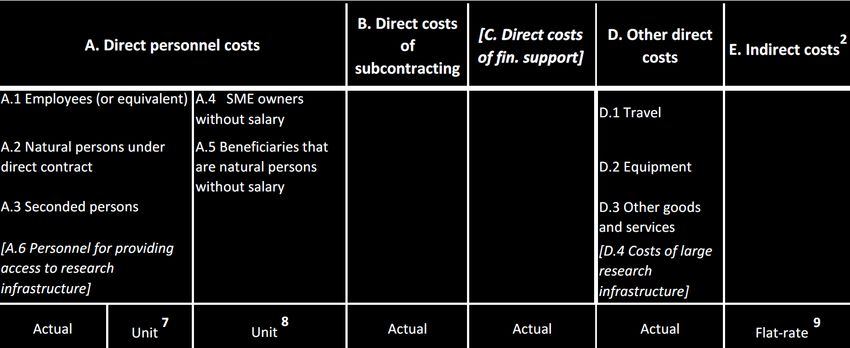
Background: FP7 10 most common errors

1. Costs claimed are not substantiated or not linked to the project

     2. Third parties and subcontracting costs not properly reported

3. Depreciation costs not correctly charged to the project

     4. Indirect costs model not properly reflecting the entity's reality

5. Indirect costs – ineligible costs included

 4                         Disclaimer: Information not legally binding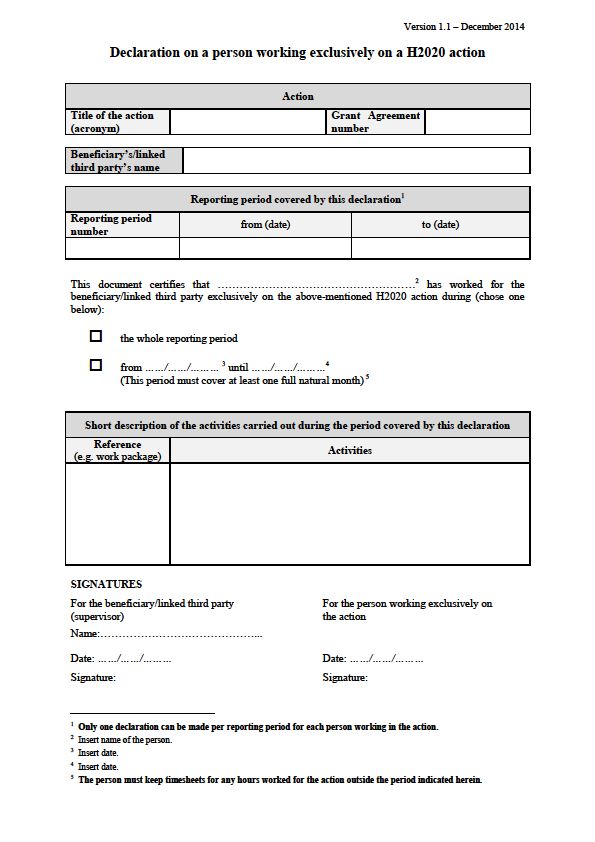
Background: FP7 10 most common errors

6. Personnel costs – calculation of productive hours

     7. Personnel costs – charging of hours worked on the project

8. Personnel costs – use of average personnel costs

     9. Payment of salaries to owner/managers of SME

10. VAT

 5                        Disclaimer: Information not legally binding
Auditor's advice: Consequences of errors

Identified errors may lead to

    • Extension of audit findings (systemic or recurrent errors)
    • Recovery of the ineligible amount
    • Penalties
    • Suspension of payments or termination of the contract
    • Reputational damage
    • Financial losses
    • ….

6                        Disclaimer: Information not legally binding
DG Declaration
Why auditing is so important of Assurance
I, the undersigned Director-General, declare that the information contained
in this report gives a true and fair view [1].
I state that I have reasonable assurance […] which is based on my own judgement
and on the information at my disposal […]
However the following reservation should be noted:
Reservation concerning the rate of residual errors with regard to the accuracy
of financial statements in the Eighth Framework Programme (H2020) grants.
Brussels, 31 March 2014
"Signed"
The Director-General
[1]True and fair in this context means a reliable, complete and correct view on the state of
affairs in the service.
7 Disclaimer: Information not legally binding
Horizon 2020 Model Grant Agreement
                                                               Specific models

                           ERC MGAs

       Marie-
             H2020
                General MGA
                 Model                                               SME
    Sklodowska                                                   instrument
                 Grant
           INTRODUCTION
    Curie MGAs
               Agreement
                                                                    MGAs

                             Co-fund
                              MGAs

8                Disclaimer: Information not legally binding
Horizon 2020 Model Grant Agreement
                A single document with all provisions

                                                  Special          Specific
    Core text      General
                                                  clauses         provisions
                  conditions                                       Annex 3
                   Annex 2

                                     FP7
9                   Disclaimer: Information not legally binding
Horizon 2020 Model Grant Agreement
                                                 Annexes to the grant

        Annex 1: Description of the action

        Annex 2: Estimated budget

        Annex 3: Accession Forms, 3a & 3b

        Annex 4: Financial statements

        Annex 5: Certificate on the financial statements

        Annex 6: Certificate on the methodology

10              Disclaimer: Information not legally binding
Forms of costs
• Costs actually incurred, identifiable and verifiable,
Actual costs recorded in the accounts, etc.
• NEW: non-deductible VAT paid is also eligible
• A fixed amount per unit determined by the Commission
Example: SME owners' unit cost
Unit costs
• For average personnel cost (based on the usual
accounting practices – with or without Certificate)
• A global amount to cover one or several cost categories
Lump sum Example: Phase 1 of the SME instrument
• A percentage to be calculated on the eligible costs
Flat rate Example: 25 % flat rate for indirect costs
11 Disclaimer: Information not legally bindingBudget categories and Forms of costs
BUDGET CATEGORIES
FORMS
DIRECT COSTS
OF INDIRECT
SPECIFIC
CATEGORIES
COSTS Financial COSTS
OF COSTS
Personnel Subcontracting support to 3rd Other
parties
Actual
costs
Yes for NEW! (2017)
- Average Yes if
Yes for
Unit costs
personnel costs
- SME owners &
natural persons
Internal
Invoices foreseen by
Comm.
Decision
without a salary
Flat-rate
costs
Yes if
Lump
sum costs foreseen by
Comm.
Decision
12 Disclaimer: Information not legally bindingBudget categories: budget transfers
Budget transfers and re-allocation Amendment needed?
From one beneficiary to another NO
From one budget category to another NO
Re-allocation of Annex 1 tasks YES
YES if the 'form' receiving the transfer
Transfers between forms of costs
was not included in the budget
(actual costs, unit costs, etc.)
(a new unit cost under column F)
Transfers within personnel costs NO
Transfers to costs of internally NEW !
NO (2017)
invoiced goods and services
New subcontracts YES (strongly advised)
13 Disclaimer: Information not legally bindingBudget categories: budget transfers (example)
Estimated budget for the action
[C. Direct
B. Direct costs of
A. Direct personnel costs costs of fin. D. Other direct costs E. Indirect costs [F. Costs of…]
subcontracting
support]
A.1 Personnel A.4 SME owners without salary D.1 Travel D.5 Cost of [F.1. Cost of…] [F.2 Cost of…]
internally
A.2 Natural persons under direct A.5 Beneficiaries that are
D.2 Equipment invoiced goods
contract natural persons without salary
and services
A.3 Seconded persons D.3 Other goods and services
[A.6 Personnel for providing access to D.4 Costs of large research
research infrastructure] infrastructure
Unit Flat rate [Unit] [Lump
Form of costs Actual Unit Actual Actual Actual Unit Unit
XX EUR/hour 25 % sum]
(a) Total (b) No hours Total (c) (d) (e) (f) (g) (g) (j1) (j2)
Beneficiary 1 500.000 0 100 3.213 150.000 0 325.000 0 207.053 0 0
Beneficiary 2 0 300.000 0 0 0 0 125.000 0 106.250 0 0
14 Disclaimer: Information not legally bindingClassifying workforce contracts
Is it the only contract with the person or
are there several contracts?
Is it an employment
contract or another type
of contract?
PERSONNEL
COSTS
Does the contract
establish the working
time conditions?
Is the contract concluded
with a person or with a
company?
And what about 'consultants'?
15 Disclaimer: Information not legally bindingWhat contract under what budget category
Workforce costs
16 Disclaimer: Information not legally bindingWhat contract under what budget category
What workforce contracts can you declare under personnel costs?
Standard case: persons hired by the beneficiary via an
employment contract
(qualified as such under national law; and for
whom the entity pays social security contributions)
Other cases:
→ Natural persons hired directly via a contract other than an employment contract
if:
o the person works under conditions similar to those of an employee (e.g.
NEW !
(2017)
organisation or work, premises, etc.)
o The result of the work belongs to the beneficiary (exceptions may apply)
o The costs are not significantly different from those of an employee of the
beneficiary doing similar tasks
→ Employees of a third party seconded to the beneficiary (must be set in Annex 1!)
17 Disclaimer: Information not legally bindingWhat contract under what budget category
What you can NOT declare under personnel costs?
Contracts with companies (e.g. temporary work agencies) to
provide staff
Natural persons (e.g. consultants) not fulfilling any of the
conditions mentioned in the previous slide.
e.g. working systematically off-site while employees have to work in the
premises of the beneficiary
Natural persons (e.g. consultants) paid for deliverables rather
than for working time
In the cases above the costs may be eligible under 'Other goods and
! services' or under 'Subcontracting' but not as personnel costs
18 Disclaimer: Information not legally bindingPersonnel costs: Calculation
Hours
Hourly rate
worked Additional
remuneration
EUR/hour
Applies only to
beneficiaries with project-
based remuneration schemes
Formula for actual
Time records
costs & specific unit
costs
19 Disclaimer: Information not legally bindingPersonnel costs: hours worked for the action
Only the hours actually worked on the action can be
charged.
Think of how you follow different projects
You cannot declare:
→ Budgeted time (what you indicated for the budget)
→ Estimated time (e.g. person 'guessing' at the end of the year)
→ Time allocation (e.g. x % of the contractual time of the person)
Hours declared to the action must be supported by
! reliable records and documentation !
20 Disclaimer: Information not legally bindingTime records: supporting documents
Depends if the person works exclusively on a H2020 action
For this purpose, "working exclusively" refers to an uninterrupted period
of at least one full calendar month during which all the hours worked by
the employee for the beneficiary were dedicated to the H2020 action.
Working Conditions
Records
exclusively (full details available in the AGA; page 160)
only one per reporting period (per person)
Declaration on exclusive work
YES for the action covering one uninterrupted period of exclusive
dedication of at least one calendar month
dated and signed at least monthly by the person
and his/her supervisor
NO Time records (i.e. timesheets)
minimum conditions and information needed are
detailed in the AGA
21 Disclaimer: Information not legally bindingDeclaration for persons working
exclusively on the action:
Model available in the AGA
(version 19/12/2014)
Only one declaration can be
! made per reporting period for
each person
22 Disclaimer: Information not legally bindingExercise
What information is
missing in this timesheet?
For whom?
When?
…?
On what? Who?
23 Disclaimer: Information not legally bindingTime recording: common errors Inconsistency with HR records Time sheets not properly dated or signed More than full time employment charged among different projects double funding! Poor or limited information captured 24 Disclaimer: Information not legally binding
Personnel costs: hourly rate

                   How to determine the Hourly Rate

                                                                        3. if you are a SME
      1. Actual        2. if you use average
                                                                         owner without a
         Costs           personnel costs
                                                                        salary or a natural
     (standard case)                                                     person without a
                        Hourly rate calculated
  Hourly rate             by the beneficiary                                   salary
 calculated as          according to its usual
                                                                        Hourly rate formula
 defined in the          accounting practices
                                                                           fixed by the
   model GA
                                                                           Commission

ACTUAL COSTS                                         UNIT COSTS

25                        Disclaimer: Information not legally binding
Personnel costs: hourly rate
SME owner without a salary
• Fixed hourly rate (unit cost) determined in the grant
Average personnel costs
• Average hourly rate (unit cost) calculate in accordance with the beneficiary's practices
Actual costs
Salary is project-based Per full-financial year
Salary is NOT project-based Per month
26 Disclaimer: Information not legally bindingPersonnel costs: hourly rate
3: if you are a SME owner without a salary or a natural person without a salary
Costs must be declared on the basis of the unit cost (hourly rate) fixed by WP
Commission Decision C(2013) 8197 and indicated in Annexes 2 and 2a of the
GA.
In practice: SYGMA calculates the hourly rate for you by using the formula:
! The SME owner or natural person may be remunerated by dividends, service
contracts between the company and the owner, etc. Still, unit costs must be
declared
27 Disclaimer: Information not legally bindingPersonnel costs: hourly rate
2: if you use average personnel costs
You calculate the hourly rate according to your usual practice provided that:
You applied it in a consistent manner, based on objective criteria, and
regardless of the source of funding
You calculate the hourly rate using the actual personnel costs recorded
in your accounts, excluding ineligible cost or costs included in other
budget categories
You use one of the options of the Grant Agreement to determine the
annual productive hours
28 Disclaimer: Information not legally bindingPersonnel costs: hourly rate
1: ACTUAL COSTS
1A - General case: the salary does not depend on specific projects
1B - Specific case: project-based remuneration
Subject to the
! provisions on
additional remuneration
29 Disclaimer: Information not legally bindingACTUAL personnel costs: hourly rate
How do I know if I am in the general case
1A or in the specific case 1B?
If your remuneration for time worked in some projects is
different from your remuneration for your other duties:
you are in the specific case (1B)
For example:
You get a supplementary employment contract for the work in the
project
You get a bonus or premium for the time worked in the project
Your contract fixes a specific hourly rate for work in specific projects
Otherwise, you are in the general case (1A)
30 Disclaimer: Information not legally bindingACTUAL personnel costs: hourly rate
Personnel costs
Hourly rate =
Productive hours
NEW !
(2016)
Annual hourly rate Monthly hourly rate
Hourly rates calculated per full Hourly rates calculated per
financial year Two month
options
Annual personnel costs Monthly personnel costs
Annual productive hours Monthly productive hours
If you are a beneficiary with project-based remuneration (1B), you will only take
into account personnel costs and hours corresponding to the H2020 action
31 Disclaimer: Information not legally bindingACTUAL personnel costs: hourly rate
Eligible personnel costs Hourly rate =
Productive hours
Include:
Salaries
Social security contributions (employers' and employees')
Taxes and other costs included in the remuneration if they arise from
national law or the employment contract
Do not include:
Any ineligible item (article 6.5)
Any costs included in other budget categories (e.g. indirect costs)
For beneficiaries with project-based remuneration (1B): any part of the
personnel costs that qualifies as additional remuneration
32 Disclaimer: Information not legally bindingACTUAL personnel costs: hourly rate
Personnel costs
Hourly rate =
Annual productive hours
1720 hours
Advice
! you must use this option if the employment contract does not specify the working
time conditions or if the "annual workable hours" cannot be determined
Individual annual productive hours
•Formula: annual workable hours + overtime - absences
Standard annual productive hours
•According to the beneficiary's usual accounting practices. Minimum threshold:
annual productive hours ≥ 90 % of the standard annual workable hours
33 Disclaimer: Information not legally bindingACTUAL personnel costs: hourly rate
Annual personnel costs
Annual hourly rate specificities Annual productive hours
! The annual hourly rate is to be calculated per full financial year
If the financial year is not closed at the time of reporting, the beneficiary
must use the hourly rate of the last closed financial year available.
01/10/2014 31/03/2016
Reporting period (example)
2014 2015 2016
Hourly rate of 2014 Hourly rate of 2015 Hourly rate of 2015
also for these months
34 Disclaimer: Information not legally bindingACTUAL personnel costs: hourly rate
Monthly personnel costs
Monthly hourly rate specificities Monthly productive hours
One hourly rate per each month the person works in the action
Monthly productive hours = 1/12 of the annual productive hours
! Only options 1 (1720) and 3 (standard) are allowed. Option 2 (individual)
is NOT allowed for monthly hourly rates.
Thirteen salary (and similar) included in each month "pro-rata"; not in full
in the month when they are paid.
Time spent in parental leave cannot be deducted from the monthly
productive hours. However, personnel costs incurred during parental leave
may be charged in proportion to the time the person worked for the action.
35 Disclaimer: Information not legally bindingCASE 1B: beneficiaries with NEW !
(2017)
project-based remuneration
The remuneration of Ms R. is composed of:
Gross annual salary fixed by contract: 20 000 EUR + family
allowance fixed in the collective labour agreement: 100 EUR/month
Besides, when she works in externally funded projects she gets an extra
remuneration of 1 000 EUR per month of full dedication
Ms R. would be in the specific case 1B!
(her remuneration is project-based)
The specific calculation of the hourly rate applies to her
And the beneficiary must check if any part of her salary qualifies
as additional remuneration
36 Disclaimer: Information not legally bindingNEW !
CASE 1B: additional remuneration (2017)
What is additional remuneration?
Article 6.2.A.1: ‘Additional remuneration’ means any part of the remuneration
which exceeds what the person would be paid for time worked in projects
funded by national schemes.
Additional
remuneration
Remuneration paid
to the person for
Remuneration work in the Horizon
paid for work BASIC 2020 action
in national remuneration
projects
! Additional remuneration may only be eligible for non-profit legal entities
37 Disclaimer: Information not legally bindingNEW !
CASE 1B: additional remuneration (2017)
What is remuneration paid in
national projects?
Remuneration set out in national law or internal rules for work in
national projects (it must have been paid at least once before the
proposal)
Only if there is no applicable national law or internal rules:
Average of the salary of the person the previous year (excluding any
part corresponding to H2020 actions)
38 Disclaimer: Information not legally bindingPersonnel costs: bonuses
• Arbitrary bonus
• Bonus based on commercial targets (e.g. sales target), fund
Ineligible raising targets or representing profit distribution (dividends)
• Bonus applied only to EU actions
BONUSES
• Triggered by specific projects and resulting in a level of
remuneration higher than under national projects
Additional • Paid for additional work or expertise
Remuneration • Part of the usual remuneration practices of the entity
• Based on objective criteria established in the internal rules
• ! Eligible only for non-profit legal entities
• If not triggered by specific projects OR if triggered by projects, up
to the level of remuneration paid in national projects
(also) Basic
Remuneration • Scheme authorised by law, collective agreement of contract
• Determined using objective criteria established in the internal
rules
39 Disclaimer: Information not legally bindingAdditional remuneration ceiling
Eligible additional remuneration is subject to a eligibility
Additional
ceiling fixed at EUR 8 000 for a full-time employee working
remuneration
exclusively for the action during the entire year.
Contract
Occupation hired full time during the entire NOT hired full time during the
year entire year
working exclusively for
the EU action during the EUR 8 000 pro-rata amount of EUR 8 000
entire year
NOT working exclusively
for the EU action during {8 000 / annual productive hours FTE} * hours worked for the
the entire year action over the year
The ceiling covers the additional salary + all additional taxes, costs and social
! security contributions triggered by the additional salary.
40 Disclaimer: Information not legally bindingExercise: Calculation of personnel costs (general case)
Ms R. has worked in 2015 and 2016 for the H2020 action whose
reporting period runs from 01/10/14 to 31/03/16.
How do we calculate the personnel costs
to be charged to the action?
Step 1 Calculate the hourly rate
Step 2 Identify the hours worked for the action
Step 3 Multiply the hours worked for the action by the hourly rate
41 Disclaimer: Information not legally bindingExercise: General calculation of personnel costs
Hourly rate
Step 1.a Calculate the hourly rate: annual personnel costs
! As 2016 is on-going at the end of the reporting period, the 2015 hourly rate will apply also
for the 2016 months of the reporting period
Ms R. has a gross monthly salary of 2 500 EUR and the employer pays 30 %
on top as social security
Annual personnel costs = (2 500 X 12) + 30 % = 30 000 + 9 000 = 39 000
42 Disclaimer: Information not legally bindingExercise: General calculation of personnel costs
Step 1.b Calculate the hourly rate: annual productive hours
Out of the three options offered by the H2020 grant agreement:
i. Fixed hours
ii. Individual annual productive hours
iii. Standard annual productive hours
The beneficiary applies option 1 for all its staff
Annual productive hours of Ms R. = 1720
? What if Ms R. would be a part time employee?
43 Disclaimer: Information not legally bindingExercise: General calculation of personnel costs Step 2 Identify the hours worked for the action Ms R. worked some hours in December 2015 (registered in a timesheet): And in 2016 she signed a declaration of exclusive work in the action covering the period: Hours worked for the action in 2016 = (1720 / 12 months) x 1,5 months = 215 44 Disclaimer: Information not legally binding
Exercise: General calculation of personnel costs

Step 3             Multiply the hours worked for the action by the hourly rate

  !        As 2016 is on-going, the 2015 hourly rate will apply also for the 2016 months of the reporting period

                                          215 x 22.67 = 4 874.05 EUR

      45                                     Disclaimer: Information not legally binding
Exercise: Individual annual productive hours
The beneficiary has chosen option 2, individual annual productive hours:
annual workable hours + overtime - absences
Ms R. contract stipulates that she works 8 hours per day from Monday to Friday (the
year has 52 weeks). She has 22 working days of annual leave + eight days of public
holidays.
In 2015 she worked 29 hours of overtime and was on sick leave for five days.
Annual productive hours =
Annual workable hours = 365 days
- 104 days (Saturdays and Sundays)
- 22 days (annual leave)
- 8 days (public holidays)
= 231 days x 8 hours per day = 1 848
1848 (annual workable hours) + 29 hours (overtime) – 40 hours (sick leave: 5 x 8) = 1 837
46 Disclaimer: Information not legally bindingCommon Audit Service & Audit Process • Common Audit Service • Outsourced and In-House Audits • Audit SelectionIdentification of • Audit Planning Direct Costs: • On-site Audit • Audit Reporting Measurement 47 Disclaimer: Information not legally binding
Direct costs for the action

 Direct costs are costs that are directly linked to the action's
 implementation. They must not include any indirect costs
                Identification of
 Direct costs are:
                   Direct Costs:
 • costs that have been caused in full by the action
 • or costs that have been caused in full by several actions
                    Measurement
     and the attribution to a single action can, and has been,
     directly measured (e.g. not allocated via cost drivers)

48                       Disclaimer: Information not legally binding
Direct costs for the action • Must be justified by sufficient persuasive evidence showing the direct link to the action • Must be properly recorded in order to allow direct measurement of the use for the action and to ensure auditability • The measurement system used by the beneficiary must accurately quantify the cost • Direct measurement of costs does not mean fair apportionment of costs through proxies, cost drivers or allocation keys. Once you use them, it's indirect cost! • In principle, what was considered direct/indirect in FP7 remains the same in H2020 But Now, it is even more important because Indirect Cost is calculated at 25% flat rate 49 Disclaimer: Information not legally binding
Examples (1)

A beneficiary uses a x-ray machine for the action for few
hours and for the rest of the time the x-ray machine is used
for other activities. The beneficiary charges the full
depreciation costs for the period in the cost statement of the
action.

                       NOT ALLOWED!

The allocation of the part of the annual depreciation to the
H2020 action must be calculated based on the number of
hours/days/months of actual use of equipment for the
action. The actual use should be directly measured (logbook,
etc.).

50                   Disclaimer: Information not legally binding
Examples (2)
The total consumables costs are charged as direct costs on
the H2020 action as a proportion of the action hours to total
worked hours in the laboratory.
NOT ALLOWED!
Even if the usual accounting practice of a beneficiary is to
consider laboratory consumables as direct costs.
The costs of other goods and services should be declared as
actual costs e.g. direct consumption for the action should be
measured.
51 Disclaimer: Information not legally bindingNEW !
Internal invoices unit cost (2017)
Internal invoices refer to costs of goods or services produced by the same
beneficiary who uses them directly for the H2020 action and calculated in
accordance with its usual cost accounting practices
LEGAL ENTITY
Department A Department B
Consumables
or Services Costs
52 Disclaimer: Information not legally bindingNEW !
Internal invoices unit cost (2017)
Self-produced consumables
• e.g. electronic wafers, chemicals, etc.
Use of devices or facilities
EXAMPLES
• e.g. clean room, wind tunnel, supercomputer, etc.
Specialised premises
• e.g. animal house, aquarium, etc.
Standardised processes
• e.g. genomic test, mass spectrometry analysis, etc.
Hosting services for researchers
• e.g. housing and canteen costs for visiting researchers
53 Disclaimer: Information not legally bindingNEW !
Internal invoices unit cost (2017)
Internal invoices must be calculated in accordance with the usual cost
accounting practice of the beneficiary, but adjusted if needed to comply with
the cost eligibility conditions
OK NOT OK
Direct staff Indirect staff
Consumables Costs of central
services
Depreciation of the
item Shared costs for
which the part used
Maintenance and for the item is not
supplies if their costs directly identifiable
are directly identifiable
Ineligible cost (e.g.
bank interest)
54 Disclaimer: Information not legally bindingThird parties
However, where it is necessary for
the action, the participants may:
Article 23.3 award subcontracts for carrying
out certain elements of the action
THIRD
H2020 Rules for
Participation
call upon linked third parties to
carry out work under the action
PARTIES
They [the participants]
shall have the use resources made available by
appropriate resources
third parties
as and when needed for
carrying out the action.
… according to the conditions set
out in the grant agreement.
55 Disclaimer: Information not legally bindingThird parties: basics
What is a third party?
A legal entity which carries out work of the action, supplies goods or provide
services for the action, but which did not sign the grant agreement
What types of third parties?
1. Third parties directly carrying out part of the work described
in Annex 1
2. Other third parties: providing resources, goods or services to
the beneficiaries for them to carry out the work described in
Annex 1
3. Third parties receiving financial support (money) from the
beneficiary as part of the action. Only when authorised in
the call
56 Disclaimer: Information not legally binding1. Third parties carrying out work in the action
Linked third parties
Beneficiary
Affiliated entities
Third parties with a
legal link
Affiliated entity
Subcontractors
• Under the direct or indirect control of the beneficiary
• Under the same direct or indirect control as the beneficiary
• Directly or indirectly controlling the beneficiary
'control' = >50 % shares or majority voting rights or decision-making powers
57 Disclaimer: Information not legally binding1. Third parties carrying out work in the action
• Similar to FP7 Special Clause 10
Linked third parties • Must be identified in the GA
Beneficiary
Affiliated entities • Same cost eligibility criteria
than for beneficiaries
• !NEW: COM or Agency may
Third parties with a request them to accept joint
legal link and several liability for their EU
contribution
Affiliated entity
Legal link
Subcontractors
• Under the direct or indirect control of the beneficiary
A legally established relationship not specifically created for the Grant
• Under the same direct or indirect control as the beneficiary
Agreement.
• Directly
It mayorbeindirectly controlling
in the framework of the beneficiary
a legal structure (e.g. the relationship between
an association and its members) or through an agreement or contract (not
'control' = >50 % shares or majority voting rights or decision-making powers
limited to the action).
58 Disclaimer: Information not legally binding1. Third parties carrying out work in the action
• Ensure best value for money
and avoid conflict of interests
Linked third parties
• !Subcontracting between
Beneficiary
beneficiaries is not allowed.
Affiliated entities Subcontracting to affiliates is
generally not allowed either
Third parties with a • Estimated costs and tasks
legal link must be identified in the
budget and in Annex 1
• NEW: if not identified in
Annex 1, Commission may still
Subcontractors approve them (beneficiary
bears the risk of rejection)
• E.g.: Testing described in Annex 1 as
action task
59 Disclaimer: Information not legally bindingNEW !
New Article 14a (2017)
"INTERNATIONAL PARTNERS"
H2020 project
Partner B
International Partner:
- Linked to Partner B
- Participant Identification
Code
X (PIC number)
Partner D
- Not Signatory of the GA
- Signatories of the GA - No EU funding
- May receive EU funding - Own (non EU) Budget
- Partner B has one - Action Tasks in the Project
International Partner - No financial reporting
60 Disclaimer: Information not legally binding2. Other third parties
• For the purchase of goods, works or
services
• Ensure best value for money and
avoid any conflict of interests
Beneficiary
Contracts • E.g.: CFS, supply of consumables, etc.
necessary for the
implementation • Free of charge or against payment
• ! Only the actual eligible costs of
the third party may be charged
• Must be set out in Annex 1
In- kind • NEW: if not identified in Annex 1,
contributions Commission may still approve
them (beneficiary bears the risk of
rejection)
• E.g.: seconded staff, use of equipment
61 Disclaimer: Information not legally binding3. Financial support to third parties
• 'Cascading grants': Equivalent
to FP7 Special Clause 42
Beneficiary
• Prizes: awarded by the
beneficiary as part of the action
Financial support • Option to be used ONLY if
to third parties foreseen in the Work
Programme
• Conditions set out in Annex 1
• E.g.: users, experimenters and
suppliers for which financial support is
granted (call: H2020-ICT-2015)
62 Disclaimer: Information not legally bindingThird parties: summary
CHARACTERISTICS
Types of
third Does work
Provides
What is
Must be
Indirect Selecting the third
resources indicated Articles
parties of the action
or services
eligible?
in Annex 1
costs party
Linked third Must be affiliated or
YES NO Costs YES YES Article 14
party have a legal link
Best value for
Subcontractors YES NO Price YES NO money, avoid Article 13
conflict of interest
Third party
providing Not used to Articles 11
NO YES Costs YES YES
in-kind circumvent the rules and 12
contributions
Best value for
Contractors NO YES Price NO YES money, avoid Article 10
conflict of interest
Only if allowed in the call
Financial
The beneficiaries’ activity consists in According to the
support to YES NO
conditions in Annex 1
Article 15
providing financial support to the
third parties target population
63 Disclaimer: Information not legally bindingThird parties: Warnings !
Linked third
Third party providing in- party
kind contribution
→ Goods
Subcontractor
→ Services
→ Works
The beneficiary retains the sole responsibility for the work and the
! costs declared !
If something goes wrong with the third party, the beneficiary will be responsible
The beneficiary must ensure that Commission, OLAF and European Court of
! Auditors can audit its third parties including subcontractors and providers
In case of an audit of a 3rd party, the beneficiary is also in copy of all relevant
communications (announcement of the audit, audit report, etc.)
64 Disclaimer: Information not legally bindingSubcontracts vs. Contracts
Subcontracting
65 Disclaimer: Information not legally bindingSubcontracting: characteristics • Based on business conditions (includes profit) • No hierarchical subordination, no direct supervision • Responsibilities lie with the beneficiary • No rights and obligations vs. the Commission/Agency or the other beneficiaries • BUT the beneficiary must ensure that its subcontractors can be audited by the Commission/Agency, OLAF and the ECA • Beneficiaries that are 'contracting authorities' must comply with applicable national law on public procurement 66 Disclaimer: Information not legally binding
Subcontracting: additional eligibility conditions

• Tasks and estimated costs should be set in Annex 1
  for each subcontract
• Total costs per beneficiary should be set in Annex 2
• The need for a subcontract should be clearly justified
  in Annex 1
• Existing framework subcontracts are acceptable: in
  such cases the name of the subcontractor may be
  indicated in Annex 1

      These conditions do not change the obligation
  !   to ensure best value for money!

 67                 Disclaimer: Information not legally binding
Subcontracting in H2020 vs. FP7: what changed? Subcontracts not set out in Annexes 1 & 2 are not eligible but the Commission/Agency may approve these costs without an amendment: • On its own discretion • If costs are duly justified in the periodic technical report • If there is no breach of principle of equal treatment of applicants • If this does not entail changes to the Grant Agreement which would call into question the decision awarding the grant Note: The following are now considered as contracts and should be reported as Other Direct Costs: • Catering for meetings • Translation services • Setting up and maintenance of a project website 68 Disclaimer: Information not legally binding
Best Practice
Do not wait for an audit!
At grant signature:
Foresee and justify all subcontracts
in Annexes 1 & 2
During the grant execution:
• Ask for amendment to include subcontracts
• Justify subcontracts in the technical reports
• Communicate clearly and in writing with the project
officers
69 Disclaimer: Information not legally bindingExample (1)
Beneficiary A lacks resources and subcontracts action
tasks to Beneficiary B. The subcontracting costs are
declared by Beneficiary A.
NOT ALLOWED!
The subcontracting between beneficiaries in the same
grant agreement is not allowed under any
circumstances. In the above case, the tasks should be
allocated to Beneficiary B and the costs should be
declared by Beneficiary B (at cost basis).
70 Disclaimer: Information not legally bindingExample (2)
Beneficiary A is the consortium's coordinator and
subcontracts coordinator's tasks.
NOT ALLOWED!
The coordinator's tasks listed in Article 41.2.b cannot be
subcontracted.
(e.g. monitor proper implementation, act as intermediary for
communication, request and review documents, submit deliverables,
ensure payments, produce funds distribution report).
71 Disclaimer: Information not legally bindingConflict of interests
Avoid conflict of interests
(Art.35 of the MGA)
'The beneficiaries must take all measures to prevent
any situation where the impartial and objective
implementation of the action is compromised for
reasons involving economic interest, political or national
affinity, family or emotional ties or any other shared
interest (‘conflict of interests’).'
72 Disclaimer: Information not legally bindingConflict of interests
Avoid conflict of interests
(Art.35 of the MGA)
The beneficiaries must formally notify the EC/Agency
without delay any situation constituting or likely to lead
to a conflict of interests and immediately take all the
necessary steps to rectify this situation.
Non-compliance may have consequences (reduction of
grant, termination).
73 Disclaimer: Information not legally bindingBest Value for Money
You must demonstrate 'best value for money' both, in
sub-contracting and in purchases of goods
• Some level of tendering to demonstrate 'best value'
– e.g. tender, three offers, market survey, etc.
• Naming the supplier in the grant does not mean that
you do not have to demonstrate best value.
• We will normally accept your standard practices,
when properly used
Your accounting practices are not necessarily
! acceptable!
(e.g. cash basis depreciation is not automatically accepted even if it is in
line with your accounting practices)
74 Disclaimer: Information not legally bindingCommon errors • 'Best value' not demonstrated – no tender, no offers, no market survey • Participants' own usual practices and procedures not applied • Subcontracting between participants • No documentation kept • Public entities not applying public procurement rules • Too high thresholds foreseen in the rules of the participant 75 Disclaimer: Information not legally binding
Synergies: Objective

The EC aims at ensuring coordination, synergies and
complementarities between actions funded by the European
Structural and Investment Funds (ESIFs), Horizon 2020 and other
EU directly managed programmes in the area of research,
innovation and competitiveness.

ESIFs are:

-
                   SYNERGIES
     ERDF – European Regional Development Fund, Cohesion Fund

- ESF – European Social Fund

- EAFRD – European Agricultural Fund for Rural Development

- EMFF – European Maritime and Fisheries Fund

76                     Disclaimer: Information not legally binding
Synergies: H2020 Article 37, H2020 Rules for Participation: "Cumulative funding: An action for which a grant from the Union budget has been awarded may also give rise to the award of a grant on the basis of H2020 provided that the grant does not cover the same cost items." A cost item is the amount declared as eligible for Union funding under a budget category which may be defined by activity (training, work package) or by nature (personnel costs, consumables, etc.) or by combination of activity and nature. 77 Disclaimer: Information not legally binding
Example

A beneficiary can be entitled to receive H2020 funding
for the reimbursement of personnel costs (if they fulfil
the cost eligibility conditions under H2020 rules) and to
receive at the same time ESIF funding for the other
costs (if they fulfil the cost eligibility conditions under
ESIF rules), provided that personnel costs are not
declared as eligible under the ESIF grant and that the
other costs are not declared as eligible under the H2020
grant.

78                  Disclaimer: Information not legally binding
Other issues

     Consortium Agreement                                     Final grant amount

      Controls and audits                                              Payments

        Exchange rates                                                 Receipts

79                       Disclaimer: Information not legally binding
Additional info
Participant Portal
At: http://ec.europa.eu/research/participants/portal/desktop/en/home.html
Horizon 2020 Annotated Grant Agreement
http://ec.europa.eu/research/participants/data/ref/h2020/grants_manual/amga/h2020-amga_en.pdf
Horizon 2020 On-line Manual
http://ec.europa.eu/research/participants/portal/desktop/en/funding/guide.html#
Questions? Research Enquiry Service
http://ec.europa.eu/research/enquiries
80 Disclaimer: Information not legally bindingHORIZON 2020
Thank you
for your attention!
Find out more:
http://ec.europa.eu/programmes/horizon2020/Consortium Agreement (CA)
CA is mandatory unless otherwise specified
in the work programme Partner
Article 41.3 of the H2020 Model Grant Agreement
Partner
Characteristics Coordinator
• It is a private agreement between the beneficiaries and does not
involve the EC/Agency (which, however, provides guidance).
• Deals with the rights and obligations of the beneficiaries amongst
themselves.
Examples: internal organisation, distribution of EU funding,
additional rules on IPR, settlement of disputes, etc.
• In principle to be concluded before signing the Grant Agreement
82 Disclaimer: Information not legally bindingControls and audits: ex-ante
Financial viability check
Most beneficiaries exempt from detailed analysis; only systematic
check for coordinators when requested EU funding for the project is ≥
EUR 500 000
Certificates
Certificate on the financial statements: Only for final payments when
total EU contribution claimed by the beneficiary on the basis of actual
costs + unit costs calculated in accordance with the beneficiary usual cost
accounting practices ≥ EUR 325.000 ( ! excluding e.g. flat rates !)
Certificate on the methodology: Optional for average personnel costs
(now under unit costs)
Disclaimer: Information not legally binding
Disclaimer: Information not legally bindingControls and audits: Ex-post
Ex-post audits
Audits of the Commission limited to two years after the payment
of the balance
… but documents must be kept for 5 years
Extension of audit findings
Former 'extrapolation' (FP7) now included in the MGA
In the case of systemic or recurrent errors, irregularities, fraud or
breach of obligations
84 Disclaimer: Information not legally bindingExchange rates provisions
Beneficiary´s accounts in Euro
For purchases in other currencies conversion into Euro according
to its usual accounting practice
Beneficiary´s accounts in other currencies
Average of the daily exchange rates published in the Official
Journal of the EU calculated over the reporting period
Calculation shortcut: you may use the editable charts on the website of the
European Central Bank at:
http://www.ecb.europa.eu/stats/exchange/eurofxref/html/index.en.html
85 Disclaimer: Information not legally bindingFinal grant amount: Calculation
Step 1 — Application of reimbursement rates to eligible costs
Total approved eligible costs (actual costs, unit costs, flat rate and lump sum costs, if any) X
reimbursement rate (100 % for research actions, 70% for innovation actions)
Step 2 — Limit to the maximum grant amount
The grant amount obtained in Step 1 is capped at the maximum grant amount set out in the GA
The grant amount following Steps 1 and 2 is the lower of the two amounts.
Step 3 — Reduction due to the no-profit rule
Profit of the action = Grant amount obtained in Step 2 + Receipts – Total eligible costs of the action
If Profit > 0 grant amount obtained in Step 2 is reduced
If Profit < or = 0 grant amount obtained in Step 2 is not reduced
Step 4 — Reduction due to improper implementation or breach of other obligations under the GA at
the payment of the balance
Final grant amount is the lower of the following two amounts:
Amount obtained following Steps 1 to 3 Amount obtained in Step 4
86 Disclaimer: Information not legally bindingFinal grant amount: Example
EXAMPLE
Maximum grant amount Approved eligible costs Funding rate If Receipts If Reduction
200 220 100% 30 20
Step 1 Total approved eligible costs X reimbursement rate
220 * 100 % = 220
Step 2 The lower between Step 1 and the maximum amount of the grant
Lower between (220; 200) = 200
Step 3 Step 2 - profit of the action (Profit (only if positive) = Step 2 + receipts – Eligible cost)
200 – (200 + 30 -220) 200 – 10 = 190
Step 4 The lower between Step 3 and the reduced maximum grant amount (if any reduction)
Lower between (190; (200 - 20)) Lower between (190; 180) = 180
87 Disclaimer: Information not legally bindingPayments
Time-to-Pay From
From: entry into force or
10 days before the starting
One Pre-financing 30 days date (whichever is the
latest)
→ Retention 5 % of maximum grant for the Guarantee Fund
From reception of periodic
Interim Payments 90 days report
→ Based on financial statements
(EU contribution= eligible costs approved * reimbursement rate)
→ Limit = 90 % of the maximum grant (Retention 10%)
From reception of final
Payment of the Balance 90 days reports
88 Disclaimer: Information not legally bindingReceipts
Income generated by the
action Income generated from the sale
of assets purchased in the GA
(except for action's results)
Receipts
Financial contributions
In-kind contributions: specifically assigned by
-specifically for the action the donors to finance
-received free of charge the eligible costs
No-profit rule applied at project level, not per beneficiary!
89 Disclaimer: Information not legally bindingHORIZON 2020
Thank you
for your attention!
Find out more:
http://ec.europa.eu/programmes/horizon2020/You can also read


