Housing - Louth County Council
←
→
Page content transcription
If your browser does not render page correctly, please read the page content below
Chapter 3
Housing

  “To facilitate the provision of a high quality, suitable mix of adaptable,
  lifetime housing that meets the needs of all residents in the County;
  based on the principles of place making, compact growth, and healthy,
  sustainable communities where housing is close to services and where
  sustainable modes of transport can be facilitated.”
3 HOUSING
3.1 INTRODUCTION
This chapter will set out the strategy for the At the time of writing this Draft Plan the
provision of housing in urban and rural country was emerging from an
parts of the County during the life of this unprecedented lockdown in attempts to
Plan. It will focus on creating places where slow down the spread of the coronavirus
people want to live and delivering well (Covid-19). This lockdown resulted in
designed and located housing that is disruption to almost all sectors of the
adaptable and resilient to the impacts of economy. The economic impact of this
climate change and capable of meeting the lockdown on the national and global
current and future housing needs of the economy is unclear.
County. It will also take account of the This uncertainty and disruption in the
national and regional policy focus of economy may have significant impacts on
achieving compact growth and will consider the housing market, including a decrease in
the role of building height in achieving the number of residential units completed.
higher residential densities in the Regional This is dependent on a number of factors
Growth Centres of Drogheda and Dundalk. including; the extent of the disruption, the
speed of any recovery, the impact on
3.2 RECENT TRENDS IN HOUSING household incomes, and international
The effects of the global financial crisis in investment into the country.
2008 and the recession that followed are
3.2.1 Legislative Changes and
still evident in the residential sector, with
demand for housing continuing to outstrip Policy Response
supply. This is due to a prolonged period of The response to the housing shortage has
inactivity in residential construction which been co-ordinated by the government at a
saw the number of housing units completed national level through the introduction of
go from record highs in 2006 to record lows legislation and policy initiatives that aim to
in the period 2008-2013. As the economy increase the output of housing.
began to recover from 2014, the level of Consequently, there has been significant
activity in residential construction began to new legislative provision since the adoption
increase, albeit from a relatively low base. of the last plan.
Associated with the economic recovery is The following pieces of legislation were
the increased demand for housing with enacted as part of the response to the
inward migration increasing as employment housing shortage:
opportunities improve. This placed The Urban Regeneration and Housing
additional pressures on an already Act 2015 included changes to Part V of
dysfunctional housing market, resulting in the Planning and Development Act
record increases in rent and unprecedented 2000 (as amended), with the affordable
levels of homelessness across the country. housing requirement being removed
and the social housing obligation being
lowered from 20% to 10% for
developments of 10 or more units.
Provision was included for the
introduction of a Vacant Site Levy.
Draft Louth County Development Plan 2021-2027
3-1
Section 24A of the Residential It is a multi-annual plan that seeks to
Tenancies Act 2004 (as amended) sets increase the overall supply of housing to
out the requirements for designating a 25,000 units per annum by 2021.
Rent Pressure Zone. At the time of Accelerating the delivery of housing for the
writing, all Local Electoral Areas in private, social and rented sectors is the core
Louth with the exception of Clogher objective of Rebuilding Ireland.
were designated as a Rent Pressure Supporting measures include a €6 billion
Zone. fund that will deliver an additional 50,000
Section 38 of the Residential Tenancies social housing units by 2021.
(Amendment) Act 2019 sets out the Examples of recently completed
legislative requirements for a person developments supported by this fund in the
who intends to let their property for County include Ravel Grange in Dunleer and
short-term letting purposes if the Castleguard in Ardee.
property is located within a Rent A €200 million Local Infrastructure Housing
Pressure Zone. Activation Fund (LIHAF) has been allocated
Section 3 of the Planning and to Local Authorities to provide enabling
Development Residential Tenancies Act infrastructure for the release of large tracts
2016 introduced, for a limited period, of strategically located residential lands for
arrangements for fast track planning the delivery of housing.
applications for Strategic Housing The Council was successful in its LIHAF
Developments (SHDs) of 100 or more funding application for the Mount Avenue
housing units, student accommodation Road upgrade in Dundalk, which will
of 200 or more bed spaces, or shared support an initial development of 200
accommodation of 200 or more bed homes with a potential for up to 1,200 units
spaces, to be made directly to An Bord on the wider lands and the upgrade of a
Pleanála for determination. road at Newtown in Drogheda which will
The Housing Action Plan ‘Rebuilding Ireland support the delivery of up to 700 residential
– An Action Plan for Housing and units in the long term.
Homelessness’ published in 2016 sets out The Land Development Agency was
the strategy for dealing with the housing established in 2018. It is a commercial,
shortage at a national level. state-sponsored body that will coordinate
land within State control and identify any
under-utilised lands with the potential for
regeneration and residential development.
In the longer term it is envisaged that the
Agency will assemble strategic land banks
from a mix of public and private lands which
will bring long term stability to the housing
market.
In addition to legislative changes and policy
initiatives there has been new and updated
planning guidance published.
The Design Standards for New Apartments
published in 2018 are an update of the 2015
guidelines.
3-2 Draft Louth County Development Plan 2021-2027The Urban Development and Building
Heights Guidelines published in 2018, are
closely aligned with the national strategic
outcomes and objectives in the National
Planning Framework, which support higher
densities and more compact urban growth.
These guidelines acknowledge that
apartment developments will play a
significant role in securing more compact
and sustainable towns and cities and that
they must be an attractive and desirable
housing option if compact growth is to be These Guidelines support increased building
achieved. The amendments to the heights in appropriate urban locations.
guidelines focus on: The housing policy in this Draft Plan has
taken account of the updated legislation
Enabling a mix of apartment types that
and policy response and guidance provided
better reflects contemporary
at a national level.
household formation and demand
patterns; 3.3 HOUSING SUPPLY IN LOUTH
Making better provision for building
refurbishment and small scale urban There has been a steady increase in the
infill schemes; supply of housing in the County since 2015.
Addressing the emerging ‘build to rent’ This increased supply is concentrated in the
and ‘shared accommodation’ sectors urban settlements of Drogheda, Dundalk,
and Ardee and Dunleer. In the open countryside
Removing requirements for car parking the construction and demand for one off
housing remains high.
in certain circumstances where there
are better mobility solutions and to
reduce costs.
Draft Louth County Development Plan 2021-2027
3-33.4 HOUSING STRATEGY
In accordance with the requirements of It provides a robust assessment of regional
Section 94 of the Planning and and localised influences, such as population
Development Act 2000 (as amended), a and migration in quantifying needs and
Housing Strategy has been prepared for this demands.
Draft Plan. The purpose of a Housing The Housing Strategy has determined that
Strategy is to ensure that provision is made 2,260 households will not qualify for a
for the housing requirements of the existing mortgage during the plan period. It has also
and future population of the County. been determined that these 2,260
National Policy Objective 37 of the National households will not meet the affordability
Planning Framework (NPF), requires each criteria for private rental. These households
Local Authority to develop a Housing Need are considered to require social and
Demand Assessment (HNDA), which must affordable housing. This equates to 29.4%
underpin and support the preparation of of the additional anticipated households
housing strategies and all related housing during the plan period.
policy outputs. It is anticipated that the Full details of the Housing Strategy are set
HNDA carried out as part of the Housing out in Volume 3, Appendix 3.
Strategy in this Draft Plan will enhance how
acute and unmet demand for housing is
identified before it arises.
Policy Objective
HOU 1 To secure the implementation of the Louth Housing Strategy 2021-2027.
Policy Objective
HOU 2 To support the delivery of social housing in Louth in accordance with the Council’s
Social Housing Delivery Programme and Government Policy as set out in Rebuilding
Ireland: Action Plan for Housing and Homelessness.
Policy Objective
HOU 3 To apply a 10% social housing requirement, pursuant to Part V of the Planning and
Development Act 2000 (as amended), to land zoned for residential use, regeneration,
or for a mixture of residential and other uses.
Policy Objective
HOU 4 To facilitate the development of emergency accommodation, including hostels for
homeless individuals and families, in a balanced way throughout the county but based on
needs in particular areas.
Policy Objective
HOU 5 To review the Housing Strategy as part of the mandatory Two Year Development
Plan review.
3-4 Draft Louth County Development Plan 2021-2027Policy Objective
HOU 6 To monitor and maintain a record of residential development permitted in
settlements designated under the Settlement Hierarchy in accordance with
forthcoming Departmental guidance around the establishment of a HNDA
coordination and monitoring unit and related implementation of a centralised
spatial database for Local Authority Housing.
Policy Objective
HOU 7 To support the ongoing monitoring and review of the HNDA in accordance with
the forthcoming guidance on HNDA methodology to be issued by the Department
of Housing, Planning and Local Government.
3.5 VACANT SITE LEVY 3.5.1 Lands Identified for
As part of the government strategy to
Residential Use
incentivise the use and development of The following land use zonings are
vacant and under-utilised lands as a means applicable to the residential category of the
of supporting economic development in Vacant Site Levy:
urban areas, a Vacant Site Levy was A1 Existing Residential;
introduced. The legislation for this levy is A2 New Residential;
set out in the Urban Regeneration and B1 Town or Village Centre;
Housing Act 2015. C1 Mixed Use.
The intention of the Vacant Site Levy is to
function as a site activation tool that 3.5.2 Lands Identified For
incentivises the development of vacant or Regeneration
idle sites that will allow the Council to The lands identified with a ‘D1
engage in a strategy of active land Regeneration’ zoning objective are
management. This Levy will assist in the applicable to the regeneration category of
implementation of the Development Plan the vacant site levy.
strategy of supporting compact growth, the
regeneration of under-utilised lands in 3.5.3 Implementation of the
urban areas and meeting the housing needs Vacant Site Levy
of the County.
As part of the active land management
The levy is applicable to residential and
strategy for the County, the Council will
regeneration lands, which are defined as
establish a Vacant Site Register, by
follows:
identifying sites which are vacant and meet
Residential lands means lands zoned the requirements of the Urban
for use solely or primarily for Regeneration and Housing Act (as
residential purposes in accordance with amended). This Register will be monitored
Section 10(2)(a) of the Planning and and reviewed by the Council on a regular
Development Act 2000 (as amended). basis.
Regeneration land means lands Section 16 of the Urban Regeneration and
identified for renewal or regeneration Housing Act 2015 (as amended) sets out the
in accordance with Section 10(2)(h) of levy due, which is equal to 7% of the market
the Planning and Development Act value of the site for 2019 and subsequent
2000 (as amended). years (unless otherwise revised).
Draft Louth County Development Plan 2021-2027
3-5Policy Objective
HOU 8 To promote the sustainable development of vacant residential and regeneration sites in all
development centres in the County, as appropriate, in accordance with the requirements of
the Urban Regeneration and Housing Act 2015 (as amended).
3.5.4 Regeneration Areas
In recognition of the need to promote and Such regeneration projects will assist in the
facilitate compact growth and the creation of more sustainable
consolidation of development in urban neighbourhoods and communities through
areas, this Draft Plan has identified lands on enhancements to the public realm and built
which regeneration proposals will be environment which will make the areas
supported. more attractive for economic investment.
These regeneration areas are set in the
Table 3.1 below.
Policy Objective
HOU 9 To support and facilitate investment in areas and lands in the County identified for
regeneration including those as set out on the Land Use Zoning Maps and to
collaborate with landowners and stakeholders in the development of these lands.
Table 3.1: Lands/Areas identified for Regeneration in Louth
Settlement General Location Overview
An extensive area of lands to the north and south of the
Drogheda Docklands Area River Boyne with potential for a new urban quarter. An
Area Plan for the Docklands was published in 2007.
An area to the west of the town centre characterised by
a high level of underutilised buildings and vacant lands
Drogheda Westgate Area with potential for a mixed use development including
commercial and residential uses. The Westgate Vision
was published in 2018.
A former quarry located in the northern part of the town
Drogheda Former Quarry with potential for tourism, recreation and residential
uses.
The land includes the former Carroll Village Shopping
Centre and a large surface car park with a total area of 2
Dundalk Carroll Village hectares. The site is suitable for a mixed use
development including commercial, retail and residential
uses.
3-6 Draft Louth County Development Plan 2021-2027Settlement General Location Overview
The existing Longwalk Shopping Centre is located
immediately south of the former Carroll Village Shopping
Centre. The shopping centre has declined significantly in
Longwalk recent years. Tesco remains the anchor tenant within the
Dundalk
Shopping Centre centre. The former Toymaster building to the north-east
of the centre is included within this regeneration area.
There is a potential for this area to be redeveloped for
retail and associated mixed uses.
This area of the town has experienced high levels of
vacancy, ad-hoc development and dereliction. The area
St. Nicholas
Dundalk has the potential to be rejuvenated and developed as an
Quarter
urban quarter along Bridge Street, Northgate Street, and
Linenhall Street.
This site is the former Ardee Bakery and is located on the
Former Bakery eastern side of Castle Street. The building is a Protected
Ardee
Site Structure of notable design with significant development
potential for a range of uses.
3.6 SUSTAINABLE NEIGHBOURHOODS AND COMMUNITIES
The way we experience our towns and Promoting social integration that
villages is through local neighbourhoods – supports the creation of mixed tenure
where we live, work, spend our free time communities where there is an
and socialise. It is within these appropriate mix of housing to meet the
neighbourhoods that communities develop. needs of the entire community, and
As we strive to create more compact Creating safe, accessible
settlements and facilitate population neighbourhoods that encourage more
growth in a consolidated urban social interaction and outdoor
environment, it is critical that such growth activities.
provides for the creation of sustainable, This Draft Plan seeks to support the
healthier neighbourhoods and continued development of sustainable
communities. This can be achieved by: neighbourhoods and communities
Connecting residential, employment, throughout the County. It will facilitate
commercial and recreational areas with employment creation and economic
footpaths, cycle paths and public investment in locations that would reduce
transport; journey times to work. It will promote
Promoting wellbeing and an active healthy living by encouraging compact
lifestyle in the local community; growth and the development of infill and
Engagement with the local community brownfield sites in preference to edge of
and promoting sustainable practices centre greenfield locations, and promote
such as energy and water conservation quality residential developments with a
and waste reduction; suitable mix of housing in proximity to local
services and community and recreational
facilities.
Draft Louth County Development Plan 2021-2027
3-7Policy Objective
HOU 10 To continue to support the creation of sustainable communities throughout the
County by facilitating the creation of attractive neighbourhoods where there are
strong links and connections to local services, community facilities and employment
areas and where walking, cycling, and public transport is prioritised.
3.7 TOWN CENTRE LIVING
The traditional role of the town centre was Policy Objective
to meet the retail needs of the local HOU 11 To encourage and support a
community. Changing consumer habits, range of appropriate uses in
continued competition from out of town town and village centres that
shopping and the increasing presence of will assist in the regeneration of
online retailing is resulting in town centres vacant and under-utilised
facing unprecedented challenges, resulting buildings and land and will
in a decrease in footfall and an increase in re-energise the town and village
vacancy. centres, subject to a high
Taking account of the changing retail standard of development being
environment, a new approach is required to achieved.
assist in revitalising town centres.
This Draft Plan will support a multi- 3.8 HOUSING FOR OLDER PEOPLE
dimensional approach to re-energising and With people living longer and the
returning the vibrancy to town centres. proportion of older people in the
This includes support for different business population projected to increase, it is
uses that will allow town centres to become important that there is a suitable choice of
multi-functional destinations providing accommodation for older people that will
services, leisure, cultural, civic and allow them to live independently for longer
residential uses. and remain part of the community.
Part of this multi-dimensional strategy is to The Council has been proactive in its
bring people back to the town centre by support for older people and has published
facilitating town centre living. This will ‘The Louth Age Friendly Strategy’, which
include the re-use or adaptation of vacant seeks to strengthen the wellbeing of older
and under-utilised buildings. people within their communities. At a
Residential development may be national level the Government recognises
considered at ground floor level in certain the evolving needs of older people, who
circumstances, or locations where there has should be encouraged and supported to live
been a sustained level of vacancy over a independently for as long as possible.
prolonged period. This will normally be on The Policy Statement ‘Housing Options for
lands outside the Core Retail Area of town Our Ageing Population’ published by the
centres. Government in 2020 identifies the need to
The provision of such accommodation will plan ahead to meet the needs of an ageing
only be facilitated in circumstances where, population.
it is demonstrated that, the development
would complement the role of the town
centre as a ‘destination’ for commercial,
social or cultural activities.
3-8 Draft Louth County Development Plan 2021-2027This Policy Statement has identified 6 where there are opportunities to integrate
principles for Housing for our Ageing and connect with the local community; and
population as follows: Working Together: It is essential that all
Ageing in Place: Housing should be located stakeholders work together to develop
close to amenities and services to enhance appropriate housing options and choice for
independence; people as they age.
Supporting Urban Renewal: The provision This Draft Plan will support the
of quality urban centres with a choice of implementation of these principles in order
housing tenures will support ageing in place to ensure housing for older people is
and will allow older people to choose appropriately located to allow people to
housing options appropriate to their needs; retain their independence and remain part
Promoting Sustainable Lifetime Housing: of the community as they get older.
Accommodation should be adaptable and As part of the strategy of consolidation and
accessible to meet the changing housing compact growth, there will be opportunities
and health requirements of people as they for the redevelopment of infill and
get older; brownfield land in central areas of towns
Using Assistive Technology: and villages. Such lands may be suitable for
Accommodation should be designed to accommodation for older people.
facilitate the installation of smart In larger developments, consideration
technology to facilitate assistive should be given to providing single storey
technologies such as TeleCare, TeleHealth, units. This would give older people living in
and Remote Monitoring, in order to provide larger houses the choice to ‘rightsize’ if they
a sense of security and connectivity for desire.
older people living alone; Further details on housing options for older
Staying Socially Connected: people are set out in Chapter 4 ‘Social and
Accommodation should be located in areas Community’.
where social supports are available, and
Policy Objective
HOU 12 To support the implementation
of the Policy Statement ‘Housing
Options for Our Ageing
Population’ and the provision of
independent and/or assisted
living for older people such as
purpose built accommodation,
the adaptation of existing
properties, and opportunities for
older people to avail of
‘rightsizing’ within their
community at locations that are
proximate to existing services
and amenities including
pedestrian paths, local shops,
parks and public transport.’
Draft Louth County Development Plan 2021-2027
3-93.9 SPECIALIST HOUSING 3.10 TRAVELLER ACCOMMODATION
The provision of appropriate housing for The Louth Traveller Accommodation
people with disabilities or mental health Programme 2019-2024 sets out the
issues, including specialist and supported Council’s policy in relation to Traveller
housing, is crucial to helping them live safe Accommodation. There are a full range of
and independent lives. housing options available in the provision of
Location is key when considering housing accommodation for Traveller’s including;
for people with disabilities. standard social housing, traveller halting
Access to public transport, local community site accommodation, private house
services and facilities are significant factors ownership and private rented
in improving quality of life. In terms of accommodation, with the support of the
housing design, compliance with Part M of Housing Assistance Payment (HAP).
the Building Regulations expands options The Programme includes proposals to carry
available to people with a disability. out refurbishments and energy upgrades to
The Council will support development existing traveller group housing schemes in
which will provide respite and/or residential Drogheda and Dundalk. It is also proposed
care at appropriate locations in the County, to progress four group housing schemes in
which should be designed and constructed Dundalk during the life of the Programme.
in accordance with the principles of With regard to halting sites there was a
universal design. major refurbishment to the Woodland Park
In all cases, development must be in halting site in Dundalk. It is envisaged that
accordance with the principles of universal the need for halting site accommodation
design and the National Disability will be met through re-letting of the existing
Authority’s ‘Building for Everyone’ bays.
publication and shall have regard to the The requirement for a halting site in
Government’s ‘National Disability Strategy’ Drogheda will be reviewed during the life of
(2004) and ‘National Disability Strategy the Programme.
Implementation Plan 2013-2015’.
Policy Objective
In 2016 the Council published a strategy for
HOU 14 To secure the implementation of
Housing Persons with a Disability. This
the Louth County Council
Strategy seeks to facilitate access for people
Traveller Accommodation
with disabilities to the appropriate range of
Programme 2019-2024 and any
housing and support services and to deliver
subsequent Programme
this housing in the mainstream housing
prepared during the life of this
environment.
Plan.
Policy Objective
HOU 13 To support the provision of
independent and/or assisted
living for people with disabilities
or mental health issues such as
purpose built accommodation or
the adaptation of existing
properties
3-10 Draft Louth County Development Plan 2021-20273.11 DENSITIES
As part of the strategy of securing more Sustainable Residential Development in
compact growth and consolidating Urban Areas – Guidelines for Planning
development in central locations there will Authorities, which requires higher density
be a greater focus on delivering developments in centrally located areas,
developments at a higher density. Such an large urban areas and along public transport
approach would make more effective use of corridors.
land, would increase the critical mass of Whilst it is an objective of this Draft Plan to
population in the urban core of settlements support higher densities, this will take
and maximise the return on infrastructure account of the capacity of the lands to
investment. accommodate this type of development,
Depending on the built form of a the location of the lands and public
development, different densities can be transport accessibility.
achieved. This can include apartment The primary considerations will be the
developments in courtyards or quality of the residential environment that
single/multiple blocks, terraces consisting of will be created. The recommended density
standard housing or apartments and duplex of residential developments in the County
units, and detached and semi-detached are detailed in Table 3.2. In the Self-
units. Sustaining Towns and Small Towns and
When identifying the potential density of a Villages, the density of development will be
site, consideration must be given to the reflective of the character of the settlement
surrounding context and how the and the existing pattern of development in
development would relate to the existing the area.
built form and character of its location. Whilst all developments should strive to
One of the key elements of making a high achieve the recommended densities, it is
density development an attractive place to acknowledged that there will be cases
live, is in the quality of the internal design where there are specific constraints (such
such as, the amount of daylight the as topography) that will restrict the scale of
accommodation receives and the external development that can be delivered. In such
space on which the building(s) is located i.e. cases a lower density than that prescribed
the quality of the public realm. The quality may be considered acceptable.
of the open space is also a critical aspect.
The densities in this Draft Plan are informed
by national and regional policy and the
Table 3.2: Recommended Densities in Higher Tier Settlements
Settlement Category Recommended Minimum Density per Hectare
Town Centre Edge of Settlement
Regional Growth Centres 50 35
Dundalk and Drogheda
Self-Sustaining Growth 35 25
Town
Ardee and Dunleer
Draft Louth County Development Plan 2021-2027
3-11Policy Objective
HOU 15 To promote development that facilitates a higher, sustainable density that
supports compact growth and the consolidation of urban areas, which will be
appropriate to the local context and enhance the local environment in which it is
located.
3.12 BUILDINGS OF HEIGHT
In the right location higher buildings can Location: Higher buildings will normally be
raise the profile of an area, signal change, located in central areas of towns close to
support regeneration and create local public transport, in strategic locations at the
employment opportunities. entrance to towns or on strategic lands on
National and Regional policy supports the approach road to the town centre.
compact growth and consolidating and The local area shall have the social and
strengthening the existing built up areas of physical infrastructure to accommodate the
settlements. increased levels of activity.
It is envisaged that this will be achieved by Strengthened Legibility: Higher buildings
increasing the building height and density of shall be a positive landmark in the
residential development in urban streetscape and shall respect and respond
settlements. to the character of the area.
The traditional height of buildings in Louth Strengthen the Sense of Place: Higher
consists of low rise buildings. In the town buildings have an important role in shaping
centre areas of Drogheda and Dundalk the perceptions of an area. If they are
buildings are generally 2-3 storeys high. poorly designed or located in the wrong
However, in recent years, a number of taller area they can create a negative image for
buildings have been developed for an area.
commercial and residential uses. Promote Quality Design: Higher buildings
This Draft Plan will support increased must make a positive and lasting
building heights particularly in Drogheda contribution to their location.
and Dundalk, signifying their importance as Protect and Enhance the Existing
regional growth centres. Streetscape and Heritage: It is important
When identifying a potential location for that higher buildings do not disrupt or
higher buildings the following principles and negatively impact on the historic areas of
criteria shall be taken into account: towns or intrude on important views. They
should only be located in places that would
enhance the character of an area.
Policy Objective
HOU 16 To support increased building heights in appropriate locations in the Regional
Growth Centres of Drogheda and Dundalk.
3-12 Draft Louth County Development Plan 2021-20273.13 PRINCIPLES FOR QUALITY DESIGN AND LAYOUT
A well designed development can add value The Urban Design Manual demonstrates
to the local environment by creating a sense how the Sustainable Residential
of wellbeing and community, improving the Development Guidelines can be
quality of the built environment and implemented.
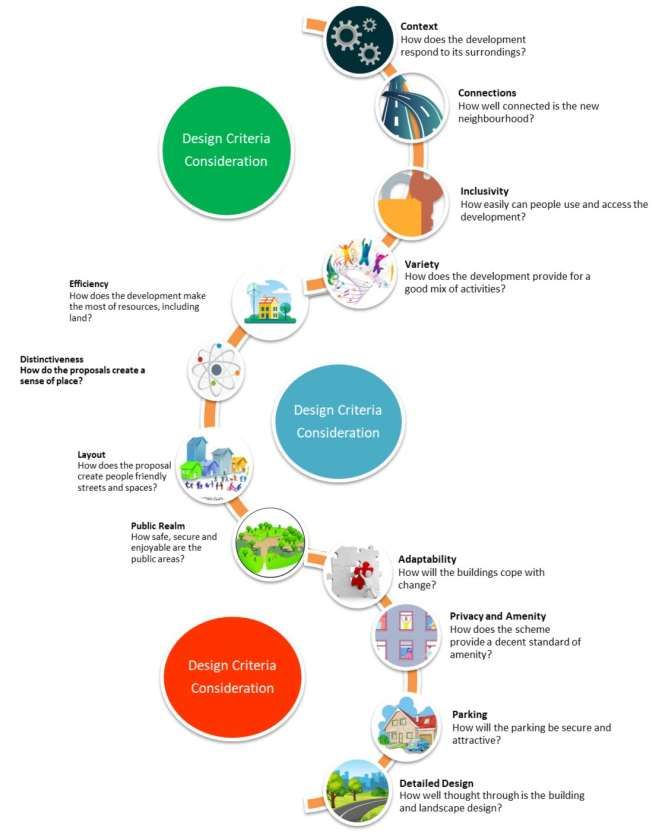
promoting active and healthy lifestyles. The Manual is based on twelve criteria that
There are various guidelines that have been incorporate the design considerations for a
published over the past decade which residential development. These criteria are
provide a policy foundation for the design intended to act as a practical guide in the
of residential developments and urban design process and can assist in
neighbourhoods. These include: identifying a design response and solution
The policy statement Delivering Homes during this process.
Sustaining Communities and associated
3.13.1 Placemaking
guidelines Quality Housing for
Sustainable Communities, (published in Placemaking is a design approach that can
2007) and add value to a development. This takes
The Sustainable Residential account of the location, character,
Development in Urban Areas Guidelines topography, history and any other issues
and accompanying Urban Design that have shaped the area in which a
Manual – A Best Practice Guide, development is located. It is a broad
(published in 2009). concept that brings together a range of
interrelated disciplines including planning,
architecture, landscape architecture,
engineering and infrastructure, ecology,
economics and social work.
Some of the key principles of placemaking
include the creation of neighbourhoods
where people can fulfil their daily needs
and feel safe. The most successful
neighbourhoods are well-connected, multi-
functional and tend to have a wide variety
of things to do in them.
A full list of the guidance documents
They have attractive streets and spaces that
relating to residential developments is
are safe, secure and easy to navigate. These
available in Section 13.8 ‘Housing’ of the
principles assist in creating a sense of
Development Management Guidelines in
community and identity and make places
Chapter 13.
more attractive to live, due to the vibrancy
and quality of life associated with such
places and neighbourhoods.
Policy Objective
HOU 17 To promote and facilitate the sustainable development of a high quality built
environment where there is a distinctive sense of place in attractive streets,
spaces, and neighbourhoods that are accessible and safe places for all members of
the community to meet and socialise.
Draft Louth County Development Plan 2021-2027
3-13Figure 3.1: Urban Design Manual Criteria 3-14 Draft Louth County Development Plan 2021-2027
3.14 CREATING A WELL DESIGNED PLACE
  In achieving a well-designed place there are     ii.    Form, Scale and Mass: The form of a
  a range of factors that need to be                      building refers to its three-dimensional
  considered, including:                                  shape, which is dependent on its size,
i. Layout: The layout of a development sets               height and bulk/volume. The mass of a
     out its arrangement, the distribution of             building combines with its shape and
     uses, and how the buildings, streets and             bulk and refers to the actual size of a
     open spaces connect to one another. The              building, or its size relative to its local
     layout should be functional and be                   context. It is directly related to the visual
     designed to promote social interaction               impact of a building.
     where people are encouraged to walk,                 The scale of a building refers to its
     cycle and utilise areas of open space.               height, width and length in relation to its
  This can be achieved by creating an active              surroundings. It can relate to the size of a
     frontage where buildings front onto                  building in the context of its surrounding
     streets and open spaces and by                       area or the relationship between
     positioning open spaces in accessible and            different parts of a building, which are
     centrally located areas. In larger                   known as its proportions. The scale of a
     developments, a well-designed layout                 building can affect how the space around
     should be able to accommodate a range                it can be used and experienced.
     of uses including residential, community,     iii.   Visual Appearance: The appearance of a
     educational,         commercial        and           building refers to its design aspects
     employment related uses.                             which determine the visual impact it has
  In such a mixed use scheme, the layout                  both in isolation and in the surrounding
     should ensure that the location of the               environment. This includes the style of
     various land uses would minimise the                 the building, and its scale, proportions
     requirement to travel by car, whilst also            and finishes.
     protecting the amenity of residential         iv.    Hard and Soft Landscaping: Hard
     neighbourhoods and creating a safe and               landscaping includes surfacing, boundary
     secure environment where children can                treatments, street furniture and play
     play and neighbours can interact. The                equipment while soft landscaping
     limited use of vehicular cul-de-sacs may             includes trees, shrubs, grassed areas and
     be      considered       in     residential          other planting. These are important
     developments where there is a particular             features in determining how a building
     concern regarding through traffic or                 or development integrates with the
     challenges in creating an inclusive, safe,           surrounding environment.
     and secure living environment. This will       v.    Finishes: The finishes to a building or
     only be considered where their use                   space can affect the overall design
     would not dominate such layouts. On                  quality of a development and can
     larger and/or irregular blocks short cul-            influence the relationship between the
     de-sacs may also be used for midblock                building or space and what is around it.
     penetration to serve a small number of               The finishes should be appropriate for
     dwellings and to enable more compact/                the location, be durable and attractive,
     efficient forms of development.                      and facilitate the integration of the
                                                          building or development into the local
                                                          landscape.

                         Draft Louth County Development Plan 2021-2027
                                                                                                          3-15
Policy Objective
HOU 18 To develop sustainable and successful neighbourhoods through the
consolidation and redevelopment of built-up areas and promote new compact
mixed-use urban and rural villages served by public transport and green
infrastructure.
Policy Objective
HOU 19 To enhance and develop the fabric of existing urban and rural settlements in
accordance with the principles of good urban design including the promotion of
high quality well-designed visually attractive main entries into our towns and
villages.
Policy Objective
HOU 20 To require a design led approach to be taken to sustainable residential
development in accordance with the 12 urban design principles set out in the
‘Urban Design Manual – A Best Practice Guide (2009) to ensure the creation of
quality, attractive, and well connected residential areas and neighbourhoods.
Policy Objective
HOU 21 To ensure that new residential developments are consistent, in so far as
practicable, with the Guidelines on Sustainable Residential Development in
Urban Areas in creating attractive, sustainable, climate resilient and healthy
communities.
Policy Objective
HOU 22 To require residential developments to prioritise and facilitate walking, cycling,
and public transport and to include provision for links and connections to
existing facilities and public transport nodes in the wider neighbourhood.
Policy Objective
HOU 23 To require the layout of residential developments to take account of the Design
Manual for Urban Roads and Streets (2019) in the provision of pedestrian and
cycling infrastructure and crossing points and the design of estate roads and
junctions.
Policy Objective
HOU 24 To require the provision of high quality areas of public open space in new
residential developments that are functional spaces, centrally located, and
passively overlooked.
Policy Objective
HOU 25 All new residential and single house developments shall be designed and
constructed in accordance with the Development Management Guidelines set
out in Chapter 13 of this Draft Plan.
3-16 Draft Louth County Development Plan 2021-20273.15 DWELLING MIX AND ADAPTABLE HOMES
It is important for new residential areas to The application of the ‘Universal Design’
include an appropriate mix of house types concept at the design and construction
to meet the needs of all tenures and age stage of a development can be a cost
groups including families, persons living effective way of future proofing a home and
alone and older people. This will provide incorporating sustainable designs and smart
choice for people and will support the technologies that will allow people to live
creation of a balanced, sustainable independently for longer.
community. In larger housing developments of 100
The provision of a range of housing types residential units or more provisions shall be
and sizes in the County will become more made for single storey properties to
important, as trends show a decline in broaden the choice of accommodation
family housing and an increase in elderly available.
and single person households.
New homes should be designed so that they
are adaptable and can be altered to meet
the needs of residents through different
stages of life.
Policy Objective
HOU 26 To require the provision of an appropriate mix of house types and sizes in
residential developments throughout the County that would meet the needs of
the population and support the creation of balanced and inclusive communities.
Policy Objective
HOU 27 To require the provision of single storey properties in residential developments
in excess of 100 units at a rate of at least 1% single storey units per 100
residential units unless it can be demonstrated by evidence based research
carried out by an appropriately qualified professional that there is no demand
for this type of accommodation.
Policy Objective
HOU 28 To encourage innovation in design that delivers buildings of a high quality that
positively contribute to the built environment and local streetscape.
Policy Objective
HOU 29 To seek that all new residential developments in excess of 20 residential units
provide for a minimum of 5% universally designed units in accordance with the
requirements of ‘Building for Everyone: A Universal Design’ published by the
Centre for Excellence in Universal Design.
Draft Louth County Development Plan 2021-2027
3-17Policy Objective
HOU 30 To encourage building design and layout that maximises daylight and natural
ventilation and incorporates energy efficiency and conservation measures that
will improve the environmental performance of buildings in line with best
practice.
Policy Objective
HOU 31 To actively support proposals that encourage town centre living such as
converting upper floors of buildings (above ground floor) into residential use in
order to revitalise the social and physical fabric of urban centres in the County
and to facilitate a relaxation of development standards for such projects subject
to the provision of good quality accommodation.
3.16 OTHER RESIDENTIAL DEVELOPMENTS IN URBAN AREAS
3.16.1 Infill, Corner and Backland 3.16.2 Extensions to Dwellings
Sites
The need for people to extend and renovate
The development of underutilised infill, their dwellings is recognised and
corner and backland sites in existing acknowledged.
residential areas is generally encouraged. A Extensions of appropriate scale will be
balance is needed, between the protection considered favourably where they do not
of amenities, privacy, the established have a negative impact on adjoining
character of the area and new residential properties or on the nature of the
infill. The use of contemporary and surrounding area.
innovative design solutions will be
considered for this type of development. Policy Objective
HOU 34 To encourage sensitively
Policy Objective designed extensions to existing
HOU 32 To encourage and promote the dwellings which do not
development of underutilised negatively impact on the
infill, corner and backland sites environment, residential
in existing urban areas subject to amenities, surrounding
the character of the area and properties, or the local
environment being protected. streetscape and are climate
resilient.
Policy Objective
HOU 33 To promote the use of 3.16.3 Student Accommodation
contemporary and innovative Dundalk Institute of Technology (DkIT) is
design solutions subject to the the most significant third level institution in
design respecting the character County Louth. Drogheda Institute of Further
and architectural heritage of the Education (DIFE) located in Moneymore
area. also provides many training courses and
programmes. The Lourdes Hospital is also a
major training hospital in close proximity to
DIFE.
3-18 Draft Louth County Development Plan 2021-2027In considering planning applications for The quality of life associated with rural
student accommodation the Council will living means there is a high demand for
have regard to the ‘Guidelines on housing in the open countryside.
Residential Developments for Third Level This is presenting challenges for the long
Students’ updated in 2020 (particularly in term sustainability of rural areas as the
relation to location and design). landscape is being gradually eroded and
farmland is slowly being depleted.
Policy Objective This Draft Plan recognises the importance of
HOU 35 To support the provision of rural life and the rural economy to the
accommodation for third level County and will strive to support the
students on the campus of Third continued growth and development of rural
Level Institutions or at other areas. It is important that a balance is
appropriate locations with achieved that will allow the countryside to
access to high quality cycling and be preserved for future generations whilst
walking linkages and public also facilitating the growth of the rural
transport that are proximate to economy and rural communities.
centres of third level education.
3.17.1 Rural Housing and Climate
3.17 HOUSING IN THE OPEN Change
COUNTRYSIDE In achieving a balance of supporting rural
The open countryside in Louth is a valuable communities and protecting the
resource to the County and wider Region. countryside, consideration must be given to
The scenic landscape and the local the impact of the pattern of development
amenities are an important source of associated with one off housing on the
enjoyment and the farmland produces high climate and environment.
quality agricultural produce. The sporadic nature of one off housing
results in an over-dependence on the car,
with limited opportunities for people to
walk or cycle due to the distance between
homes and school, work or local services.
The proliferation of individual septic tanks
and waste water treatment systems is also
impacting on soil and water quality.
As we strive to mitigate against the impacts
of climate change, it is important that
future development patterns reduce our
carbon footprint, protects our environment
and promotes more sustainable ways of
living.
Draft Louth County Development Plan 2021-2027
3-193.17.2 Policy Context
The policy for single housing in the Applications for one off rural dwellings in
countryside in this Draft Plan has been these locations are to be considered with
guided by national and regional policy, a regard to an economic or social need to live
summary of which is set out as follows: in the rural area, siting and design criteria
The National Planning Framework (NPF) and the viability of smaller towns and rural
acknowledges the contribution of rural settlements2.
areas to the economic, social and cultural Regional Spatial Economic Strategy (RSES)
development of the country. for the Eastern and Midland Region 2019-
2031 recognises that in planning for rural
areas, a balance is required between
managing urban generated demand and
supporting the sustainable growth of rural
communities and economies.
It seeks to strengthen rural communities,
improve connectivity and address decline
by focusing on the potential for the renewal
and development of smaller towns and
villages. The document identifies a link The Strategy highlights the significant levels
between the spatial imbalance created by of growth experienced in rural areas close
one off housing and the impact this has had to large urban settlements and the need to
on the decline of smaller settlements and manage the level of growth in these
the level of services available. locations.
There is therefore a strong emphasis on There is an acknowledgement that support
revitalising towns and villages and focusing for housing and population growth within
local housing and employment growth in rural towns and villages would provide a
these locations. viable alternative to one-off rural housing.
The NPF developed an evidence based This is confirmed in the policy objective
approach to the identification of rural areas supporting the development of a ‘New
under pressure for development, by Homes in Small Towns and Villages’
including a definition of the functional initiative in Development Plans included in
urban area or commuter catchment around the Strategy3.
a city or large town1. Any rural areas located
1
within the commuter catchment of a city or This definition is based on the EU/OECD definition of a
city region which is where 15% of the principal workforce
large town are considered to be areas is employed in the principal city area.
under urban influence. 2
This criteria is set out in National Policy Objective 19 of
the National Planning Framework.
3
Regional Policy Objective 4.78
3-20 Draft Louth County Development Plan 2021-2027Sustainable Rural Housing, Guidelines for An identification of areas and
Planning Authorities, published in 2005, landscapes that are environmentally
advocate that Planning Authorities should sensitive or of high scenic value.
take an analytical and plan led approach to In the analysis of the POWSCAR data, it was
enable Development Plans to respond to evident that there is a strong relationship
the challenges facing rural areas. They between large urban centres and the rural
require the needs of rural communities to areas with high volumes of commuting to
be identified in the development plan Drogheda, Dundalk and the Dublin
process and that residential development is Metropolitan Area.
accommodated at appropriate locations This analysis is consistent with the approach
necessary to sustain rural communities. taken in the NPF and RSES, where the
The Guidelines require the Council to ‘Functional Urban Area’ (FUA) or commuter
identify the different types of rural areas catchment of cities and large urban centres
within the County, depending on the was identified5.
pressure the area is under for development. Following a detailed analysis of the
There is also an emphasis on ensuring the information gathered it was concluded that
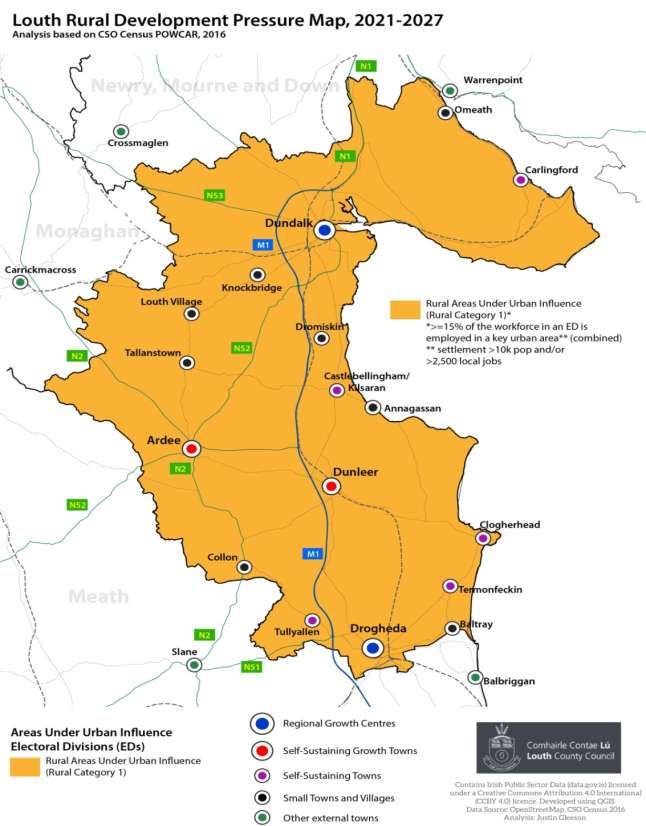
planning system guides development to the the entire county is ‘under strong urban
right locations thereby protecting natural influence’. This is due to a number of
habitats such as environmentally sensitive factors including the following:
areas and important scenic landscapes. The high rate of outbound commuting
In 2017, the DECLG issued a Circular Letter from rural areas in Louth to the Dublin
PL 2/2017 indicating that the Guidelines are Metropolitan Area and the Regional
currently being reviewed to take account of Growth Centres of Drogheda and
the ‘Flemish Decree Case’ by the European Dundalk for employment;
Court of Justice and the updated policy Recent and historic levels of one off
approach to rural development set out in housing in rural parts of the County;
the National Planning Framework. At the Pressure on infrastructure in rural areas
time of writing the updated guidelines had such as local roads and
not been published. Pressure on rural areas of high scenic
3.17.3 Identifying Rural Area Types quality and environmental sensitivity.
In addition to being under pressure from
As part of the information gathering and urban generated development, there are
evidence base on which this Draft Plan has parts of the County that are
been prepared, an analysis of the level of environmentally sensitive areas due to
development in rural areas in the County their high scenic quality and cultural value.
was carried out. This included: It is important that development in these
The use of POWSCAR 4 data from locations is carefully managed in order to
Census 2016 to identify where people preserve these sensitive landscapes.
in rural areas are working;
An analysis of census data to examine
population and housing levels, and
vacancy in rural areas;
An analysis of CSO ‘New Dwelling
Completions’ data to identify the
number of new dwellings completed in
rural areas ;and
Draft Louth County Development Plan 2021-2027
3-21These locations are as follows: Taking this into account, two Rural Policy
Areas of Outstanding Natural Beauty: Zones have been identified in the County as
Carlingford and Feede Mountains, follows:
and Table 3.3: Rural Policy Zones
Clogherhead and Port Oriel.
Areas of High Scenic Quality: Policy Zone Description
Feede Mountains and Cooley Area;
Monasterboice; Rural Policy
Area under strong urban
Boyne Valley/King Williams Glen; influence and of significant
Zone 1
landscape value
Collon Uplands;
Dunany and Rural Policy Area under strong urban
Ardee Bog. Zone 2 influence
Areas of Cultural Value:
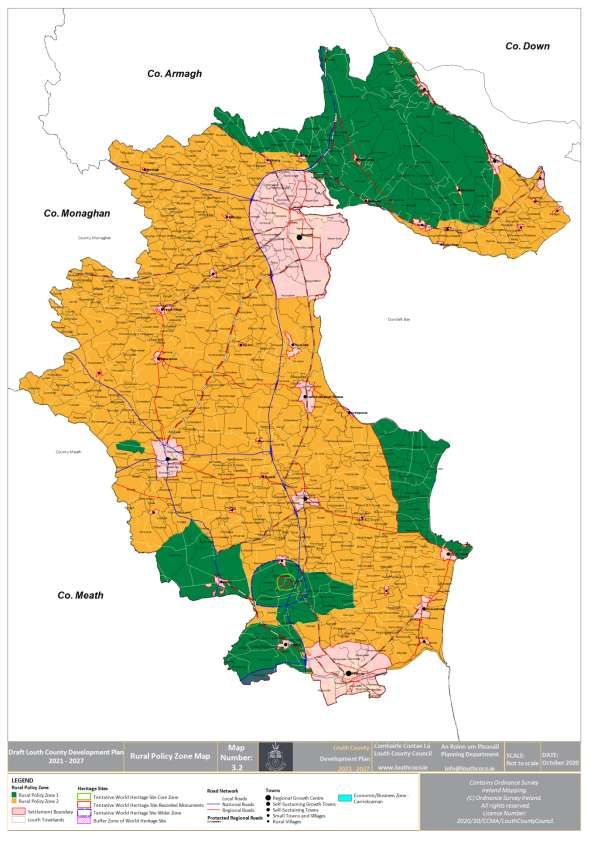
The UNESCO World Heritage Site of The extent of these policy zones are set out
Brú na Boinne: in Map 3.2.
The Tentative World Heritage Site 4
of Monasterboice; and Place of Work, School or College – Census of Anonymised
Records.
The Battle of the Boyne Battlefield 5
Based on the OECD definition of a ‘Functional Urban
Site. Area’ if more than 15% of the resident population from an
Further details on the importance of these Electoral District travel to a city/large urban centre to work
landscapes can be found in Chapter 8 they are considered to be within the ‘Functional Urban
Area’ or commuter catchment of that settlement.
Natural Heritage, Biodiversity, and Green
Infrastructure, and Chapter 9 Built Heritage
and Culture.
3-22 Draft Louth County Development Plan 2021-2027Map 3.1: Louth Rural Development Pressure Map 2021-2027
Draft Louth County Development Plan 2021-2027
3-23Map 3.2: Rural Policy Zones in County Louth 3-24 Draft Louth County Development Plan 2021-2027
3.17.4 Rural Generated Housing Need
This section sets out the policy for rural For clarification any persons from Rural
housing in the open countryside, which is Policy Zone 1 who are native residents of
defined as all areas outside the the area and have demonstrated a rural
development boundary of settlements in housing need but are not engaged in full
Levels 1-5 identified in the settlement time agricultural activities will be deemed
hierarchy in Table 2.4. It recognises the to qualify to build on a suitably located site
importance of facilitating people with a in Rural Policy Zone 2. The application site
strong economic or social link to their local shall not normally be a distance of more
rural area 6 , in strengthening the rural than 6 kilometres from the qualifying family
community. There is a specific qualifying residence.
criteria for each of the Rural Policy Zones
6
that is set out in Tables 3.4 and 3.5. For the purposes of this Plan the ‘local rural area’ is
Applicants will be required to demonstrate defined as being a radius of 6 kilometres from the
qualifying family residence. Where the qualifying
to the Planning Authority that they qualify
area is reduced by reason of its location, for example
with one of the criteria in the relevant Rural proximity to the coast, county boundaries, or
Policy Zone. development zone boundaries, the 6 kilometre
radius may be extended to include an area
equivalent to the area lost.
Table 3.4: Local Housing Need Qualifying Criteria in Rural Policy Zone 1
Qualifying Criteria Rural Policy Zone 1 –
Area Under Strong Urban Influence and of Significant Landscape Value
1. Persons engaged in full time agriculture. This includes livestock, poultry, dairy, and
tillage farming, bloodstock and equine related activities, forestry, and horticulture. The
nature of the agriculture activity shall, by reference to the landholding, livestock
numbers, or intensity of the use of the land, be sufficient to support full time or
significant part time occupation. Depending on the activity the documentation available
will vary however the onus will be on the applicant to demonstrate the viability of the
enterprise. Information to be provided shall include:
The size of the landholding
The nature of the operations
Buildings and storage associated with the operations
Number of persons employed
Livestock numbers (if applicable)
Participation in government schemes/ programmes e.g. Bord Bia Quality
Assurance, Basic Payment Scheme (BPS), GLAS, or any similar/updated
programmes or schemes.
Any other information that would support the application.
Or
Draft Louth County Development Plan 2021-2027
3-25Qualifying Criteria Rural Policy Zone 1 –
Area Under Strong Urban Influence and of Significant Landscape Value
2. Permission will be considered for 2 no. dwellings, in addition to the family home, for a
son or daughter of a landowner who are native residents of the area to build a first
home for permanent occupation. A qualifying landowner is defined as a person who
owns a landholding of at least 3 hectares and has owned the land for a minimum of 10
years. Any applicant under this category must demonstrate a rural housing need and
shall not have previously owned a dwelling. Any application will be subject to the
appropriate siting and consideration of proper planning and sustainable development.
Table 3.5: Local Housing Need Qualifying Criteria in Rural Policy Zone 2
Qualifying Criteria Rural Policy Zone 2 –
Area Under Strong Urban Influence
1. Persons engaged in full time agriculture. This includes livestock, poultry, dairy, and
tillage farming, bloodstock and equine related activities, forestry, and horticulture. The
nature of the agriculture activity shall, by reference to the landholding, livestock
numbers, or intensity of the use of the land, be sufficient to support full time or
significant part time occupation. Depending on the activity the documentation available
will vary however the onus will be on the applicant to demonstrate the viability of the
enterprise. Information to be provided shall include:
The size of the landholding
The nature of the operations
Buildings and storage associated with the operations
Number of persons employed
Livestock numbers (if applicable)
i. Participation in government schemes/ programmes e.g. Bord Bia Quality
Assurance, Basic Payment Scheme (BPS), GLAS, or any similar or replacement
programmes or schemes.
ii. Any other information that would support the application.
or
2. A person whose business requires them to reside in the rural area. The nature of the
operations of the business shall be specific to the rural area. Any application shall
demonstrate the viability of the business and clearly set out the nature of activities
associated with the business and why it requires the owner to reside in the vicinity.
or
3. Landowners including their sons and daughters who are native residents of the area. A
native resident is someone who has resided in the rural area of Louth for at least 18
years prior to any application for planning permission. Any applicant under this
category must demonstrate a rural housing need and shall not own or have sold a
residential property in the County for a minimum of 10 years prior to making an
application.
3-26 Draft Louth County Development Plan 2021-2027You can also read


