IB (International Baccalaureate) Course Guide 2019-2021 - Bedford School
←
→
Page content transcription
If your browser does not render page correctly, please read the page content below

IB (International Baccalaureate) Course Guide 2019-2021
2 | International Baccalaureate Course Guide
Contents
   Introduction                                          5

   IB or A Level – Which for me?                         7

   Careers Advice                                        10

   Work Experience                                       11

   Sixth Form Entrance Requirements                      12

   Curriculum Options                                    14

   Group 1: Studies in Language & Literature

           Language A: Literature                        16

           Language A: Language & Literature             20

   Group 2: Language Acquisition

           Second Language (Modern Foreign Language)     24

           Latin                                         26

   Group 3: Individuals & Societies

           Economics                                     27

           Geography                                     28

           History                                       30

           Philosophy                                    33

   Group 4: Sciences

           Biology                                       35

           Chemistry                                     37

           Physics                                       39
           Design & Technology                           41
   Group 5: Mathematics
                                                         43
           Mathematics
                                                         48
           Mathematics: Applications & Interpretations
   Group 6: The Arts / Elective
           Music                                         50

           Theatre                                       52

           Visual Arts                                   55

3 | International Baccalaureate Course Guide
Core
Theory of Knowledge 58
Extended Essay 59
Creativity, Activity & Service 60
Frequently Asked Questions 61
Academic Advice and Support 64
Educational Support 64
Contact Details 65
‘Old’ v ‘New’ Grade Structure 66
Art History: an optional additional opportunity 67
Requirements for entry into German university with the 68
International Baccalaureate Diploma
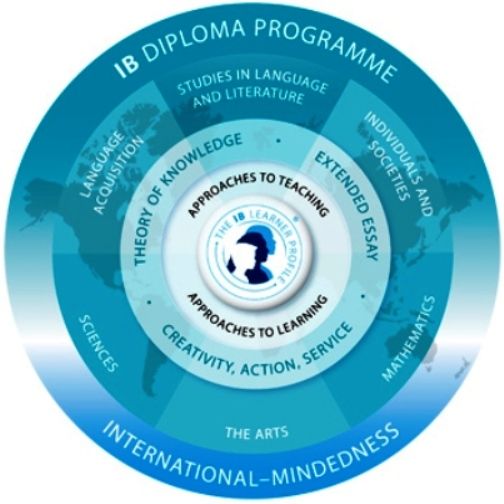
4 | International Baccalaureate Course GuideIntroduction This booklet is designed to assist boys in selecting their two-year International Baccalaureate (IB) Diploma course options. It includes a useful overview of the curriculum, an overview of the options that are available and detailed course descriptions for all subjects. We encourage all boys to read this booklet carefully with their families and to seek advice from the Director of IB (Mr Finch) as well as their Tutors, Housemasters, Heads of Faculty and Subject Teachers. Boys may also speak to the Head of UCAS and Careers (Mrs Lincoln) if they require advice about subjects needed for various careers. The Deputy Head (Academic) (Mr Baldock) is also always available to boys and parents who wish to discuss their options. Additionally, all 5th Form boys will attend an interview with a senior member of staff in the second half of the Autumn Term to consider their subject, university and career options in more detail, in addition to Futurewise career interviews with independent experts in the first half of the 5th Form Autumn Term. The Curriculum Requiring the study of six subjects, the IB allows boys to achieve depth of knowledge within their specialist areas while preserving breadth; it also recognises the importance of continuing, at some level, the study of each boy's native language, a foreign language, Mathematics, a humanities subject and Science up to the end of formal secondary education. In addition to this, all IB students follow a course in Theory of Knowledge, write an Extended Essay on a topic that holds particular interest for them and follow an extra-curricular programme of Creativity, Activity and Service (CAS). The IB Diploma Programme structure is illustrated in the following model: 5 | International Baccalaureate Course Guide
Assessment
Diploma candidates are required to study six subjects (one from each of the six subject groups), with
at least three (and not more than four) of these taken at Higher Level (allowing for greater depth of
study in those areas). The other subjects will be taken at Standard Level. Up to 7 points are awarded
for each subject regardless of the level at which the subject is studied.

By arranging work in this fashion, students are able to explore some subjects in depth and others
more broadly over the two-year period; this is a deliberate compromise between the early
specialisation preferred in some national systems and the breadth found in others.

In addition, three points are available for Theory of Knowledge and the Extended Essay. It is also a
requirement for the award of the Diploma that pupils should satisfactorily complete the CAS
programme.

Teaching
Boys opting for Higher Level study will receive six timetabled lessons each week in these subjects.
Standard level subjects are allocated four timetabled lessons each week. There may be some additional
teaching depending on subjects. More details follow in the subject summaries.

University Applications
The IB is highly regarded by universities globally. A recent survey of UK and US university admissions
tutors revealed that the IB is the most highly regarded of all qualifications, in particular because it:

    •    Develops global awareness and creativity;
    •    Develops communication skills and numeracy;
    •    Develops self-management skills;
    •    Nurtures an open mind; and
    •    Encourages independent enquiry.
As a result, university offers to IB students are often very generous. Some universities now make a
‘flat’ offer to all IB students in an attempt to encourage IB students to apply. Birmingham, for example,
makes an extremely achievable offer of 32 points to all students, with specific requirements for their
HL subjects depending upon the course.

UCAS
Just like A Level boys, all IB students who wish to attend a UK university will apply through UCAS.
GCSE/IGCSE Grades are an important part of any UCAS application, and boys must not underestimate
the importance of securing the best possible GCSE grades to give them the best university options.
Exams taken at the end of the Lower Sixth (IB1), however, are crucial in the university application
process. Although the offer of a place will be determined by IB2 results, any IB2 grade prediction the
School is able to make must be based on performance in IB1 internal exams. A boy’s grades in the end
of Lower Sixth IB1 exams, therefore, directly affects UCAS Predictions and the School can only make
IB2 predictions which are in line with the grades they have achieved at IB1 Level.

6 | International Baccalaureate Course Guide
IB or A Level – Which for me?
What is not different?
It is worth first mentioning the things that are not different:
• Both systems will serve you equally well in securing a place at university;
• Both systems are academically demanding. It is a real challenge to achieve a 7 at Higher
Level or an A* in A Level;
• Universities will have high expectations in terms of their offers to students of either
system;
• The number of taught periods you will attend will be very similar in both systems;
• Both systems give boys the opportunity to demonstrate academic extension beyond
the curriculum, either via the Extended Essay in IB or via BSIP/EPQ in A Level;
• The structure of the year, assemblies, tutor time, games, parents’ evenings, the UCAS
application process, Citizenship mornings (to name but a few aspects of a school year
in the Sixth Form) will all be the same regardless of your choice of Sixth Form
curriculum.
What is different?
The key difference between the two systems is the educational philosophy.
If you subscribe to the IB Diploma programme you accept that breadth of education is an important
part of Sixth Form education. Developing your skills in Mathematics and English, for example, is a core
part of your education, regardless of your specification, the logic being that these are skills you are
going to use later in life whatever job you end up doing. Learning an additional language is important
in today’s global community; studying a science deepens appreciation of the nature of scientific debate;
critical thinking developed through studying the Theory of Knowledge course is a useful academic tool.
The depth of study in your principal subjects, however, is likely to be very similar for IB Higher Level
or A Level – the conceptual challenges within subject courses are broadly the same across both
systems.
If you subscribe to A Level courses you accept that focus on particular subject areas is more important
in Sixth Form education. Developing your skills in areas of study that you will continue at university is
your primary focus, without having to study in subject areas you would rather leave behind. The
development of wider skills – the quality of your writing, your confidence with numbers and your
analytical skills – may be developed through your A Level subject options rather than through a
broader educational programme and separate critical thinking course.
If you subscribe to A Levels then you accept that you will not necessarily develop your skills across a
broad range of subject areas, in exchange for more time in lessons devoted to your principal subjects.
You can, of course, introduce some breadth in your curriculum by choosing a contrasting subject
within your four A Level choices.
It is worth noting that the differences between the same subjects at IB or A Level can vary considerably,
noticeably in the topics studied. Boys should consider carefully the differences between the content
of your principal subjects before you make a final decision.
7 | International Baccalaureate Course GuideA Table of Comparison
The IB Diploma A Level
Subjects
Students choose 6 subjects from the following groups: Four subjects in the Lower Sixth.
• English
• A foreign language Four or three subjects in the Upper Sixth.
• Humanities
• Sciences Subject choices must fit the A Level Blocking Structure
• Maths (one subject per block).
• Creative arts (optional – you can instead
choose to study another science, language or Subjects follow a linear two-year course, with an
humanity). externally assessed exam at the end of the Upper Sixth.
3 subjects are studied in depth as Higher Level (HL)
subjects, and 3 at Standard Level (SL). Consequently,
the IB route creates a broader curriculum,
encompassing a wide range of skills. However, writing
an extended essay and the ability to select two
subjects from the same group enables students to
achieve a depth of knowledge as well as expanding
their broader skill base.
The Broader Curriculum
As well as studying 6 HL/SL subjects, students also: All boys undertake a piece of independent research and
• Write a 4000-word Extended Essay (EE) on a writing known as the Bedford School Independent
topic of their choice. The EE is often a superb Project (BSIP) in the first term of the Lower Sixth.
topic of conversation at university interviews;
• Study Theory of Knowledge (ToK), a course Boys are strongly encouraged to build on this work in
which is designed to encourage students to the Spring Term, since evidence of work outside the
reflect on the nature of knowledge and to core curriculum significantly enhances any university
think critically – again, a useful skill for application. The best work is included in a Presentation
university interviews; and Evening in the Summer Term.
• Partake is CAS (Community, Activity and
Service) on Wednesday afternoons in their Boys are also encouraged to use their BSIP work as the
first year. This not only enriches the foundation for an additional A Level qualification called
curriculum but also provides students with the EPQ (Extended Project Qualification). Boys submit
lots of useful material for their UCAS their work to the exam board in the Autumn Term of
statement and CV. the Upper Sixth.
Assessment and Grading
All subjects have a coursework component. Terminal externally-assessed exams in June of the Upper
Sixth.
Externally assessed exams are all taken in May of the
second year. An internal assessment takes place at the All subjects have an internal assessment at the end of the
end of the Lower Sixth, which provides evidence for Lower Sixth. This will determine the suitability of
UCAS predicted grades. continuing with a fourth subject in the Upper Sixth, and
provide evidence for UCAS predicted grades.
Each HL and SL subject is assessed out of a maximum
of 7 points. 3 additional points are available for the EE Coursework is subject dependent.
and ToK essay/presentation. The maximum mark for
the Diploma is therefore 45 points. Individual subjects graded A*, A, B, C, D, E and U
8 | International Baccalaureate Course GuideFinally Don’t worry about your choice of curriculum. Bedford has been delivering the IB Diploma programme for over ten years with tremendous success, and the staff at Bedford are equally experienced as IB and A Level teachers and examiners. Regardless of your choice of curriculum you will be inspired, supported and challenged in equal measure. 9 | International Baccalaureate Course Guide
Careers Advice
Careers advice at Bedford School regarding the important choices to be made as boys move from the
Fifth Form to the Sixth Form is infused throughout the curricular and extra-curricular life of the School,
enabling them to access exceptional, tailored, professional experience and advice.

The source of this advice ranges from specific Citizenship Mornings run by Inspiring Futures, the
Independent Schools Careers Organisation, to individual Tutor advice, Heads of Department meetings
and Housemaster input. One to one interviews in the Autumn Term of the 5th Form with independent
experts from Inspiring Futures and subsequently with the Head Master and other members of the
Core Management Team ensures each boy makes the right decisions for himself.

In addition, there is a dedicated Careers service, available 24/7, to reinforce the information and
choices available for boys, and to illustrate the range of career pathways and university and
apprenticeship requirements.

careers@bedfordschool.org.uk crucially allows each and every boy to be directed on an
individual needs basis to the most relevant and qualified member of staff to help them.
This email address is managed by Mrs Melanie Lincoln, Head of Careers and UCAS at
Bedford School.

Boys with a specific career path in mind MUST ensure they have spoken to the relevant staff to
ensure the combination of subjects at A Level or IB is appropriate for that vocation.

Boys with less of a firm idea of what they want to do in future, must choose subjects they feel they
can excel in, that they enjoy and that crucially do not close any doors in future.

The Annual Old Bedfordian Careers Fair, coordinated and run by the OB Association, provides access
to a selection of the vibrant community of 8,500 members Bedford School has worldwide. The OB
Club is also instrumental in assisting the ‘Beyond Bedford’ ethos by providing assistance for any boy
needing a work placement through a sophisticated networking system.

10 | International Baccalaureate Course Guide
Alongside selective use of the already mentioned external well-respected organisations such as
Inspiring Futures, the School makes use of COA, (Cambridge Occupational Analysts) for specific
Career path analysis in the L6th, High Fliers, (the research body behind the Times 100 Graduate
Employers), NCS (the National Citizen Service) for work experience and apprenticeships, and of
course, UCAS, the University and Colleges Admissions Service.

On average, approximately 70% of Bedford School boys who apply through UCAS each year go to
Russell Group universities, and recent evidence has shown that many other leading universities we
send boys to that are not Russell Group are outperforming those that are.

A valuable source of information regarding University Options, along with information about 6th
Form subject requirements for certain University courses, can be found by following this link:
http://russellgroup.ac.uk/for-students/school-and-college-in-the-uk/subject-choices-at-school-and-
college/

Work Experience
Universities and employers increasingly ask boys to demonstrate evidence of relevant work experience
to support and enhance applications. Work experience can be organised at any point during a boy’s
5th or 6th Form career, but the time after a boy’s GCSE exams is an excellent opportunity for him to
gain work experience in a career field of interest. We strongly encourage all our boys to take full
advantage of this time to arrange some work experience, using either family or business contacts, or
via companies’ advertised work experience programmes. If, having tried these initial contacts, any boy
is still finding it difficult to arrange their own work experience placement, we may sometimes be able
to find some assistance via contacts in the OB Club, as well as via past and present parents. Boys who
undertake work experience placements will be asked to write up a report on their placement to help
with university application Personal Statements in due course.

11 | International Baccalaureate Course Guide
Sixth Form Entrance Requirements
On entering the Sixth Form, all boys embarking on A Level will study four subjects in the Lower Sixth
Year, with most reducing to three A Levels in the Upper Sixth Year. Those embarking on the IB
Diploma will study three subjects at Standard Level (SL) and three subjects at Higher Level (HL).

    1. For entry into the Sixth Form to take A Level, a pupil must:
           a. Gain a minimum of grade 6/B at GCSE in their chosen four A Level subjects.
                    i. The exception to this concerns boys studying Triple Award Science who wish
                       to study Physics, Biology or Chemistry at A Level, who will need to have
                       achieved a minimum of a grade 7 at GCSE/IGCSE.
                   ii. Those wishing to study Physics A Level are additionally required to get at least
                       a grade 7 in Maths, and are advised to have at least a 7 in Physics.
                  iii. Those wishing to study Maths are required to get at least a grade 7 in Maths.
                       The School’s advice is that boys are best placed to do well at Maths A Level
                       if they have at least a high grade 7 or above at GCSE.
                  iv. Those wishing to study Further Maths at A Level are required to get a grade
                       8 or 9 in Maths.
                   v. Boys studying the IGCSE Double Award Science specification wishing to
                       pursue a Science A Level will need a minimum of grade 87 (A*A equivalent)
                       in Science in order to study a Science subject at A Level.
            b. Gain at least grade 4 in Maths and at least a grade 4 in either English Language or
               English Literature (ideally both).

    2. For entry into the Sixth Form to take the IB Diploma, a pupil must:
           a. Gain a minimum of grade 6/B at GCSE/IGCSE for their chosen Higher Level subjects,
               and a minimum grade profile at GCSE/IGCSE of grades 665/BBC for their chosen
               Standard Level subjects.
                     i. The exception to this concerns boys wishing to study HL Physics, Chemistry
                        and Biology who are required to get a minimum grade 7 at GCSE/IGCSE (or
                        87 grade if studying Double Award Science)
                    ii. Those wishing to study Physics HL are additionally required to get at least a
                        grade 7 in Maths, and are best advised to have at least a 7 in Physics.
                   iii. Those who wish to study Maths HL are required to get a grade 8 or 9 in
                        Maths at GCSE.
                   iv. Those wishing to study Maths SL are required to get a minimum of a grade 7
                        in Maths.
            b. Gain at least grade 4 in Maths and at least a grade 4 in either English Language or
               English Literature (ideally both).

    3. Where a chosen A Level or IB Level subject is not offered by the School at GCSE/IGCSE the
        following grades are required in defined and related subjects as described here:

                For Economics           =        At least Grade 6 in Mathematics and English
                For Business Studies    =        At least Grade 6 in Mathematics and English
                For Computing Science   =        At least Grade 7 in Mathematics
                For Politics            =        At least Grade 6 in English and History/Geography
                For Music Technology    =        At least Grade 6 in Music (some exceptions may be
                                                 made for boys who have not studied music GCSE
                                                 after consultation with the Director of Music)

12 | International Baccalaureate Course Guide
4. Pre-IB boys entering the School in the 5th Form are expected to achieve this required standard,
and the School will review a pre-IB boy’s case in respect of Sixth Form entry if he has not
achieved this standard.
5. Boys whose first language is not English will usually be required to take additional ‘English as a
Second Language’ lessons to support them with academic English if the subject teacher judges
this to be necessary for the student to cope with the requirements of his written work. The
School can also provide tuition to students who wish to study for the IELTs (International
English language Testing System) qualification, which is usually required for University.
6. The Head Master and School reserve the right to make exceptions to these requirements in
certain circumstances.
N.B. Whilst the reforms to GCSE continue, please note that the School consider the new number
grades to equate to the old letter grades as follows:
A* 8/9
A 7
B 6
C 5/4
September 2018
13 | International Baccalaureate Course GuideThe Curriculum Options The provision of any subject is provisional at IB depending on numbers opting for that subject. The options available can change each academic year. The most up to date version will be published to boys and parents in the Spring Term of the Fifth Form prior to boys making their choices. After that point, the options available are likely to amended, and subsequent requests to change options may not always be possible. IB choices which do not fit into this block structure will be considered, but we cannot guarantee to be able to accommodate them. 14 | International Baccalaureate Course Guide
Group 1: Studies in Language & Literature (Language A)
 English Literature                                       HL   SL
 English Language & Literature                            HL   SL
 German Language and Literature                           HL   SL
 Mandarin Language and Literature                              SL
 Group 2: Language Acquisition (Second Language)
 Language B – French, German, Spanish                     HL   SL
 Latin                                                    HL   SL
 Mandarin or Spanish ab initio (for beginners)                 SL
 Group 3: Individuals & Societies
 Economics                                                HL   SL
 Geography                                                HL   SL
 History                                                  HL   SL
 Philosophy                                               HL   SL
 Group 4: Sciences
 Biology                                                  HL   SL
 Chemistry                                                HL   SL
 Physics                                                  HL   SL
 DT                                                            SL
 Group 5: Mathematics
 Maths Analysis and Approaches                            HL   SL
 Maths Applications and Interpretations                        SL
 Group 6: The Arts / Elective
 Music                                                    HL   SL
 Theatre                                                  HL   SL
 Visual Arts                                              HL   SL
 Chemistry                                                HL   SL
 Economics                                                HL   SL
 Core
 Theory of Knowledge
 Extended Essay
 Creativity, Activity & Service (CAS)

15 | International Baccalaureate Course Guide
Lang A: Literature
LANGUAGE A: LITERATURE

                                                                                                                     IB
Head of Department:              Mr N Hopton

Entry Requirement

An IB HL student should be able to demonstrate a strong competency in English before HL can be
recommended. At least a 6 in IGCSE English Literature is required, although a 7 is preferable.

Introduction

Both the Literature and Language & Literature courses are in the process of revision by the IB and full
details have not yet been published. The information here reflects what has been confirmed. The
course is built on the assumption that literature is concerned with our conceptions, interpretations
and experiences of the world. The study of literature can therefore be seen as an exploration of the
way it represents the complex pursuits, anxieties, joys and fears to which human beings are exposed
in the daily business of living. It enables an exploration of one of the more enduring fields of human
creativity, and provides opportunities for encouraging independent, original, critical and clear thinking.
It also promotes respect for the imagination and a perceptive approach to the understanding and
interpretation of literary works.

Through the study of a wide range of literature, the Language A: Literature course encourages students
to appreciate the artistry of literature and to develop an ability to reflect critically on their reading.
Works are studied in their literary and cultural contexts, through close study of individual texts and
passages, and by considering a range of critical approaches. In view of the international nature of the
IB and its commitment to intercultural understanding, the Language A: Literature course does not limit
the study of works to the products of one culture or the cultures covered by any one language. The
study of works in translation is especially important in introducing students, through literature, to
other cultural perspectives. The response to the study of literature is through oral and written
communication, thus enabling students to develop and refine their command of language.

Language A: Literature is a flexible course that allows teachers to choose works from prescribed lists
of authors and to construct a course that suits the particular needs and interests of their students. It
is divided into four parts, each with a particular focus.

•   Part 1: Works in translation
•   Part 2: Detailed study
•   Part 3: Literary genres
•   Part 4: Options (in which works are freely chosen)

The aims of Language A: Literature at SL and at HL are to:

•    Introduce students to a range of texts from different periods, styles and genres
•    Develop in students the ability to engage in close, detailed analysis of individual texts and make
     relevant connections
•    Develop the students’ powers of expression, both in oral and written communication

16 | International Baccalaureate Course Guide
• Encourage students to recognize the importance of the contexts in which texts are written and
received
• Encourage, through the study of texts, an appreciation of the different perspectives of people
from other cultures, and how these perspectives construct meaning
• Encourage students to appreciate the formal, stylistic and aesthetic qualities of texts
• Promote in students an enjoyment of, and lifelong interest in, language and literature
Syllabus Content
Standard Level (SL)
Assessment component Weighting
External assessment (3 hours) 70%
Paper 1: Guided literary analysis (1 hour 15 minutes)
The paper consists of two literary passages. Students choose one and write a guided literary analysis
in response to two questions. (20 marks) 35%
Paper 2: Essay (1 hour 45 minutes)
The paper will require candidates to write a literary essay about two works in response to a question.
Candidates must choose from one of four tasks, each of a general nature. They must compare and
contrast two of the works they have studied in connection with one of these tasks. The works used
to answer this paper could be works written by authors on the prescribed reading list or works freely
chosen, and they could be either works studied in translation or written originally in the language
studied. There will be a focus on genre so the texts used could be from any combination of literary
forms. The only restriction is that no work used for a paper 2 response can have been used in the
preparation of other components (25 marks) 35%.
Internal assessment
Individual Oral (30%)
This component is internally assessed by the teacher and externally moderated by the IB at the end
of the course. It will consist of a 15-minute individual oral exploring two of the texts in relation to a
global issue of the student’s choice. The first 10 minutes will consist of the student’s analysis of the
extracts and the overall texts in connection with the chosen global issue. In the remaining 5 minutes,
the teacher will ask questions of the student that will encourage further development, exploration or
discussion. The prompt the students will respond to will be: Examine the ways in which the global
issue of your choice is presented through the content and form of two of the texts that you have
studied.
17 | International Baccalaureate Course GuideHigher Level (HL) Assessment component Weighting External assessment 80% Paper 1: Literary commentary (2 hours 15 minutes) The paper consists of two literary passages. Students write a literary commentary on each of the passages. (20 marks) 35% Paper 2: Essay (1 hour 45 hours) The paper will require candidates to write a literary essay about two works in response to a question. Candidates must choose from one of four tasks, each of a general nature. They must compare and contrast two of the works they have studied in connection with one of these tasks. The works used to answer this paper could be works written by authors on the prescribed reading list or works freely chosen, and they could be either works studied in translation or written originally in the language studied. There will be a focus on genre so the texts used could be from any combination of literary forms. The only restriction is that no work used for a paper 2 response can have been used in the preparation of other components (25 marks) 25%. Higher Level Essay (20%) The HL essay is a component that requires candidates to write a 1200-1500 word formal essay, following a line of inquiry of their own choice into one of the texts studied. HL Language A: language and literature candidates will have a choice between writing about a non-literary or literary text. Students can choose any of the texts studied during the course, with the exception of the texts they have used for their internal assessment or that they plan to use for their Paper 2. In order to guide students in their choice of topic, a recommendation will be made in the guide to use the seven central concepts in the course as a starting point for developing a line of inquiry. Internal assessment This component is internally assessed by the teacher and externally moderated by the IB at the end Individual Oral (20%) This component is internally assessed by the teacher and externally moderated by the IB at the end of the course. It will consist of a 15-minute individual oral exploring two of the texts in relation to a global issue of the student’s choice. The first 10 minutes will consist of the student’s analysis of the extracts and the overall texts in connection with the chosen global issue. In the remaining 5 minutes, the teacher will ask questions of the student that will encourage further development, exploration or discussion. The prompt the students will respond to will be: Examine the ways in which the global issue of your choice is presented through the content and form of two of the texts that you have studied. 18 | International Baccalaureate Course Guide
The Learner Portfolio

This constitutes a collection and selection of a student’s work including all sorts of tasks students
might develop in their interaction with the texts and in their preparation of all assessment components.
It will consist not only of entries where students reflect on the texts studied, but also of all sorts of
activities which students might engage in as they respond critically or creatively to the texts they read.
It can be either an electronic portfolio or a paper one. Although it will not be formally assessed by the
IB, the learner portfolio will be a central element of the new courses and will be instrumental in the
preparation of all assessment components.

Setting

Mixed ability within the SL and HL course where more than one set is required.

19 | International Baccalaureate Course Guide
Lang A: English Lang
                                                                                                                & Lit IB
LANGUAGE A: LANGUAGE & LITERATURE

Head of Department:              Mr N Hopton

Entry Requirement

An IB HL student should be able to demonstrate a strong competency in English before HL can be
recommended. At least a 6 in IGCSE English Literature is required, although a 7 is preferable.

Introduction

Both the Literature and Language & Literature courses are in the process of revision by the IB and full
details have not yet been published. The information here reflects what has been confirmed. Language
A: Language and Literature comprises four parts—two relate to the study of language and two to the
study of literature.

The study of the texts produced in a language is central to an active engagement with language and
culture and, by extension, to how we see and understand the world in which we live. A key aim of the
Language A: Language and Literature course is to encourage students to question the meaning
generated by language and texts, which, it can be argued, is rarely straightforward and unambiguous.
Helping students to focus closely on the language of the texts they study and to become aware of the
role of each text’s wider context in shaping its meaning is central to the course.

The Language A: Language and Literature course aims to develop in students skills of textual analysis
and the understanding that texts, both literary and non-literary, can be seen as autonomous yet
simultaneously related to culturally determined reading practices. The course is designed to be
flexible—teachers have the opportunity to construct it in a way that reflects the interests and concerns
that are relevant to their students while developing in students a range of transferable skills. An
understanding of the ways in which formal elements are used to create meaning in a text is combined
with an exploration of how that meaning is affected by reading practices that are culturally defined and
by the circumstances of production and reception.

In view of the international nature of the IB and its commitment to intercultural understanding, the
language A: language and literature course does not limit the study of texts to the products of one
culture or of the cultures covered by any one language. The study of literature in translation from
other cultures is especially important to IB Diploma Programme students because it contributes to a
global perspective, thereby promoting an insight into, and understanding of, the different ways in which
cultures influence and shape the experiences of life common to all humanity.

The aims of Language A: Language and Literature are to:

•   introduce students to a range of texts from different periods, styles and genres
•   develop in students the ability to engage in close, detailed analysis of individual texts and make
    relevant connections
•   develop the students’ powers of expression, both in oral and written communication
•   encourage students to recognize the importance of the contexts in which texts are written and
    received

20 | International Baccalaureate Course Guide
• encourage, through the study of texts, an appreciation of the different perspectives of people from
other cultures, and how these perspectives construct meaning
• encourage students to appreciate the formal, stylistic and aesthetic qualities of texts
• promote in students an enjoyment of, and lifelong interest in, language and literature
• develop in students an understanding of how language, culture and context determine the ways in
which meaning is constructed in texts
• encourage students to think critically about the different interactions between text, audience and
purpose.
Syllabus Content
Standard Level (SL)
Assessment Component Weighting
External assessment ((1 hour 15 minutes) 70%
Paper 1: Textual analysis (1 hour 30 minutes)
The paper consists of two unseen non-literary passages, each a different text type.
Students write an analysis of one of these texts. (20 marks) 35%
Paper 2: Essay (1 hour 45 minutes)
The paper will require candidates to write a literary essay about two works in response to a question.
Candidates must choose from one of four tasks, each of a general nature. They must compare and
contrast two of the works they have studied in connection with one of these tasks. The works used
to answer this paper could be works written by authors on the prescribed reading list or works freely
chosen, and they could be either works studied in translation or written originally in the language
studied. There will be a focus on genre so the texts used could be from any combination of literary
forms. The only restriction is that no work used for a paper 2 response can have been used in the
preparation of other components (25 marks) 35%.
Higher Level Essay (20%)
The HL essay is a component that requires candidates to write a 1200-1500 word formal essay,
following a line of inquiry of their own choice into one of the texts studied. HL Language A: language
and literature candidates will have a choice between writing about a non-literary or literary text.
Students can choose any of the texts studied during the course, with the exception of the texts they
have used for their internal assessment or that they plan to use for their Paper 2. In order to guide
students in their choice of topic, a recommendation will be made in the guide to use the seven central
concepts in the course as a starting point for developing a line of inquiry.
21 | International Baccalaureate Course GuideInternal Assessment Individual Oral (30%) This component is internally assessed by the teacher and externally moderated by the IB at the end of the course. It will consist of a 15-minute individual oral exploring two of the texts in relation to a global issue of the student’s choice. The first 10 minutes will consist of the student’s analysis of the extracts and the overall texts in connection with the chosen global issue. In the remaining 5 minutes, the teacher will ask questions of the student that will encourage further development, exploration or discussion. The prompt the students will respond to will be: Examine the ways in which the global issue of your choice is presented through the content and form of two of the texts that you have studied. Higher Level (HL) Assessment Component Weighting External assessment 80% Paper 1: Textual analysis (2 hours 15 minutes) The paper consists of two unseen non-literary passages, each a different text type. Students write an analysis of each passage. (20 marks) 35% Paper 2: Essay (1 hour) 45 minutes The paper will require candidates to write a literary essay about two works in response to a question. Candidates must choose from one of four tasks, each of a general nature. They must compare and contrast two of the works they have studied in connection with one of these tasks. The works used to answer this paper could be works written by authors on the prescribed reading list or works freely chosen, and they could be either works studied in translation or written originally in the language studied. There will be a focus on genre so the texts used could be from any combination of literary forms. The only restriction is that no work used for a paper 2 response can have been used in the preparation of other components (25 marks) 25%. Higher Level Essay (20%) The HL essay is a component that requires candidates to write a 1200-1500 word formal essay, following a line of inquiry of their own choice into one of the texts studied. HL Language A: language and literature candidates will have a choice between writing about a non-literary or literary text. Students can choose any of the texts studied during the course, with the exception of the texts they have used for their internal assessment or that they plan to use for their Paper 2. In order to guide students in their choice of topic, a recommendation will be made in the guide to use the seven central concepts in the course as a starting point for developing a line of inquiry. 22 | International Baccalaureate Course Guide
Internal assessment

Individual Oral (20%)

This component is internally assessed by the teacher and externally moderated by the IB at the end
of the course. It will consist of a 15-minute individual oral exploring two of the texts in relation to a
global issue of the student’s choice. The first 10 minutes will consist of the student’s analysis of the
extracts and the overall texts in connection with the chosen global issue. In the remaining 5 minutes,
the teacher will ask questions of the student that will encourage further development, exploration or
discussion. The prompt the students will respond to will be: Examine the ways in which the global
issue of your choice is presented through the content and form of two of the texts that you have
studied.

The Learner Portfolio

This constitutes a collection and selection of a student’s work including all sorts of tasks students
might develop in their interaction with the texts and in their preparation of all assessment components.
It will consist not only of entries where students reflect on the texts studied, but also of all sorts of
activities which students might engage in as they respond critically or creatively to the texts they read.
It can be either an electronic portfolio or a paper one. Although it will not be formally assessed by the
IB, the learner portfolio will be a central element of the new courses and will be instrumental in the
preparation of all assessment components.

Setting

Mixed ability within the SL and HL course where more than one set is required.

23 | International Baccalaureate Course Guide
Second Language
                                                                                                              MFL IB
SECOND LANGUAGE: MODERN FOREIGN LANGUAGE

Heads of Department:             MFL & German Mr F Graeff

                                 French           Ms V Fletcher (acting) / Mrs Wahid

                                 Spanish          Mr A Huxford

                                 Mandarin         Dr A Chen

All students who opt for the IB have to study a modern foreign or classical language. Those who
particularly enjoy languages may choose to study two. We offer French, German, Spanish and Chinese
as Language B for which a GCSE Level (or equivalent level of prior learning) is required.

We also offer Spanish and Mandarin at ab initio Level (i.e. for beginners).

There is a provision for German and Chinese as Language A, a course designed for native speakers.
The course offered is Language A: Language and Literature, and it follows the same structure as the
English A: Language and Literature course. The course develops essay skills and practises dealing with
complex texts in German or Chinese. Please refer to the English section for more on the course
structure. While German is available at both Standard and Higher Level, Chinese is offered at Standard
Level only.

Entry Requirement

To study the language at Standard Level a GCSE grade 6 is required, but candidates with a grade 7 or
8/9 knowledge of grammar and vocabulary should consider Higher Level. For ab initio there should be
no prior study of the subject.

The Standard Level course entails four periods per week; Higher Level students have six periods and
undertake more advanced work. In addition, all students have a weekly conversation lesson with the
native language assistant to boost their confidence in speaking.

IB Language B courses are very accessible and our IGCSE students cope well with their demands.

For the Language A courses, a native speaker level of language competency is required.

Introduction

The Language part of the IB develops crucial elements in its learners. Beyond understanding and using
the language in many different contexts, you will enhance your intercultural understanding and acquire
a great set of transferable skills, such as learning to work with complex (linguistic) systems. Through
the study of texts and social interaction, you will increase your awareness and appreciation of the
different perspectives of people from other cultures. The skills you pick up will open doors to further
study and work opportunities. Language skills are highly sought after both by universities and
employers and are a great asset in fields ranging from Arts to Law, from Business to Science, from

24 | International Baccalaureate Course Guide
History to Engineering. After the course, you might find yourself using foreign language sources for
your university essays, giving presentations to international business partners or impressing friends
with your intercultural knowledge and sensibility. Previous students have studied abroad, and some
have gone on to take up language degrees or international law.
Syllabus Content
The Language B course develops receptive and productive skills (i.e. understanding and producing
language). Listening, Reading, Speaking and Writing exams each carry a weight of 25% towards the final
mark. Much like in GCSE English, students will become familiar with a variety of different linguistic
registers and text types. The language skills are practised within the context of themes and topics –
such as Identities and Experiences, Human Ingenuity, Social Organisation and Sharing the Planet - which
promote an awareness of the society in which the language is spoken and afford an insight into its
culture. The Higher Level course includes a literary element, usually in the form of a play, short novel,
prose extracts or poems. These works are studied for their themes, characters and contexts, not
analysed for their literary devices. The course content is flexible and we tailor it according to the
students’ interests.
The overall assessment outline for the course are as follows (subject to change):
Language B SL Language B HL Language ab initio
Paper 1 Paper 1 Paper 1
Writing 1 hr 15 min Writing 1 hr 30 min Writing 1 hr
Producing a text based on a Producing a text based on a Producing 2 texts based on
choice of specific text types (e.g. choice of specific text types a choice of specific text
article, speech, letter, flyer) of (e.g. article, speech, letter, types (e.g. article, speech,
250-400 words length flyer) of 450-600 words length etc.) of 70-150 words each
25% weighting 25% weighting 25% weighting
Paper 2 Paper 2 Paper 2
Receptive skills – listening and Receptive skills – listening and Receptive skills – listening
reading (separate sections) reading (separate sections) and reading (separate
sections)
Listening comp. – 45 min Listening comp. – 1 hr
Reading comp. – 1 hr Reading comp. – 1 hr Listening comp. – 45 min
Reading comp. – 1 hr
50% weighting 50% weighting
50% weighting
Internal Assessment Internal Assessment Internal Assessment
Individual oral 12-15 min Individual oral 12-15 min Individual oral 7-10 min
+ 15 min of preparation + 20 min of preparation + 15 min of preparation
25% weighting For HL, this is based on an Picture-based presentation
extract from the two literary and discussion followed by
works studied during the general conversation
course
25% weighting
25% weighting
25 | International Baccalaureate Course GuideSecond Language
Latin IB
SECOND LANGUAGE: LATIN
Head of Department: Mr A Melvill
Entry Requirement
Latin is offered at both Standard and Higher Level to pupils who have achieved at least a grade 6 at
GCSE.
Introduction
Latin is offered within the IB Diploma Course, where it may be studied as an alternative to a modern
foreign language in Group 2, or as an elective subject in Group 6. The department offers Latin at both
Standard and Higher Level to pupils who have achieved at least a B grade at GCSE. IB Latin involves
gaining a deeper understanding and appreciation of Latin language and literature by reading a wide
range of unabridged texts in the original language.
One week you might be studying a vehement law-court attack by Cicero upon a corrupt official or a
bitter rival; the next week you might study a tender love-poem or a bitingly satirical epigram by
Catullus, a playful and imaginative retelling of a well-known myth by Ovid, or the stirring and exciting
account of the hero Aeneas’ epic journey to Italy. It’s the sheer variety which makes Roman literature
so fresh and engaging.
Syllabus Content
There are 3 parts to the course, which are the same for both Higher and Standard Level:
Part One: Latin Language (35%)
Pupils are required to demonstrate their knowledge and understanding of Latin language, grammar
and vocabulary by translating a passage of unseen Latin verse into English. Pupils will study Ovid’s
greatest work; The Metamorphoses in order to develop language translation skills for the exam. Pupils
will be required to translate a passage from Ovid, using a Latin dictionary for help!
Part Two: Latin Literature Genre Study (45%)
In this Unit, pupils develop the skills needed to show knowledge, understanding and appreciation of
Latin texts within their literary, social and historical contexts. They will study two set texts and will
have to show their detailed understanding of the texts by answering comprehension and translation
questions. In addition, they will develop their understanding of Latin literary techniques, and will
produce personal responses to the Latin texts. In recent years, pupils have studied Tacitus, Livy,
Catullus and Virgil.
Part Three: Research Dossier (20%)
Pupils will also work over the two year course on an annotated collection of source materials relating
to a topic in classical history, literature, language, religion, mythology, art, archaeology of the pupil’s
own choosing. The Research Dossier allows the pupil to specialize and study an aspect of the classical
world that really interests them. The final dossier is internally assessed and externally moderated.
26 | International Baccalaureate Course GuideEconomics
ECONOMICS
IB
Head of Department: Mr P Waterhouse
Entry Requirement
Candidates would be expected to secure at least a grade 6 in GCSE Maths.
Introduction
The overall aim of the course is to give students a deeper understanding of the nature and scope of
Economics. The different parts of the course are designed to complement each other enabling students
to develop a range of fundamental economic skills. The course naturally takes a global outlook from
the onset, and the teaching and resources used to teach the course reflect this.
We aim to:
Equip boys with a strong and intellectual understanding of core economics topics, themes and
theories.
Capture the boys’ interest in the subject of economics, making them aware of the subjects wide
ranging application to the real world and their own lives.
Develop the boys’ analytical, evaluative and mathematical skills when applying their economics
knowledge to these real-world events.
Syllabus Content
The IB course consists of four parts, Microeconomics, Macroeconomics, International Economics and
Development Economics. The microeconomics section gives boys an understanding of the key
microeconomics topics, such as supply and demand, elasticities, externalities and government
intervention, market structures. The macroeconomics section focuses on the main macroeconomics
model of aggregate demand and supply, the component parts of aggregate demand, factors affecting a
country’s supply, measures of macroeconomic performance, government policy and macroeconomics
objectives. The international section focuses on the reasons for trade, comparative advantage,
protectionism, exchange rate policy, economic integration. The development section focuses on the
factors affecting a country’s development, development goals, and development policy.
Assessment
80% of the boys total grade in the subject is assessed through external examinations. For the Standard
Level two papers are taken, consisting of an essay style paper and a data response style paper. The
Higher Level students take three examination papers, again one essay style paper, one date response
paper, but also a mathematical paper.
Boys must complete a piece of Internal Assessment worth 20% of their overall grade. Students produce
a portfolio of three commentaries, based on different sections of the syllabus and on published extracts
from the news media.
27 | International Baccalaureate Course GuideGeography
GEOGRAPHY
IB
Head of Department: Mr T Rees
Entry Requirement
Candidates would be expected to secure at least a grade 6 at GCSE or the equivalent.
Introduction
The International Baccalaureate Course considers both human and physical geography, examining the
way people live and their interactions with the Physical Environment. The geography course examines
key issues such as poverty, sustainability and climate change at a variety of scales. Such considerations
are highly pertinent in the twenty first century where economic, social and environmental issues
dominate the news; geography can use its position to examine such challenges in a holistic manner,
drawing on ideas from a variety of disciplines.
The aims of IB Geography are stated as enabling students to:
1. Develop an understanding of the dynamic interrelationships between people, places,
spaces and the environment at different scales.
2. Develop a critical awareness and consider complexity thinking in the context of the nexus
of geographic issues, including:
• acquiring an in-depth understanding of how geographic issues, or wicked problems,
have been shaped by powerful human and physical processes
• synthesizing diverse geographic knowledge in order to form viewpoints about how
these issues could be resolved
3. Understand and evaluate the need for planning and sustainable development through the
management of resources at varying scales.
Standard Level (SL)
Students study the Core theme, 2 Optional themes and complete the Internal Assessment.
This is tested in 2 papers sat at the end of the 2 year course.
Paper 1 (Geographical Themes) is 1 hr 30 mins and is worth 35% of your total grade.
Paper 2 (Cores) is 1 hr 15 mins and is worth 40% of your total grade.
The Internal Assessment is worth 25% of your total grade.
Higher Level (HL)
Students study the Core theme, 3 Optional themes, HL Extension and complete the Internal
Assessment.
This is tested in 3 papers sat at the end of the 2 year course.
Paper 1 (Geographical Themes) is 2 hrs 15 mins and is worth 35% of your total grade.
28 | International Baccalaureate Course Guide Paper 2 (Core) is 1 hr 15 mins and is worth 25% of your total grade. Paper 3 (Core Extension) is 1 hr and is worth 20% of your total grade. The Internal Assessment is worth 20% of your total grade. Syllabus Content Paper 1 – Geographical Themes (HL students study three of these whilst SL students study two) 1. Freshwater (SL & HL) 2. Food & Health (SL & HL) 3. Geophysical Hazards (HL Only) Paper 2 – Core Themes (HL and SL Students) Changing Population Global Climate – Vulnerability & Resilience Global Resource Consumption & Security Paper 3 – Geographic Perspectives – Global Interactions (HL Only) 1. Power, Places & Networks 2. Human Development & Diversity 3. Global Risks & Resilience Internal Assessment A report, written as a result of a fieldwork investigation taught over 20 hours to both HL and SL students. The study is taken from the core or option themes and involves the collection of primary information at a local scale. Fieldwork will be conducted on a 3 day residential trip, allowing boys the chance to plan, prepare, collect and analyse their data in a well-equipped, focussed environment (this is a chargeable trip). Setting Generally our numbers allow us to run one set for all IB Geographers with Higher Level students also receiving tuition as a collective in a smaller grouping. 29 | International Baccalaureate Course Guide
History
HISTORY

                                                                                                             IB
Head of Department:              Miss E Parcell

Entry Requirement

A grade 6 in IGCSE/GCSE History or English is required.

Introduction

The IB History course is structured to give pupils an overview of the major European events of the
late 19th and 20th Centuries and is unique in the way that papers interact with each other and require
pupils to cross-refer and compare themes and countries. Pupils will emerge after two years with an
understanding of the key historical events that have shaped the world in which they live. They will be
able to compare and contrast the rise and rule of key historical figures of the 20th Century; they will
have had the opportunity to study a topic of their choice in the Internal Assessment; and they will
have an understanding of the ways in which world wars and civil and guerrilla wars start and are fought.

History is much respected by employers and in higher education and through IB pupils will develop
not only subject-specific skills, but also be required to manage their time in such a way as to ideally
prepare them for university life. The Department hopes that pupils will take IB History because they
have a genuine interest in the subject and because they value the skills it develops. These skills are
much in demand in today’s changing world and the choice of History is a gateway to a wide range of
careers. In recent years, many pupils have decided to study the subject at university, or have used
their IB to enter a law course, where the skills are interchangeable.

There is an emphasis on participation in debate, discussion and argument; pupils should be willing to
accept differences of opinion, think for themselves and be able to defend their views. The Department
also encourages individual research and excellent written and verbal skills. Pupils will be expected to
read widely, research material independently and write with increasing accuracy and fluency. The ability
to argue and critically evaluate written source material is also very important. The Department will,
of course, aim to foster all these skills and has over recent years produced some extremely gifted
historians and prize-winning essay writers. Pupils will acquire both breadth and depth of historical
knowledge and develop their skills of communicating this knowledge in a clear and effective manner.
They will further their understanding of historical explanations and develop the ability to reach
substantiated judgements. In particular, they will continue to advance their skills of handling source
material.

Syllabus Content

Pupils can opt to take Higher or Standard Level. Higher Level consists of three papers, plus an
internal assessment; Standard Level consists of two papers and an internal assessment (i.e., omitting
Paper Three).

30 | International Baccalaureate Course Guide
Paper 1 - Prescribed Subject Exam: 1 hour
Content Skill Tested % HL % SL
The move to global war. Pupils will examine This is a skills-based paper 20% 30%
two case studies from the 20th century, testing pupils’ ability to analyse
Japanese expansion in East Asia from 1931- and manipulate a variety of
1941, and German and Italian expansion, primary and secondary source
1933-1940. These options dovetail neatly with material.
the Paper Two topics on single-party states.
Paper 2 - Century world history topics Exam: 1 hour 30 mins
Content Skill Tested % HL % SL
Topic one: Causes and effects of 20 Century Essay. Two extended response
th 25% 45%
Wars. This will include a study of the First questions to be answered, each
World War, Second World War and two key chosen from a different topic.
civil wars (China and Russia). Pupils will be
encouraged to compare and contrast causes, Each essay is marked out of 20.
effects, technological developments and the Total mark for the exam is out
home fronts. of 40.
Topic two: Origin and development of
authoritarian and single party states. Pupils will
study left and right-wing states such as
Mussolini’s Italy and Castro’s Cuba. Pupils will
be encouraged to compare and contrast the
rise to power, social and economic policies,
extent and success of opposition and
totalitarian nature of these regimes.
Internal Assessment
Content Skill Tested HL% SL%
Pupils are given a choice of topic areas which This is a coursework topic. 20% 20%
they study independently with teacher The final piece of work is
guidance. They will produce a study of marked out of 25.
approximately 2,200 words.
Syllabus Content Higher
Paper 3 – Regional Option Exam: 2 hours 30 mins
Students should study three sections of the HL European option
Content Skill Tested HL%
Topic: Russia 1855-C1990. Pupils study the The examination will consist of 24 35%
last tsars of Russia, the Revolutions of 1905 questions. Two questions will be set on
and 1917, the civil war and rise of Stalin. They each syllabus section. Students must
also look at the USSR after Stalin and the choose three questions to answer.
eventual collapse of communism. There is a
great deal of overlap with the Paper Two Each essay is marked out of 20, total
topics in the final paper and they are marks for the paper 60.
encouraged to revise Paper Two topics to give
them the widest possible choice of questions.
31 | International Baccalaureate Course GuideYou can also read


