Loganlea State High School 2019
Yr 10 Subject Selection
←
→
Page content transcription
If your browser does not render page correctly, please read the page content below

Loganlea State High School 2019 Yr 10 Subject Selection
-1- Version May 2019
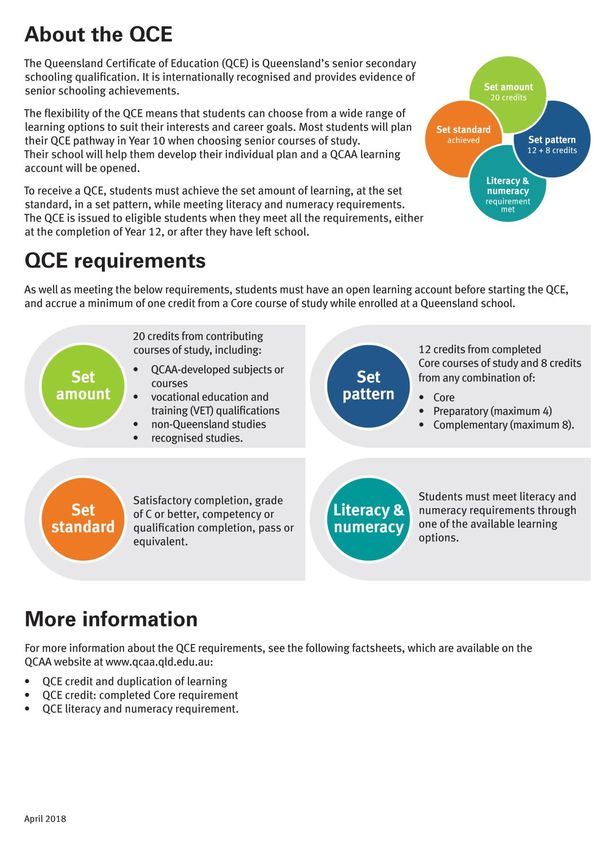
TABLE OF CONTENTS
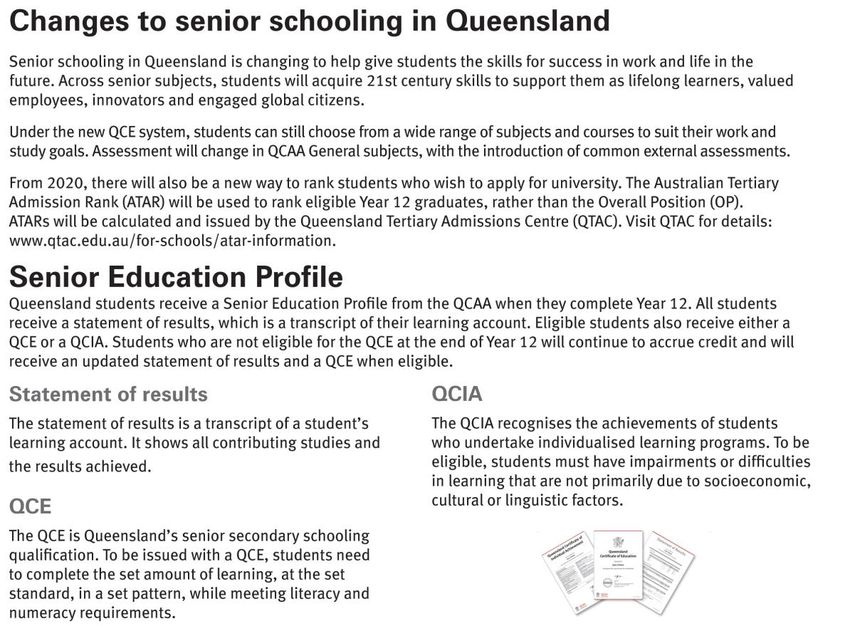
CHANGES TO SENIOR SCHOOLING IN QUEENSLAND ..................................................................... …….3
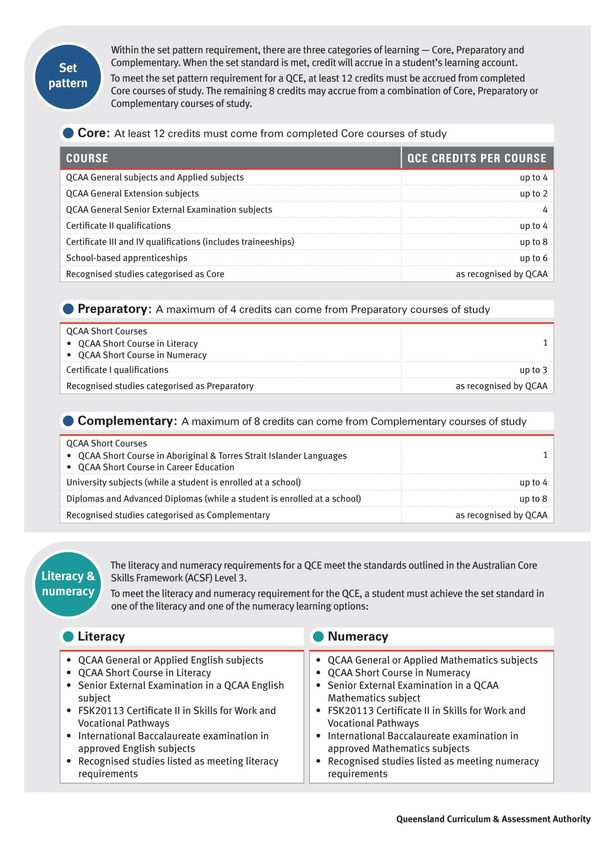
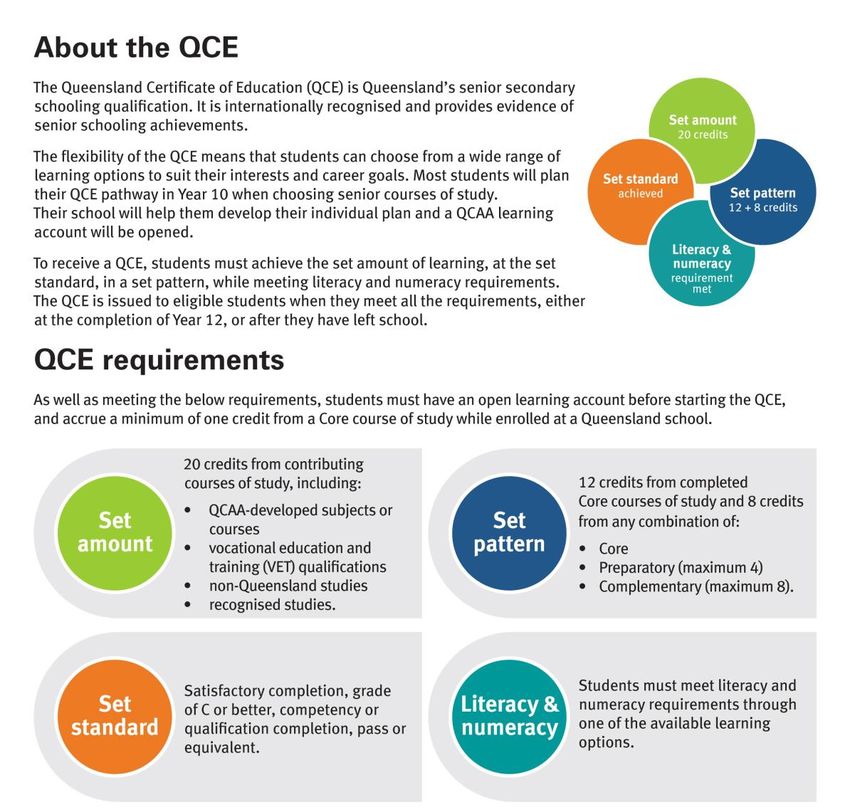
ABOUT THE QCE ................................................................................................................................... …….3
YEAR 10 – A YEAR OF TRANSITION ............................................................................................................ 5
ASSESSMENT AND REPORTING ................................................................................................................ 5
VOCATIONAL EDUCATION AND TRAINING (VET) PRIVACY NOTICE ....................................................... 6
SCHOOL BASED APPRENTICESHIPS AND TRAINEESHIPS (SATs) .......................................................... 7
CAREE ADVICE AND OCCUPATIONS RELATED TO SUBJECTS IN YEARS 10 ........................................ 8
COMPULSORY:
ENGLISH....................................................................................................................................................... 11
MATHEMATICS ............................................................................................................................................ 12
          ADVANCED MATHEMATICS ............................................................................................................ 14
          CORE MATHEMATICS ...................................................................................................................... 14
SCIENCE ...................................................................................................................................................... 15
HISTORY .................................................................................................................................................... 16
ELECTIVES:
AGRIBUSINESS ........................................................................................................................................... 17
          AGRIFOOD OPERATIONS CERTIFICATE I .................................................................................... 18
          ANIMAL HUSBANDRY ...................................................................................................................... 19
          CONSERVATION & LAND MANAGEMENT CERTIFICATE I ........................................................... 20
ART ............................................................................................................................................................... 21
BUSINESS CERTIFICATE I ......................................................................................................................... 22
BUSINESS CERTIFICATE II ........................................................................................................................ 23
CHINESE ...................................................................................................................................................... 24
DANCE .......................................................................................................................................................... 25
DRAMA ......................................................................................................................................................... 26
ECONOMICS & BUSINESS .......................................................................................................................... 27
GEOGRAPHY ............................................................................................................................................... 28
HEALTH AND LIFESTYLE ............................................................................................................................ 29
HEALTH & PHYSICAL EDUCATION ............................................................................................................ 30
HOSPITALITY CERTIFICATE II ................................................................................................................... 31
KITCHEN OPERATIONS CERTIFICATE II .................................................................................................. 32
DIGITAL TECHNOLOGY (INFORMATION & DIGITAL MEDIA CERTIFICATE I) ........................................ 33
MEDIA ARTS ............................................................................................................................................... 34
MUSIC ........................................................................................................................................................... 35
OUTDOOR RECREATION CERTIFICATE II ................................................................................................ 36
PRE-CONSTRUCTION ................................................................................................................................. 38
PRE-ENGINEERING ..................................................................................................................................... 39
PRE-FURNISHING........................................................................................................................................ 40
RETAIL CERTIFICATE II ............................................................................................................................. 41
SCIENCE – INTRODUCTION TO SENIOR SCIENCES ............................................................................... 42
SKILLS FOR VOCATIONAL PATHWAYS CERTIFICATE I ……………………………………..…………….....43
SKILLS FOR WORK & VOCATIONAL PATHWAYS CERTIFICATE II ..................... ………………………....44
VISUAL ART CERTIFICATE II ............................................................................. …………………………....45

                                                                       -2-                                                              Version May 2019
-3- Version May 2019
-4- Version May 2019
YEAR 10 – A YEAR OF TRANSITION
Year 10 is a transition year which provides a foundation for senior studies.
In making your selection of Year 10 subjects, ask yourself the following questions:
What subjects do I like?
In which subjects am I most successful?
Am I more suited to the practical subjects than the academic subjects?
What subjects am I likely to be studying in Year 11?
Have I made a balanced selection of subjects?
All students study a core of English, Mathematics, Science (one semester) and History (one
semester).
In Year 10, Health & Physical Education is no longer compulsory. Students may choose Health
& Physical Education as an elective if they wish.
Elective subjects are to be selected from the list below:
Animal Husbandry Dance
Art Drama
Certificate I in Business Geography
Chinese Health and Lifestyle
Certificate I in Agrifood Health & Physical Education
Certificate I in Conservation Introduction to Senior
and Land Management Sciences
Certificate II in Hospitality Music
Certificate I Information, Digital Pre-construction
Media and Technology Pre-furnishing
Certificate II in Kitchen Operations Pre-engineering
Certificate II in Outdoor Recreation Certificate II in Skills for Work
Certificate II in Visual Arts and Vocational Pathways
ASSESSMENT AND REPORTING
Subjects are a transition into the Senior Phase of Learning, which begins in Year 10. Your
achievements are measured against a standard or an outcome statement and graded on a five
point scale. Each subject has its own assessment program. Assessment programs are referred
to briefly in the subject descriptions, which follow later in this booklet.
Year 10 students receive a report at the end of each semester. These are very similar to the
reports received during Year 8 and 9. In addition, all students receive an interim report about
halfway through Semester One to indicate progress over the first 10 weeks of the school year.
-5- Version May 2019
VOCATIONAL EDUCATION AND TRAINING (VET)
PRIVACY NOTICE
Under the Data Provision Requirements 2012, Loganlea State High School is required to collect
personal information about you and to disclose that personal information to the National Centre for
Vocational Education Research Ltd (NCVER - National Centre for Vocational Education Research) and
the Queensland Curriculum and Assessment Authority (QCAA).
Your personal information may be used or disclosed by Loganlea State High School for statistical,
administrative, regulatory and research purposes. Loganlea State High School may disclose your
personal information for these purposes to:
Commonwealth and State or Territory government departments and authorised agencies; and
NCVER.
Personal information that has been disclosed to NCVER may be used or disclosed by NCVER for the
following purposes:
populating authenticated VET (Vocational Education and Training) transcripts;
facilitating statistics and research relating to education, including surveys and data linkage;
pre-populating RTO student enrolment forms;
understanding how the VET market operates, for policy, workforce planning and consumer
information; and
administering VET, including program administration, regulation, monitoring and evaluation.
You may receive a student survey which may be administered by a government department or NCVER
employee, agent or third party contractor or other authorised agencies. Please note you may opt out of
the survey at the time of being contacted.
NCVER will collect, hold, use and disclose your personal information in accordance with the Privacy Act
1988 (Cth), the National VET Data Policy and all NCVER policies and protocols (including those
published on NCVER's website at www.ncver.edu.au (http://www.ncver.edu.au/)).
6 Version May 2019
SCHOOL BASED APPRENTICESHIPS AND
TRAINEESHIPS (SATs)
Prerequisite: Successful completion of Careers Unit
Loganlea State High School offers a program which incorporates a School Based Apprenticeship
or Traineeship in the Senior Phase of learning (Years 10, 11, and 12).
Benefits of Completing a School Based Apprenticeship or Traineeship
Students will be eligible upon completion of the Apprenticeship/Traineeship (SAT) to
receive a nationally recognised vocational education and training qualification.
Contributes points towards their QCE. (Queensland Certificate of Education).
Training with a Registered Training Organisation.
An easier transition from school to work.
Payment for the time spent in the workplace.
VET qualification can lead to an entry into tertiary education.
Learning and Earning.
Real job skills in real work situations.
Structure
There are a number of options for students who become a School Based Apprentice or Trainee.
Each case will be determined individually to accommodate both the employer and the student
needs.
Students may attend school 3 or 4 days per week studying. On the other day/days students will
be employed in the workforce where they will be engaged in paid, productive work. They may
also be involved in off-the-job training with a Registered Training Organisation. School- based
Traineeships may be completed during the Senior Phase of Learning. Students completing a
School-based Apprenticeship will continue either full time or part time after Year 12.
Cost For Students/Parents
If students are required to travel these costs must be met by the student/parents
The off-the-job training with a Registered Training Organisation will be funded by DETE
(Department of Education Training and Employment) while students are school based.
Possible Traineeships / Apprenticeships
NB: Employers have the right to choose the most appropriate applicant so the school can make
no guarantees of placement. Examples:
Business Administration Hospitality Furnishing Public
Services
Refrigeration / Air-conditioning Horticulture Hairdressing Printing
Multi-media/Information Technology Retail Child Care Tourism
Building and Construction Education Automotive Medical &
Dental
Sport & Recreation Manufacturing Warehousing
Bakery/Pastry
Aged Car / Residential Mechanics Engineering Plumbing
The School will accept applications for any other Apprenticeship or Traineeship that is currently
available and will endeavour to find work place and training opportunities. If students have a
particular area other than the above this would certainly be considered.
It is important that students are very sure about their goals and career plans before
signing up, and that they stay committed to completing their senior schooling, as well as
completing all training and workplace requirements.
For further information for parents and students, application forms and brochures etc.
contact the VET Co-ordinator
7 Version May 2019
CAREER ADVICE
As you move into Year 10, it is important that you begin to explore the range of career
opportunities in the light of your abilities, interests and achievements. If you can identify some
career goals, it will put additional purpose into your schooling and give you something to strive
for.
Students and parents are also invited to discuss, with the Guidance Officer or Teachers, any
concerns they may have about student progress at school or any difficulties that students may be
experiencing. Students always have direct access to the Guidance Officer and can make
appointments at times suitable to the student, the classroom teacher and the Guidance Officer.
During Year 10, you will be assisted in developing a “Senior Education and Training” plan (SETp or
SET plan). This plan maps out how you will work towards a Senior Certificate, Certificate
vocational qualification and/or a viable work option.
The SET plan is designed to:
work as a ‘road map’ to help you achieve your learning goals during the Senior Phase of
Learning,
include flexible and coordinated pathway options,
assist you to examine further options across education, training and employment sectors, and
help you to communicate with your parents/carers or personnel from your school/learning
provider.
In your personal plan, you will be able to list a variety of different learning pathways, some of which
you may access outside the current formal structure of your school. This will allow you to create
more options and flexibility in your learning. The plan can be altered if you decide to change
direction and explore different learning pathways.
Refer to QCAA.qld.edu.au for more information on SET Plans.
OCCUPATIONS RELATED TO SUBJECTS IN YEAR 10
Have you thought about the type of work you would like to do when you finish school? It is wise to
begin investigating possibilities early because the better informed you are, the better decisions
you will make in the future.
You can use this handout to investigate careers by relating your interest in school subjects to
possible occupations.
You may wish to use the following steps:
1. identify the subjects you enjoy and do best in
2. use this handout to identify the types of occupations that may be related to these
subjects
3. gather information about these occupations by reading the Job Guide, accessing
information from the myfuture website (http://www.myfuture.edu.au), going on work
experience, and talking to people in the workplace
4. talk to your guidance officer or career counsellor.
As you learn more about yourself and about jobs, you may change your ideas about the type of
jobs you are interested in. This is part of the process most people go through before deciding on
a post-school occupation or before changing from one occupation to another during their career.
Although subjects can be related to a number of jobs, very few of the subjects are
prerequisites for those jobs. A prerequisite subject is one which must be studied in Years
11 and 12 to gain entry to a specific tertiary course. However, a small number of Year 11
and 12 subjects require previous study in Years 9 and 10. Talk to your guidance officer or
career counsellor about these prerequisites.
8 Version May 2019
ENGLISH                                       LANGUAGES OTHER THAN ENGLISH
English                                                           French, German, Italian, Japanese, Indonesian,
                                                                  Chinese, Korean, Spanish
Actor                                                             Announcer
Archivist                                                         Anthropologist
Author                                                            Archaeologist
Book editor                                                       Book editor
Broadcaster                                                       Customs officer
Copywriter                                                        Employee relations officer
Foreign affairs & trade officer                                   Flight attendant
Interpreter                                                       Foreign affairs and trade officer
Journalist                                                        Interpreter
Lawyer                                                            Journalist
Librarian                                                         Probation and parole officer
Management consultant                                             Ship’s officer
Public Relations Officer                                          Social worker
Publisher                                                         Sociologist
Receptionist                                                      Teacher
Speech pathologist                                                Tour guide
Teacher                                                           Translator
Teacher’s aide                                                    Travel consultant
Travel consultant                                                 Writer
Writer

        MATHEMATICS                                                                   SCIENCE
Mathematics                                        Science                                   Agricultural Science
(Some careers require core and
extension)
Accountant                                         Automotive electrician                             Agricultural economist
Actuary                                            Chemist                                            Agricultural engineer
Bank officer                                       Computer programmer                                Agricultural technical officer
Bookkeeper                                         Electrical fitter                                  Animal attendant
Credit officer                                     Engineer                                           Botanist
Economist                                          Electronics service person                         Food technologist
Electrical fitter                                  Environmental scientist                            Forest technical officer
Engineer                                           Forensic scientist                                 Forester
Financial Planner                                  Laboratory worker                                  Horticultural technical officer
Geologist                                          Medical practitioner                               Pest and weed controller
Mathematician                                      Meteorologist                                      Sugarcane analyst
Motor mechanic                                     Nurse                                              Veterinary nurse
Physicist                                          Pharmacist                                         Wool classer
Programmer (information technology)                Refrigeration and air-conditioning mechanic
Quantity surveyor                                  Sports scientist
Statistician                                       Sugarcane analyst
Stockbroker                                        Teacher
Surveyor                                           Telecommunication technician
Taxation agent                                     Veterinarian
Teacher                                            Winemaker

                                                       SOCIAL SCIENCES
History                           Geography                  Civics, Study of Society                     Business Education
                                                             & Environment
Anthropologist                    Agricultural scientist          Anthropologist                          Accountant
Archaeologist                     Biological scientist            Archivist                               Bank officer
Archivist                         Cartographer                    Child care worker                       Bookkeeper
Barrister                         Environmental scientist         Community worker                        Car rental officer
Community worker                  Forest technical officer        Counsellor                              Cashier
Criminologist                     Geographer                      Environmental scientist                 Court and Hansard reporter
Foreign affairs and trade         Geologist                       Geographer                              Court officer
officer                           Hydrographer                    Library technician                      Credit officer
Geologist                         Landscape architect             Police officer                          Croupier
Historian                         Marine scientist                Probation and parole officer            Economist
Journalist                        Meteorologist                   Public relations officer                Farm manager
Lawyer                            Ocean hydrographer              Recreation officer                      Hotel/motel manager
Librarian                         Park ranger                     Religious leader                        Human resources officer
Museum curator                    Surveyor                        Social worker                           Office administrator
Public relations officer          Teacher                         Sociologist                             Paralegal worker
Religious leader                  Tour guide                      Teacher                                 Real estate salesperson
Sociologist                       Town planner                    Town planner                            Receptionist
Stage manager                     Travel consultant               Trade union official                    Secretary
Teacher                           Water services officer          Youth worker                            Stock and station agent
Writer                                                                                                    Teacher
                                                                                                          Travel consultant
THE ARTS
Dance/Drama Media Music Visual Arts
Actor Advertising officer Announcer Architect
Announcer Announcer Arts administrator Artist
Arts administrator Film and TV critic Composer Craftsperson
Choreographer Film and TV producer Conductor Dressmaker
Dancer Government administration Film and TV producer Engraver
Film and TV lighting operator Journalist Multimedia developer Fashion designer
Film and TV producer Marketing officer Music critic Florist
Make-up artist Multimedia developer Music therapist Graphic designer
Model Public relations officer Musical instrument maker Hairdresser
Public relations officer Sales person Musician Interior decorator
Receptionist Teacher – media Piano technician Industrial designer
Recreation officer Writer Recreation officer Jeweller
Set designer Singer/vocalist Landscape architect
Speech pathologist Sound technician Make-up artist
Stage manager Stage manager Multimedia developer
Teacher – dance Teacher – early childhood Photographer
Teacher – speech & drama Teacher – music Screen printer
Tour guide Teacher – primary Set designer
Writer Teacher – secondary Signwriter
Teacher
HEALTH
Health Physical Education
Butcher Acupuncturist
Catering manager Ambulance officer
Cook/chef Beauty therapist
Craftsperson Chiropractor
Dietician/nutritionist Fitness instructor
Events manager Hospital food service manager
Food technologist Massage therapist
Home care worker Nurse
Home economist Occupational health and safety
Hospital food service manager officer
Hotel/motel manager Occupational therapist
Nanny Physiotherapist Curriculum Division
Nurse Podiatrist Education Queensland
Teacher Psychologist - sport October 2007
Radiation therapist © The State of Queensland
Recreation officer (Department of Education,
Sports scientist Training and the Arts)
Sports coach
Stunt performer
Teacher
TECHNOLOGIES
Industrial Technology Information & Food and Textiles Agriculture
& Design Communication
Technology
Architect Analyst (Information technology) Butcher Agricultural economist
Architectural drafter Architectural drafter Catering Manager Agricultural engineer
Assembler Business systems analyst Clothing patternmaker Animal attendant
Automotive electrician Computer systems engineer Cook/chef Farmhand
Boilermaker Computer hardware service Craftsperson Fisher
Builder technician Dietician/nutritionist Food technologist
Cabinetmaker Computer systems officer Dressmaker Forest technical officer
Carpenter/joiner Data processing operator Events manager Forester
Cartographer Database administrator Fashion designer Gardener
Engineering associate Desktop publisher Food technologist Horticultural technical
(mechanical) Help desk operator Home care worker officer
Fitter Information technology educator Home economist Jackeroo/jillaroo
Graphic designer Information technology manager Hospital food service manager Landscape gardener
Industrial designer Multimedia developer Hotel/motel manager Pest and weed
Landscape architect Programmer Interior decorator controller
Leadlight worker Software designer Nanny Stablehand
Metal fabricator Software engineer Nurse Stock and station agent
Panel beater Systems designer Pattern maker Veterinary nurse
Picture framer Teacher Retail buyer Wool classer
Sheetmetal worker Training officer Tailor
Teacher Telecommunications engineer Teacher
Wood machinist Website administrator
10ENGLISH – 2 Semesters
WHY STUDY ENGLISH
To become a fully rounded person and an effective member of the workforce and society, it is
important to be able to communicate in both the spoken and written forms. We need to be able to
articulate our thoughts as well as critically analyse information presented to us by the media,
politicians and others attempting to influence our thinking. We need to be adept at using newer
technological forms of communication.
The study of English can also fulfil a personal, aesthetic role in providing students with opportunities
to read and view a range of interesting texts from different genres and time periods.
Lastly, it is well known that practice in reading assists students with their comprehension, vocabulary
and writing skills, amongst others, and leads to an improvement in their overall level of literacy. This
assists their studies in all subject areas.
COURSE OUTLINE
Students will study a range of text types and enjoy a diversity of learning experiences in units of
varying lengths. They will learn how to construct an assortment of texts as well as critically analyse
real-world examples of these texts. In Year 10 units may include, poetry, drama, novels, genres in
television, imaginative, analytical and reflective writing.
In the context of these units of work, students will undertake revision and consolidation of language
skills, e.g. spelling, punctuation, rules of grammar, sentence construction, in order to enhance their
ability to communicate effectively.
ASSESSMENT
Students will complete a number of assessment tasks, both spoken and written. Each completed
task will be awarded a grade from A to E, which contributes to an overall level of achievement at the
end of each semester. Assessment tasks will vary by class and unit, but may include some of the
following examples:-
A 3-4 minute speech/presentation to the class;
A written response to a question under exam conditions;
A Multi-modal presentation;
A narrative intervention;
An analytical essay.
FUTURE PATHWAYS:
This subject is compulsory at all year levels. Students in Years 11 & 12
can choose to study either English General (General Subject) or English
Essential (Applied). Those students who choose English General are
generally ATAR-eligible, or choose certain career paths. English
Essential is usually chosen by students who do not require an ATAR, or who are undertaking
vocational studies. It should be noted that some students encounter difficulty with the complexity of
texts studied in English General and are more suited to English Essential.
11MATHEMATICS – 2 Semesters
WHY STUDY MATHEMATICS?
Mathematics has the power to shape the future of a society. It is the basis of many
activities related to everyday living — from shopping to advances in space travel.
Mathematics assists us to develop strategies for managing time and money, interpreting
data, estimating and taking measurements, giving and following directions, making
calculations and determining the probabilities of events.
What Is The Investigative Approach To Mathematics?
The Mathematics program in Year 7, 8, 9, and 10 in 2019 and beyond will follow the
Australian Curriculum. This curriculum aims to provide continuity from Prep to Year 10 and
is designed to help teachers provide students with opportunities to understand
mathematics and become fluent in problem solving and reasoning mathematically.
Students develop the ability to think, reason and work mathematically by investigating
real-life questions and problems.
Course Structure
In Yr 10, students will be placed into the level of mathematics based on their ability and
interest.
Each level includes areas of study to suit the wide range of interests and abilities among
students, as well as providing a foundation for students to enter the various mathematics
studies available in Year 11.
The two Levels in Yr 10 are:
Advanced Mathematics - which gives access to Specialist Mathematics, Mathematical
Methods and General Mathematics and in Year 11
Core Mathematics, which allows access to General Mathematics and Essential
Mathematics in Year 11
The diagram below displays the relationship between the two levels and current
mathematics subjects in year 11/12.
YEAR 7 YEAR 8 YEAR 9 YEAR 10 YEARS 11/12
Core Advanced
Mathematics Mathematics Specialist
Core Mathematics
Mathematics
Mathematical
Mathematics
Methods
/ XLR8
General
XLR8 Mathematics
XLR8 Core
Mathematics Essential
Mathematics
Note: Subjects Specialist Mathematics, Mathematical Methods and General Mathematics count
towards an ATAR needed for Tertiary entrance. Essential Mathematics is an applied subject and one
applied subject can count towards an ATAR.
Please Note the following:
It is possible that some students will move from one strand of mathematics study to
another. Student performance is reviewed at the end of each semester and suggested
changes are advised.
It is imperative that students complete set homework every night and regularly revise
their work. The school offers tutorial assistance at lunch hour and after school through
the Homework Centre. Times and days will be advised at the beginning of each year.
12Students who wish to have tutorial assistance need to consult with the Head of
Department –Mathematics.
Bookwork is an important aspect of mathematics. The bookwork policy is given to every
student each year.
COURSE OUTLINE
The concepts of mathematics are organised into three strands with strands broken into
interconnecting topics:
Number and Algebra - Number Concepts
- Addition and Subtraction
- Multiplication and Division
- Patterns and functions
- Equivalence and equations
Measurement and Geometry - Length, mass, area and volume
- Time
- Shape and Line
- Location, direction and movement
Chance and Probability - Chance
- Data
Number and Algebra
Number and Algebra are developed together, as each enriches the study of the other.
Students apply number sense and strategies for counting and representing numbers. They
explore the magnitude and properties of numbers. They apply a range of strategies for
computation and understand the connections between operations. They recognize patterns
and understand the concepts of variable and function. They build on their understanding of
the number system to describe relationships and formulate generalizations. They recognize
equivalence and solve equations and inequalities. They apply their number and algebra skills
to conduct investigations, solve problems and communicate their reasoning.
Measurement and Geometry
Measurement and Geometry are presented together to emphasise their relationship to each
other, enhancing their practical relevance. Students develop an increasingly sophisticated
understanding of size, shape, relative position and movement of two-dimensional figures in
the plan and three-dimensional objects in space. They investigate properties and apply their
understanding of them to define, compare and construct figures and objects. They learn to
develop geometric arguments. They make meaningful measurements of quantities, choosing
appropriate metric units of measurement. They build an understanding of the connections
between units and calculate derived measures such as area, speed and density.
Statistics and Probability
Statistics and Probability initially develop in parallel and the curriculum then progressively
builds the links between them. Students recognize and analyse data and draw inferences.
They represent, summarize and interpret data and undertake purposeful investigations
involving the collection and interpretation of data. They assess likelihood and assign
probabilities using experimental and theoretical approaches. They develop increasingly
sophisticated ability to critically evaluate chance and data concepts and make reasoned
judgments and decisions, as well as building skills to critically evaluate statistical information
and develop intuitions about data.
ASSESSMENT:
Students will be assessed in the following criteria using a unit test and an investigation:
Understanding and Fluency
Problem Solving and Reasoning
CALCULATOR and COMPUTER USE:
A scientific calculator is MANDATORY – a two-line display calculator is preferred
(recommended CASIO FX82AU PLUS II Scientific Calculator).
Year 10 Advanced Mathematics students are recommended to purchase a
graphics calculator which they are required to have in Mathematical Methods and
Specialist Mathematics in years 11/12. The graphics calculator will be introduced in
Year 9 Maths and used more increasingly in Year 10 Advanced Mathematics.
13 Use of computer software (e.g., Excel spreadsheets) will be incorporated into
lessons and assessment. Class time is set aside for introductory lessons in
using spreadsheets. Home computer use is not assumed.
Advanced Mathematics:
WHY STUDY ADVANCED MATHEMATICS?
This strand of mathematical studies
is geared towards those students who have an interest in mathematics, science
and computing areas
is designed for students who wish to study General Mathematics, Mathematical
Methods and Specialist Mathematics in Years 11/12
provides a challenging and interesting development of mathematics topics for
those with above average mathematics skills.
Homework:
A minimum of two hours per week of home study is needed if students hope to gain a
Sound Achievement. In each unit 2 - 3 homework sheets are given.
FUTURE PATHWAYS:
Advanced Mathematics is a pre-requisite for Mathematical Methods and Specialist
Mathematics in Year 11 and 12.
Careers such as engineering, the physical sciences, some agriculture degrees,
accounting, food technology, economics and management, psychology to name a few,
require Mathematical Methods.
For further information on Tertiary requirements for different courses, check the
detailed course book available from the Guidance officer.
Mathematical Methods is often recommended for access to engineering, electrical
and other apprenticeships.
Even if students choose to study General Mathematics in Year 11, they will have an
advantage in the breadth and depth of mathematics studied if they pursue this
course.
Core Mathematics:
WHY STUDY CORE MATHEMATICS?
This strand of mathematical studies
Will focus on the skills and applications of mathematics found in the Australian
Curriculum.
Algebra concepts will also be studied at a level particularly to allow students to develop
skills needed in Year 11
Can lead to careers such as toolmaking, sheet-metal working, fitting and turning,
carpentry and plumbing, auto mechanics, tourism and hospitality, administrative and
managerial employment in a wide range of industries, architecture and nursing.
Is a pre-requisite for General Mathematics in Year 11/12
Homework:
A minimum of one and a half to two hours per week of home study is needed if students
hope to gain a Sound Achievement. In each unit 2 - 3 homework sheets are given
FUTURE PATHWAYS:
Core Mathematics is a pre-requisite for General Mathematics in Year 11/12
Students may also study Essential Mathematics in Year 11 and 12 if they studied
Core Mathematics in year 10.
General Mathematics is required for some apprenticeships.
14SCIENCE – 1 Semester (Compulsory)
WHY STUDY SCIENCE?
Humans are innately curious about their world. Science is a dynamic, collaborative and creative
human endeavour arising from our desire to make sense of our world through exploring the unknown,
investigating universal mysteries and solving problems. The knowledge it produces has proved to be
a reliable basis for action in our personal, social and economic lives. Science aims to understand a
large number of observations in terms of a much smaller number of broad principles.
The study of science supports students to develop the scientific knowledge, understandings and skills to
make informed decisions about local, national and global issues. Science promotes the use of critical
and creative thinking, problem solving and decision making. It encourages students to reflect on and
monitor
their thinking as they make decisions and take action. As students think and work scientifically, they
construct understanding of scientific concepts.
COURSE OUTLINE:
Science has three interrelated strands:
Science Understanding
Science understanding is evident when a person selects and integrates appropriate science
knowledge to explain and predict phenomena, and applies that knowledge to new situations.
The Science Understanding strand comprises four sub-strands: Biological Sciences,
Chemical Sciences, Earth and Space Sciences, and Physical Sciences.
Science as a Human Endeavour
Through science, humans seek to improve their understanding and explanations of the
natural world. This strand highlights the development of science as a unique way of knowing
and doing, and the role of science in contemporary decision making and problem solving. It
acknowledges that in making decisions about science practices and applications, ethical and
social implications must be taken into account.
Science Inquiry Skills
Science inquiry involves identifying and posing questions; planning, conducting and reflecting
on investigations; processing, analysing and interpreting evidence; and communicating
findings. This strand is concerned with evaluating claims, investigating ideas, solving
problems, drawing valid conclusions and developing evidence based arguments.
In year 10 students can choose to study Introduction to Senior Science, Science and Society or
Science with an Agricultural Focus. The choice they make should complement the learning pathways
they will be undertaking in years 11 and 12.
Years 11/12
PHYSICS: Prerequisites – a minimum of a
Years Year 10 ‘C’ result in Y10 Intro to Snr Sciences & a
minimum of a ‘B’ result in Advanced
7,8 & 9 Mathematics
Science
(compulsory CHEMISTRY: Prerequisites – a minimum of
a ‘C’ result in Y10 Science (Ag Focus) or
semester) Intro to Senior Sciences AND Core
Science
(with Mathematics
embedded
elements of BIOLOGICAL SCIENCE/
Agricultural Introduction to Senior AGRICULTURAL SCIENCE: Prerequisites
Science) Sciences – a minimum of a ‘C’ result in Y10 Intro to
(compulsory for Senior Sciences
students wanting to
undertake Sciences in
Senior, elective for
interested students) SCIENCE IN PRACTICE.
15HISTORY – 1 Semester (Compulsory)
WHY STUDY HISTORY?
HISTORY (1 Semester)
History provides an opportunity for students to develop knowledge
and understanding of the past in order to appreciate themselves
and others, to understand the present and to contribute to debate
about planning for the future.
Students develop critical understanding and learn how to
compare different accounts of events in the past relating to war,
revolution, religion, imperialism and everyday life. In seeking explanations for historical events and
developments, students encounter key historical concepts such as change, continuity, cause, motive
and effect.
YOU WILL STUDY:
World War II-A World and Nation reborn
10 Weeks
Freedoms and Rights- Indigenous struggles in Australia
10 Weeks
COURSE OUTLINE:
History
Students will develop their research skills and embark on studies that develop their understanding of
Democracy and Federation, Ancient cultures and the major civilisations of Europe, Asia, Africa,
America and Australia. They should understand Australian history within a comparative framework
that embraces the Indigenous and settler components, and they should be aware of its regional and
global dimensions.
ASSESSMENT:
Assessment is based on a number of types of tasks, including range of written tasks, oral tasks and
ongoing moderated individual and group activities.
FUTURE PATHWAYS:
More advanced studies in Modern and Ancient History, Senior Geography, Social and Community
Studies and Aboriginal and Torres Strait Islander Studies. Students will also gain social and literacy
skills required in senior and for life beyond school..
16AGRIBUSINESS
WHY STUDY AGRIBUSINESS SUBJECTS?
In the Agribusiness courses students have opportunity to complete industry relevant tasks in a practical
setting. Our working farm provides students with the opportunity to learn about agriculture, the environment
(including plants and animals) and machinery. The program is tailored to meet the individual needs of
students. Agribusiness offers real world experiences and a hands-on approach to study. Life skills and the
ability to work as a team are important aspects of Agribusiness Studies at Loganlea State High School.
HOW ARE YOU ASSESSED IN AGRIBUSINESS SUBJECTS?
As students progress through courses, they will find that they will need to show practical skills and abilities in
addition to theoretical knowledge. Competency based assessment in Agribusiness gives students several
opportunities to show their knowledge, skills and abilities. In practical activities, if students do not succeed on
the first attempt then they can try again, as we have ongoing assessment. Our subjects also offer a
Recognition of Prior Learning (RPL) process which can assist students who study similar courses outside of
Loganlea State High School.
COURSE STRUCTURE:
Agribusiness at Loganlea State High School offers subjects on a yearly progression. While it is not
compulsory to study these subjects in the junior subjects, it is of benefit to students to gain the basic
knowledge and skill base required, before entering in to the senior subjects. Students can choose to do
multiple subjects in the one year.
The diagram below outlines the recommended progression though the current subjects offered.
Year 7 Year 8 Year 9 Year 10 Years11/12
Animal Senior
Animal Husbandry Agricultural
Husbandry Science
Show team
Introduction to Basic Show team
Agribusiness Agribusiness AHC10216
Skills Certificate 1 AHC20116
Agricultural Agrifood Certificate II
Technologies Operations Agriculture
AHC10116 AHC21016 (awaiting
Certificate 1 approval)
Conservation Certificate II
and Land Conservation
Management and Land
Management
Traineeship/Apprenticeships
17AGRIFOOD OPERATIONS
Certificate I in Agrifood Operations AHC10216 – 2 Semesters (Elective)
WHY STUDY CERTIFICATE I IN AGRIFOOD IN YEAR 10?
Studying rural operations will give students skills and knowledge related to the Agricultural fields.
These skills are easily adapted and used later in life to maintain small machines and many other jobs
around the home or farm.
This is a one year course. The RTO guarantees that the student will be provided with every
opportunity to complete the certificate as per the rights and obligations outlined in the enrolment
process and VET information provided on the student drive. Students successfully achieving all
qualification requirements will be provided with a qualification and record of results. Students who
achieve at least one unit (but not the full qualification) will receive a Statement of Attainment.
COURSE OUTLINE:
This course is essentially a practical-based course involving practical hands-on situations both on
and off campus. It consists of core (i.e. compulsory) and selected units of competency. The core units
of competency are varied depending on the level.
Students will work through the following core and selection of elective units of competency:
MEM18001C Use hand tools
AHCMOM101 Assist with routine maintenance of machinery and equipment
AHCLSK101 Support extensive livestock work
AHCLSK102 Support intensive livestock work
AHCMOM203 Operate basic machinery and equipment
AHCOHS101 Work safely
AHCWRK101 Maintain the workplace
AHCINF203 Maintain properties and structures
ASSESSMENT:
Students must be prepared to “get their hands dirty”. The assessment criteria and assessment
methods are stated in each unit of competency. Competence will be achieved when the learner can
successfully complete the learning outcomes. Students will be issued with a Record Book, which will
serve to record competencies achieved during the course. All successful units of competency will be
recorded with a Certificate I possibly being completed. Part-completion of the course will result in the
student being issued with a Statement listing industry competency standards in which the student has
demonstrated competence. The course allows for the recognition of a student's prior learning
(referred to as "RPL") should the student proceed into a TAFE program incorporating units of
competency already determined as competent while at secondary school.
FUTURE PATHWAYS:
The school currently offers several Certificate I and II in Years 11 and 12.
This extends what is learnt in Years 10 in a very practical, skills-based way.
The skills and knowledge gained in this course are an advantage to students
wishing to enter the rural trades as well as any of the higher education
courses in agricultural colleges. The skills learned are also usable in “real
life” after school.
18ANIMAL HUSBANDRY – 2 Semesters (Elective)
WHY STUDY ANIMAL HUSBANDRY?
Animal Husbandry is the subject that allows students to gain the underpinning knowledge and skills to
transition into the Senior Agricultural Science program. Students who have an interest in animals and plants
will enjoy the opportunity to work with a range of species and develop practical skills.
COURSE OUTLINE:
Animal Husbandry is about students getting in and having a go. The subject is a practically based theory
subject. This approach achieves a balance of “hands-on” experience with an understanding of how and why
things are done.
In Year 10, students will work with a range of animals on the school farm. Students will learn about safe
handling techniques, animal behaviour and welfare, breeds, digestion, reproduction, anatomy and physiology
as well as diseases and parasites.
ASSESSMENT:
This subject assesses on both the theoretical and practical aspects. Theory assessment includes tests and
assignments. Practical assessment involves demonstrating correct handling techniques and procedures.
FUTURE PATHWAYS
Students studying Animal Husbandry in Yr 10 will gain pre-requisite knowledge and skills for the Senior
Agriculture Science Program. The Animal Husbandry course allows students to gain the underpinning
knowledge and skills to transition into the Senior Agricultural Science program and Vocational Education
subjects that are offered at this school. Students will have opportunities to extend themselves in this field
through show activities, work placement and animal care activities.
Considerations:
As this course does involve practical activities,
students should expect (and are expected) to get
involved with the real life (and often smelly) farm
situations. Changes of clothes are advisable.
This subject does expose students to some degree
of risk, as animal behaviour cannot be totally
controlled. Students who pose a risk to other
students or animals, who do not participate or who
persistently ignore instructions will be required to
reselect a different subject.
19CONSERVATION AND LAND MANAGEMENT
Certificate I in Conservation and Land Management AHC10116– 2 Semesters
(Elective)
WHY STUDY CONSERVATION AND LAND MANAGEMENT IN YR 10?
The course enables students to participate in an agricultural course with an environmental focus and
achieve vocational outcomes. It is an activity-based subject in which students learn by doing to develop
a range of practical skills related to land management and associated industries. Commitment to the
environment and work ethic is encouraged and preparation for the workplace is facilitated. There is a
focus on individuality and on teamwork as well as on the planning and carrying out of routine tasks with
some assistance.
This is a one year course. The RTO guarantees that the student will be provided with every opportunity
to complete the certificate as per the rights and obligations outlined in the enrolment process and VET
information provided on the student drive. Students successfully achieving all qualification requirements
will be provided with a qualification and record of results. Students who achieve at least one unit (but
not the full qualification) will receive a Statement of Attainment.
COURSE OUTLINE:
This course is essentially a practical-based course involving practical hands-on situations both on
and off campus. It consists of core (i.e. compulsory) and selected units of competency. The core
units of competency are varied depending on the level.
Students will work through a selection of core and elective units of competency including:
Certificate I in Conservation and Land Management (AHC10110)
AHCCHM101 Follow basic chemical safety rules
AHCMOM101 Assist with routine maintenance of machinery and equipment
AHCMOM203 Operate basic machinery and equipment
AHCNAR101 Support natural area conservation
AHCNSY101 Support nursery work
AHCOHS101 Work safely
AHCWRK101 Maintain the workplace
AHCWRK204 Work effectively in the industry
MEM18001C Use hand tools
AHCNAR102 Support native seed collection
AHCSAW201 Conduct erosion and sediment control activities
AHCCHM101 Follow basic chemical safety rules
ASSESSMENT:
The assessment criteria and assessment methods are stated in each unit of competency.
Competence will be achieved when the learner can successfully complete the learning outcomes.
Students will be issued with a Record Book, which will serve to record competencies achieved during
the course. All successful units of competency will be recorded with a Certificate I and possibly
Certificate II being completed. Part-completion of the course will result in the student being issued
with a Statement listing industry competency standards in which the student has demonstrated
competence. The course allows for the recognition of a student's prior learning (referred to as "RPL")
should the student proceed into a TAFE program incorporating units of competency already
determined as competent while at secondary school.
FUTURE PATHWAYS:
The school currently offers several Certificate I and II programs in Years 11 and 12. This extends
what is learnt in Years 10 in a very practical, skills-based way. The skills and knowledge gained in
this course are an advantage to students wishing to enter the rural trades as well as any of the higher
education courses in agricultural colleges. The skills learned are also usable in “real life” after school.
20ART – 2 Semesters (Elective)
WHY STUDY ART?
Art is a subject best suited to students who enjoy making
artworks and want to express their own creative ideas and
meaning through art making.
Art allows students to learn techniques and processes
across a range of media areas including painting, drawing,
photography, collage, ceramics and digital media.
As well as learning how to make artworks, students will learn about artists from a range of cultural
backgrounds as well as historical and contemporary art movements and how they have influenced
artworks made today. Building on the art knowledge from year 9 Art, students will learn how to ‘read’
artworks and discover what artists are really saying to us through their artworks.
COURSE OUTLINE:
Unit 1: Unit 2:
Paint It Like You Stole It Wearable Art
Acrylic painting techniques Wearable Art/Cardboard
and processes construction techniques and
Developing knowledge of the processes
Pop Art movement (key Artist’s Statement (Written or
artists, intentions, style, etc.) Spoken)
Creation of a celebrity portrait
Pop Art Exhibit Spoken Task
Unit 3: Unit 4:
Altering Reality Down The Rabbit Hole
Ceramic techniques and Printmaking techniques and
processes processes
Developing knowledge of Creation of printmaking folio
narrative sculpture and how based on Alice’s Adventures
to ‘alter reality’ in Wonderland
Drawing folio of ‘altering Art analysis exam
reality’ activities
In Art, students will have a chance to develop their:
creative thinking and expression
critical and imaginative thinking and inquiry learning
independent work habits and teamwork when required
valuable problem solving skills
openness to new experiences and ideas
responsible and safe working practices
researching and writing skills
ASSESSMENT: Students will be assessed using the Visual Art criteria of Visual Literacy and Making
for practical work and Appraising for theory tasks.
FUTURE PATHWAYS: Visual Art is one of the top ten subjects chosen for study in years 11 and 12
across the state. There are many career opportunities connected to the study of Visual Art including
architecture, graphic design, fashion design, photography, multimedia, fine artist, interior design,
computer game development, animation, teaching (primary and secondary) to name just a few.
Alternatively, students may elect to study Visual Art Studies in year 11 and 12.
21BUSINESS - Certificate I in Business (BSB10115)
WHY STUDY BUSINESS:
This qualification allows individuals to develop basic skills and knowledge to prepare for work. They may
undertake a range of simple tasks under supervision. It will enable a person to undertake basic ICT
functions using a personal computer and to engage in fundamental online activities. Its objective is to enable
people to acquire basic ICT and office management knowledge and skills at a fundamental or foundation
level.
QCE Points:
Completion of this course may contribute 2 QCE points.
Duration:
This course may be started at the beginning of year 10, 11 or 12 and will take 12 months to complete.
COURSE OUTLINE:
Students will study Certificate Business (BSB10115) through the following units:
Occupational Health Safety and Sustainability
Communication in the work environment
Keyboard skills
Spreadsheeting
Computer and Internet usage
This qualification has 6 units required to be completed:
BSBWHS201 - Contribute to health and safety of self and others
BSBADM101 - Use business equipment and resources
BSBCMM101 - Apply basic communication skills
BSBITU111 - Operate a digital device
BSBITU112 - Develop keyboard skills
BSBITU212 - Create and use spreadsheets
At Certificate I level, students are expected to meet the following learning outcomes:
to demonstrate knowledge by recall in a narrow range of areas
to demonstrate basic practical skills such as the use of relevant tools
to perform a sequence of routine tasks given clear directions
to receive and pass on messages or information.
Requirements:
It is suggested that students purchase a USB flash drive for storage and transferring of files.
ASSESSMENT:
This course is competency based. Where a student can demonstrate prior learning in a particular learning
outcome, the student is eligible for recognition of prior learning. The assessment tools include quizzes, case
studies, observations and with a large focus on practical activities within a simulated work environment
where students will gain experience using business equipment and technology.
EMPLOYMENT / FURTHER STUDY OPPORTUNITIES:
Traineeship and employment opportunities in a wide range of areas including administration assistant,
clerical worker, data entry operator, information desk clerk, office junior, receptionists, office managers,
secretaries and personal assistants in a range of work environments.
Pathways include: Transition to Certificate II in Business, TAFE and other training organizations, various
Certificates and Diplomas in Business, Finance & Administration. Universities - various degrees in business,
management, marketing, law, finance, education.
22BUSINESS - Certificate II in Business (BSB20115)
WHY STUDY BUSINESS:
This qualification reflects the role of individuals who perform a range of mainly routine tasks using practical
skills and fundamental operational knowledge in a defined context, working under direct supervision. It
enables students to acquire basic ICT and office management knowledge and skills.
The business services industry is a major contributor to the Australian economy and employs a significant
proportion of the workforce. Business services workers provide the crucial services that keep all other
industries functioning.
QCE Points:
Completion of this course may contribute 4 QCE points.
Duration:
This course may be started at the beginning of year 10, 11 or 12 and will take 12 months to complete.
COURSE OUTLINE:
Students will study Certificate Business (BSB20115) through the following units:
Occupational Health Safety and Sustainability
Communication in the work environment
Information Management
Organisational Skills
Financial management
Competencies:
BSBWHS201 Contribute to health and safety of self and others
BSBWOR202 Organise and complete daily work activities
BSBCMM201 Communicate in the workplace
BSBWOR203 Work effectively with others
BSBWOR204 Use business technology
BSBINM201 Process and maintain workplace information
BSBIND201 Work effectively in a business environment
BSBITU102 Develop keyboard skills
BSBITU201 Produce simple word processed documents
BSBITU202 Create and use spreadsheets
BSBSUS201 Participate in environmentally sustainable work practices
BSBITU302 Create electronic presentations
Requirements:
It is suggested that students purchase a USB flash drive for storage and transferring of files.
ASSESSMENT:
This course is competency based. Where a student can demonstrate prior learning in a particular learning
outcome, the student is eligible for recognition of prior learning. The assessment tools include quizzes, case
studies, observations and practical activities within a simulated work environment where students will gain
experience using business equipment and technology.
EMPLOYMENT / FURTHER STUDY OPPORTUNITIES:
Traineeship and employment opportunities in a wide range of areas including administration assistant,
clerical worker, data entry operator, information desk clerk, office junior, receptionists, office managers,
secretaries and personal assistants in a range of work environments such as: Administration,
Communication, Finance, Information and Communications Technology, Management and leadership,
Stakeholder relations, Business development, Knowledge management, Industry capability and workforce
development, Regulation, licensing and risk and Workforce development.
Pathways include: TAFE and other training organizations, various Certificates and Diplomas in business,
finance & admin. Universities - various degrees in business, management, marketing, law, finance, education.
23You can also read


