INGERSOLL-RAND PLC FORM DEF 14A
←
→
Page content transcription
If your browser does not render page correctly, please read the page content below
INGERSOLL-RAND PLC

                         FORM         DEF 14A
                          (Proxy Statement (definitive))

Filed 04/25/13 for the Period Ending 06/06/13

Telephone          732-652-7000
        CIK        0001466258
    Symbol         IR
 SIC Code          3560 - General Industrial Machinery And Equipment
   Industry        Auto & Truck Manufacturers
     Sector        Consumer Cyclical
Fiscal Year        12/31

                                     http://www.edgar-online.com
                     © Copyright 2013, EDGAR Online, Inc. All Rights Reserved.
      Distribution and use of this document restricted under EDGAR Online, Inc. Terms of Use.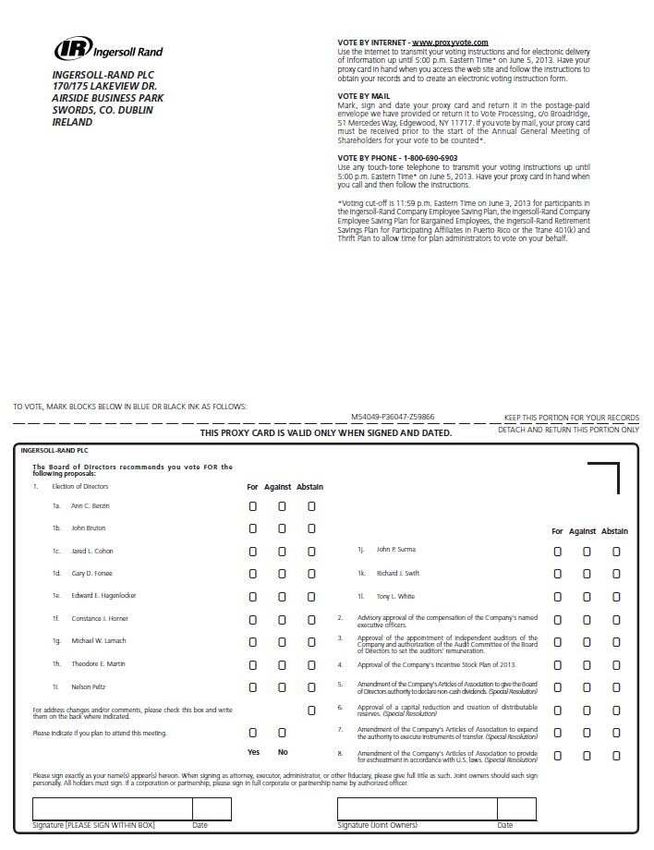
Table of Contents
UNITED STATES
SECURITIES AND EXCHANGE COMMISSION
Washington, D.C. 20549
SCHEDULE 14A
(Rule 14a-101)
Proxy Statement Pursuant to Section 14(a) of the
Securities Exchange Act of 1934
(Amendment No. )
Filed by the Registrant
Filed by a Party other than the Registrant
Check the appropriate box:
Preliminary Proxy Statement
Confidential, for Use of the Commission Only (as permitted by Rule 14a-6(e)(2))
Definitive Proxy Statement
Definitive Additional Materials
Soliciting Material Pursuant to §240.14a-12
Ingersoll-Rand Public Limited Company
(Name of Registrant as Specified In Its Charter)
(Name of Person(s) Filing Proxy Statement, if other than the Registrant)
Payment of Filing Fee (Check the appropriate box):
No fee required.
Fee computed on table below per Exchange Act Rules 14a-6(i)(1) and 0-11.
1) Title of each class of securities to which transaction applies:
___________________________________________________________________________________________________________________________________________________________________________________________________________________________________________________
2) Aggregate number of securities to which transaction applies:
___________________________________________________________________________________________________________________________________________________________________________________________________________________________________________________
3) Per unit price or other underlying value of transaction computed pursuant to Exchange Act Rule 0-11 (set forth the amount on which
the filing fee is calculated and state how it was determined):
___________________________________________________________________________________________________________________________________________________________________________________________________________________________________________________
4) Proposed maximum aggregate value of transaction:
___________________________________________________________________________________________________________________________________________________________________________________________________________________________________________________
5) Total fee paid:
___________________________________________________________________________________________________________________________________________________________________________________________________________________________________________________
Fee paid previously with preliminary materials.
Check box if any part of the fee is offset as provided by Exchange Act Rule 0-11(a)(2) and identify the filing for which the offsetting fee
was paid previously. Identify the previous filing by registration statement number, or the Form or Schedule and the date of its filing.
1) Amount Previously Paid:
___________________________________________________________________________________________________________________________________________________________________________________________________________________________________________________
2) Form, Schedule or Registration Statement No.:
___________________________________________________________________________________________________________________________________________________________________________________________________________________________________________________
3) Filing Party:
___________________________________________________________________________________________________________________________________________________________________________________________________________________________________________________
4) Date Filed:
___________________________________________________________________________________________________________________________________________________________________________________________________________________________________________________Table of Contents
Ingersoll-Rand plc U.S. Mailing Address:
Registered in Ireland No. 469272 One Centennial Avenue
Piscataway, NJ 08854
(732) 652-7000
NOTICE OF 2013 ANNUAL GENERAL MEETING OF SHAREHOLDERS
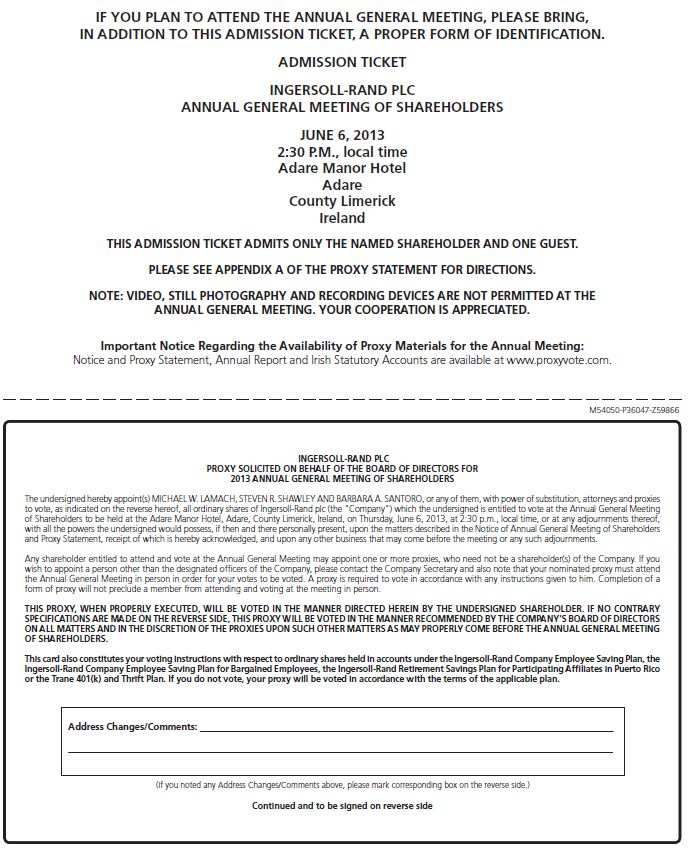
The Annual General Meeting of Shareholders of Ingersoll-Rand plc (the “Company”) will be held on Thursday, June 6, 2013, at 2:30 p.m.,
local time, at Adare Manor Hotel, Adare, County Limerick, Ireland, to consider and vote upon the following proposals:
1. By separate resolutions, to re-elect as directors for a period of 1 year expiring at the end of the Annual General Meeting
of Shareholders of Ingersoll-Rand plc in 2014, the following 12 individuals:
(a) Ann C. Berzin (g) Michael W. Lamach
(b) John Bruton (h) Theodore E. Martin
(c) Jared L. Cohon (i) Nelson Peltz
(d) Gary D. Forsee (j) John P. Surma
(e) Edward E. Hagenlocker (k) Richard J. Swift
(f) Constance J. Horner (l) Tony L. White
2. To give advisory approval of the compensation of the Company’s named executive officers.
3. To approve the appointment of PricewaterhouseCoopers as independent auditors of the Company and authorize the Audit
Committee of the Board of Directors to set the auditors’ remuneration.
4. To approve the Company’s Incentive Stock Plan of 2013.
5. To amend the Company’s Articles of Association to give the Board of Directors authority to declare non-cash dividends.
(Special Resolution)
6. To approve a capital reduction and creation of distributable reserves. (Special Resolution)
7. To amend the Company’s Articles of Association to expand the authority to execute instruments of transfer. (Special
Resolution)
8. To amend the Company’s Articles of Association to provide for escheatment in accordance with U.S. laws. (Special
Resolution)
9. To conduct such other business properly brought before the meeting.
Only shareholders of record as of the close of business on April 8, 2013, are entitled to receive notice of and to vote at the Annual General
Meeting. Whether or not you plan to attend the meeting, please provide your proxy by either using the Internet or telephone as further
explained in the accompanying proxy statement or filling in, signing, dating, and promptly mailing a proxy card.
Directions to the meeting can be found in Appendix A of the attached Proxy Statement.
Registered Office: By Order of the Board of Directors,
170/175 Lakeview Dr. BARBARA A. SANTORO
Airside Business Park
Swords, Co. Dublin
Ireland Vice President—Corporate Governance and Secretary
IF YOU ARE A SHAREHOLDER WHO IS ENTITLED TO ATTEND AND VOTE, THEN YOU ARE ENTITLED TO APPOINT A
PROXY OR PROXIES TO ATTEND AND VOTE ON YOUR BEHALF. A PROXY IS NOT REQUIRED TO BE A SHAREHOLDER
IN THE COMPANY. IF YOU WISH TO APPOINT AS PROXY ANY PERSON OTHER THAN THE INDIVIDUALS SPECIFIED ON
THE PROXY CARD, PLEASE CONTACT THE COMPANY SECRETARY AT OUR REGISTERED OFFICE.
IMPORTANT NOTICE REGARDING THE AVAILABILITY OF PROXY MATERIALS
FOR THE ANNUAL GENERAL MEETING OF SHAREHOLDERS TO BE HELD ON JUNE 6, 2013
The Annual Report and Proxy Statement are available at www.proxyvote.com.
The Notice of Internet Availability of Proxy Materials, or this Notice of 2013 Annual General Meeting of Shareholders, the Proxy
Statement and the Annual Report are first being mailed to shareholders on or about April 25 , 2013.Table of Contents
TABLE OF CONTENTS
Page
SUMMARY INFORMATION 1
PROPOSALS REQUIRING YOUR VOTE 4
Item 1. Election of Directors 4
Item 2. Advisory Approval of the Compensation of Our Named Executive Officers 10
Item 3. Approval of Appointment of Independent Auditors 11
Audit Committee Report 11
Fees of the Independent Auditors 12
Item 4. Approval of the Company’s Incentive Stock Plan of 2013 13
Item 5. Amend the Company’s Articles of Association to give the Board of Directors authority to declare non-cash dividends 18
Item 6. Approval of a capital reduction and creation of distributable reserves 19
Item 7. Amend the Company’s Articles of Association to expand the authority to execute instruments of transfer 20
Item 8. Amend the Company’s Articles of Association to provide for escheatment in accordance with U.S. laws 21
CORPORATE GOVERNANCE 22
Corporate Governance Guidelines 22
Director Independence 24
Communication with Directors 25
Code of Conduct 25
Anti-Hedging Policy and Other Restrictions 25
Committees of the Board 25
Compensation of Directors 28
COMPENSATION DISCUSSION AND ANALYSIS 30
COMPENSATION COMMITTEE REPORT 42
SUMMARY OF REALIZED COMPENSATION 43
EXECUTIVE COMPENSATION 44
INFORMATION CONCERNING VOTING AND SOLICITATION 59
Why Did I Receive This Proxy Statement? 59
Why Are There Two Sets Of Financial Statements Covering The Same Fiscal Period? 59
How Do I Attend The Annual General Meeting? 59
Who May Vote? 59
How Do I Vote? 59
How May Employees Vote Under Our Employee Plans? 60
May I Revoke My Proxy? 60
How Will My Proxy Get Voted? 60
What Constitutes a Quorum? 60
What Vote is Required To Approve Each Proposal? 61
Who Pays The Expenses Of This Proxy Statement? 61
How Will Voting On Any Other Matter Be Conducted? 61
SECURITY OWNERSHIP OF CERTAIN BENEFICIAL OWNERS AND MANAGEMENT 62
CERTAIN RELATIONSHIPS AND RELATED PERSON TRANSACTIONS 64
SECTION 16(a) BENEFICIAL OWNERSHIP REPORTING COMPLIANCE 64
SHAREHOLDER PROPOSALS AND NOMINATIONS 64
HOUSEHOLDING 65
Appendix A - Directions to the Annual Meeting A- 1
Appendix B - Incentive Stock Plan of 2013 B- 1Table of Contents
SUMMARY INFORMATION
This summary highlights information contained elsewhere in this Proxy Statement. For more complete information about these topics, please
review Ingersoll-Rand plc’s Annual Report on Form 10-K and the entire Proxy Statement.
Annual General Meeting of Shareholders
Date and Time: June 6, 2013 at 2:30 p.m., local time
Place: Adare Manor Hotel
Adare, County Limerick
Ireland
Record Date: April 8, 2013
Voting: Shareholders as of the record date are entitled to vote. Each ordinary share is entitled to one vote for each
director nominee and each of the other proposals.
Attendance: All shareholders may attend the meeting.
Meeting Agenda and Voting Recommendations
The Board of Directors recommends that you vote “For” each of the following items that will be submitted for shareholder approval at
the Annual General Meeting.
Agenda Item Vote Required Page
Election of 12 directors named in the proxy statement. Majority of votes cast 4
Advisory approval of the compensation of the Company’s named executive Majority of votes cast 10
officers.
Approval of appointment of PricewaterhouseCoopers LLP as the Company’s Majority of votes cast 11
independent auditors and authorize the Audit Committee to set auditors’
remuneration.
Approval of the Company’s Incentive Stock Plan of 2013. Majority of votes cast 13
Amendment of the Company’s Articles of Association to give the Board of 75% of votes cast 18
Directors authority to declare non-cash dividends. ( Special Resolution )
Approval of a capital reduction and creation of distributable reserves. ( Special 75% of votes cast 19
Resolution )
Amendment of the Company’s Articles of Association to expand the authority to 75% of votes cast 20
execute instruments of transfer. ( Special Resolution )
Amendment of the Company’s Articles of Association to provide for escheatment 75% of votes cast 21
in accordance with U.S. laws. ( Special Resolution )
Corporate Governance Highlights
Substantial majority of independent directors (11 of 12) Annual Board and committee self-assessments
Annual election of directors Executive sessions of non-management directors
Majority vote for directors Continuing director education
Independent Lead Director Executive and director stock ownership guidelines
Board oversight of risk management Board oversight of sustainability program
Succession planning at all levels, including for Board and CEO
1Table of Contents
Director Nominees
Set forth below is summary information about each director nominee.
Director
Nominee Age Since Principal Occupation Independent Committee Memberships
Ann C. Berzin 61 2001 Former Chairman and CEO of Audit
Financial Guaranty Insurance Finance
Company
John Bruton 65 2010 Former Prime Minister of the Compensation
Republic of Ireland Corporate Governance and
Nominating
Jared L. Cohon 65 2008 President of Carnegie Mellon Compensation
University Corporate Governance and
Nominating
Gary D. Forsee 63 2007 Former President of University of Compensation
Missouri System Corporate Governance and
Nominating (Chair)
Edward E. Hagenlocker 73 2008 Former Vice Chairman of Ford Audit
Motor Company Finance
Constance J. Horner 71 1994 Former Commissioner of U.S. Compensation
Commission on Civil Rights Corporate Governance and
Nominating
Michael W. Lamach 49 2010 Chairman and CEO of Ingersoll-
Rand plc
Theodore E. Martin 73 1996 Former President and CEO of Audit
Barnes Group Inc. Finance
Nelson Peltz 70 2012 CEO of Trian Fund Management, Finance
L.P. Corporate Governance and
Nominating
John P. Surma 58 2013 Chairman and CEO of United Audit
States Steel Corporation Finance
Richard J. Swift 68 1995 Former Chairman of Financial Audit (Chair)
Accounting Standards Advisory Finance
Council
Tony L. White 66 1997 Former Chairman and CEO of Compensation (Chair)
Applied Biosystems Inc. Corporate Governance and
Nominating
Advisory Approval of Our Executive Compensation
We are asking for your advisory approval of the compensation of our named executive officers. While our Board of Directors intends to
carefully consider the shareholder vote resulting from the proposal, the final vote will not be binding on us and is advisory in nature. Before
considering this proposal, please read our Compensation Discussion and Analysis, which explains our executive compensation programs and the
Compensation Committee’s compensation decisions.
Executive Compensation
Pay-for Performance
Our executive compensation programs are based on the principles of (i) program competitiveness, (ii) pay for performance, (iii)
appropriate mix of short and long-term incentives, (iv) internal parity, (v) shareholder alignment and (vi) alignment with business strategies.
Consistent with these principles, the Compensation Committee has adopted executive compensation programs with a strong link between pay
and achievement of short and long-term Company goals.
2Table of Contents
2012 Results
In a year with a challenging business environment, we achieved solid financial performance in the key operating metrics that are
aligned with our business strategy. In particular, we achieved the following results in 2012:
• Adjusted annual revenue of $14.035 billion, an increase of 0.09% over 2011;
• Adjusted operating income margin of 10.8%, an increase of 0.2 percentage points from 10.6% in 2011;
• Adjusted available cash flow of 111.5% of after-tax income;
• Adjusted earnings per share (“EPS”) of $3.29, an increase of 22.76% over 2011;
• Relative 3-year EPS growth (2010 - 2012) of 138.41%, which ranks at approximately the 75th percentile of the companies in the
S&P 500 Industrial Index; and
• Total shareholder return of 59.5%.
Based on our 2012 results, we achieved:
• a financial score of 77.94% of target for the enterprise under our annual incentive program (Annual Incentive Matrix or “AIM”);
• an AIM financial score of 0.00% and 132.96% of target for Climate Solutions and Residential Solutions, respectively, two of our
four sectors whose presidents were named executive officers in 2012; and
• 199% of target for our 2010 to 2012 performance share units.
Approval of Appointment of Independent Auditors
We are asking you to approve the appointment of PricewaterhouseCoopers LLP (“PwC”) as our independent auditors for 2013 and to
authorize the Audit Committee to set PwC’s remuneration.
Approval of the Company’s Incentive Stock Plan of 2013
The Board of Directors believes that maintaining an equity compensation plan is an important means of attracting, retaining and
motivating key personnel and is necessary for us to achieve superior performance in the future. As such, we are asking you to approve the
Incentive Stock Plan of 2013 (“2013 Plan”), which would replace the Incentive Stock Plan of 2007 (“2007 Plan”). The 2013 Plan is intended to
continue the incentive arrangements of the 2007 Plan. The 2013 Plan covers 20,000,000 ordinary shares. Upon shareholder approval of the 2013
Plan, no further grants will be made under the 2007 Plan except for any off-cycle grants made at the June 6, 2013 meeting of our Compensation
Committee. Approximately 2,700,000 shares remaining under the 2007 Plan will no longer be available for new awards upon shareholder
approval of the 2013 Plan.
Amendment of Articles of Association to give the Board of Directors Authority to Declare Non-Cash Dividends
We are asking you to approve an amendment to the Articles of Association to provide the Board of Directors with the authority to
declare non-cash dividends. This authority is common for boards of directors of companies listed on the New York Stock Exchange.
Capital Reduction and Creation of Distributable Reserves
We are asking you to approve the reduction of our share capital and the creation of additional distributable reserves in the amount of
approximately $ 8.7 billion. The creation of these distributable reserves will allow the Company to maintain its ability to make future
distributions to shareholders.
Amendment of Articles of Association to Expand the Authority to Execute Instruments of Transfer
We are asking you to approve an amendment to the Articles of Association to allow the Company’s Secretary and Assistant Secretary to
delegate the power to execute instruments of transfer, which are required under Irish law in connection with each transfer of shares on our
register of members. This amendment will allow greater efficiency and flexibility in creating these instruments of transfer.
Amendment of Articles of Association to Provide for Escheatment in Accordance with U.S. laws
We are asking for you to approve an amendment to the Articles of Association to harmonize our obligations under Irish law with our
obligations under U.S. laws related to unclaimed property.
2014 Annual Meeting
Deadline for shareholder proposals for inclusion in the proxy statement: December 26, 2013
Deadline for business proposals and nominations for director: March 7, 2014
3Table of Contents
Ingersoll-Rand plc U.S. Mailing Address:
One Centennial Avenue
Piscataway, NJ 08855
(732) 652-7000
PROXY STATEMENT
In this Proxy Statement, “Ingersoll Rand,” the “Company,” “we,” “us” and “our” refer to Ingersoll-Rand plc, an Irish public limited
company. This Proxy Statement and the enclosed proxy card, or the Notice of Internet Availability of Proxy Materials , are first being mailed to
shareholders of record on April 8, 2013 (the “Record Date”) on or about April 25 , 2013.
PROPOSALS REQUIRING YOUR VOTE
Item 1. Election of Directors
The Company uses a majority of votes cast standard for the election of directors. A majority of the votes cast means that the number of
votes cast “for” a director nominee must exceed the number of votes cast “against” that director nominee. Each director of the Company is being
nominated for election for a one-year term beginning at the 2013 Annual General Meeting of Shareholders to be held on June 6, 2013 (the
“Annual General Meeting”) and expiring at the end of the 2014 Annual General Meeting of Shareholders.
Under our articles of association, if a director is not re-elected in a director election, the director shall retire at the close or adjournment of
the Annual General Meeting. Each director standing for election was elected as a director at our 2012 Annual General Meeting, other than Mr.
Peltz, who was appointed to the Board of Directors in August 2012, and Mr. Surma, who was appointed to the Board of Directors effective
January 2013. Messrs. Peltz and Surma were appointed to the Board based on the recommendation of the Corporate Governance and Nominating
Committee. Mr. Peter Godsoe is retiring at the Annual General Meeting in accordance with our Corporate Governance Guidelines due to his
attaining the age 75 prior to such meeting.
The Board of Directors recommends a vote FOR the directors nominated for election listed under proposals 1(a) through
(l) below.
(a) Ann C. Berzin – age 61, director since 2001
• Chairman and Chief Executive Officer of Financial Guaranty Insurance Company (insurer of municipal bonds and structured finance
obligations), a subsidiary of General Electric Capital Corporation, from 1992 to 2001.
• Current Directorships:
▪ Exelon Corporation
• Other Directorships Held in the Past Five Years:
▪ Constellation Energy Group, Inc.
▪ Kindred Healthcare, Inc.
Ms. Berzin’s extensive experience in finance at a global diversified industrial firm and her expertise in complex investment and financial
products and services bring critical insight to the Company’s financial affairs, including its borrowings, capitalization, and liquidity. In
addition, Ms. Berzin’s relationships across the global financial community strengthen Ingersoll Rand’s access to capital markets. Her board
memberships provide deep understanding of trends in the energy and healthcare sectors, both of which present ongoing challenges and
opportunities for Ingersoll Rand.
(b) John Bruton – age 65, director since 2010
• European Union Commission Head of Delegation to the United States from 2004 to 2009.
• Prime Minister of the Republic of Ireland from 1994 to 1997.
• Current Directorships:
▪ Montpelier Re Holding Ltd.
• Other Directorships Held in the Past Five Years: None
Mr. Bruton’s long and successful career of public service on behalf of Ireland and Europe provides extraordinary insight into critical
regional and global economic, social and political issues, all of which directly influence the successful execution of the Company’s
strategic plan. In particular, Mr. Bruton’s leadership role in transforming Ireland into one of the world’s leading economies during his
tenure, as well as in preparing the governing document for managing the Euro, lend substantial authority to Ingersoll Rand’s economic and
financial oversight.
4Table of Contents
(c) Jared L. Cohon – age 65, director since 2008
• President of Carnegie Mellon University since 1997 and also appointed Professor of Civil and Environmental Engineering and
Professor of Engineering and Public Policy.
• Current Directorships:
▪ Lexmark, Inc.
• Other Directorships Held in the Past Five Years:
▪ Trane Inc. (formerly American Standard)
• Other Activities:
▪ Appointed by President George W. Bush to serve on his Homeland Security Advisory Council in 2002 and reappointed in
2010 by President Barack Obama.
Dr. Cohon’s extensive career in academics, including 15 years as president of an institution known throughout the world for its leadership
in the fields of computer science, robotics, and advanced-technology teaching and research, offers the Company tremendous insight into
the latest developments in areas critical to commercial innovation and manufacturing process improvement. A member of the National
Academy of Engineering, Dr. Cohon is a recognized authority on environmental and water resources systems analysis and management. As
such, Dr. Cohon also brings unique perspectives on sustainable business practices, both within our own operations and on behalf of our
customers and communities. In 2008 and 2009, at the request of Congress, Dr. Cohon chaired the National Research Council Committee
that produced the report, “Hidden Costs of Energy: Unpriced Consequences of Energy Production and Use.” Finally, Dr. Cohon’s more
than nine years of service as a member of Trane Inc.’s (formerly American Standard) board of directors provides critical insight into that
part of the Company’s business.
(d) Gary D. Forsee – age 63, director since 2007
• President, University of Missouri System from 2008 to 2011.
• Chairman of the Board (from 2006 to 2007) and Chief Executive Officer (from 2005 to 2007) of Sprint Nextel Corporation (a
telecommunications company).
• Current Directorships:
▪ Great Plains Energy Inc.
• Other Directorships Held in the Past Five Years: None
• Other Activities:
▪ Trustee, National Board of Trustees, Boy Scouts of America
▪ Trustee, Midwest Research Institute
▪ Trustee, University of Missouri - Kansas City Foundation
In addition to his broad operational and financial expertise, Mr. Forsee’s experience as chairman and chief executive officer with the third
largest U.S. firm in the global telecommunications industry offers a deep understanding of the challenges and opportunities within markets
experiencing significant technology-driven change. His recent role as president of a major university system provides insight into the
Company’s talent development initiatives, which remain a critical enabler of Ingersoll Rand’s long-term success. Mr. Forsee’s membership
on the board of an energy services utility also benefits the Company as it seeks to achieve more energy-efficient operations and customer
solutions.
5Table of Contents
(e) Edward E. Hagenlocker – age 73, director since 2008
• Vice-Chairman of Ford Motor Company (an automobile manufacturer) from 1996 until his retirement in 1999.
• Chairman of Visteon Automotive Systems (a manufacturer and supplier of automobile products) from 1997 to 1999.
• Current Directorships:
▪ AmeriSourceBergen Corporation
• Other Directorships Held in the Past Five Years:
▪ Alcatel-Lucent
▪ Air Products and Chemicals, Inc.
▪ Trane Inc. (formerly American Standard)
Mr. Hagenlocker’s nearly 35 years in the automotive industry, including experience as the vice chairman of the largest independent U.S.
automotive company and as chairman of a major automotive systems supplier, brings to Ingersoll Rand extensive expertise in global
manufacturing, engineering, design, marketing and channel management, as well as consumer-focused business disciplines.
Mr. Hagenlocker’s seven years of service as a member of Trane Inc.’s (formerly American Standard) board of directors provides critical
insight into that part of the Company’s business. In addition, his board memberships include businesses engaged in the manufacture of
specialty and atmospheric gases for industrial processes, which provides insight into new technologies for our operations, and
pharmaceutical distribution and services, which enhances our understanding of trends and developments in the healthcare sector.
(f) Constance J. Horner – age 71, director since 1994
• Guest Scholar at the Brookings Institution (a non-partisan research institute) from 1993 to 2005.
• Commissioner of U.S. Commission on Civil Rights from 1993 to 1998.
• Assistant to the President and Director of Presidential Personnel from 1991 to 1993.
• Deputy Secretary, U.S. Department of Health and Human Services from 1989 to 1991.
• Current Directorships:
▪ Pfizer Inc.
▪ Prudential Financial, Inc.
• Other Directorships Held in the Past Five Years: None
• Other Activities:
▪ Trustee, The Prudential Foundation
▪ Fellow, National Academy of Public Administration
Ms. Horner’s substantial leadership experience and public-policy expertise resulting from her service in two presidential administrations
and several U.S. government departments provide Ingersoll Rand with important perspective on matters that directly affect the Company’s
operations and financial affairs. In particular, Ms. Horner has deep insight into employee relations, talent development, diversity,
operational management and healthcare through her leadership positions at various federal departments and commissions. Ms. Horner’s
board memberships afford ongoing engagement in the areas of healthcare, risk management and financial services, all of which have a
direct influence on Ingersoll Rand’s success.
6Table of Contents
(g) Michael W. Lamach – age 49, Chairman since June 2010 and director since February 2010
• President and Chief Executive Officer (since February 2010) of the Company.
• President and Chief Operating Officer of the Company from February 2009 to February 2010.
• Senior Vice President and President, Trane Commercial Systems, of the Company from June 2008 to September 2009.
• Senior Vice President and President, Security Technologies, of the Company from February 2004 to June 2008.
• Current Directorships:
▪ Iron Mountain Incorporated
• Other Directorships Held in the Past Five Years: None
Mr. Lamach’s extensive career of successfully leading global businesses, including nine years with Ingersoll Rand, brings significant
experience and expertise to the Company’s management and governance. His 28 years of business leadership encompass global automotive
components, controls, security and HVAC systems businesses, representing a broad and diverse range of products and services, markets,
channels, applied technologies and operational profiles. In his most recent role as president and chief operating officer of the Company, he
was instrumental in driving strong productivity improvement and cost savings across the Company’s global operations. Mr. Lamach’s
board membership with a leading information management systems firm provides ongoing insight into trends and developments in the
critical areas of data security and information protection and retention.
(h) Theodore E. Martin – age 73, director since 1996
• President and Chief Executive Officer of Barnes Group Inc. (manufacturer and distributor of automotive and aircraft components and
maintenance products) from 1995 until his retirement in 1998.
• Current Directorships: None
• Other Directorships Held in the Past Five Years:
▪ Applied Biosystems, Inc. (formerly known as Applera Corporation)
▪ C. R. Bard, Inc.
▪ Unisys Corporation
• Other Activities:
▪ Chairman, Edna McConnell Clark Foundation
Mr. Martin’s experience as chief executive officer of a diversified global industrial firm lends valuable and direct expertise across all
aspects of Ingersoll Rand’s operational and financial activities. In particular, Mr. Martin’s leadership of a large industrial manufacturing
organization provides practical insight to help drive the Company’s long-term productivity initiatives. His board memberships, which
include organizations at the forefront of healthcare products and information technology, enhance the Company’s access to important
developments in these sectors.
7Table of Contents
(i) Nelson Peltz – age 70, director since 2012
• Chief Executive Officer and a founding partner of Trian Fund Management, L.P. (a management company for various investment funds
and accounts) since 2005 .
• Chairman and Chief Executive Officer of Triarc Companies, Inc. (which owned consumer and industrial businesses) from 1993 to
2007 .
• Current Directorships:
▪ H.J. Heinz Company
▪ Legg Mason, Inc.
▪ The Wendy’s Company, Inc. (Non-Executive Chairman)
• Other Directorships Held in the Past Five Years:
▪ Trian Acquisition I Corp.
Mr. Peltz’s experience as a successful investor provides the Company with a valuable investor’s perspective on how to create value for
shareholders. In addition, through his 40 years of experience in investing in and building companies, Mr. Peltz has strong operating
experience and strategic planning skills that will benefit the Company’s operational excellence initiatives and its long-term strategic
planning.
(j) John P. Surma – age 58, director since 2013
• Chairman (since 2006) and Chief Executive Officer (since 2004) of United States Steel Corporation (a steel manufacturing company) .
• Current Directorships:
▪ Marathon Petroleum Corporation
▪ MPLX LP (a publicly traded subsidiary of Marathon Petroleum Corporation)
• Other Directorships Held in the Past Five Years:
▪ The Bank of New York Mellon Corporation
▪ Calgon Carbon Corporation
• Other Activities:
▪ Vice Chairman, U.S. President’s Advisory Committee for Trade Policy and Negotiations
▪ Director, Federal Reserve Bank of Cleveland
▪ Trustee, Pennsylvania State University
Mr. Surma’s experience as the chairman and chief executive officer of a large industrial company provides significant and direct expertise
across all aspects of Ingersoll Rand’s operational and financial affairs. In particular, Mr. Surma’s financial experience, having previously
served as the chief financial officer of United States Steel Corporation and as a partner of the audit firm PricewaterhouseCoopers, provides
the Board with valuable insight into financial reporting and accounting oversight of a public company. Mr. Surma’s board memberships
and other activities provide the Board an understanding of developments in the energy sector as the Company seeks to develop more
energy-efficient operations and insight into national and international business and trade policy that could impact the Company.
8Table of Contents
(k) Richard J. Swift – age 68, Lead Director since 2010 and director since 1995
• Chairman of Financial Accounting Standards Advisory Council from 2002 through 2006.
• Chairman, President and Chief Executive Officer of Foster Wheeler Ltd. (provider of design, engineering, construction, manufacturing,
management and environmental services) from 1994 to 2001.
• Current Directorships:
▪ CVS Caremark Corporation
▪ Hubbell Incorporated
▪ Kaman Corporation
▪ Public Service Enterprise Group
• Other Directorships Held in the Past Five Years: None
Mr. Swift’s experience as chairman and chief executive officer of a global engineering firm and his five-year leadership of the advisory
organization to a major accounting standards board imparts substantial expertise to all of the Company’s operational and financial matters.
His leadership of an organization that was instrumental in some of the world’s most significant engineering projects provides unique
insight into the complex systems involved in the efficient and effective development of buildings and industrial operations, which represent
key global market segments for Ingersoll Rand’s products and services. Mr. Swift’s board memberships include firms engaged in the
manufacture and distribution of industrial, electrical and electronic products, which directly correspond to key elements of the Company’s
growth and operational strategies.
(l) Tony L. White – age 66, director since 1997
• Chairman, President and Chief Executive Officer of Applied Biosystems Inc. (a developer, manufacturer and marketer of life science
systems and genomic information products) from 1995 until his retirement in 2008.
• Current Directorships:
▪ C.R. Bard, Inc.
▪ CVS Caremark Corporation
• Other Directorships Held in the Past Five Years:
▪ Applied Biosystems Inc. (formerly known as Applera Corporation)
Mr. White’s extensive management experience, including 13 years as chairman and chief executive officer of an advanced-technology life
sciences firm, provides substantial expertise and guidance across all aspects of Ingersoll Rand’s operational and financial affairs. In
particular, Mr. White’s leadership of an organization whose success was directly connected to innovation and applied technologies aligns
with the Company’s focus on innovation as a key source of growth. The Company benefits from Mr. White’s ongoing board memberships,
where developments related to biotechnology and healthcare delivery systems can offer instructive process methodologies to accelerate our
innovation efforts.
9Table of Contents
Item 2. Advisory Approval of the Compensation of Our Named Executive Officers
The Company is presenting the following proposal, commonly known as a “Say-on-Pay” proposal, which gives you as a shareholder the
opportunity to endorse or not endorse our compensation program for named executive officers by voting for or against the following resolution:
“RESOLVED, that the shareholders approve the compensation of the Company’s named executive officers, as disclosed in the
Compensation Discussion and Analysis, the compensation tables, and the related disclosure contained in the Company’s proxy
statement.”
While our Board of Directors intends to carefully consider the shareholder vote resulting from the proposal, the final vote will not be
binding on us and is advisory in nature.
In considering your vote, please be advised that our compensation program for named executive officers is guided by our design
principles, as described in the Compensation Discussion and Analysis section of this Proxy Statement:
• Program competitiveness
• Pay for performance
• Appropriate mix of short and long-term incentives
• Internal parity
• Shareholder alignment
• Alignment with business strategies
By following these design principles, we believe that our compensation program for named executive officers is strongly aligned with the
long-term interests of our shareholders.
The Board of Directors recommends that you vote FOR advisory approval of the compensation of our named executive officers as
disclosed in the Compensation Discussion and Analysis, the compensation tables, and the related disclosure contained in this proxy
statement.
10Table of Contents
Item 3. Approval of Appointment of Independent Auditors
At the Annual General Meeting, shareholders will be asked to approve the appointment of PricewaterhouseCoopers (“PwC”) as our
independent auditors for the fiscal year ending December 31, 2013, and to authorize the Audit Committee of our Board of Directors to set the
independent auditors’ remuneration. PwC has been acting as our independent auditors for many years and, both by virtue of its long familiarity
with the Company’s affairs and its ability, is considered best qualified to perform this important function.
Representatives of PwC will be present at the Annual General Meeting and will be available to respond to appropriate questions. They
will have an opportunity to make a statement if they so desire.
The Board of Directors recommends a vote FOR the proposal to approve the appointment of PwC as independent auditors of
the Company and to authorize the Audit Committee of the Board of Directors to set the auditors’ remuneration.
Audit Committee Report
While management has the primary responsibility for the financial statements and the reporting process, including the system of internal
controls, the Audit Committee reviews the Company’s audited financial statements and financial reporting process on behalf of the Board of
Directors. The independent auditors are responsible for performing an independent audit of the Company’s consolidated financial statements in
accordance with the standards of the Public Company Accounting Oversight Board (United States) and to issue a report thereon. The Audit
Committee monitors those processes. In this context, the Audit Committee has met and held discussions with management and the independent
auditors regarding the fair and complete presentation of the Company’s results. The Audit Committee has discussed significant accounting
policies applied by the Company in its financial statements, as well as alternative treatments. Management has represented to the Audit
Committee that the Company’s consolidated financial statements were prepared in accordance with United States generally accepted accounting
principles, and the Audit Committee has reviewed and discussed the consolidated financial statements with management and the independent
auditors. The Audit Committee also discussed with the independent auditors the matters required to be discussed by Statement on Auditing
Standards No. 61, as amended (Communication With Audit Committees), as adopted by the Public Company Accounting Oversight Board
(United States).
In addition, the Audit Committee has received and reviewed the written disclosures and the letter from PwC required by the Public
Company Accounting Oversight Board regarding PwC’s communications with the Audit Committee concerning independence and discussed
with PwC the auditors’ independence from the Company and its management in connection with the matters stated therein. The Audit
Committee also considered whether the independent auditors’ provision of non-audit services to the Company is compatible with the auditors’
independence. The Audit Committee has concluded that the independent auditors are independent from the Company and its management.
The Audit Committee discussed with the Company’s internal and independent auditors the overall scope and plans for their respective
audits. The Audit Committee meets separately with the internal and independent auditors, with and without management present, to discuss the
results of their examinations, the evaluations of the Company’s internal controls and the overall quality of the Company’s financial reporting.
In reliance on the reviews and discussions referred to above, the Audit Committee recommended to the Board of Directors, and the
Board has approved, that the audited financial statements be included in the Company’s Annual Report on Form 10-K for the fiscal year ended
December 31, 2012 (“2012 Form 10-K”), for filing with the Securities and Exchange Commission (the “SEC”). The Audit Committee has
selected PwC, subject to shareholder approval, as the Company’s independent auditors for the fiscal year ending December 31, 2013.
AUDIT COMMITTEE
Richard J. Swift (Chair)
Ann C. Berzin
Peter C. Godsoe
Edward E. Hagenlocker
Theodore E. Martin
John P. Surma
11Table of Contents
Fees of the Independent Auditors
The following table shows the fees paid or accrued by the Company for audit and other services provided by PwC for the fiscal years
ended December 31, 2012 and 2011:
2012 2011
Audit Fees (a) $ 14,753,000 $ 14,141,000
Audit-Related Fees (b) 1,003,000 2,184,000
Tax Fees (c) 6,703,000 4,607,000
All Other Fees (d) 934,000 207,000
Total $ 23,393,000 $ 21,139,000
_______________
(a) Audit Fees for the fiscal years ended December 31, 2012 and 2011, respectively, were for professional services rendered for the audits
of the Company’s annual consolidated financial statements and its internal controls over financial reporting, including quarterly
reviews, statutory audits, issuance of consents, comfort letters and assistance with, and review of, documents filed with the SEC.
(b) Audit-Related Fees consist of assurance services that are related to performing the audit and review of our financial statements. Audit-
Related Fees for the fiscal year ended December 31, 2012 include employee benefit plan audits, abandoned and unclaimed property tax
assessments and systems implementation risk assessment. Audit-Related Fees for the fiscal year ended December 31, 2011 include
services related to carve-out audits of disposed businesses, employee benefit plan audits, abandoned and unclaimed property tax
assessments, and advise on internal financial accounting and compliance controls to be included in an integrated information system.
(c) Tax Fees for the fiscal years ended December 31, 2012 and 2011 include consulting and compliance services in the U.S. and non-U.S.
locations.
(d) All Other Fees for the fiscal year ended December 31, 2012 include trading platform redesign services, integrated supply chain
materials and parts planning and license fees for technical accounting software. All Other Fees for the fiscal year ended December 31,
2011 include certain consulting services associated with the integrated supply chain operations and license fees for technical accounting
software.
The Audit Committee has adopted policies and procedures which require that the Audit Committee pre-approve all non-audit services
that may be provided to the Company by its independent auditors. The policy: (i) provides for pre-approval of an annual budget for each type of
service; (ii) requires Audit Committee approval of specific projects over $100,000, even if included in the approved budget; and (iii) requires
Audit Committee approval if the forecast of expenditures exceeds the approved budget on any type of service. The Audit Committee pre-
approved all of the services described under “Audit-Related Fees,” “Tax Fees” and “All Other Fees.” The Audit Committee has determined that
the provision of all such non-audit services is compatible with maintaining the independence of PwC.
12Table of Contents
Item 4. Approval of the Company’s Incentive Stock Plan of 2013
At the Annual General Meeting, we are asking shareholders to approve the Ingersoll-Rand plc Incentive Stock Plan of 2013 (the “2013
Plan”). The 2013 Plan is intended to continue the incentive arrangements of the Ingersoll-Rand plc Incentive Stock Plan of 2007 (Amended and
Restated as of December 1, 2010) (the “2007 Plan”). We are seeking approval of 20,000,000 ordinary shares under the 2013 Plan. Upon
shareholder approval of the 2013 Plan, no further grants will be made under the 2007 Plan except for any off-cycle grants made at the June 6,
2013 meeting of our Compensation Committee which will not exceed 35,000 ordinary shares, calculated under the current 2.05 fungible share
counting ratio. As a result, approximately 2,700,000 ordinary shares that were previously authorized and were available for grant under the 2007
Plan will no longer be available for new awards.
As of the Record Date, our overhang was 6.0 % and our share utilization rate was 0.9 %. This compares to a median overhang of 8.6 %
and 0.9 % share utilization rate of our executive compensation peer group. Assuming shareholders approve the 2013 Plan, our overhang will be
11.8 %. For this purpose, “overhang” is defined as the amount of outstanding shares that have been awarded to key employees and directors
under the 2007 Plan and prior Company equity incentive plans, plus shares available for future grant, divided by ordinary shares outstanding,
and “share utilization” is the number of shares underlying equity awards granted to key employees and directors in a fiscal year, divided by
ordinary shares outstanding. Although, after adoption of the 2013 Plan, our overhang will exceed the median of our executive compensation peer
group, this is typical upon receipt of shareholder approval for additional shares and this rate is expected to decrease each year as shares
underlying restricted stock units (“RSUs”) and performance share units (“PSUs”) vest and stock options are exercised.
On the Record Date, the closing price of our ordinary shares traded on the New York Stock Exchange (“NYSE”) was $ 54.90 per share.
Reasons Why the Board of Directors Recommends Voting for the 2013 Plan
We grant annual equity awards each February and grant off-cycle equity awards at other times throughout the year as approved by the
Compensation Committee. These awards have reduced the number of shares available for issuance under the 2007 Plan by an average of
approximately 4.3 million shares per year. As we intend to continue issuing annual and off-cycle awards to key employees in accordance with
our past practice, there are not sufficient shares remaining available under the 2007 Plan to complete the 2014 annual grant. The 2013 Plan is
projected to provide sufficient shares to permit making equity grants to employees in accordance with past practice through 2020. In evaluating
the Company’s request to recommend that our Board of Directors adopt the 2013 Plan, the Compensation Committee considered the number of
shares required to continue making equity grants in accordance with past practice, along with the dilutive impact of the 2013 Plan. Upon
concluding this analysis, the Compensation Committee recommended and the Board of Directors approved the adoption of the 2013 Plan and
inclusion of this proposal in our proxy statement.
We have had shareholder-approved incentive compensation programs since 1959 as a means of providing long-term incentives to our
key executives and other key employees. The Board of Directors believes that these plans are an important means of attracting, retaining and
motivating key personnel in a manner that is aligned with shareholder interest and are necessary for us to achieve superior performance in the
future. Therefore, shareholder approval of the adoption of the 2013 Plan is vitally important.
Shareholder approval is necessary under the NYSE rules and, among other requirements, necessary for tax deductibility of certain
performance-based awards under the 2013 Plan pursuant to Section 162(m) of the Internal Revenue Code of 1986, as amended (the “Code”).
Section 162(m) limits the annual federal tax deduction for compensation paid to our Chief Executive Officer and the other three most highly
compensated executive officers, other than the Chief Financial Officer, to $1 million. Certain performance-based compensation is excluded from
this limitation.
The following is a summary of the principal features of the 2013 Plan and is qualified in its entirety by reference to the 2013 Plan,
which is attached to this proxy statement as Appendix B . The summary does not purport to be a complete description of all the provisions of the
2013 Plan.
Description of the 2013 Plan
Purpose
The purpose of the 2013 Plan is to assist the Company and its affiliates in recruiting and retaining key employees and directors and in
motivating such individuals to exert their best efforts on behalf of the Company and its shareholders by providing appropriate stock incentive
awards.
Shares Subject to the Plan
The 2013 Plan authorizes the issuance of up to 20,000,000 ordinary shares in connection with stock incentives. Each
13Table of Contents
share issued in connection with awards other than stock options or stock appreciation rights (“SARs”) (awards under the 2013 Plan other than
stock options or SARs are “Full Value Awards”) shall count as 2.54 shares for purposes of the overall share limit under the 2013 Plan. Shares
not issued because of the termination or cancellation of individual stock incentives or in order to satisfy tax withholding obligations on Full
Value Awards can be reused under the 2013 Plan. Awards granted in assumption of or substitution for awards granted by companies we acquire
are not counted against the 2013 Plan’s share limit.
Governance Features
The following features of the 2013 Plan illustrate the Company’s commitment to good corporate governance practices:
• The 2013 Plan prohibits reducing the exercise price of stock options or SARs without shareholder approval.
• The 2013 Plan prohibits the cancellation of stock options or SARs and replacement with a cash payment that is greater than
the fair market value of the stock option or SAR or with a new award that has a lower exercise price than the replaced stock
option or SAR without shareholder approval.
• The 2013 Plan prohibits the granting of stock options or SARs with an exercise price that is lower than the fair market values
of the Company’s ordinary shares on the date of grant.
• The total number of shares available under the 2013 Plan will be reduced by 2.54 shares for each ordinary share subject to a
Full Value Award.
• Awards granted under the 2013 Plan will be subject to the Company’s clawback policy.
• Neither dividends nor dividend equivalents will be payable with respect to outstanding stock options or SARs.
• Dividend equivalents are accumulated on unvested stock-based awards, other than stock options and SARs, including
performance-based awards, but are not paid unless and until the corresponding award vests.
• Any material amendment to the 2013 Plan requires shareholder approval to be effective.
Awards granted under the 2013 Plan are also subject to our policies and procedures, including our Insider Trading Policy and restrictions on the
hedging or pledging of our securities.
Eligibility
The 2013 Plan permits the grant of awards to key employees as approved by the Compensation Committee and to all non-employee
directors. Approximately 1,800 employees ( 3.7% of the total of current employees), including our executive officers, were granted awards under
the 2007 Plan. We have not granted directors stock based awards since 2009.
Stock Options and Stock Appreciation Rights
Stock options and SARs are forms of stock incentives. Neither stock options nor SARs may be granted at less than the fair market value
of our ordinary shares (defined as the average of the high and low stock price of an ordinary share on the NYSE on such date) on the date of
grant. The term of a stock option or a SAR cannot exceed ten years. Other than with respect to adjusted or substitute awards in connection with
certain corporate transactions, the 2013 Plan prohibits amending, or canceling and re-granting, a stock option or a SAR to lower the exercise
price or to provide for cancellation of such an award and replacement with a cash payment or taking of any other action with respect to such
awards that would be considered a “repricing” for purposes of the shareholder approval rules of any securities exchange on which the ordinary
shares of the Company are traded.
SARs entitle the holder to receive ordinary shares with a value equal to the difference between the closing price of the ordinary shares
on the NYSE on the exercise date and the fair market value at the time the SARs were granted. Payment is made in ordinary shares. SARs may
be granted either independently or in conjunction with stock options.
Stock options and SARs generally vest over a three year period, subject to accelerated vesting upon a change in control or upon
termination of employment due to death or disability, and partial vesting upon group termination events. Stock options and SARs terminate
within specified periods following the holder’s termination of employment. A holder of stock options or SARs may not exercise them under any
circumstances once they have expired.
Shares purchased under a stock option may be paid for in cash (or its equivalent) in full at the time of the exercise or through the
cashless exercise method, subject to the Company withholding for the payment of taxes associated with the exercise of stock options.
14Table of Contents
Stock Awards
The 2013 Plan permits the payment of incentive awards in ordinary shares. A stock award may, but need not, be contingent in whole or
in part upon the attainment of certain pre-established performance objectives, as described below. Shares subject to an award may be issued at
the time the award is granted, or at any time thereafter, or in installments and may be subject to forfeiture as the Compensation Committee may
decide. Since 2009, we have granted RSUs as part of our annual equity grant, which typically vest ratably over three years from the date of grant,
subject to accelerated vesting upon a change in control or upon a termination of employment due to death or disability, and partial vesting upon
group termination events.
Performance-Based Awards
The 2013 Plan sets forth the following performance criteria that the Compensation Committee may apply to determine the amount of
performance-based awards: consolidated earnings before or after taxes (including earnings before interest, taxes, depreciation and amortization),
net income, operating income, operating income margin, gross margin, earnings per share, book value per share, return on shareholders’ equity,
expense management, return on invested capital, improvements in capital structure, profitability of an identifiable business unit or product,
maintenance or improvement of profit margins or revenue, stock price, market share, revenues or sales, costs, available cash flow, working
capital, return on assets, total shareholder return, productivity ratios and economic value added. In addition, to the extent consistent with Section
162(m) of the Code, the performance criteria may be determined without regard to extraordinary items.
The maximum amount of performance-based awards that may be awarded to a participant during any calendar year cannot exceed:
(i) with respect to performance-based awards that are stock options or SARs, 750,000 shares and (ii) with respect to performance-based awards
that are not stock options or SARs, $15,000,000 in value on the date of the award. In addition, the Compensation Committee can reduce, but not
increase, the amount of any performance-based award payable to a participant as it deems appropriate in its discretion.
Adjustment and Change in Control Provisions
The 2013 Plan provides that in the event of a reorganization, recapitalization, split-up or consolidation of ordinary shares of, or other
significant corporate transaction involving the Company, shares subject to a stock incentive shall be equitably adjusted by the Compensation
Committee as to number, classification, exercise price or any other affected terms of the applicable award, including, without limitation, affected
performance measures or goals applicable to performance-based awards.
Upon a change in control, all outstanding stock options and SARs held by such participant shall become fully vested and exercisable
and non-performance based stock awards held by such participant shall become vested and payable. With respect to performance-based awards,
other than stock options and SARs, participants shall be deemed to have earned their target award opportunity for the performance periods
multiplied by a fraction, the numerator of which is the number of full plus partial months in the performance period that have elapsed prior to the
date of the change in control and the denominator of which is the total number of months in the performance period. In addition, the
Compensation Committee has authority to take certain actions upon a change in control, including, without limitation, cancellation of awards for
fair value or providing for the issuance of substitute awards.
Subject to approval of the 2013 Plan by shareholders, our Compensation Committee intends to adopt equity award agreements under
the 2013 Plan that provide that following an involuntary loss of job without cause or a good reason termination that occurs between December
10, 2012 and the first anniversary of the consummation of a Major Restructuring (as defined below) unless the termination is substantially
unrelated to the Major Restructuring, the participant will be provided with (i) immediate vesting of unvested stock options and the ability to
exercise all vested stock options at any time within the following three-year period or the remaining term of the stock option, if shorter, (ii)
immediate vesting of RSUs, except that retirement eligible participants would continue their existing vesting schedule, (iii) prorated payout of
outstanding PSUs based on actual performance at the end of performance period following termination of employment, and (iv) the ability to
exercise all vested SARs at any time within the following three-year period or the remaining term of the SAR, if shorter. A “Major
Restructuring” is defined as a reorganization, recapitalization, extraordinary stock dividend, merger, sale, spin-off or other similar transaction or
series of transactions, which individually or in the aggregate, has the effect of resulting in the elimination of all, or the majority of, any one or
more of the Company’s four business sectors ( i.e. , Climate Solutions, Residential Solutions, Industrial Technologies and Security
Technologies), so long as such transaction or transactions do not constitute a change in control.
Term, Administration and Amendment
The 2013 Plan has a term of ten years and is administered by the Compensation Committee, which is composed of independent
directors. In general, the Compensation Committee may exercise all of our authority under the 2013 Plan, including establishing the terms and
conditions of awards, except for amending the 2013 Plan (other than amendments the Compensation Committee deems necessary to permit the
granting of awards to meet the requirements of the Code or other
15You can also read


