Instructional Continuity Plan 2020-2021 - Houston ISD
←
→
Page content transcription
If your browser does not render page correctly, please read the page content below
2020-2021
Instructional Continuity Plan
Parker Elementary Instructional Continuity Plan

Page 3     Introduction
Page 4     Parker’s Approach to Virtual Learning
Page 5     How will Parker Communicate with Parents and Students?
Page 6     Guidelines for Parker Elementary Parents and Students
Page 8     Guidelines for Parker Elementary Teachers
Page 9     Roles and Responsibilities During Virtual Learning
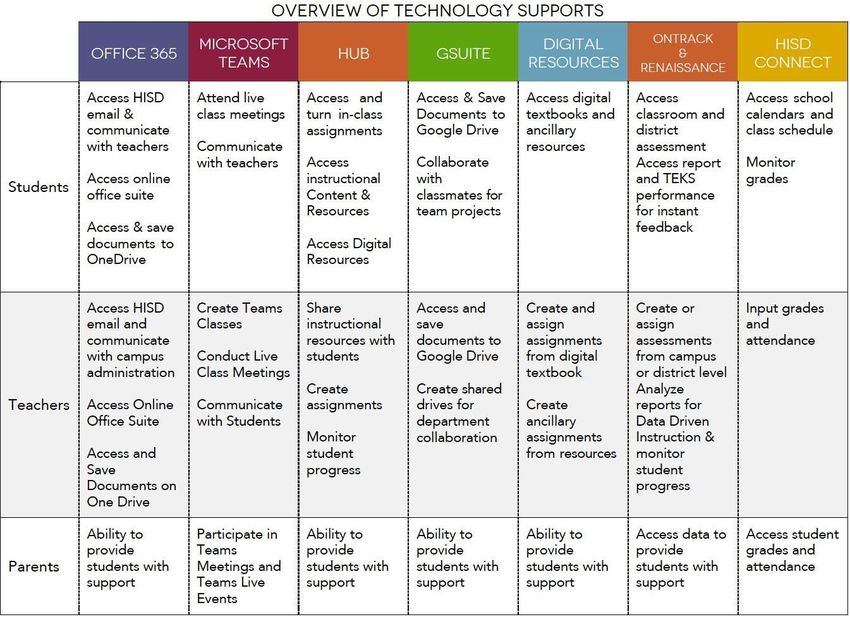
Page 14    Technology Systems
Page 16    Instructional Priorities
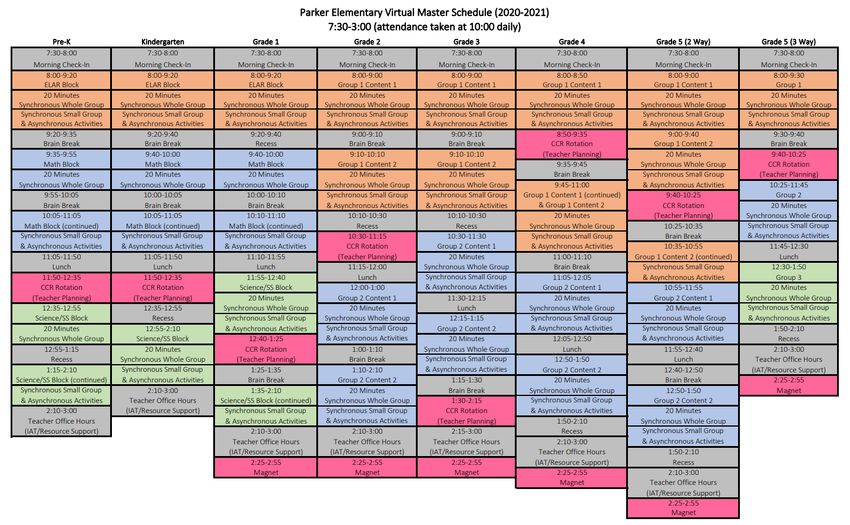
Page 17    Fall Virtual Schedules
Page 18    Fall Virtual Master Schedule
Page 19    Grading Policy
Page 20    Attendance
Page 21    Social Emotional Learning
Page 23    Campus Contacts
Page 24    Professional Development for Parents and Students

                                               2
Introduction
The staff and leadership Team of Parker Elementary collaborate with other schools both in the
immediate area and throughout the district. We would like to give special thanks to Principal
Greenberg at Condit Elementary as well as the central administration for their assistance in the
development of this instructional continuity plan.
The Parker Elementary Instructional Continuity Plan will provide guidance and support during the
time in which teaching and learning take place virtually. This plan is designed to clarify the roles of
school staff, students, and families during the implementation of remote instruction, including
content delivery. This plan also provides clear expectations regarding the amount of time students
will need to devote to schooling each day and throughout the week.
Our main goal in the development of this plan is to keep instruction at the forefront for all
students. Parker Elementary will be implementing an asynchronous instructional model while
providing synchronous live support. Students will complete self-paced and personalized activities
via the HUB through HISD @ H.O.M.E. with computers, laptops, tablets, and Chromebooks.
Students will be assigned work to complete and will have access to an instructional support
schedule from their classroom teacher that is timely, appropriate, targeted, and consistent.
Microsoft Teams will be the district's digital platform that offers virtual communication and
collaboration available through HISD @ H.O.M.E. It will provide secure communication between
teachers and students as well as collaboration between staff members. The HUB will be used as
the district's learning management platform. This platform will provide access to multiple digital
resources to personalize instruction through digital lesson plans created by teachers. The HISD
Connect Parent Portal will be available for registered users (i.e., parents and students) to login to
access a variety of student information. The district will provide virtual professional development
opportunities for all stakeholders regarding these resources.
Parker’s Instructional Continuity Plan will also provide information regarding daily attendance and
grading procedures so that families will know what students need to do each day/week to be
counted as present and to provide a clear understanding of grading expectations.
3Parker’s Approach to Virtual Learning
Educating & nurturing the whole child through the integration of academics, music, and
innovative meaningful learning experiences, Parker's mission, will not stop simply because we are
in a virtual environment. School may look a bit different, but our approach to setting high
expectations and fostering a love for learning, music, and the arts will continue to guide our
decision making.
The learning experiences teachers design when school is in regular session cannot simply be
replicated through virtual learning. In particular, the invaluable social interactions that occur
naturally among students and between teachers and students cannot be recreated in the same
way. Additionally, teachers must find new methods for providing timely and specific feedback to
support student growth and learning.
At the core of Parker’s approach to virtual learning is the belief we should think differently about
our opportunities when responding to challenging circumstances, and that we should embrace new
opportunities for students to learn in authentic, meaningful ways.
4How will Parker communicate with parents and students?
Parker will continue to use the same channels it employs for normal day-to-day communications
with parents, students, and faculty/staff. They contain announcing and messaging tools that will
allow Parker to ensure that all students and parents are receiving important communications. The
table below describes these systems:
Channel Audience Description & Access
Houston Independent School district will
District Callouts, District Text Faculty,
utilize all communication methods to indicate
Messages, District Social Media staff,
opening and closure of schools, including
Accounts parents
Parker Elementary.
Class Dojo will be used for by teachers and
staff for major communications and
announcements. School Messenger will be
Class Dojo and School Faculty,
used to communicate both school and district
Messenger staff,
information.
parents
Parker PTO will utilize their regular
Faculty, communication publications (Facebook and
PTO Communications staff, the PTO website) to share school specific
parents information as it pertains to parent
involvement.
Microsoft Teams, The HUB, and Our teachers and students will continue to
Other Digital Tools Students utilize online tools to provide a platform for
both synchronous and asynchronous
learning.
You can find general district information at
Parker Elementary HISD General http://www.houstonisd.org and Parker
Website Public information at
https://www.houstonisd.org/parkerelem
5Guidelines for Parker ES Parents and Students
The transition to virtual learning will be challenging for families. Parents will need to think
differently about how to support their children; how to create structures and routines that allow
their children to be successful; and how to monitor and support their children's learning. Some
students will thrive with virtual learning, while others may struggle. The nine guidelines provided
below are intended to help parents think about what they can do to help their children find
success in a virtual learning environment.
1. Establish routines and expectations. We encourage parents to set regular hours for your
children's school work. Keep normal bedtime routines for younger children. Your children
should move regularly and take periodic breaks as they work. It is important that parents
set these expectations for how their children will spend their days starting as soon as
virtual learning is implemented, not several days later after it becomes apparent a child is
struggling with the absence of routine.
2. Define the physical space for your children's studies. Your children may have a regular
place for doing homework under normal circumstances, but this space may or may not be
suitable for an extended period of time, as will be the case during virtual learning. We
encourage families to establish a space/location where their children will learn most of the
time. This should be a public/family space, and, whenever possible, not in a child's
bedroom. It should be a place that can be quiet at times and that will have a strong wireless
internet signal, if possible. Above all, it should be a space where parents or an adult are
present and monitoring their children's learning.
3. Monitor communications from your children's teachers. Teachers will communicate with
parents through Class Dojo. When contacting children's teachers, however, we ask parents
to remember that teachers will be communicating with many other families, and that
communications should be essential and succinct. We also encourage parents to have their
children explain the Online Learning Systems (Microsoft Teams, The HUB, Imagine Math,
etc.) that teachers are using.
4. Begin and end each day with a check-in. Parents are encouraged to start and finish each
day with a simple check-in. In the morning, ask your children what they are learning today,
how they will spend their time, what resources they require, and what supports they will
need. This brief conversation matters. It allows children to process the instructions
they've received from their teachers. It helps them organize themselves and set priorities.
Older students may not want to have these check-ins with parents, but they should
nevertheless. Parents should establish these check-ins as regular parts of each day. Not all
students thrive in a virtual learning environment; some struggle with too much
independence or lack of structure. These check-in routines need to be established early,
before students fall behind or begin to struggle.
5. Take an active role in helping your children process and own their learning. Throughout
the course of a regular school day at Parker your children will be engaging with other
students and adults. These social interactions include turning to a peer to exchange a
thought or idea, participating in small or large group discussions, asking
6questions for clarification, collaborating on group projects, and countless other activities.
While some of these social interactions will be re-created on virtual platforms, others will
not. Children learn best when they have opportunities to process their learning with
others. Beyond the check-ins recommended at the start and end of each day, parents
should regularly circle back and engage with their children about what they're learning.
However, it is important that your children own their work. Please do not complete
assignments for them, even when they are struggling.
6. Establish times for quiet and reflection. A huge challenge for families with multiple
children will be how to manage all of their children's needs, especially when those
children are different ages and have different needs. There may be times when siblings
need to work in different rooms to avoid distraction. Parents may even consider using
noise-cancelling headphones to block out distractions.
7. Encourage physical activity and exercise. Make sure your children remember to move and
exercise. This is vitally important to their health, wellbeing, and to their learning. Coach
Chili will recommend activities or exercises, but it is important for parents to model and
encourage exercise! Think also about how your children can pitch in more around the
house with chores or other responsibilities.
8. Remain mindful of your children's stress or worry. It is imperative for parents to help their
children manage the worry, anxiety, and range of emotions they may experience from
being out of school. Difficult though it may be, please do your best not to transfer your
stress or worry to your children. They will be out of sorts, whether they admit it or not,
and need as many normal routines as parents can provide. Our school counselor, Ms.
Carlock, and the entire administrative team are available for support and guidance in
terms of the stress and worry you may observe in your children.
9. Monitor how much time your child is spending online. The goal is not to have students
staring at computer screens for 5-6 hours a day. We ask that parents remember most
teachers are not experts in virtual learning and that it will require some trial-and-error
before we find the right balance between online and offline learning experiences. Parker's
administrative team and teachers will periodically check in with you to assess what you're
seeing at home and what we need to adjust. We thank you in advance for your patience and
partnership!
7Guidelines for Parker ES Teachers
The transition to virtual learning will not be simple or easy. Teachers will need to think differently
about how to communicate, give instruction, and provide feedback; how to design lessons and
assignments that are authentic and meaningful; and how to ensure students continue to
collaborate and communicate with others. The guidelines provided below are intended to help
teachers and parents reflect on challenges they will confront in shifting to virtual learning.
1. Evaluate your students' conditions for virtual learning. While many students will have
reliable online access at home and the necessary devices to shift to virtual learning, others
will not. Teachers should remember that each family's circumstances will vary, and they
should avoid assumptions about limitations or restrictions students are facing. Teachers
should keep an open dialogue with families and avoid assumptions that all students'
circumstances are the same.
2. Teachers should remember that while many students will thrive with virtual learning,
others will struggle. Many families will be experiencing new learning platforms (Microsoft
Teams, the HUB) that provide different experiences. Please be prepared to support
families’ needs or direct them to the administrative team if they need further assistance.
3. Less is more. Teachers should take a perspective of prioritization, including the pacing of
lessons and assignments.
4. Provide space for personalized learning. Virtual learning will provide opportunities for
students to personalize what, how, and when they learn.
5. When it comes to student engagement and learning, relationships matter as much
online as they do in person. Consider how to foster community when we are not in the
same room.
6. Monitor student engagement. Parker’s teachers, parents, and administrative team will
work together to take appropriate proactive and reactive steps when student engagement
is not consistent. School staff will have designated times during the day to check for
engagement and to follow up with students or families who are not engaging consistently
in lessons and work assignments.
7. Think differently about assessment. Assessment is one of the most challenging
adjustments for teachers new to virtual learning. Virtual learning should be seen as an
opportunity for students to learn in different ways and complete a variety of work
products. Teachers are encouraged to think creatively about types of formative and
summative assessments during this time as well.
8Roles and Responsibilities during Virtual Learning
School Personnel Roles and Responsibilities
Principal and ● Establish clear expectations for campus procedures for online
Administrative Team learning aligned with the HISD Instructional Continuity Plan
● Communicate with the central office on a weekly basis to ensure
alignment of resources
● Hold weekly meetings with staff and the administrative team
● Communicate on a weekly basis with the community via website,
email, and social media
● Check-in with teachers and visit their virtual classes on at least
a weekly basis
● Monitor attendance, grades, and interventions
● Complete required online professional development
● Establish a virtual learning schedule for remote instruction
● Address online student discipline according to the district's
student code of conduct
● Communicate with the Office of Special Populations regarding
services provided to students to assure campus services are
documented, current, and compliant with district, state and
federal guidelines.
● Attend professional learning communities (PLCs)
Leadership Team ● Establish and maintain clear channels of communication
between faculty, and families
● Support faculty and families shifting to a virtual learning
environment
● Support teachers in lesson implementation
● Provide models and structures for virtual lessons and units
● Recommend new methods for providing feedback to students
● Support teachers in designing methods to assess student
learning
● Support teachers and teams in developing strategies to
differentiate and/or extend learning
● Monitor the tech needs of teachers, students, and parents to
troubleshoot challenges
● Lead professional learning communities (PLCs)
● Complete required online professional development
9Grade Level ● Collaborate with other members of your team to design virtual
Teachers learning experiences for your students
● Communicate frequently with your students and, as needed, with
their parents
● Provide timely feedback to support your students' learning
● Collaborate with teammates to ensure manageable student
workloads
● Create a sufficient, instructional support schedule in which
teacher interactions are consistent and predictable so that
students know how and when to interact
● Construct and provide students and parents with information
regarding goals, objectives, and class expectations
● Scheduled consistent teacher availability for students, in
advance, to discuss student progress
● Provide students with clear means to engage with daily
instructional resources and activities
● Develop and provide engaging lesson plans at least once a
week in advance
● Ensure that engagement of academic work is equivalent to the
engagement during a normal school year
● Provide student feedback weekly including next steps or
necessary remediation to improve student performance
● Post instructional resources and materials on the HUB
● Ensure students can access instructional resources and materials
when needed
● Check email daily and respond within 24 hours
● Update grades & provide student feedback weekly
● Meet weekly for professional learning communities (PLCs)
● Complete required virtual and program specific professional
development
● Follow student IEPs regardless of the learning environment to
ensure they receive a Free, and Appropriate Public Education
(FAPE)
● Communicate with the Office of Special Populations regarding
students' progress, growth and concerns regarding services
provided
● Ensure that whole group lessons are recorded when delivered to
students
Counselor ● Serve as liaison for communication with students or families in
crisis
● Communicate with teachers about students or families in crisis
● Proactively share resources related to wellness or crisis
10management with the community.
● Check-in with students for instructional or emotional supports,
including those who are not participating on a consistent basis
● Establish a schedule for wellness checks for teachers and
students
● Communicate with the Office of Special Populations regarding
services provided to students
● Complete required virtual professional development
Creative ● See grade level teachers’ roles and responsibilities
Core and ● Identify opportunities to collaborate with classroom teachers to
Magnet integrate art, music, technology, literacy, and physical education
Teachers into classroom experiences.
Support Staff ● Communicate regularly with classroom teachers and
administration to identify way to support students
● Monitor student learning and provide feedback as
requested by supervising teacher
Student Roles and Responsibilities
● Establish daily routines for engaging in learning experiences (ex: start time)
● Identify a comfortable, quiet space in your home where you can work effectively and
successfully
● Complete assignments honestly, and do your best work
● Communicate proactively with your parents and/or teachers if you need additional help
● Check the HUB and Microsoft Teams for information on classes, assignment, and
resources
● Complete and submit assignments on time
● Actively participate in online activities and assignments provided by your teachers
● Learn how to access and operate online resources
● Be mindful that all activity posted on Microsoft Teams and other platforms in teachers’ virtual
classrooms are monitored by HISD and our school staff. Please be certain that all posts and
chats are appropriate to learning and instruction
● Complete independent reading goals
11Parent/Guardian Roles and Responsibilities
● Establish a routine that will help students be more successful in their learning
● Provide an appropriate learning space for students when possible
Communicate any instructional needs to the campus such as a lack of device or internet
connection
● Consistently monitor campus and district communication for continuous updates via
callouts and websites.
● Maintain communication with teachers as needed
● Connect with your student every day at a time that works well for your household. This
might be a quick check-in a few times a day or a longer check-in in the morning or
evening.
○ Some questions that might help spark a conversation include:
○ Were you able to complete all the assigned activities?
○ What did you learn/practice/read today?
○ What was easy or challenging for you?
○ Do you have any questions for your teacher?
○ Monitor student time on task and encourage physical activity and/or exercise.
Provide support to your children by adhering to the following 9 guideline for Parker ES Parents:
● Establish routines and expectations
● Define the physical space for your child's study
● Monitor communications from your children's teacher
● Begin and end each day with a check in
● Take an active role in helping your children process their learning
● Establish times for quiet reflection
● Encourage physical activity and/or exercise
● Remain mindful of your child's stress or worry
● Monitor how much time your child is spending online
12For questions about... Contact
A specific assignment or password help Classroom teacher
A technology problem HISD Service Desk
A device problem Mr. Harrison, Campus Technologist
Music and instrument questions Magnet teacher
Magnet, GT, or transportation questions Ms. Kehlenbrink, Magnet Coordinator
Personal or social emotional problem Ms. Carlock, School Counselor
Other issues Mr. Mitchell, School Principal
Mr. Berry, Assistant Principal
13Technology Systems
During remote operation of schools, teachers and students will use our district adopted platforms
to communicate and provide instruction. Microsoft Teams will be used to provide instructional
support and host live class meetings with students. The district's adopted learning management
system (LMS), the HUB (itslearning), will be used to host, deliver, and manage content,
instructional resources, and student assignments. The HUB will also be used to monitor student
engagement and progress.
Teachers and students may also use Microsoft Office 365 Suite and Google for Education Suite (G-
Suite) to access a variety of productivity tools to enhance communication and support the creation
of instructional content, resources, and other essential elements for the learning process.
Office 365
HISD teachers and students have access to Office 365 for Education. It is an online, cloud-based
suite that offers communication and productivity tools such as Outlook, Word, Excel, PowerPoint,
OneNote, and OneDrive.
Microsoft Teams
Microsoft Teams is a digital platform that offers virtual communication and collaboration between
students and teachers. Students can be provided with continued support and an enhanced
learning experience through conversations, video and audio meetings, and live events.
The HUB (it’s Learning) https://houston.itslearning.com
The HUB, also known as itslearning, is the district's learning management system. This platform
provides access to multiple digital resources to personalize instruction through digital lesson
plans created by teachers and the curriculum department. Teachers can use this platform to
create and grade assignments and share resources with colleagues and students.
14G Suite
G Suite is a cloud-based application that makes learning accessible anywhere with internet
access. All HISD personnel and students have Google accounts that are managed by Houston
ISD and accessed by using their district credentials and network password. Teachers and
students have the G Suite for education which gives them access to Google Slides, Google
Docs, Google Sheets, Google Forms, Google Sites, Chrome Sync, Google Drive, and Google
Drawings.
Digital Resources Page
HISD provides a variety of educational resources for students to access. The collection of
resources is district approved tools and applications that include textbooks, content-specific
applications, online reading libraries, and formative and summative assessment tools. Students
and teachers can gain access to the education material needed for their specific class. Students
can also access assessment tools such as Ontrack and Renaissance as well as check out books
from MackinVia and MyOn.
15PreK Priorities
● Virtual learning for preschool children remains holistically focused on broad language,
cognitive, physical, and social emotional development.
● Learning activities and experiences will emphasize interaction and creativity. These
activities will require minimal specialized material.
● The PreK teachers will provide parents with weekly lesson plans with recommended
activities and experiences to target foundational skills.
Subject Area Activities
Emergent Literacy Activities - Reading Workshop and ● Teachers facilitate short,
ELA synchronous live class
interactions (instruction, CFU, SEL,
Emergent Numeracy Activities - Math and Daily Calendar
etc.) with students via Teams.
Science/Social Studies ● Students complete work as assigned
by teachers independently
Enrichment - Physical Education/Art/Library/ ● Teachers provide opportunities for
Technology/Music small group instruction
Elementary School K-5 Priorities
● Students will have both off and on screen learning activities designed to engage ES
learners in experiences that connect to current curriculum.
● Learning tasks and activities will provide direction to families on how best to support
student learning. Given the level of adult support required by elementary-aged students,
our intent is to prioritize learning. It is expected that students in grades K-2 will need
higher levels of parental support than students in grades 3-5.
● Teachers will engage in collaborative planning throughout the week with both their grade
level teams and with campus instructional leaders.
Subject Area Activities
English Language Arts ● Teachers facilitate short, synchronous live
class interactions (instruction, CFU, SEL,
Math etc.) with students via Teams.
● Independent Reading daily
Science
● Students complete work as assigned by
Social Studies teachers independently
● Teachers provide opportunities for small
Enrichment - Physical Education/Art/Library/ group instruction
Technology/Music
16Fall Virtual Schedule
Our goal with the virtual schedule is to provide synchronous parts of the day for families who
prefer direct engagement, while also ensuring all content and instruction is available
asynchronously. In the chart below you will find the different pieces of the virtual instructional
day. The chart on the following page shows how all of these pieces fit together for the different
grade levels. Our goal is to mirror the best practices of our instructional day when we are
in-person and create a similar learning flow online. Each piece is important in creating the Parker
student experience.
Morning Check-In and Our campus will utilize this time to engage in morning check-ins with
Daily Expectations students, provide an instructional overview of the school day, and engage
on Microsoft Teams students in daily routines such as calendar math, morning message,
announcements, and circles
Whole Group Whole group happens 3 times each day for PK-1 and 4 times each day
on Microsoft Teams for grades 2-5. It is important to spend 15-20 minutes setting the
stage for the academic work that will be done that day. Live whole
group lessons will be conducted on Microsoft Teams and will be
recorded for asynchronous viewing.
Small Group on Small groups will be pulled during the independent work time noted on
on Microsoft Teams the schedule below. Groups will be flexible and the skill work will be
targeted in order to provide differentiated instruction.
Graded Work During remote learning students will complete and submit two
on The HUB assignments per week, per subject. Graded assignments will be
submitted through the HUB.
Live Teacher Office School wide teacher office hours will be held on Microsoft Teams so
Hours on Microsoft that students and parents will have regular, live access to teachers to
Teams ask questions and get additional help.
Documentation and A designated time in the day will be scheduled for teachers to document
Outreach their academic accommodations for our special population students.
Additionally, time will be built in at the end of the day for teachers to
reach out to students who were marked absent or who did not turn in
their assignments for that day.
1718
Grading Policy

Students enrolled in remote/virtual instruction follow the same grading policies as in-person
instruction. Teachers receive support and guidance on effective grading practices to ensure that
grading guidelines are followed in both instructional models. Grades will be taken during each
grading cycle of the 2020-2021 school year. All cycle grades will be used in the calculation of
the final average for any class. Grades should reflect student mastery of the content being
taught and should not overly-rely on student work habits.

 How many assignments will my child be               There will be 2 graded assignments per week,
 required to complete?                               per subject area.

 Is there a difference for PreK and                  PreKindergarten and Kindergarten use a
 Kindergarten?                                       standards based report card so there may be
                                                     differences in the type and amount of work
                                                     that is assigned.

 Will grades be broken into weighted                 Yes, graded assignments will be divided
 categories?                                         between major and minor grades. Major grades
                                                     will count for a minimum of 25% of the child’s
                                                     overall average per grading period (six week
                                                     cycle).
 What is the policy for reassessment?                Students who receive a grade below 70% on
                                                     an assessment will have the opportunity to
                                                     reassess, but will only be capable of receiving
                                                     a maximum grade of 70%.
 When are daily assignments due?                     Students will have until 11:59pm each day to
                                                     complete the work assigned.

 What is the late work policy?                       Students will lose 10 points each day that an
                                                     assignment is turned in late until the maximum
                                                     grade possible becomes a 70%. Late work will
                                                     not be accepted after 5 school days past the
                                                     assigned due date.
 When will we receive progress reports and           Report cards will run on a 6 week cycle this
 report cards?                                       year, progress reports will be run for students in
                                                     grade 1st – 5th 3 weeks into each grading cycle.

                                                19
Attendance
Students who engage in learning activities via the HUB, participate in a Teams meeting with
teachers, or submit assignments via the HUB are considered "present” and will not be marked
absent.
For any questions concerning attendance or to submit any absence notes, please contact Ms.
Gibson at rgibson@houstonisd.org .
Students can engage with their teacher though the following:
● Daily participation in the HUB, the HISD Learning Management System (LMS), completion of
independent reading and work assignments, use of assigned digital tools, and/or group
interactions.
● Interaction with teachers via Teams as part of live or small group instruction.
● Student assignments will be submitted via the HUB. When unable to submit via the HUB
students can submit assignments via emails, photos, phone conferences or other forms
of documentation.
This absence can be resolved if the student engages in daily learning assigned by their teachers
via the HUB by 11:59 pm that same day. Parents and students will receive absence notifications
via School Messenger after 6:00 pm each day and will be reminded of the opportunity to resolve
that day's absence if the student engages in learning before 11:59 pm of the same day via the
HUB. Any absences recorded, but resolved by the student before 11:59 pm on the same day, will
be reconciled based on login records of the HUB.
If a student is engaged in remote learning and completes the entire week's worth of learning
activities on Monday and does not log in for the remainder of the week, he/she will be marked
"present” on Monday only and counted "absent” for Tuesday-Friday.
Teachers and staff have designated office hours each day to contact students and parents who may
need additional assistance participating in lessons and completing work.
20Social Emotional Learning
The Social Emotional Learning Department promotes the process for helping children and adults
develop fundamental skills for life effectiveness. SEL teaches social competencies and
interpersonal skills we need to be successful citizens, have positive relationships, and function
effectively in society. These skills are designed to foster positive student academic outcomes and
to help adults understand, develop, and model SEL skills such as:
● recognizing and managing our emotions
● developing caring and concern for others
● establishing positive relationships
● making responsible decisions, and
● managing challenging situations constructively and ethically.
Students, ● Establish routines to help each child be more successful.
Parents, ● Monitor use of social media platforms and limit viewing of news
Guardians at broadcasts.
Home ● Students may develop symptoms of anxiety, depression, and
post-traumatic stress. Understand the role mental health plays in the
development of the whole child in physical health, school performance,
and behavior.
SEL supports include resources and trainings on various topics such as:
● Weekly Webinars based on current SEL and Mental Health topics
● How to effectively utilize SEL resources at home to provide hands on
tools to support students
● Understanding the reasons that may cause a student to display
challenging behaviors or adjustment problems
● Offering various options and solutions to effectively respond to the
challenging behaviors
● Mindfulness – relaxation techniques, calmly accepting feelings, noticing
your reactions, feelings in the body, and helpful versus harmful thoughts
● Effective parenting for children experiencing trauma:
○ Identifying patterns of behavior and reactions that do not seem
to "fit” the situation (triggers)
○ What distracts your child, makes him or her anxious, or results
in negative behavior?
○ Help your child avoid situations that trigger trauma
21Administration ● Check-in with campus-based crisis team for suicide, threat
Team assessments, and safety concerns
● Facilitate trainings including, but not limited to:
○ TOTs (Trauma Informed/Responsive Practices, De-escalation,
Restorative Discipline, Integrating SEL into Academics)
○ Mental Health First Aid to identify, understand, and respond to
mental health and substance issues
○ Student Discipline Management (TEC Chapter 37 and HISD
Code of Student Conduct)
○ Cultural Sensitivity
○ Campus Behavior Coordinator modules
● Assist with development of schoolwide behavior management systems
to include implementation of progressive discipline management
techniques and positive behavioral interventions and supports
● Check-in with students with identified instructional or
behavioral/emotional supports
● Consult with behavior staff to develop tiered interventions and groups
for students
● Use the SEL OneSource website to access and capture the following
information:
○ HISD SEL Crisis Protocol
○ Sandy Hook referral process (Say Something Anonymous
Reporting)
2210626 Atwell Dr. · Houston, TX 77096
713.726.3634
Campus Contacts
Campus Administrators
Principal Chavis Mitchell cmitche7@houstonisd.org
Assistant Principal Bryan Berry bberry1@houstonisd.org
Magnet Coordinator Carol Kehlenbrink ckehlenb@houstonisd.org
Campus Support
Counselor Susan Carlock scarlock@houstonisd.org
Nurse Sonia Garcia mgarci42@houstonisd.org
Technology
HISD Service Desk (713)892-7378 servicedesk@houstonisd.org
Campus Technologist Dale Harrison dharri18@houstonisd.org
Campus Program Coordinators
Special Education Phebe Chen pchen@houstonisd.org
LPAC Bryan Berry bberry1@houstonisd.org
Gifted & Talented Carol Kehlenbrink ckehlenb@houstonisd.org
Intervention Assistance (IAT) Helen Brook hbrook@houstonisd.org
504 Susan Carlock scarlock@houstonisd.org
Dyslexia Helen Brook hbrook@houstonisd.org
23Professional Development for Parents & Students
Students
These introductory training sessions are intended to provide entry into the District's learning management system,
the HUB, as well as other district resources for instruction and communication. Teachers will utilize these throughout
the school year in alignment with the respective courses being taught.
Platform Topic Required/Optional Timeline Description
Intro HISD @ All ES Students August Learn to access HISD resources such as the HUB,
H.O.M.E. for (Required) 2020 and Teams, and HISD Email. Develop a learning plan
Elementary Students upon entry with the help of your parents.
into District
Visit the following website to access archived
student trainings:
https://www.houstonisd.org/Page/180262
Using the HUB All ES Students August Learn how to use the HISD HUB to submit
(highly 2020 and assignments, navigate courses, and install the HUB
recommended) upon entry app on your phone or other mobile devices.
into District
Visit the following website to access archived
student trainings:
https://www.houstonisd.org/Page/180262
24Parents
The following professional development will encompass introductory training to support synchronous and
asynchronous learning. Parents will receive training to support their students as they navigate and utilize the HUB,
Houston ISD's Learning Management System (LMS), and other district resources while at home. All professional
development will be evaluated and formatted for repeated asynchronous and synchronous presentations
periodically throughout the school year.
Platform Topic Required/Optional Timeline Description
Intro HISD @ Highly Recommended August 2020 Learn how to best support your learner during
H.O.M.E. for Parents and upon entry HISD @ H.O.M.E. by helping develop a learning
into District schedule, communication plan, how to access
district instructional resources and where to
locate additional support.
Visit the following website to access archived
parent trainings:
https://www.houstonisd.org/Page/180262
Visit the following website to access
upcoming parent trainings:
https://www.houstonisd.org/Page/182897
Using the HUB Highly Recommended August 2020 Learn about the Imagine Learning Suite that the
and upon entry district uses to supplement learning.
into District Understand how to support students in using
the resource and how to read and use the
progress reports.
Visit the following website to access archived
parent trainings:
https://www.houstonisd.org/Page/180262
Visit the following website to access
upcoming parent trainings:
https://www.houstonisd.org/Page/182897
25You can also read


