Interim Report by the German Federal Government - Second National Action Plan 2019 2021 - Open ...
←
→
Page content transcription
If your browser does not render page correctly, please read the page content below
Second National
Action Plan
2019 – 2021

Interim Report
by the German Federal
Government

Publication data Interim Report by the German Federal Government on the Implementation of the Second National Action Plan (NAP) for 2019-2021 in the Framework of Germany’s Participation in the Open Government Partnership (OGP) Published by Federal Chancellery Willy-Brandt-Str. 1 10557 Berlin, Germany Contact Division Digital State (OGP@bk.bund.de) www.open-government-deutschland.de Date of issue October 2020 Licence Creative Commons Attribution 4.0 International (CC BY 4.0) Image credits Page 8: OGP Page 9: Federal Government Page 10: shutterstock/whiteMocca
Interim Report by the German Federal Government on the I mplementation of the Second National Action Plan (NAP) for 2019 – 2021 in the Framework of Germany’s Participation in the Open Government Partnership
Contents

1. Introduction                                                            7

2. The road to the second National Action Plan                            11

3. Implementation of the commitments – an overview                        12

4. Detailed descriptions of the commitments                               15

Regional
Open Government Labs                                                      16

Civil-society dialogue
on foreign policy                                                         17

Youth participation in the Federal Government’s
joint youth strategy                                                      18

Establishment of an e-government agency as
a Digital Innovation Team of the federal administration                   19

Promotion of transparency and participation
in development cooperation                                                20

Further development and promotion
of the open data environment                                              22

Participatory process to develop research and innovation policy further
in the framework of the 2025 High-Tech Strategy                           23

Better regulation
through participation and testing                                         24

Smarte.Land.Regionen –
a pilot project for smart rural regions                                   26

Annex:
Commitments by the Länder                                                 29

5. Outlook                                                                36

6. Index of abbreviations                                                 38
“I’m addressing you in this unconventional way today because
I want to tell you what guides me as Federal Chancellor and
all my colleagues in the Federal Government in this situation.
This is part of what open democracy is about: that we make
political decisions transparent and explain them. That we
justify and communicate our actions as best we can, so that
people are able to understand them.”
(Federal Chancellor Angela Merkel in a
televised address of 18 March 2020,
https://www.bundesregierung.de/breg-en/
search/statement-chancellor-1732302)1. Introduction
This interim report is part of the mandatory reporting on commitments in the framework of
the participation in the Open Government Partnership (OGP). The present report provides
an insight into the progress made on implementing the second National Action Plan (NAP)
submitted in September 2019.
Open Open government gives governments and
administrations the opportunity to garner ideas
government for improving the way they operate and to build
trust through transparency and dialogue. Open-
ness about the operation of governments and
during the administrations is not just important in times of
pandemic, though; it is crucial at all times. The
coronavirus following descriptions provide a small insight into
the developments beyond the specific commit-
pandemic – ments of the second NAP.
more important
and valuable
than ever
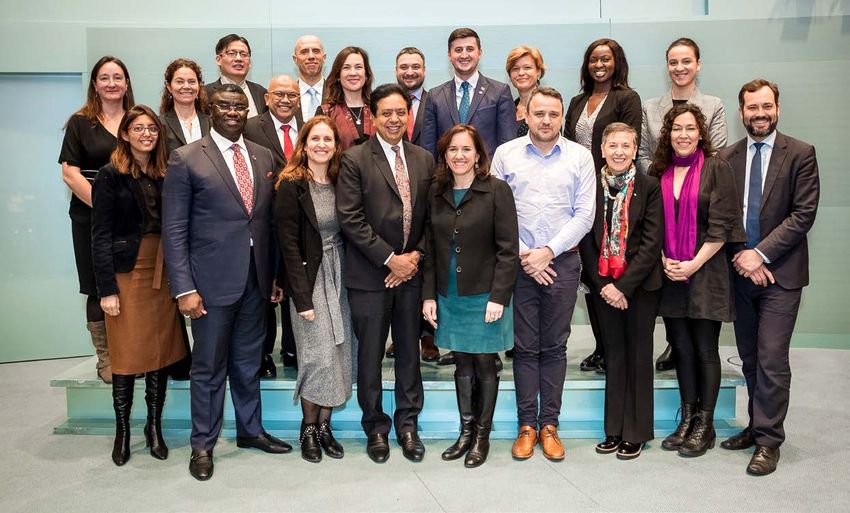
7Recent additional developments of the past year Meeting of the OGP steering committee in Berlin The OGP steering committee met in Berlin from 25 to 27 February 2020. Germany has had a seat on that body since October 2019. During the three-day conference, the visiting delega- tions from governments and non-governmental organisations discussed a range of organi- sational and policy matters that had been prepared since the previous meeting, held at the OGP Global Summit in Ottawa in May 2019. The group also toured the Stasi archives in Berlin (Federal Commissioner for the Records of the State Security Service of the former GDR), an experience which made an impression on many of the participants (report in German available at https://www.bstu.de/ueber-uns/ aktuelles/detail/open-government-partnership-besucht-das-archiv). 8
An open government success story:
the coronavirus warning app
The coronavirus warning app, or “Corona-Warn-App”, is a project commissioned by the Ger-
man Government. The app assists in recognising chains of infection more quickly and ex-
tensively and effectively interrupting them. Thanks to the decision to take the open-source
route, the entire source code not only for the app and its documentation but also for the
back-end systems is freely available. The decentralised data storage ensures that the whole
system is compliant with Germany and Europe’s high data-protection standards. The app’s
users remain anonymous at all times. It was developed to be fully accessible as a matter of
principle and uses the accessibility features of the smartphone operating systems supported.
“It was worthwhile insisting on absolute transparency,
comprehensive data privacy and the most rigorous
IT security standards. Today we can say that this app
deserves your trust.”
Extract from Federal Chancellor
Angela Merkel’s podcast on the coronavirus
warning app, 20 June 2020
Online participation – planning and permits
in times of pandemic
In May 2020, the German Bundestag passed the Planning Assurance Act (Planungssicher
stellungsgesetz) to prevent numerous important projects being obstructed or even
scuppered by the COVID 19 pandemic. Many planning and authorisation procedures require
people to be physically present, for example to examine documents or attend public inquir-
ies, and therefore cannot take place as normal. The Planning Assurance Act establishes
alternatives to such procedures that accommodate the rights of members of the public to
participate, chiefly making use of the potential of the internet.
9Online consultation on the data strategy The Federal Government is working on a data strategy. Its aim is to significantly increase responsible provision and use of data on the part of individuals and institutions in (civil) society, business, academia and the federal administration in Germany, to prevent the cre- ation of new data monopolies, to ensure fair participation and to deal with data misuse con- sistently. People had the opportunity between 28 February and 3 April 2020 to contribute ideas and assessments to support the process of developing a Federal Government data strategy. An online consultation was made available to that end which allowed interested members of the general public as well as specialists to give their input directly. A total of around 1300 questionnaires were completed and fed into the evaluation. One of the focus areas of the overarching data strategy will be open data. It will therefore be flanked by an open data strategy established for the federal administration (cf. Commitment #6). 10
2. The road to the
   second National Action Plan
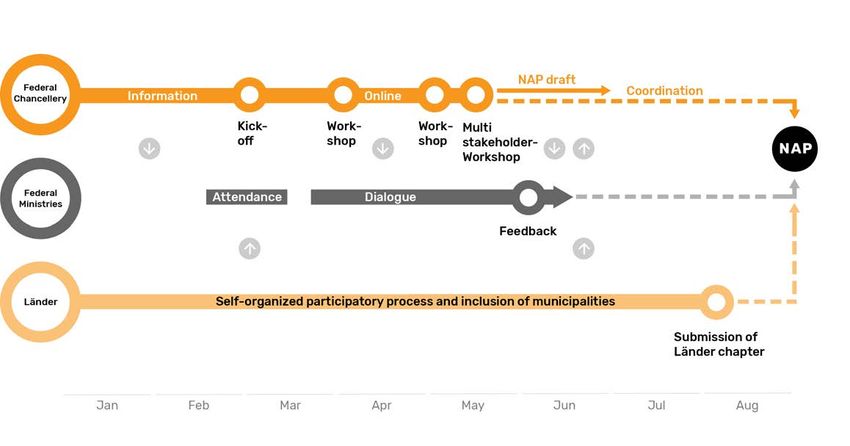
   The Federal Government co-created the second National Action Plan between March and
   August 2019. At the heart of the process was the approximately two-month consultation
   with civil society. This resulted not only in intensive dialogue on open government but also
   in the formulation of around 60 commitment proposals, which formed the basis of discus-
   sions among the various federal ministries.

   The Federal Cabinet adopted the second NAP in September 2019. Nine commitments by
   the Federal Government, alongside, for the first time, five commitments by three different
   Länder, give an impression of the ongoing development of open government in Germany.
   The full text of the action plan and commitments is available at

→ www.open-government-deutschland.de

                                                                                             11
3. Implementation of the
commitments – an overview
The Federal Chancellery enquires at the
ministry responsible for each commitment
as to the progress made on implementation,
generally on a quarterly basis. The traffic-
light-coded table below is kept updated at
www.open-government-deutschland.de.
There is currently no indication that the
coronavirus pandemic is causing substan-
tial delays in the implementation of the
second NAP which might jeopardise the
timely fulfilment of the commitments. In the
case of milestones where certain processes
are not yet running according to plan, this
is explained in the detailed descriptions
below.
At the time of writing, the implementation
of the commitments in the second NAP
is well under way. A total of 16 out of 68
milestones have been achieved, a further
43 are on schedule and only nine have ex-
perienced delays. Chapter 4 below gives a
detailed description of each commitment.
implementation complete
implementation begun or being prepared or
partially complete
delayed
deadline no longer feasible or already passed
(milestone not implemented on schedule at
the time of enquiring)
The progress indicators relate exclusively
to the milestones set out in the NAP. Some
of the commitments here simply represent
phases of multiannual projects.
12Nr. Commitment Milestones
1 Regional Open Government 1 2 3 4 5
Labs
2 Civil-society dialogue on 1 2 3
foreign policy
3 Youth participation in the 1 2 3
Federal Government’s joint
youth strategy
4 Establishment of an e-government 1 2 3 4
agency as a Digital Innovation Team
of the federal administration
5 Promotion of transparency and 1 2 3 4 5
participation in development
cooperation
6 Further development and promotion 1 2 3 4 5 6 7 8
of the open data environment
7 Participatory process to develop 1 2 3 4
research and innovation policy
further in the framework of the 2025
High-Tech Strategy
8 Better regulation through 1 2 3 4 5 6
participation and testing
9 Smarte.Land.Regionen – a pilot 1 2 3 4 5 6
project for smart rural regions
10 Annex:
Commitments by the Länder
North Rhine-Westphalia I: Developing infra
1 2 3 4 5 6 7 8 9
structure and framework conditions for open
government in North Rhine-Westphalia (NRW)
North Rhine-Westphalia II: Creating spaces for
1 2 3
exchange and cooperation in NRW
North Rhine-Westphalia III: Strengthening data
1 2 3
sovereignty
Saxony: Further developing and establishing the
1 2 3 4 5
participation portal of the Free State of Saxony
Schleswig-Holstein: Open-source software in
1 2 3 4
public administrations
134. Detailed reporting
on the commitments
For more detail and the full text of the committments, see the
second National Action Plan of September 2019, available at
→ www.open-government-deutschland.de
15Regional Open Government Labs
The commitment in brief: The Federal Ministry of the Interior, Building and Community
(BMI) promotes regional forms of cooperation between administrative entities and civil so-
ciety in the interests of open government. Thirteen regional Open Government Labs were
selected by means of a two-stage expression-of-interest procedure. A total of 2.7 million
euro in funding is available. The BMI is further supporting the process through research as-
sistance, events and public-relations activities. The objective of the labs’ work is to facilitate
the practical application of the principles of open government – particularly civil society
involvement, transparency and accountability - in the day-to-day collaboration between a
region’s administration and society and in regional development.
Implementation status of commitment: Substantial progress
Additional information: Due to coronavirus restrictions, face-to-face events in the labs,
particularly workshops, cannot take place. The people involved in the labs are endeavouring
to collaborate more online.
Milestone activity with a verifiable deliverable End date Status
Application phase and selection of up to January Thirteen regOGLs have been
16 regOGLs 2020 selected (see announcement).
Assignment of the following tasks to a research March The tasks have been assigned.
assistant: 2020
• Ensuring exchange among the regOGLs
• Generalising the findings
• Managing public relations work
Developing and establishing the labs’ work June First (digital) workshop held
2020 on 16 — 17 June 2020
Preparing interim conclusions for second NAP March
OGP and regional conference 2021
Preparing deliverables and presenting September
at final conference 2022
Implementing body: Federal Ministry of the Interior, Building and Community (BMI) Contact: Dr Kristina Schade
(Division HII1) Other stakeholders (ministries, agencies, divisions): Municipal administrations as sponsors of
the regOGLs (42 municipalities and municipal bodies) Other stakeholders (NGOs, private business, multilateral
organisations, working groups): Seven institutions of higher education as well as partners from civil society in
the regOGLs (59 civil-society organisations)
16Civil-society dialogue on foreign policy
The commitment in brief: The various opportunities for dialogue and participation offered by
the Federal Foreign Office (FFO) are to be further expanded in order to keep the public better
informed about foreign policy and more involved in consultative processes. This will mean in-
tensifying dialogue processes on foreign policy, such as citizens’ dialogues and various work-
shop formats as well as the PeaceLab blog on the implementation of the policy guidelines on
preventing crises, resolving conflicts, building peace – or crisis guidelines, for short. The FFO
is also digitising some of the holdings of its Political Archive, and will put these online for free,
non-commercial use. This will generate a high degree of additional transparency.
Implementation status of commitment: Limited progress
Additional information: The focus has been on digital formats in 2020, because of COVID 19,
but the element of dialogue and public involvement remains central. A decision as to whether
the 2020 Citizens’ Workshop will be held as a face-to-face event or an online seminar has
yet to be made.
Milestone activity with a verifiable deliverable End date Status
Explaining and discussing German foreign 2020 (citizens’ Implementation / preparations
policy: Informative formats with think tanks and dialogues) under way
citizens, online and offline. Ongoing
• Broad-ranging informational events (workshops)
on 150 years of the Foreign Office
• Ongoing citizens’ dialogues
• Annual Citizens’ Workshop on foreign policy
• Regular Open Situation Rooms
Having a say in German foreign policy: until Three PeaceLab debates held in 2019
consultative formats. 2021 on promoting the rule of law, security-
• An additional blog-based debate on peacelab. sector reform and dealing with the
blog, the results of which will be taken into past; additional debates on crisis
account in implementing the Federal Foreign communication in 2019 / 2020 as
Office’s crisis guidelines well as on the effects of COVID 19 on
• Organisation of a hackathon to improve models engagement in crisis areas; additional
for early recognition of crises and early warn- debates using the PeaceLab format
ing tools with academic experts initiated by civil society itself (e.g.
by the Advisory Board to the Federal
Government for Civilian Crisis Preven-
tion and Peacebuilding)
Hackathon “ORANGE”, initially planned
for the 2nd quarter of 2020, post-
poned until the 1st half of 2021 due
to COVID-19
Additional projects still ongoing
Digitising and publishing selected parts of the 2020 Implementation being prepared
FFO Political Archive: making files accessible
online for everyone
17Implementing body: Federal Foreign Office (FFO) Contact: Anke Schlimm, Citizens’ Dialogue and Public Diplomacy
(Germany) Division, Directorate-General 6, 611-RL@diplo.de Other stakeholders (ministries, agencies, divisions):
Directorates-General 1, 4, 6 and S are involved, as are the Policy Planning Staff and the Press Division. Other
stakeholders (NGOs, private business, multilateral organisations, working groups): none
Youth participation in the Federal
Government’s joint youth strategy
The commitment in brief: Young people want to help shape our society, and they wish to
be asked for input on the political course that will affect their future. They desire to have
a say in projects and decisions in all areas of policy which may be relevant to young peo-
ple. The Federal Ministry for Family Affairs, Senior Citizens, Women and Youth (BMFSFJ) will
use various formats to ensure the broadest and most well-founded possible involvement of
young people in the development and implementation of the Federal Government’s youth
strategy. The intention is to enable young people to play a role in shaping “their” youth strat-
egy. The results of the participatory process will be fed into the implementation of the Fed-
eral Government youth strategy via the interministerial working group on youth. Simultane-
ously, as part of the process of implementing the youth strategy, the BMFSFJ encourages
projects from other minis-tries to involve people in youth-strategy measures.
Implementation status of commitment: Substantial progress
Additional information: none
Milestone activity with a verifiable deliverable End date Status
Adopting a Cabinet decision on the joint youth December Implemented (see press release,
strategy of the Federal Government 2019 in German: https://www.
bmfsfj.de/bmfsfj/aktuelles/
alle-meldungen/bundeskabinett-
beschliesst-jugendstrategie-
der-bundesregierung/141990)
Conducting a youth conference as an interim September Implemented (see news update, in
review of how the youth strategy has taken shape 2020 German: https://www.bmfsfj.de/
and been implemented to date bmfsfj/aktuelles/alle-meldungen/
die-bundesjugendkonferenz-2020-
live-verfolgen/160496)
More details in German also available
at www.bundesjugendkonferenz.org
18Milestone activity with a verifiable deliverable End date Status
Holding the JugendPolitikTage 2021 (Youth Pol- Spring On schedule
itics Days; form is yet to be determined) to take 2021
stock of the youth strategy from the perspective
of the younger generation and derive, among
other things, additional prospects for effective
youth participation formats at federal level
Implementing body: Federal Ministry for Family Affairs, Senior Citizens, Women and Youth (BMFSFJ) Contact:
BMFSFJ Division 501, Immanuel Benz, Immanuel.Benz@bmfsfj.bund.de; Division Z26, z26@bmfsfj.bund.de Other
stakeholders (ministries, agencies, divisions): Interministerial working group on youth Other stakeholders
(NGOs, private business, multilateral organisations, working groups): Child and Youth Welfare Association
(AGJ), German Federal Youth Council, Kooperationsverbund Jugendsozialarbeit, Federal Association of Non-Stat-
utory Welfare, German Youth Institute, “jugendgerecht.de – the Independent Youth Policy Office” (co-organisation
of youth conference), among others
Establishment of an e-government agency as a
Digital Innovation Team of the federal administration
The commitment in brief: In order to keep pace with the digital transformation, the ad-
ministration must be quicker, more agile and more open in trying out ideas with an eye for
user-friendliness and in finding solutions to problems. Implementing digitalisation projects
in the separate “silos” of the administration still often hinders that endeavour. The Feder-
al Ministry of the Interior, Building and Community (BMI) is setting up a Digital Innovation
Team. This will act as a “think & do tank”, establishing structured innovation management in
the federal administration and disseminating and embedding methods from design think-
ing, service design and agile working. It is also intended to connect stakeholders, commu-
nicate transparently about projects and help bring about lasting change in the mindset of
the federal administration.
Implementation status of commitment: Limited progress
Additional information: none
Milestone activity with a verifiable deliverable End date Status
Setting up a workshop space for project partners March Workshop space delayed until the end
from the federal administration to carry out work- 2020 of 2020; implementation under way in
shops on innovation, design thinking and similar all other respects
themes
19Milestone activity with a verifiable deliverable End date Status
Carrying out transparent testing of the January Implementation of projects under
innovation process at two federal agencies 2020 way; transparent reporting on them
delayed, now expected in October
Carrying out transparent testing of the – if December Implementation under way
necessary, redesigned – innovation process 2020
in at least four additional projects
Conducting at least three training events December Implementation under way
(workshops, lunch lectures, etc.) for federal 2020
administrative agencies per year
Implementing body: Federal Ministry of the Interior, Building and Community (BMI) Contact: Project Group on
Designing and Establishing a Digital Innovation Team/an E-Government Agency (PG DIT) pgdit@bmi.bund.de,
http://dit.bund.de Other stakeholders (ministries, agencies, divisions): none Other stakeholders (NGOs,
private business, multilateral organisations, working groups): none
Promotion of transparency and participation
in development cooperation
The commitment in brief: In the interests of evidence-based decision-making and partici
pation in the partner countries of Germany’s development cooperation, it is important for
current and detailed project information and data to be made public in keeping with open
data principles. The IATI Standard, set by the International Aid Transparency Initiative and
agreed internationally to that end, is only partially implemented within the Federal Govern-
ment. The aim of this commitment is to propagate the publication of data in accordance
with international transparency standards and to promote the use of those data, especially
to promote participation in politics. The Federal Ministry for Economic Cooperation and De-
velopment (BMZ) will continue the dialogue between state and non-state actors regarding
transparent development cooperation.
Implementation status of commitment: Limited progress
Additional information: The name of the division has changed.
20Milestone activity with a verifiable deliverable End date Status
• Utilisation concept: specifying potential for use September Consulting specialist NGOs on
and obstacles to use regarding IATI data 2020 possible priorities of the utilisation
• Conceptualising and implementing support concept
measures June Developing the terms of reference
2021 and approaching potential asses-
sors, delayed
Coordinating strategic steps with ministries and Strategy by Conducting annual planning for
civil society to implement principles of open data December content of 2020 interministerial
(especially from the G8 Open Data Charter) and 2020 meetings
open government in the context of development Holding a meeting of the Inter
cooperation as well as to expand IATI data reporting June 2021 ministerial Steering Group on
(regarding current data reporters and potentially 20 January
additional ones)
Developing a continued-training format and car- July Delayed
rying out training events on the IATI Standard and 2020
IATI data for development-policy players from
German civil society June
2021
Introducing an IATI data QA system (especially a QA System: Identifying priority measures to
feedback mechanism) and expanding the BMZ’s December implement the milestone
IATI data (project reports, impact data, etc.) 2020 Revising the BMZ’s organisational
data to expand IATI reporting
June Liaising with implementing organi
2021 sations about the next steps in
expanding IATI reporting (in respect
of co-financing arrangements,
relevance to SDGs, impact data)
Developing a BMZ visualisation portal to improve Concept by Implementation under way
the presentation of IATI data September
2020
June
2021
Implementing body: Federal Ministry for Economic Cooperation and Development (BMZ) Contact: Division GS21,
rlgs21@bmz.bund.de Other stakeholders (ministries, agencies, divisions): Federal implementing organisations
(GIZ, KfW, BGR, PTB, Engagement Global); Federal Foreign Office; additional ministries Other stakeholders (NGOs,
private business, multilateral organisations, working groups): German development cooperation NGOs,
Transparency International, Open Knowledge Foundation
21Further development and promotion
of the open data environment
The commitment in brief: The Open Data Law (Section 12a of the E-Government Act)
established a foundation for the active provision of open data by the agencies of the direct
federal administration. The success of this law hinges largely on its effective and compre-
hensive implementation. The intention behind this commitment is to strengthen the shared
knowledge base and develop coherent criteria for the implementation of open data in the
federal administration.
Implementation status of commitment: Limited progress
Additional information: Open data strategy of the federal administration: implementa-
tion is directly tied to the adoption of a Federal Government data strategy and is therefore
expected to be delayed until the second half of 2020.
Milestone activity with a verifiable deliverable End date Status
Adopting a federal administration May Implementation under way –
open data strategy 2020 adoption in autumn 2020
together with data strategy
Organising or participating in a workshop on February Implemented:
exchange with stakeholders in the context of 2020 Participated in session 2 of the
creating an open data strategy BarCamp “Offene Kommunen.NRW”
on 16 November 2019
Issuing a declaration on the implementation of August
the International Open Data Charter principles 2021
Involving civil-society organisations, associa- Ongoing / once Implementation under way,
tions, journalists, start-ups and academics in per quarter events on
regular federal administration events on the topic 1 October 2019
of open data 17 December 2019
Holding or participating in international events, Ongoing / at least Implementation under way, events
including in the framework of the 2020 – 2021 twice per year on 22 October 2019 (conference
Presidency of the Council of the EU involving Germany, Austria, Switzer-
land and Liechtenstein)
Holding an open data conference with federal 4th quarter Planning under way
and Land participation to bolster the coordinated of 2020
and standardised provision of open data at the
federal, Land and local levels
22Milestone activity with a verifiable deliverable End date Status
Expanding knowledge management June Implemented at
through the creation of a central open 2020 https://www.bva.bund.de/DE/
data information website Services/Behoerden/Beratung/
Beratungszentrum/OpenData/
opendata_node.html (accessible in
future via opendata.bund.de)
Creating a central directory for open data June Implemented. The collection of
applications 2020 links to examples of open data
in use is continually added
to at https://www.bva.bund.
de/DE/Services/Behoerden/
Beratung/Beratungszentrum/
OpenData/Use_Cases/use_
cases_node.html.
Implementing body: Federal Ministry of the Interior, Building and Community (BMI) Contact: Division DG I 1,
dgi1@bmi.bund.de Other stakeholders (ministries, agencies, divisions): Federal ministries; Competence Centre
Open Data (CCOD, Federal Office of Administration) Division VM II 8, opendata@bva.bund.de Other stakeholders
(NGOs, private business, multilateral organisations, working groups): none
Participatory process to develop research and
innovation policy further in the framework of the
2025 High-Tech Strategy
The commitment in brief: The 2025 High-Tech Strategy is the current research and in-
novation strategy of the Federal Government. It encompasses three fields of action: social
challenges, future-oriented skills and an open culture of innovation and risk-taking. Voca-
tional and continuing training, promotion of research and technology, and an interested,
involved public are all closely interrelated. The goal of the participatory process is to initiate
a dialogue between the participants from academia, business, civil society and the Federal
Government on the future of research and innovation. The Federal Ministry of Education and
Research (BMBF) will hold regional dialogue events to that end.
Implementation status of commitment: Substantial progress
Additional information: www.mitmachen-hts.de
23Milestone activity with a verifiable deliverable End date Status
Six to eight dialogue events supplemented by Spring Implementation concluded
online participation 2020
Discussing and categorising the results on the Autumn On schedule
High-Tech Forum panel of experts 2020
Submitting the results to the Federal Government Autumn On schedule
Deciding on implementation in the state secretaries 2020
working group on HTS 2025
Providing feedback to participants Winter On schedule
2020
Implementing body: Federal Ministry of Education and Research (BMBF) Contact: Division 113, 113@bmbf.bund.de
Other stakeholders (ministries, agencies, divisions): none Other stakeholders (NGOs, private business,
multilateral organisations, working groups): High-Tech Forum (advisory group on the High-Tech Strategy
comprising 20 academic, business and civil-society experts chaired by Prof. Reimund Neugebauer, President of the
Fraunhofer-Gesellschaft, and Christian Luft, State Secretary at the BMBF)
Better regulation through participation
and testing
The commitment in brief: To preserve the high quality of our law, we need to further develop
it systematically and cautiously, with an eye for the requirements of the future. In some
cases, provisions are not perceived as feasible in practice. The Federal Chancellery and the
relevant ministries will intensify early involvement of the public and trial regulatory initia-
tives. The Unit for Legal Drafting Support at the Federal Ministry of Justice and Consumer
Protection (BMJV) will be strengthened, and electronic promulgation will be introduced.
Implementation status of commitment: Limited progress
Additional information: none
24Milestone activity with a verifiable deliverable End date Status
Developing a strategy to strengthen early March 2021 Implementation begun
participation in policy initiatives and legislation (two workshops with federal minis-
on the basis of positive practical examples, such tries; debate in the State Secretaries
as establishing central consulting hours to advise Committee on Better Regulation;
ministries on participation projects and setting consulting hours established and
up an interministerial experience-sharing net- communicated to ministries)
work on participation in the legislative process
Testing regulatory alternatives in practice in March 2021 Implementation begun
suitable cases, in collaboration with affected (information-sharing and train-
individuals, companies and the participating ing measures for ministries,
agencies or bodies entrusted with devolved tasks design-thinking seminars at the
Conducting at least five practical trials or pilot Federal Chancellery)
projects (e.g. to make laws comprehensible
in cooperation with the BMJV’s Unit for Legal
Drafting Support)
Holding at least eight training courses for Current (including First cycle of “Understanding,
employees on early participation and trialling two cycles of the Developing, Testing” successfully
(including on “Understanding, Developing, Citizen-Centred concluded in 2020; second cycle
Testing” – Division 612, Citizen-Centred Government Divi- to begin in autumn 2020
Government – and on early participation) sion training series
“Understanding,
Developing, Test-
ing” by 2021)
Evaluating the results of the 3rd Life Situation March 2021 Implementation begun
Survey run by the Federal Statistical Office on (results available since autumn
behalf of the Federal Government and deriving 2019, published at https://www.
suggestions for improvement together with amtlich-einfach.de/DE/Ergebnisse/
experts, practitioners and affected people; Ergebnisse_gesamt_node.html;
publication of the results (online and offline) preparation of workshops under way
and first (online) workshop held)
Completing the establishment of electronic January 2022 Implementation begun
promulgation of laws and free digital access (Federal Government decision of
to the Federal Law Gazette 12 December 2018, see also
https://www.bundesregierung.de/
breg-de/themen/einfuehrung-
der-elektronischen-verkuendung-
von-gesetzen-und-verordnungen-
des-bundes-1587586)
Improving information about participation 2nd quarter Implementation begun
processes at federal level via an online presence of 2020 (launch of website imminent)
and preparations for a Federal Government
participation platform that facilitates the trans-
parent participation of citizens and associations
25Implementing body: Federal Chancellery and relevant ministries Contact: Federal Chancellery, Division 613,
bürokratieabbau@bk.bund.de and Division 612, wirksam.regieren@bk.bund.de Other stakeholders (ministries,
agencies, divisions): All federal ministries; Federal Chancellery (Citizen-Centred Government and Digital State
Divisions) Federal Government Commissioner for Culture and the Media, Federal Office of Justice (Promulgation
Division) Other stakeholders (NGOs, private business, multilateral organisations, working groups): none
Smarte.Land.Regionen – a pilot project
for smart rural regions
The commitment in brief: The specific challenge facing rural regions is that they are
sparsely populated, with infrastructure and services in many areas seeing reduced demand
and proving increasingly uneconomical. Over the course of four years, the Federal Ministry
of Food and Agriculture (BMEL) will provide funds to seven districts, which will cooperate
with a research institute to develop and trial digital solutions seeking to improve everyday
life in rural areas in response to real needs. The outcome will be the development and ex-
ploration of a digital ecosystem (digital services of general interest operated and innovated
via a networking platform and a complementary participation/open-innovation platform)
including digital services.
Implementation status of commitment: Limited progress
Additional information: The official title has been changed from “Smarte LandRegion” to
“Smarte.Land.Regionen”. The expected implementation date for the milestones is the end
of 2024.
Additional measure: Accompanying academic research project (implementation from the
first half of 2020 to the end of 2024 (TBC); status: started – preparations for tendering pro-
cess under way)
New project elements: Developing a participation / open-innovation platform to integrate
the districts as well as the 15 districts from the second selection phase which were not
chosen (implementation from the first half of 2021 to the end of 2024 (TBC); status: prepa-
rations under way)
Milestone activity with a verifiable deliverable End date Status
Securing approval of the research project end of 2023 Approval secured at the end
(TBC) of 2019
Implementation until the end
of 2024 (TBC)
Issuing a call for bids to districts 2019 Call for bids published at the
end of 2019
26Milestone activity with a verifiable deliverable End date Status
Selecting and funding seven districts end of 2023 Selection process under way
(pilot regions) (TBC) Selection expected in the 2nd
half of 2020, funding approval
expected within the 2nd half of
2020 (funding for 48 months
for up to seven districts / pilot
regions until the end of 2024
(TBC)
Launching the digital platform; developing and 2023 (TBC) Preparations begun;
trialling digital services (four central services implementation expected by 2024;
and 21 additional, less complex services) preparations under way for addi-
tional services, their number as yet
undecided
Funding digital projects run by regional 2023 (TBC) Selection and funding postponed
players (e.g. businesses, associations, etc.) until 2021 – 2024
in the seven districts (preparations under way)
At least once a year: publishing the project 2023 / 24 First publication planned for
outcomes around the end of 2020
(preparations under way);
implementation by 2024
Implementing body: Federal Ministry of Food and Agriculture (BMEL) Contact: Dr Michael Heut (Division 812);
Division 824 Other stakeholders (ministries, agencies, divisions): Federal Office for Agriculture and Food
with its Centre of Excellence for Rural Development (KomLE, Division 423) Other stakeholders (NGOs, private
business, multilateral organisations, working groups): Fraunhofer Institute for Experimental Software
Engineering (IESE), Association of German Counties
277,4 mm
Annex:
Commitments by
the Länder
The second NAP is the first to include commitments made by three Län-
der. All decisions about entering into these commitments and about how
they should be implemented were made by the Länder themselves. For
constitutional reasons, these commitments are not covered by the Fed-
eral Government decision underpinning the other chapters of the second
NAP. Nonetheless, the second NAP would not be truly complete without
these contributions by the Länder. The same holds true for the present
interim report.

North Rhine-Westphalia I: Developing infrastructure and
framework conditions for open government in North Rhine-Westphalia       30

North Rhine-Westphalia II: Creating spaces for exchange and
cooperation in North Rhine-Westphalia                                    31

North Rhine-Westphalia III:
Strengthening data sovereignty                                           32

Saxony: Further developing and establishing the participation portal
of the Free State of Saxony                                              33

Schleswig-Holstein: Open-source software
in public administrations                                                34

                                                                         29
North Rhine-Westphalia I: Developing infrastructure
and framework conditions for open government in
North Rhine-Westphalia
The commitment in brief: There are a variety of good open government projects and
initiatives in North Rhine-Westphalia. The goal of this commitment is to help anchor open
government in all areas and for the long term in North Rhine-Westphalia. Priorities here
include avoiding redundant effort, boosting synergies and signposting the onward evolu-
tion of open government.
Primarily, the commitment is to provide access to technological means of simplifying open
government. This will involve creating open standards for APIs and making open data easier
to provide and to find. The introduction of an open government label is intended to create an
incentive for more administrations to join open government initiatives.
Implementation status of commitment: Substantial progress
Additional information: none
Milestone activity with a verifiable deliverable End date Status
Recommending the OParl standard for use January 2021 Implementation begun
across North Rhine-Westphalia (NRW) June 2020
• Concept development November 2020
• Implementation
Recommending the OffenerHaushalt standard August 2021 Implementation begun
for use across NRW June 2020
• Concept development June 2021
• Testing and release of the platform August 2021 (TBC)
• Implementation
Recommending the Open311 standard August Implementation begun
for use across NRW 2021
Recommending the XErleben standard August Implementation begun
2021
Creating easier options for Land authorities December Implemented (https://www.
to make data available via central Land 2019 wirtschaft.nrw/pressemitteilung/
metadata portal Open.NRW neustart-des-opennrw-portals-
alle-open-government-aktivitaeten-
auf-einen-blick)
Creating easier options for municipal authorities June Implemented: https://open.nrw/
to make data available via central Land metadata 2020 unabhaengig-kommunale-
portal Open.NRW verwaltungsdaten-veroeffentlichen
Enhancing accessibility of data via search engine June Implementation begun, to be finalised
2020 in autumn 2020
30Milestone activity with a verifiable deliverable End date Status
Expanding the model data catalogue for June Implemented: https://open.nrw/
North Rhine-Westphalia 2020 musterdatenkatalog
Developing and testing a prototype open August Preparations under way
government label 2021
Implementing body: North Rhine-Westphalia Ministry of Economic Affairs, Innovation, Digitization and Energy
and Open Government Working Group Contact: North Rhine-Westphalia Ministry of Economic Affairs, Innovation,
Digitization and Energy, Division II A 2 (Open.NRW office): kontakt@open.nrw.de Other stakeholders (ministries,
agencies, divisions): OParl, OffenerHaushalt: kdvz Rhein-Erft-Rur (municipal data-processing centre), City
of Bonn, XErleben: County of Warendorf, City of Duisburg, City of Solingen, City of Dortmund, Cologne Regional
Commission Other stakeholders (NGOs, private business, multilateral organisations, working groups): OParl:
Open Knowledge Foundation Deutschland e. V. (OKF), Düsseldorf University, producers of information systems for
municipal administrations, OffenerHaushalt: Fraunhofer Fokus, XErleben: EFTAS Fernerkundung Technologietrans-
fer GmbH, con terra GmbH, model data catalogue: Rhineland Open Data Region, GovData, Bertelsmann Stiftung
North Rhine-Westphalia II: Creating spaces for
exchange and cooperation in North Rhine-Westphalia
The commitment in brief: Spaces for innovation and experimentation have been created
in many Länder in recent years, in both the public and private sectors. In North Rhine-West-
phalia too, the first good examples are in evidence, including on the municipal level. For
these innovative forms of cooperation to become established, physical as well as digital
spaces to accommodate dialogue and interaction are increasingly needed. This commit-
ment is intended to create such spaces in North Rhine-Westphalia for exchange and co-
operation with the public administration. Providing central physical spaces fosters regular
exchange among the Land and municipal administrations, start-ups and civil society and
encourages goal-oriented collaboration.
Implementation status of commitment: Limited progress
Additional information: none
Milestone activity with a verifiable deliverable End date Status
Creating Land Government space for exchange August Preparations under way
and agile cooperation 2021
31Milestone activity with a verifiable deliverable End date Status
Developing a plan for a GovTech initiative August Preparations under way
and testing in a pilot project 2021
Holding start-up pitches at August Preparations under way
administrative offices 2021
Implementing body: North Rhine-Westphalia Ministry of Economic Affairs, Innovation, Digitization and Energy
and Open Government Working Group Contact: North Rhine-Westphalia Ministry of Economic Affairs, Innovation,
Digitization and Energy, Division II A 2 (Open.NRW office): kontakt@open.nrw.de Other stakeholders (ministries,
agencies, divisions): none Other stakeholders (NGOs, private business, multilateral organisations, working
groups): Bertelsmann Stiftung, Offene Kommunen.NRW Institut e. V. (OKNRW), Open Knowledge Foundation
Deutschland e. V. (OKF)
North Rhine-Westphalia III:
Strengthening data sovereignty
The commitment in brief: North Rhine-Westphalia adopted legislation for open data in
2019. The goal is for the administration’s data to be made available, comprehensively and
free of charge, for unlimited re-use. If data are to be made available in their entirety, it is
crucial for the administrative authorities themselves to be the sovereign and authoritative
instance when it comes to their data. Not all administrative bodies have the requisite knowl-
edge and information at their disposal to ensure that they are. North Rhine-Westphalia will
therefore draw up recommendations and guidelines to be made available to the adminis-
trations.
Implementation status of commitment: Limited progress
Additional information: none
Milestone activity with a verifiable deliverable End date Status
Taking stock of data sovereignty in municipalities December Implemented, https://www.pd-g.
2019 de/presse/pressemitteilungen/
meldung/datensouveraenitaet-in-
der-smart-city-pd-veroeffentlicht-
handlungsempfehlungen/
32Milestone activity with a verifiable deliverable End date Status
Writing guidelines on ensuring public administra- December Preparations under way
tions’ sovereignty and authority regarding data 2020
Publishing and recommending August Preparations under way
guidelines 2021
Implementing body: North Rhine-Westphalia Ministry of Economic Affairs, Innovation, Digitization and Energy
and Open Government Working Group Contact: North Rhine-Westphalia Ministry of Economic Affairs, Innovation,
Digitization and Energy, Division II A 2 (Open.NRW office): kontakt@open.nrw.de Other stakeholders (ministries,
agencies, divisions): City of Bonn, Rhineland Open Data Region, Association of German Cities, German Association
of Towns and Municipalities Other stakeholders (NGOs, private business, multilateral organisations, working
groups): Consulting agency PD – Berater der öffentlichen Hand GmbH
Saxony: Further developing and establishing the
participation portal of the Free State of Saxony
The commitment in brief: The people of the Free State of Saxony have a growing need
for a sense of ownership and a voice within a modern, vibrant democracy. They expect
their representatives and their administrative institutions to come up with innovative and
effective solutions. Correspondingly, people’s desire for transparency and involvement in
decision-making processes is continuously increasing. The Free State of Saxony’s Beteili-
gungsportal, or participation portal, is just the kind of instrument required. The Free State
of Saxony is committed to strengthening public participation by continuing to develop the
portal in terms of both content and technology.
Implementation status of commitment: Substantial progress
Additional information: none
Milestone activity with a verifiable deliverable End date Status
General ongoing evolution Continuous
Urban land-use planning 2.0 31 December 2019 Concept again adapted and
expanded in response to
amendment of legal framework
(Federal Building Code)
Implementation begun
New date: 3rd quarter of 2020
33Milestone activity with a verifiable deliverable End date Status
App for specialised reporting procedures 31 December 2019 App available for beta testing; full
launch to follow after successful
testing and piloting
Assuring interoperability in planning procedures 30 April 2020 Implementation running as
by means of the XPlanung standard planned; launch dependent
for content on urban land-use
planning 2.0 (see above)
Repeating BITV test to check accessibility 31 March 2020 Task assigned; certification provided
by the German Centre for Accessible
Reading (dzb lesen)
Implementing body: Chancellery of the Free State of Saxony Contact: Chancellery of the Free State of Saxony;
Division 43, Ralf Pietsch, Telephone: +49 351 564 14320, Email: ralf.pietsch@sk.sachsen.de Other stakeholders
(ministries, agencies, divisions): none Other stakeholders (NGOs, private business, multilateral organisa-
tions, working groups): none
Schleswig-Holstein: Open-source software
in public administrations
The commitment in brief: The digital services proffered and used by public administrations
constitute critical infrastructure for our democracy. Public bodies in particular should avoid
the high costs of commercial software being compounded by undesirable side-effects – such
as loss of confidentiality and/or integrity of data processing, lack of control with respect to
the onward development of solutions, or insufficient implementation of new or amended legal
provisions – caused by software providers having exclusive rights over the development of
their products. In the context of software development, Schleswig-Holstein will therefore be
pursuing the goal of open-source development in the interests of more vendor independence
as well as greater IT security and data protection.
Implementation status of commitment: Limited progress
Additional information: The plans to use LibreOffice in the Schleswig-Holstein administra-
tion enjoyed widespread media coverage in June and July 2020.
34Milestone activity with a verifiable deliverable End date Status
Launching a platform for publishing and April Only internal tests with own GitLab
collaborating 2020 instance run to date
Next stage delayed by COVID-
related change of priorities
Piloting use of the Open Document format and Feasibility study successful,
LibreOffice as standard in administrative posts preparations under way for testing
specialist connections with approx.
150 posts
See also the Schleswig-Holstein
Government’s Report on the use of
open-source software (in German,
PDF)
Releasing source code for five administrative June Delayed because platform
applications 2020 not yet ready
Releasing source code for another five December
administrative applications 2020
Implementing body: Schleswig-Holstein Ministry of Energy, Agriculture, the Environment, Nature and Digitaliza-
tion Contact: Dr Jesper Zedlitz, Division 30, Digitalization and Central IT Management of the Land Government,
Ministry of Energy, Agriculture, the Environment, Nature and Digitalization, Email: jesper.zedlitz@melund.landsh.de,
Telephone: +49 431 988 7884 Other stakeholders (ministries, agencies, divisions): none Other stakeholders
(NGOs, private business, multilateral organisations, working groups): Dataport A. ö. R.
355. Outlook The outlook is difficult to define in these times of uncertainty. It is hard to predict what additional consequences the COVID‑19 pandemic may have for the world and thus for Ger- many in the coming months. Although there are as yet no signs of substantial delays to the implementation of this action plan, it must be said that broad-based commitment to open government thrives on exchange between various stakeholders – which is particularly chal- lenging to bring about in the current situation. Add to this the fact that Germany has six elections due in 2021: Land elections in Saxony-An- halt, Baden-Württemberg and Rhineland-Westphalia in spring and in Mecklenburg-Western Pomerania and Berlin come the autumn, when parliamentary elections for the German Bun- destag will also be held. Germany’s Presidency of the Council of the EU until the end of 2020 Germany holds the Presidency of the Council of the European Union for the second half of 2020. Germany’s Presidency will go differently to the way it was originally planned. The agenda is now dominated by one topic, namely the COVID‑19 pandemic and its medical, economic and social fallout. The overarching goal is to overcome this pandemic by working together and with our eyes on the long term. Germany has a special responsibility in this endeavour. It will put everything into ensuring that Europe comes out of the crisis stronger than it was before. The Federal Ministry of Transport and Digital Infrastructure (BMVI) is planning an event en- titled Open Data for Smart Mobility in Europe, to be held on 17 November 2020 under the aegis of the Presidency of the Council, as a contribution to the development and promotion of the open data environment as specified in Commitment 6 (see https://www.eu2020.de/ eu2020-en/events/-/2345222). Third National Action Plan for 2021 - 2023 In line with the OGP cycle, the third National Action Plan (NAP) for 2021 – 2023 is due to be adopted in summer 2021. Information-sharing, networking and preparatory conceptual work are to begin before the end of this autumn. What is needed in this pandemic situation, with social-distancing rules and limited personal contact, is to find and establish new ways of collaborating. The Federal Government hopes that civil society and the Länder will get actively involved in the process of drawing up the third NAP. 36
“In a democracy
there must be truth
and transparency” Federal Chancellor Angela Merkel
in her speech of 8 July 2020
to the European Parliament
(https://www.bundesregierung.de/
breg-en/issues/europe/rede-ep-
ratsprasidentschaft-1767412)
376. Index of abbreviations
BK-Amt Federal Chancellery
BMBF Federal Ministry of Education and
Research
BMEL Federal Ministry of Food and Agriculture
BMFSFJ Federal Ministry for Family Affairs,
Senior Citizens, Women and Youth
BMI Federal Ministry of the Interior,
Building and Community
BMVI Federal Ministry of Transport and
Digital Infrastructure
BMZ Federal Ministry for Economic
ooperation and Development
C
EU European Union
FFO Federal Foreign Office
IATI International Aid Transparency Initiative
NAP National Action Plan
NRW North Rhine-Westphalia
OGP Open Government Partnership
regOGL Regional Open Government Lab
SDG Sustainable Development Goals
SH Schleswig-Holstein
SN Saxony
38You can also read


