Introduction to Ajax Distributed Systems LA Dott. Ing. Giulio Piancastelli
←
→
Page content transcription
If your browser does not render page correctly, please read the page content below
Introduction to Ajax
                                             Distributed Systems LA

                                           Dott. Ing. Giulio Piancastelli
                                      giulio.piancastelli@unibo.it

                                          Ingegneria Due
                         Alma Mater Studiorum—Università di Bologna a Cesena

                                            Academic Year 2007/2008

G. Piancastelli (Università di Bologna)           Introduction to Ajax     A.Y. 2007/2008   1 / 92
Outline
1 A new model for Web interaction
2 Ajax interaction technologies
Frames
iframe elements
The XMLHttpRequest object
3 Security
4 Payload formats for Ajax
5 Patterns and frameworks
G. Piancastelli (Università di Bologna) Introduction to Ajax A.Y. 2007/2008 2 / 92Part I
A new model for Web interaction
G. Piancastelli (Università di Bologna) Introduction to Ajax A.Y. 2007/2008 3 / 92A new model for Web interaction
What is Ajax?
A cleaning powder
A Dutch football team
A Greek hero
A different approach to web interaction
None of the previous
All of the previous
G. Piancastelli (Università di Bologna) Introduction to Ajax A.Y. 2007/2008 4 / 92A new model for Web interaction
History of web interaction (1/2)
JavaScript gets released and for the first time developers are able to
affect the interaction between the user and the web page (Netscape
Navigator 2)
Frame are introduced and the web page can be split up into several
documents (Netscape Navigator 2)
The ability to use JavaScript to control a frame and its contents lets
the hidden frame technique for client-server interaction emerge
A frame represents a completely separated request to the server
The technique represents the first asynchronous request/response
model for web applications
G. Piancastelli (Università di Bologna) Introduction to Ajax A.Y. 2007/2008 5 / 92A new model for Web interaction
History of web interaction (2/2)
DHTML enables developers to alter any part of a loaded page by
using JavaScript. Combining it with hidden frames let any part of a
page to be refreshed with server information at any time (Internet
Explorer 4)
Implementation of the DOM standard and the iframe HTML
element let the hidden iframe technique emerge: dynamic creation of
an iframe to make a request and get a response on the fly (Internet
Explorer 5, Netscape 6)
The XMLHttp object gets introduced as an ActiveX control: an
ad-hoc HTTP request that can be controlled from JavaScript
independently from the page load/reload cycle (Internet Explorer 5)
An XMLHttpRequest native JavaScript object gets implemented by
virtually every modern web browser
G. Piancastelli (Università di Bologna) Introduction to Ajax A.Y. 2007/2008 6 / 92A new model for Web interaction
History of Ajax (I)
Developers have tried to give users a more interactive and satisfying
experience of the web since the days of JavaScript and frames, long
before those techniques were called Ajax
A technology can be called mature not when some developers play
with it, but when big enterprises adopt it for their core business
The Ajax turning point is generally considered to be Google Maps,
appeared even before the term Ajax was coined
G. Piancastelli (Università di Bologna) Introduction to Ajax A.Y. 2007/2008 7 / 92A new model for Web interaction Google Maps (1/2) G. Piancastelli (Università di Bologna) Introduction to Ajax A.Y. 2007/2008 8 / 92
A new model for Web interaction

Google Maps (2/2)

         A scrollable and draggable map broken in a grid of tiles
         asynchronously downloaded from the server during the normal user
         workflow
         Zooming and zoom level control widget
         Push pins and active dialogs (with shadows!) used to highlight search
         results on a map

G. Piancastelli (Università di Bologna)             Introduction to Ajax   A.Y. 2007/2008   9 / 92
A new model for Web interaction
History of Ajax (II)
In February 2005, Jesse James Garrett (Adaptive Path) coins the
term Ajax, meaning Asynchronous JavaScript and XML, and quotes
Google Maps and Google Suggest as examples of Ajax applications
The Ajax tidal wave raises
because all the Ajax component technologies (HTML, CSS, DOM,
XML, JavaScript) are already known and deployed
and because of the Google effect and experience
More companies (e.g. Amazon) adopt Ajax on the web
Web frameworks (e.g. Ruby on Rails) add Ajax support, and toolkits
(e.g. Google Web Toolkit) start to appear
G. Piancastelli (Università di Bologna) Introduction to Ajax A.Y. 2007/2008 10 / 92A new model for Web interaction
Why is Ajax different?
Ajax can be viewed as
a set of technologies
a web application architecture
More precisely, Ajax can be viewed as a set of relatively old
technologies combined to create a new architecture for web
applications, meant to increase the page’s interactivity, speed, and
usability
G. Piancastelli (Università di Bologna) Introduction to Ajax A.Y. 2007/2008 11 / 92A new model for Web interaction Classic web application architecture G. Piancastelli (Università di Bologna) Introduction to Ajax A.Y. 2007/2008 12 / 92
A new model for Web interaction

Ajax web application architecture

               A new abstraction is
               introduced, making the
               interaction engine emerge
               as a programmable
               separate entity
               Requests can be made
               asynchronously from the
               user interface

G. Piancastelli (Università di Bologna)             Introduction to Ajax   A.Y. 2007/2008   13 / 92
A new model for Web interaction
Model View Control
Web applications are usually built following the Model View Control
design pattern
The Model is represented by the business logic on the server side
The Controller is represented by the application logic, again hosted on
the server side
The View is the content of web pages displayed on the client side
The introduction of the Ajax engine moves some of the Controller
responsibilities on the client side, bringing along some Model
representation responsibilities
With the introduction of Ajax, the MVC web application pattern gets
replicated at a smaller scale
G. Piancastelli (Università di Bologna) Introduction to Ajax A.Y. 2007/2008 14 / 92A new model for Web interaction
Architecture and interaction model (I)
The architecture of an application also dictates the interaction model
that the user experiences
The web started as a world of document and data sharing, not
interactivity in its most meaningful sense
In the conventional web application architecture, a page is defined for
every event in the system, and each action synchronously returns
another full page as its result
G. Piancastelli (Università di Bologna) Introduction to Ajax A.Y. 2007/2008 15 / 92A new model for Web interaction Classic web application interaction model G. Piancastelli (Università di Bologna) Introduction to Ajax A.Y. 2007/2008 16 / 92
A new model for Web interaction

Ajax web application interaction model

G. Piancastelli (Università di Bologna)             Introduction to Ajax   A.Y. 2007/2008   17 / 92
A new model for Web interaction

Architecture and interaction model (II)

The Ajax web application architecture introduces a new interaction model
based around three main characteristics
         It encompasses small server side responses: small requests are made
         to get only the data needed to update limited portions of a page
         It is asynchronous, so that frequent small requests do not interrupt
         the user workflow
         It defines a fine grained event model able to trap almost every action
         a user can do on a page, which may trigger an asynchronous request
         to the server

G. Piancastelli (Università di Bologna)             Introduction to Ajax   A.Y. 2007/2008   18 / 92
A new model for Web interaction
Ajax principles
From the architecture and the interaction model, some defining principles
for the design of Ajax applications can be extracted
The browser hosts (part of) an application, not (just) content
The server delivers data, not content
User interaction with the application can be fluid and continuous
G. Piancastelli (Università di Bologna) Introduction to Ajax A.Y. 2007/2008 19 / 92A new model for Web interaction
Ajax applications
Starting from the defining principles, at least two kinds of Ajax usage can
be envisioned
The development of self-contained Ajax widgets to be embedded as
islands of application-like functionalities into document-like pages
e.g. Google Suggest, Google Maps
The development of a host application, like a desktop application or
environment, where application-like and document-like fragments can
reside
e.g. Google Mail, ajaxLaunch applications
G. Piancastelli (Università di Bologna) Introduction to Ajax A.Y. 2007/2008 20 / 92A new model for Web interaction
Ajax technologies
(X)HTML and CSS as standard-based content presentation languages
The DOM as a way to perform dynamic display of information and
interaction with the user
XML as a format for data interchange
The XMLHttpRequest object for asynchronous data retrieval from the
server side of the application
JavaScript as the scripting language gluing these components together
G. Piancastelli (Università di Bologna) Introduction to Ajax A.Y. 2007/2008 21 / 92A new model for Web interaction
Which technologies do you really need?
Developers employed asynchronous techniques way before the
XMLHttpRequest object appeared
Is XML the only viable format for data interchange?
Does it pay off bringing along companion XML technologies like XPath
and XSLT?
Are your data unstructured enough to benefit from the use of a more
lightweight interchange format?
G. Piancastelli (Università di Bologna) Introduction to Ajax A.Y. 2007/2008 22 / 92Part II
Ajax interaction technologies
G. Piancastelli (Università di Bologna) Introduction to Ajax A.Y. 2007/2008 23 / 92Ajax interaction technologies Frames
Ajax with frames
The page is composed by a frameset with a hidden frame which is
used for communication between the client and server side of the
application
The hidden frame technique follows a four-step pattern
1 A JavaScript call is made to the hidden frame, as a consequence of an
user’s action which requires additional data from the server
2 A request is made to the server
3 The response is received from the server, under the form of a web
page, since the application deals with frames
4 The received web page in the hidden frame calls a JavaScript function
in the visible frame to transfer the data there, and let the application
decide what to do with the data
G. Piancastelli (Università di Bologna) Introduction to Ajax A.Y. 2007/2008 24 / 92Ajax interaction technologies Frames
Intermission: HTTP request
Unlike RPC, requests in HTTP are directed to resources using a
generic interface with standard semantics that can be interpreted by
intermediaries almost as well as by the machines that originated
services
The most important methods in the generic HTTP interface and their
semantics are
GET to retrieve a representation of the resource in an
idempotent way
POST to create a new subordinate entity of the specified
resource using the content sent in the request
PUT to create or modify the specified resource using the
content sent in the request
DELETE specifying that the resource must be deleted
G. Piancastelli (Università di Bologna) Introduction to Ajax A.Y. 2007/2008 25 / 92Ajax interaction technologies Frames
GET requests with hidden frame (1/4)
Start with a frameset
The rows, frameborder, noresize attributes help hiding the frame
and the framing nature of the page
The hidden frame starts blank
G. Piancastelli (Università di Bologna) Introduction to Ajax A.Y. 2007/2008 26 / 92Ajax interaction technologies Frames
GET requests with hidden frame (2/4)
In the visible frame, given a stock name, its current value will be
displayed
Stock Name:
From the stockName element the stock name is taken
To the stockValueButton element a JavaScript function calling the
hidden frame will be associated, separating view from control
In the stockValue element the stock value will be displayed
G. Piancastelli (Università di Bologna) Introduction to Ajax A.Y. 2007/2008 27 / 92Ajax interaction technologies Frames
GET requests with hidden frame (3/4)
Here are the JavaScript functions for the visible frame
function requestStockValue() {
var stockName = document.getElementById(’stockName’).value
top.frames[’hiddenFrame’].location =
’getStockValue.jsp?stock=’ + stockName
}
function displayStockValue(value) {
var divStockValue =
document.getElementById(’stockValue’)
divStockValue.innerHTML = value
}
window.onload = function() {
document.getElementById(’stockValueButton’).onclick =
requestStockValue
}
G. Piancastelli (Università di Bologna) Introduction to Ajax A.Y. 2007/2008 28 / 92Ajax interaction technologies Frames
GET requests with hidden frame (4/4)
On the server side, the JSP page will return to the hidden frame an
entire web page containing the stock value in an HTML element
A JavaScript function is automatically triggered when the page gets
loaded in the hidden frame, to return sensible data to the visible frame
window.onload = function() {
var stockValue =
document.getElementById(’stockValue’).innerHTML
top.frames[’displayFrame’].displayStockValue(stockValue)
}
G. Piancastelli (Università di Bologna) Introduction to Ajax A.Y. 2007/2008 29 / 92Ajax interaction technologies Frames
POST requests with hidden frame (1/3)
The frameset does not change, but the visible frame now contains a
form to submit data
Stock Name:
The stockStatus element will contain information on the server
status after the request has been accepted and the action has been
performed
G. Piancastelli (Università di Bologna) Introduction to Ajax A.Y. 2007/2008 30 / 92Ajax interaction technologies Frames
POST requests with hidden frame (2/3)
In the visible frame, only one JavaScript function needs to be defined
function saveResult(message) {
var status = document.getElementById(’stockStatus’)
status.innerHTML = ’Request completed: ’ + message
}
The saveResult function will be invoked by the page returned in the
hidden frame, receiving data from the response and following the
usual four-step pattern of the hidden frame technique
G. Piancastelli (Università di Bologna) Introduction to Ajax A.Y. 2007/2008 31 / 92Ajax interaction technologies Frames
POST requests with hidden frame (3/3)
Provided that the JSP page on the server side saves the status of the
executed request in the status variable, only one JavaScript function
needs to be defined
window.onload = function() {
top.frames[’displayFrame’].saveResult(’’)
}
It will be automatically executed after page loading
The saveResult function needs a string as an argument, so the JSP
inline invocation needs to be put between quotes
The page body can be left empty
G. Piancastelli (Università di Bologna) Introduction to Ajax A.Y. 2007/2008 32 / 92Ajax interaction technologies iframe elements
Ajax with iframe elements
An iframe element is the same as a frame that can be placed inside
a non frameset HTML page
The iframe technique can be applied to pages not originally created
as a frameset, making it better suited to incremental addition of
functionality
An iframe element can even be created on the fly by some
JavaScript code, allowing better separation between HTML and
dynamic Ajax enhancements
Note that iframe elements can be used and accessed in the same
way as regular frames
G. Piancastelli (Università di Bologna) Introduction to Ajax A.Y. 2007/2008 33 / 92Ajax interaction technologies iframe elements
GET requests with iframe elements
No more frameset
The displayed page contains a hidden iframe
In the document loaded by the hidden iframe, the JavaScript
function that calls back the visible page need not to access another
frame, but only its parent element
parent.displayStockValue(stockValue)
G. Piancastelli (Università di Bologna) Introduction to Ajax A.Y. 2007/2008 34 / 92Ajax interaction technologies iframe elements
Dynamic creation of iframe elements (1/2)
An iframe element can be easily created on the fly using the DOM
JavaScript API
function createIframe() {
var iframeElement = document.createElement(’iframe’)
iframeElement.name = ’hiddenFrame’
iframeElement.id = ’hiddenFrame’
iframeElement.width = 0
iframeElement.height = 0
iframeElement.frameBorder = 0
document.body.appendChild(iframeElement)
return frames[’hiddenFrame’]
}
The function returns a reference to the iframe element just created
G. Piancastelli (Università di Bologna) Introduction to Ajax A.Y. 2007/2008 35 / 92Ajax interaction technologies iframe elements
Dynamic creation of iframe elements (2/2)
Some browsers may happen not to immediately recognized the
inserted iframe and allow requests to be sent, so a little timeout
trick could be needed
var iframe = null
function requestStockValue() {
if (!iframe) {
iframe = createIframe()
setTimeout(requestStockValue, 10)
return
}
// use the iframe just created
}
The timeout let the requestStockValue function be called again
after a time interval of 10 milliseconds if the iframe is not recognized
G. Piancastelli (Università di Bologna) Introduction to Ajax A.Y. 2007/2008 36 / 92Ajax interaction technologies iframe elements
POST requests with iframe elements (1/4)
Not every browser let the target of a form be set to a dinamically
created iframe
To accomplish a POST request with a hidden iframe, a different
approach has to be employed
1 load a page that contains an empty form into the hidden iframe
2 populate that form with data from the visible form
3 submit the hidden form instead of the visible form
The visible form submission has to be cancelled and the information it
contains needs to be forwarded to the form in the hidden iframe
G. Piancastelli (Università di Bologna) Introduction to Ajax A.Y. 2007/2008 37 / 92Ajax interaction technologies iframe elements
POST requests with iframe elements (2/4)
Create the hidden iframe and load it in a page that contains a form
var iframe = null
function checkIframe() {
if (!iframe)
iframe = createIframe()
setTimeout(function() {
iframe.location = ’proxy_form.html’
}, 10)
}
Intercept the visible form’s submission and cancel it
window.onload = function() {
var stockForm = document.getElementById(’stockForm’)
stockForm.onsubmit = function() {
checkIframe(); return false
}
}
G. Piancastelli (Università di Bologna) Introduction to Ajax A.Y. 2007/2008 38 / 92Ajax interaction technologies iframe elements
POST requests with iframe elements (3/4)
The new hidden form is initially empty
When loaded into the hidden iframe, the page containing the proxy
form asks the visible page to transfer data from the original form to
itself
window.onload = function() { parent.setForm() }
The hidden form gets populated and submitted
In the document loaded by the hidden iframe, the JavaScript
function that calls back the visible page need not to access another
frame, but only its parent element
parent.saveResult(’’)
G. Piancastelli (Università di Bologna) Introduction to Ajax A.Y. 2007/2008 39 / 92Ajax interaction technologies iframe elements
POST requests with iframe elements (4/4)
function setForm() {
var hiddenForm = iframe.document.forms[0]
var form = document.forms[0]
for (var i = 0; i < form.elements.length; i++) {
var hiddenInput = iframe.document.createElement(’input’)
hiddenInput.type = ’hidden’
hiddenInput.name = form.elements[i].name
hiddenInput.value = form.elements[i].value
hiddenForm.appendChild(hiddenInput)
}
hiddenForm.action = form.action
hiddenForm.submit()
}
G. Piancastelli (Università di Bologna) Introduction to Ajax A.Y. 2007/2008 40 / 92Ajax interaction technologies iframe elements
Advantages of hidden frames
Hidden frames maintain browser history and thus enable users to use
the Back and Forward buttons effectively
The browser keeps track of the requests made through frames, and
the Back and Forward buttons move through history of frames
whereas the main page of the application does not change
Be careful with iframe elements: depending on how they are created
and the browser used, iframe history may or may not be kept
G. Piancastelli (Università di Bologna) Introduction to Ajax A.Y. 2007/2008 41 / 92Ajax interaction technologies iframe elements
Disadvantages of hidden frames
The application relies on the proper page being correctly returned to
the hidden frames
There is very little information about what happens in the hidden
frames
No notification of problems loading the page
Timeout techniques can be employed, but they are just a workaround
A developer can not control the HTTP request nor the HTTP response
being returned
G. Piancastelli (Università di Bologna) Introduction to Ajax A.Y. 2007/2008 42 / 92Ajax interaction technologies The XMLHttpRequest object
Ajax with XMLHttpRequest
The XMLHttp or XMLHttpRequest object enables developers to
initiate a HTTP transaction from anywhere in an application
This technique follows the callback pattern
1 An XMLHttpRequest object is created and the request is initialized
2 JavaScript asks the browser to perform the actual HTTP request
towards the server
3 The browser receives the HTTP response from the server and calls
back a previously set XMLHttpRequest handler to manage data and
information from the response
G. Piancastelli (Università di Bologna) Introduction to Ajax A.Y. 2007/2008 43 / 92Ajax interaction technologies The XMLHttpRequest object
Creating a XMLHttpRequest (1/3)
The two different implementations as a JavaScript native object or as
an ActiveX control must be taken into account
For non-Microsoft browsers, creation is quite simple
var request = new XMLHttpRequest()
For Microsoft browsers, it could be as simple. . .
var request = new ActiveXObject(’Microsoft.XMLHTTP’)
. . . but that line creates only the first version of the object: what to
do if a more recent version has to be used?
G. Piancastelli (Università di Bologna) Introduction to Ajax A.Y. 2007/2008 44 / 92Ajax interaction technologies The XMLHttpRequest object
Creating a XMLHttpRequest (2/3)
The only way to determine the best Microsoft object version to use is to
try and create each one
var VERSIONS = [ "MSXML2.XMLHttp.5.0", "MSXML2.XMLHttp.4.0",
"MSXML2.XMLHttp.3.0", "MSXML2.XMLHttp",
"Microsoft.XMLHttp" ]
for (var i = 0; i < VERSIONS.length; i++) {
try {
var request = new ActiveXObject(VERSIONS[i])
return request
} catch (error) {
// do nothing
}
}
G. Piancastelli (Università di Bologna) Introduction to Ajax A.Y. 2007/2008 45 / 92Ajax interaction technologies The XMLHttpRequest object
Creating a XMLHttpRequest (3/3)
You also need to distinguish between the two implementations to know
which is the correct one to create in the context of the browser in use
function createXmlHttpRequest() {
if (typeof XMLHttpRequest != ’undefined’)
return new XMLHttpRequest()
else if (window.ActiveXObject) {
// create and return the appropriate Microsoft object
}
throw new Error(’XMLHttpRequest object could not be created.’)
}
G. Piancastelli (Università di Bologna) Introduction to Ajax A.Y. 2007/2008 46 / 92Ajax interaction technologies The XMLHttpRequest object
Methods of XMLHttpRequest (1/2)
getAllResponseHeaders() returns all the HTTP response headers as
key-value string pairs
getResponseHeader(header) takes the name of the specified response
header as a string and returns its value as a string
open(method, url, async, user, password) initializes the method
HTTP request directed to url
async is an optional boolean parameter, defaulted to
true, to specify if the request should be
performed in an asynchronous way
G. Piancastelli (Università di Bologna) Introduction to Ajax A.Y. 2007/2008 47 / 92Ajax interaction technologies The XMLHttpRequest object
Methods of XMLHttpRequest (2/2)
send(content) asks the browser to perform the HTTP request and
immediately returns if the request is to be asynchronously
made
content is a mandatory argument that can be a DOM
document instance, a string, or a stream, and
its content is sent as the request body
abort() stops the current request
G. Piancastelli (Università di Bologna) Introduction to Ajax A.Y. 2007/2008 48 / 92Ajax interaction technologies The XMLHttpRequest object
Properties of XMLHttpRequest
onreadystatechange is the event handler that fires its assigned callback
function at every state change of the request
readyState is an integer representing the state of the request
responseText is the body of the server response, represented as a string
responseXML is the body of the server response, represented as an XML
DOM document object
status is the HTTP response numeric status received from the
server
statusText is the HTTP response textual status received from the server
G. Piancastelli (Università di Bologna) Introduction to Ajax A.Y. 2007/2008 49 / 92Ajax interaction technologies The XMLHttpRequest object
XMLHttpRequest ready states
The readyState property changes its value as the HTTP transaction is
performed, the request is set, and the response is received
0 When the XMLHttpRequest object is created, its readyState property is
set to 0 (uninitialized)
1 When the open method is called, the request gets initialized and
readyState is set to 1 (loading)
2 Immediately after the request has been sent using the send method,
readyState changes to 2 (loaded)
3 When the browser starts to receive data from the HTTP response,
readyState passes to the value 3 (interactive)
4 When all response data has been received and the connection with the
server has been closed, readyState changes to 4 (complete)
Because of differences in browser implementations, the only reliable ready states
for cross browser development are 0, 1, and 4
G. Piancastelli (Università di Bologna) Introduction to Ajax A.Y. 2007/2008 50 / 92Ajax interaction technologies The XMLHttpRequest object
Intermission: HTTP response status codes
The HTTP response status code is analogous to a summary of the
response, and lets the client know the basic outcome of the server’s
attempt to fulfill the request
Status codes are grouped into ranges, and the most important are the
following
Successful (200-299) for example, 200 OK indicates that the request
has succeeded
Client error (400-499) for example, 404 Not Found indicates that
the resource cannot be found
Server error (500-599) for example, 501 Not Implemented indicates
that the server does not support the method used in the
HTTP request
G. Piancastelli (Università di Bologna) Introduction to Ajax A.Y. 2007/2008 51 / 92Ajax interaction technologies The XMLHttpRequest object
GET requests with XMLHttpRequest (1/3)
A request must be created and opened towards the appropriate server
side resource
var stockName = document.getElementById(’stockName’).value
var request = createXmlHttpRequest()
request.open(’get’, ’getStockValue.jsp?stock=’ + stockName)
An onreadystatechange handler must be defined, which will be
called back by the browser on each ready state transition
The handler needs to check the readyState to be sure to perform its
action only when the response has been actually received. . .
. . . and it needs to check the response status code in order to provide
some support if something goes wrong
G. Piancastelli (Università di Bologna) Introduction to Ajax A.Y. 2007/2008 52 / 92Ajax interaction technologies The XMLHttpRequest object
GET requests with XMLHttpRequest (2/3)
The handler can be created inline as an anonymous function
request.onreadystatechange = function() {
if (request.readyState == 4)
if (request.status == 200)
displayStockValue(request.responseText)
else
displayStockValue(’An error occurred: ’ +
request.statusText)
}
Finally, the request must be sent, without any content since it is of
the GET sort
request.send(null)
G. Piancastelli (Università di Bologna) Introduction to Ajax A.Y. 2007/2008 53 / 92Ajax interaction technologies The XMLHttpRequest object
GET requests with XMLHttpRequest (3/3)
The server side JSP page returns just the stock value as a simple
plain text document
No JavaScript code is required outside the main page
G. Piancastelli (Università di Bologna) Introduction to Ajax A.Y. 2007/2008 54 / 92Ajax interaction technologies The XMLHttpRequest object
Pssst. . . a word about browser caching
Some browsers tend to cache certain resources to improve the speed
of displaying and downloading sites
When those browsers deal with repeated GET requests to the same
page, they may happen to present the user the same old cached
response instead of asking anew information to the server
To avoid inconvenience, use the appropriate HTTP header on any
data being sent from the server. . .
Cache-Control: no-cache
. . . and another header to maintain backward compatibility with
clients implementing HTTP/1.0 only
Pragma: no-cache
G. Piancastelli (Università di Bologna) Introduction to Ajax A.Y. 2007/2008 55 / 92Ajax interaction technologies The XMLHttpRequest object
POST requests with XMLHttpRequest (1/3)
The form submission must be prevented and its data must be
assembled into the body of the JavaScript request represented by a
XMLHttpRequest object
document.getElementById(’stockForm’).onsubmit = function() {
sendRequest()
return false
}
The data for a POST request must be sent in the following format,
similar to a query string. . .
name1=value1&name2=value2...
. . . but both the name and value of each parameter must be encoded
in order to avoid data loss during transmission
G. Piancastelli (Università di Bologna) Introduction to Ajax A.Y. 2007/2008 56 / 92Ajax interaction technologies The XMLHttpRequest object
POST requests with XMLHttpRequest (2/3)
To assemble the JavaScript request, the following function can be
used
function getRequestBody(form) {
var params = new Array()
for (var i = 0; i < form.elements.length; i++) {
var param = encodeURIComponent(form.elements[i].name)
+ ’=’
+ encodeURIComponent(form.elements[i].value)
params.push(param)
}
return params.join(’&’)
}
The JavaScript built-in function encodeURIComponent is used to
perform parameter encoding
Parameters are stored in an array and later joined in a string with a
predefined separator
G. Piancastelli (Università di Bologna) Introduction to Ajax A.Y. 2007/2008 57 / 92Ajax interaction technologies The XMLHttpRequest object
POST requests with XMLHttpRequest (3/3)
A request must be created with the appropriate target
var form = document.forms[0]
var body = getRequestBody(form)
var request = createXmlHttpRequest()
request.open(’post’, form.action)
Since it is a POST request, the content type must be appropriately
set up
request.setRequestHeader(’Content-Type’,
’application/x-www-form-urlencoded’)
The structure of the onreadystatechange handler is identical to the
GET request example
The request must be sent with its body
request.send(body)
The server side JSP page changes in the same way as the GET
request example
G. Piancastelli (Università di Bologna) Introduction to Ajax A.Y. 2007/2008 58 / 92Ajax interaction technologies The XMLHttpRequest object
Advantages of XMLHttpRequest
Cleaner code intent
Better separation of JavaScript code playing the role of the
application controller
Complete access to HTTP request and response properties enabling a
better error handling
Freedom to use a XMLHttp or XMLHttpRequest object anywhere in
the code
G. Piancastelli (Università di Bologna) Introduction to Ajax A.Y. 2007/2008 59 / 92Ajax interaction technologies The XMLHttpRequest object
Disadvantages of XMLHttpRequest
For security reasons, only URLs on the same server and port as the
page that includes the call to XMLHttpRequest can be loaded
There is no browser history record of the calls that are made using
XMLHttpRequest
There is a supplemental unwanted dependency on ActiveX controls in
Microsoft browsers which could have been disabled by the user for
security reasons
G. Piancastelli (Università di Bologna) Introduction to Ajax A.Y. 2007/2008 60 / 92Ajax interaction technologies The XMLHttpRequest object
Which is the better technique to use?
Given known advantages and disadvantages of both, developers
should use the technique that better suites their application
Do not forget application design principles
Be consistent in user interface choices
Follow established conventions in interaction
Avoid unnecessary and distracting elements
Consider accessibility issues
Design with the user in mind before anything else
Bottom line: the greatest applications like Google Mail of Google
Maps use a mix of both techniques to make a truly usable interface
and provide a better user experience
G. Piancastelli (Università di Bologna) Introduction to Ajax A.Y. 2007/2008 61 / 92Ajax interaction technologies The XMLHttpRequest object
What about PUT and DELETE requests?
The PUT and DELETE HTTP requests are the stepchildren of the web
Forms do not support PUT and DELETE methods
Some platforms, notably J2ME, do not even implement PUT and
DELETE requests in their HTTP library
Incomplete implementations of XMLHttpRequest are scattered
around browsers without support for PUT and DELETE requests
G. Piancastelli (Università di Bologna) Introduction to Ajax A.Y. 2007/2008 62 / 92Part III
Security
G. Piancastelli (Università di Bologna) Introduction to Ajax A.Y. 2007/2008 63 / 92Security
The Same Origin policy
The Same Origin policy is a security measure for client-side scripting
introduced by Netscape Navigator 2 when JavaScript first appeared
states that browsers should not trust content loaded from arbitrary
web sites
without protection, a malicious Web page could compromise the
confidentiality or integrity of another Web page
prevents scripts loaded from one Web site from getting or setting
properties of a document loaded from a different site
The Same Origin check verifies that the URL of the document in the target
window has the same origin as the document containing the calling script
Definition
An origin is defined as the 3-tuple < PR, D, PT > where PR is the
protocol, D is the domain, PT is the port
G. Piancastelli (Università di Bologna) Introduction to Ajax A.Y. 2007/2008 64 / 92Security
Practical effects of the Same Origin policy
If two frames or iframe elements have not been loaded from the
same origin, scripts can not cross the frame boundary.
External scripts are considered part of the page they are embedded in,
so that they can be linked from a different origin. In this case, the
Same Origin policy applies only when scripts attempt to cross a
window boundary.
The origin must be the same as the embedding document to let the
script cross window boundaries.
The request URL given to a XMLHttpRequest object must belong to
the same origin as the URL for the page where that object was
created.
G. Piancastelli (Università di Bologna) Introduction to Ajax A.Y. 2007/2008 65 / 92Security
Working around the Same Origin policy
Scripts with digital signature
Use a proxy script on the server side
Manipulate browser-specific security options
Internet Explorer
Enable loose enough preferences in the Internet security zone
Mozilla Firefox
Enable the UniversalBrowserRead security privilege
netscape.security.PrivilegeManager.enablePrivilege(’UniversalBrowserRead’);
and allow access to a bunch of capability.policy.default.*
preferences, for example
user_pref(’capability.policy.default.XMLHttpRequest.open’, ’allAccess’);
user_pref(’capability.policy.default.XMLDocument.documentElement’, ’allAccess’);
G. Piancastelli (Università di Bologna) Introduction to Ajax A.Y. 2007/2008 66 / 92Security
Access Control for Cross-site requests
The World Wide Web Consortium is working on the Access Control for
Cross-site requests draft defining a mechanism to enable client-side
cross-site requests
allow a more flexible way to build mash-ups and applications with
information already provided by content creators
allow content creators on the server side to actively agree or disagree
to cross-site requests
The Cross-site Access Request policy is an extension of the Same Origin
policy so that security for client-side scripting is played along two axes
1 loading/downloading of Web documents
2 read/write access to the properties of loaded Web documents
The proposal is currently implemented for privileged code in Firefox 3 (e.g.
extension code but not Web content)
G. Piancastelli (Università di Bologna) Introduction to Ajax A.Y. 2007/2008 67 / 92Security Access Control on the server side On the server side, access control is granted by the Access-Control header in HTTP responses Access-Control: allow exclude For XML documents, the access-control processing instruction can also be exploited It is responsibility of the client side to enforce the policy as it is prescribed by the server side Different algorithms are used for HTTP GET and non-GET requests G. Piancastelli (Università di Bologna) Introduction to Ajax A.Y. 2007/2008 68 / 92
Security

Access Control on the client side

On the client side, the Access-Control-Origin header describes the
origin of the cross-site request

Access-Control-Origin: http://example.com:81

The server may then enforce limitations on cross-site requests acceptance
based on the origin information

G. Piancastelli (Università di Bologna)   Introduction to Ajax   A.Y. 2007/2008   69 / 92
Part IV

                                      Payload formats for Ajax

G. Piancastelli (Università di Bologna)     Introduction to Ajax   A.Y. 2007/2008   70 / 92
Payload formats for Ajax
Payload format
The data returned by a HTTP response, commonly known as the
payload, can be of many sorts
HTML or XML fragments
Scripts to be executed by the client
Arbitrary data in a variety of formats, starting from simple plain text
The web has lately seen the birth of some lightweight formats to
represent arbitrary data avoiding use of XML, and the creation of
software libraries for manipulating data in those formats
G. Piancastelli (Università di Bologna) Introduction to Ajax A.Y. 2007/2008 71 / 92Payload formats for Ajax
Why use XML?
Despite the acronym buzzword, the use of XML as a data format is
not needed to implement Ajax techniques
As with any other technology, XML should be adopted whenever
developers think it is necessary for the application
Do they want to define custom data vocabularies?
Do they need human readable payloads?
Do they want to introduce data validation?
Do they want to take advantage of companion technologies like XSLT
and XPath, or have to work with XML based technologies such as
feeds or web services?
Do not forget the Keep It Simple, Stupid (KISS) principle
G. Piancastelli (Università di Bologna) Introduction to Ajax A.Y. 2007/2008 72 / 92Payload formats for Ajax
Using XML
If the HTTP response returns XML as its payload, the responseXML
property of the XMLHttpRequest object will contain the data as a
DOM document object
The object stored in the responseXML property can be accessed and
manipulated using the standard DOM API, also used with HTML
documents
From version 1.6 of the JavaScript language, the E4X extension has
been introduced, allowing manipulation of XML documents as native
data objects
Create an XML object using a string representation of the document,
then easily manipulate and access its elements
Unfortunately, only on SeaMonkey (1.0 and above) and Firefox (1.5
and above)
G. Piancastelli (Università di Bologna) Introduction to Ajax A.Y. 2007/2008 73 / 92Payload formats for Ajax
JSON
As opposed to the heavyweight XML format, Douglas Crockford
proposed a new data format called JavaScript Object Notation1
The format is based on the JavaScript notation for array and object
literals
var stockNames = [’Bnl’, ’Fiat’, ’Juventus FC’]
var stock = {’name’:’Fastweb’, ’value’:38.28}
JSON syntax is really nothing more than the mixture of object and
array literals to store data
1
See http://json.org for full details on JSON
G. Piancastelli (Università di Bologna) Introduction to Ajax A.Y. 2007/2008 74 / 92Payload formats for Ajax JSON syntax G. Piancastelli (Università di Bologna) Introduction to Ajax A.Y. 2007/2008 75 / 92
Payload formats for Ajax

Manipulating JSON data (1/2)

         To manipulate JSON data on the client side, it is necessary to
         transform its string representation into an object
         Given the JSON string. . .
         var s = "{’colors’:[’red’, ’blue’, ’gray’], ’doors’:[2, 4]}"
         . . . transforming it into an object is as simple as. . .
         var carInfo = eval("(" + s + ")")
         . . . then the object can be used as usual
         carInfo.colors[1] // returns blue
         carInfo.doors[0] // returns 2

G. Piancastelli (Università di Bologna)               Introduction to Ajax   A.Y. 2007/2008   76 / 92
Payload formats for Ajax
Manipulating JSON data (2/2)
Extra parentheses around any JSON string must be included before
passing it to eval, because they help indicating that the code
between curly braces is an expression to be evaluated, not a
statement to be run
But the use of eval can be a huge security risk: libraries are available
to parse and convert only JSON code into objects instead of
evaluating arbitrary JavaScript code
On the server side, there is plenty of libraries for the most popular
languages, starting with Java
G. Piancastelli (Università di Bologna) Introduction to Ajax A.Y. 2007/2008 77 / 92Payload formats for Ajax
XML vs JSON
{ ’stocks’ : [
Bnl { ’name’:’Bnl’,
3.21 ’value’:3.21 },
{ ’name’:’Unipol’,
’value’:2.40 }
Unipol ]
2.40 }
G. Piancastelli (Università di Bologna) Introduction to Ajax A.Y. 2007/2008 78 / 92Part V
Patterns and frameworks
G. Piancastelli (Università di Bologna) Introduction to Ajax A.Y. 2007/2008 79 / 92Patterns and frameworks
Towards Ajax design patterns
Design patterns describe programming techniques known to be
successful at solving common problems
As Ajax emerges, developers learn more about what sorts of design
work, and need ways of documenting this information and talking
about it
Design patterns are an excellent means of knowledge representation:
a concise way to represent the knowledge embodied in the Ajax
applications living currently on the web
The aim is to discover best practices by investigating how developers
have successfully traded off conflicting design principles, delivering
usability in the face of constraints
G. Piancastelli (Università di Bologna) Introduction to Ajax A.Y. 2007/2008 80 / 92Patterns and frameworks
Ajax design patterns
The techniques described under the term Ajax have already been
extensively used in the past, giving rise to several Ajax patterns that
solve specific problems
The hidden frame technique and the asynchronous XMLHttpRequest
call are two of these patterns
Various pattern classifications exist
The community has to generate collective wisdom around specific
patterns, and individuals need to decide whether and how to
implement a given pattern
G. Piancastelli (Università di Bologna) Introduction to Ajax A.Y. 2007/2008 81 / 92Patterns and frameworks
Pattern example: periodic refresh (1/2)
It belongs to the Browser-Server Dialogue category of Programming
Patterns
Problem: how can the application keep users informed of changes
occurring on the server?
Forces
The state of many web applications is inherently volatile because
changes can come from numerous sources
HTTP requests can only emerge from the client
Solution: the browser periodically issues a XMLHttpRequest call to
gain new information
G. Piancastelli (Università di Bologna) Introduction to Ajax A.Y. 2007/2008 82 / 92Patterns and frameworks
Pattern example: periodic refresh (2/2)
Set an interval for the periodic request
var interval = 10000 // milliseconds
In the onreadystatechange handler, retrigger the main function
containing it after the periodic interval
function requestStockValue() {
request.onreadystatechange = function() {
if (request.readyState == 4) {
// do something when status is 200...
setTimeout(requestStockValue, interval)
}
}
}
Start the main function with periodic requests in the window.onload
listener
G. Piancastelli (Università di Bologna) Introduction to Ajax A.Y. 2007/2008 83 / 92Patterns and frameworks
Pattern example: one second spotlight (1/2)
It belongs to the Visual Effects category of Functionality and Usability
Patterns
Problem: how can you direct the user’s attention to spots on the
page?
Forces
To ensure the user is working with current data, the browser display
must be frequently updated
The screen can get cluttered with a lot of information, much of which
might be changing at any time
While human vision is good at spotting changes, it is easy to miss a
sudden change, especially if it is a subtle one
Solution: when a display element undergoes a significant change,
dynamically increase its brightness for a second
G. Piancastelli (Università di Bologna) Introduction to Ajax A.Y. 2007/2008 84 / 92Patterns and frameworks
Pattern example: one second spotlight (2/2)
To fade an element the following algorithm may be used
1 Remember the element’s current color setting
2 Set element.style.color to a bright setting
3 Then, every 100 milliseconds...
1 Fade the element a bit. More precisely, drop color by 10% of the bright
setting. This applies individually to each color component (R, G, B)
2 Check if 1000 milliseconds has already passed. If so, set the element
back to its original color setting (it should already be about that
anyway)
G. Piancastelli (Università di Bologna) Introduction to Ajax A.Y. 2007/2008 85 / 92Patterns and frameworks
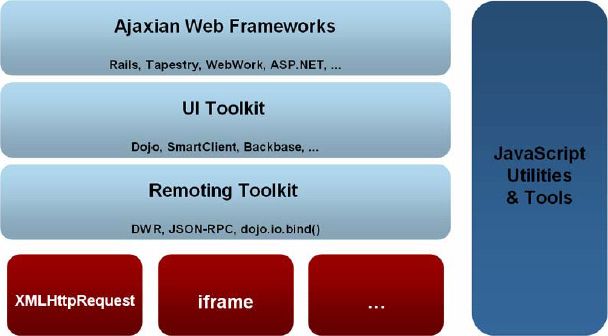
Towards Ajax frameworks
Frequently used Ajax techniques and design patterns get usually
provided by libraries, toolkits, and frameworks which make them more
easily accessible in production ready code
Ajax support in tools gets quite layered as more and more details are
shielded from the developer
Three main categories can be envisioned
Remoting toolkits
UI toolkits
Web frameworks with Ajax support
G. Piancastelli (Università di Bologna) Introduction to Ajax A.Y. 2007/2008 86 / 92Patterns and frameworks Ajax frameworks (1/2) G. Piancastelli (Università di Bologna) Introduction to Ajax A.Y. 2007/2008 87 / 92
Patterns and frameworks

Ajax frameworks (2/2)

         Remoting toolkits provide wrappers around XMLHttpRequest to
         make it more usable, adding support for error handling and automatic
         fallback for older browsers
         UI toolkits provide easy access to visual effects and to smart and
         richer widget components
         Web frameworks can be Ajax-aware in different ways: incorporating
         libraries and toolkits, with automatic code generation, or exploiting
         component technology

G. Piancastelli (Università di Bologna)              Introduction to Ajax   A.Y. 2007/2008   88 / 92
Patterns and frameworks
Using Prototype: periodic refresh
Prototype2 is a JavaScript library providing DOM extensions and
implementations for many fundamental low-level Ajax patterns
The Ajax.PeriodicalUpdater object provides a complete
realization of the periodic refresh pattern, which the developer only
needs to properly configure
new Ajax.PeriodicalUpdater(
’stockValue’,
’getStockValue.jsp?stock=’ + stockName,
{ method: ’get’, frequency: interval, decay: 0 }
)
No need to act directly on XMLHttpRequest and its
onreadystatechange property
2
Home page at http://www.prototypejs.org
G. Piancastelli (Università di Bologna) Introduction to Ajax A.Y. 2007/2008 89 / 92Patterns and frameworks
Using Script.aculo.us: one second spotlight
Script.aculo.us3 is a JavaScript library built on top of Prototype,
adding more Ajax goodies such as visual effects
The one second spotlight pattern is implemented by a single object
taking as a constructor parameter the id of the element to be
highlighted
new Effect.Highlight(’stockValue’)
Periodic spotlight can be realized in combination with Prototype’s
Ajax.Updater object and the setInterval standard JavaScript
function
3
Download it from http://script.aculo.us
G. Piancastelli (Università di Bologna) Introduction to Ajax A.Y. 2007/2008 90 / 92Patterns and frameworks
References I
Jesse James Garrett, Ajax: a New Approach to Web Applications,
Adaptive Path, 2005, available at
http://www.adaptivepath.com/publications/essays/archives/000385.php
Nicholas Zakas, Jeremy McPeak, Joe Fawcett, Professional Ajax,
Wiley Publishing, 2006
Justin Gehtland, Ben Galbraith, Dion Almaer, Pragmatic Ajax,
Pragmatic Bookshelf, 2006
Brett McLaughlin, Head Rush Ajax, O’Reilly, 2006
Ryan Asleson, Nathaniel Schutta, Foundations of Ajax, Apress, 2005
Michael Mahemoff, Ajax Design Patterns, O’Reilly, 2006
G. Piancastelli (Università di Bologna) Introduction to Ajax A.Y. 2007/2008 91 / 92Patterns and frameworks
References II
Roy Fielding, James Gettys, Jeffrey Mogul, Henrik Frystyk, Larry
Masinter, Paul Leach, Tim Berners-Lee, Hypertext Transfer Protocol
– HTTP/1.1, Internet RFC 2616, June 1999, available at
http://www.w3.org/Protocols/rfc2616/rfc2616.html
Roy Fielding, Architectural Styles and the Design of Network-based
Software Architecture, Ph.D. Thesis, University of California, Irvine,
2000
Web Appication Formats Working Group, Access Control for
Cross-site Requests, W3C Working Draft, 14 February 2008, available
at http://www.w3.org/TR/access-control/
G. Piancastelli (Università di Bologna) Introduction to Ajax A.Y. 2007/2008 92 / 92You can also read


