Invited perspectives: The ECMWF strategy 2021-2030 Challenges in the area of natural hazards - NHESS
←
→
Page content transcription
If your browser does not render page correctly, please read the page content below
Invited perspectives: The ECMWF strategy 2021-2030 Challenges in
     the area of natural hazards
     Florian Pappenberger1, Florence Rabier1, Fabio Venuti1

     1
5        European Centre for Medium-range Weather Forecasts, Reading/Bologna/Bonn, UK/Italy/Germany
     Correspondence to: Florian Pappenberger (florian.pappenberger@ecmwf.int, @FPappenberger)

     Abstract.
     The European Centre for Medium-Range Weather Forecasts mission is to deliver high quality global medium‐range
     numerical weather predictions and monitoring of the Earth system to its Member States. The modelling and forecasting of
10   natural hazards are an important part of this mission. Challenges in this areafor the future include the integration of
     innovative observations into the Eearth system, a realistic representations of water, energy, and carbon cycles, coupling and
     initialisation of all Eearth system components, adequate representation of uncertainties, supporting the development of user
     specific products to enable optimal decision making under uncertainties and advances in software engineering. The new
     ECMWF strategy identified 3 pillars to sustain its future development (ECMWF, 2021): Science and Technology (World
15   leading weather and Eearth -system science, cutting- edge technology and computational science), Impact (High- quality
     products fit for purpose, efficient and easy access to products) and People (Inspiring and hiring the best experts). several
     goals: producing world leading weather and earth-system science, cutting edge technology and computational science, high
     quality products fit for purpose, efficient and easy access to products, and aiming to inspire and hire the best experts.
     Challenges for the future include integration of innovative observations into the earth system, a realistic representations of
20   water, energy, and carbon cycles, coupling and initialisation of all earth system components, adequate representation of
     uncertainties and advances in software engineering. Progress in all these areas will need enhanced collaboration with
     Member States and partners across Europe and beyond.

     1 Introduction

     The forecasting of weather, hydrology, cryosphere, and oceans, as well as the representation of past and future climates, are
25   all key elements in the understanding and prediction of natural hazards. Forecasts of the Earth system are important to
     prepare for humanitarian disasters resulting from, for example, tropical cyclones (Emerton et al. 2020, Magnusson, 2019),
     floods (Lavers et at 2020), extreme precipitation events (Lavers et al 2018) or heat waves (Napoli et al 2020).
     Representations of the past climate, known as reanalysis, are key to establish risk i.e., return periods (Harrigan et al (2020a),

                                                                    1
natural and artificial trends (Zsótér et al 2020) as well as understanding scientific challenges. Progress in these areas can only
30 be achieved through an Earth system approach (Harrigan et al 2020b).
The vision is to achieve this by produceing cutting‐edge science, world‐leading weather predictions and monitoring of the
Earth system with a particular focus on the medium and sub-seasonal forecast range. In order toTo meet this vision, there are
several research challenges which that need addressing. The required step changes in science and forecasting can be grouped
35 into 3 pillars (ECMWF, 2021): Science and Technology (World leading weather and eEarth -system science, cutting- edge
technology and computational science), Impact (High- quality products fit for purpose, efficiently and easilyy accessed to
products) and People (Inspiring and hiring the best experts). ECMWF has been a collaborative organisation from the start
and the size of the upcoming challenges make it even more important to collaborate effectively with its Member States.
40 2 Science and Technology
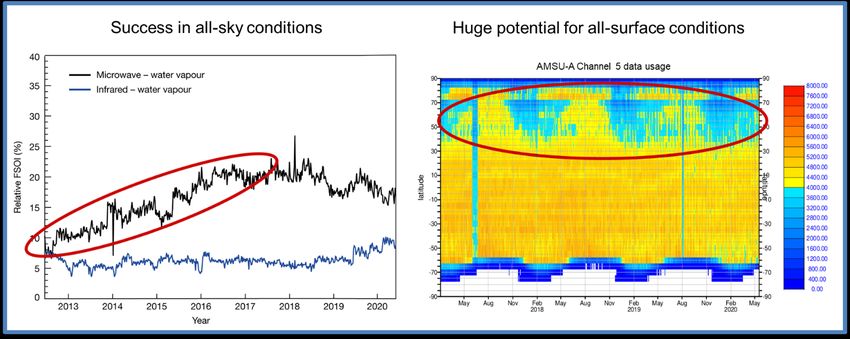
Earth system model predictions can be substantially improved if we maximise the use of current observations (Figure 1)
i.e.e.g., using all available information from existing satellites over land, snow and sea ice in cloudy, rainy and clear
conditions) (Geer et al., 2018). Newly available observations from satellites and radar, will need to be efficiently integrated
into the Earth system model. For example, the new EUMETSAT MTGs will provide high frequency atmospheric profiles as
45 well as real- time lightning detection (lightnings can cause fires). The European Commission’s Copernicus Sentinel 6
Michael Freilich (a radar altimeter satellite) will measure sea level change and river levels addressing a range of natural
hazards such as floods, storm surges and droughts. In addition, the operational use of innovative new observing systems,
e.g., derived through the Internet of Things (IoT, including observations foorom cars and, mobile phones, etc.), provides the
potential to significantly advance science and forecasts of the Earth system and natural hazards. Collaboration with the
50 Member States in this area will be particularly useful, as the use of IoT is expected to benefit short-range forecasts even
before the medium-range.
255 Figure 1: Better exploitation of satellite observations. The plot on the left shows that the relative contribution of microwave water
vapour channels to the forecast quality measured with a Forecast Sensitivity to Observation Impact (FSOI) technique. The
contribution increased dramatically from little more than 5% to approaching 20%, thanks to the development of solutions to use
microwave data in all-sky conditions. The ECMWF’s strategy aims to expand this approach to cover all-surface conditions, a
challenging but potentially very rewarding research area. The plot on the right, in fact, shows the microwave radiometer AMSU-A
60 lower tropospheric temperature (channel 5) assimilated daily at different latitudes. that iIn the northern latitudeshemisphere,
ECMWF manages to assimilate far less data from the microwave radiometer AMSU-A at high latitudes in winter than summer,
due to the current inlimited ability to use the data over surfaces like snow and ice.
65
70
These innovations must be paired with a consistent modelling approach which includes realistic representations of the water,
energyenergy, and carbon cycles. This is currently not the case for the water cycle, for example, as in current data
assimilation/forecast the mass in the system does not remain constant (principle of mass conservation, does not conserve Formatted: Font: (Default) Times New Roman, 10 pt, Font
color: Auto
75 mass (Zsótér et al 2020). The efficient coupling of many of these different processes poses a significant research challenge,
Formatted: Font: (Default) Times New Roman, 10 pt, Font
closely linked to problems such as the initialisation of a complex Earth system consisting of components like land, snow, color: Auto
rivers, oceans, and atmospheric compositions. For instance, the provision of the initial conditions of the snowpack on a
global scale, which is important for flood forecasts, can only be addressed with more real-time adequate measurements as
3well as a better physical representation of the processes in the snowpack (ECMWF currently utilizes a single layer snow
80 model).
Another essential aspect of weather forecasting is toIt is also essential to capture and represent in our predictions as many of
the model and other uncertainties as necessary by using ensemble predictions: for example, we know that many parts of the
Earth system are inadequately observed (Beven et al 2020). ,. However,but finite computing and requirements to produce
timely forecasts will only allow a limited number of ensemble members to represent these uncertainties. A chaotic, flow-
85 dependentd system will always have to rely on representing uncertainties within some sort of Monte Carlo type framework.,
future challenges do More research is needed to better include not only research into ways how represent uncertainties better
are presented but alsoand, for example, to define the optimal how large such ensembles size have to be to adequately
represent tails of the climate and forecast distribution. Other methods such as post-processing or Artificial Intelligence (AI)I
will be able to represent such uncertainties to some degree and a careful balance between these various methods has to be
90 found. The efficient coupling of many of these different processes poses significant research challenge,. problems asThis is
closely linked to the challenge of how to the initialiseation of a complex Earth system consisting of components like land,
snow, rivers, oceans, and atmospheric compositions. For instance, the provision of the initial conditions ofInitialising the
snowpack on a global scale, which is important for flood forecasts, is an example of such a challenge.
Such scientific advances must be supported by substantial technological innovations. Novel HPC architectures, both for
95 computing and storage, are required to The compute and storage power of novel HPC architectures is required to improve
the representation of processes and uncertainties. Aat the same time, existing software codes and algorithms need to be Formatted: Font: (Default) Times New Roman, 10 pt, Font
color: Auto
adapted toso that they can take advantage of these new resources and optimize (speedup and scaleup of parallel processing),
however existing large code bases to model and forecast natural hazards are ill equipped to scale for such novel
architectures. This requires significant investment in computational science, for example in the use of high-performance,
100 heterogeneous GPU/CPU architectures through domain specific languages, which will allow domain experts (such as natural
hazard scientists) to easily develop programs independently from the underlying architecture (Mernik et al, 2005). GPU
basedNovel architectures (i.e. GPU/FGPU etc) are particularly suited to be used by AIartificial intelligence and Mmachine
lLearning (ML), which will play an increasingly revolutionary role throughout the entire research and operational and
research chain, from the quality control of observations and approximation of physical equations to speed up execution, to
105 the improved representation of uncertainties in extreme natural hazards through post-processing (Duben et al., 2021). This is
another area where collaboration with the Member States will be fruitful. Finally, we will investigate Other novel ways need
to be found to address the need of increasingly compute-intensive and storage hungry forecasts and simulations, and should
therefore also includinge computing solutions beyond supercomputers. For example, the OpenIFS@home project allows
scientists to exploit spare compute cycles on desktop computers provided by volunteers to run huge ensembles offering
110 researchers a new tool to study weather forecast related questions (Sparrow et al., 2020)..
The data produced by these sophisticated systems can however be of use only if they are easily accessible and provided
reliably. Future Earth system models and forecasts will generate such large volumes of data that the only feasible way to
4extract relevant information will be to bring computing to the data rather than transfer the data to a computing infrastructure
(Pappenberger and Palkovic, 2020). This also requires research into novel ways for storing and manipulating big data
115 (Hanley et al., 2020). A typical workflow for a natural hazard forecast or model contains the following components: pre-
processing, numerical simulation, post-processing and visualization. Numerical simulations are often run on a High-
Performance Computer, whilst the other tasks are more suited to be executed in a cloud environment, although these
different technologies will converge in the future. Moving the computation to the data will have the additional benefit of
providing an environment that allows systems and workflow components to be co-designed and shared with and by the
120 Member States, stimulating the creation of an eco-system of meteorological data and applications. Research into the efficient
management and orchestration of workflows spanning these different computing environments will crucially improve the
overall performance of a forecast and model chain. This will allow a larger proportion of limited human and computing
resources to be used to improve natural hazard forecasts and models.
125 3 Impact
Advances in science and technology are only relevant within the context of an operational framework if users can maximise
the usefulness and accessibility of high-quality products and outputs. Communication and decision-making using big data
representing uncertainties remains a significant challenge which will need to be addressed to increase the impact of natural
hazard predictions and reanalysis (Neumann et al., 2018, Thielen et al., 2020). ECMWF will aim to provide detailed Earth
130 system simulations of the past, present and future. Although they may be used for different purposes, simulations at different
time scales need to be considered in a holistic way. For instance, re-analysis data may be used to establish return periods,
which in turn are used to detect weather time anomalies in forecasting or risk-based decisions on climate projections or they
may be used simply on their own for a risk analysis. A with a particular focus attention will be devoted toon extreme events
for several weeks ahead, in order toto providefor example: skilful predictions of extreme temperature anomalies and
135 hydrological impacts such as droughts and floods, air quality, fires, floods, heat and cold waves, as well as outputs which
monitor the environment (i.e., anthropogenic CO2 emissions). In addition, fForecasts of natural hazards beyond two weeks
require an improved understanding of the sources of predictability and teleconnections (Mastrantonas et al. 2020). In this
context, it is necessary to focus more strongly on a user-oriented evaluation over multiple temporal scales, variables and
coupled components which will inform the optimal pathway of model development. Indeed, user feedback especially from
140 the Member States needs to be more closely integrated into the evaluation chain to allow for cost benefit assessments and
ensure that the proportion of resources employed on all elements of the system provides maximum benefits to users. Policy
and decision makers, emergency responders in the Member States and beyond and the public in general will be able to
significantly improve their decision making when trust in forecasts is increased through metrics which are understandable
and meaning full to them (WMO, 2021, Ebert et al., 2018). A key research challenge is to generate detailed and high-
5145 resolution Earth system scenarios able to simulate the effects of different environmental policies and sustainable
development plans to derive optimal conclusions (European Commission, 2021). Each component of the Eearth system as
well as other processes factors such as environmental policies have uncertainties attached to them which will interact in
complex non-linear ways. Therefore, it is important to fully propagate and cascade all dominant uncertainties through the
entire value chain, which is key in supporting efficient user decision making.
150 The dData produced by these sophisticated systems can however only be of use only if they are easily accessible and
provided reliably and are easily accessible. Future Earth system models and forecasts will generate such large volumes of
data that the only feasible way to extract relevant information will be to bring computing to the data rather than transfer the
data to a computing infrastructure (Pappenberger and Palkovic, 2020). This also requires research into novel ways for storing
and manipulating big data (Hanley et al., 2020). A typical workflow for a natural hazard forecast or model contains the
155 following components: pre-processing, numerical simulation, post-processing and visualization. Numerical simulations are
often run on a High-Performance Computer, whilst the other tasks are more suited to be executed in a cloud environment,
although these different technologies will converge in the future. Moving the computation to the data will have the additional
benefit of providing an environment that allows systems and workflow components to be co-designed and shared with and
by the Member States, stimulating the creation of an eco-system of meteorological data and applications. Research into the
160 efficient managementing and orchestrationng of workflows spanning these different computinge environments will crucially
improve the overall performance of a forecast and model change and thus allow a larger proportion of limited human and
computinge resources to be used to improve natural hazard forecasts and models. Communication and decision-making
using big data representing uncertainties remains a significant challenge which will need to be addressed to increase the
impact of natural hazard predictions and reanalysis (Neumann et al., 2018, Thielen et al., 2020).
165 4 People
Expert and highly motivated people are the most important resource for research or operational activities to improve natural
hazard forecasts and models. The working environments are rapidly changing under the pressure and mutual influences of
technological advances, globalization and, in the last year, the effects of lockdowns. Successful organisations that which see
it as their missionaim to create step changes to advance the science and practise in natural hazards need to adapt and harness
170 the opportunities that more dynamic working conditions bring and adapt. The expansion of ECMWF’s activities in the area
of computational science and AI for numerical weather prediction means also that the organisation needs to position itself
and become attractive in a highly competitive and rapidly changing job market, which is a key to be able to address the
challenges mentioned above. ECMWF willis becominge a multi-site organisation and as such will bebe more attractive to
potential employees and existing staff as it allows for more flexibility in terms of work placeswhere people work from, while
175 aiming to maintain a “One ECMWF” culture. In parallel, ECMWF will continue to modernise its social policies with a
particular attention to It will aim to develop policies (i.e. flexible working patterns) that will fostering an appropriate work-
6life balances, e.g. via flexible working patternsand continue to modernise its social policies. ECMWF is already an
organisation with a strong environmental consciousness as it operates the Copernicus Climate Change Service, which makes
it an attractive employer. It is therefore essential However, it will aim to continue enhancinge its environmental awareness,
180 reducinge theits carbon footprint and embed environmental awareness even more deeperly in the organisational culture.
Importantly, all this can be not be achieved by a single entity such as ECMWF but will requireonly via a collaborative and
cooperative approach withacross the entire sector which includes the private sector, the European Meteorological
Infrastructure as well as other international and national partners, and the private sector.
5 Conclusion
185 ECMWF has embarked on a new strategy aiming to produce cutting-edge science and world-leading weather predictions and
monitoring of the Earth system in close collaboration with the members of the European Meteorological Infrastructure, for a
safe and prosperous society. An essential part of this strategy is to deliver forecasts of high-impact weather events and
natural hazards well into the second week and further ahead. For example, our target is to provide skilful predictions of
extreme temperature anomalies and hydrological impacts such as droughts up to three weeks ahead on average. We will need
190 to develop a high-precision digital model of our planet that will make it possible to interactively explore various natural
processes and human activities. Advancements in machine learning need to be intertwined with physical based models so
that they become indistinguishable from each other revolutionizing the European capability to monitor and predict our
changing planet, based on the integration of extreme-scale computing and the real-time exploitation of all available
environmental data.
195 In addition, ECMWF aims to support the natural hazard domain through global reanalyses and re-forecasts of weather and
environmental hazards to monitor changing patterns and predictability of high-impact events. For example, we will develop
anthropogenic CO2 emission estimation systems at global, regional and local scales with a full representation of
uncertainties to support the implementation of the international agreements such as the Paris agreement. .
The achievement of these goals is vision will require the adoption of new technologies, the integration of different areas of
200 research, extensive collaboration with National Hydro-meteorological Services and other environmental organisations in
Europe and worldwide.
References
1. Beven, K., Asadullah, A., Bates, P., Blyth, E., Chappell, N., Child, S., Cloke, H., Dadson, S., Everard, N., Fowler,
H. J., Freer, J., Hannah, D. M., Heppell, K., Holden, J., Lamb, R., Lewis, H., Morgan, G., Parry, L. and Wagener,
205 T., 2020, Developing observational methods to drive future hydrological science: can we make a start as a
community? Hydrological Processes, 34 (3). pp. 868-873. ISSN 0885-6087 doi: https://doi.org/10.1002/hyp.13622
72. Di Napoli, C., Barnard, C., Prudhomme, C., Cloke, H.L, Pappenberger, F., 2020, ERA5‐HEAT: A global gridded
historical dataset of human thermal comfort indices from climate reanalysis, Geoscience Data Journal.
3. Düben, P, Modigliani, U, Geer, A, Siemen, S, Pappenberger, F, Bauer, P, Brown, A, Palkovic, M, Raoult, B, Wedi,
210 N, Baousis, V, 2021, Machine learning at ECMWF: A roadmap for the next 10 years, ECMWF Technical
memorandum 878, doi: 10.21957/ge7ckgm
4. ECMWF, 2021, The ECMWF Strategy 2021–2030, https://www.ecmwf.int/en/about/what-we-do/strategy, last
accessed: 22/01/2021
5. Ebert, E., Brown, B. G., Göber, M., Haiden, T., Mittermaier, M., Nurmi, P., … Schuster, D. (2018). The WMO Formatted: Font: Times New Roman, Font color: Text 1,
German (Germany)
215 challenge to develop and demonstrate the best new user-oriented forecast verification metric. Meteorologische
Formatted: Font: Times New Roman, Font color: Text 1
Zeitschrift, 27, 435-440. doi:10.1127/metz/2018/0892
Formatted: List Paragraph, Line spacing: single, Numbered
4. + Level: 1 + Numbering Style: 1, 2, 3, … + Start at: 1 +
Alignment: Left + Aligned at: 0.63 cm + Indent at: 1.27 cm,
5.6. Emerton, R., Cloke, H., Ficchi, A., Hawker, L., de Wit, S., Speight, L., Prudhomme, C., Rundell, P., West, R., Neal, Font Alignment: Auto, Pattern: Clear
J., Cuna, J., Harrigan, S., Titley, H., Magnusson, L., Pappenberger, F., Klingaman, N. and Stephens, L. (2020) Formatted: Font: Times New Roman, Font color: Text 1
220 Emergency flood bulletins for Cyclones Idai and Kenneth: a critical evaluation of the use of global flood forecasts Formatted: Font: Times New Roman, Font color: Text 1
Formatted: Default Paragraph Font, Font: Times New
for international humanitarian preparedness and response. International Journal of Disaster Risk Reduction, 50. Roman, Font color: Text 1, Border: : (No border)
101811. ISSN 2212-4209 doi: https://doi.org/10.1016/j.ijdrr.2020.101811 Formatted: Font: Times New Roman, Font color: Text 1
6.7. European Commission, 2021, https://ec.europa.eu/digital-single-market/en/destination-earth-destine, last access Formatted: Default Paragraph Font, Font: Times New
Roman, Font color: Text 1, Border: : (No border)
22/01/2021.
Formatted: Font: Times New Roman, Font color: Text 1
225 7.8. Florian Pappenberger, Martin Palkovic (November 2020) Progress towards a European Weather Cloud, ECMWF Formatted: Font: Times New Roman, Bold, Font color: Text
Newsletter, issue 165, pp. 24-27. DOI: 10.21957/9pft4uy055 Formatted: Indent: Left: 1.27 cm, No bullets or numbering
8.9. Geer, AJ, Lonitz, K, Weston, P, et al. All‐sky satellite data assimilation at operational weather forecasting Formatted: Danish
centres. Q J R Meteorol Soc. 2018; 144: 1191– 1217. https://doi.org/10.1002/qj.3202
9.10. Hanley, J., Siemen, S., Hawkes, J., Vuckovic, M., Quintino, T., Pappenberger, F., 2020, Building Cloud-
230 Based Data Services to Enable Earth Science Workflows. DOI: 10.5194/egusphere-egu2020-10297
10.11. Harrigan, S., Cloke, H. and Pappenberger, F., 2020b, Innovating global hydrological prediction through an
Earth system approach. WMO Bulletin, 69 (1). ISSN 0042-9767
11.12. Harrigan, S., Zsoter, E., Alfieri, L., Prudhomme, C., Salamon, P., Wetterhall, F., Barnard, D., Cloke, H.L.,
Pappenberger, F., 2020a, GloFAS-ERA5 operational global river discharge reanalysis 1979–present. DOI:
235 10.5194/essd-2019-232
12.13. Lavers, D.A., Rodwell, M.J., Richardson, D.S., Ralph, F.M., Doyle, J.D., Reynolds, C.A., Tallapragada,
V., Pappenberger, F., 2018, The Gauging and Modeling of Rivers in the Sky, Geophysical Research Letters n. 15,
pp. 7828–7834. DOI: 10.1029/2018GL079019
813.14. Lavers, D.A.; Ramos, M.-H.; Magnusson, L.; Pechlivanidis, I.; Klein, B.; Prudhomme, C.; Arnal, L.;
240 Crochemore, L.; Van Den Hurk, B.; Weerts, A.H.; Harrigan, S.; Cloke, H.L.; Richardson, D.S.; Pappenberger, F. A
Vision for Hydrological Prediction. Atmosphere 2020, 11, 237.
14.15. Magnusson L., Bidlot J.-R., Bonavita M., Brown A.R., Browne P.A., De Chiara G., Dahoui M., Lang
S.T.K., McNally T., Mogensen K.S., Pappenberger F., Prates F., Rabier F., Richardson D.S., Vitart F., Malardel S.
(2019) ECMWF activities for improved hurricane forecasts, Bulletin of the American Meteorological Society n. 3,
245 pp. 445-457. DOI: 10.1175/BAMS-D-18-0044.1
15.16. Mastrantonas, N., Herrera‐Lormendez, P., Magnusson, L., Pappenberger, F. and Matschullat, J., 2020,
Extreme precipitation events in the Mediterranean: Spatiotemporal characteristics and connection to large‐scale
atmospheric flow patterns. Int J Climatol. Accepted Author Manuscript. https://doi.org/10.1002/joc.6985
16.17. Mernik, M., Heering, J., and Sloane, A.M., 2005 When and how to develop domain-specific
250 languages. ACM Computing Surveys, 37(4):316–344, 2005. doi:10.1145/1118890.1118892
17.18. Neumann, J., Arnal, L., Emerton, R., Griffith, H., Hyslop, S., Theofanidi, S. and Cloke, H., 2018, Can
seasonal hydrological forecasts inform local decisions and actions? A decision-making activity. Geoscience
Communications, 1. pp. 35-57. ISSN 2569-7110 doi: https://doi.org/10.5194/gc-1-35-2018
18.19. Sparrow, S., Bowery, A., Carver, G.D., Köhler, M., Ollinaho, P., Pappenberger, F., Wallom, D.,
255 Weisheimer, A., 2020, OpenIFS@home version 1: a citizen science project for ensemble weather and climate
forecasting. DOI: 10.5194/gmd-2020-217
20. Thielen-del Pozo, J., Autogena, L, Portway, J., Pappenberger F., (March 2020) The science-policy interface – in
need for "society" as a third component. DOI: 10.5194/egusphere-egu2020-21623
19.21. WMO, (2021), WMO project on High Impact Weather, http://hiweather.net/Lists/15.html, last accessed
260 20/04/2021
20.22. Zsótér, E., Cloke H., Stephens E., DE ROSNAY P., Muñoz-Sabater J., Prudhomme C., Pappenberger F.
(2019) How well do operational numerical weather prediction configurations represent hydrology?, Journal of
Hydrometeorology n. 8, pp. 1533-1552. DOI: 10.1175/JHM-D-18-0086.1
21.23. Zsótér, E., Cloke, H. L., Prudhomme, C., Harrigan, S., de Rosnay, P., Munoz-Sabater, J. and Stephens, E.,
265 (2020) Trends in the GloFAS-ERA5 river discharge reanalysis. ECMWF Technical Memoranda. 871. Technical
Report. ECMWF doi: https://doi.org/10.21957/p9jrh0xp
9You can also read


