John Chowning Turenas 1972 - Brahms IRCAM
←
→
Page content transcription
If your browser does not render page correctly, please read the page content below
Document printed Sat 10 Aug 2019 00:17                                                                   IRCAM

                                                John Chowning
                                                   Turenas
                                                     1972
                                                  Turenas Live concert Stanford 2014
                                                                    2016

                                            The setup and the execution of the electroacoustic part
                                         of this work requires a Computer Music Designer (Max expert).

                                                                    1 / 10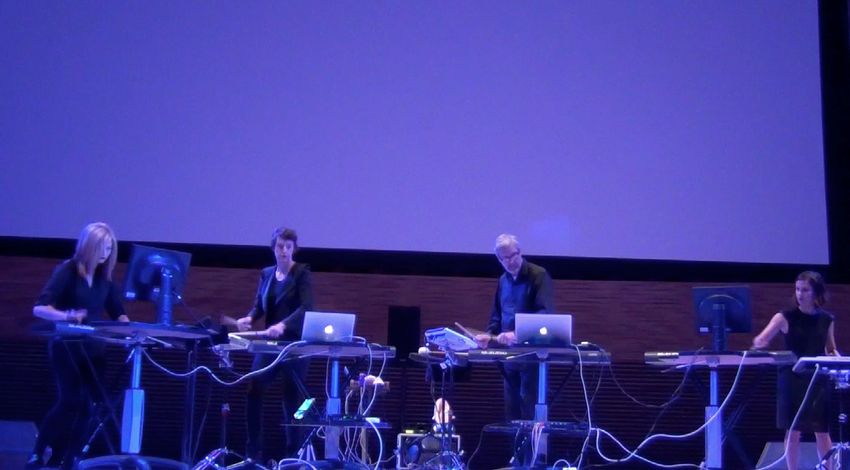
Document printed Sat 10 Aug 2019 00:17                 IRCAM

Table of content

     Work related information                      3
           Performance details                     3
           Useful links on Brahms                  3
     Version related information                   4
           Documentalist                           4
           Realisation                             4
           Upgrade Motivation                      4
           Other version(s)                        5
           Electronic equipment list               6
           Files                                   7
     Instructions                                  8
           Audio setup                             8
           Loudspeaker setup                       8
           Midi setup                              8
           Software installation                   9
           System calibration and tests            9
           Initialization routine                  9
           Patch presentation                      9
           Performance notes                       9

                                          2 / 10
Document printed Sat 10 Aug 2019 00:17 IRCAM
Work related information
Performance details
• Jan. 1, 1972, États-Unis, Université Stanford
Publisher : Inédit
Useful links on Brahms
• Turenas pour électronique (1971-1972), 10mn
• John Chowning
3 / 10Document printed Sat 10 Aug 2019 00:17 IRCAM
Version related information
Performance date: Oct. 26, 2014
Documentation date: Aug. 28, 2016
Version state: Documented
Documentalist
You noticed a mistake in this documentation or you were really happy to use it? Send us feedback!
Realisation
• Laurent Pottier (Computer Music Designer, Arranger)
Version length: 10 mn
Default work length: 10 mn
Upgrade Motivation
Version 7 (26 oct. 2014) : concert à Stanford (triple CCRMAlite), Patchs Max V1.40, diffusion 8HP.
Diffusion sur 8 HP en cercle autour du public.
Un seul ordinateur DSP (le second seulement pour contrôle gestuel musiciens 3 et 4).
Interprètes : Chryssie Nanou , Mark Veregge , Jessie Marino , Mckenzie Camp
Note de programme :
TripleCCRMAlite 40, 50, 80
A triply jubilant occasion
On the occasion of the 40th anniversary of CCRMA, the 50th anniversary of the first computer music piece
played at Stanford via punch cards from Max Mathews at Bell Labs, and the 80th birthday of John
Chowning
Turenas (arranged for live performers by LAURENT POTTIER)
Electronic percussion and keyboards:
Mckenzie Camp
Jessie Marino
Chryssie Nanou
Mark Veregge
Turenas is a masterpiece in the history of computer music. Written in 1972 by John Chowning, it introduced
and combined what were then two revolutionary technologies: FM synthesis and sound spatialization. All
the piece's sounds were synthesized by a computer using the FM synthesis technique developed and
4 / 10Document printed Sat 10 Aug 2019 00:17 IRCAM
described by the composer himself a few years earlier. It was also a piece in which sounds were spatialized
and moved around the audience using the concept of virtual acoustics.
Until now, Turenas existed as a piece of electroacoustic music for 4-channel tape. Through meticulous
analysis, Laurent Pottier has recreated at CIEREC (France) all the synthesizers used for the original, and
realized a version for four percussionists. He presents today a new version of the piece (US version) where
all sounds are synthesized and controlled in real time by the musicians.
Other version(s)
• John Chowning - Turenas - Turenas Live concert Tours 2011 (Aug. 28, 2016)
• John Chowning - Turenas - Turenas Live concert Bordeaux 2014 (Aug. 28, 2016)
• John Chowning - Turenas - Turenas Live concert Beijing 2015 (Aug. 28, 2016)
• John Chowning - Turenas - Turenas Live concert Shanghai 2015 (Aug. 28, 2016)
• John Chowning - Turenas - Turenas Live pour quatre percussions et claviers électroniques (Nov. 26,
2014)
• John Chowning - Turenas - transfert_mustica_ftp (April 14, 2010)
5 / 10Document printed Sat 10 Aug 2019 00:17 IRCAM
Electronic equipment list
Audio Equipment
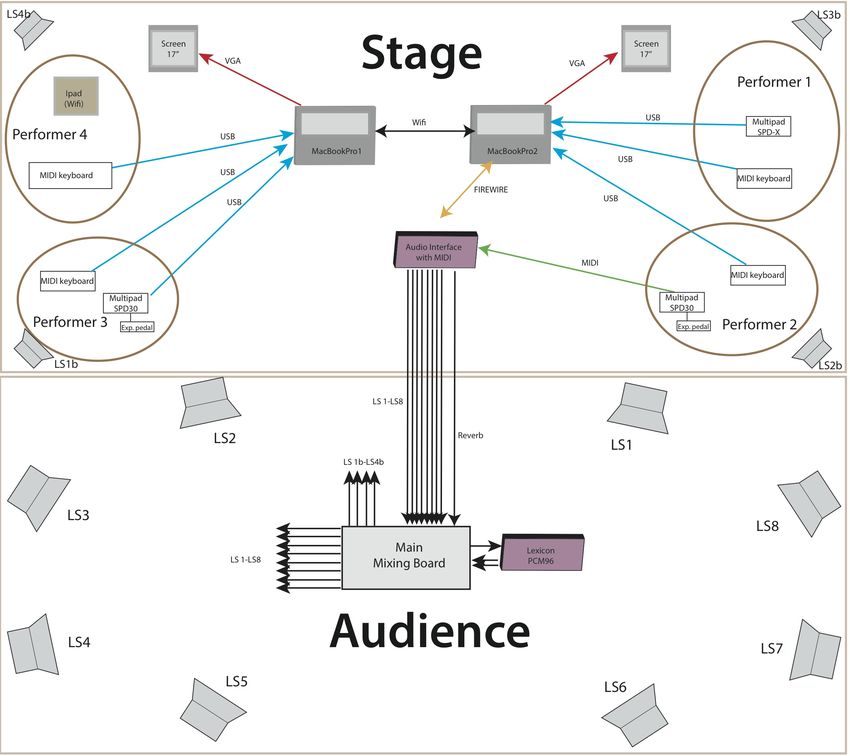
• 4 Transducers - Transducers MIDI keyboards with 8 sliders (cc) and 8 buttons (pgm)
• 1 Transducers - Transducers Motu Traveller interface audio 10 sorties
Computer Music Equipment
• 2 MacBook Pro - Apple Laptops (Apple) MacOS10.5-10.10
• 1 iPad - Tablets (Apple) avec touchOSC
• 2 SPD-S Sampling Pad - Sampler (Roland)
• 1 Octapad SPD30 - Pad (Roland)
Video
• 2 Screen 17 pouces
6 / 10Document printed Sat 10 Aug 2019 00:17 IRCAM
Files
File Type Author(s) Comment
Patch Patch Laurent Pottier Patchs V1.40
Performance
Notice pour interprétes Laurent Pottier Notice pour interprétes
documentation
Partition Score Laurent Pottier partition
7 / 10Document printed Sat 10 Aug 2019 00:17 IRCAM
Instructions
Audio setup
Loudspeaker setup
Location of speakers. One octophonic layout around the audience and a quadriphonic around performers on stage.
Midi setup
8 / 10Document printed Sat 10 Aug 2019 00:17 IRCAM
Most equipment are directly connected via USB to computers, except Roland SPD-S which are connected to MIDI
audio interfaces.
WIFI connection between the two computers and with the IPAD
Software installation
Max/MSP 5, 6 ou 7 versions
System calibration and tests
White noise on the two circles of speakers.
Test the reverb on the first sounds that musician 1 and musician 4 have to play (reverb : hall 3.5 to 4.5 sec
depending on the acoustic).
Initialization routine
Assign MIDI instruments on both patches.
Each performer must tests the MIDI messages (notein, ctlin and pgmin) on each device.
Before starting, everyone calls the preset # 1.
Musician 2 is the leader and starts playing the score (goto 0 then press "P" to start)
Patch presentation
Two computers are used (synchronized via OSC on a local Ethernet network). Two different patches :
"turenasPatchLeeMarDSP-V140.maxpat" for computer 1 and "turenasPatchLeoRemiSsDSP-V138.maxpat" for
computer 2. From the main window of the patch, open the partition (button "front : Partition").
On the "front: Presets" button, click on "(0) MIDI MATERIAL CONNECTED" and properly distribute MIDI
equipment.
Performance notes
The most complex parts of the score (part3, part4, part5) are not necessarily played "literally" (originally they were
produced by random generators), but in the spirit of the score. When the density decreases, performers must be
closer to what is written. The nuances are important, listening to others too.
Each player controls its own volume (controller 7 on channel 1), so mixing is managed on stage. No intervention on
the patch by a RIM or a sound engineer during the concert. Only general control on volume and reverb.
9 / 10Document printed Sat 10 Aug 2019 00:17 IRCAM
Version documentation creation date: Aug. 28, 2016, 9:08 a.m., update date: May 3, 2018, 6:22 p.m.
10 / 10You can also read


