Jonas E. Salk Elementary School School Improvement Plan 2009-2010
←
→
Page content transcription
If your browser does not render page correctly, please read the page content below
Jonas E. Salk Elementary School
   School Improvement Plan
           2009-2010

                                  1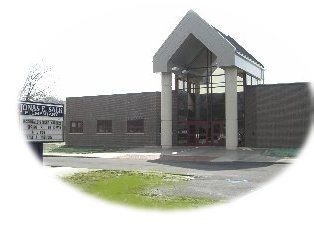
Jonas E. Salk Elementary School

Community and School Profile

                                  2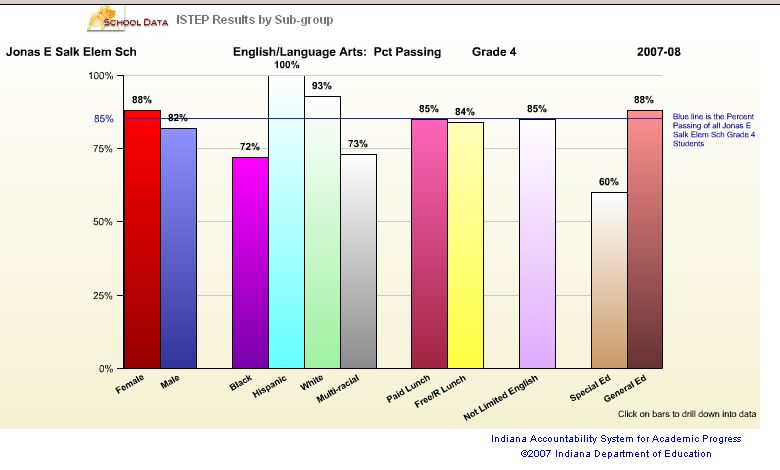
Introduction

A. Community and School Profile

Jonas E. Salk Elementary School is located in the northwest corner of Indiana in the town of Merrillville. Merrillville covers 35 square miles in
Lake County and ranks 22nd in community size in the state. It is part of the Gary Metropolitan Statistical Area. It is bordered by Crown Point to
the south, Hobart to the east, Gary to the north, and Griffith and Schererville to the west.

Merrillville is primarily a residential community with a population of approximately 35.000. Many residents commute to either the industrial
areas of north Lake County, Porter County, or to Chicago for employment. Neighboring Salk School, the median sale prices of homes in the
Lincoln Gardens subdivision is $110,000, and the median sale price of those in the Independence Hill area is $95,000.

Salk School is one of five public elementary schools in the Merrillville Community School Corporation. The building was constructed in 1960,
followed by a series of additions and improvements in 1961, 1963, 1967, 1969, 1982, and 2005. Renovation was completed in 2007 with the
addition of 13 new classrooms including two computer labs, science lab, and multi-purpose room.

Salk School has an enrollment of 539 students in grades K- 4. The male/female ratio is 50 per cent male and 50 per cent female. Forty-two
percent of the students receive free lunches and twelve percent receive reduced-price meals. The ethnic background of the students is 42 percent
Caucasian, 13 percent Hispanic, 36 percent African-American, 2 percent Asian, and 8 percent multi-racial.

Although the number and the diversity of Salk families remains relatively stable. Our stability index is 84%.

The Merrillville School Corporation reduces overcrowded classrooms in other elementary schools by placing new students in classrooms of
another school with fewer students.

Our Principal, Kara S. Bonin, has been an educator for the past 15 years, serving as teacher at the elementary and middle school level.
She is completing her 5th year as principal.

There are 25 classroom teachers with an average class size of 22 students in K-4. 28% percent of the teachers have been at Salk over 25 years.
Ten teachers hold master’s degrees in education and ten have special endorsements or additional endorsements.

Nine certified employees provide instruction or services in art, physical education, music, Remedial reading, support services, speech therapy,
and in the learning disabilities of mild and moderate mental handicaps. English for the foreign-speaking services are provided at another
elementary.

                                                                                                                                               3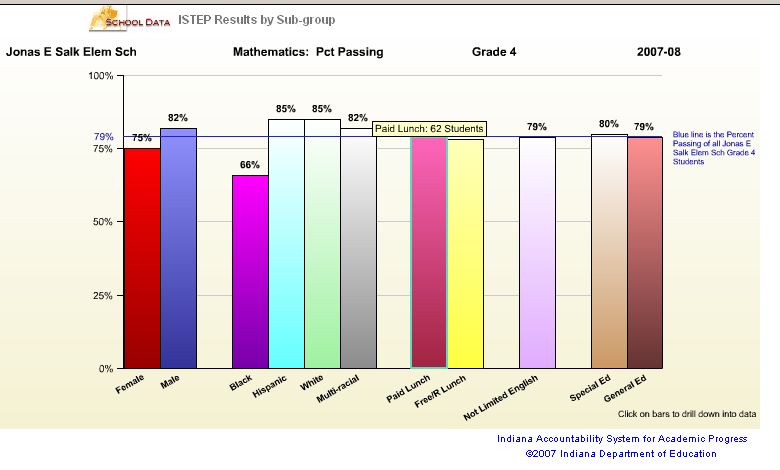
Salk School provides two moderate mentally handicapped classrooms. These are self-contained classrooms. One class serves the primary level
students, and the other class serves the intermediate students. These classes serve all designated students in the Merrillville district. In addition,
there is a resource room with an LRE teacher serving all grade levels.

The support staff includes one full-time secretary, one part-time secretary, a computer technology aide, a full-time media clerk, and a
behavioral/instructional aide, a cafeteria staff of four and four custodians. There are 7 aides for playground and cafeteria supervision. A full-
time teacher aide is responsible for photocopying, laminating, and meeting other various teacher needs. A full-time school nurse is in the
building. . Four para-professionals assist students with special needs.

Salk School continues to house the Honors program for the elementary schools. Students from each of the five elementary schools are selected at
the end of second grade to participate in a self-contained gifted-talented program in grades three and four.

In order to keep communication open between parents and staff, we have parent conferences and a parent information line, which informs
parents of student homework assignments, information regarding lunch, school calendar and other activities. To better communicate with
parents, a Synre phone system has been installed. Monthly principal newsletters, P.T.O. newsletters and monthly meetings with principal and
P.T.O board members also allow communication between school and home.

Every day that school is in session, after-school extended day care is available. An all day program for pre-school children of working parents
from 6:00 a.m. to 6:00 p.m. is provided.

After-school programs, which include Girl Scout and Boy Scout after-school activities; Young Rembrandts and Merrillville Jr. Pirate basketball,
are held in the evenings.

B. Description and Location of Curriculum
The curriculum for language arts, math, social studies, science, art, music, and physical education is based on the Indiana Academic Standards.
We have created curriculum maps for math, social studies, and science. All of the certified staff, K-4, has been instructed in 4-block language
arts program, power writing program, 6+1 Traits, mental models, and mastering math facts program and are implemented daily in the classroom
The Baldrige Integrated Management System as the basis for the design of the curriculum. Copies of the curriculum are located in the classroom,
central office of the Merrillville School Corporation, the office of Salk School, and the Merrillville Corporation website. Updated copies are
distributed as needed.

                                                                                                                                                    4
C. Assessment Instruments
The Indiana Statewide Testing for Educational Progress-Plus (ISTEP+) is given to all third and fourth grade students. The Northwest Evaluation
Association, NWEA, test is given to all Grade 2 students in the spring.. The results are shared with the parents. A record is kept on the progress
of each student as an individual from year to year which is the purpose and focus of the test.
ISTAR is used to evaluate MOMH students in third and fourth grade.
Universal screening of all students is conducted 3x a year. For grade 2-4, the Rigby Reads Assessment for comprehension is used. Dibels is used
in grades K-4. The Merrillville Community School Corporation Kindergarten Readiness test is given to all incoming kindergarten students.
In the year 2009-2010, Aquity will be used for grades 2-4, and the Scholastic Reading Inventory will be used for grades 1-4. Formal and informal
running records will also be given by teachers in grades K-4. In the spring Metropolitan Early Childhood Assessment is given in the spring to all
kindergarten students. Results are used from these various assessments to identify Title 1 and Remedial Reading students and possible students
for RTI. Assessment results are provided to parents, while teachers use assessments to create flexible grouping for Guided Reading.
Students in grades 1-4 are evaluated on math Power indicators. They are regrouped for remediation and enrichment. Quarterly math
assessments are conducted.
5Jonas E. Salk Elementary
School Vision and Mission Statement
6II. Statement of Vision and Mission
Merrillville Community School Corporation Vision Statement
At the crossroads of Northwest Indiana, the Merrillville Community Corporation creates a hometown feeling in a metropolitan area. This sprawling school community,
nestled in comfortable neighborhoods settings, offers attractive, well-maintained and safe schools and a comprehensive curriculum with state-of-the-art technology. A
wide range of educational programs and activities are equally available to all, from pre-school to senior citizens. Families are woven into a tapestry representing various
ethnic, racial and religious traditions united by the common bond of seeking a quality education for community.
People feel a close connection to the school system due to the emphasis on communication. Communication is the core that allows for a collaborative relationship among
the school staff, parents and community. These relationships foster and support the learning experiences that challenge each student at a level appropriate to the
individual’s needs and interests.
The Merrillville community has long enjoyed a reputation for the professional competence and character of it faculty, staff and administration. The professional staff
understands and accepts personal responsibility for achieving the mission of the school corporation. The school system is committed to designing an organization of
learning that seeks continuous improvement and quality, resulting in highest student achievement. Clearly written goals, aligned with rigorous academic standards, have
been established that go far beyond the minimum standards required by the Indiana Department of Education. These goals also focus on developing independent, life-
long learners and responsible, productive citizens.
Learning environments throughout the school corporation are energized by a sense of awe, curiosity, and enthusiasm generated by knowledgeable, caring adults who
ignite and sustain the desire to learn. Teachers who use a wide range of teaching methods cause students to become inspired learners. Students find the content of their
subjects to be meaningful and applicable to the next stage of their development as learners. Each student is motivated to take ownership for learning resulting in the
mastery of basic skills, literacy in a wide range of subjects and proficiency in the use of technology.
Students are able to make intelligent academic, personal and career choices as a result of individual counseling and community-based learning opportunities. Career
exploration activities are provided through internships and mentoring with local business people, civic leaders and government officials. Other interests are pursued
through participation in curricular and co-curricular activities. Upon graduation, students are then prepared to further their vocational and academic goals leading to
productive and satisfying career choices.
Parents are actively involved in the education of their children and have entered into a highly functional partnership with the schools. The school system provides
excellent communication to homes so that parents feel fully informed about their student’s educational plan and progress toward its fulfillment. Exemplary programs are
available to parents who seek more knowledge and skills related to effective responsible parenting. Parents take responsibility for knowing and supporting school policies
and classroom standards. They establish and maintain high expectations for scholarship and citizenship.
7Parents enthusiastically support their students in activities by attending school programs and events. They further support the schools by working as volunteers in a wide
variety of ways that enrich the school district’s capacity to provide opportunities for all it students.
Citizens served by the Merrillville Schools take pride in the cultural diversity of their school community. Individuals respect the heritage and traditions of the many
groups living compatibly together. People feel their school system provides equal opportunities for all, values everyone’s input, and is fair and just. The Merrillville
community School Corporation exists to uphold this vision.
Jonas E. Salk Vision Statement
Salk School is a safe and welcoming environment where everyone abides by the Pirate Code by being responsible, respectful, and safe. Researched based best practices
are used for both instructional and behavior purposes. These strategies will close the achievement gap while facilitating highest student achievement.
Belief Statements
• We believe it is our job to facilitate students to become independent learners and thinkers
• We believe that education should be interesting and fun
• We believe in teaching all students the necessary skills to be successful both in school and in life
• We believe in building positive relationships with the entire Salk family
• We believe in providing a safe, caring place to learn
Jonas E. Salk Mission Statement
In collaboration with parents and community, we will:
• Create a respectful, supportive, and safe environment
• Assist students to strive towards mastery of academic standards
• Prepare students to be responsible and productive citizens
8Jonas E. Salk Elementary
Data Analysis
ISTEP+ NWEA DISCIPLINE ATTENDANCE WRITING
QUARTERLY ASSESSMENTS
9III. DATA SUMMARY
The status of the educational programming at Jonas Salk Elementary is derived using data collected from a variety of lagging and leading
measures. The ISTEP+ (3rd and 4th grades) is the lagging measure used to assess academic achievement of students. Leading measures used
to assess the success of the educational programming at Jonas Salk Elementary include classroom tests, benchmark reading levels, individual
indicator tests for math, and quarterly math assessments. Attendance and discipline data is also collected to complete the educational
programming picture of Salk.
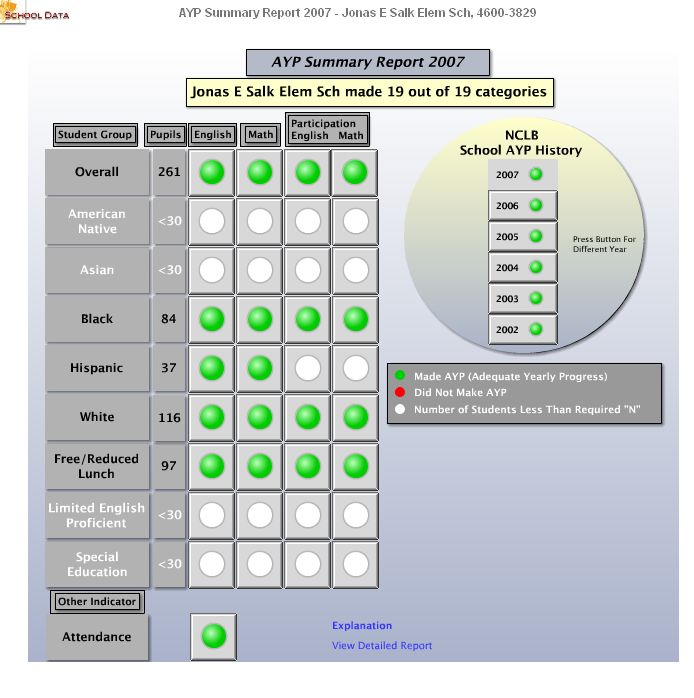
2008 ISTEP+ SUMMARY OF RESULTS
3rd Grade
83% of all students passed English/Language Arts and 80% passed Math. There were no significant gaps in ELA. However, in math,
there is a significant gap between our African American Students and Caucasian students (71% and 85%) .
104th Grade
84% of all students passed English/Language Arts and 82% passed Math. There is significant gap in ELA academic achievement
among 4th African American and Caucasian students (81% and 90%) and male and female students (82% and 92%). In math
achievement, there is a significant gap between African American and Caucasian (72% and 88%).
2008 SPRING NWEA SUMMARY OF RESULTS
2nd Grade
Overall, the 2nd grade students scored below the National norms in the areas of reading and math. Areas of concern include
computation, Vocabulary, and writing application.
TECHNOLOGY USAGE
Classrooms attend the computer lab once a week for 40 minutes. Jonas Salk Elementary has a 98% attendance rate for scheduled computer
times. A technology map is used for technology curriculum.
ATTENDANCE
Attendance continues to be an area of concern. Jonas Salk Elementary average attendance percentage for 2008-2009 school year was 95.8%.
This is below the state average.
DISCIPLINE
A referral may be given by the teacher, aides, or principal. A student that has received a referral receives one of the following consequences:
recess detention, lunch detention, isolation, or timeout. They may also have received an in-school or out-of-school suspension. As of April
22, 2009 , there have been 518 referrals.
1112
13
14
15
16
17
18
19
20
21
22
23
24
Salk - Grade 3
                      Percent Passing ISTEP

100

                           91                   92
 90                        89
                 87
                                                83              82
 80                                                     81      80
                 79
         76                                             76
         73
 70

 60

 50

 40

 30

 20

 10

  0
      2002    2003      2004              2005       2006    2007

                                Eng/LA   Math

                                                                     25
Salk - Grade 4
Percent Passing ISTEP
100
93
90
86 86 85
83
80 79
78
73
70
60
50
40
30
20
10
0
2004 2005 2006 2007
Eng/LA Math
26Achievement GAP
English - Grade 3 Salk
Percent Above Standard
100
95
92 93
90 91 91
88 88 87
86 86 85
83 83
80 81 80 80
79
77
72
70
68
60
56
53
50
40 40
30
20
10
0
2001 2002 2003 2004 2005 2006 2007
Caucasian Hispanic African American Free and Reduced Lunch Special Education
27Achievement GAP
English - Grade 4/Salk
Percent Above Standard
120
100 100
98
95
92 93
90 90
87
86 85
84 84
82
80 80
72 71 72
69
60 60
40
20
0
2004 2005 2006 2007
Caucasian Hispanic African American Free and Reduced Lunch Special Education LEP
28Achievement GAP
Math - Grade 3 Salk
Percent Above Standard
100 100
95
90 91
89
88 88 88
87 87
85 85
n/a n/a 83 83
80 80 80
77
73
70 71
67 68 67
60
50 50
40 40
30 30
20
10
0
2001 2002 2003 2004 2005 2006 2007
Caucasian Hispanic African American Free and Reduced Lunch Special Education LEP
29Achievement GAP
Math - Grade 4/Salk
Percent Above Standard
120
100 100
95
90 90
88
85
82 83
80 80
78 78
74
73
71
69
66 66
60
56
40
20
0
2004 2005 2006 2007
Caucasian Hispanic African American Free and Reduced Lunch Special Education LEP
30ISTEP WRITING APPLICATION DATA
0 1 2 3 4 5 6
2007
Grade 3 0 0 7 32 37 20 4
Grade 4 0 0 2 20 60 17 1
2006
Grade 3 0 1 5 24 59 11 0
Grade 4 0 0 1 23 73 3 0
2005
Grade 3 0 3 30 49 11 3 0
Grade 4 0 3 28 47 17 2 0
Third Grade ISTEP+: Math
Applied Skills Frequency Distribution
Item # Points Poss. 0 Pts. 1 pt. 2 Pts. 3 Pts.
Number sense 2 2% 4% 95%
Number Sense 2 30% 5% 65%
Problem solving 3 8% 36% 33% 23%
Problem solving 2 31% 32% 37%
Problem solving 3 25% 5% 14% 54%
Problem solving 2 77% 4% 19%
Problem solving 3 10% 26% 59% 5%
Geometry 2 22% 62% 16%
Fourth Grade ISTEP+: Math
Applied Skills Frequency Distribution
Item # Points Poss. 0 Pts. 1 Pt. 2 Pts. 3 Pts.
Algebra and functions 2 33% 30% 35%
Measurement 2 13% 19% 68%
Problem Solving 2 61% 10% 28%
Problem Solving 3 37% 9% 19% 34%
Problem solving 2 42% 27% 29%
Number sense 2 12% 34% 54%
Number Sense 2 22% 44% 32%
Geometry 2 51% 19% 29%
Computation
31
2 40% 19% 40%
Computation 2 28% 34% 36%
Problem Solving 2 66% 6% 28%32
Second Grade NWEA Mean RIT Score

            200

            198

            196

            194

            192
RIT Score

                                                                                 Language
                                                                                 Math
                                                                                 Reading
            190

            188

            186

            184

            182
                  2002   2003   2004       2005        2006        2007   2008

                                                                                            33
3rd Grade NWEA Mean RIT Score
210
208
206
204
202
RIT Score
Language
Math
Reading
200
198
196
194
192
2002 2003 2004 2005 2006 2007 2008
344th Grade NWEA Mean RIT Score
218
216
214
212
RIT Score
Language
Math
Reading
210
208
206
204
2002 2003 2004 2005 2006 2007 2008
35English/Language Arts - Grade 3
Spring NWEA Predicting Fall ISTEP 2007
100
94
90
90
84
80 81
80 78
74
71 72
70 68
60 58 57
56 55
51
50
44 45
43
41
40 38
30
20
10
0
Fieler Iddings Miller Salk Wood
Spring NWEA Rdg Spring NWEA LA Spring NWEA Rdg+LA Fall ISTEP
36English/Language Arts - Grade 4
Spring NWEA Predicting Fall ISTEP 2007
100
90
85
80
80 77 76
73 74 74 73
72 71
70 67
65 64 65 65
60 59
60
55
53
51
50
40
30
20
10
0
Fieler Iddings Miller Salk Wood
Spring NWEA Rdg Spring NWEA LA Spring NWEA Rdg+LA Fall ISTEP
37Mathematics - Grade 3
Spring NWEA Predicting Fall ISTEP 2007
100
90
84
82
80 77
69
70 67
60
51
50
45
42 41
40 37
30
20
10
0
Fieler Iddings Miller Salk Wood
Grade 3 Math Spring NWEA Grade 3 Math Fall ISTEP
38Mathematics - Grade 4
Spring NWEA Predicting Fall ISTEP 2007
100
90
79
80 76
75 74
72 71
70
62
60
54
52
50
43
40
30
20
10
0
Fieler Iddings Miller Salk Wood
Grade 4 Math Spring NWEA Grade 4 Math Fall ISTEP
39Discipline Violations Longitudinal Data
2004- 2005- 2006- 2007-
2005 2006 2007 2008
Refusing to Follow Directions 63 39 35 174
Does Not Keep Hands, Feet, Objects to Self 30 27 27 81
Disrespectful to another student 17 22 29 28
Use of Improper/Inappropriate language 6 18 10 42
Excessive Talking in class, cafeteria, hall 19 4 4 144
Cheating on class assignment or test 8 0 10 19
Repeatedly not finishing homework 236 239 206 1
Disrepectful to adult 28 13 15 58
Lying to someone 6 5 8 27
Fighting 18 28 33 16
Threatened to harm another student 11 3 12 10
Throwing food in cafeteria 2 0 0 0
Comet to school after the starting bell 37 82 225 0
Major or minor vadalism to school 2 5 2 7
Stealing 5 5 4 14
Misbeahving on school bus 4 1 2 18
Forging or attmepting to forge someone else 7 0 4 3
Miscellaneous behavior vilation and/or severe 5 3 3 5
Possession of deadly weapon/look alike 1 1 1 1
40Behavior Referrals
180
160 161
140 142
120
Number of Referrals
100
2005-2006
2006-2007
2007-2008
80
75
64
60 60 58
51 52
45
40
30 32
29 29
28 29 27
24 24
20 21
19
18
10 10 9
0
Aug/Sept. Oct. Nov. Dec. Jan Feb. March April
41Jonas E. Salk School (K-6)
2007-2008 Annual Quality of Education Parent Survey
We appreciate your willingness to take a few minutes to complete this short survey. Your thoughtful responses to each of the items will help us to improve further the quality of education that is provided to our
students and your children. Please return the completed survey to the school in the report card envelope no later than April 7, 2006.
Strongly Agree Disagree Strongly Do not
Agree Disagree know
1. I feel welcomed in my child’s school. 105 33 1 0 1
2. My child is safe at school. 98 41 0 0 0
3. The school meets the social needs of my child. 82 53 4 0 1
4. The school meets the academic needs of my child. 94 43 1 1 1
5. The school expects quality work from my child. 100 38 0 1 1
6. The school succeeds in preparing my child for the ISTEP+ test. 85 37 3 0 13
7. The school provides sufficient and appropriate information regarding my 89 47 4 0 0
child’s progress.
8. The school provides regular communication to me about school news, 82 54 3 1 0
activities, and events.
9. School staff maintain consistent discipline which is conducive to learning. 81 52 4 0 3
10. The school provides challenging instruction in the language arts (reading, 81 52 2 1 3
writing, listening, and speaking.)
11. The school provides challenging instruction in mathematics. 85 49 3 1 2
12. The school provides challenging instruction in science. 75 50 4 0 11
13. The school provides challenging instruction in social studies (geography, 75 51 2 0 11
history, ….).
14. The school prepares my child to use computers and technology. 91 43 2 0 4
15. The school is preparing my child to be successful in the future. 86 49 3 0 1
16.The school staff encourages children to be respectful and responsible. 108 32 0 0 0
17. Students are treated equally and fairly. 84 49 5 0 2
42Jonas E. Salk Elementary
Current Status of Educational Programming
43A. SCHOOL CURRICULUM AND STATE STANDARDS
Salk school is committed in seeking continuous improvement and quality in achieving highest student achievement. The curriculum in each
core academic area is aligned to the Indiana Academic Standards. A committee is used to determine which textbooks are best aligned with
the State Standards and provide appropriate instruction for struggling, average, and accelerated students. Supplemental materials are used to
complete pieces that may be weak or missing from adopted textbook programs. In order to align all grade levels and schools, curriculum maps
are used in Social Studies, Math, and Science. It is the goal of the corporation to create a curriculum map for all core subject areas. To
further align the curriculum with the state standards, the Merrillville Community Schools Writing Rubric, K-12, was developed. In order to
promote reading comprehension, the Required Reading program also aligns books recommended by the state to the Merrillville reading
curriculum.
Teachers meet on a regular basis to discuss the curriculum, identify where skills are or are not being learned and develop a plan that will
assure improved student learning in the future. Grade levels work collaboratively to provide tutorial, maintenance, and enrichment for
students throughout the school year. Focus Meetings are held monthly to discuss curricular and instructional strategies that are working in
the classroom.
Merrillville Community Schools offers a summer school program with a strong focus on essential skills. This program helps prepare students
for taking the ISTEP+ in the fall.
B. INSTRUCTIONAL STRATEGIES AND STATE STANDARDS
A variety of instructional strategies are used to promote student learning that is aligned with the Indiana Academic Standards. Teachers at
Jonas Salk Elementary will be using Rigby’s, “Literacy by Design” balanced literacy textbook to teach reading. Power Writing, 6+1
Traits and the Merrillville Community Schools writing rubrics are two of the tools used to teach writing. In Kindergarten, Rigby and the
Jolly Phonics series will be used for reading instruction and Handwriting Without Tears program are used for handwriting.
SSP: Student Success Process for Math is used in grades 1-4 for math instruction. Think, Solve, and Explain, Mountain Math, Daily Oral
Math, and Math Facts Made Easy are just a few of the instructional strategies used to teach the Indiana Academic Standards in math.
A variety of supplemental programs encourage students to continue working on skills aligned with the Indiana Academic Standards.
Academic extensions of the classroom include: Spell. Bowl competition, Book-It, Pirate Reading Program, Six Flags Reading Club,
planetarium instruction, curricula-related field trips, and special school-wide assemblies.
44In the classroom, teachers differentiate instruction to meet the needs of all learners. Instructional strategies, such as hands-on activities, visual
aides, field trips, and role-playing create an excitement for learning in the classroom. Teachers also meet the needs of individual students
through small-group or one-on-one instruction.
The Baldrige Quality Schools principles are the framework for continuous school improvement. Baldrige strategies place the ownership of
learning on the learner. Each classroom creates a mission statement. Classrooms and students set goals and chart improvement in areas of
work habits, attendance, and behavior. Mental Models, such as flowcharts, are used to provide structure to classroom procedures.
The honors program for 3rd and 4th grade students is housed at Jonas Salk Elementary. Both an accelerated and enrichment curriculum is
used. A novel based approached in used in both classrooms for reading instruction. Both classrooms, with access to laptop computers, use
technology extensively for all subject areas.
C. ASSESSMENT OF STUDENT ACHIEVEMENT
Student achievement is assessed using both lagging and leading measures. The two lagging measure are the ISTEP+ and Northwest
Evaluation Association’s Measure of Academic Progress (NWEA-MAP). The ISTEP+ test is taken in the Fall and is given to all 3rd and 4th
grade students. Students in grades 2-4 take the Northwest Evaluation Association’s Measure of Academic Progress (NWEA-MAP) in the
Spring
There are a variety of leading measures used to monitor student achievement. In Kindergarten, the Brigance and Peabody Picture and
Vocabulary test are administered twice each year. The Metropolitan Readiness test is given once each year. . Teacher-created tests, math
indicator quizzes, quarterly assessments in math, bi-monthly writing assessments, and daily math fact quizzes also provide important
information in assessing student improvement. Data from these assessments are used to evaluate student progress and plan instruction to
meet the needs of all learners.
The goals set in our previous School Improvement Plan were both met and not met. Our Language Arts goal of 82% of all third
graders will be at mastery level on the ISTEP+ fell short with 80% of our students meeting mastery. In fourth grade, our goal of 94%
meeting mastery was exceeded with 85% of our students meeting mastery in Language Arts. In Math, our third grade goal was that
78% of our students would achieve mastery. We exceed our goal with 82% of our students meeting mastery. In fourth grade, our goal
for math was that 88% of all 4th grade students would meet mastery. We fell short of our goal of 79% of our students met mastery.
After analyzing the data from both the lagging and leading measures of assessment, there are priorities for immediate attention and
improvement, which will be the focus of the school improvement plans. As noted in section 3 of this document, , writing development
and writing application are areas of needed improvement. We also want to improve in the open-ended section of the ISTEP+
decreasing the number of students achieving only 0-1 point. We also want to close the achievement gap between our black and white
students.
45D. PARENTAL PARTICIPATION
The parents are a vital asset to the school in providing education support, survey data, and fund-raising projects that benefit the children as
well as the teachers and staff. The PTO keeps parents informed through a monthly newsletter. A parent is also a member of the corporation
Advisory Council and Continuous Improvement Council.
All money raised through fundraising efforts is given back to the students. These funds provide a portion of the Scholarship Fund for Salk
Elementary, ice cream for our Students of the Month, assemblies for students, classroom parties, and awards for special events. Monetary
gifts are given to the teachers at the beginning of each semester to help provide supplies for each classroom.
As part of our cultural competency component of our school improvement plan, the assemblies brought to our school focused on
diversity. An open forum about diversity was held on evening for parents. Danny Lackey, Diversity Coordinator for Merrillville
Community School Corporation led the talk in topics that ranged from parental involvement to minority stereotypes. For Black
History Month, students created a museum around the building with bulletin boards of famous black inventors and sang and
performed songs in music. In October, during Bullying Week, teachers read stories about accepting differences in others. “Fiddle
and Feet” program introduces students to the Celtic culture of music and dance. Teachers continue the cultural competency effort in
their classrooms by using a variety trade books that highlight various cultures.
A strong board of 5 parents leads PTO in organizing a variety of school-wide activities. Instead of monthly PTO meetings, Family Nights
were held bi-monthly. The themes for those nights include Bingo night, Winter Fest, Literacy Night, and a beach themed end of the year
party. PTO also provided a special treat for Student of the Month winners, which was held after the school-wide assembly honoring these
students.
Parent volunteers assist with a variety of activities throughout the school year. These activities include:
Open House
Grade level supply bag sale
Kindergarten registration
Book Fair
Christmas Gift Shop
Classroom parties
Market Day
Walking program
46E. TECHNOLOGY AS A LEARNING TOOL
Salk Elementary School has some of the most current technology available to its staff and students. The Merrillville Community Schools
Corporation K-4 technology curriculum is the foundation for implementing the state standards.
Salk School is equipped with two PC labs containing 30 student workstations, a laser printer, Smart Board, three digital cameras, one digital
video camera, and two scanners. In addition, there is a PC lab in the 3rd grade Honors class containing 19 laptop stations, a scanner, digital
camera, and printers. Each workstation is connected to the corporation server to provide faster access to the Internet and to the student’s
password-protected folder. All student workstations are equipped with Windows 2000 Professional. Both PC labs are equipped with a
projection system connected to the teacher station, allowing for classroom instruction.
A weekly schedule guarantees each class one session per week with additional time available as needed. Each grade level has a
technology curriculum that is to be used to enhance the learning of the Indiana Academic Standards. To achieve writing goals, students use
word processing, Kid Works, HyperStudio, and/or Power Point, to draft, edit, revise, and publish student writing and/or projects. Research
skills are practiced through Internet projects using websites. Graphic organizers and mental models are created on Inspiration. Websites on
the Internet are used for tutorial purposes to reinforce and maintain skills. Salk piloted the PLATO learning system this year. It was used
as a remediation tool for at-risk students in 3rd and 4th grade.
The Merrillville Community School Corporation and Salk Elementary are continually providing professional development opportunities for
their staff in the area of technology. Professional development opportunities are offered on an as needed basis, in after-school sessions, and in
the summer. Some examples of workshop topics include:
Microsoft Word Basics
Developing Web Quests
Integrating Technology into Lessons
KidWorks
Excel for Beginners and Advanced
Multimedia using Hyperstudio
Scott-Foresman Math
Inspiration
Power Point
Web page Design
F. SAFE AND DISCIPLINED LEARNING ENVIRONMENT
The administration and staff at Salk School have worked to create a secure and safe environment. A School Crisis Guide has been
created and distributed. Fire, tornado, and lockdown drills are practiced. Security doors and cameras provide limited and
monitored access to the building. Visitors must sign in/out and wear a dated identification badge. Parents picking up children must
show identification to verify identity. Parents are asked a series of questions to verify phone calls and identity of whom is talking.
47The Merrillville Community School Corporation, as a member of the Partnership for a Drug-Free Lake County, provides extensive
intervention within all its schools. Some of the interventions practiced at Salk School include Drug Abuse Resistance Education, The Officer
Friendly Program, Red Ribbon Week and the drug program at Robert Crown Health Center.
Clear guidelines for student behavior are provided to each student in a handbook and calendar, which is given when they enter Salk School
every year. The handbook has discipline policies and operating procedures. The student’s parent is requested to review the handbook with
their child and sign an acknowledgment form. The staff also reviews the handbook with the students and clarifies any questions. In addition
to standard procedures for major and minor offenses, the school district has implemented a zero tolerance policy regarding serious offenses.
These acts are grounds for expulsion. This year our corporation implemented a Civility Policy that provides communication guidelines for
students, staff, and parents. A corporation wide focus on bullying is conducted twice during the year. The social worker, along with
teachers on the bullying committee, develop activities during the bullying week. These topics are reviewed throughout the year
through our school-wide Monday Morning meetings and in classroom meetings.
Comprehensive, consistent, progressive discipline, homework and tardy plans have been developed. Any referrals for behavior are monitored
and graphed according to the Baldrige Principles. Results are shared with students at Monday morning meetings and goals are established for
the next month. The other methods used to discipline students include, but are not limited to, student and/or parent conferences, lunch or
before and after-school detention, peer mediation, counseling referral, behavior contract, reprimand, warning, in-school suspension, out-of-
school suspension, or expulsion.
A healthy climate between students and staff in our school promotes a positive and cultural competent school experience. Through positive
interaction with the staff, student learning, self-esteem, and self-discipline are promoted. An example of this would be our Monday Morning
Meetings. Each Monday morning the principal addresses important issues emphasizing formal behavior and helping students focus on
weekly or monthly goals. Staff is available to students before school, during lunch, and after school for assistance in both academic and
social problems. Teachers implement daily morning meetings in their classroom. Teachers use their knowledge from our Ruby Payne
training to create positive relationships with students. Issues such as cultural diversity and socio-economic diversity are addressed through the
sharing and discussion portions of these meetings. Monthly activities such as Black History month, Holidays Around the World, and the
integration of multi-cultural literature add the understanding and acceptance of all cultures in our diverse population. In the 2007-2008 school
year, teachers incorporated anti-bullying techniques to their morning meetings. Students will be taught the definition of bullying, how to stop
a bully, and what to do if someone you know is being bullied.
In the 2007-2008 school year, a more positive based incentive program was used to promote formal behavior. PBIS was implemented
school-wide. Two teams were established: the Universal Team created lessons and activities based on behavior data, and the
48Secondary Team focused on those students in which the regular intervention strategies do not work. Students were taught through
modeling and reinforcement the expectations for Salk. Three times a year, students were moved to stations to be taught the
expectations at various areas of the school. Each week a different expectation will be the focus of our classroom meetings. The school
posted the “Pirate Code” throughout the building to remind students of the expectations. Bi-weekly Cool Tools were developed and
taught. All students worked on that behavior skill and were rewarded by earning tickets. The tickets went into a classroom weekly
drawing for prizes out of the treasure box. Booster Weeks were held to promote following the Salk Code during special times of the
year. Students that earned a certain number of tickets earned rewards such as game day, movie and popcorn, special snack, etc…
The HUG program was developed. Repeat offenders of discipline were partnered up with a mentor. They checked in and checked out
each day with a progress report of their behavior. Students moved in and out of the program as their behavior improved or declined.
Teachers and administrators work with students and their parents to develop a healthy home/school partnership. We have continued to
implement our after-school pick-up procedure for parents whose children are not riding the bus. Students are individually released to parents/
guardian, which in turn increases the safety and protection of our students. Monthly newsletters are sent home to parents with school-wide
and grade level information. Parents and teacher communicate through e-mail, phone, and assignment books.
G. PROFESSIONAL DEVELOPMENT
The Merrillville Community School System is committed to the professional development of the staff. There are six half-day periods
dedicated to professional development. A corporation committee, Partners in Excellence (PIE), and the Continuous Improvement Council
(CIC), determine the focus of each professional development day. The focus for professional development is to continue to align curriculum
with new state standards and to implement the PL 221 document.
The Continuous Improvement Council, consisting of teachers, staff, administrators and parents, leads the school improvement movement.
This group is in charge of developing the school improvement plan and communicating issues to the rest of the community. The meetings are
held after school and during the school day.
The Salk School staff has been trained in the Baldrige Integrated Management System. The corporation is using the Baldrige System as a
model in developing its improvement plan.
Workshops are available through NWIESC and other resources depending on the availability of funding. Teachers are encouraged to
continue their professional development related to personal teaching needs. Throughout the year, teachers also have the opportunity to attend
various technology workshops. Classes are developed according to teacher needs, which include a range of topics. These topics include
anything from basic computer literacy to web page design.
49The Teacher Enhancement Program, TEP, is available to tenured teachers as an option to teacher evaluation. Each teacher, who chooses to do
so, is able to pursue an area of choice to improve instruction.
Shared Information Services are utilized to provide teaching resources.
In 2007-2008, our Professional Development plan was the 6 Traits of Writing. In a follow-up survey, 100% of all staff members felt
they learned useful activities to meet the needs of all learners in the classroom. Our September, October, November, February, and
March in-service consisted on training teachers in the 6 Traits and how to teach and implement them into their writing block.
Teachers developed and shared strategies used and learned in the previous in-services. Teachers also reflected on data to analyze and
revisit goals for the 2008-2009 school year.
Professional development for the 2008-2009 school year will focus on ELA and math. Teachers will begin training in the newly
adopted reading program, Literacy by Design. Teachers will be introduced to the components of Balanced Literacy. Teachers will
learn how to used leveled readers for small group instruction. One teacher will begin training to become our Literacy Coach. This
training will be provided by LASS. We will also conduct at book study and DVD study of, The Fluent Reader by Timothy Rasinski.
The chapters will be divided and each teacher responsible to summarize and teach the staff. In math, we will continue to study ways
to include best practices and higher order thinking strategies into problem solving.
50Jonas E. Salk Elementary
Student Achievement Goals
511.0 Leadership
Continuous Improvement Council, Principal,
Teachers
7.0 Results
3.0 Aim
Highest Student Achievement 2004-2005
3rd: 91%
4th: 86%
2005-2006
3rd: 92%
4th: 83%
2006-2007
rd
3 grade: 81%
th
4 grade: 93%
2007-2008
2.0 Goals and Measures rd
3 grade: 80%
English/Language Arts th
4 grade: 85%
To increase our overall 3rd and 4th grade
ISTEP+ mastery level by 1% each year.
4.0 Information and Analysis
1. ISTEP+
2. NWEA
5.0 Human Resources
3. MCSC writing assessments
1. School staff
2. Parents/guardians
Classroom assessments
3. Ruby Payne 6.0 Processes
4. University students 1. Mental Models t
5. Indiana Academic Standards
2. Power Writing )
6. Writing Rubrics 3. Being a Writer
7. 6+1 Traits
Being a Writer 4. Modeling
5. Writing across the curriculum
6. Use of Technology: Internet research;
Inspiration; Word
7. Grade Level appropriate activities:
a. rhyming
b. Rigby Leveled readers and Sourcebook
c. vocabulary
e. journaling
f. Jolly Phonics
g. Open-ended response questions
h. Daily oral language
11: 6+1 Traits
521.0 Leadership
Continuous Improvement Council, Principal,
Teachers
7.0 Results
3.0 Aim
2004-2005
Highest Student Achievement
3rd: 89%
4th: 73%
2005-2006
3rd: 83%
4th: 78%
2006-2007
3rd: 76%
th
4 grade: 86%
2.0 Goals and Measures
2007-2008
Math 3rd: 82%
4th: 79%
To increase our overall 3rd grade ISTEP+
mastery level by 1% and 4th grade
ISTEP+ mastery level by 2% each year.
5.0 Human Resources 4.0 Information and Analysis
1. School staff 1. ISTEP+
2. Parents/guardians 2. NWEA
3. Ruby Payne 3. MCSC Assessments
4. University students 6.0 Processes 4. Mastering Math Facts
5. Indiana Academic Standards 1. Mental Models
6. Curriculum maps 2. Manipulatives
7. Quarterly Assessments 3. Mountain Math
4. Think, Solve, Explain
5. Grade level appropriate activities:
a. calendar
b. games
c. centers
d. daily oral math
e. spiral review
6. Flex grouping
7. Mastery Math Facts program
8. Think, solve, Explain
9. SSP: Remediation and Enrichment program
531.0 Leadership
Continuous Improvement Council, Principal,
Teachers
7.0 Results
2004-2005: 314 Total Referrals
3.0 Aim Repecting Others: 60
Create a Healthy, Safe, Friendly Hands/Feet: 49
Learning Environment Following Directions: 88
2005-2006: 184 Total Referrals
Respecting Others: 40
Hands/Feet: 29
2006-2007 Data: 205 Referrals
Respecting Others: 44
Hands/Feet: 27
Following Directions: 35
2007-2008 Data: 648 referrals
Hands/Feet: 81
Respecting Others: 28
2.0 Goals and Measures Following Directions: 174
To decrease the number of behavior
referrals, with an emphasis on respecting
others, keeping hands/feet/objects to
self, and following directions, by 5%
each year.
5.0 Human Resources
1. School Staff
4.0 Information and Analysis
2. Parent/Guardians
1. Data from AS400
3. Ruby Payne
4. Salk Essential Binder
5. Bully Program 6.0 Processes
6. PBIS trainer 1. School-wide Monday Morning Meetings
2. Daily classroom meetings
3. Salk Essential Binder
4. Peer Mediation
5. Bully Training/Program
6. Ruby Payne Training
7. Implementation of PBIS
54Jonas E. Salk Elementary
Areas of Needed Improvement
55After analyzing the data from both the lagging and leading measures of assessment, there are priorities for immediate attention and
improvement, which will be the focus of the school improvement plan. As noted in section 3 of this document, writing application,
open-ended problem solving, computation, vocabulary, and reducing the number of behavior referrals, with an emphasis on
respecting others, keeping hands, feet, and objects to self, and following directions, will be our priorities for the 2008-2009 school
year.
56Jonas E. Salk Elementary
Scorecard
57MERRILLVILLE COMMUNITY SCHOOL CORPORATION
BALANCED SCORECARD SCHOOL: Jonas E. Salk Elementary 2007-2008
Aims: 1. Implement Integrated Management System
2. Produce Highest Student Achievement
3. Provide Professional Development
4. Create Healthy, Safe, Friendly Learning Environments
5. Build Family and Community Communication and Involvement
Performance Projections for Third Grade Performance Projections for Fourth Grade
G (Chart in Results 7.0) (Chart in Results 7.0)
Lagging or
Leading r
Results Actual Proj. Actual Proj. Actual Proj. Actual Proj. Actual Proj. Actual Proj. Actual Proj. Actual Proj.
Goal Focus (2.0) Measures a
Measures
(4.0) d
(4.0)
e 04/05 05/06 05/06 06/07 06/07 07/08 07/08 08/09 04/05 05/06 05/06 06/07 06/07 07/08 07/08 08/09
To increase our
overall third grade quarterly
math ISTEP+ assessments
mastery level by
ISTEP+
1% and fourth
NWEA
indicator tests K-4 89% 90% 83% 84% 76% 78% 82% 83% 73% 75% 78% 80% 86% 88% 79% 81%
grade math
ISTEP+ mastery mastering
level by 2% each math facts
year.
MCSC writing
pre&post
test
To increase our
monthly &
overall third and
bi-monthly
fourth grade
ISTEP+ prompts
Language Arts
NWEA K-4 91% 92% 93% 94% 81% 82% 80% 81% 86% 87% 83% 84% 93% 94% 85% 86%
ISTEP+ mastery
skills tests
level by 1% each
from reading
year.
series
unit reading
tests
G Performance Projections for K - 4
Lagging or
Leading r
Results
Goal Focus (2.0) Measures a
Measures
(4.0) d Actual Proj. Actual Proj. Actual Proj. Actual Proj.
(4.0)
e 04/05 05/06 05/06 06/07 06/07 07/08 07/08 08/09
648
175 204 as of
To decrease
Data from Weekly Data 367 as as
behavior referrals
AS400 from AS400 K-4
Total
349 of
166 of
193 5-
by 5% each year.
4/1/06 4/1/07 01-
08 600
58Jonas E. Salk Elementary
Proposed Interventions and Strategies: Action Plans
Kindergarten
First Grade
Second Grade
Third Grade
Fourth Grade
59MERRILLVILLE COMMUNITY SCHOOL CORPORATION
What Are Your Strategies?
School: Jonas E. Salk 2008-2009 Responsibilities: Kindergarten teachers, staff, administration
GOAL: All kindergarten students will master numeral recognition up to 20.
GOALS -- LAGGING AND LEADING STRATEGIES EVIDENCE OF DEPLOYMENT RESOURCES REQUIRED
INDICATORS
MCSC quarterly assessments Mountain Math lesson plans Mountain Math Program
classroom assessments
observations
checklists
Kdg. Readiness assessment calendar / problem of the day lesson plans calendar/overlays
mental models lesson plans and posted models Learning Structures by Ruby
Payne
manipulatives lesson plans manipulatives
learning centers skills checklist learning centers
Remediation/enrichment program Lesson plans Teaching materials, power
indicators
GOAL: All kindergarten students will master letter recognition and initial sound recognition.
GOALS -- LAGGING AND LEADING STRATEGIES EVIDENCE OF DEPLOYMENT RESOURCES REQUIRED
INDICATORS
classroom assessments Jolly Phonics lesson plans Rigby
Kdg. Readiness assessment Rigby’s Literacy by Design Jolly Phonics
observations Balanced Literacy
daily practice lesson plans set of letters
calendar lesson plans calendar
learning centers skills checklist learning centers
Fountas/Pinnell Phonics Kit Lesson plans Fountas/Pinnell Phonics Kit
HWT: Handwriting without Tears Lesson plans HWT program
60MERRILLVILLE COMMUNITY SCHOOL CORPORATION
What Are Your Strategies?
School: Jonas E. Salk 2008-2009 Responsibilities: First grade teachers, staff, administration
GOAL: All first grade students will master phonemic awareness.
GOALS -- LAGGING AND LEADING STRATEGIES EVIDENCE OF DEPLOYMENT RESOURCES REQUIRED
INDICATORS
rhyming assessments rhyming practice using rhyming assessments letter tiles and books focused on
phonics assessments manipulatives word chunks
mental models lesson plans and posted models Learning Structures by Ruby
Payne
Rigby phonics chart Lesson plans charts
Balanced Literacy Lesson plans Literacy by Design
GOAL: Using the MCSC writing development rubric, all first grade students will be able to write 4 complete sentences.
GOALS -- LAGGING AND LEADING STRATEGIES EVIDENCE OF DEPLOYMENT RESOURCES REQUIRED
INDICATORS
Writing prompts Power Writing/6+1 Traits daily writing practice and rubric writing prompts
scores
Being a Writer writing journals, lesson plans manual
mental models lesson plans and posted models Learning Structures by Ruby
Payne and graphic organizers
Writing across the curriculum Writing journals
Science and social studies books
Integration of technology Writing samples
Word, Inspiration, computer lab
61MERRILLVILLE COMMUNITY SCHOOL CORPORATION
What Are Your Strategies?
School: Jonas E. Salk 2008-2009 Responsibilities: First grade teachers, staff, administration
GOAL: All first grade students will master number sense.
GOALS -- LAGGING AND LEADING STRATEGIES EVIDENCE OF DEPLOYMENT RESOURCES REQUIRED
INDICATORS
MCSC quarterly assessments Mountain Math Mountain Math student boards Mountain Math program
MCSC indicator tests
manipulatives and mental models lesson plans and posted models Learning Structures by Ruby
Payne and manipulatives
standardized test practice lesson plans and the Indiana lesson plans and the Indiana
Practice and Test Prep from Scott Practice and Test Prep from
Foresman Scott Foresman
Think, Solve, Explain Notebook Notebooks
SSP Lesson plans Teaching materials, power
indicators, assessments
GOAL: All first grade students will master addition and subtraction facts to 20.
GOALS -- LAGGING AND LEADING STRATEGIES EVIDENCE OF DEPLOYMENT RESOURCES REQUIRED
INDICATORS
MCSC quarterly assessments Mastering Math Facts Prg. computation tests and Mastering Mastering Math Facts program
MCSC indicator tests Math Facts rocket recording sheets
Mastering Math Facts tests
SSP class lists and assessment scores MCSC indicator and quarterly
assessments
homework/parental involvement homework assignments homework assignments
62MERRILLVILLE COMMUNITY SCHOOL CORPORATION
What Are Your Strategies?
School: Jonas E. Salk 2008-2009 Responsibilities: Second grade teachers, staff, administration
GOAL: All second grade students will master vocabulary and comprehension
GOALS -- LAGGING AND LEADING STRATEGIES EVIDENCE OF DEPLOYMENT RESOURCES REQUIRED
INDICATORS
NWEA Vocabulary activities and Lesson plans, charts, word Rigby reading series, vocabulary
ISTEP+ comprehension graphic organizers ladders, student journals, graphic practice journals,
classroom reading tests Balanced Literacy organizers, lesson plans, running
records
mental models lesson plans and posted models Learning Structures by Ruby
Payne and graphic organizers
Open-ended questions added to Tests, rubric score Reading series, test booklets,
tests in all curriculum areas rubric
GOAL: Using the MCSC writing development rubric, all second grade students will score a 4.
GOALS -- LAGGING AND LEADING STRATEGIES EVIDENCE OF DEPLOYMENT RESOURCES REQUIRED
INDICATORS
ISTEP+
Writing prompts
modeling teacher planning and posted literature, posted models
samples
Power Writing writing practice and rubric score writing prompts
Writing Block Student writing samples Being a Writer, Rigby series
Writing across the curriculum Writing journals Science and social studies books
Writing samples
Integration of technology Word, Inspiration
Writing samples, lesson plans
6+1 Traits 6+1 Traits materials
63MERRILLVILLE COMMUNITY SCHOOL CORPORATION
What Are Your Strategies?
School: Jonas E. Salk 2008-2009 Responsibilities: Second grade teachers, staff, administration
GOAL: All second grade students will master number sense.
GOALS -- LAGGING AND STRATEGIES EVIDENCE OF DEPLOYMENT RESOURCES REQUIRED
LEADING INDICATORS
NWEA Mountain Math Mountain Math student sheets Mountain Math program
ISTEP+
MCSC indicator tests
MCSC quarterly assessments
Problem solving assessments
daily practice of number lesson plans and the Indiana Practice lesson plans and the Indiana
sense lessons and Test Prep from Scott Foresman Practice and Test Prep from
Scott Foresman
manipulatives and mental lesson plans and posted models Learning Structures by Ruby
models Payne and manipulatives
SSP class lists and assessment scores MCSC indicator and quarterly
assessments
Think, Solve Explain Math journals Math problems, textbook
GOAL: All second grade students will master computation.
GOALS -- LAGGING AND STRATEGIES EVIDENCE OF DEPLOYMENT RESOURCES REQUIRED
LEADING INDICATORS
NWEA Mastering Math Facts Prg. computation tests and Mastering Math Mastering Math Facts
ISTEP+ Facts rocket recording sheet program
MCSC indicator tests
MCSC quarterly assessments
Mastering Math Facts tests
Mountain Math Mountain Math student sheets Mountain Math program
SSP/Think, solve, Explain SSP and assessment scores MCSC indicator and quarterly
assessments
manipulatives and mental lesson plans and posted models Learning Structures by Ruby
models Payne and manipulatives
64MERRILLVILLE COMMUNITY SCHOOL CORPORATION
What Are Your Strategies?
School: Jonas E. Salk 2008-2009 Responsibilities: Third grade teachers, staff, administration
GOAL: All third grade students will master vocabulary.
GOALS -- LAGGING AND LEADING STRATEGIES EVIDENCE OF DEPLOYMENT RESOURCES REQUIRED
INDICATORS
ISTEP+ Weekly vocabulary vocabulary notebook Rigby sourcebook
unit reading tests
unit social studies tests
mental models lesson plans and posted models Learning Structures by Ruby
Payne and grphic organizers
GOAL: Using the MCSC writing development rubric, all third grade students will score a 4.
GOALS -- LAGGING AND LEADING STRATEGIES EVIDENCE OF DEPLOYMENT RESOURCES REQUIRED
INDICATORS
ISTEP+ modeling teacher planning and posted literature, posted models
Writing prompts samples
6+1 Traits daily writing practice and rubric writing prompts
score, writing journals, interactive
writing
Being a Writer Writing samples Being a Writer manual
mental models lesson plans and posted models Learning Structures by Ruby
Payne and grphic organizers
Open –ended questions added to Tests, rubric scores
various curriculum tests Reading scores, tests, rubrics,
Science and Social Studies
books
Integration of technology Writing samples
Word, Inspiration
GOAL: All third grade students will master comprehension.
GOALS -- LAGGING AND LEADING STRATEGIES EVIDENCE OF DEPLOYMENT RESOURCES REQUIRED
INDICATORS
ISTEP+ daily comprehension skills using lesson plans, skills chart Rigby Sourcebook, leveled
varied genre selections through readers,
Balanced Literacy
65MERRILLVILLE COMMUNITY SCHOOL CORPORATION
What Are Your Strategies?
School: Jonas E. Salk 2008-2009 Responsibilities: Third grade teachers, staff, administration
GOAL: All third grade students will master number sense.
GOALS -- LAGGING AND LEADING STRATEGIES EVIDENCE OF DEPLOYMENT RESOURCES REQUIRED
INDICATORS
ISTEP+ Mountain Math Mountain Math student sheets Mountain Math program
MCSC indicator tests
MCSC quarterly assessments
manipulatives and mental models lesson plans and posted models Learning Structures by Ruby
Payne and manipulatives
flex grouping for remediation and class lists and assessment scores MCSC indicator and quarterly
enrichment program (SSP) assessments
Open ended story problems Math journal Think, Solve, Explain
GOAL: All third grade students will master computation
GOALS -- LAGGING AND LEADING STRATEGIES EVIDENCE OF DEPLOYMENT RESOURCES REQUIRED
INDICATORS
ISTEP+ Mastering Math Facts Prg. computation tests and Mastering Mastering Math Facts program
MCSC indicator tests Math Facts rocket recording sheet
MCSC quarterly assessments
Mastering Math Facts tests
Mountain Math Mountain Math student sheets Mountain Math program
(SSP) class lists and assessment scores MCSC indicator and quarterly
assessments, white boards
manipulatives and mental models lesson plans and posted models Learning Structures by Ruby
Payne and manipulatives
66MERRILLVILLE COMMUNITY SCHOOL CORPORATION
What Are Your Strategies?
School: Jonas E. Salk 2008-2009 Responsibilities: Fourth grade teachers, staff, administration
GOAL: All fourth grade students will master literary response.
GOALS -- LAGGING AND LEADING STRATEGIES EVIDENCE OF DEPLOYMENT RESOURCES REQUIRED
INDICATORS
ISTEP+ writing across the curriculum: science lesson plans and posted models Houghton Mifflin strategies for open-
and social studies ended response questions
Weekly practice of writing strategies lesson plans and posted models novels, textbooks
for literary response
Open-ended questions added to Tests, rubric scores Reading series, tests, rubrics,
various curriculum tests
Balanced Literacy Student scores on tests Rigby’s Literacy by Design
GOAL: Using the MCSC writing development rubric, all fourth grade students will score a four or higher.
GOALS -- LAGGING AND LEADING STRATEGIES EVIDENCE OF DEPLOYMENT RESOURCES REQUIRED
INDICATORS
ISTEP+ writing across the curriculum: science lesson plans and posted models Houghton Mifflin strategies for open-
Writing prompts and social studies ended response questions
Weekly modeling teacher planning and posted samples, literature, posted models, Being a
Writer
Power Writing daily writing practice and rubric score writing prompts
6+1 Traits Student writing samples Training in 6+1 writing
Integration of technology Writing samples Word, Internet, Inspiration
67You can also read


