JUNIOR CERTIFICATE SUBJECT OPTIONS - 2020 NENAGH COLLEGE
←
→
Page content transcription
If your browser does not render page correctly, please read the page content below
JUNIOR CERTIFICATE
SUBJECT OPTIONS
2020
NENAGH COLLEGE
Vital to choose the right subjects Students must pick subjects carefully as it will determine their Leaving Certificate options and perhaps even their career choice in later years.
Main Advice Keep all your options open. Pick a range of subjects from different subject groupings. Pick subjects that you are good at, subjects you enjoy most and will work well in. Remember that there are NO EASY OR HARD subjects- ALL subjects require hard work, study and commitment in order to succeed. Every subject becomes more difficult in second year- as there is a lot more work involved.

Common pitfalls when
picking subjects
Pick the subject not the teacher
Don’t chose a subject just because
your older brother or sister did well in
it.
Don’t follow friends
Amount of work or homework you
think is involved in the subject.
Picking subjects without any
thought
All subjects with a strong project
element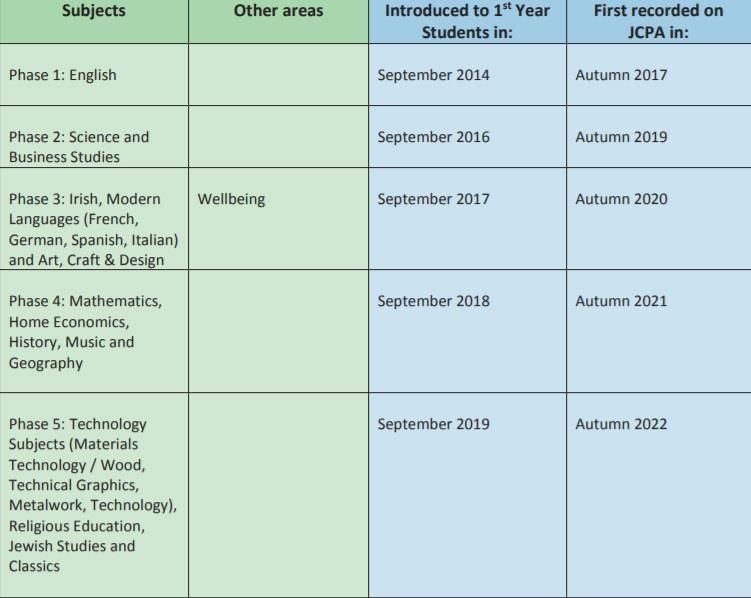
New Junior Cert Assessment 2015-2022 The most significant change in the new Junior Cycle is in the area of assessment A dual approach to assessment that supports student learning over the three years of junior cycle and also measures achievement at the end of those three years. This dual approach reduces the focus on one externally assessed examination as a means of assessing students It increases the prominence given to classroom-based assessment (CBA’s)

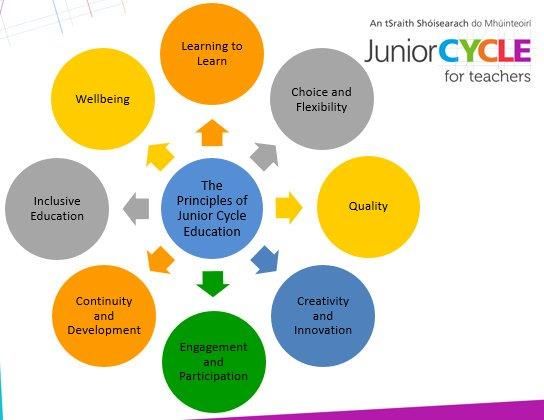
8 Key Skills and Principles of
the Junior Certificate

Phasing out of Subjects
Assessment for 2020 2nd Years Subjects below will be assessed under the new Junior Cert Specifications- English, Irish and Maths- will be assessed at Higher or Ordinary level Art, Business, French, Geography, History Home Economics, Music, Science – all assessed at a common level Usually a 2-2.5hr final exam and have 2 CBA’s in 2nd & 3rd Year
Junior Cert & JCPA
Subject Options 2nd Year
4 Core Examination
Subjects
Irish (unless Exempt)
English
Maths
ScienceNon Exam Subjects Non Examination Subjects Religion Wellbeing (PE,SPHE, CSPE)
Optional Subjects
3 Optional Subjects: Choose from
Art
Business Studies
French
Geography
History
Home Economics
Material Technology (Metalwork)
Material Technology (Woodwork)
Music
Technical GraphicsSubject Groupings Language Group Irish, English, French Science Group Mathematics, Science. Business Studies Group Business Social Studies Group History, Geography, Art, Music, Home Economics Practical Group Materials Technology (Wood), Materials Technology (Metal), Technical Graphics
Language Group English: A Pass is required for most courses; sometimes Irish will be accepted instead Junior Cert Reform- 10% based on Classroom Based Assessment (CBA) in 2nd and 3rd yr Irish-requirement for entry to the University and IT’s Classroom Based Assessment in 2nd and 3rd yr Also a requirement for the Cadets. Gardai require two languages. H4 (60%-69%) Higher Level required for primary teaching or study Irish at Trinity College
Modern Foreign Languages-French At present a third or a foreign language (French) is required for the majority of programmes at- N.U.I. Galway, Maynooth, UCC, UCD, the National College of Surgeons as well as some Colleges linked to them such as St. Angela’s, Sligo; Shannon School of Management; N.C.D.A and Army Cadetships and the Air Corps. Often it is too early for students to drop their foreign language before the JC Students exempt from Irish and receiving resource will find French difficult CBA in 2nd & 3rd Yr One Common level final exam 2hrs duration
Third Language Exceptions Nursing courses in any of the Colleges mentioned above, Agricultural Science, General Science and Engineering courses at N.U.I Galway ,Maynooth, UCD and UCC. It is important to remember that there are many colleges such as U.L and DCU and the Institutes of Technology that DO NOT require a third language for entry.
Business Group This subject is concerned with understanding the environment in which business operates, the business environment both the public and private sectors. The course of study through the three inter-connected strands: Personal Finance , Enterprise and Our Economy . 2 Classroom based Assessments (CBA’s) in 2nd and 3rd year. Final Exam- Common Level- 2 Hrs duration
Science Group- Core
Biology, Chemistry,
Physics are covered at
Junior Certificate.
Science is compulsory at
JC
Science is required for
anything in the
Engineering, Medical,
Paramedical, Science
and Nursing fields.
2 Classroom based
Assessments (CBA’s) in
2nd and 3rd year. Final
Exam- Common Level- 2
Hrs durationSocial Studies Group
Art
Geography
History
Home Economics
MusicArt Many of the skills you learn while studying Art are very useful outside of school and in whatever job you choose to do in the future. There are many career opportunities - areas such as: photography, illustration, interior/industrial/fashion design, education and architecture. 2 Classroom-Based Assessments , For the SEC- students will reflect on and use the feedback from their teacher and peers, as the basis to create further significant developmental work in their Visual Art sketchpad as well as two realised pieces for the examination.
Geography It is the study of places, people and what shapes the environment Geography prepares you for careers in town planning, outdoor pursuits education, weather forecasting, tourism and transport. Geography keeps you informed of topics which arise in conversation, current affairs, newspaper reports, and on TV, such as climate change, renewable energy and aid to poorer nations. 2 CBA’s – Geography in the news and My Geography in 2nd & 3rd Yr 1 Common level exam 2 hrs in duration
History
History involves the study of History can help you in may
people who lived in the past - different careers, especially
ordinary people as well as those linked with heritage,
famous people- using sources tourism, research and the
and other evidence. environment.
Finding out about important 2 CBA’s – The Past in my place
changes that, over time, have and A life in Time in 2nd & 3rd Yr
helped to shape the world in
which we live.
1 Common level exam 2 hrs in
duration
Compulsory from 2020 ( 1st year)History and Geography promote…. “Literacy is a bridge from misery to hope. It is, the road to human progress and the means through which every man, woman and child can realise his or her full potential.” Kofi Annan - United Nations General Secretary
Home Economics Home Economics is a subject where you will learn how to take care of yourself, others, your home and your environment. As Home Economics is a very practical subject, you will carry out a lot of activities in school and at home. Students will sit a written examination of one and a half hour's duration based on three strands: Food, Health and Culinary Skills, Responsible Family Living, Textiles and Craft Practical Exam 2 Classroom based assessments in 2nd & 3rd Yr - Creative textiles and Food literacy skills brief
Music
In JC Music, you will sing
and learn how to play an
instrument. You will listen
to many types of music
such as pop, classical
and traditional Irish
music. You will also start Possible careers in music:
composing. education (teacher,
lecturer), business (sound
2 CBAs- Composition
engineer, lyricist,
portfolio and a
reviewer, therapist) and
programme note
performance (composer,
Practical (30%)and performer, conductor).
written exam(70%)Practical Group Note: Specifications for the technology subjects will be revised in phase 4 of the Junior Cycle Developments, with the changes commencing in 2019, for certification in 2022. Materials Technology (Wood) Material Technology (Metalwork) Technical Graphics
Materials Technology: Wood
In MTW you will learn to design How will Materials Technology
small projects and the skills Wood be useful to me?
required to use tools and
equipment to make your designs. You will know the correct
You will work mainly with wood procedures to follow when
but also with the materials. You developing an idea into a
will learn about wood as a finished artefact e.g. a piece
material and how it is produced. of furniture or a child’s toy etc.
You will be able to identify
different trees, recognise their
importance to us and our
environment
You will also have the skills to
make objects from wood and
know how to apply
appropriate finishes to them,
e.g. paint, varnish, stain or
polish.
Course work Project (66%)and
Written ExamMaterials Technology:
Metalwork
It is an activity-based How will Metalwork be useful
course focusing on metal, to me?
how to work with it and
how to assemble different You will be able to work with
parts. Other materials such metals and other materials
as plastics and wood are such as wood and plastic.
also Investigated and used You will be able to assemble
in project work. You will be these materials into useful
working with basic and interesting items. You will
electronic components know the most suitable finish
too. to apply to your project and
how to apply it.
Course work Project, Written
Exam and Practical exam
(Higher level)Technical Graphics
In Technical Graphics you How will Technical Graphics be useful to
will learn how to represent me?
3-D objects on paper and Technical Graphics helps you to
on computer. You will think in a more logical and creative
develop problem solving
and creative thinking skills way. You will be able to
through the solution of communicate information using
graphical problems. diagrams and sketches. You will
have learned how to present
information in a neat and organised
This subject will be of use fashion.
to you if you want to This subject will be of use to you if
progress into career areas
such as architecture or you want to progress into career
engineering. areas such as architecture or
engineering.SHORT COURSES-
Classroom-Based Assessment relating to short courses will be
communicated to parents in interim reporting and in the Junior Cycle
Profile of Achievement (JCPA)
Digital media
Coding Literacy
The short course aims to This short course aims to
develop the student's extend and refine
ability to formulate students’ ability to use
problems logically; to digital technology,
design, write and test communication tools,
code through the and the internet
development of creatively, critically and
programs, apps, games, safely, in support of their
animations or websites; development, learning
and, through their and capacity to
chosen learning participate effectively in
activities, to learn about social and community
computer science. life.Remember Homework is re-enforcing schoolwork Do homework both oral, written and research consistently Study-revision-learning- re: learning 2nd Year student-2 hours study per night Most Subjects have CBA- Attendance and steady work in class is a must Learning takes place in the classroom Be organised with books and equipment
Work hard …Dream Big
Last Words Think carefully before you choose your subjects It may be difficult to change subjects once chosen Every subject requires hard work and study- 3rd language – French not necessary for all Colleges. Practical subjects have projects-outside of class time Difficult to do a subject for LC if not taken for JC
Please note While every effort will be made to facilitate your son/daughter with their 5 highest preference subjects, this may not always be possible due to subject combinations and timetabling restraints Useful website: For the new Junior Cert Specifications: https://www.curriculumonline.ie/Junior-cycle/Junior- Cycle-Subjects
Success in school
THANK YOU! ANY QUESTIONS?
You can also read


