Let's Look Ahead 2019-2020 - Grades 9 - 12 Course Selection Guide - Abington School District
←
→
Page content transcription
If your browser does not render page correctly, please read the page content below
Let’s Look Ahead
     2019-2020

        Abington, PA

     Grades 9 - 12
 Course Selection Guide
BOARD OF SCHOOL DIRECTORS
The outstanding quality of the educational program in the Abington School District
through the years has been a reflection of the strong values that the people of the
community hold for education. These values are perhaps nowhere better
exemplified than in the high standards and strong educational commitment of the
Board of School Directors.
Raymond McGarry, Esq.
President
Ms. Susan D. Arnhold
Vice-President
Mr. Brian Allen
Mr. Daniel Sean Kaye
Mrs. Tracy Panella
Adam M. Share, Esq.
Joshua Stein, Esq.
Mr. Barry J. Stupine
Mrs. Michele R. Tinsman
Jeffrey S. Fecher, Ed.D.
Superintendent of Schools
Let’s Look Ahead is designed to help you successfully plan your high school years. The selection
of a program of studies is a serious responsibility. What you choose to study will greatly influence
your future.
The brief course and program descriptions included in this planning guide serve as an
introduction to the opportunities and options available to you in 9th through 12th grades. This also
includes important information on graduation requirements. This information should be
discussed with your parents/guardians, counselors and teachers. The result can and should be a
program of studies that reflects your past record of achievement, your abilities and interests, and
your goals.
2INDEX
Introduction Page
Academic Proficiency and Requirements for Graduation 5
Grade Placement 8
Culminating Project 8
Weighted Grade Procedures 9
GPA Exclusion Option 9
Class Rank 10
Course Selection 10
Computer Science Option 12
Opportunities to Learn 13
Dual Enrollment 13
Special Education 15
Protected Handicapped Services 15
Gifted Education 15
Course Changes 15
Summer School 16
Curriculum Outline
Required Courses 17
Grading System 17
Academic Guidelines 18
Student Records 18
Homework 18
Counseling Program and Services
Guidance Services 19
Psychological Services 19
College Planning 20
Course Descriptions
Advanced Placement Capstone Program 21
Design Thinking 23
Art 24
Business 28
English 35
Family and Consumer Science 39
Health and Physical Education 40
Mathematics 43
Music 47
Reading 50
Science 52
Social Studies 57
Special Opportunities 62
3World Language 62
Master Course Lists
Grade 9 Course Offerings 73
Grade 10 – 12 Course Offerings 75
Eastern Center for Arts & Technology 81
4INTRODUCTION
ACADEMIC PROFICIENCY AND REQUIREMENTS FOR GRADUATION
In order to graduate, a student in the class of 2019, 2020 or 2021 must:
Meet Abington School District’s course and achievement requirements as delineated in
Let’s Look Ahead, the Abington High School Course Selection Guide.
Demonstrate proficiency in Biology, English Language Arts (Literature) and Algebra I on
either the Pennsylvania Keystone Exams or on local assessments aligned with the
Pennsylvania Standards and the State assessments.
Complete a culminating project as described in Let’s Look Ahead, the Abington High
School Course Selection Guide.
In order to graduate, a student in the class of 2022 and beyond must:
Meet Abington School District’s course and achievement requirements as delineated in
Let’s Look Ahead, the Abington High School Course Selection Guide.
Complete a culminating project as described in Let’s Look Ahead, the Abington High
School Course Selection Guide.
Demonstrate graduation readiness through one of the pathways indicated below.
1. Attain a proficient or advanced score on each of the three Keystone Exams: Algebra
1, Biology, and Literature.
2. Attain a proficient score on at least one of the three Keystone Exams and at least a
basic score on the other two Keystone Exams, and have the combined scores on the
three exams meet or exceed a state-specified composite score.*
3. Meet or exceed local course grade requirements in academic content areas associated
with the Keystone Exams on which proficiency was not achieved and demonstrate one
of the following:
a. Attain at least a state-specified score on the SAT, PSAT, ACT, or Armed Services
Vocational Aptitude Battery test (ASVAB)
b. Attain a state-specified score on an Advanced Placement Exam in an academic
content area associated with a Keystone Exam in which proficiency was not
achieved
c. Attain at least a gold level on the ACT WorkKeys assessment, which measures
career readiness
d. Successfully complete a dual enrollment course in an academic content area in
which Keystone Exam proficiency was not achieved
5e. Successfully complete a pre-apprenticeship program
f. Attain acceptance into a four-year high education institution and demonstrate
evidence of the ability to complete college-level, credit-bearing coursework
4. Meet or exceed local course grade requirements in academic content areas associated
with the Keystone Exams on which proficiency was not achieved, and obtain three
pieces of evidence demonstrating readiness for meaningful postsecondary
engagement consistent with the student’s career plan. The evidence must include one
of the following:
a. Earn a silver level or better on the ACT WorkKeys assessment, which measures
career readiness
b. Attain at least a state-specified score on a SAT subject test
c. Attain acceptance into an accredited non-profit institution of higher education,
other than a four-year college, and demonstrate evidence of the ability to
complete college-level, credit-bearing coursework
d. Attain an industry-recognized credential
e. Attain a state-specified score on an Advanced Placement Exam
f. Successfully complete a dual enrollment course
The additional two pieces of evidence may include any of the evidence listed above as 4a
through 4f, as well as:
g. Satisfactorily complete a service learning project approved by the Superintendent
or designee
h. Attain a proficient or advanced score on a Keystone Exam
i. Attain a letter guaranteeing full-time employment
j. Successfully complete an internship/externship/cooperative education program
k. Attain at least a 2.0 GPA in the NCAA’s core courses for college-bound student
athletes
5. For Career and Technical Education (CTE) concentrators, meet or exceed local course
grade requirements in areas tested by the Keystone Exams on which the student did
not achieve proficiency, and:
a. Attain an industry-based competency certification related to the CTE program of
study or,
b. Demonstrate a high likelihood of success on an industry-based competency
assessment or readiness for continued meaningful engagement in the CTE
program of study as demonstrated by performance on benchmark assessments,
course grades, and other factors consistent with the CTE concentrator’s goals and
career plan (this determination must be made no later than the end of grade 11)
6Students with Disabilities
A student with a disability will qualify for graduation by satisfactorily completing the special
education program developed by his/her Individualized Education Program team under the
provisions delineated in the Individuals with Disabilities Education Act.
*Score to be set by the Pennsylvania Department of Education no later than July 30, 2019.
CREDIT REQUIREMENTS: To graduate from Abington High School, you must earn a minimum of
two hundred and nineteen points in grades nine, ten, eleven, and twelve and meet the course
requirements listed below.
Subject Years Points
English 4 40
Social Studies 3 30
Science 3 30
Mathematics 3 30
Subject Years Points
Health Education (grades 9 and 12) 2 8
Physical Education 4 16
Additional Electives 4 65
Minimum Total for Graduation 219
7Grade Placement
TO ENTER GRADE: MUST HAVE PASSED THE FOLLOWING MUST HAVE ACCUMULATED
SUBJECTS: THE FOLLOWING CREDITS:
English (9); Social Studies (9);
10 Mathematics (9); Science (9); Health & 53
Physical Education (9)
English (9, 10); Social Studies (9, 10);
11 Mathematics (9, 10); Science (9, 10); 103
Health (9); Physical Education (9, 10)
English (9, 10, 11); Social Studies (9, 10,
11); Mathematics (9, 10, 11); Science (9,
12 166
10, 11); Health (9); Physical Education (9,
10, 11)
STUDENTS ARE REQUIRED TO SCHEDULE THE FOLLOWING MINIMUM NUMBER OF CREDITS:
9TH GRADE -- 59 CREDITS
10TH GRADE -- 56 CREDITS
11TH GRADE -- 50 CREDITS
12TH GRADE -- 54 CREDITS
TOTAL – 219 CREDITS / GRADUATION REQUIREMENT
You should note that certain elements in the required programs in mathematics, social studies
and English are sequential in nature. Students should study one level in both of these required
programs per year. Consequently, students will not be permitted to take more than one full year
course within English or social studies during the same school year unless one course is taken
outside of Abington Senior High School. Concerns regarding this limitation should be directed to
the building principal.
Culminating Project
Students in Abington School District will engage in a three-year culminating project in their social
studies classes. The culminating project includes specially developed activities that mesh service-
learning and community exploration opportunities with the social studies curriculum. Students
will begin career exploration as related to public service and the non-profit world. As they
conclude their program, students will connect their service learning activities with specific areas
of interest that will become the focus of their individualized projects. They will refine and develop
8their projects with the final goal of presenting an oral report and a project portfolio as evidence
of satisfactory completion of the project. Abington Senior High School students will be required
to submit evidence that the culminating project guidelines have been achieved prior to
graduation. Students are expected to complete fifteen hours of service per year in grades nine
and ten, and twenty hours of service in grade eleven. Please refer to the school’s website for
further details.
Weighted Grade Procedures
Weights are applied to Honors, Advanced Placement, and Dual Enrollment courses only. High
school transcripts report the weighting process to the colleges.
The chart below shows the factors in use for all courses. It recognizes the significant workload
undertaken by students in the Honors, Advanced Placement and Dual Enrollment offerings.
Students enrolled in an Advanced Placement course are required to complete the Advanced
Placement exam or the locally developed final exam for the course.
For Determination of Rank in Class
with Weights assigned to GPA-Calculated Courses
at the Honors, Advanced Placement, and Dual Enrollment Level
Advanced
Honors/Dual Enrollment Placement/Dual
College Prep
Letter Grade in 2-Year College Courses Enrollment in 4-Year
Courses
(x 1.15) College Courses
(x 1.25)
A 4.0 4.60 5.00
B 3.0 3.45 3.75
C 2.0 2.30 2.50
D 1.0 1.00 1.00
E/F 0 0 0
GPA Exclusion Option
Students who are enrolled in courses totaling at least 50 credits, consisting of 5 major subjects,
have the option to take up to 10 additional credits which may not be factored into the GPA.
9Grades for these courses, while not counting toward the GPA, will be recorded on the student’s
report card and transcript as letter grades. The option to take 10 credits which are not factored
into the GPA can include any electives beyond the 50 credits which are taken as major subjects.
This option must be finalized prior to the end of the first marking period.
Grades earned in Gifted Seminar, Health Education and Physical Education are not factored into
the GPA.
Class Rank
Class rank is derived from the cumulative grades earned during the 9 th through 12th years. The
actual computation of rank occurs eight times — mid-year of the 9th year, the end of the 9th year,
mid-year of the 10th year, the end of the 10th year, mid-year of the 11th year, at the end of the
11th year, mid-year of the 12th year, and at the end of the 12th year. The mid-year of the 12th year
rank is used to determine the top ten percent of the graduating class and the selection of
valedictorian and salutatorian. Grades earned in Gifted Seminar, Health Education and Physical
Education are not factored into the GPA. In addition, students who are already enrolled in courses
totaling at least 50 credits and meeting the graduation requirements for the grade level, may
take up to 10 additional credits per year which are not factored in the GPA.
For those courses which are calculated in the GPA, class rank is determined by dividing grade
points earned by number of credits scheduled. Grade points are determined by multiplying the
number of credits each course carries by the value number assigned to each mark. Value
numbers are:
A = 4; B = 3; C = 2; D = 1; F = 0
For example: an A in a 10-credit course earns 40 grade points; a B in a 4 credit course earns 12,
etc.
The numerical averages arrived at by dividing total grade points earned by total credits scheduled
are arranged in descending order to determine rank in class. In the case of identical numerical
averages, students are assigned the same class rank.
Those taking Honors/Advanced Placement/Dual Enrollment courses will have weighted factors
applied to these courses for class ranking purposes.
Course Selection
Abington School District is committed to providing you with the best education possible. To
achieve this goal, the professional staff strive to place you in the educational environment best
suited to all phases of your development.
10In the academic areas of English, mathematics, science, social studies, and world language, your
ability, achievement, and interest all have a significant bearing on the ease and speed with which
you learn. In the spring of each year, school counselors meet with students to evaluate course
options. This course selection conference is guided by teacher input and student interest in the
selection of courses. In all subject areas, grading is on the basis of achievement.
A program of special education is available to students with disabilities at Abington High School.
Course selection is completed for individual students through the IEP team process. Students are
encouraged to participate in this process and to consider increased involvement in general
education courses and school-wide activities when appropriate. Direct instruction special
education classes, tutorials and credit bearing support classes are available to help students
succeed.
Academically-able students in grades 9-12 with high scholastic attainment are encouraged to
enroll in Honors/Advanced Placement/Dual Enrollment classes. These classes are offered in
those academic areas where there is sufficient enrollment to warrant forming classes of this kind.
Honors courses typically will differ from regular classes in pace, breadth, and depth. Membership
in these classes will be noted on transcripts. It is expected that students who are successful in
Honors courses should be well prepared for examinations like the College Entrance Examination
Board Advanced Placement Examinations. Most colleges offer advanced placement and/or
credit to students who do well in these examinations. Other enrichment and advancement
opportunities—such as special interest groups, and individual research projects—are made
available to students at all grade levels as the need arises. All courses designated Advanced
Placement on student transcripts have been officially authorized through the Advanced
Placement Course Audit process for each academic year in which these courses are offered. Each
teacher of an Advanced Placement Course has been officially authorized through the Advanced
Placement Course Audit process for each academic year in which these courses are offered.
The secondary school instructional program offers Honors/Advanced Placement/Dual
Enrollment and college preparatory courses in the required areas of English, mathematics,
science and social studies. In addition, during the junior high school experience, there are
required courses in art, computer literacy, general music, health and physical education, reading
and technology education, and at the high school, there are required courses in Academic Access,
health education, and physical education. The secondary program also includes electives in art,
business, and information systems, computer science, English, family and consumer science,
music, reading, science, social studies, technology education, and world languages.
Parents/guardians are an integral part of the course selection process and are provided with a
scheduling worksheet/card on which they indicate, for their student, applicable course selections
for honors/advanced placement courses, college preparatory courses, and elective courses.
Academic proficiency is the critical element and should take priority in decisions concerning
course selection. Open enrollment is available for all courses. However, a decision to select an
11honors/advanced placement course should reflect academic proficiency and a teacher
recommendation. The teacher recommendation is to be based upon review of the student’s most
recent standardized test scores, classroom performance, completion of course prerequisites, and
consultation with the department chairperson and the school counselor. No single criteria will
automatically exclude any student from a course.
Students who have not demonstrated proficiency on their most recent Keystone examinations in
Algebra I, Biology and Literature will be assigned to additional periods of instruction in the
respective subject area(s).
Abington High School offers a diverse array of courses within many different subject areas. The
process of choosing courses, both major and elective courses, is critical and should reflect the
student’s interest and potential college major and/or career path. Students in grades nine to
eleven are expected to complete a course load that includes no more than three study halls per
week. Students requesting more than three study halls per week must have this request
approved by their school counselor during the course selection process.
Computer Science Option
To meet the third-year mathematics requirement for graduation, a student who has completed
Algebra I, Geometry, and Algebra II may opt to take one of the following:
An Honors or Advanced Placement Computer Science course in lieu of either an honors
or an Advanced Placement mathematics course
A college preparatory Computer Science course in lieu of a college preparatory
mathematics course
OR
To meet the third-year science requirement for graduation, a student who has completed Biology
and either Applied Biochemistry or Chemistry may apply to take one of the following:
An Honors or Advanced Placement Computer Science course in lieu of either an Advanced
Placement or a college preparatory science course
A college preparatory Computer Science course in lieu of a college preparatory science
course
Interested students and parents should contact the Guidance Office.
To request changes beyond those listed above, parents and students must contact the Guidance
Office to schedule a conference with the student’s Guidance Counselor, the Principal, and
appropriate faculty.
12Opportunities to Learn
The Opportunities to Learn initiative at Abington High School promotes achievement for all
students and equal access to challenging secondary studies. Since its inception, 90% of Abington
High School graduates have progressed to post-secondary studies. Abington students have the
opportunity to engage in rigorous college preparatory or Honors/Advanced Placement course
work, with the expectation that students can pursue further academic advancement after their
successful completion of high school. The current academic program incorporates differentiated
learning techniques, with a strong emphasis on the infusion of technology in direct instruction,
in order to provide students with the necessary skills to succeed in furthering their academic
pursuits beyond high school.
Abington High School upholds the tenets of the Opportunities to Learn initiative by providing a
wide array of academic supports. Students have access to professional staff members in English,
social studies, mathematics and science through tutorial periods that support Advanced
Placement, Honors and College Preparatory courses. Teachers in major subject areas incorporate
a vast array of study and organizational skill instruction into their academic programs, including
note-taking strategies, outlining methods and reading strategies. Members of the Guidance
Department provide individualized study and organizational skill development.
Dual Enrollment
Abington Senior High School students may participate in Dual Enrollment programs available
through postsecondary institutions as well as the Eastern Center for Arts and Technology. These
programs provide high school students the opportunity to earn college credit at the student’s
expense while completing their high school education.
Please refer to the section of Let’s Look Ahead entitled Weighted Grade Procedures for
information regarding the weighting of Dual Enrollment course grades for class rank and grade
point average (GPA). Each Dual Enrollment program varies in its criteria, application procedures,
requirements, fees, and grades. Students interested in Dual Enrollment must contact the
Guidance Office prior to course matriculation. The student is responsible for all arrangements
related to participation in Dual Enrollment programs including payment of tuition and fees, books
and other required materials.
Special Dual Enrollment Partnerships
On-site Opportunities
Gwynedd Mercy University
An opportunity for students to enroll simultaneously in both a high school class and a college
class has been arranged between Abington Senior High School and Gwynedd Mercy University’s
School of Business and Education. Upon satisfactory completion of Accounting I, which is taught
by an Abington Senior High School instructor, a student who has completed an application and
13all necessary payments for Dual Enrollment can earn three (3) college credits from Gwynedd
Mercy University at a reduced tuition rate. This Dual Enrollment opportunity is only offered to
junior or senior students. Sophomore students are not eligible to participate in the Dual
Enrollment program, as per Gwynedd Mercy University’s policy.
Stockton University *(pending approval of Stockton University Dual Enrollment Application
by Pennsylvania Department of Education)
Students may enroll in Holocaust and Genocide Studies, a Dual Enrollment Social Studies course
offered through a partnership between Abington Senior High School and Stockton University.
This course, taught at the high school by an Abington Senior High School instructor, with guidance
and supervision from a Stockton University faculty member who has specialization in Holocaust
and Genocide Studies, will include opportunities for students to engage with guest lecturers,
participate in field trips, and other related activities. To earn four (4) college credits at a reduced
tuition rate from Stockton University, students must complete an application and all necessary
payments for Dual Enrollment and successfully complete the course.
Off-site Opportunities
Penn State University-Abington College
Abington Senior High School offers a Dual Enrollment Program with Pennsylvania State University
(PSU), Abington College. This program provides juniors and seniors the opportunity to earn
college credit at a discounted tuition rate while completing their high school education. Through
this partnership, Abington Senior High School students will be able to enroll in college courses
approved by Abington School District and instructed at PSU’s Abington College. Courses
completed at PSU’s Abington College may satisfy elective credits toward graduation
requirements. Students may complete up to two (2) college courses for high school credit per
year. Students must pay all tuition and fees up front and must provide their own transportation
to PSU’s Abington College. Interested students and parents/guardians should contact the
Guidance Office or visit the Guidance Department website for more information on the Dual
Enrollment application process and for a list of courses approved for Dual Enrollment.
Montgomery County Community College
Abington Senior High School offers a Dual Enrollment Program with Montgomery County
Community College (MCCC). This program provides juniors and seniors the opportunity to earn
college credit at a discounted tuition rate while completing their high school education. Through
this partnership, Abington Senior High School students will be able to enroll in college courses
approved by Abington School District and taught by college faculty at MCCC’s Blue Bell campus
or on-line. Courses completed at MCCC may satisfy elective credits toward graduation
requirements. Students may complete up to two (2) college courses for high school credit per
year. Students must pay all tuition and fees up front and must provide their own transportation
to MCCC’s Blue Bell campus. Interested students and parents/guardians should contact the
Guidance Office or visit the Guidance Department website for more information on the Dual
Enrollment application process and for a list of courses approved for Dual Enrollment.
14Special Education (PA Code Chapter 14)
Consistent with federal and state laws, students with disabilities are provided a learning
environment that addresses their individual learning needs and differences in the least restrictive
setting. This can range from itinerant to full time services. To support our students within the
general education classroom, students may receive Itinerant Support classes. Itinerant Support
classes are grade-based classes that focus on: creating study strategies, breaking down
assignments in manageable chunks, additional test/quiz time as needed, developing,
encouraging and fostering self-advocacy skill for transitioning independency into the general
education classroom.
Protected Handicapped Services (PA Code Chapter 15)
The District also provides services, related aids or reasonable accommodations for those
individuals identified as protected handicapped students. Students are eligible for a Service
Agreement if they have a physical or mental disability which substantially limits a major life
activity such as caring for oneself, performing manual tasks, walking, seeing, hearing, speaking,
learning, breathing, or working. Plans are developed to provide reasonable accommodations for
the student to be successful in the general education program. For more information, contact
the Building Principal, School Counselor or the Coordinator of Student Support Services.
Gifted Education (PA Code Chapter 16)
Abington High School recognizes the uniqueness of our student population and the needs of
mentally gifted students. Opportunities are available for students to enrich their learning
experiences through the GIEP process, with various forms of enrichment including Gifted
Seminar. Gifted Seminar is a credit bearing course designed to meeting the learning needs of the
students who are gifted according to Chapter 16 of the PA Regulations. This course is intended
to stimulate and encourage independence and creativity. For each student, an individualized
course of study will be developed to address the student’s area(s) of strengths and interests and
to align the instruction with the goals established in the student’s Gifted Individualized
Educational Program (GIEP).
Course Changes
Course verification letters will be sent to all students in the spring following the course selection
process with school counselors. Students will have until the end of June to request a course
change by contacting the school counselor. A copy of the final schedule will be sent to each
student in August. Questions regarding the schedule received in August should be directed to
the student’s counselor. Students may request a course change within the first seven days of the
15school. With the exception of scheduling errors, all change requests should include a written
request from the student and parent. Changes should be submitted to the student’s school
counselor within the appropriate time frame. The Coordinator of Student Support Services will
review requests for veracity and, where appropriate, will forward requests to the Administrative
Team for review. Any change requests after this time period will be subject to a comprehensive
review by all appropriate parties, which may include: teacher, school counselor, department
chairperson, assistant principal and principal.
Summer School
Remedial courses are offered in summer school. It is important for you to understand that five-
week make-up courses do not duplicate course offerings during the school year. It is impossible
to provide in twenty-five days the same learning experience provided over a 184-day period.
Therefore, emphasis will be directed toward the basic skills and concepts in each course. Because
of the lack of comparability between summer school make-up courses and those taught during
the school year, a “C” is the highest grade attainable in a summer school make-up course. You
may repeat courses in summer school in order to raise your grade. In all cases both grades will
be reported on the permanent record card and on transcripts to institutions of higher learning.
Participation in the summer school program assumes that the student has familiarity with the
course content. In order to register for any course, a student must have attained at least an
average of 40% for the final grade during the regular school session. In courses where final
examinations are administered, the student must have taken that examination. Students who
do not meet these criteria will not be permitted to enroll in remedial courses in the summer
school program.
You are encouraged to pursue summer school study within the district whenever possible. With
the approval of the principal, a total of twenty points for work taken outside the district may be
counted toward graduation. No graduation credits are permitted for summer school courses
taken before the completion of grade nine. A complete list of summer school offerings will be
distributed each year in the spring.
A preparation program is available for nonproficient students who wish to complete the Summer
Keystone Exam in Algebra 1, Biology and/or Literature or the project required by the
Pennsylvania Department of Education for those students who do not demonstrate proficiency
on the Keystone Exams.
16Curriculum Outline
Grade 9 Requirements* Grade 10 Requirements**
Course Periods Points Course Periods Points
English 5 10 English 5 10
Social Studies 5 10 Social Studies 5 10
Mathematics 5 10 Mathematics 5 10
Science 5/6 10 Science 5/6 10
Health Education 2 4 Academic Access English 1 2
Physical Education 2 4 Physical Education 2 4
Electives 11 Electives 10
Grade 11 Requirements Grade 12 Requirements***
Course Period Points Course Periods Points
English 5 10 English 5 10
Social Studies 5 10 Health Education 2 4
Mathematics 5 10 Physical Education 2 4
Science 5/6 10 Electives 36
Physical Education 2 4
Electives 6
*In addition to the above, a minimum of 11 points of elective credits must be scheduled for a
total of 59 points in 9th grade.
**Students are expected to successfully complete a 10-week unit of Aquatics in 10th grade.
***Students not proficient in Keystone Algebra I and/or Literature will be required to enroll in
the appropriate remediation course. Students who have not completed the Culminating Project
by the end of grade eleven must enroll in a social studies elective or senior seminar.
Grading System
A = 90 – 100
B = 80 - 89
C = 70 - 79
D = 60 - 69
E = Failing - eligible for Summer School 40% - 59%
F = Failing – ineligible for Summer School 0% – 39%
I = Incomplete
W =Grade withheld and/or work incomplete
17Academic Guidelines
Teachers, counselors, and administrators carefully guide students with their recommendations
for course placements. Students are advised to listen to this counsel and seriously consider the
recommendations of these professionals.
Students and parents ultimately have the responsibility to decide on an appropriate program of
studies. Students are not restricted to a particular course. Over time, many students are able to
take greater and greater challenges. Some students may benefit from a more reduced pace;
taking a mastery approach that will produce equal success. It is the goal of Abington High School
to provide that flexibility for all students.
The school day is divided into eight class periods of instructional time. To make the most efficient
use of coursework available at Abington, students are required to request a full course load of
32-35 class periods. Each year, students must register for required courses in English,
mathematics, science, and social studies depending on grade level. Additional courses in World
Language, Arts, Technology and Humanities are strongly suggested.
Student Records
Parents, guardians and eligible students (at least 18 years of age or attending an institution of
post-secondary education) have the right to inspect and review their child’s or their own student
records. Requests must be made through the building principal. For more information, refer to
the Superintendent’s Administrative Procedure on “Records of Students”, which can be found
at: http://www.abington.k12.pa.us/board/policies/index.php?dir=STUDENTS .
Homework
Abington High School educators believe that homework is a vital part of the process of education.
Course work completed outside the classroom reinforces skills and knowledge enriching the
student’s personal growth. One goal of education is to assist students to become responsible,
capable, and independent life-long learners.
Teachers are in the best position to diagnose the needs of their students and to stipulate
homework to meet those needs. Parents have an important role in providing their children with
the time, the support and the conducive environment for completing assignments at home.
Students are responsible for completing their own assignments and for coming to class prepared
every day.
18COUNSELING PROGRAM & SERVICES
Guidance Services
The mission of Abington School District K-12 Counseling Program is to enhance student success
by fostering social, personal, academic, and career development within a diverse student
population. School counselors work collaboratively with school staff, families, and the
community to help provide a positive social climate and to implement a comprehensive support
system, thus enabling students to achieve their maximum potential and become productive
members of society.
The counseling program is developmental and comprehensive in design to help students
recognize their potential and become independent persons. To provide students with the
information they need to make wise decisions affecting their educational and personal lives, the
Guidance Department works with the academic departments to provide students with
experiences related to Career Awareness and Preparation, Career Acquisition, Career Retention
and Advancement, and Entrepreneurship. These experiences are designed to enable every
student, by the end of eleventh grade, to complete a career portfolio that documents the
student’s educational performance, career exploration, and employment experiences over time.
School counselors assess students’ needs, identify the obstacles that may hinder student success,
and advocate strategies to support learning and growth. Counselors work collaboratively with
parents and teachers to assist in course selection and post high school planning. Students are
also encouraged to consult with their teachers for recommendations regarding course selection
and placement.
The high school counseling program includes: evening parent workshops, individual and group
counseling, crisis intervention, classroom lessons and many other types of academic and
emotional support
Many counselors are members of the Student Assistance Program (SAP) whose mission is to
collaborate as a team with students, parents, teachers and community agencies to identify
students at high-risk and to facilitate appropriate interventions. Teachers, parents, students or
administrators may refer a student for this service.
Psychological Services
Our school psychologists provide direct and indirect services to students, parents, and teachers.
They work as part of various teams in order to support students. Team members work in a
collaborative manner to address student needs in the general education program. If the team
or parent believes that a student may be in need of special education services, the psychologist
coordinates the evaluation process. This includes gathering information from parents and
teachers, completing classroom observations, administering psychological and educational
assessments and assisting in the development of an Individual Education Program (IEP), if
19appropriate. Facilitating counseling groups, assessing student eligibility for Gifted Services and
coordinating the re-evaluation of special education programs are other psychological activities.
College Planning
The high school transcript begins in ninth grade. Included on the high school transcript are: final
grades for all course work in grades 9-12, annual attendance totals, cumulative Grade Point
Average and class rank, and standardized test scores for college entrance exams and proficiency
assessments.
Students who are planning to go to college need to be familiar with the entrance requirements
of institutions in which they are most interested. Students should be sure to consult the school
counselor for help in the selection of high school courses required for admission to colleges.
The high school counseling program utilizes Naviance Success, a web-based college and career
planning tool, as the primary resource for college-bound students. Students are introduced to
this program at the Junior High School and continue their use of Naviance through the end of
their high school career.
For comprehensive information about the college admissions process, be sure to access the
Information Guide for College-Bound Students on the Senior High School Guidance page.
20COURSE DESCRIPTIONS
ADVANCED PLACEMENT CAPSTONE PROGRAM
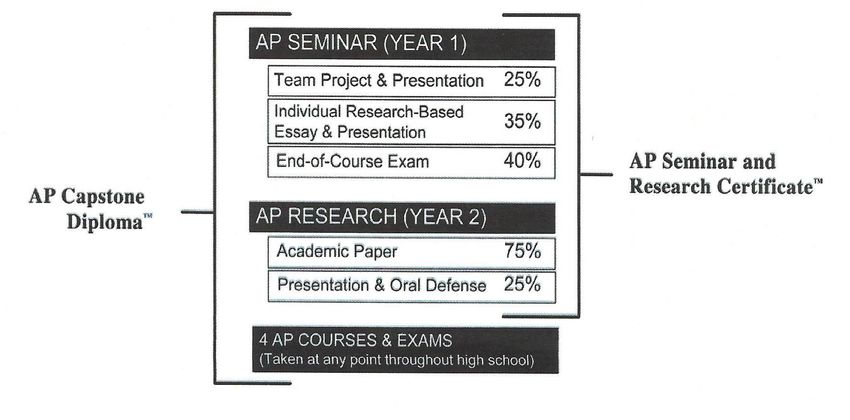
The Advanced Placement Capstone Program is an innovative program from the College Board
that equips students with the independent research, collaborative teamwork, and
communication skills that are increasingly valued by colleges. Advanced Placement Capstone is
built on the foundation of two Advanced Placement courses—Advanced Placement Seminar and
Research—and is designed to complement and enhance the in-depth, discipline-specific study
experienced in other Advanced Placement courses. Students who earn scores of 3 or higher in
both Advanced Placement Seminar and Advanced Placement Research, and on four additional
Advanced Placement Exams of their choosing will receive the Advanced Placement Capstone
Diploma, signifying outstanding academic achievement and attainment of college-level academic
and research skills. Students who earn scores of 3 or higher in both Advanced Placement Seminar
and Advanced Placement Research, but not on four additional Advanced Placement Exams, will
receive the Advanced Placement Seminar and Research Certificate signifying attainment of
college-level academic and research skills.
ADVANCED PLACEMENT SEMINAR (APSM)
Prerequisite: open to students entering grades 10 and 11
In this interdisciplinary course, students investigate real-world issues from multiple perspectives, gathering and
analyzing information from multiple sources in order to develop, communicate, and defend credible and valid
evidence-based arguments presented through written essays, oral presentations, and visual presentations, both
individually and as part of a team. The course is designed to challenge students to think critically about complex
issues and make connections across disciplines. Advanced Placement Seminar is a prerequisite for Advanced
Placement Research, which will be offered beginning in the 2019-2020 school year. In Advanced Placement
Research, students will independently design, plan, and conduct a yearlong research-based investigation on a topic
of individual interest.
21ADVANCED PLACEMENT RESEARCH (APRS)
Prerequisite: Successful completion of Advanced Placement Seminar, including all assessment components of the
course.
This course is the second of two courses in the College Board’s Advanced Placement Capstone Program. Students
enrolled in Advanced Placement Research will explore an academic topic, problem, issue, or idea of individual
interest. Students may dig deeper into a topic studied in another course, work across academic areas on an
interdisciplinary topic, or study a new area of interest, perhaps one related to a potential career field.
Students will design, plan, and conduct a yearlong investigation to address a research question. Through this inquiry,
they will further develop the skills acquired in Advanced Placement Seminar by learning research methodology,
employing ethical research practices, and accessing, analyzing, and synthesizing information. Students will
document their research and curate artifacts of their work in a process and reflection portfolio. Advanced Placement
Research culminates in students writing an academic paper of 4,000-5,000 words, presenting their research findings,
and completing an oral defense.
22DESIGN THINKING
EMPATHIZE DEFINE IDEATE PROTOTYPE TEST
STEM I (offered for all grade 7 students)
Using the Design Thinking Process as a framework for discussion, students will engage in projects that require
innovation, creativity, critical thinking, collaboration and communication. Understanding design thinking will
empower students to solve complex problems that occur over a wide range of academic and career/vocational areas.
In STEM I students will apply the design process to solve problems and will engage in computer science as a means
of investigating and communicating.
STEM II (offered for all grade 8 students)
Using the Design Thinking Process as a framework for discussion, students will engage in projects that require
innovation, creativity, critical thinking, collaboration and communication. Understanding design thinking will
empower students to solve complex problems that occur over a wide range of academic and career/vocational areas.
In STEM II students will apply principles of engineering, technology and science to engage in interdisciplinary
activities that include real-world application.
FOUNDATIONS OF INNOVATION (offered for grades 9 and 10 students)
Using the Design Thinking Process as a framework for discussion, students will engage in projects that require
innovation, creativity, critical thinking, collaboration and communication. Understanding design thinking will
empower students to solve complex problems that occur over a wide range of academic and career/vocational areas.
In Foundations of Innovation, students will engage in an interdisciplinary approach to problem solving and critical
thinking by using detective skills and technology to investigate and solve real-world problems.
23ART
The Art Program at the high school is designed for students who want to learn about art, enjoy
making art or are considering art as a college major or career. The curriculum offers courses to
beginners as well as more advanced students, and is designed to be a progressive program. In
grade 9, students may select from the following electives:
ART I
This course is a two-period a week elective designed for students of all levels & abilities. Students will be given the
opportunity to experience a variety of different art forms – both two – and three-dimensional- and to use the most
current tools and materials available to express themselves in art. To better appreciate and analyze works of art,
students will also study related vocabulary, history, aesthetics, and criticism.
ART II
Prerequisite – successful completion of Art I elective in grade 8
This course is a two-period a week elective designed for students of all levels & abilities. Through the structured
classroom and at-home projects, students will be exposed to the formal elements and principles of design, as well
as become familiar with different art media including, but not limited to, drawing, painting, sculpture, and design.
Students will also be exposed to: art history, multicultural art, and how art relates to the commercial world.
CERAMICS 9
This course is designed for students who love working in clay. Students will learn all aspects of sculpting using “hand
built techniques.” This is known as Slab and Coil and bas-relief. Students work at their own level of experience.
Student work is glazed and fired. Students work with both white clay and terra cotta clay.
GRAPHICS
This course is designed for students of all levels & abilities. In this one-year graphics art course, students will be
introduced to projects that will challenge their critical thinking, their creative abilities, and their problem-solving
skills. Through the structured classroom and at-home projects, students will be exposed to the formal elements and
principles of design, as well as become familiar with different graphic design media including, but not limited to,
design, printmaking, photography, computer graphics, serigraphy, and book making. Along with skill building,
students will begin to refine both compositional layout and best visual concepts for the design problem. Assignments
given will be based on themes from literature, advertisement, packaging promotions, textile design and so forth.
(Internet access at home is helpful).
Grades 10 and 11 Offerings
Full Year Courses
ART I MAJOR
No prerequisite
Art I Major is a full-year art course in which students will explore in depth a variety of artistic techniques such as
drawing, painting, printmaking, and sculpture. Students will learn the principles of design and experiment with the
elements of art. Art I Major will also have an art history component. There will be studio and art history homework
assignments.
24ART II MAJOR
Prerequisite: Student must successfully complete Art I Major, two semester art electives, or a portfolio review.
Art II Major involves two areas of learning-Studio Art and Art History. Studio Art stresses refining and advancing the
basic skills in drawing and painting and introduces clay sculpture. Subject matter includes human form, still life,
landscape, and design. Art history surveys the development of Western art from Egyptian art to the Baroque period.
A considerable amount of out-of-class preparation is required.
HONORS ART
Prerequisite: This course must be taken in conjunction with an Art Major course.
Honors Art is designed to give the students a foundation in creative visual thinking and problem solving. Projects
will involve experimentation with methods and media. The artistic mediums explored will involve a variety of
advanced drawing, painting, printmaking, and sculptural techniques. Students will have studio and academic
homework. This course is for the serious art student who desires to create a portfolio.
ART III MAJOR
Prerequisite: Art II Major and recommendation of instructor
Art III Major involves two areas of learning: Studio Art and Art History. Studio Art continues the study of design
fundamentals and artistic techniques. The course fosters the development of a mature attitude toward expressive
and conceptual art. Subject matter deals primarily with still life, landscape and the human figure from direct
observation to advanced conceptual works. Art History continues the survey of the development of Western Art
from the end of the Baroque period to contemporary art. Studio techniques taught include watercolor, oil painting,
drawing, and sculpture. A considerable amount of out-of-class preparation is required. This course is strongly
recommended for those students contemplating pursuing further education in art or a serious student who wants
to continue an in-depth study of art.
ADVANCED PLACEMENT STUDIO ART
Prerequisite: Art II Major (This course must be taken in conjunction with Art III Major)
Advanced Placement Studio Art is a full-year course in which students will create a cohesive body of work in a subject
area of their choice. These works, along with others will be submitted in digital form for review by the College Board
Association. Students must choose to submit a Drawing, Design, or Sculpture portfolio. Students who successfully
complete the course and meet advanced placement test criteria are eligible for college credit and are exceptionally
well prepared for college level art courses. Independent work habits will be developed and practiced in the course.
COMPUTER ART & DESIGN I
No prerequisite
This is an introductory course that teaches the basics of architectural design and mechanical drawing. For the first
half of the year students will use classic drafting tools to make architectural drawings and draw a variety of other
objects. Students will also learn sketching and how to draw in perspective. In this course students will also build
architectural models of towers and bridges. This is an excellent background course for students who plan to enter
engineering, architectural, technical or vocational fields.
COMPUTER ART & DESIGN II, III
Prerequisite: Computer Art & Design I
Building on Computer Art & Design I students will continue to work with drafting tools, and the CAD computer
program to create more advanced isometric, architectural, and perspective drawings. An emphasis is placed on
creative product design, freehand sketching, and 3D programs like SketchUp. Students will also draw and build
architectural models based on their own designs. Using a 3D printer is also an important part of this class.
25Electives – One Semester
INTRODUCTION TO PHOTOGRAPHY
Prerequisite: Digital Photography, Design I or Drawing I
As a thorough introduction to black and white film photography, this class will teach students how to use a manual
35mm film camera to create powerful personal images. Students will explore lenses, lighting, picture taking, film
development, and all aspects of a darkroom lab. Class projects will include making large and small photographs,
creating photograms, double exposures, motion photographs, and the basics of good photographic design. The class
will also explore essential photographers from the history of photography. Cameras and all other materials are
supplied.
ADVANCED PHOTOGRAPHY
Prerequisite: Introduction to Photography
Advanced Photography is designed for students who have successfully completed Darkroom Photography l and are
interested in furthering their knowledge. Building on Darkroom Photography l, students will explore alternative
processes like Print toning, Cyanotype, Solarization, and Photo-montage. Students will also engage in an
independent concentration based on the work of a famous photographer. At the end of this course students will
have a portfolio of high quality prints that exhibit a mature understanding of black and white photography.
DIGITAL PHOTOGRAPHY
No Prerequisite
This class introduces students to the digital camera and the emerging technologies of digital photography. These
technologies include high quality color printers, scanners, computers, and the Photoshop computer program. Topics
include design, composition, visual creativity, photography, digital cameras and lens operation, photo exposure,
white balance, lighting, and image editing with Photoshop. Projects to include: Portraits, Photographic restoration,
Posters, Advertising and Fine art images. Maintaining and archiving images on a student generated website will also
be explored.
DESIGN I
No prerequisite
This course introduces students to the concepts and techniques used by commercial artists and graphic designers.
Composition, color theory, two-dimensional design, logo design, Type design, and posters are examples of class
projects. The Computer software program Adobe Photoshop will be taught and used to create images. The
foundations of this course are the principles of design and visual communication.
DESIGN II
Prerequisite: Design I
This course builds upon the skills of Design I. It introduces students to conceptually challenging projects such as
signage, book illustration, bag design, greeting cards, and personal logos. Students will use advanced Photoshop
techniques in addition to scanners and digital cameras. This course can be used to create a 2-D design portfolio.
DRAWING I
No prerequisite
The Drawing course presents beginner students with an introduction to principles of design and various drawing
techniques. The course will focus on observational drawing, composition and design. Projects include a still life,
head and figure drawings. This course is a prerequisite for painting and printmaking courses as well as Art II Major.
26DRAWING II
Prerequisite: Drawing I
In addition to observational drawing, students will use a variety of alternative sources for their work. Students in
this class will use pastel, watercolor, and collage, in addition to pencil and charcoal, and will explore the styles of
many different art movements.
PAINTING I
Prerequisite: Drawing I or permission of instructor
Painting I presents students with an introduction to the basic painting techniques of watercolor, oil, and acrylic. An
emphasis will be placed upon color theory, composition and painting from life. Students will also be presented with
art history discussions that focus on drawing and painting.
PAINTING II
Prerequisite: Painting I
Painting II provides students with the opportunity to utilize the basic skills they learned in Painting I and to advance
their techniques through further in-depth studies of painting. Students will develop a deeper understanding of oil
paint as well as the use of color, shape, and form, enabling them to reach their personal artistic goals. This course
will explore painting from life as well as conceptual/abstract painting.
PRINTMAKING
Prerequisite: Drawing I
Printmaking is a course designed to introduce students to a variety of printmaking media including collograph,
woodcut, silkscreen, intaglio, linoleum, etc. Emphasis will be placed on individual creative growth and aesthetic
awareness through exploration of various media. A survey of the art history of each printmaking process will be
explored.
CERAMICS: WHEEL-THROWING I
No prerequisite
This is a semester course that will introduce beginner students to the skills, tools, and materials used in creating 3-
D works of art using the potter’s wheel. Beginning with the fundamentals of centering clay to making more
sophisticated forms on the wheel, students will practice skills as they work toward proficiency through repetition.
Students are exposed to both historical and contemporary works of art through slide discussions, museum trips and
various media resources.
CERAMICS: HAND-BUILDING I
No prerequisite
This is a semester course that will introduce beginner students to the skills, tools, and materials used in creating 3-
D works of art without the use of a pottery wheel. Hand-building techniques such as pinch, coil and slab will be
utilized to make functional and sculptural works of art. Students are exposed to both historical and contemporary
works of art through slide discussions, museum trips and various media resources.
CERAMICS: WHEEL-THROWING II
Prerequisite: Ceramics: Wheel-Throwing I
This class is designed for students who wish to further their knowledge and skills using the potter’s wheel as their
main tool for production. Wheel-Throwing II engages students with more complex 3-D design problems and
encourages in-depth personal solutions to artistic challenges. Advanced sculpture and wheel-throwing techniques
will be emphasized. Students are exposed to both historical and contemporary works of art through slide discussions,
museum trips and various media resources.
27CERAMICS: HAND-BUILDING II
Prerequisite: Ceramics: Hand-Building I
This course is designed to give students who have completed Ceramics: Hand-Building 1 the opportunity to continue
working with three-dimensional media without the aid of the potter’s wheel. Hand-Building II engages students with
more complex 3-D design problems and encourages in-depth personal solutions to artistic challenges. Advanced
sculpture techniques will be emphasized. Students are exposed to both historical and contemporary works of art
through slide discussions, museum trips and various media resources.
ADVANCED PROJECTS IN SCULPTURE I
Prerequisite: Sculpture/ Ceramics II
This course is designed to give students who have completed Sculpture/Ceramics I and II the opportunity to continue
working with three-dimensional media. Students will choose a specific topic or technique to investigate for one
semester in order to develop an individualized, cohesive body of three-dimensional work. Along with studio work,
students will create a sketch book/journal of their process and a final rational paper.
ADVANCED PROJECTS IN SCULPTURE II
Prerequisite: Advanced Projects in Sculpture I
This is a semester course that gives students who have completed Advanced Projects in Sculpture I the opportunity
to continue working with three-dimensional media. Students will create a personal concept for making three-
dimensional work that will culminate in a final portfolio of related works and a written Artist Statement.
BUSINESS ADMINISTRATION
Grade 9 Offerings
ADVANCED MULTIMEDIA TECH
This is a fast-paced course that meets twice per week for the duration of the year. Students must have already taken
and passed Multimedia Tech as a 7th or 8th grade student. Tasks & Projects will utilize Internet Explorer, GIMP (similar
to PhotoShop), and HTML Webpage Coding. Students will create numerous LIVE web sites utilizing advanced HTML
language and free online domain hosting. Students will be introduced to Windows MovieMaker and will create
videos incorporating digitally “cut” music.
INTRODUCTION TO BUSINESS
This course is designed to help students learn and understand skills in the areas of business operations, leadership
proficiency, communication skills, technology innovations, trends in the US/global business world, money
management and banking, credit, savings and investments as an employee and/or owner, insurances, careers in the
broad and growing business environment, etc. Emphasis is placed on the integration of various skill areas, such
as: basic financial mathematics, communications, social skill studies and professionalism, critical thinking/higher-
order thinking, cooperative learning, ethics, and workplace values. This course meets twice per week for the
duration of the year; the class is taught in a computer lab setting. Students will utilize software, like Microsoft
Publisher and Windows MovieMaker, to create business presentations. This course serves as a base before students
move to the high school to enroll in their various business electives.
28You can also read


