Local Communities' Attitudes and Support Towards the Kgalagadi Transfrontier Park in Southwest Botswana - MDPI
←
→
Page content transcription
If your browser does not render page correctly, please read the page content below
sustainability

Article
Local Communities’ Attitudes and Support Towards
the Kgalagadi Transfrontier Park in
Southwest Botswana
Naomi Moswete 1 , Brijesh Thapa 2, *                    and William K. Darley 3
 1    Department of Environmental Science, University of Botswana, Gaborone 00704, Botswana;
      MOATSHEN@mopipi.ub.bw
 2    Department of Tourism, Hospitality and Event Management, University of Florida, Gainesville, FL 32611,
      USA
 3    College of Business and Innovation, University of Toledo, Toledo, OH 43606, USA; wd4361@gmail.com
 *    Correspondence: bthapa@hhp.ufl.edu; Tel.: +1-352-294-1656

 Received: 16 January 2020; Accepted: 12 February 2020; Published: 18 February 2020

 Abstract: Protected areas are of national importance and have developed into sources of benefits
 while in other situations have sparked conflicts among stakeholders, including residents from
 adjacent local communities, and park authorities. In this study, we examined community residents’
 attitudes towards the Kgalagadi Transfrontier Park (KTP) in the Kalahari region (SW Botswana).
 This study assessed factors that influence support for, or opposition to, the KTP. A questionnaire
 with semi-structured questions was used to gather information from head of households (N = 746)
 in nine villages in the Kalahari region. Overall, positive attitudes and support for the KTP as
 a transfrontier park were documented, though tangible benefits were limited. Further based on
 analyses, literacy, proximity, and employment status were key variables that influenced support.
 In addition, any increase in residents’ perceived benefits, land ownership, conservation awareness,
 and local benefits resulted in increased support for KTP. The implications indicated that communities
 near the KTP (Botswana side) need to be consulted, while further communications between the
 KTP management and authorities and adjacent villages are required to initiate effective community
 conservation programs. Additional programs and community outreach initiatives would also enable
 positive attitudes and support of KTP.

 Keywords: conservation; Transboundary Park; residents; attitudes; Kalahari; southern Africa

1. Introduction
     Parks and protected areas are generally associated with benefits and related values (monetary,
pride) by local residents due to improved quality of the environment, and other social and economic
benefits including employment [1–10]. However, local residents’ attitudes towards protected areas
in the developing world have been mixed [1,3,11–17]. Research has identified various factors that
influence negative attitudes such as, human-wildlife conflict [14,18–22], land claims [23–25], restrictive
policies and access regulations to collect non-timber forest products (e.g., nuts, wild mushrooms,
berries, seeds, medicinal plants and herbs, etc.), and livestock grazing [18,24,26–30]. Conversely,
positive attitudes have been influenced by community and personal economic benefits largely derived
from tourism [4,22,31–37]. As evident, there are challenges faced by stakeholders (i.e., local residents,
resource managers, park authorities, tourism planners, developers, and conservation organizations)
with respect to the balance of conservation priorities and livelihood needs [7,38–42].
     In general, rural people in developing countries experience hardships and have had difficulties
with minimal resources due to climate change, limited agricultural production as a result of

Sustainability 2020, 12, 1524; doi:10.3390/su12041524                             www.mdpi.com/journal/sustainability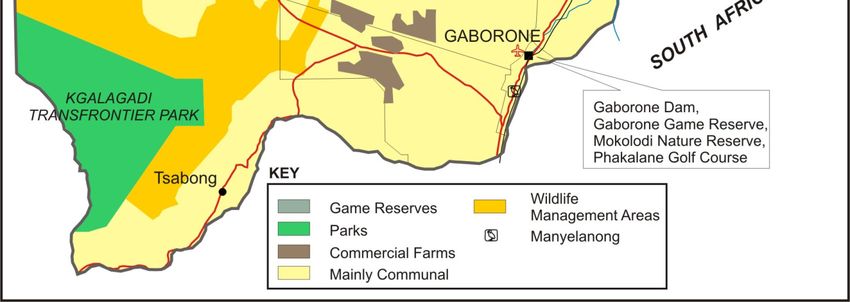
Sustainability 2020, 12, 1524                                                                        2 of 17

unreliable rainfall and recurring droughts, and population growth in villages flanking protected
areas [6,10,13,21,26,34,43–47]. In southern Africa, livelihood activities with sole dependence on
forest and rangeland resources have caused, and in some instances, exacerbated soil and land
degradation [48,49]. Subsequently, instances of conflicts over natural resource use between different
stakeholders that include park authorities and adjacent local communities [15,24,50–52] have also
fueled unsustainable livelihood activities such as illegal hunting, overharvesting of rare species of flora
and fauna [32]. In response, rural communities have resorted to new livelihood ventures, such as
park-based community ecotourism and wildlife safaris enterprises in the form of Community-based
Organizations (CBOs) or Trusts near or in Protected Areas (PAs) [5,47,52–55]. In Botswana, the
government has introduced the concept of community based natural resource management (CBNRM)
and community based organization (CBOs) (e.g., wildlife based Trusts) as a strategy to diversify
rural livelihoods and reduce competition for the same resources among stakeholders [24,49]. It is
through such initiatives that rural communities are encouraged to establish CBOs (Trusts) to develop
community-based tourism enterprises from which they collectively plan, make decisions, manage and
operate tourism enterprises and share benefits [5,56,57].
     Thus, many rural communities especially those found in or near resource rich (i.e., fauna, flora,
and cultural-heritage) protected areas have formed CBOs/Trusts which are comprised of one or several
villages with equal rights of ownership and management. For instance, local residents of Khwai,
Sankuyo and Mababe villages in the Okavango Delta region were found to benefit from ecotourism
ventures via their CBOs/Trusts [54]. In the southern Kalahari region, marginalized communities with
CBOs/Trusts accrued benefits from ecotourism activities tied to wildlife in PAs [33,47,58]. Likewise,
residents of Khawa village and Ngwatle, Ukhwi and Ncaang settlements, all are located in the Wildlife
Management Areas (WMAs) derived benefits from CBNRM - safari hunting operations through their
CBOs/Trusts [56]. WMAs are areas reserved by the government for wildlife uses and other conservation
activities. Permitted land uses are for consumptive or non-consumptive wildlife utilization. These
areas are situated in the buffer zones of PAs and mitigate land uses conflicts, and are used for migratory
corridors for wildlife [59].
     Overall, tourism activities that occur in all types of protected areas create opportunities (e.g.,
tour guides, entrepreneurial activities (e.g., beadwork for souvenirs)) as well as lead to increased
competitiveness as destinations [3,5,35,36,60,61]. Hence, it is important that local people are actively
involved in all spheres of decision-making with regards to community-based ventures [33,37,62], and
conservation of resources (i.e., fauna, flora, and cultural heritage) [7,53,63].

2. Site Context
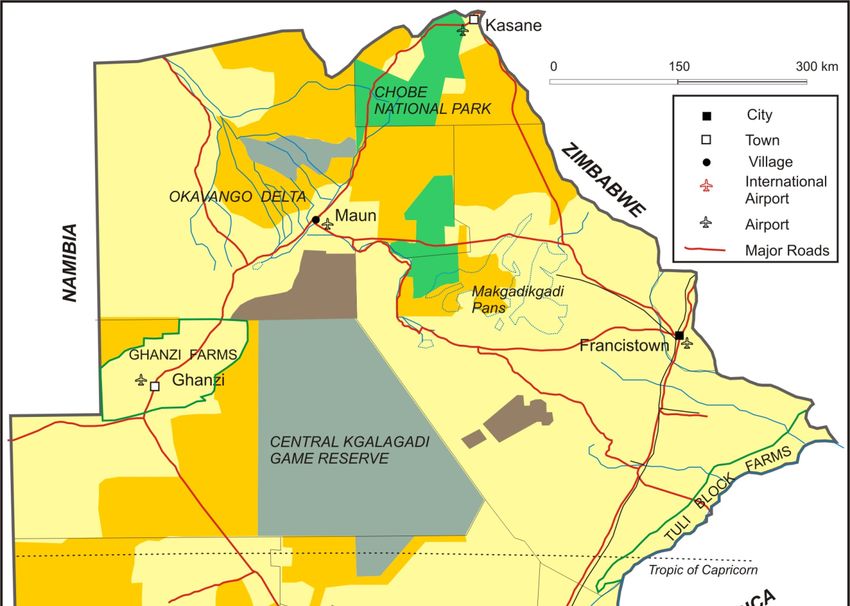
      The southwest Kalahari region is popularly known for and is associated with the Kgalagadi
Transfrontier Park (KTP) that is conterminous with Botswana and South Africa (see Figure 1). KTP
is the first transboundary protected area to be created in southern Africa [48,64,65], and has become
important for conservation as well as sources of livelihood for local people that reside within or adjacent
to it [5,7,41,52,58]. In Botswana, national parks and game reserves were created to safeguard and
maintain wildlife resources, preserve biodiversity, integrate conservation and development activities,
foster ecological education and promote park-based tourism to benefit environmental resources and
people [41,66,67]. The government’s commitment to conservation and preservation of the natural and
cultural resource base, and the promotion of sustainable utilization of such assets are evident [29,68].
The protection and preservation of wildlife resources inside and/or in the Wildlife Management Areas
(WMAs) or buffer zones of PAs have created increased numbers of wild animals in some parts of
Botswana [69]. There has also been benefits in terms of improved grass cover and biomass for wild
animals and for grazing domesticated animals—goats and sheep. It is also in these WMAs that local
people have established CBOs through which they venture in tourism—e.g., photographic tourism
and community camping sites for wilderness or nature-based tourists.
Agriculture in the Kgalagadi region only benefits a number of small to medium scale commercial
farmers [48,64,71], and there is over exploitation of tree resources, especially adjacent to villages and
settlements [39,47,72]. Thus, recent recommendations include the necessity for alternative livelihoods
in which rural
Sustainability people
2020, 12, 1524 could use rangeland in a sustainable manner to benefit themselves and 3 ofthe
17
environment [29,32,41,50].
Figure
Figure 1. 1.Map
MapofofBotswana
Botswana depicting
depicting Wildlife
Wildlife Management
ManagementAreas
Areas(WMAs)
(WMAs)andandthethe
location of of
location
Kgalagadi Transfrontier
Kgalagadi Transfrontier Park
Park (KTP) in (KTP) inBotswana
southwest southwest Botswana
(P.G. (P.G. Koorutwe).
Koorutwe).
Additionally,
In the Kgalagadi,
the case of the Kgalagadi region
studieshas high
have unemployment
identified along with
that rangelands havelimited opportunities
supported to
a diversity
initiate
of income
wildlife andgenerating
livelihoodactivities
activities[47].
suchThe
as KTP
game offers opportunities
ranches (Tsabong,toMaubelo
further capitalize on and
and Maralaleng
developTrust/CBO
villages community-based
located inecotourism initiativessouth)
Tsabong, Kgalagadi [32,33,47,61]. The recent
[32], subsistence emphasis
hunting, andon sustainable
gathering [70].
ecotourism initiatives
Agriculture demands
in the Kgalagadi that local
region onlypeople’s
benefitsinvolvement
a number ofin tourism
small ventures,
to medium especially
scale those
commercial
that reside
farmers in or near
[48,64,71], and PAs
therebe increased,
is over particularly
exploitation of tree among theespecially
resources, most affected [16,29].
adjacent Given and
to villages the
importance [39,47,72].
settlements in the establishment
Thus, recent of the KTP for transboundary
recommendations include the conservation,
necessity forlocal residents
alternative have also
livelihoods
had
in expectations
which rural peoplefor could
development
use rangelandopportunities for their
in a sustainable mannerrespective
to benefit communities
themselves and [48,65].
the
Additionally,[29,32,41,50].
environment there is limited research that pertains to conservation, tourism, and local communities
adjacent to PAs inthe
Additionally, southwestern
Kgalagadi regionBotswana [19,32,33,47].
has high unemployment Hence,along
the purpose of this
with limited study was to
opportunities
examineincome
initiate local communities’ attitudes[47].
generating activities andThe
support
KTP towards the Kgalagadi
offers opportunities Transfrontier
to further Park.onMore
capitalize and
specifically,
develop to identify factors
community-based which influence
ecotourism the[32,33,47,61].
initiatives level of support Theorrecent
opposition
emphasis of KTP. This study
on sustainable
only focusedinitiatives
ecotourism on communities
demands onthat
the local
Botswana sideinvolvement
people’s of KTP due to inthe paucity
tourism of research.
ventures, Additional
especially those
information
that reside in about the South
or near PAs beAfrican perspective
increased, has been
particularly amongdetailed elsewhere
the most [7,25,30,58,70].
affected [16,29]. Given the
importance in the establishment of the KTP for transboundary conservation, local residents have also
3. Methods
had expectations for development opportunities for their respective communities [48,65]. Additionally,
there is limited research that pertains to conservation, tourism, and local communities adjacent to
3.1. Study
PAs Site
in southwestern Botswana [19,32,33,47]. Hence, the purpose of this study was to examine local
communities’ attitudes
The Kgalagadi region andissupport
known for towards the Kgalagadi
its unique, Transfrontier
large and relatively Park.
pristine More specifically,
ecosystem, with large-to
identify factors which
scale migratory routesinfluence
for wild the level ofand
ungulates support or opposition
predatory mammalian of KTP. This study
carnivores. Theonly focused
region has
on communities on the Botswana side of KTP due to the paucity of research. Additional
desert features such as salt pans, calcrete rimmed fossil valleys, and undulating and crisscrossing information
about the South
sand dunes Africanthroughout
scattered perspective its haslandscape
been detailed elsewhere [7,25,30,58,70].
[41,48,59,65,72]. The attractiveness of southern
Kalahari and the greater KTP includes unique natural attractions—birdlife and social weaver nests.
3. Methods
Other desert tourism attractions include cultural heritage with ethnic songs, music, dances,
traditions, local food, poetry, folklore, handicrafts, religion, language, and traditional costumes [47].
3.1. Study Site
The study site is distinctive as it boasts of unspoiled wilderness, desert-adapted wildlife (e.g.,
The Kgalagadi
elephants), region isofknown
and handicrafts for its Kalahari
the diverse unique, large
peopleand relatively
that include pristine ecosystem,
San/Basarwa, with
BaHerero,
large-scale migratory routes for wild ungulates and predatory mammalian carnivores. The region
BaKgalagadi, and many others [47,73]. The architecture of dwellings is unique, and is an attraction has
desert features such as salt pans, calcrete rimmed fossil valleys, and undulating and crisscrossing sand
dunes scattered throughout its landscape [41,48,59,65,72]. The attractiveness of southern Kalahari
and the greater KTP includes unique natural attractions—birdlife and social weaver nests. Other
desert tourism attractions include cultural heritage with ethnic songs, music, dances, traditions,Sustainability 2020, 12, 1524 4 of 17
local food, poetry, folklore, handicrafts, religion, language, and traditional costumes [47]. The study
site is distinctive as it boasts of unspoiled wilderness, desert-adapted wildlife (e.g., elephants), and
handicrafts of the diverse Kalahari people that include San/Basarwa, BaHerero, BaKgalagadi, and
many others [47,73]. The architecture of dwellings is unique, and is an attraction in its own way as
appreciated at the Trailblaizers cultural village for tourism, situated about 10 miles from the village of
Ghanzi in northern Kalahari.
The Kgalagadi district is sparsely populated (49,049) with a density of 0.38 people per square
kilometer [74]. The population is comprised of six ethnic groups, namely Bangologa, Basarwa, Baherero,
Batlharo, Coloureds, and Nama. Residents overwhelming live in the communal areas mostly in and
around the villages of Matsheng, Kang and Tsabong [48]. On average, the village/settlement size
consists of 198 inhabitants. Within the district, there are more people and settlements in the southern
Kgalagadi region (59%) than the north (41%) [48]. The economy is principally based on raising
small scale livestock and nominal crop farming, while traditional livelihood activities inclusive of
subsistence hunting and gathering are also evident [39,50]. For this study, nine village/settlements were
selected from the districts: Kang, Ncaang, Ukhwi, Zutshwa, Tshane (Kgalagadi North) and Khawa,
Struizendam, Bokspits, Tsabong (Kgalagadi south).
3.2. Data Collection
The targeted respondent was the head of the household. In the event this person (father or mother)
was not available, then any member of the family (18 years or older) who had lived in the village or
settlement for at least 12 months was requested. The survey questions were translated into the national
language—Setswana. The translation was checked and verified for consistency by an expert in English
and African languages. The questionnaire was translated back to English [75], as it is the official
language and used as the medium of instruction at schools and government institutions. Responses to
the survey questions (45–60 minutes approximately) were conducted verbally by the lead author who
is a native of Botswana. Collectively 746 responses were completed for a response rate of 75% (see
Table 1).
Table 1. Selected villages, population, distance from KTP and sample households.
Approx.
Total
Total Village 30% of Household Distance from
Village/Settlements Households
Population (N) Households Sampled the Park Fence
(n) *
(km)
North Kgalagadi
Ncaang 175 43 13 37 250
Ukhwi 453 114 34 59 90
Zutshwa 469 118 35 55 75
Tshane 858 209 63 89 160
Kang 3744 913 274 122 (82) ** 280
South Kgalagadi
Khawa 517 128 39 75 21
Struizendam 313 76 23 44 23
Bokspits 499 122 37 53 53
Tsabong 6591 1608 482 212 (145) ** 300
Total (9) 13,619 3331 1000 746
* Household estimate = total population/4.1; Note: ** Initially sampled 30% of the total households and subsequently
extracted 30% of this sample (number in parentheses) for data collection. (Source: GoB, 2001).Sustainability 2020, 12, 1524 5 of 17
3.3. Operationalization of Variables
The questionnaire had items that measured various constructs and issues. First, attitudes towards
KTP (independent variable) were operationalized with 13 items adapted from the literature [22,26,34,76].
The items focused on conservation priorities, land ownership, perceived benefits, resource use and
management. Each was operationalized using a five-point Likert-type scale anchored by 1 (strongly
disagree) to 5 (strongly agree). In addition, knowledge about KTP was operationalized with three
items (Yes/No/Don’t Know) such as: KTP provides opportunities for community development
programs/projects; community campsites outside KTP accrue more money from visitors; and many
visitors who visit KTP stay in my district.
Support for KTP (dependent variable) was measured via 5 items in a Likert-type scale anchored
by 1 (strongly oppose); 2 (Oppose); 3 (Neutral); 4 (support) to 5 (strongly support). The items focused
on support or opposition towards KTP regulations and guidelines, management staff, transfrontier
status, conservation area, buffer zones and wildlife management areas. The items were adapted
from the literature [43,77,78]. Finally, ancillary items that relate to age, gender, education, household
income, employment, residency, ethnicity, household size, sources of income, and occupation were
also measured. Among these, four items such as literacy (educated/uneducated), proximity to KTP
(distance in kilometers), employment status (formal, part-time, self-employed, unemployed, retired),
and length of stay (residence in the area) were included as covariates, as past research has demonstrated
its applicability at this site [33].
4. Results
4.1. Profile of Respondents
With respect to the sample, 45% of the respondents were from Tsabong and Kang, 20% from
Tshane and Khawa, and 35% from Ncaang, Ukhwi, Zutshwa Struizendam and Bokspits. Only 45%
were males and 55% females, as reflective of the time of day for the household survey since most men
were engaged in agricultural and livestock related work, and women largely focused on domestic
chores. Forty one percent were in the 18-30 age category, 40% between 31 and 50 years old, and 19%
above 51 years old. About 21% had primary education while 16% had no formal schooling. Only 18%
reported a high school education. With respect to distance, 38% lived close (21–99 km) to the park
whereas 62% lived further away (100-300 km). About two-thirds had lived at their current address
since birth, while a third of the respondents had lived between 1 to 10 years. For income, 42% noted
less than P1000 total household income per month, 31% between P1001 and P3500, and 26% reported
over P3500 (US $1.00–BWP 10.00 based on May 2017 USA-BWP conversion). The primary source
of income was through formal employment (31%) (e.g., security guard, family welfare nurse) and
self-employment (24%) (e.g., souvenir production for commercial purposes). In addition, 25% reported
to be unemployed and were dependent on government aided welfare support programme. The
study area had mixed race/ethnic groupings with Bakgalagadi as the majority, followed by Batlharo,
Bangologa, and San/Basarwa.
4.2. Conservation Attitudes and Support for KTP
Some of the key findings relate to the fact that nearly all household heads (98%) agreed (strongly
agreed and agreed responses combined) that KTP should be protected to benefit future generations,
while 92% agreed to the importance in the protection for survival of plants. The majority (91%) agreed
that it was essential for the government to devote more money toward a strong conservation program
for KTP. However, 87% agreed that if hunting and cattle grazing were allowed in KTP, then wild
animals would all disappear. Moreover, the majority (85%) agreed that unlimited access to natural
resources (e.g., collecting fuel wood, medicinal plants, herbs, etc.) inside the KTP would lead to loss of
and extinction of some rare species. About 70% disagreed (strongly disagreed and disagreed responses
combined) that conservation and protection of KTP had taken land from the community. Similarly, 71%Sustainability 2020, 12, 1524 6 of 17
disagreed that farmers did not have land to cultivate and graze their livestock due to KTP, while 20%
agreed. Respondents were also asked to put forth their views about whether it would be better if some
parts of the land in KTP were allocated to communities to utilize for agriculture. A sizeable percentage
of respondents (69%) disagreed that parts of land from KTP should be allocated for agriculture, while
23% agreed (see Table 2).
Table 2. Residents’ attitudes (percentages) towards the Kgalagadi Transfrontier Park (N = 746).
Strongly Strongly
Statements Disagree Neutral Agree
Disagree Agree
KTP should be protected for benefit of our future generations. 0.4 0.4 1.3 42.9 55
KTP protection has taken our land from us *. 17.8 51.7 9.5 17.8 3.1
It is important to protect KTP for survival of plants. 0.8 3.6 3.2 68.0 24.3
Farmers don’t have land to cultivate and graze livestock due
19.2 51.7 9.0 15.8 4.3
to KTP*.
Staff from KTP has done nothing for villagers’ lives *. 6.4 36.2 20.0 29.8 7.6
It is better if some parts in KTP be allocated to the local people
19.7 49.7 7.4 19.2 3.6
to use for agriculture *.
If hunting and grazing in KTP is allowed then wildlife will
2.4 6.3 3.6 57.4 30.0
disappear.
If there is unlimited access to forest resources in KTP
(Firewood, medicinal plants, forest foods) they will all 3.4 6.7 5.4 61.7 22.9
disappear.
It is important for government to devote more money toward
1.2 3.9 4.4 62.9 27.5
a strong a conservation program for the KTP.
KTP provides jobs for people from the village. 5.4 31.1 12.1 42.4 9.1
KTP is being managed for the local people. 4.2 35.3 16.4 35.3 8.7
I am happy to have my village next to KTP. 0.9 6.4 9.5 66.2 16.2
It is important to protect KTP for the survival of wildlife. 1.6 1.5 2.9 61.9 32.0
* Item reverse coded prior to analysis.
Similarly, majority of respondents (95%) expressed support (strongly support and support
responses combined) for the protection of KTP as a conservation area. A sizeable proportion (72%)
were supportive of KTP as a transfrontier park. Also, the level of support for the current management
staff was noted by 65% of the respondents. Although the majority were supportive of KTP as a
transfrontier park, there were others (21%) who opposed it (strongly oppose and oppose responses
combined). Additionally, a large number (78%) were supportive of the creation of KTP buffer zones
and Wildlife Management Areas, while 73% supported regulations and guidelines that maintained
KTP as a transfrontier park (see Table 3).
Table 3. Residents’ level of support (percentages) for Kgalagadi Transfrontier Park (N = 746).
Strongly Strongly
Statements – I Support Oppose Neutral Support
Oppose Support
KTP as a Transfrontier Park. 9.4 11.9 6.7 51.7 20.0
Current management staff at KTP. 1.1 14.6 19.2 51.5 13.5
Creation of buffer zones and WMAs. 2.1 6.2 13.0 58.8 19.6
Regulation and guidelines for KTP. 4.3 7.6 15.3 54.2 18.5
Protection of KTP as a conservation area. 0.4 1.2 2.8 65.5 29.8Sustainability 2020, 12, 1524 7 of 17
4.3. Data Analysis
First, the 13-item independent attitudinal measures were assessed for appropriateness to conduct
data analysis via Bartlett’s test of sphericity and Kaiser-Meyer-Oaklin (KMO) measure of sampling
adequacy. Bartlett’s test of sphericity was highly significant (approximate chi-square = 1386.647, df =
78, p < 0.001), and KMO was 0.752, which exceeded [79] recommended cut-off of 0.60. Likewise, for
the five-item dependent variable measure (i.e., support) Bartlett’s test of sphericity was also highly
significant (approximate chi-square = 753.445, df = 10, p < 0.001), and KMO was 0.699. These two
measures for the independent and dependent variable measures suggested that the data was suitable
for factor analysis.
Second, a principal component analysis (PCA) was performed using Varimax rotation with Kaiser
normalization. Four factors (i.e., land ownership, conservation awareness, local benefits, and resource
use) were generated and accounted for 53.14% of the total variance which exceeded the minimum
cut-off of the 50% [79,80]. The four factors explained 20.09%, 12.27%, 10.03%, and 7.75% of the variance,
and had eigenvalues of 3.00, 1.59, 1.30, and 1.01, respectively (see Table 4). The single factor for the
criterion or dependent measure explained 46.71% of the total variance. Factor loadings 0.40 or greater
were considered significant [81]. The reliability score ranged from 0.56 to 0.70, and were deemed
acceptable [81]. Considering these scores, [82] recommend reporting the mean inter-item correlation
for the items, and suggests an optimal range of 0.20 to 0.40. For this study, the ranges of inter-item
correlation means were 0.241 to 0.440, and noted to be acceptable. Although reliabilities were lower
than desired, they were not low enough to justify discontinuation given the range of mean inter-item
correlations, number of items, and the unique nature of the data [81–84]. The items within each factor
were computed as independent index, respectively. In addition, an index was created for the three
items that measured perceived benefits about KTP which were: 1.) KTP provides opportunities for
community development; community; 2) Community campsites accrue more money from visitors;
and 3) Many visitors who visit KTP stay in my district.
Table 4. Factor loadings and reliabilities.
% of Mean
No. of Scale
Constructs and Items Loading Variance Inter-item Reliability
Items Mean *
Explained Correlation
10.92
Land Ownership 3 20.09 0.440 0.70
(2.58)
Farmers don’t have land to cultivate and
0.806
graze livestock due to KTP.
KTP protection has taken our land from us. 0.802
It is better if some parts of land in KTP is
allocated to local people to 0.705
use for agriculture.
16.96
Conservation Awareness 4 12.27 0.242 0.56
(1.81)
KTP should be protected for the future of
0.701
our new generation.
It is important to protect KTP for the
0.601
survival of wildlife.
It is important for the government to devote
more money towards a strong conservation 0.570
program for KTP.
It is important to protect KTP for
0.479
survival of plants.Sustainability 2020, 12, 1524 8 of 17
Table 4. Cont.
% of Mean
No. of Scale
Constructs and Items Loading Variance Inter-item Reliability
Items Mean *
Explained Correlation
10.76
Local Benefits 4 10.03 0.241 0.56
(2.74)
KTP provides jobs to people from the village. 0.765
Staff from KTP have done nothing for
0.682
villagers’ lives. 8 of 16
KTP is being managed for the local people. 0.641
8 of 16 8 of 16 8 of 16 8 of 16
I am happy to have my village 8 of 16
I am happy to have my village next to KTP. 0.415 0.415
next to KTP.
I am happy to I am
havehappy
my village
Itoam have
happymy village
Itoam
havehappy
my village
to have my village 8.01 8.01
I am happyResource to have my village 0.415 0.415 0.415
0.396 7.750.415
next to KTP.next Resource
toUse
KTP.next Use to KTP.next 2 to KTP. 0.415 2 7.75 0.57 0.396
(1.52)
0.57
(1.52)
next to KTP. 8 of 16
8.01 8.01 8.01 8.01
IfIfhunting and
huntingResource
and grazing
Resourcegrazing inResource
Use KTP
in KTP is Use is Resource
allowed 2 UseResource
2 Use 7.752 7.75
0.396
2 7.75
0.396
0.57 7.758.01
0.3960.57 0.396
0.57 0.57
Use 2 7.75 0.789 0.396 0.57 ( 1.52) ( 1.52) ( 1.52) ( 1.52)
allowed
Ithen
am
then
wild
happy
wild animals
animals
to will will
disappear. 0.789 (1.52)
If hunting
disappear. andIfhave my
hunting
grazing village
and
inIf KTP
hunting
grazing
is and in
If KTP
hunting
grazing
is 0.415
and
in KTP
grazing
is in KTP is
If hunting
next to KTP. and grazing in KTP is 8 of 16
allowed then allowed
wild animals
then allowed
wild
will
to animals
then allowed
wild
willanimals
then0.789
wild
willanimals 0.789
will 0.789 0.789
IfIfthere
thereisisunlimited
allowed
unlimited
then wild animals
access
access to
will
forest
0.789 8.01
disappear.
resources in disappear.
KTP
Resource (e.g., disappear.
firewood,
Use(e.g., disappear.
medicinal
2 7.75 0.775 0.396 0.57
forest resources
disappear. in KTP (1.52)
Iplants)
am happy
If there then toIfhave
ismedicinal
unlimited
there
they myis village
access
will unlimited
If there
also to isaccess
disappear. unlimited
If there
to isaccess0.775to access to
unlimited
firewood,
If there
hunting is unlimited
and grazing plants)
access
in KTPtothenis 0.415
next to KTP.
forest resources forestin resources
KTP (e.g.,
forest in resources
KTP (e.g.,
forest in resources
KTP (e.g.,in KTP (e.g.,
they
forest
allowed will alsoDependent
resources
then disappear.
wild in animals
KTP (e.g., Measure
will 0.775
0.789 0.775 0.775 0.775 8.01
firewood,Resource
medicinal
firewood, plants)
Use medicinal
firewood,
then plants)
medicinal
firewood,
2 thenplants)
medicinal
0.775 thenplants) 7.75 then 0.396 0.57
firewood,
disappear. Dependent
medicinal Measure
plants) then (1.52)
they will also they
disappear.
will also theydisappear.
will also theydisappear.
will also disappear. 19.08 19.08
they
If therewillisalso
hunting unlimited
KTP
KTP
anddisappear.
grazing
Support
Support
access
in KTP to is Dependent 5 Dependent
5 46.71 .327
46.71 0.70 .327 0.70
Dependent Measure
Dependent Measure Measure Measure ( 3.16) (3.16)
allowed Dependent
forest resources
then wild Measure
in animals
KTP (e.g., will 0.789
Regulations and guidelines 0.775 Support 19.08 19.08 19.08 19.08
Regulations
firewood,
disappear. KTPand
medicinal Support KTPto
guidelines
plants) thento maintain
Support 5 KTPKTP
KTP Support 5 46.715 46.71.327
5 46.71
.327
0.70 46.71 19.08
.3270.70 .327
0.70 0.70
KTP Support 5 46.710.789 .327 0.70 (3.16) (3.16) (3.16) (3.16)
maintain
as
they
If
a KTP
Transfrontier
willisalso
there
as a Transfrontier
disappear.
unlimited
Park.
accessRegulations
to toguidelines
0.789 ( 3.16)
Regulations
Park. Regulations
and guidelines and Regulations
andtoguidelines andtoguidelines to
Regulations
Current
forest Dependentandin
management
resources guidelines
Measure staff to at KTP. 0.753 0.789
maintain KTP as aKTP
maintain (e.g.,
Transfrontier
KTP maintain
as a Transfrontier
KTP maintain
as a Transfrontier
KTP0.789
0.775as a Transfrontier
0.789 0.789
Current management
maintain KTP as a staff at KTP.
Transfrontier 0.753
0.789 19.08
firewood,
Park.as a medicinalPark. plants) Park.then Park.
KTP KTP SupportNational
Transfrontier National Park. 5 46.71 0.701 .327 0.70
KTP
Park.
they as a Transfrontier
will also disappear. 0.701 (3.16)
Current management
Current management
staff
Current
at KTP. management
staff
Current
at KTP. management
staff
0.753
at KTP.staff 0.753
at KTP. 0.753 0.753
Park.
Current
Regulations
Protection management
and
of KTP staff
guidelines
as attoKTP.
aNational
conservation area. 0.753 0.614
KTP as Dependent
a Transfrontier
KTP Measure
as a Transfrontier
KTP as a Transfrontier
National
KTP as a Transfrontier
National National
Protection of KTP
KTP as a Transfrontier
maintain KTP as a as a National
Transfrontier 0.701
0.789 0.701 0.701 0.701 19.08
Park.
Creation of
KTP Park.
KTP buffer
Support Park.
zones and Park.
WMAs.
5 0.614
0.701 46.71 0.527 .327 0.70
conservation area.
Park. (3.16)
Protection ofProtection
KTP as a ofProtection
KTP as a ofProtectionKTP as a of KTP as a
Creation
Protection
Current
Regulations ofofKTPKTPbuffer
management
and zones
as astaff
guidelines and
attoKTP. * Scale
0.614standard
0.753 deviation
0.614 in brackets.
0.614 0.614
conservation conservation
area. conservation
area. conservation
area. 0.527
area.
0.614
WMAs.
conservation
KTP
maintain KTParea.
as a Transfrontier National
as a Transfrontier 0.789
Creation of KTP Creation
buffer ofzones
KTP
Creation buffer
andof zonesKTP
Creationbuffer
andof0.701
zones
KTP buffer
and zones and
Creation of KTP buffer zones and * Scale standard
Park. 0.527
deviation in 0.527
brackets. 0.527 0.527
WMAs.Furthermore,
WMAs. management
Protection
Current
WMAs. several
of KTP as astaff at KTP.
WMAs. techniques WMAs. 0.527 were used to ensure against multi-collinearity. First, a correlation
0.753
analysis was
Furthermore,
conservation
KTP area.
as a Transfrontierconducted
several
National along
techniques* Scale with were a0.614
* Scale standard
standard
* Scale
used
deviation
standard
collinearity
deviation
* Scale
to ensure
in deviation
brackets.
standard
* Scale
diagnosis.
in brackets.
indeviation
brackets.
standard indeviation
The bivariate
against multi-collinearity.
brackets. in brackets.
correlations
First, a ranged between
0.701
correlation
Creation
Park.
0.01 and of analysis
KTP
0.49, buffer
and waszones
were conducted
and below along
0.70 with
[80] a collinearity
(see Table diagnosis.
5). The
Subsequently, bivariate cutcorrelations
off points were earmarked
Furthermore, Furthermore,
severalFurthermore,
techniques
severalFurthermore,
techniques
were
several
0.527used techniques
were
several
to ensure
usedtechniques
were
to
against
ensure
usedweremulti-collinearity.
to
against
ensure
used multi-collinearity.
toagainst
ensure First,
multi-collinearity.
against
a First, multi-collinearity.
a First, a First, a
WMAs. Furthermore,
Protection
ranged of KTP0.01
between asseveral
a and 0.49, techniques
and werewere below used
0.70 to [80]ensure
(see Tableagainst multi-collinearity.
5). Subsequently, cut offFirst,
pointsa
toconservation
determine
correlation area.
multicollinearity—tolerance
correlation
analysis was
correlation
analysis
conducted was
correlation
analysis
* Scale
conducted
along
standard
0.614
was
with
analysis value
conducted
along
a collinearity
was
with of less
conducted
along
a 0.10,
collinearity
diagnosis.
with along
a or a variance
collinearity
diagnosis.
The
withbivariate
a inflation
collinearity
diagnosis.
The correlations
bivariate factor
diagnosis.
The correlations
bivariate The(VIF) value
correlations
bivariate correlations
correlation
were earmarked analysis was conducted
to determine along withdeviation
multicollinearity—tolerance in brackets.
a collinearity valuediagnosis.
of less 0.10,The orbivariate
a variance correlations
inflation
ranged
ofCreation
above between
ranged
10 [84] 0.01
between
(p. and
ranged 0.49,
164). 0.01
between
and
ranged
and
The were
0.49,
0.01
between
below
and
and
tolerance were
0.49,
0.70
0.01 below
and
[80]
and (see
were
0.49,
0.70Table
below
and
[80] were
5).
(see
0.70
Subsequently,
Table
below
[80] (see
5).0.70
Subsequently,
Table
[80]
cut (see
5).
off Subsequently,
points
Table
0.98 or less with 0.98off points
cut 5).
off Subsequently,
points
cut off points
cut
ranged
factor (VIF)of KTP
between value buffer
0.01 zones
and
of above and
0.49,
10 and
[84] were
(p. 164). below
The
0.527 0.70value
tolerance[80] (see for
value each
Table
for 5). of
each of the variables
Subsequently,
the variables cutwasoffwaspoints
0.98 or
were
WMAs. earmarked
Furthermore, were earmarked
to determine
were
several earmarked
to multicollinearity—tolerance
determine
techniques were earmarked
to determine
multicollinearity—tolerance
to determine
multicollinearity—tolerance
valuemulticollinearity—tolerance
of lessvalue
0.10, of
orless
avalue
variance
0.10, ofor
lessinflation
a
value
variance
0.10,oforless
ainflation
variance
0.10, or ainflation
variance inflation
as the
were highest,
earmarked to which
determine greaterwere thanused
is multicollinearity—tolerance 0.10.to The ensure
less with .98 as the highest, which is greater than 0.10. The variance inflation factor (VIF) was 1.432 against
variance
value multi-collinearity.
inflation
of less 0.10, First,
(VIF)a was 1.432 (highest),
factorinflation
or a variance
factor (VIF)factor
correlation value(VIF)
of above
analysis factor
value10
(VIF)
of[84]
*above
factor
value
(p. standard
Scale 164).
10
(VIF)
of[84]
above
The
value
(p.
tolerance
164).
10of[84]
above
deviationThe
in(p.
value
tolerance
164).
10 [84]
for
brackets.The
(p.
each
value
tolerance
164).
of for
the
Theeach
variables
value
tolerance
offor
thewas
each
variables
value
0.98
offor
the
orwas
each
variables
0.98
of the
orwas
variables
0.98 orwas 0.98 or
factor (VIF)
(highest),
which value
which
was was
below of was
above
below
theconducted
10
the[84]
cut-offcut-offalong
(p.of164).
of with
10.
10. The a collinearity
tolerance
Collectively,
Collectively, value
thethediagnosis.
for each ofThe
multicollinearity the bivariate
variables
assumption correlations
waswas0.98notor
less with
ranged .98
betweenless
as with
the highest,
0.01 .98
less
and aswith
the
which
0.49, highest,
.98
and less
as
is with
weregreater
the
which
highest,
.98
below than
as
is0.70
the
greater
which
0.10.
highest,
[80] The
than
(see 0.10.multicollinearity
is greater
variance
which
Table The
than
isinflation
5). greater
variance
0.10. The
than
factor
Subsequently,inflationassumption
variance
0.10.
(VIF)
cutThe
factor
was
inflation
off variance
1.432 was1.432
(VIF)factor
was not
inflation
(VIF) violated.
factor
was 1.432
(VIF) was 1.432
less with In
violated. .98addition,
as the highest, which validity
discriminant is greater than 0.10.was
assessment Theperformed,
variance inflation
and thefactor
bivariate(VIF) waspoints
1.432
correlations
In addition,
(highest), which
Furthermore,
were earmarked discriminant
(highest),
was which
below
(highest),
several
totodetermine was
the validity
which
cut-off
techniques(highest),
below was
the
of
wereassessment
10.
which
cut-off
below
Collectively,
used was
the
ofto10. was
cut-off
below performed,
Collectively,
ensurethethe
ofmulticollinearity
10.
cut-off
Collectively,
against theof and the
multicollinearity
10. Collectively,
assumption
the bivariate
multicollinearity
multi-collinearity. assumption
the
was
First, correlations
multicollinearity
not
a assumption
was not ranged
assumption
was not was not
(highest),
ranged which
from 0.01was below
0.49, themulticollinearity—tolerance
while cut-off of 10.were
reliabilities Collectively,
from 0.56the value of Thus,
less 0.10,
to multicollinearity
0.70. orassumption
a variance
discriminant inflation
waswas
validity not
violated.
correlation
from
factor 0.01
(VIF) Inanalysis
violated.
toaddition,
value0.49,
of Indiscriminant
wasviolated.
addition,
while
above conducted
10 Inviolated.
[84] discriminant
addition,
validity
(p.along
reliabilities 164). Inassessment
discriminant
with
were
Theaddition,
validity
a from discriminant
assessment
was
validity
collinearity
tolerance 0.56
valueperformed,
assessment
wasvalidity
diagnosis.
to 0.70.
for each performed,
and
of The
Thus, the
assessment
thewas bivariate
performed,
and the
bivariate
discriminant
variables was
correlations
bivariate
performed,
and
correlations
was 0.98 thecorrelations
validity
or bivariate
and
was thecorrelations
bivariatefor
verified correlations
violated. In the
verified for addition, discriminant validity assessment was performed, and the bivariate correlations
constructs.
ranged
ranged
less with from
between
.98 ranged
as0.01
0.01
the to
from
0.49,
ranged
and
highest,0.01
while
0.49, to
from
whichand0.49,
reliabilities
ranged
0.01
were
is while
to
greaterfrom
0.49,
reliabilities
below were
0.01
than while
from
0.70 to[80]
0.10. 0.49,
reliabilities
were
0.56
The while
(see to
from
0.70.
Table
variance reliabilities
were
0.56
Thus,
5). to
from
0.70.
discriminant
were
0.56
Thus,
Subsequently,
inflation factor to
from
0.70.
discriminant
cut
(VIF)validity
0.56
Thus,
off
was to1.432
0.70.
discriminant
was
points validity
Thus, discriminant
was
validity wasvalidity was
the constructs.
ranged from 0.01 to 0.49, while reliabilities were from 0.56 to 0.70. Thus, discriminant validity was
verified
were for
earmarked verified
the was
constructs.
forverified
to determinethe constructs.
for verified
the constructs.
for Collectively,
themulticollinearity—tolerance the constructs. value
(highest),
verified for which
theTable 5.below
constructs. Correlation cut-off
matrix of 10.
of study the
variables, means andofstandard
less 0.10,
multicollinearity orassumption
a variance inflation
deviations. was not
factor (VIF)
violated. value of above
In addition, 10 [84] validity
discriminant (p. 164).assessment
The tolerance was value for eachand
performed, of the
the variables correlations
bivariate was 0.98 or
Table
Ƶ1 highest, 5. Correlation
ƵTable matrix of study variables, means and standard deviations.
Variables
less
rangedwith .98 as
from
Table
the
0.01
Tableto 5.
5. Correlation
0.49,
2
which
while
Correlation isƵ3 greater
5. matrix
Correlation
Table
reliabilities
matrix
5.Ƶthan
of study
were
of study
X15.
4Correlation
matrix
Table
variables,
of
0.10.
from
study
The
0.56
variables,
X2ofand
Correlation
matrix
means
variables,
study
variance
to 0.70.
means
X3
matrix
standard
means
variables,
of and
study
inflation
Thus,
and standard
X4
deviations.
standard
means
factor
discriminant(VIF)
deviations.
X5standard
variables,
and was
validity
Y1
deviations.
means and
1.432
was
deviations.
standard deviations.
Covariates
(highest),
verified
Variableswhich
Variables was
for theVariables below
constructs.
Ƶ11 the
Ƶ2 Ƶ21
Variables cut-off of 10. Collectively, the multicollinearity
Ƶ3 Ƶ2 Ƶ31 Ƶ4 Ƶ3 Ƶ2 Ƶ41 X1 Ƶ4 Ƶ3 Ƶ2X1
Variables X2X1Ƶ4 Ƶ3 X3 assumption
X2X1Ƶ4 X4X3
X2 was
X2X1 X5X4X3
X3 not
X2 Y1 X5X4X3
X4 X5 Y1 X5X4Y1 Y1 X5 Y1
Literacy
Variables( 1) 1.000
Ƶ1 discriminantƵ2 Ƶ3 Ƶ4 X1was performed,
X2 X3 X4 X5 Y1
violated. In addition, validity assessment
Covariates Covariates and the bivariate
Covariates Covariatescorrelations
Proximity (Ƶ2) 0.11 ** 1.000 Covariates Covariates
ranged from
Literacy ( 1)0.01 to 5.
Literacy
Table 0.49,
1.000 while
( Correlation
1)Literacy 1.000(reliabilities
1)Literacy
matrix 1.000( were
of study from
1.000 0.56
1) variables, to 0.70.
means Thus, discriminant
and standard deviations. validity was
Employment
Literacy ( 1)
Literacy −0.20
1.000
verified for (Ƶ
Proximity the
2) constructs.
1.000
Proximity
0.11 2−0.10
**(ƵProximity
) 1.000 ** **(Ƶ1.000
0.11 Proximity
2) 1.0000.11 **(Ƶ2) 1.000
0.11 ** 1.000
status (Ƶ
Variables
Proximity )) 2) 0.11
( 31(Ƶ Ƶ**1 ** Ƶ2
1.000 Ƶ3 Ƶ4 X1 X2 X3 X4 X5 Y1
EmploymentEmployment −0.20 Employment −0.20 Employment −0.20 −0.20
Length
Employmentof stay
Proximity −0.50
−0.20 −0.10 ** 1.000
−0.10 ** Covariates
1.000
−0.10 ** 1.000
−0.10 ** 1.000
status (Ƶ3) Table
status
0.11**(Ƶ
5. ) −0.09
status
Correlation
** −0.10 1.000
3 *
****(Ƶ3 0.31
)
matrix
1.000**
statusof**
(Ƶ1.000
study
3 ) **
variables, means and standard deviations.
(Ƶ4)(Ƶ
status
Literacy ( (3))1) **
**
1.000
Length of2 stay Length−0.50
of stay Length−0.50 of stayLength−0.50of stay −0.50
Variables
Length
Proximity of stay
(Ƶ 2) Ƶ
−0.50
0.11 1 ** −0.09
Ƶ
1.000
2 * 0.31 Independent
Ƶ3−0.09
** * 1.000
Ƶ4 0.31 ** Measures
−0.09 * 1.000
X1 0.31
−0.09
**X2* 1.000
0.31X3** 1.000X4 X5 Y1
Employment
(Ƶ4) (Ƶ4**) −0.09(Ƶ*4**) 0.31 **(Ƶ4** ) 1.000 **
Perceived
Employment)
(Ƶ4status ** **
−0.20
−0.20 −0.10 ** 1.000 Covariates
−0.07 −0.13 **
−0.10 ** −0.07 −0.04
1.000 Independent 1.000
Independent
Measures Independent
MeasuresIndependent
Measures Measures
benefits
Literacy ((X1)
status (Ƶ (33))1) **
1.000 Independent Measures
Perceived Perceived Perceived Perceived
Land
Perceived
Length
Proximity of stay
(Ƶ2) 0.11 −0.07
−0.50 ** −0.13
1.000 −0.07
** −0.07
−0.13 −0.07
** −0.04 −0.07
−0.13
−0.07
**
1.000
−0.04
−0.07
−0.13 **1.000
−0.04
−0.07 1.000−0.04 1.000
Length
benefits (X1)benefits
−0.07 (X1)−0.13
benefits
−0.09** * (X1)
** benefits
−0.07
0.31 ** −0.15
(X1)
−0.04
1.000 1.000
Ownership
benefits4) (X1)
(Ƶof
Employment stay 0.12** ** ** 0.20−0.09
−0.20
−0.50 *−0.07Land
0.31 **** 0.04
1.000 1.000
Land
(X2)(Ƶ Land Land
−0.10 ** 1.000
Land
status ( 34)) ** −0.15
Independent −0.15
Measures −0.15 −0.15
Ownership Ownership
0.12 ** Ownership0.200.12** ** Ownership
−0.07
0.20
0.12**−0.15
** −0.07 0.20
0.12**0.04
** −0.070.201.000
** 0.04−0.07 1.000
0.04 1.000
0.04 1.000
Conservation
Ownership
Perceived
Length of stay 0.12
−0.50 ** 0.20 ** −0.07 ** 0.04 ** 1.000 ** **
(X2) (X2)
−0.07 −0.13
−0.09(X2)
**
* −0.13*
−0.07
0.31 ** (X2) **
−0.04
1.000 1.000
Awareness
(X2)
benefits
(Ƶ4) (X1) −0.06
** −0.06 0.01 0.23 ** 0.25 ** 1.000
Conservation Conservation Conservation *
Conservation
(X3)
Conservation
Land −0.13* Independent −0.13* Measures −0.13* −0.13*
Awareness Awareness −0.06 Awareness −0.06
−0.06 −0.13*Awareness
−0.06
−0.06 0.01 −0.06
−0.15 −0.06
0.230.01
** −0.060.25
0.23
**0.01
** 1.000
0.25
0.23
**0.01
** 1.000
0.25
0.23
** ** 1.000
0.25 ** 1.000
Awareness
Ownership
Perceived −0.06
0.12 ** −0.06
0.20 ** −0.07* 0.01 * 0.23 0.04** *0.25 1.000** *
1.000
(X3) (X3)
−0.07 −0.13(X3)** * (X3) −0.04
−0.07 ** 1.000
(X3) (X1)
(X2)
benefits
Conservation
Land
−0.13* −0.15
Awareness
Ownership −0.06
0.12 ** −0.06
0.20 ** −0.07 0.01 0.23
0.04** 0.25
1.000** 1.000
* **
(X3)
(X2)
Conservation
−0.13*
Awareness −0.06 −0.06 0.01 0.23 ** 0.25 ** 1.000ranged between
ranged0.01
between
and
ranged
0.49,
0.01
between
and
ranged
andwere
0.49,
0.01
between
below
and
andwere
0.49,
0.70
0.01below
and
[80]
and(see
were
0.49,
0.70
Table
below
and
[80] were
5).
(see
0.70
Subsequently,
Table
below
[80] (see
5).0.70
Subsequently,
Table
[80]
cut (see
5).
off Subsequently,
points
Table
cut 5).
offSubsequently,
points
cut off points
cut off points
were earmarked
were earmarked
to determine
were earmarked
to multicollinearity—tolerance
determine
were earmarked
to determine
multicollinearity—tolerance
to determine
multicollinearity—tolerance
value
multicollinearity—tolerance
of less
value
0.10,oforless
avalue
variance
0.10,oforless
inflation
avalue
variance
0.10,oforless
ainflation
variance
0.10, or ainflation
variance inflation
factor (VIF)factor
value(VIF)
of above
factor
value10
(VIF)
of[84]
above
factor
value
(p. 164).
10
(VIF)
of[84]
above
The
value
(p.tolerance
164).
10of[84]
above
The(p.
value
tolerance
164).
10 [84]
forThe
(p.
each
value
tolerance
164).
of for
the
The
each
variables
value
tolerance
offor
thewas
each
variables
value 0.98
offor
the
orwas
each
variables
0.98
of the
orwas
variables
0.98 orwas 0.98 or
less with .98less
as with
the highest,
.98
less
aswith
the
which
highest,
.98
less
as
is with
greater
the
whichhighest,
.98 than
as
is the
greater
which
0.10.
highest,
The
than
is greater
variance
which
0.10. The
than
isinflation
greater
variance
0.10. The
than
factor
inflation
variance
0.10.
(VIF)
The
factor
was
inflation
variance
1.432
(VIF)factor
was
inflation
1.432
(VIF)factor
was 1.432
(VIF) was 1.432
(highest), which
(highest),
was which
below
(highest),
was
the which
cut-off
(highest),
belowwas the
of 10.which
cut-off
below
Collectively,
was
the
of 10.
cut-off
below
Collectively,
thethe
ofmulticollinearity
10.
cut-off
Collectively,
theofmulticollinearity
10. Collectively,
assumption
the multicollinearity
assumption
the
was multicollinearity
not assumption
was not assumption
was not was not
violated. Inviolated.
addition,Indiscriminant
violated.
addition,Inviolated.
discriminant
addition,
validityInassessment
discriminant
addition,
validity discriminant
assessment
was
validity
performed,
assessment
was
validity
performed,
and theassessment
wasbivariate
performed,
and thewas
correlations
bivariate
performed,
and thecorrelations
bivariate
and thecorrelations
bivariate correlations
Sustainability 2020, 12, 1524 9 of 17
ranged from ranged
0.01 to
from
0.49,
ranged
0.01
while
to
from0.49,
reliabilities
ranged
0.01
while
to
from0.49,
reliabilities
were
0.01
while
from
to 0.49,
reliabilities
were
0.56while
to
from
0.70.
reliabilities
were
0.56
Thus,
to
from
0.70.
discriminant
were
0.56
Thus,to
from
0.70.
discriminant
validity
0.56
Thus,to 0.70.
discriminant
wasvalidity
Thus, discriminant
wasvalidity was validity was
verified forverified
the constructs.
forverified
the constructs.
forverified
the constructs.
for the constructs.
Table 5. Correlation
Table 5. matrix
Correlation
Tableof study
5. Correlation
matrix
Table Table
variables,
of 5.
study 5.ofCont.
Correlation
matrix
means
variables,
and
study
matrix
standard
means
variables,
of and
study
deviations.
standard
means
variables,
and
deviations.
standard
means anddeviations.
standard deviations.
Variables
Variables VariablesƵ11 Ƶ2 Ƶ21
Variables Ƶ3 Ƶ2 Ƶ31 Ƶ4 Ƶ3 Ƶ2 Ƶ41 X1 Ƶ4 Ƶ3 Ƶ2X1
Variables X2X1Ƶ4 Ƶ3 X3 X2X2X1Ƶ4 X4X3 X2X1 X5X4X3
X3 X2 Y1 X5X4X3
X4 X5 Y1 X5X4Y1 Y1 X5 Y1
Covariates Covariates
Independent Measures Covariates Covariates
Literacy ( 1)Literacy
1.000( 1)Literacy
1.000 ( 1)Literacy
1.000 ( 1) 1.000
Perceived
Proximity (ƵProximity
2) 0.11 **(ƵProximity
2) 1.000
0.11 **(ƵProximity
2) 1.000
0.11 **(Ƶ2) 1.0000.11 ** 1.000
benefits −0.07 −0.13 ** −0.07 −0.04 1.000
Employment −0.20 Employment
(X1) Employment −0.20 Employment−0.20 −0.20
−0.10 ** 1.000
−0.10 ** 1.000
−0.10 ** 1.000
−0.10 ** 1.000
status (Ƶ3) status**(Ƶ3) status**(Ƶ3) status**(Ƶ3) **
Land
Length of stay Length−0.50 Length−0.50
of stay Length−0.50
of stay of stay −0.50
Ownership 0.12 ** −0.09 0.20* ** 0.31 −0.07
−0.09
** * 1.000
0.31 −0.15
** * **
−0.09 1.000
0.31 **0.04
−0.09 * 1.000
0.31 **1.000 1.000
4)
(Ƶ(X2) (Ƶ4**
) (Ƶ4**
) (Ƶ4**
) **
IndependentIndependent
Measures Independent
MeasuresIndependent
Measures Measures
Conservation
Perceived Perceived Perceived Perceived
Awareness −0.07 −0.06 −0.13 −0.06
−0.07
** −0.13**
−0.07
−0.13−0.07
** −0.04−0.07
−0.13 0.01
−0.07
**
1.000
−0.04
−0.070.23
−0.13 **−0.04
**1.000 −0.070.251.000
**−0.04 1.000
1.000
benefits
(X3)(X1)benefits (X1)benefits (X1)benefits (X1)
Land Land Land Land
Local −0.15 −0.15 −0.15 −0.15
Ownership Ownership
0.12 ** Ownership
0.20
0.12
** ** Ownership
−0.07
0.20
0.12
** ** −0.070.20
0.12
**0.04
** −0.07
0.201.000
** 0.04−0.07 1.000 0.04 1.000
0.04 1.000
Benefits 0.13 ** 0.14 ** 0.05 ** 0.02 ** −0.40 ** ** −0.17 ** ** −0.32 ** 1.000
(X2) (X2) (X2) (X2)
(X4)
Conservation Conservation Conservation Conservation
Resource −0.13* −0.13* −0.13* −0.13*
Awareness Awareness−0.06
−0.05 Awareness
−0.06
−0.06 Awareness
−0.01 −0.06
−0.06 0.01 −0.06 −0.06
0.230.01
** −0.06
0.25
0.23**0.01
** 1.000
0.25
0.23
**0.01
** 1.000
0.25
0.23
**** ** −0.176
1.000
0.25 ** 1.000
Use (X5) * −0.07 * −0.01 * 0.10 ** * 0.26** 0.35 ** 1.000
(X3) (X3) (X3) (X3)
Dependent Measure
KTP
Support −0.16 ** −0.11 ** −0.07 0.04 0.30 ** 0.16 ** 0.25 ** −0.40 ** 0.16 ** 1.000
(Y1)
Mean 0.60 0.62 2.46 28.51 0.37 3.64 4.24 2.69 4.00 3.82
Standard
0.49 0.49 1.20 19.84 0.32 0.86 0.45 0.68 0.76 0.63
Deviation
* Correlation Significant at the 0.05 level (2 tailed); ** Correlation significant at the 0.01 level (2 tailed).
4.4. Regression Analysis
Hierarchical regression was conducted with five predictor independent measures (perceived
benefits, land ownership, conservation awareness, local benefits, and resource use) along with four
covariates (literacy, proximity, employment status, and length of stay) on the outcome dependent
measure (KTP support). Except for perceived benefits that employed an index, means of the predictor
and outcome constructs were used in the analysis. The use of means has two advantages. First, “it
provides a means of overcoming to some extent the measurement error inherent in all measured
variables,” and second, the mean is able “to represent the multiple aspects of a concept in a single
measure” [81] (p. 116–117). In the analysis, two models were produced and referred to as Model 1 and
2 (see Table 6).
Model 1 presents the effects of the four covariates (literacy, proximity, employment status, and
length of stay) on KTP support. The relationship was significant (F = 8.854, p < 0.001) as the variables
explained 4.6% of the variance in KTP support. Literacy (beta = −0.183, p < 0.001), proximity (beta =
−0.100, p < 0.01) and employment status (beta = −0.102, p < 0.01) were all significant and had negative
relationships with KTP Support. However, length of stay failed to register a significant relationship.
So, the next step was to control the four covariates, and identify if the five independent variables could
predict a significant amount of variance in KTP support.
Model 2 was highly significant (F= 23.281, p < 0.001) along with the change in the F value
(F = 33.273, p < 0.001). Results demonstrated that with the control of the four covariates, the five
independent variables predicted a significant amount of variance in KTP support. This new model
explained 22.2% of the variance with the five independent variables that accounted for 17.7% of
additional variance. Of the four covariates, only literacy had a significant effect on KTP support (beta
= −0.116, p < 0.01). Essentially, any increase in the level of literacy resulted in support for KTP. Among
the five independent variables, only resource use was not statistically significant. Perceived benefits
(beta = 0.143, p < 0.001), land ownership (beta= 0.109, p < 0.01), conservation awareness (beta= 0.071, p
< 0.05), and local benefits (beta= 0.272, p < 0.001) were all positively related to KTP support. In addition,
local benefits had the strongest relationship followed by perceived benefits, land ownership, and thenWMAs.
correlation analysis was
Furthermore, conducted
several techniquesalongwere with useda collinearity
to ensure diagnosis.
against The bivariate correlations
multi-collinearity. First, a
* Scale standard deviation in brackets.
ranged between
correlation 0.01
analysis and
was 0.49, and
conducted werealongbelow with 0.70
a [80] (see
collinearity Table 5).
diagnosis.Subsequently,
Furthermore, several techniques were used to ensure against multi-collinearity. First, a The cut
bivariate off points
correlations
were earmarked
ranged between to0.01
correlation determine
and
analysis multicollinearity—tolerance
0.49, and
was were below
conducted 0.70
along [80]to
with value
a(see of less
Table
collinearity5). 0.10, or a variance
Subsequently,
diagnosis. Thecut inflation
off points
bivariate correlations
Furthermore, several techniques were used ensure against multi-collinearity. First, a
factor (VIF)
werecorrelationvalue
earmarked of
to above
determine10 [84] (p. 164). The tolerance
multicollinearity—tolerance valuevaluefor each
of lessof the
0.10, variables
or a was
variance 0.98cut
or off points
rangedanalysis
betweenwas 0.01conducted
and 0.49, and along werewith below 0.70 [80] (see
a collinearity Table 5).
diagnosis. The bivariate inflation
Subsequently, correlations
less with(VIF)
factor .98
wereas the
value highest,
of above
earmarked which
to 10 [84]is(p.
determine greater
164). than
The 0.10. The value
tolerance
multicollinearity—tolerance variance inflation
forTable
each
value ofof factor
the (VIF)
variables
less 0.10, was
orwas
acut 1.432or inflation
0.98
variance
ranged
Sustainability between
2020, 12, 1524 0.01 and 0.49, and were below 0.70 [80] (see 5). Subsequently, off points
10 of 17
(highest),
withwhich
less were .98
factoras was
the below
highest,
(VIF) value the cut-off
which is of 10.
greater Collectively,
than
of abovemulticollinearity—tolerance0.10. the
The
10 [84] (p. 164). The tolerance multicollinearity
variance inflation
value for each assumption
factor (VIF) was
was notwas
1.432
earmarked to determine value of less 0.10,of orthe variables
a variance 0.98 or
inflation
violated.
(highest),Inless
addition,
which was discriminant
below the validity
cut-off of assessment
10. was
Collectively, performed,
the and the bivariate
multicollinearity correlations
assumption was not
factor (VIF) value of above 10 [84] (p. 164). The tolerance value for each of the variables was 0.98 or1.432
with .98 as the highest, which is greater than 0.10. The variance inflation factor (VIF) was
ranged from
violated. In 0.01 to 0.49,
addition, while
discriminant reliabilities
validity were from
assessment 0.56
wasto 0.70. Thus,
performed, the anddiscriminant
the bivariate validity was was not
conservation (highest),
less with .98 aswhich
awareness. the was below
highest,
Basically, which
any theis cut-off
greater
increase of
in 10.
thaneachCollectively,
0.10.
ofThe the variance
independent inflation factor correlations
multicollinearity
variables assumption
(VIF)
(i.e.,was 1.432
perceived
verified for
ranged from the constructs.
0.01
violated. to addition,
In 0.49, while reliabilities
discriminant were
validity from 0.56 to 0.70.
assessment Thus, discriminant
wasmulticollinearity
performed, and the validity
bivariatewascorrelations
benefits,(highest), which
land ownership, was below
conservationthe cut-off of
awareness, 10. Collectively, the
and local benefits) resulted inassumption
support forwas not
KTP.
verified for
violated. the
rangedIn constructs.
from 0.01discriminant
addition, to 0.49, while reliabilities
validity were from
assessment was 0.56 to 0.70.and
performed, Thus,the discriminant
bivariate validity was
correlations
Table 5. Correlation matrix of study variables, means and standard deviations.
ranged verified
from6.for0.01 theto constructs.
0.49, while reliabilities were from 0.56 to 0.70. Thus, discriminant
Table Table Hierarchical
5. Correlation regression
matrix of analysis
study with
variables, KTP
means support as dependent variable. validity was
Variables Ƶ
verified for the constructs.
1 Ƶ2 Ƶ3 Ƶ4 X1 X2 and standard
X3 deviations.
X4 X5 Y1
Variables Ƶ1 TableƵ2 5. Correlation
Ƶ3 matrix
Ƶ4 of 1study
Covariates
Model X1 variables,X2 means X3and standard deviations.
X4 Model 2X5 Y1
Literacy ( 1) 1.000Table 5. Correlation matrix ofCovariates study variables, means and standard deviations.
Variables Ƶ1 B Ƶ2 Ƶ3
Beta Ƶ4 T-Value X1 X2 B X3 Beta X4 X5
T-Value Y1
Proximity
Literacy(Ƶ( 2)1) 0.11 **
1.000 1.000
Covariates Variables−0.20 Ƶ1 Ƶ2 Ƶ3 Ƶ4 Covariates
X1 X2 X3 X4 X5 Y1
Employment
Proximity (Ƶ 2) 0.11
Literacy ( 1** ) −0.10 1.000
**
1.000 1.000 Covariates
status
Literacy (Ƶ
(
Employment 31)) **
−0.20 −0.236 −0.183 −4.420 *** −0.150 −0.116 3.044 **
LiteracyProximity ( −0.50
1)
(Ƶ21.000
) −0.10
0.11 ** ** 1.000
1.000
Length
status
Proximity of stay
(Ƶ 32))
( Employment ** −0.130 −0.100 −2.762 ** −0.077 −0.059 1.725
Proximity (Ƶ ) 0.11 −0.09
**−0.20* 1.000
0.31 ** 1.000
(Ƶ4) of stay
Length
2 **
−0.50 −0.10 ** 1.000
Employment
Employment status
Status (Ƶ
( 33)) **
−0.20−0.09 * −0.054
0.31 ** −0.102
1.000 Measures −2.685 ** −0.030 −0.057 1.643
(Ƶ4) Length of ** stay −0.50−0.10 ** Independent
1.000
Length ofstatus
Perceived Stay (Ƶ ( 34)) ** −0.001
−0.09 * −0.028
0.31 ** 1.000 −0.660 0.001 0.020 0.522
Length (Ƶ−0.07
of stay 4) −0.13****
−0.50 −0.07 Independent
−0.04 Measures
1.000
benefits
Independent
Perceived(X1) Measures −0.09 * 0.31 ** 1.000
Land benefits(Ƶ4) −0.07 ** −0.13 ** −0.07 −0.04 Independent
1.000 Measures
benefits
Perceived (X1) Perceived(X1) −0.15 0.278 0.143 3.964 ***
Ownership 0.12 ** 0.20 **
−0.07 −0.07
−0.13 ** Independent
−0.07 0.04 Measures
−0.04 1.000 1.000
Land benefits
Land(X2)
Ownership (X2) (X1) ** 0.080 0.109 3.047 **
Perceived −0.15
Ownership Land 0.12 **−0.070.20−0.13 ** **−0.07−0.07 −0.04 0.041.000 1.000
benefitsAwareness
Conservation
Conservation (X1) (X3) ** −0.15 0.100 0.071 1.954 *
(X2) Ownership 0.12 ** −0.13*0.20 ** −0.07 0.04 1.000
Awareness
Local Land
Benefits (X4) −0.06 −0.06 0.01 0.23 **
** 0.25 ** 1.000 0.251 0.272 7.213 ***
Conservation (X2) 0.12 ** * −0.07 −0.15
(X3) Ownership 0.20 **−0.13* 0.04 1.000
Awareness
Resource Use (X5)
Conservation −0.06 −0.06 0.01 ** 0.23 ** 0.25 ** 1.000
0.027 0.032 0.910
(X2) * −0.13*
(X3) Awareness −0.06 −0.06 0.01 0.23 ** 0.25 ** 1.000
R2 Conservation 0.046 0.222
(X3) −0.13* *
Adj. R2 Awareness −0.06 −0.06
* 0.0410.01 0.23 ** 0.25 ** 1.000 0.213
(X3)
F Value 8.854 *** 23.281 ***
df 4738 9733
∆R2 0.177
∆F 33.273 ***
VIFYou can also read


