The Relationship between Energy Poverty and Individual Development: Exploring the Serial Mediating Effects of Learning Behavior and Health Condition
←
→
Page content transcription
If your browser does not render page correctly, please read the page content below
International Journal of
               Environmental Research
               and Public Health

Article
The Relationship between Energy Poverty and Individual
Development: Exploring the Serial Mediating Effects of
Learning Behavior and Health Condition
Yiming Xiao, Han Wu *, Guohua Wang and Shangrui Wang

                                          College of Public Administration, Huazhong University of Science and Technology, Wuhan 430074, China;
                                          xiaoe@hust.edu.cn (Y.X.); mpawin@hust.edu.cn (G.W.); m202074914@hust.edu.cn (S.W.)
                                          * Correspondence: d201881096@hust.edu.cn

                                          Abstract: Energy poverty has negative impacts on the residents’ life from various aspects. A compre-
                                          hensive understanding of these impacts is the top priority in energy poverty governance. Previous
                                          qualitative studies have shown that energy poverty has the potential to negatively impact the indi-
                                          vidual development of residents through multiple pathways. However, few scholars have explored
                                          this issue from a quantitative perspective. To fill the gaps in existing research, this study aims to
                                          examine the impact of energy poverty on individual development and explore the serial mediating
                                          effects of learning behavior and health condition in the relationship. A total of 2289 valid samples
                                          are obtained from the dataset of Chinese General Social Survey (CGSS). SPSS 26.0 and PROCESS
                                          3.5 are used to conduct serial mediating effects analysis. The results show that energy poverty can

                                   significantly negatively impact the individual development of residents. Learning behavior and
                                          health condition are found to independently or serially mediate the relationship between energy
Citation: Xiao, Y.; Wu, H.; Wang, G.;
                                          poverty and individual development. Health condition has the stronger mediating effect, whereas the
Wang, S. The Relationship between
                                          mediating effect of learning behavior is weaker. This study may contribute to a better understanding
Energy Poverty and Individual
Development: Exploring the Serial
                                          of the consequences of energy poverty in government and academia.
Mediating Effects of Learning
Behavior and Health Condition. Int. J.    Keywords: energy poverty; individual development; health condition; serial mediation
Environ. Res. Public Health 2021, 18,
8888. https://doi.org/10.3390/
ijerph18168888
                                          1. Introduction
Academic Editor: Paul B. Tchounwou             Energy plays an increasingly important role in modern society [1]. Sufficient energy is
                                          the prerequisite for residents to live a decent life [2]. However, there are still large numbers
Received: 2 August 2021
                                          of people who have to use primitive solid fuel such as firewood and coal for cooking and
Accepted: 22 August 2021
                                          heating, or be burdened with heavy debt for purchasing modern energy services [3,4].
Published: 23 August 2021
                                          Energy poverty, as an emerging concept to define above situation, is gradually attracting
                                          the attention of government and academia [5]. It is estimated that many countries in
Publisher’s Note: MDPI stays neutral
                                          Asia and Africa have more than half of their total population living in energy poverty [6].
with regard to jurisdictional claims in
                                          During the past decade, energy poverty situations in some countries have even worsened
published maps and institutional affil-
                                          due to lagging governance and economic depression [7].
iations.
                                               The concept of energy poverty emerged during the oil crisis in the 1970s [8]. In 1991,
                                          Boardman proposed that families were in energy poverty if they had to spend more than
                                          10% of their income to get necessary modern energy services [9]. On the basis of “10%
                                          indicator”, many scholars have defined energy poverty in terms of household income and
Copyright: © 2021 by the authors.
                                          energy consumption, such as Low Income-High Cost index (LIHC), Minimum Income
Licensee MDPI, Basel, Switzerland.
                                          Standards (MIS) and Double Median Expenditure (2M) [10–12]. In Warm Homes and En-
This article is an open access article
                                          ergy Conservation Act 2000, UK government defined energy-poverty people as “members
distributed under the terms and
                                          of a household living on a lower income poverty in a home which cannot be kept warm
conditions of the Creative Commons
Attribution (CC BY) license (https://
                                          at reasonable cost” [13]. In order to reflect the complexity of the nexus between access to
creativecommons.org/licenses/by/
                                          modern energy services and human development, Nussbaumer has underlined the multi-
4.0/).
                                          dimensional nature of energy poverty and proposed the Multidimensional Energy Poverty

Int. J. Environ. Res. Public Health 2021, 18, 8888. https://doi.org/10.3390/ijerph18168888                   https://www.mdpi.com/journal/ijerph
Int. J. Environ. Res. Public Health 2021, 18, 8888 2 of 14
Index (MEPI) [2]. He has included the adequacy of household modern energy services
(cooking, lighting, entertainment/education, etc.) into the identification of energy poverty.
According to the study of Villalobos, energy poverty has been defined as a condition of a
household experiencing systematic underachievement in energy-related dimensions that
could negatively affect functions such as education and health [14]. Furthermore, Villalobos
has proposed Perception-based Multidimensional Energy Poverty Index (PMEPI) based on
Alkire-Foster method. With the definition evolving, scholars are gradually recognizing the
serious consequences of energy poverty. As a key factor affecting the overall well-being
of a household, energy poverty is likely to result in low indoor temperature, indoor air
pollution and inadequate lighting, leading to health risks, lack of educational opportunities,
and even development dilemmas for residents [14,15].
For many years, scholars have been exploring the negative impact of energy poverty
on the health condition of residents. Healy analyzed the key factors contributing to
mortality in winter, finding a strong correlation between energy poverty and increased
mortality [16]. Further, Liddell found that people in energy poverty were more likely to
suffer from respiratory diseases such as influenza, bronchitis, and asthma [17,18]. Scholars
have reached a consensus that the main consequence of energy poverty are health risks.
In addition to the health risks, residents in energy poverty have to spend more
time and opportunity costs collecting primitive solid fuel due to the lack of modern
energy service [19], thus leading to a decrease of time allocated to learning and productive
activities [20,21]. Many studies suggested that learning behavior was negatively associated
with energy poverty. Khandker has found that residents without electricity supply had
less learning time and completed schooling years [22]. For children, energy poverty even
causes a decline in their academic performance [23].
However, the negative impacts caused by energy poverty are far more than health con-
dition or learning behavior. In modern society, almost all domestic activities require energy
supply. In the case of energy shortage, lighting, cleaning, laundry, communication, and
other activities are all seriously impacted [24]. According to the ecological system theory of
human development, the individual development of residents is the result of a complex set
of contexts, indicating that the household environment shaped by energy poverty is likely
to have a significant impact on individual development [25,26]. Accordingly, Acheampong
has investigated the association between energy accessibility (one dimension of energy
poverty) and human development index among 79 countries, and found that modern
energy service such as electricity can effectively contribute to human development [27].
Nevertheless, such macro studies at country level can hardly reveal how energy poverty is
associated with individual development. Further research is needed to fill the current gap.
Only with a comprehensive understanding of the consequences resulting from energy
poverty can governments implement targeted policies. Beyond the direct effect of energy
poverty on individual development, health condition and learning behavior may also
mediate this relationship considering the existing research basis. Therefore, we have
introduced health condition and learning behavior as mediating variables to analysis the
specific mechanisms. In summary, this paper uses the data obtained from Chinese General
Social Survey (CGSS) to conduct quantitative research, trying to explore the answers to
following questions: (1) Does energy poverty have a negative impact on the individual
development of the residents? (2) If so, what are the specific mechanisms in the impact of
energy poverty on individual development?
The contributions of this paper are shown as follows: Firstly, most scholars have
focused on the health risks caused by energy poverty, but paid little attention to the
impact on individual development [28]. This paper hopes to enrich existing studies, and
systematically explore how energy poverty influences individual development. Secondly,
compared with Acheampong’s research, the inclusion of two mediating variables, health
condition and learning behavior, enables this paper to conduct an in-depth mechanism
analysis [27]. Last but not least, based on individual-level data, this paper can provide
more reliable evidence than previous country-level studies [27]. Overall, this paper aimsInt. J. Environ. Res. Public Health 2021, 18, 8888 3 of 14
to shed light on the negative impacts of energy poverty on individual development, and
provide some insights for governments to understand energy poverty.
2. Theoretical Bases and Hypothesis
Energy ladder model and need hierarchy theory are the theory bases of this research.
As a classical theory to study the dynamics of fuel switching, energy ladder model has been
widely discussed since the 20th century [29]. It divided energy into three types (primitive
type, transition type and advanced type), and pointed out that there were a close correlation
between energy type used in daily life and residents’ socio-economic status [30]. Need
hierarchy theory was proposed by Maslow. He argued that the need for an individual could
be arranged in a hierarchy. Only after the lower level needs are met, would individuals
have the motivation to pursue the higher level needs [31,32]. Energy and individual
development belong to different levels of need, and it is obvious that the satisfaction of
energy needs may facilitate the residents’ pursuit for individual development.
2.1. Relationship between Energy Poverty and Individual Development
Previous literature noted that energy poverty was likely to have a negative impact
on individual development. According to Chang’s study, energy-poverty families are
characterized by high energy expense and low energy efficiency, and these dilemmas
has shown a strong self-reinforcing tendency [33]. High energy expense will take up the
spending that should be devoted to residents’ development activities, such as purchase of
books or part-time education, making it difficult for the residents to improve their social-
economic status [34]. As the United Nations stated in a report, energy poverty restricts
one’s capabilities to realize his/her full potential [35,36]. On the other hand, energy
poverty is the primary source of cumulative stress and negative emotion [37]. Zhang’s
study found that energy poverty could negatively affect the class identity and fairness
perception of the residents [38]. These pessimistic perceptions will make residents lack the
intrinsic motivation to implement productive activities and improve their socioeconomic
status. Therefore, the negative impact of energy poverty on individual development can
be explained by both internal and external aspects. In addition, the energy ladder model
states that one’s development can actually be seen as a process of climbing energy ladder
to the higher level, supporting the above points to a certain extent [30].
2.2. Mediating Effect of Health Condition
The causality between energy poverty and health condition has been widely ex-
plored [37]. It has been proved that inadequate heating in energy-poverty families is
significantly negatively associated with health condition [39]. By analyzing mortality data
from the United Kingdom, Wilkinson has found that residents living in inadequately heated
houses are more likely to die from cardiovascular disease [40]. For another, energy poverty
also impairs residents’ health condition by polluting indoor air. In many cases, energy
poverty means that a family can only use solid fuels for heating and cooking, leaving
residents vulnerable to many diseases [41]. Peabody has conducted a large cross-sectional
study of rural China, and found that indoor combustion of coal was associated with poorer
health condition [42]. In fact, there are 38 million disability-adjusted life years lost per year
around the world because of solid-fuel indoor air pollution [43]. Correspondingly, people
with poorer health condition have to spend more money on medical care, which further
reduces their ability to improve their living conditions and enhance their social-economic
status [36,38]. Therefore, health condition is thus considered to mediate the relationship
between energy poverty and individual development.
2.3. Mediating Effect of Learning Behavior
Energy poverty causes residents to spend a lot of time on fuel collection, which makes
them allocate little time for regular learning. Adequate nighttime lighting is crucial to
learning. However, energy poverty may hinder the learning behavior of the residentsInt. J. Environ. Res. Public Health 2021, 18, 8888 4 of 14
by reducing nighttime lighting [44,45]. On the other hand, a suitable environment is
extremely important for the formation of learning behavior [46]. According to the need
hierarchy theory, individuals must satisfy lower-level needs of themselves before pursuing
the higher-level needs [47]. It is obvious that residents have no motivation to engage in
creative activities such as learning new knowledge in a cold and damp environment caused
by energy poverty. Further, numerous studies have confirmed that learning behavior is
closely related to individual development [48,49]. Based on above analysis, we argue
that learning behavior may also mediate the relationship between energy poverty and
individual development.
2.4. Serial Mediating Effect of Learning Behavior and Health Condition
Learning behavior has been proven to have positive impacts on health condition. Ac-
cording to general theories of agency and self-efficacy, learning can mildly change people’s
ingrained attitudes and behaviors to some extent, and thus improve their health [50]. Schol-
ars have observed significant improvements in health condition among the people who
engage in learning [51]. Aldridge conducted a survey of active adult learners, and found
that about 90 percent of the respondents had experienced health benefits from learning [52].
Hence, we hypothesize that learning behavior and health condition can serially mediate
the relationship between energy poverty and individual development.
2.5. Hypothesis of Current study
This study aims to explore the impact of energy poverty on individual development
and the specific mechanisms of the relationship. Based on the theoretical analysis and
previous studies, we propose the following hypotheses.
Hypothesis 1 (H1). Energy poverty has a negative effect on individual development.
Hypothesis 2 (H2). Learning behavior mediates the relationship between energy poverty and
individual development.
Hypothesis 3 (H3). Health condition mediates the relationship between energy poverty and
individual development.
Hypothesis 4 (H4). Learning behavior and health condition serially mediates the relationship
between energy poverty and individual development.
3. Methodology
3.1. Serial Mediation Model
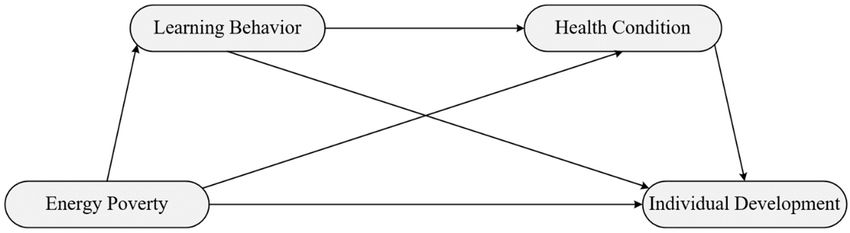
As shown in Figure 1, we have developed a serial mediation model with two mediators
to verify above hypotheses [53]. Learning behavior and health condition are defined as
the first and second mediators separately. According to the serial mediation model and
corresponding quantification method, we can figure out whether and how energy poverty
affects individual development.
3.2. Data Source
Data used in this study are derived from the Chinese General Social Survey (CGSS).
CGSS is an authoritative survey project conducted by National Survey Research Center at
Renmin University of China. In compliance with multistage stratified sampling, CGSS has
been continuously collecting cross-sectional data from different provinces [54,55]. In addi-
tion to the core modules, CGSS conducted in different years contains different modules to
help scholars and governments investigate emerging social issues in each period. Specially,
energy module was included in the CGSS2015, providing a data foundation for energy
poverty study of China. We obtained the CGSS 2015 dataset containing 10,968 samples from
the official website (http://cgss.ruc.edu.cn/ accessed on 15 July 2021). Specifically, the sur-Int. J. Environ. Res. Public Health 2021, 18, 8888 5 of 14
veyors randomly selected one-third of the 10,968 respondents to ask questions about energy
consumption. Some of the selected samples did not contain all of the key variables that this
study needs. Therefore, we dropped 8679 samples, which did not ask related questions or
did not contain key variables, and obtained a final 2289 valid samples. Although a certain
number of samples were dropped, 2289 samples retained in this study were adequate
enough to support the following quantitative analysis. According to CGSS2015 dataset, we
can get a comprehensive understanding of the energy consumption situation in a given
individual’s household, thus effectively determine whether the individual’s household is
Int. J. Environ. Res. Public Health 2021,in
18,energy
8888 poverty or not. Therefore, we are able to explore the impact of energy poverty
5 of on
14
the individual development of residents by following quantitative methods.
Figure 1.
Figure 1. Serial
Serial mediation
mediation model.
model.
3.2.
3.3. Data Source
Variable Measures
3.3.1.Data
Individual
used inDevelopment
this study are(Dependent
derived from Variable)
the Chinese General Social Survey (CGSS).
CGSSThe is an authoritative
individual survey project
development conducted
variable by National
was obtained withSurvey Research
the question Center at
“Compared
Renmin
to three University
years ago,ofhow China.do In
youcompliance
think your with multistage stratified
socioeconomic sampling,
status has CGSSThe
changed?” has
been continuously
respondents’ answerscollecting
ranged cross-sectional
from “has risen”, data
“hasfrom
notdifferent
changed”provinces [54,55]. InThis
to “has declined”. ad-
dition
question to has
the core
been modules,
frequentlyCGSS used conducted
in previousin different
studies years
based contains
on CGSS datadifferent
[56]. To modules
facilitate
to
thehelp
datascholars
analysis,andwegovernments
recoded “has investigate
risen” as 3, emerging social issues
“has not changed” as 2,inand
each period.
“has Spe-
declined”
cially,
as 1. Theenergy
highermodule was included
score implied that thein the CGSS2015,
individual providing
development a data
of the foundation
residents for
was better.
energy poverty study of China. We obtained the CGSS 2015 dataset containing 10,968
3.3.2. Energy
samples fromPoverty (Independent
the official Variable)
website (http://cgss.ruc.edu.cn/ accessed on 15 July 2021). Spe-
cifically,
Energythe poverty
surveyors randomly
should include selected one-third
two equally of the 10,968
important respondents
dimensions to ask
consisting ques-
of acces-
sibility
tions and affordability
about [57]. Accessibility
energy consumption. Some ofreflects the residents’
the selected samplesdependence
did not contain on solid fuels,
all of the
while affordability reflects the residents’ difficulty in paying for necessary
key variables that this study needs. Therefore, we dropped 8679 samples, which did not energy [27,58].
Based
ask on previous
related questionsstudies,
or did wenot
treated residents
contain using solid
key variables, and fuels for cooking
obtained a finalor2289
spending
valid
more than
samples. 10% of their
Although family
a certain income
number ofon energywere
samples as being in energy
dropped, poverty retained
2289 samples [57]. More in
specifically,
this study were the level of energy
adequate enough poverty was classified
to support as “not
the following in energy analysis.
quantitative poverty”Accord-
= 1, “in
mildtoenergy
ing CGSS2015poverty (in one
dataset, weofcanthegettwo energy poverty understanding
a comprehensive types)” = 2 andof “in severe
the energyenergy
con-
poverty (in both types of energy poverty)” = 3.
sumption situation in a given individual’s household, thus effectively determine whether
the individual’s household is in energy poverty or not. Therefore, we are able to explore
3.3.3. Learning Behavior and Health Condition (Moderating Variables)
the impact of energy poverty on the individual development of residents by following
The learning
quantitative behavior variable was obtained from the question set “In the past year,
methods.
did you often do the following in your free time?” One sub-question of this question set
was the frequency
3.3. Variable Measures of “learning”. Respondents were asked to answer this sub-question
with a 5-point Likert scale ranging from “never” (=1) to “frequently” (=5). The higher score
3.3.1. Individual Development (Dependent Variable)
implied that the residents spent more time on learning.
The individual
The health development
condition variable variable was obtained
was obtained with the “How
from the question question do “Compared
you feel about to
three years ago,
your current how condition?”.
health do you think your socioeconomic
Respondents status
were also has changed?”
asked to answer The the respond-
question
ents’ answers ranged from “has risen”, “has not changed” to
with a 5-point Likert scale ranging from “very unhealthy” (=1) to “very healthy”“has declined”. This question
(=5).
has been frequently used in previous studies based on
Accordingly, higher score implied better health condition of the residents.CGSS data [56]. To facilitate the
data analysis, we recoded “has risen” as 3, “has not changed” as 2, and “has declined” as
1. The higher score implied that the individual development of the residents was better.
3.3.2. Energy Poverty (Independent Variable)
Energy poverty should include two equally important dimensions consisting of ac-
cessibility and affordability [57]. Accessibility reflects the residents’ dependence on solidInt. J. Environ. Res. Public Health 2021, 18, 8888 6 of 14
3.3.4. Sociodemographic Characteristics (Covariates)
Based on previous studies on energy poverty and individual development [36,59–61],
we selected six sociodemographic characteristics including age, gender (male = 0, female = 1),
educational level (primary school and below = 1, middle school = 2, high school = 3, junior
college = 4, bachelor degree and above = 5), marital status (not having a spouse = 0, having
a spouse = 1), family income and region (urban area = 0, rural area = 1) as covariates.
3.4. Data Analysis
Descriptive statistics including percentage, mean and standard deviation of the vari-
ables was shown in the following section. Meanwhile, we used Pearson’s correlation
coefficients matrix to examine the correlation among key variables. The descriptive statis-
tics and correlation analysis were conducted by IBM SPSS Statistics 26.0 (SPSS, IBM Corp,
Armonk, NY, USA). Further, PROCESS macro version 3.5 was used to conduct serial
mediating effects analysis [62]. Based on model 6 of PROCESS, we can examine the di-
rect/indirect effects of energy poverty on individual development via mediating variables
of learning behavior and health condition [63]. The bootstrap method (95% confidence
intervals, 5000 bootstrap samples) was conducted to estimate the coefficients of indirect
effects. Specifically, the indirect effect was statistically significant if 0 was not within the
95% CI.
4. Results
4.1. Descriptive Statistics and Correlation Analysis
The descriptive statistics is presented in Table 1. After sample screening and elimi-
nating, a total of 2289 valid samples were included in the study. In total, 35.08% of the
respondents achieved a good individual development. More than half of the respondents
were in mild energy poverty (40.15%) or severe energy poverty (10.62%). The average
score of learning behavior was 1.90, indicating that spontaneous learning is still not the
main activity in residents’ spare time. The average score of health condition was 3.59. In
terms of sociodemographic characteristics, the proportion of male respondents (47.27%)
was similar to that of female respondents (52.73%). The average age of the respondents
was 57 years old, and the average family annual income was RMB 66,932. In total, 81.61%
of the respondents have a spouse. In total, 39.49% of the respondents had an educational
level of primary school and below, while only 6.12% of the respondents had an educational
level of bachelor degree and above. In addition, 53.21% of the respondents lived in an
urban area, and 46.79% in a rural area.
Table 1. Descriptive statistics.
Variable Categories Percentage Mean Standard Deviation
Socioeconomic status has declined (1) 10.18
Individual development Socioeconomic status has not changed (2) 54.74 2.25 0.63
Socioeconomic status has risen (3) 35.08
Not in energy poverty (1) 49.24
Energy poverty In mild energy poverty (2) 40.15 1.61 0.67
In severe energy poverty (3) 10.62
Never (1) 46.61
Rarely (2) 28.27
Learning behavior Sometimes (3) 15.47 1.90 1.05
Often (4) 7.60
Frequently (5) 2.05
Very unhealthy (1) 2.97
Unhealthy (2) 15.81
Health condition Normal (3) 21.97 3.59 1.08
Healthy (4) 37.96
Very healthy (5) 21.28
Male (0) 47.27
Gender 0.53 0.50
Female (1) 52.73Int. J. Environ. Res. Public Health 2021, 18, 8888 7 of 14
Table 1. Cont.
Variable Categories Percentage Mean Standard Deviation
Primary school and below (1) 39.49
Middle school (2) 29.84
Educational level High school (3) 17.39 2.11 1.18
Junior college (4) 7.16
Bachelor degree and above (5) 6.12
Not having a spouse (0) 18.39
Marital status 0.82 0.39
Having a spouse (1) 81.61
Urban area (0) 53.21
Region 0.47 0.50
Rural area (1) 46.79
Age 56.90 16.09
Income 66,932.08 250,613.51
The correlation analysis among variables is presented in Table 2. Energy poverty
is significantly negatively correlated with individual development (r = −0.053, p = 0.05),
learning behavior (r = −0.250, p = 0.01) and health condition (r = −0.201, p = 0.01). Learning
behavior shows significant positive correlations with individual development (r = 0.080,
p = 0.01) and health condition (r = 0. 236, p = 0.01). Health condition shows a significant
positive correlation with individual development (r = 0. 123, p = 0.01). Correlation analysis
provided a basic support for the following hypothesis validations.
Table 2. Correlation analysis.
Variables Individual Development Energy Poverty Learning Behavior Health Condition
Individual development 1
Energy poverty −0.053 * 1
Learning behavior 0.080 ** −0.250 ** 1
Health condition 0.123 ** −0.201 ** 0.236 ** 1
Note. * p < 0.05, ** p < 0.01.
4.2. Serial Mediating Effects Analysis
Serial mediating effects analysis was conducted to verify the mediating effects of the
Int. J. Environ. Res. Public Health 2021,two mediating
18, 8888 variables, learning behavior and health condition. The results of8 serial
of 14
mediating effects analysis are shown in Figure 2.
Figure2.2.Overall
Figure Overallpathways
pathwaysand
and coefficient.
coefficient. Note.
Note. **
** ppInt. J. Environ. Res. Public Health 2021, 18, 8888 8 of 14
Figure 2 illustrates that energy poverty was significantly negatively correlated with
learning behavior (r = −0.104, p < 0.01), health condition (r = −0.211, p < 0.001) and
individual development (r = −0.064, p < 0.01). Learning behavior positively affects health
condition (r = 0.104, p < 0.001) and individual development (r = 0.046, p < 0.01). Health
condition positively affects individual development (r = 0.061, p < 0.001).
The direct and indirect effects of energy poverty on individual development are pre-
sented in Table 3. Of all the results, 0 is not within the 95% CI, indicating that estimated
effects are significant. The direct effect of energy poverty on individual development is
−0.0641 (CI: −0.1084, −0.0199). Hypothesis 1 is confirmed. In terms of indirect effect, learn-
ing behavior has a significant mediating effect on the relationship (indirect effect = −0.0047,
95% CI: −0.0091, −0.0012), while health condition also has a significant mediating effect
(indirect effect = −0.0128, 95% CI: −0.0209, −0.0060). Thus, Hypothesis 2 and Hypothesis
3 are confirmed. In addition, there is a significant indirect effect of energy poverty on the
individual development via the serial mediation of learning behavior and health condition
(indirect effect = −0.0007, 95% CI: −0.0013, −0.0002), supporting Hypothesis 4. In sum-
mary, the hypotheses presented above are all confirmed. In other words, learning behavior
and health condition can partially mediate the relationship between energy poverty and
individual development.
Table 3. The serial mediating effects analysis among variables.
95%CI
Pathway Effect SE
LLCI ULCI
Direct effect −0.0641 0.0226 −0.1084 −0.0199
Indirect effect
EP → Learning behavior → Individual development −0.0047 0.0020 −0.0091 −0.0012
EP → Health condition → Individual development −0.0128 0.0038 −0.0209 −0.0060
EP → Learning behavior → Health condition → Individual development −0.0007 0.0003 −0.0013 −0.0002
Note. EP means energy poverty, SE means standard error, LLCI means lower limit confidence interval, ULCI means upper limit
confidence interval.
To analyze whether sociodemographic feature influences the relationship between
energy poverty and individual development, we have conducted pathways analysis for
urban and rural region respectively. The results are shown in Figure 3. Energy poverty
significantly directly affects individual development in both urban and rural regions.
However, in terms of indirect effects, the results in urban and rural regions have shown
notable differences. For urban regions, the indirect effects are consistent with the initial
hypotheses that learning behavior and health condition can independently or serially
mediate the relationship between energy poverty and individual development. For rural
region, the mediating effect of learning behavior is not significant, while the mediating
effect of health condition is quite strong.Int. J. Environ. Res. Public Health 2021, 18, 8888 9 of 14
Int. J. Environ. Res. Public Health 2021, 18, 8888 9 of 14
Figure 3. Pathways and coefficient in urban and rural regions. Note. * p < 0.05, ** p < 0.01, *** p < 0.001.
Figure 3. Pathways and coefficient in urban and rural regions. Note. * p < 0.05, ** p < 0.01, *** p < 0.001.
5. Discussion
5. Discussion
Energy plays an irreplaceable role in modern society. As a new type of poverty, en-
Energy
ergy poverty plays
hasan irreplaceable
negative impactsrole in modern
on the residents’society.
life from Asvarious
a newaspects.
type of A poverty,
compre-energy
poverty
hensivehas negative impacts
understanding of these onimpacts
the residents’
is the top life from various
priority in energyaspects.
povertyA comprehensive
governance.
understanding
This study hasof these impacts
explored the impact isofthe top priority
energy poverty on inindividual
energy poverty governance.
development and the This
study has mechanisms
specific explored the impact
using of energy
a serial mediation poverty
model. on individual
Large-scale development
sample data obtained and the
specific mechanisms
from Chinese General using
SocialaSurvey
serial mediation
guaranteed the model. Large-scale
reliability sample data obtained
of this study.
This study
from Chinese has broadened
General the previous
Social Survey literatures
guaranteed the on both research
reliability content
of this study. and meth-
odology.
This study There has
havebroadened
been many the quantitative
previous studies focusing
literatures ononboth
the impacts
research of content
energy and
poverty on health
methodology. There condition
have been [8,57],many
but studies about the
quantitative correlation
studies amongon
focusing energy pov-
the impacts of
erty, learning behavior, and individual development have been
energy poverty on health condition [8,57], but studies about the correlation among en- limited to the qualitative
perspective [64]. This study has developed an integrative framework about energy pov-
ergy poverty, learning behavior, and individual development have been limited to the
erty’s negative impacts, and is the first to explore the relationship between energy poverty
qualitative perspective [64]. This study has developed an integrative framework about
and individual development from a quantitative perspective. On the other hand, previous
energy
studiespoverty’s
on energynegative impacts,
poverty usually and is
utilized the firstsimple
relatively to explore
modelsthethatrelationship
only directly between
ex-
energy
amined the relationship between energy poverty and a specific dependent variable,On
poverty and individual development from a quantitative perspective. the other
which
hand, previous
inevitably studies
resulted on energy
in variable poverty
omission and usually
estimation utilized relatively
errors. The simple
use of the serialmodels
medi- that
only directly examined the relationship between energy poverty
ation model in this study enables us to comprehensively incorporate the various impacts and a specific dependent
variable,
of energywhich inevitably
poverty, resulted
and obtain more in variable
reliable omission
estimate resultsand estimation errors. The use of
[65,66].
It ismediation
the serial found that model
energy poverty has a significant
in this study enables us negative correlation with incorporate
to comprehensively individual the
development, and learning behavior and health condition
various impacts of energy poverty, and obtain more reliable estimate results can independently or [65,66].
serially
mediate
It is found that energy poverty has a significant negative correlation withasindividual
the correlation. Specifically, several meaningful conclusions can be drawn fol-
lows.
development, and learning behavior and health condition can independently or serially
mediate the correlation. Specifically, several meaningful conclusions can be drawn as follows.
Firstly, the direct effect of energy poverty on individual development indicates that
energy poverty can strongly and negatively affect one’s development. Considering that the
samples used in this study actually cover all age groups of the residents, we argue that theInt. J. Environ. Res. Public Health 2021, 18, 8888 10 of 14
impact of energy poverty on individual development is experienced almost throughout
someone’s lifetime. This finding is a further expansion of previous research that mainly
focused on the development of children and women [23,67]. Due to the inclusion of
income, region and other covariates, this study also confirms that, even with similar income,
residents’ pursuit and utilization of modern fuel can drive up their socioeconomic status.
Therefore, this study has enriched the energy ladder theory and provided new, fact-based
evidence to the discussion of the link between energy consumption and socioeconomic
status. With regard to the governance of energy poverty, the government should not
view energy poverty as a short-term predicament of a person or a family, but treat energy
poverty as an obstacle factor for long-term development of residents, and take proactive
measures to prevent them from falling into the “vicious cycle” of energy poverty.
Secondly, learning behavior and health condition can independently or serially medi-
ate the relationship between energy poverty and individual development. Health condition
has the strongest mediating effect. Previous studies showed that energy poverty caused
negative effects on residents’ health through polluted indoor air and low indoor temper-
ature [68,69]. Meanwhile, studies of Liu and Campino confirmed that health condition
was crucial for individual development [70,71]. This study has revalidated and integrated
previous findings, and emphasized that energy inequalities are likely to lead to health
inequalities and development inequalities. Compared to health condition, the coefficient
between energy poverty and learning behavior is smaller, that is, the mediating effect
of learning behavior is weaker. By econometric methods, Zhang has demonstrated that
energy poverty can affect children’s academic performance [23]. This study has expanded
the concepts and scopes of Zhang’s study, broadening academic performance into learn-
ing behavior, from children into the adult population. The mediating effect of learning
behavior has confirmed and enriched Maslow’s need hierarchy theory: Energy is the basic
need of the residents in modern society, and only when energy need is satisfied, residents
can pursue higher-level needs such as learning and self-actualization. Some interesting
results are obtained in the pathways analysis for rural and urban regions. For rural region,
learning behavior cannot mediate the relationship between energy poverty and individual
development, while health condition plays a stronger mediating role. Compared with
urban regions, most rural regions are less developed [72]. Due to the universal lack of
attention to learning and self-improvement, rural residents’ learning behaviors are clearly
less frequent than that of urban residents, thus weakening the mediating effect of learning
behavior [73]. On the other hand, while urban energy-poverty residents may use coal as a
cooking/heating fuel, energy-poverty residents in rural regions do not even have access to
coal and have to collect straw, firewood, and animal dung as energy sources [74,75]. These
extremely rudimentary fuels have undoubtedly caused greater health risks, and thus make
the mediating effect of health condition stronger.
The findings of this study have provided some policy implications about energy
poverty governance: Energy poverty encompasses two dimensions including accessibility
and affordability. Energy poverty does not only occur in rural areas with poor infrastructure,
but also occurring in urban low-income households. Therefore, to help residents achieve
better development, the government should improve energy infrastructure in rural areas
while alleviating the energy price burden of the residents as much as possible. Furthermore,
governments should not only be fully aware of various impacts of energy poverty, but
also set priorities for coping with these impacts. In consideration of the strong impact of
energy poverty on health condition in rural regions, governments should first and foremost
provide necessary supports for the residents with poor health condition due to energy
poverty, followed by persuading residents to use modern energy to facilitate their own
learning activities.
Nevertheless, there are several research limitations that should be improved in the
future. First, due to the questionnaire limitations of CGSS, this study used a self-reported
indicator to represent individual development, which inevitably leads to subjective bias.
Scholars are suggested to use composite objective indicators to improve the reliability ofInt. J. Environ. Res. Public Health 2021, 18, 8888 11 of 14
research in the future. Second, in addition to health condition and learning behavior, there are
also some psychological factors such as subjective well-being that could be correlated with
energy poverty [58]. It is recommended that future studies integrate psychological factors
into their research framework to ensure comprehensiveness. Third, we recommend that
future studies further explore the limitation of educational opportunities caused by energy
poverty according to a well-designed questionnaire survey to clarify the relationship between
them. Last but not least, compared with panel data, we cannot thoroughly examine the causal
relationships among variables by cross-sectional data used in this study [26]. Future studies
should consider including multi-year panel data when the data source is reliable.
6. Conclusions
This study has explored the impact of energy poverty on individual development
and the specific mechanisms of this process. Drawing upon energy ladder model and
need hierarchy theory, we found that energy poverty can negatively impact individual
development. Further, learning behavior and health condition were found to be correlated
with energy poverty. Both of these factors can independently or serially mediate the
relationship between energy poverty and individual development. Health condition has
the stronger mediating effect, whereas the mediating effect of learning behavior is weaker.
Moreover, the health condition of rural residents is more vulnerable to energy poverty due
to the shortage of modern fuels. This study may contribute to a better understanding of
the consequences of energy poverty in government and academia.
Author Contributions: Y.X., Research design, methodology, results analysis, original draft writing;
H.W., Data collection, data screening, reviewing; G.W., Supervision and reviewing; S.W., Reviewing
and editing. All authors have read and agreed to the published version of the manuscript.
Funding: This work was supported by the NSFC project of China “Risk Identification and Prevention
Mechanisms of Non-traditional Security Issues—A Case Study of Information Sharing and Use in
Smart City Governance” (Project No. 71734002) and the Fundamental Research Funds for the Central
Universities, HUST: 2020JYCXJJ033.
Institutional Review Board Statement: Not applicable.
Informed Consent Statement: Not applicable.
Data Availability Statement: Not applicable.
Conflicts of Interest: The authors declare no conflict of interest.
References
1. Adom, P.K.; Amuakwa-Mensah, F.; Agradi, M.P.; Nsabimana, A. Energy Poverty, Development Outcomes, and Transition to
Green Energy. Renew. Energy 2021, 178, 1337–1352. [CrossRef]
2. Nussbaumer, P.; Bazilian, M.; Modi, V. Measuring Energy Poverty: Focusing on What Matters. Renew. Sustain. Energy Rev. 2012,
16, 231–243. [CrossRef]
3. Shyu, C.-W. A Framework for ‘Right to Energy’ to Meet UN SDG7: Policy Implications to Meet Basic Human Energy Needs,
Eradicate Energy Poverty, Enhance Energy Justice, and Uphold Energy Democracy. Energy Res. Soc. Sci. 2021, 79, 102199.
[CrossRef]
4. Dubois, U.; Meier, H. Energy Affordability and Energy Inequality in Europe: Implications for Policymaking. Energy Res. Soc. Sci.
2016, 18, 21–35. [CrossRef]
5. González-Eguino, M. Energy Poverty: An Overview. Renew. Sustain. Energy Rev. 2015, 47, 377–385. [CrossRef]
6. Garba, I.; Nieradzinska, K.; Bellingham, R. The Energy Poverty Situation: A Review of Developing Countries. In Advanced Studies
in Energy Efficiency and Built Environment for Developing Countries; Alalouch, C., Abdalla, H., Bozonnet, E., Elvin, G., Carracedo, O.,
Eds.; Springer International Publishing: Cham, Switzerland, 2019; pp. 41–49; ISBN 978-3-030-10856-4.
7. Che, X.; Zhu, B.; Wang, P. Assessing Global Energy Poverty: An Integrated Approach. Energy Policy 2021, 149, 112099. [CrossRef]
8. Primc, K.; Dominko, M.; Slabe-Erker, R. 30 Years of Energy and Fuel Poverty Research: A Retrospective Analysis and Future
Trends. J. Clean. Prod. 2021, 301, 127003. [CrossRef]
9. Boardman, B. Fuel Poverty: From Cold Homes to Affordable Warmth; Belhaven Press: London, UK, 1991; ISBN 1852931396.
10. Hills, J. Fuel Poverty: The Problem and Its Measurement. Interim Report of the Fuel Poverty Review; Centre for Analysis of Social
Exclusion: London, UK, 2011.Int. J. Environ. Res. Public Health 2021, 18, 8888 12 of 14
11. Moore, R. Definitions of Fuel Poverty: Implications for Policy. Energy Policy 2012, 49, 19–26. [CrossRef]
12. Schuessler, R. Energy Poverty Indicators: Conceptual Issues—Part I: The Ten-Percent-Rule and Double Median/Mean Indicators.
SSRN Electron. J. 2014. [CrossRef]
13. Warm Homes and Energy Conservation Act 2000 The Stationery Office Limited. 2000. Available online: https://www.legislation.
gov.uk/ukpga/2000/31/pdfs/ukpga_20000031_en.pdf (accessed on 20 August 2021).
14. Villalobos, C.; Chávez, C.; Uribe, A. Energy Poverty Measures and the Identification of the Energy Poor: A Comparison between
the Utilitarian and Capability-Based Approaches in Chile. Energy Policy 2021, 152, 112146. [CrossRef]
15. Sovacool, B.K. The Political Economy of Energy Poverty: A Review of Key Challenges. Energy Sustain. Dev. 2012, 16, 272–282.
[CrossRef]
16. Healy, J.D. Excess Winter Mortality in Europe: A Cross Country Analysis Identifying Key Risk Factors. J. Epidemiol. Commun.
Health 2003, 57, 784–789. [CrossRef]
17. Zock, J.-P.; Jarvis, D.; Luczynska, C.; Sunyer, J.; Burney, P. Housing Characteristics, Reported Mold Exposure, and Asthma in the
European Community Respiratory Health Survey. J. Allergy Clin. Immunol. 2002, 110, 285–292. [CrossRef]
18. Liddell, C.; Morris, C. Fuel Poverty and Human Health: A Review of Recent Evidence. Energy Policy 2010, 38, 2987–2997.
[CrossRef]
19. Pachauri, S.; Mueller, A.; Kemmler, A.; Spreng, D. On Measuring Energy Poverty in Indian Households. World Dev. 2004, 32,
2083–2104. [CrossRef]
20. Sambodo, M.T.; Novandra, R. The State of Energy Poverty in Indonesia and Its Impact on Welfare. Energy Policy 2019, 132,
113–121. [CrossRef]
21. Sovacool, B.K.; Drupady, I.M. Energy Access, Poverty, and Development; Routledge: London, UK, 2016; ISBN 9781317143741.
22. Khandker, S.R.; Samad, H.A.; Ali, R.; Barnes, D.F. Who Benefits Most from Rural Electrification? Evidence in India. Energy J. 2014,
35. [CrossRef]
23. Zhang, Q.; Appau, S.; Kodom, P.L. Energy Poverty, Children’s Wellbeing and the Mediating Role of Academic Performance:
Evidence from China. Energy Econ. 2021, 97, 105206. [CrossRef]
24. Yohanis, Y.G. Domestic Energy Use and Householders’ Energy Behaviour. Energy Policy 2012, 41, 654–665. [CrossRef]
25. Bronfenbrenner, U. Making Human Beings Human: Bioecological Perspectives on Human Development; Sage: Thousand Oaks, CA,
USA, 2005; ISBN 0761927123.
26. Zhang, L.; Ma, X.; Yu, X.; Ye, M.; Li, N.; Lu, S.; Wang, J. Childhood Trauma and Psychological Distress: A Serial Mediation Model
among Chinese Adolescents. Int. J. Environ. Res. Public Health 2021, 18, 6808. [CrossRef]
27. Acheampong, A.O.; Erdiaw-Kwasie, M.O.; Abunyewah, M. Does Energy Accessibility Improve Human Development? Evidence
from Energy-Poor Regions. Energy Econ. 2021, 96, 105165. [CrossRef]
28. Oliveras, L.; Peralta, A.; Palència, L.; Gotsens, M.; López, M.J.; Artazcoz, L.; Borrell, C.; Marí-Dell’Olmo, M. Energy Poverty and
Health: Trends in the European Union before and during the Economic Crisis, 2007–2016. Health Place 2021, 67, 102294. [CrossRef]
29. Leach, G. The Energy Transition. Energy Policy 1992, 20, 116–123. [CrossRef]
30. van der Kroon, B.; Brouwer, R.; van Beukering, P.J.H. The Energy Ladder: Theoretical Myth or Empirical Truth? Results from a
Meta-Analysis. Renew. Sustain. Energy Rev. 2013, 20, 504–513. [CrossRef]
31. Ozguner, Z.; Ozguner, M. A Managerial Point of View on the Relationship between of Maslow’s Hierarchy of Needs and
Herzberg’s Dual Factor Theory. Int. J. Bus. Soc. Sci. 2014, 5. [CrossRef]
32. Maslow, A.H. Motivation and Personality; Prabhat Prakashan: New Delhi, India, 1981.
33. Chang, H.; He, K.; Zhang, J. Energy Poverty in Rural China: A Psychological Explanations Base on Households. China Popul.
Resour. Environ. 2020, 30, 11–20.
34. Wang, Z.; Yan, B. Analysis of Energy and Poverty from the Perspective of Resident Welfare Changes. J. Quant. Tech. Econ. 2020,
37, 100–118. [CrossRef]
35. United Nations Development Programme; University of Bergen. Policy Brief No.8. Interlinkages among Energy, Poverty and
Inequalities; United Nations: New York, NY, USA, 2018.
36. Oum, S. Energy Poverty in the Lao PDR and Its Impacts on Education and Health. Energy Policy 2019, 132, 247–253. [CrossRef]
37. Zhang, Z.; Shu, H.; Yi, H.; Wang, X. Household Multidimensional Energy Poverty and Its Impacts on Physical and Mental Health.
Energy Policy 2021, 156, 112381. [CrossRef]
38. Zhang, Z.; Shu, H. Multidimensional Energy Poverty and Resident Health. J. Shanxi Univ. Financ. Econ. 2020, 42, 16–26. [CrossRef]
39. Kose, T. Energy Poverty and Health: The Turkish Case. Energy Sources Part B Econ. Plan. Policy 2019, 14, 201–213. [CrossRef]
40. Wilkinson, P.; Landon, M.; Armstrong, B.; Stevenson, S.; McKee, M. Cold Comfort: The Social and Environmental Determinants of
Excess Winter Death in England, 1986–1996; Joseph Rowntree Foundation: York, UK, 2001.
41. Gonzales, C.G. Energy poverty and the environment. In International Energy and Poverty; Routledge: London, UK, 2015;
pp. 137–154; ISBN 131576220X.
42. Peabody, J.W.; Riddell, T.J.; Smith, K.R.; Liu, Y.; Zhao, Y.; Gong, J.; Milet, M.; Sinton, J.E. Indoor Air Pollution in Rural China:
Cooking Fuels, Stoves, and Health Status. Arch. Environ. Occup. Health 2005, 60, 86–95. [CrossRef]
43. World Health Organization. The World Health Report 2002: Reducing Risks, Promoting Healthy Life; World Health Organization:
Geneve, Switzerland, 2002; ISBN 9241562072.Int. J. Environ. Res. Public Health 2021, 18, 8888 13 of 14
44. Rafi, M.; Naseef, M.; Prasad, S. Multidimensional Energy Poverty and Human Capital Development: Empirical Evidence from
India. Energy Econ. 2021, 101, 105427. [CrossRef]
45. Urpelainen, J. Energy Poverty and Perceptions of Solar Power in Marginalized Communities: Survey Evidence from Uttar
Pradesh, India. Renew. Energy 2016, 85, 534–539. [CrossRef]
46. Choi, W.; Jacobs, R.L. Influences of Formal Learning, Personal Learning Orientation, and Supportive Learning Environment on
Informal Learning. Hum. Resour. Dev. Q. 2011, 22, 239–257. [CrossRef]
47. McLeod, S. Maslow’s Hierarchy of Needs. Simply Psychol. 2007. Available online: https://www.simplypsychology.org/maslow.
html (accessed on 15 July 2021).
48. Dey, C. Effect of Study Habit on Academic Achievement. Int. J. Res. Humanit. Soc. Sci. 2014, 2, 101–105.
49. Ijeoma, R.E.; Johnson, O. Relationship between Achievement Motivation, Study Habit and Educational Career of Secondary
School Students in Rivers State, Nigeria. Sch. Bull. 2019, 5, 25–29. [CrossRef]
50. Field, J. Adult Learning, Health and Well-Being–Changing Lives. Adult Learn. 2011, 13–25. Available online: https://eric.ed.gov/
?id=EJ954303 (accessed on 15 July 2021).
51. Feinstein, L.; Hammond, C. The Contribution of Adult Learning to Health and Social Capital. Oxford Rev. Educ. 2004, 30, 199–221.
[CrossRef]
52. Aldridge, F.; Lavender, P. The Impact of Learning on Health; National Institute of Adult Continuing Education: Leicester, UK, 2000.
53. Wang, C.-J.; Yang, I.-H. Why and How Does Empowering Leadership Promote Proactive Work Behavior? An Examination with a
Serial Mediation Model among Hotel Employees. Int. J. Environ. Res. Public Health 2021, 18, 2386. [CrossRef]
54. National Survey Research Center at Renmin University of China Chinese General Social Survey. Available online: http:
//cgss.ruc.edu.cn/ (accessed on 15 July 2021).
55. Wang, J.; Liang, C.; Li, K. Impact of Internet Use on Elderly Health: Empirical Study Based on Chinese General Social Survey
(CGSS) Data. Healthcare 2020, 8, 482. [CrossRef]
56. Liu, J. Social Governance Efficacy of Contemporary Youth and Its Influencing Factors: Based on CGSS2015 Data. China Youth
Study 2020, 6, 60–66. [CrossRef]
57. Zhang, D.; Li, J.; Han, P. A Multidimensional Measure of Energy Poverty in China and Its Impacts on Health: An Empirical Study
Based on the China Family Panel Studies. Energy Policy 2019, 131, 72–81. [CrossRef]
58. Nie, P.; Li, Q.; Sousa-Poza, A. Energy Poverty and Subjective Well-Being in China: New Evidence from the China Family Panel Studies.
IZA Discussion Paper No. 14429. 2021. Available online: https://ssrn.com/abstract=3865454 (accessed on 15 July 2021).
59. Awaworyi Churchill, S.; Smyth, R. Energy Poverty and Health: Panel Data Evidence from Australia. Energy Econ. 2021, 97, 105219.
[CrossRef]
60. Wang, M.; Bi, X.; Ye, H. Growth Mixture Modeling: A Method for Describing Specific Class Growth Trajectory. Sociol. Stud. 2014,
29, 220–241+246. [CrossRef]
61. Tomul, E.; Polat, G. The Effects of Socioeconomic Characteristics of Students on Their Academic Achievement in Higher Education.
Am. J. Educ. Res. 2013, 1, 449–455. [CrossRef]
62. Hayes, A.F. Introduction to Mediation, Moderation, and Conditional Process Analysis: A Regression-Based Approach; Guilford Publica-
tions: New York, NY, USA, 2017; ISBN 1462534651.
63. Hwang, Y.; Oh, J. The Relationship between Self-Directed Learning and Problem-Solving Ability: The Mediating Role of Academic
Self-Efficacy and Self-Regulated Learning among Nursing Students. Int. J. Environ. Res. Public Health 2021, 18, 1738. [CrossRef]
64. Oparaocha, S.; Dutta, S. Gender and Energy for Sustainable Development. Curr. Opin. Environ. Sustain. 2011, 3, 265–271.
[CrossRef]
65. Judd, C.M.; Kenny, D.A. Process Analysis: Estimating Mediation in Treatment Evaluations. Eval. Rev. 1981, 5, 602–619. [CrossRef]
66. Kim, Y.; Lee, H.; Lee, M.; Lee, H.; Kim, S.; Konlan, K.D. The Sequential Mediating Effects of Dietary Behavior and Perceived
Stress on the Relationship between Subjective Socioeconomic Status and Multicultural Adolescent Health. Int. J. Environ. Res.
Public Health 2021, 18, 3604. [CrossRef]
67. Listo, R. Gender Myths in Energy Poverty Literature: A Critical Discourse Analysis. Energy Res. Soc. Sci. 2018, 38, 9–18. [CrossRef]
68. Nasir, Z.A.; Murtaza, F.; Colbeck, I. Role of Poverty in Fuel Choice and Exposure to Indoor Air Pollution in Pakistan. J. Integr.
Environ. Sci. 2015, 12, 107–117. [CrossRef]
69. Reyes, R.; Schueftan, A.; Ruiz, C.; González, A.D. Controlling Air Pollution in a Context of High Energy Poverty Levels in
Southern Chile: Clean Air but Colder Houses? Energy Policy 2019, 124, 301–311. [CrossRef]
70. Liu, G.G.; Dow, W.H.; Fu, A.Z.; Akin, J.; Lance, P. Income Productivity in China: On the Role of Health. In Investing in Human
Capital for Economic Development in China; World Scientific: Singapore, 2010; pp. 293–311.
71. Campino, A.; Monteiro, C.A.; Conde, W.L.; Machado, F.M.S. Health, Human Capital and Economic Growth in Brazil; European
Regional Science Association: Porto, Portugal, 2004.
72. Ma, L.; Chen, M.; Fang, F.; Che, X. Research on the Spatiotemporal Variation of Rural-Urban Transformation and Its Driving
Mechanisms in Underdeveloped Regions: Gansu Province in Western China as an Example. Sustain. Cities Soc. 2019, 50, 101675.
[CrossRef]
73. Cantrell, S.C.; Rintamaa, M.; Anderman, E.M.; Anderman, L.H. Rural Adolescents’ Reading Motivation, Achievement and
Behavior across Transition to High School. J. Educ. Res. 2018, 111, 417–428. [CrossRef]Int. J. Environ. Res. Public Health 2021, 18, 8888 14 of 14
74. Sagar, A.D. Alleviating Energy Poverty for the World’s Poor. Energy Policy 2005, 33, 1367–1372. [CrossRef]
75. Bhide, A.; Monroy, C.R. Energy Poverty: A Special Focus on Energy Poverty in India and Renewable Energy Technologies. Renew.
Sustain. Energy Rev. 2011, 15, 1057–1066. [CrossRef]You can also read


