Management Alert - FEMA Did Not Safeguard Disaster Survivors' Sensitive Personally Identifiable Information (REDACTED) - March 15, 2019 - Quanexus
←
→
Page content transcription
If your browser does not render page correctly, please read the page content below
Management Alert –
FEMA Did Not Safeguard
Disaster Survivors’ Sensitive
Personally Identifiable
Information (REDACTED)

                      March 15, 2019
                          OIG-19-32
FOR OFFICAL USE ONLY
                   OFFICE OF INSPECTOR GENERAL
                        Department of Homeland Security
                         Washington, DC 20528 / www.oig.dhs.gov

                                  March 15, 2019

MEMORANDUM FOR:          Peter T. Gaynor
                         Acting Administrator
                         Federal Emergency Management Agency

FROM:                    John V. Kelly
                         Acting Inspector General

SUBJECT:                 Management Alert – FEMA Did Not Safeguard Disaster
                         Survivors’ Sensitive Personally Identifiable Information
                         – For Official Use Only

For your action is our Management Alert – FEMA Did Not Safeguard Disaster
Survivors’ Sensitive Personally Identifiable Information – For Official Use Only.
We considered technical comments and incorporated the formal comments
provided by your office.

This alert contains two recommendations directing actions Federal Emergency
Management Agency (FEMA) should take to safeguard both Personally
Identifiable Information (PII) and Sensitive Personally Identifiable Information
(SPII) of disaster survivors and prevent additional privacy incidents similar to
one we identified during our ongoing audit of FEMA’s Transitional Sheltering
Assistance (TSA) program. FEMA concurred with both recommendations.

Based on information provided in your response to the draft alert, we consider
the recommendations resolved and open. Once your office has fully
implemented the recommendations, please submit a formal closeout letter to
us within 30 days so that we may close the recommendations. The
memorandum should be accompanied by evidence of completion of agreed-
upon corrective actions.

Please send your response or closure request to
OIGAuditsFollowup@oig.dhs.gov.

Consistent with our responsibility under the Inspector General Act, we will
provide copies of our alert to congressional committees with oversight and
appropriation responsibility over the Department of Homeland Security. We will
post a redacted version of the alert on our website.

Please call me with any questions, or your staff may contact Sondra McCauley,
Assistant Inspector General for Audits, at (202) 981-6000.

www.oig.dhs.gov
                           FOR OFFICIAL USE ONLY
FOR OFFICAL USE ONLY
                     OFFICE OF INSPECTOR GENERAL
                          Department of Homeland Security

Results in Brief

During our ongoing audit of the Federal Emergency Management Agency’s
(FEMA) Transitional Sheltering Assistance (TSA) program, we determined that
FEMA violated the Privacy Act of 19741 and Department of Homeland Security
policy2 by releasing to                                          the PII and SPII of
2.3 million survivors of hurricanes Harvey, Irma, and Maria and the California
wildfires in 2017.3 FEMA should only provide           with limited information
needed to verify disaster survivors’ eligibility for the TSA program. The privacy
incident4 occurred because FEMA did not take steps to ensure it provided only
required data elements to        Without corrective action, the disaster
survivors involved in the privacy incident are at increased risk of identity theft
and fraud.

Background

Through the TSA program, FEMA provides transitional sheltering in hotels to
disaster survivors displaced by emergencies or major disasters. TSA reduces
the number of survivors in congregate emergency shelters by providing hotel
lodging. The contractor administering the TSA program,           helps disaster
survivors obtain short-term lodging at participating hotels. FEMA identified
more than 2.3 million disaster survivor registrants eligible for the TSA program
during the response to hurricanes Harvey, Irma, and Maria, and the California
wildfires in 2017.

When applying for FEMA disaster assistance, applicants are required to provide
PII and SPII. The Privacy Act of 1974 (the Act) protects individuals by ensuring
personal information collected by Federal agencies is limited to what is legally
authorized and necessary. The Act also dictates that agencies maintain PII and
SPII to preclude unwarranted intrusions upon individual privacy. DHS’

1
 Privacy Act of 1974, 5 USC 552a, as amended
2DHS Management Directive 11042.1 - Safeguarding Sensitive but Unclassified (For Official
Use) Information (January 6, 2005)
3
 Hurricane Harvey (DR-4332); Hurricane Irma (DR-4336 in Puerto Rico; DR 4337 in Florida);
Hurricane Maria (DR-4339); and the California Wildfires (DR-4344)
4
 A privacy incident is defined as the loss of control, compromise, unauthorized disclosure,
unauthorized acquisition, or any similar occurrence when (1) a person other than the
authorized user accesses or potentially accesses PII or (2) an authorized user accesses or
potentially accesses PII for an unauthorized purpose. The term encompasses both suspected
and confirmed incidents involving PII, whether intentional or inadvertent, which raises a
reasonable risk of harm. The term “privacy incident’ can be used synonymously with the term
“breach” (DHS Privacy Policy Instruction 047-01-008, Privacy Incident Handling Guidance).

www.oig.dhs.gov                             2                                     OIG-19-32
                              FOR OFFICIAL USE ONLY
FOR OFFICAL USE ONLY
OFFICE OF INSPECTOR GENERAL
Department of Homeland Security
Handbook for Safeguarding Sensitive Personally Identifiable Information
(December 2017) defines these terms as follows:
Personally Identifiable Information (PII) is any information that permits
the identity of an individual to be directly or indirectly inferred, including
any information that is linked or linkable to that individual, regardless of
whether the individual is a U.S. citizen, legal permanent resident, visitor
to the U.S., or employee or contractor to the Department. This includes
complete name, home address, and birthdate when combined.
Sensitive PII (SPII) is a subset of PII, which if lost, compromised, or
disclosed without authorization, could result in substantial harm,
embarrassment, inconvenience, or unfairness to an individual. SPII
requires stricter handling guidelines because of the increased risk
to an individual if the data are compromised. This includes
financial account information.
As required by the E-Government Act of 2002, FEMA completed a Privacy
Impact Assessment for the Individual Assistance Program, which includes the
TSA program. The assessment identifies the PII, including SPII that will be
collected from applicants, and includes details on the use of this information in
implementing FEMA’s Individual Assistance programs.
Additionally, DHS’ Handbook for Safeguarding Sensitive PII (December 4, 2017)
states that only PII necessary for agency staff to perform their official duties
should be collected, used, and disseminated to individuals on a need-to-know
basis.
Survivor Information at Risk
FEMA released unnecessary PII and SPII for approximately 2.3 million disaster
survivors to its contractor, in direct violation of Federal and DHS
requirements and its August 2015 TSA program Performance Work Statement.
The Performance Work Statement identifies 13 data elements FEMA must send
to to verify disaster survivor eligibility during the TSA check-in process at
participating hotels. Some of the data elements contain PII, but none of the
individual data elements contain SPII.5 The data elements that FEMA must
share include:
5
Some data elements by themselves rise to a level of SPII (called standalone SPII), while other
data elements of PII grouped together jointly rise to the level of SPII.
www.oig.dhs.gov 3 OIG-19-32
FOR OFFICIAL USE ONLY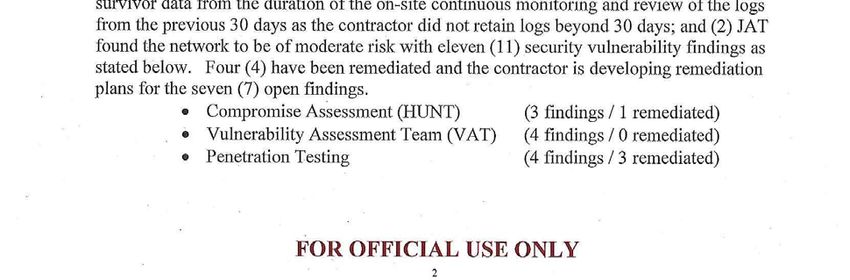
FOR OFFICAL USE ONLY
OFFICE OF INSPECTOR GENERAL
Department of Homeland Security
Applicant First Name
Applicant Middle Name
Applicant Last Name
Applicant Date of Birth
Last 4 digits of Applicant’s Social Security Number
Disaster Number
Authorization for TSA
Number of Occupants in Applicants Household
Eligibility Start Date
Eligibility End Date
Global Name
Export Sequence Number
FEMA Registration Number
A privacy incident occurred because FEMA did not ensure it shared with the
contractor only the data elements the contractor requires to perform its official
duties administering the TSA program. FEMA provided and continues to
provide with more than 20 unnecessary data fields for survivors
participating in the TSA program. Of the 20 unnecessary data fields, FEMA
does not safeguard and improperly releases 6 that include SPII:
Applicant Street Address
Applicant City Name
Applicant Zip Code
Applicant’s Financial Institution Name
Applicant’s Electronic Funds Transfer Number
Applicant’s Bank Transit Number
FEMA’s Performance Work Statement identified the data elements needed,
yet FEMA did not take steps to ensure it provided only the required data
elements. FEMA only confirmed that received the data transmitted. Prior
iterations of the TSA program required additional information such as bank
names and account numbers; however, the current TSA program does not
require the additional personal information.
FEMA headquarters officials told us it may be feasible to change the data
transfer script to remove the unnecessary PII, but such change would need to
be coordinated with the Individual Assistance and Mass Care program offices,
which may be time consuming.
also did not notify FEMA that it was providing information unnecessary to
fulfilling the contract terms. Although not required to do so, had officials
notified FEMA officials that the agency was providing unnecessary PII and SPII
www.oig.dhs.gov 4 OIG-19-32
FOR OFFICIAL USE ONLY
FOR OFFICAL USE ONLY
                   OFFICE OF INSPECTOR GENERAL
                       Department of Homeland Security

for eligible survivors, FEMA may have been able to remedy this situation earlier
and avoid additional privacy incidents.

FEMA’s failure to provide only required data elements to       has placed
approximately 2.3 million disaster survivors at increased risk of identity theft
and fraud. FEMA must take corrective action to safeguard against improperly
releasing PII and SPII of disaster survivors in the future.

Recommendations

Recommendation 1: We recommend that the Federal Emergency Management
Agency’s Assistant Administrator for the Recovery Directorate implement
controls to ensure that the agency only sends required data elements of
registered disaster survivors to contractors, such as
             .

Recommendation 2: We recommend that the Federal Emergency Management
Agency’s Assistant Administrator for the Recovery Directorate assess the extent
of this privacy incident and implement a process for ensuring that Personally
Identifiable Information, including Sensitive Personally Identifiable Information,
of registered disaster survivors previously released to
              is properly destroyed pursuant to DHS policy.

Management Comments and OIG Analysis

FEMA concurred with our two recommendations. We included a copy of the
Department’s management comments in their entirety in appendix A. We also
received technical comments to the draft report and revised the report as
appropriate.

In its written comments, FEMA indicated it has begun to implement measures
to assess and mitigate this privacy incident, including deploying a Joint
Assessment Team of cyber security personnel to the contractor’s facilities.
FEMA indicated that the Joint Assessment Team had documented the
sanitization and removal of the unnecessarily shared PII and SPII from the
contractor’s system and performed an in-depth assessment of the contractor’s
network. According to FEMA, these assessments found no indication of
intrusion within the last 30 days although the assessment identified that the
contractor did not maintain logs past 30 days. The Joint Assessment Team also
identified several security vulnerabilities. As of March 2019, four vulnerabilities
had been remediated and the contractor was developing remediation plans for
the remaining seven. FEMA’s estimated completion date for implementing the
recommendations is June 30, 2020. Given the sensitive nature of these

www.oig.dhs.gov                         5                                OIG-19-32
                           FOR OFFICIAL USE ONLY
FOR OFFICAL USE ONLY
                  OFFICE OF INSPECTOR GENERAL
                      Department of Homeland Security

findings, we urge FEMA to expedite this timeline.

FEMA Response to Recommendation 1: Concur. In agreement with OIG’s
observations, FEMA determined that numerous elements constituting SPII were
not necessary to administer the TSA program. FEMA stated it had implemented
immediate measures to discontinue sharing the unnecessary data and had
begun an on-site assessment of        network.

Estimated Completion Date: June 30, 2020.

OIG Analysis: We consider these actions responsive to the recommendation.
This recommendation is resolved and open until FEMA:

   1) provides a report about the controls implemented to ensure that the
      agency only sends required data elements on registered disaster
      survivors to contractors;
   2) provides a report on the final outcome of the on-site assessment of
      network;
   3) provides copies of the contract amendments, including the Homeland
      Security Acquisition Regulation clause requiring annual privacy and
      security awareness training of      staff; and
   4) provides a report on FEMA’s annual privacy and security training of
      FEMA employees to mitigate future privacy incidents similar to the one
      we identified.

FEMA Response to Recommendation 2: Concur. FEMA's Office of the Chief
Information Officer (OCIO) has begun taking corrective actions to conduct an
on-site security and risk assessment of        data systems and network. Upon
completion of initial assessment activities, FEMA worked with       to sanitize
all previously transferred, non-required PII/SPII from      system. FEMA
stated the OCIO will continue to assess        systems on a regular basis to
assure       maintains a security posture in accordance with Federal security
standards on handling PII/SPII, as well as the FEMA Records Retention
Schedule covering this information.

Estimated Completion Date: June 30, 2020.

OIG Analysis: We consider these actions responsive to the recommendation.
This recommendation is resolved and open until FEMA provides a report on its
actions to mitigate this privacy incident and its ongoing assessments to ensure
the contractor maintains a security posture in accordance with Federal
standards for handling PII/SPII.

www.oig.dhs.gov                       6                               OIG-19-32
                          FOR OFFICIAL USE ONLY
FOR OFFICAL USE ONLY
                  OFFICE OF INSPECTOR GENERAL
                       Department of Homeland Security

Objective, Scope, and Methodology

The DHS Office of Inspector General was established by the Homeland Security
Act of 2002, Pub. L. No. 107−296, 116 Stat. 2135, which amended the
Inspector General Act of 1978. We issued this management alert during an
ongoing audit of FEMA’s TSA program. The objective of our ongoing audit is to
determine to what extent FEMA ensured compliance with contract
requirements concerning the TSA program.

We conducted interviews in June 2018 with FEMA headquarters officials in
charge of the TSA program; and in July 2018 with FEMA financial
management, information technology, and contracting officials in Winchester,
Virginia, to inform them of the privacy incident. We also interviewed state and
FEMA officials in Texas, specifically concerning the use of the TSA program
following Hurricane Harvey in 2017.

We reviewed Federal, DHS, and FEMA criteria related to transitional sheltering
and contracting; TSA process workflows and standard operating procedures;
     policies, procedures and other documentation; and TSA data from
Hurricanes Harvey, Irma, and Maria (from August 2017 to August 2018), and
California wildfires in 2017, including all eligible households, program
recipients of TSA, and program costs.

We conducted our work under the Inspector General Act of 1978, as amended,
Section 2.2(b), to promote economy, efficiency, and effectiveness in the
administration of; and to prevent and detect fraud and abuse in, such
programs and operations. This management alert focuses only on FEMA’s
release of PII and SPII. We are continuing this audit, so additional
recommendations regarding this issue may be included in the full audit report.
Any corrective actions FEMA takes in response to this management alert will
be addressed in our full audit report.

Office of Audits major contributors to this management alert are Yesi
Starinsky, Director; Andrew Smith, Audit Manager; David Kinard, Auditor-in-
Charge; Keith Lutgen, Program Analyst; Haidee Lai, Auditor; Edward Brann,
Program Analyst; Daniel Malone, Program Analyst; Deborah Mouton-Miller,
Communications Analyst; and John Skrmetti, Independent Report Referencer.

www.oig.dhs.gov                        7                               OIG-19-32
                          FOR OFFICIAL USE ONLY
FOR OFFICAL USE ONLY
OFFICE OF INSPECTOR GENERAL
Department of Homeland Security
Appendix A
FEMA Comments to the Draft Alert
www.oig.dhs.gov 8 OIG-19-32
FOR OFFICIAL USE ONLYFOR OFFICAL USE ONLY
OFFICE OF INSPECTOR GENERAL
Department of Homeland Security
www.oig.dhs.gov 9 OIG-19-32
FOR OFFICIAL USE ONLYFOR OFFICAL USE ONLY
OFFICE OF INSPECTOR GENERAL
Department of Homeland Security
www.oig.dhs.gov 10 OIG-19-32
FOR OFFICIAL USE ONLYFOR OFFICAL USE ONLY
OFFICE OF INSPECTOR GENERAL
Department of Homeland Security
www.oig.dhs.gov 11 OIG-19-32
FOR OFFICIAL USE ONLYFOR OFFICAL USE ONLY
OFFICE OF INSPECTOR GENERAL
Department of Homeland Security
Appendix B
Report Distribution
Department of Homeland Security
Secretary
Deputy Secretary
Chief of Staff
General Counsel
Executive Secretary
Director, GAO/OIG Liaison Office
Assistant Secretary for Office of Policy
Assistant Secretary for Office of Public Affairs
Assistant Secretary for Office of Legislative Affairs
FEMA Audit Liaison
Congress
Congressional Oversight and Appropriations Committee
www.oig.dhs.gov 12 OIG-19-32
FOR OFFICIAL USE ONLYAdditional Information and Copies
To view this and any of our other reports, please visit our website at:
www.oig.dhs.gov.
For further information or questions, please contact Office of Inspector General
Public Affairs at: DHS-OIG.OfficePublicAffairs@oig.dhs.gov.
Follow us on Twitter at: @dhsoig.
OIG Hotline
To report fraud, waste, or abuse, visit our website at www.oig.dhs.gov and click
on the red "Hotline" tab. If you cannot access our website, call our hotline at
(800) 323-8603, fax our hotline at (202) 254-4297, or write to us at:
Department of Homeland Security
Office of Inspector General, Mail Stop 0305
Attention: Hotline
245 Murray Drive, SW
Washington, DC 20528-0305You can also read


