Measles and rubella monitoring - SURVEILLANCE REPORT
←
→
Page content transcription
If your browser does not render page correctly, please read the page content below
SURVEILLANCE REPORT
                                                           Measles and rubella
                                                                   monitoring
                                                                                                 February 2014
                                          Reporting on January–December 2013 surveillance data
                                       and epidemic intelligence data to the end of February 2014

  Main developments
  Measles
       During the most recent 12-month period (January 2013 to December 2013) the 30 EU/EEA countries
       conducting measles surveillance reported 10 271 cases. Twenty-five of the 30 contributing countries
       reported consistently for the 12-month period.
       Germany, Italy, the Netherlands, Romania and the United Kingdom accounted for 91% of the cases in this
       period.
       In ten countries, the measles notification rate was less than one case per million population during the
       last 12 months.
       Sixty per cent of the cases had a positive result in a measles laboratory test (serology, virus detection, or
       isolation).
       Of the 10 268 cases for which information on vaccination status was available, 88% were unvaccinated.
       In the target group for routine childhood MMR vaccination (1–4-year-olds), 80% of the cases were
       unvaccinated.
       Three measles-related deaths were reported during the period January 2013 to December 2013, and
       eight cases were complicated by acute measles encephalitis.
       Anthroposophic schools were involved in two 2014 measles outbreaks in Austria and Finland.
       A new outbreak was reported in Wales in October 2013, in the same area as last year’s outbreaks.
       The UK has seen ten measles cases in returning travellers from the Philippines where there is an ongoing
       outbreak.
       The measles outbreak in the Netherlands is still ongoing but is showing signs of slowing down.
       Of the EU neighbouring countries, Russia reported several large outbreaks which are still ongoing.

Erratum. The following correction was made on 4 March 2014:

Page 4, Table 1: ‘November 2012 – November 2013’ was changed to read ‘January 2013 – December 2013’.

Suggested citation: European Centre for Disease Prevention and Control. Measles and rubella monitoring, February 2014 –
Reporting on January–December 2013 surveillance data and epidemic intelligence data to the end of February 2014. Stockholm:
ECDC; 2014.
© European Centre for Disease Prevention and Control, Stockholm, 2014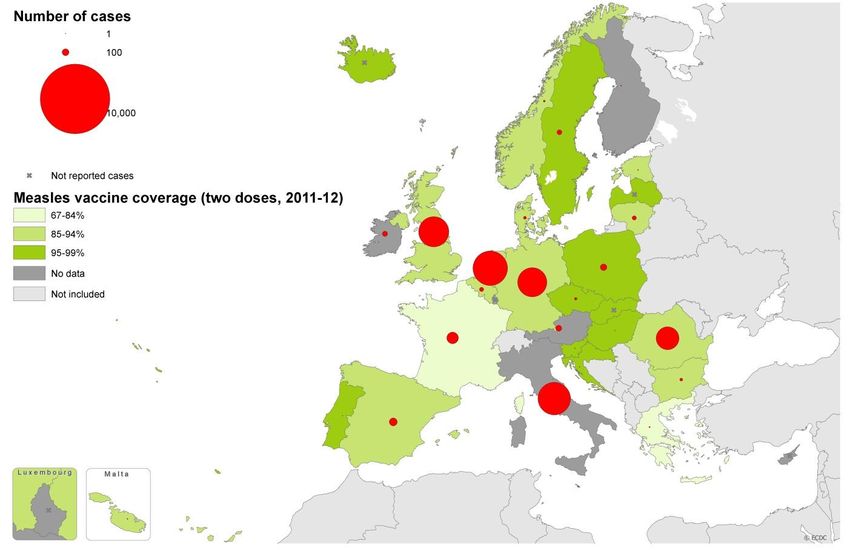
SURVEILLANCE REPORT                                                                Measles and rubella monitoring

 Rubella
       The 27 EU/EEA countries reported 38 847 rubella cases during the most recent 12-month period between
       January 2013 and December 2013. Twenty countries reported consistently for the 12-month period.
       Poland accounted for 99% of all reported rubella cases in the 12-month period; 88% of these cases were
       either unvaccinated or had an unknown vaccination status.
       Less than 1% of the cases had a positive result in a rubella laboratory test.
       In 14 countries the rubella notification rate was rate less than one case per million population during the
       last 12 months.
       No outbreaks have been detected by epidemic intelligence since the last report.

Measles
Surveillance data
The enhanced measles surveillance data were retrieved from The European Surveillance System (TESSY) on
31 January 2014. The analysis covered the 12-month period from January 2013 to December 2013. All 30
contributing EU/EEA countries reported case-based data for all 12 months, except Lithuania which reported
aggregated data. Bulgaria, the Czech Republic, Greece, Lithuania and the Netherlands did not report any data for
the month of December (Figure 1, Table 1).
During the 12-month period, 10 271 cases of measles were reported. The number of cases and the notification
rates by country for the past 12 months are shown in Table 1 and Figures 5 and 6. In 10 of the 25 countries which
reported consistently over the 12-month period, the measles notification rate was less than one case per million
population.
The countries which reported most cases were Germany (17%), Italy (22%), the Netherlands (24%), Romania
(10%) and the United Kingdom (18%) (Table 1).
The highest notification rate was among infants under one year of age (134.6 cases per million population),
followed by children aged between one and four years (78.1 cases per million population) and adolescents
between 10 and 14 years (70.3 per million population) (Figure 3).
Sixty per cent of the cases tested positive for measles (serology, virus detection or isolation); there were large
variations between countries in the proportion of laboratory-confirmed cases.
Vaccination status was known for 95% of the 10 268 cases reported with known age. Of these 9 708 cases, 88%
(8 561 cases) were unvaccinated, 8% (783) had received one dose of measles vaccine, 0.1% (7) had received two
or more doses, and 4% (35) had received an unknown number of doses. The proportion of unvaccinated cases
was high across all age groups (Figure 4) and highest among children under one year of age (98%), who are often
too young to be eligible for vaccination. Among the 1–4-year-olds, which is the age group targeted by routine
childhood vaccination programmes, 80% of the cases were unvaccinated.
Over the last 12 months, eight cases were complicated by acute measles encephalitis, and there were three
deaths.
The notification rate by age group was calculated for the five countries reporting most cases (Figure 7a-e). The
notification rates showed a very heterogeneous pattern, with Italy showing the highest incidence among
adolescents between 15 and 29 years. Germany, Romania and UK showed the highest incidence in infants below
the age of one, and the Netherlands reported the highest incidence in the age group between 5 and 14 years of
age. In all countries, the majority of cases were not vaccinated (Figure 7a-e).
The number of cases observed in 2013 remains low compared to the epidemic years 2010 and 2011 (Figure 2).
However, numbers remains unacceptably high, considering that measles and rubella are targeted for elimination in
Europe by 2015. Measures implemented in the Member States must be expanded and accelerated in order to reach
this target.

                                                           2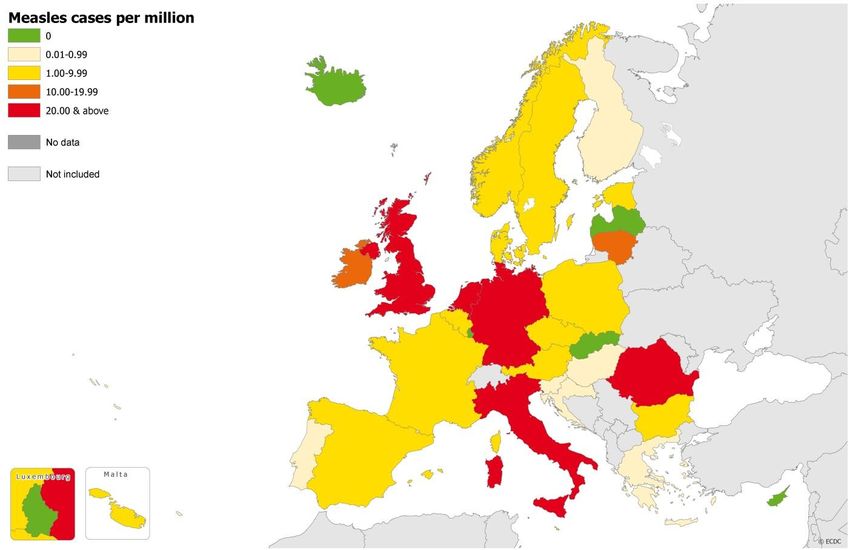
SURVEILLANCE REPORT                                                                          Measles and rubella monitoring

Figure 1. Number of measles cases in 2012 and 2013 and number of European countries reporting in
2013, by month

                                    Number of reporting countries in 2013             2012             2013
                   1600                                                                                                  30

                   1400

                   1200

                                                                                                                              Number of reporting countries
Number of cases

                   1000

                    800

                    600

                    400

                    200

                      0                                                                                                  0
                             Jan   Feb    Mar    Apr   May    Jun      Jul     Aug     Sep      Oct      Nov     Dec
                                                       Month used for statistics

Figure 2. Number of measles cases by month, EU/EEA countries, January 2006—December 2013

                   8000

                   7000

                   6000
 Number of cases

                   5000

                   4000

                   3000

                   2000

                   1000

                     0
                          2006     2007         2008       2009         2010          2011            2012        2013
                                                                      Years

Note: During 2006–2013, 29 EU/EEA countries consistently reported measles cases every month. Delays in reporting were
observed only in December 2013 and are further explained in this report. All 30 countries are included in the figure; Croatia is
included from 2012 onwards.

                                                                  3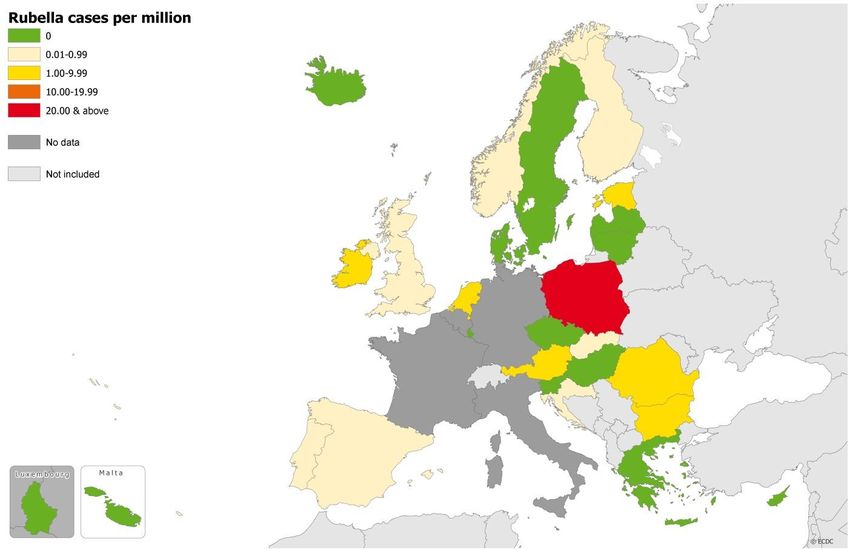
SURVEILLANCE REPORT                                                                                Measles and rubella monitoring

Table 1. Number of measles cases by month and notification rate (cases per million) by country,
January 2013–December 2013, EU/EEA countries
                                                         2013                                                                       Total
                                                                                                                         Cases       lab-
                                                                                                                          per      positive
Country             Jan     Feb   Mar    Apr   May     Jun   Jul           Aug   Sep   Oct   Nov    Dec    Total cases   million    cases
Austria                 4     8      8    11     11      5         0         6     5     9     3       5            75       8.9         46
Belgium                 3     2      5     5     13      6         2         2     0     0     0       0            38       3.4          6
Bulgaria                0     0      0     0      6      7         2         0     0     1     0     NR             16       2.2         13
Croatia                 0     0      0     0      0      0         0         1     0     0     0       0             1       0.2          0
Cyprus                  0     0      0     0      0      0         0         0     0     0     0       0             0       0.0          0
Czech Republic          0     3      3     4      3      1         0         0     0     0     0     NR             14       1.3         13
Denmark                 3     0      8     6      0      0         0         0     0     0     0       0            17       3.0         13
Estonia                 0     0      1     1      0      0         0         0     0     0     0       0             2       1.5          2
Finland                 1     0      0     0      1      0         0         0     0     0     0       0             2       0.4          0
France                26     22     23    46     37     34      25          13    13    15    11       7           272       4.2       121
Germany                 9     9     44   136    499    391   306           127   108    76    47      20         1772       21.7      1018
Greece                  2     1      0     0      0      0         0         0     0     0     0     NR              3       0.3          3
Hungary                 0     0      1     0      0      0         0         0     0     0     0       0             1       0.1          1
Iceland                 0     0      0     0      0      0         0         0     0     0     0       0             0       0.0          0
Ireland                 1     4      0     4     10      7         2         4     2    16     6       1            57      12.4         33
Italy                 83    204   213    210    360    386   199            73    42    38   175     233         2216       36.4      1149
Latvia                  0     0      0     0      0      0         0         0     0     0     0       0             0       0.0          0
Lithuania               0     0      0     0     27      7         0         0     1     0     0     NR             35      11.6          0
Luxembourg              0     0      0     0      0      0         0         0     0     0     0       0             0       0.0          0
Malta                   0     0      2     0      0      0         0         0     0     0     0       0             2       4.8          2
Netherlands             1     4     10     5     18    295   700           408   441   470   147     NR          2499      149.4       798
Norway                  0     0      1     0      0      7         0         0     0     0     0       0             8       1.6          8
Poland                  4     9      7    20     12     17      10           3     1     1     1       1            86       2.2         56
Portugal                0     0      0     1      0      0         0         0     0     0     0       0             1       0.1          1
Romania              208    219   181    146     80    105      59          26     9    22    19       0         1074       50.3       816
Slovakia                0     0      0     0      0      0         0         0     0     0     0       0             0       0.0          0
Slovenia                0     0      0     0      0      0         1         0     0     0     0       0             1       0.5          1
Spain                   5    15     13    15     15     18      31           8     4     3     0       0           127       2.7       105
Sweden                  4     8      9     1      8     16         6         0     0     0     0       0            52       5.5         50
United Kingdom       274    269   358    479    233    124      81          22    15    28    13       4         1900       30.7      1894
Total               628 777 887 1090 1333 1426 1424 693 641 679 422 271                                        10271       20.1      6149

NR: Data not reported. Lichtenstein does not report.
Notification rates were calculated using the most recent population estimates available from Eurostat (2012).
Countries with a notification rate ≥ 1 per million population are highlighted in green. The target to monitor progress towards
elimination is achievement of an incidence of less than one case per million population per year (including confirmed, probable
and possible cases but excluding imported cases).
Achieving this target is consistent with progress towards elimination but does not define elimination or confirm that it has been
achieved. In the table, all cases (endemic, imported, import-related) are included for the calculation of the notification rate.
For countries that did not report data for all 12 months, notification rates might be underestimated.
All confirmed, probable, possible or unknown cases, as defined by the EU 2008 case definitions, are included.
Tables on measles cases in previous years are available from:
http://www.ecdc.europa.eu/en/healthtopics/measles/epidemiological_data/pages/annual_epidemiological_reports.aspx

                                                                       4
SURVEILLANCE REPORT                                                                                    Measles and rubella monitoring

Figure 3. Measles notification rate (cases per million) by age group, January 2013–December 2013,
EU/EEA countries (N=10 268 cases with known age)

                      160

                      140

                      120
 Cases per million

                      100

                          80

                          60

                          40

                          20

                          0
SURVEILLANCE REPORT Measles and rubella monitoring
Figure 5. Number of measles cases by country, January 2013–December 2013 (N=10 271), and
vaccine coverage (two doses, 2011–2012, WHO*), EU/EEA countries
* Coverage figures (%) are official national figures reported via the annual WHO/UNICEF Joint Reporting Form. See notes at the
end of this report for further explanations.
Figure 6. Measles notification rate (cases per million) by country, January 2013–December 2013,
EU/EEA countries (N=10 271)
For interactive maps relating to measles see http://emmageocase.ecdc.europa.eu/atlas/measles
6SURVEILLANCE REPORT Measles and rubella monitoring
Figures 7. Notification rate of measles cases and vaccination status for the five countries with the
highest proportion of cases, by age group, January–December 2013
Vaccination status is indicated by colours:
Vaccinated, ≥ two doses Unknown vaccination status
Vaccinated, one dose Unvaccinated
Vaccinated, unknown number of doses
Figure 7a-1.Measles notification rate (cases per million) by age group, Italy, January–December 2013
140
Cases per million
120
100
80
60
40
20
0
Age groups (years)
Figure 7a-2.Number of measles cases by age group and vaccination status, Italy, January–December 2013
700
600
Number of cases
500
400
300
200
100
0
Age groups (years)
Figure 7b-1.Measles notification rate (cases per million) by age group, Germany, January–December 2013
140
Cases per million
120
100
80
60
40
20
0
Age groups (years)
7SURVEILLANCE REPORT Measles and rubella monitoring
Figure 7b-2.Number of measles cases by age group and vaccination status, Germany, January–December 2013
400
350
300
Number of cases
250
200
150
100
50
0
Age groups (years)
Figure 7c-1.Measles notification rate (cases per million) by age group, the Netherlands, January–December 2013
1000
Cases per million
800
600
400
200
0
Age groups (years)
Figure 7c-2.Number of measles cases by age group and vaccination status, the Netherlands, January–November
2013
900
800
700
600
Number of case
500
400
300
200
100
0
Age groups (years)
8SURVEILLANCE REPORT Measles and rubella monitoring
Figure 7d-1.Measles notification rate (cases per million) by age group, Romania, January–December 2013
2000
Cases per million
1500
1000
500
0
Age groups (years)
Figure 7d-2.Number of measles cases by age group and by vaccination status, Romania, January–December 2013
450
400
Number of cases
350
300
250
200
150
100
50
0
Age groups (years)
Figure 7e-1.Measles notification rate (cases per million) by age group, United Kingdom, January–December 2013
250
Cases per million
200
150
100
50
0
Age groups (years)
9SURVEILLANCE REPORT Measles and rubella monitoring
Figure 7e-2.Number of measles cases by age group and by vaccination status, United Kingdom, January–December
2013
600
Number of cases
500
400
300
200
100
0
Age groups (years)
Epidemic intelligence
In 2013, several large measles outbreaks occurred in the EU. The largest outbreaks were in Wales and the
Netherlands. Germany, England and Italy were also affected by measles outbreaks in 2013.
Updates since the last report
European Union Member States
Austria
Between 1 December 2013 and 13 February 2014, 44 cases of measles were reported in Austria, compared with 70
cases from January 2013 to November 2013. Thirty-eight cases were due to the same outbreak affecting Lower
Austria (28) and Vienna (10). Eleven cases of this outbreak were confirmed to be caused by genotype D8. In two
cases from different regions (Tirol and Salzburg), genotype B3 was identified. Sixty-eight per cent of the confirmed
and probable cases are unvaccinated, and in 11% the vaccination status is unknown. Thirty-nine per cent of the
cases are reported to have been hospitalised. Three of the patients are healthcare workers, and 12 cases are
students in an anthroposophic school. There have been previous outbreaks in anthroposophic schools in Austria.
The largest one occurred in Salzburg in 2008 with 394 cases. Outbreak investigations continue, and
recommendations are given regarding post-exposure prophylaxis as well as vaccination for people with no record
of two doses of measles vaccinations.
The Austrian Ministry of Health has launched a measles initiative in the first week of January to increase awareness
of measles vaccination.
Finland
Fifty school children in an anthroposophic school in Finland were placed under quarantine at the end of January
2014 due to a measles case in a student returning from abroad. Only half of the school's students have received
MMR vaccine against measles. There are also susceptible children in a nearby kindergarten who are unvaccinated
because of their young age.
Students who had received two MMR vaccinations were allowed to return to school, but fifty unvaccinated students
under quarantine were asked to do their school assignments from home. Students under quarantine have been
urged to stay at home and may not visit public places and friends until the end of the incubation period.
Sweden
The Swedish Public Health Agency (Folkhälsomyndigheten) reported on 7 February 2014 that investigations are
ongoing regarding three measles cases in Stockholm. The cases were born in the 1940s and 1960s, and had fallen
ill recently. None of them had been abroad before they became ill, and contact tracing is in progress to clarify the
source of infection. Two unrelated cases were reported from Örebro and Skåne involving a returning traveller and
a person who had contact with people who have recently been abroad.
The Netherlands – update
The measles epidemic in the Netherlands is still ongoing but slowing down. Since 1 May 2013 and as of 12
February 2014, RIVM reported 2 628 cases. A 17-year-old girl died due to complications. Most measles patients
are unvaccinated children (94%) between 4 and 12 years (57%).
10SURVEILLANCE REPORT Measles and rubella monitoring
Since the beginning of the outbreak, 17 health workers have been diagnosed with measles. Of these, 11 were
unvaccinated, two were vaccinated with two doses, three were given one dose, and one person was vaccinated
with three doses.
There was a spread of measles from the Netherlands to Alberta, Canada, in October 2013 through a visitor,
causing a local outbreak there with 42 cases.
The UK – measles cases ex Philippines
Public Health England reported ten cases of measles in the UK since December 2013 in persons returning from the
Philippines where there is an ongoing outbreak. Ages of the cases ranged from less than one year to 45 years.
Three cases were under 13 months of age and therefore not yet eligible for immunisation. The majority of the
cases (eight) had travelled to the Philippines to visit family and friends, and at least four cases were infectious on
their flight back to the UK, raising the possibility of onward transmission and further cases occurring.
In some instances patients seeking care were not isolated immediately, exposing healthcare workers and patients.
Current advice by the Public Health England's Immunisation Department is that individuals with clinical features
compatible with measles who have recently travelled to the Philippines should be treated as likely measles cases,
and outbreak control actions – such as identifying contacts – should start ahead of laboratory confirmation of the
diagnosis.
Several other countries have reported measles cases imported from the Philippines: Japan, the US (Hawaii),
Taiwan, Canada, New Zealand and Australia.
Wales – update
Since October 2013, several community- and school-associated outbreaks have been reported by Public Health
Wales. The majority of the cases were in or near the city of Swansea, an area which had been severely affected by
a previous outbreak. So far, the highest incidence has been in the 10–18-years age group but adults have also
been affected. Although more than 70 000 doses of MMR were given during the catch-up vaccination campaign in
Wales in response to the last outbreak, around 30 000 children and young people between 10 and 18 years of age
remain unprotected. Health authorities are again offering extended immunisation sessions in the affected schools
and areas and are urging people born after 1970 to check their previous measles immunisations and bring their
vaccination status up to date when necessary.
The largest ever outbreak reported in Wales started in November 2012 and was declared to be over in July 2013.
It resulted in 1 219 notifications of measles. Eighty-eight people needed hospitalisation and there was one death.
Germany – SSPE fatality
A German newspaper reported the death of a 19-year old adolescent due to subacute sclerosing panencephalitis
(SSPE). He contracted measles as a toddler and started to show symptoms of brain affection at the age of ten. He
was later diagnosed with SSPE and has been in a vegetative state during the last seven years. More information is
available here: http://aktion-max.de/.
Other countries
Russia
Several large ongoing outbreaks are reported. In Kursk, the number of cases of measles has reached 207 (as of 10
February) in an outbreak involving a Baptist community who refuse vaccination.
In the Astrakhan region, the number of reported measles cases (as of 10 February 2014) is 110, affecting several
villages.
Another large outbreak is ongoing in the Tula region, with 62 cases of suspected and confirmed measles cases,
both among Baptists and Roma people.
The Karachay-Cherkess Republic has reported 41 laboratory-confirmed measles cases since the beginning of 2014,
mainly among adults. Seven of the patients are healthcare workers.
Vietnam
From 1 January to 13 February, the country recorded 621 cases, including seven deaths, according to a report of
the National Institute of Hygiene and Epidemiology and the Pasteur Institute in Ho Chi Minh City. More than 160
children have been hospitalised so far because of measles. Twenty of the patients had serious complications,
including pneumonia and respiratory failure.
Publications
Weekly epidemiological record – WHO
A recent meeting of the Strategic Advisory Group of Experts on Immunization (SAGE) in November 2013 reviewed
the status of the measles and rubella situation. There has been a significant reduction in measles incidence, and
measles mortality has been reduced by 75% since 2000. The Americas have maintained elimination of both
measles and rubella, and the WHO Western Pacific region is approaching interruption of endemic measles
11SURVEILLANCE REPORT Measles and rubella monitoring
transmission. However, based on current trends and programme performance, the 2015 global targets as well as
regional elimination targets in the European (2015), Eastern Mediterranean (2015) and African (2020) regions will
not be achieved on time.
The Australian and New Zealand Journal of Public Health
Study regarding immunity to vaccine-preventable diseases in healthcare workers at an Australian
hospital
The authors determined the vaccination status of a cohort of healthcare workers at a tertiary hospital in
Melbourne, Victoria, through serology (hepatitis B, varicella, measles, mumps, rubella) and by questionnaire
(diphtheria, tetanus and pertussis). Overall, 95 healthcare workers were evaluated. Mean age and duration of
employment were 47.2 and 12.6 years, respectively. Forty-seven staff (49%) required vaccination to comply with
Australian immunisation guidelines: 18% were non-immune to hepatitis B, 2% to varicella, 8% to measles, 19% to
mumps and 13% to rubella. Healthcare workers without serological hepatitis B immunity were all staff with clinical
roles.
Rubella
Enhanced surveillance data
The enhanced rubella surveillance data were retrieved from The European Surveillance System (TESSy) on
31 January 2014. The analysis covers the 12-month period from January 2013 to December 2013.
Three EU countries – Belgium, France and Germany – do not operate rubella surveillance systems with national
coverage and hence do not contribute data to the EU/EEA enhanced rubella surveillance.
Of the 27 contributing countries, 20 reported data for the entire period. Italy did not report for the entire 12-month
period; Bulgaria, the Czech Republic, Greece, Lithuania, the Netherlands and Portugal did not report data for
December 2013 (Figure 8).
During the period January 2013–December 2013, 38 847 cases of rubella were reported. Less than 1% of the
cases were reported as laboratory confirmed (by serology, virus detection or isolation).
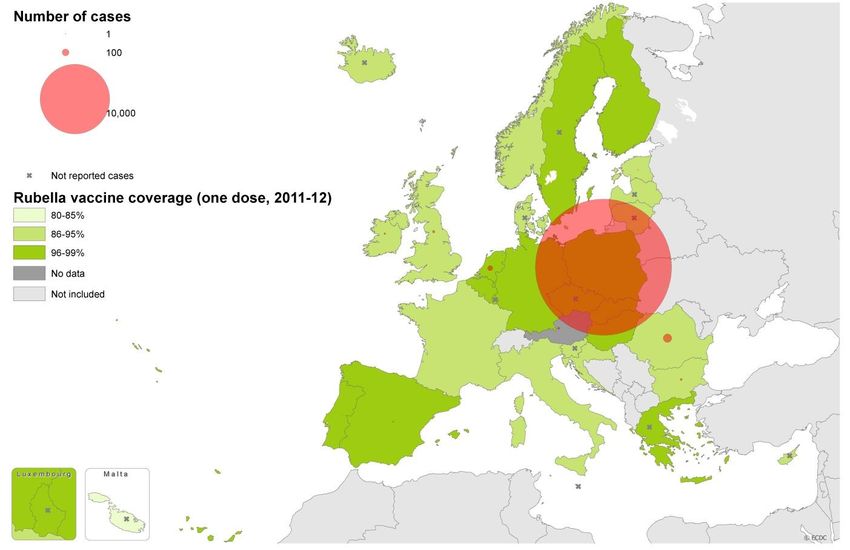
The number of cases and notification rates by country for the past 12 months are shown in Table 2 and Figures 9
and 10. Fourteen of the 21 countries that reported data for all the 12-month period met the target of less than one
case per million population.
Poland accounted for 99% of all reported rubella cases in the 12-month period (38 585 cases); data were reported
in an aggregated format. None of the 38 585 cases were reported with a positive laboratory test, and the cases
related to 2013 were reported with unknown age group. A total of 23 572 cases (61%) were unvaccinated, 4 000
(10%) cases were vaccinated with one dose, 607 (2%) cases with two or more doses, and 10 406 (27%) cases
had an unknown vaccination status.
12SURVEILLANCE REPORT Measles and rubella monitoring
Figure 8. Number of rubella cases in 2012 and 2013 and number of European countries reporting in
2013, by month
Number of reporting countries in 2013 2012 2013
12000 30
10000
Number of reporting countries
Number of caases
8000
6000
4000
2000
0 0
Jan Feb Mar Apr May Jun Jul Aug Sep Oct Nov Dec
Month used for statistics
Note: Belgium, France and Germany do not have rubella surveillance with national coverage.
13SURVEILLANCE REPORT Measles and rubella monitoring
Table 2. Number of rubella cases by month and notification rate (cases per million) by country,
January 2013–December 2013, EU/EEA countries
2013 Total
Cases lab-
per positive
Country Jan Feb Mar Apr May Jun Jul Aug Sep Oct Nov Dec Total cases million cases
Austria 0 0 1 4 4 0 1 0 0 0 0 1 11 1.3 7
Belgium NR NR NR NR NR NR NR NR NR NR NR NR NR - -
Bulgaria 1 1 1 0 3 0 0 0 2 0 1 NR 9 1.2 1
Croatia 0 0 0 0 0 0 1 0 0 0 0 0 1 0.2 1
Cyprus 0 0 0 0 0 0 0 0 0 0 0 0 0 0.0 0
Czech Republic 0 0 0 0 0 0 0 0 0 0 0 NR 0 0.0 0
Denmark 0 0 0 0 0 0 0 0 0 0 0 0 0 0.0 0
Estonia 0 0 0 0 0 2 0 0 0 0 0 0 2 1.5 2
Finland 0 0 0 1 0 1 0 0 0 0 0 0 2 0.4 0
France NR NR NR NR NR NR NR NR NR NR NR NR NR - -
Germany NR NR NR NR NR NR NR NR NR NR NR NR NR - -
Greece 0 0 0 0 0 0 0 0 0 0 0 NR 0 0.0 0
Hungary 0 0 0 0 0 0 0 0 0 0 0 0 0 0.0 0
Iceland 0 0 0 0 0 0 0 0 0 0 0 0 0 0.0 0
Ireland 0 0 1 1 2 0 1 0 1 2 0 0 8 1.7 0
Italy NR NR NR NR NR NR NR NR NR NR NR NR NR - -
Latvia 0 0 0 0 0 0 0 0 0 0 0 0 0 0.0 0
Lithuania 0 0 0 0 0 0 0 0 0 0 0 NR 0 0.0 0
Luxembourg 0 0 0 0 0 0 0 0 0 0 0 0 0 0.0 0
Malta 0 0 0 0 0 0 0 0 0 0 0 0 0 0.0 0
Netherlands 0 0 0 2 0 12 43 0 0 NR NR NR 57 3.4 15
Norway 1 1 0 0 1 0 0 0 0 0 0 0 3 0.6 3
Poland 1833 2690 5918 10856 8466 4114 1877 690 569 606 481 485 38585 1001.3 0
Portugal 0 1 0 0 0 0 0 0 0 0 0 NR 1 0.1 0
Romania 15 21 13 26 18 19 11 14 7 3 3 0 150 7.0 105
Slovakia 0 0 0 0 0 0 0 0 0 1 0 0 1 0.2 0
Slovenia 0 0 0 0 0 0 0 0 0 0 0 0 0 0.0 0
Spain 0 0 0 2 1 0 0 0 0 0 0 0 3 0.1 3
Sweden 0 0 0 0 0 0 0 0 0 0 0 0 0 0.0 0
United Kingdom 1 0 3 2 0 2 1 1 1 1 2 0 14 0.2 13
Total 1851 2714 5937 10894 8495 4150 1935 705 580 613 487 486 38847 132.8 150
The national surveillance system for rubella in Denmark currently only captures rubella infections during pregnancy; therefore the
true incidence of rubella in the Danish population will be underestimated.
NR: Data not reported. Lichtenstein does not report.
Countries with a notification rate ≥ 1 per million population are highlighted in green. The target to monitor progress towards
elimination is achievement of an incidence of less than one case per million population per year (including confirmed, probable
and possible cases but excluding imported cases).
Achieving this target is consistent with progress towards elimination but does not define elimination or confirm that it has been
achieved. In the table, all cases (endemic, imported, import-related) are included for the calculation of the notification rate.
For countries that did not report data for all 12 months, notification rates might be underestimated.
All confirmed, probable, possible or unknown cases, as defined by the EU 2008 case definition, are included.
Cases were defined as laboratory-positive if at least one of the following variables was reported as positive: serological test for
IgG, serological test for IgM, virus detection or isolation or IgG avidity test.
For tables relating to number of rubella cases in previous years,
see:http://www.ecdc.europa.eu/en/healthtopics/rubella/epidemiological-data/pages/epidemiological_data.aspx
14SURVEILLANCE REPORT Measles and rubella monitoring
Figure 8. Rubella notification rate (cases per million) by age group, January 2013–December 2013,
EU/EEA countries (N=262 cases with known age)
14
12
10
Cases per million
8
6
4
2
0SURVEILLANCE REPORT Measles and rubella monitoring
Figure 10. Rubella notification rate (cases per million) by country, January 2013 – December 2013,
EU/EEA countries (N=38 8 47)
Epidemic intelligence
No rubella outbreaks have been detected by epidemic intelligence since the previous report.
Useful links
More information about measles and rubella is available on the ECDC website:
Measles health topic page, ECDC: http://ecdc.europa.eu/en/healthtopics/measles/Pages/index.aspx
Rubella health topic page, ECDC: http://ecdc.europa.eu/EN/HEALTHTOPICS/RUBELLA/Pages/index.aspx
Measles atlas to monitor progress toward elimination, ECDC: http://emmageocase.ecdc.europa.eu/atlas/measles
Vaccination schedules in EU/EEA countries, ECDC: http://vaccine-schedule.ecdc.europa.eu/Pages/Scheduler.aspx
Let’s talk about protection, ECDC: http://www.ecdc.europa.eu/en/healthtopics/immunisation/comms-
aid/Pages/protection.aspx
Information about vaccines and immunisation from the website of the World Health Organization’s Regional Office
for Europe: http://www.euro.who.int/en/health-topics/communicable-diseases/measles-and-rubella
Website of the WHO CISID database: http://data.euro.who.int/cisid/
More information on the surveillance of vaccine-preventable diseases in the European Union is available from the
EUVAC-Net website.
Immunisation health topic page, ECDC: http://ecdc.europa.eu/en/healthtopics/immunisation/pages/index.aspx
16SURVEILLANCE REPORT Measles and rubella monitoring
Notes
The European Surveillance System (TESSy) reports a ‘date used for statistics’, which is a date chosen by the
country for reporting purposes. This date may indicate onset of disease, date of diagnosis, date of notification or
date of laboratory confirmation, depending on reporting practices in the respective countries.
Countries report on measles, rubella and other vaccine-preventable diseases to the European Surveillance System
at their own convenience. This means that the date of retrieval can influence the data presented in this report. For
this reason, the date of data retrieval is indicated for each issue. For this issue, measles data and rubella data were
retrieved on 31 January 2014. Later retrievals of data related to the same period may result in slightly different
numbers as countries have the possibility to update data in TESSy retrospectively.
The vaccine coverage displayed in the maps of the report was retrieved from the WHO Global Database available
from: http://apps.who.int/immunization_monitoring/globalsummary/timeseries/tscoveragerubella1.html and
http://apps.who.int/immunization_monitoring/globalsummary/timeseries/tscoveragemcv2.html
Measles. 2012 vaccine coverage (estimate) of two doses of measles-containing vaccine was used; if estimates from
2012 were not available, estimates from 2011 were used. Some countries do not report on coverage of two doses
of measles vaccine; instead they report only on coverage of one dose of measles-containing vaccine. For more
information, please check the above link to the WHO Global database.
Rubella. 2012 vaccine coverage (estimate) of one dose of rubella vaccine was used; if estimates from 2012 were
not available, estimates from 2011 were used.
17You can also read


