Methods in tropical reefs monitoring (9th Reef Check course at Bangka Island) - on Reef Check ...
←
→
Page content transcription
If your browser does not render page correctly, please read the page content below
Methods in tropical reefs monitoring
                                           (9th Reef Check course at Bangka Island)

                         Bangka Island, north Sulawesi, Indonesia, 8-16 October 2020
Reef Check Italia onlus, the Faculty of Fisheries and Marine Sciences of the Sam Ratulangi University (FFMS-
UNSRAT), Manado, Indonesia and Coral Eye organise an international field course on coral reefs monitoring
approaches opened to both marine biology students and diver volunteers from around the world. The course,
taught in English, aims to:

•   provide the basic knowledge for the identification of hard corals and their diseases
•   present an overview of the well-established coral reefs monitoring approaches
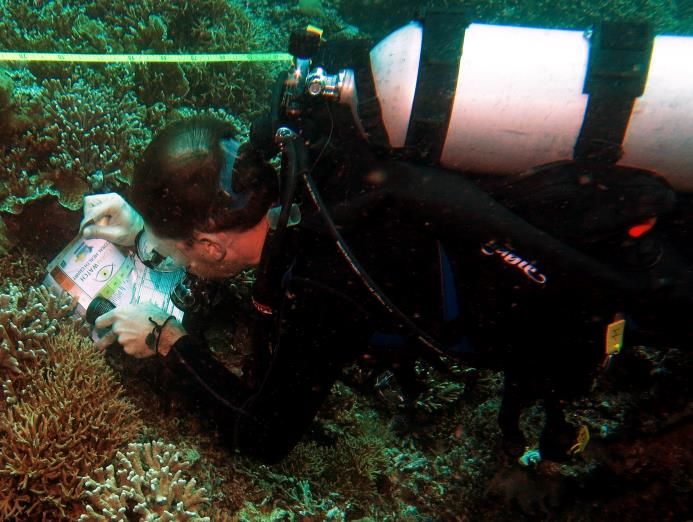
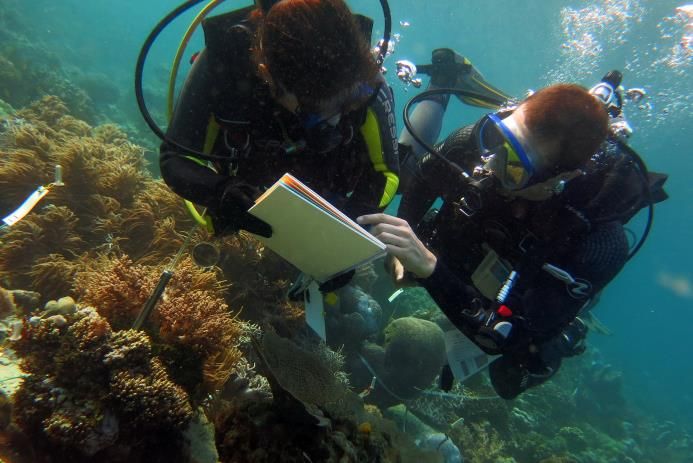
•   learn and apply different methods underwater, including Reef Check and Coral
    Watch protocols
•   contribute to the monitoring and conservation of the coral reefs at the Bangka
    outpost

Lectures and seminars will be alternated with day and night dives, as well as practical
sessions in the lab. At the end of the course, it is expected that the participants
demonstrate what they learned and discuss the results achieved. Participants will obtain
the international tropical EcoDiver certification issued by the Reef Check Foundation.

Participants
The number of participants is limited to 15. Although it is not required any scientific
qualification, participants should be confident with the main groups of marine
invertebrates and possibly have some experience in tropical dives. They should hold at
least a 2nd level international dive certificate (allowing diving to 30 m depth), a
minimum of documented 30 dives, a medical certificate allowing to safely dive (written
in English, Italian or Bahasa Indonesia) and international dive insurance (e.g., DAN,
DiveAssure, AquaMed). Each participant must carry his/her full diving equipment, except
scuba tanks and weights, provided on-site.

Costs are split in two parts:
1. Course fee, including teaching materials and Reef Check certificate, is € 260.00 and must be paid to Reef
   Check Italia onlus as a non-refundable deposit upon confirmation, either by PayPal (to
   postmaster@reefcheckitalia.it) or by bank transfer (to Reef Check Italia onlus, UBI BANCA, IBAN:
   IT08K0311113319000000010004 BIC/SWIFT: BLOPIT22).

2. Full board accommodation (9 days/8 night) and dives cost € 840.00 and must be paid to the Coral Eye upon
   arrival. You may pay by cash (Euro or IDR), however prepayment by bank transfer (PT Coral Eye Bangka,
   Commonwealth Bank, Manado, Sulawesi Utara Indonesia, Euro account: 2950000435, IDR account:
   2950000434, SWIFT: BICNIDJA) is recommended. Soft drinks/beers, additional excursions and extras are not
   included (if you want to by credit card). Moreover, a small donation to the Bangka Conservation Found
   (100,000 IDR ~ 7.00 Euros) will be required on-site. If you like to pay by Credit Card, since not always working,
   please ask in advance (to info@coral-eye.com).

Transfers from Manado to Bangka and return is managed by Coral Eye and included in the accommodation costs.
To properly organise transport from/to Bangka, every participant must arrive at Manado downtown or airport

Reef Check Italia – onlus
c/o Dipartimento di Scienze della Vita e dell’Ambiente, Università Politecnica delle Marche, Via Brecce Bianche, Monte Dago, 60131, Ancona.
Web site: www.reefcheckitalia.it         e.mail: postmaster@reefcheckitalia.it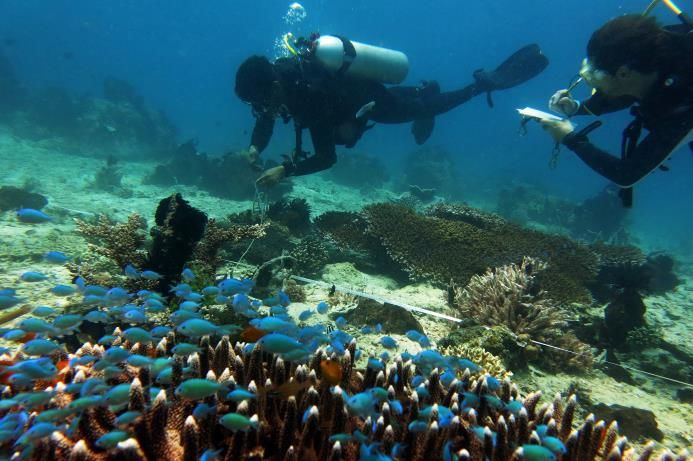
within 8th October 2020, at 9 o’clock, and leave from Manado airport not before the 16th October 2020, at 16
o’clock. A longer stay in Bangka must be agreed with Coral-Eye well in advance.

Booking & Confirmation
Subject to availability, booking is available for every participant starting from 1st of March 2020 by sending the
application form (available at www.reefcheckitalia.it) and the required attachments by email to
postmaster@reefcheckitalia.it. Based on first come first served, only requests comprehensive of all requested
documents and the non-refundable deposit fee (€ 260.00 to Reef Check Italia onlus) will be confirmed.

Grants
Reef Check Italia onlus offers 5 grants to partially cover the accommodation costs to the most deserving
undergraduate students and young (
reefs world-wide. The data are analysed and used                           monitoring and conservation of coral reefs! This course
locally by marine park managers, nationally by fisheries                   will allow you to join the Reef Check monitoring team
and environment managers and internationally by                            and assist in underwater surveys around the world.
organisations including United Nations agencies to                         Methods include substrate, fish and invertebrate
help better track and care for coral reefs.                                transects coupled with a socio-economic survey.
Become certified to conduct your Reef Check surveys                        Materials: Reef Check EcoDiver Kit for Indo-Pacific,
and take an active role in conserving your favourite                       including data board.
coral reefs. This course is designed to teach you                          Testing and Certification: PowerPoint ID test (80% to
everything you need to know to conduct full-scale Reef                     pass) and field ID test (90%) to obtain regional
Check surveys. In this program, you will learn all about                   certification. Certification qualifies the holder to
the globally standardised Reef Check methodology as                        participate in Reef Check surveys in the region and to
well as how to identify key indicator fish, invertebrates                  submit their data to the global database. More info:
and substrates selected by Reef Check for global                           http://reefcheck.org/ecodiver/about-ecodiver/

CoralWatch Protocol

                                                                           CoralWatch helps non-scientists around the globe
                                                                           understand and support effective reef management by
                                                                           using engaging tools that provide people with
                                                                           accessible information and hands-on-experience
                                                                           collecting scientific data about the health of corals
                                                                           using the Coral Health Chart. This chart standardises
                                                                           changes in coral colours and provides a simple way for
                                                                           people to quantify coral health and contribute to the
                                                                           CoralWatch global database. The Coral Health Chart is
                                                                           used by dive centres, scientists, school groups, and
                                                                           tourists.
                                                                           Materials: an underwater kit with Coral Health Chart
                                                                           and data board.
                                                                           More info: http://www.coralwatch.org
CoralWatch is a citizen science project based at The
University of Queensland, in Brisbane, Australia.

Coral Finder Method

                                                                           world’s most powerful supercomputer capable of
                                                                           solving complex visual problems instantly. Traditional
                                                                           field guides put text between you and the answer –
                                                                           and text needs to be interpreted. The Coral Finder
                                                                           reduces the problem of identifying corals to a series of
                                                                           simple visual choices. The Coral Finder makes coral
                                                                           identification practical and easy by using WYSIWYLF –
                                                                           What You See Is What You Look For! Instead of
                                                                           memorising thousands of images and names in your
                                                                           head you just look up the shape, and the Coral Finder
                                                                           gives you a simple matrix of best bets to choose.
                                                                           Simple – just the way we like it. The Coral Finder
                                                                           creates a choice matrix for easy, at-a-glance decision-
An underwater book to learn how to identify hard                           making.
corals and discover the huge species diversity in a coral                  Materials: underwater book.
reef. The answer to the question “What coral is that?”                     More info: http://www.byoguides.com/
is in your head – literally. Your eyes and brain are the
Reef Check Italia – onlus
c/o Dipartimento di Scienze della Vita e dell’Ambiente, Università Politecnica delle Marche, Via Brecce Bianche, Monte Dago, 60131, Ancona.
Web site: www.reefcheckitalia.it         e.mail: postmaster@reefcheckitalia.it
Teaching staff
Prof. Massimo Ponti, benthic ecologist at the University of Bologna
                       Massimo is graduated in Environmental Science and has a PhD in Ecology. He is adjunct professor in
                       Scientific Diving Methods and Marine Experimental Laboratory at the University of Bologna, in Marine
                       Communities and Ecosystems at the University of Padoa (Italy) and in Quantitative methods in marine
                       science at the Polytechnic University of Marche (Italy). He is the President of the Italian association of
                       scientific divers, diving master instructor and Vice-President of the Reef Check Italy no-profit association. His
                       research experiences range from temperate to tropical benthic ecology, mainly focusing on species diversity,
                       habitat-species interactions, human disturbances, global climate change, marine protected areas and
                       biodiversity conservation.
Prof. Leo Chan Lai, associate Director State Key Laboratory in Marine Pollution City University of Hong Kong
                       Visiting associate professor, Department of Biomedical Sciences, City University of Hong Kong; Deputy
                       Secretary-General, Shenzhen Marine Innovative Research, Education and Industry Consortium; Director,
                       Shenzhen Key Laboratory for Sustainable Use of Marine Biodiversity; Founder and President, Sea Dweller
                       Union (SDU); Deputy Secretary-General, Shenzhen Marine Research and Technology Consortium (SMART);
                       Deputy Director, Shenzhen Research Centre for the Oceans and Human Health (H2O); Chief Technical
                       Advisor, State Key Laboratory of Marine Environmental Science (Xiamen University); Adjunct Professor,
                       Xiamen University.

Prof. Markus T. Lasut, marine biologist at the Sam Ratulangi University, Manado
                       Prof. Markus T. Lasut, marine biologist at the Sam Ratulangi University, Manado. Markus is graduated in
                       Faculty of Fisheries at the Sam Ratulangi University (Indonesia) and Marine Science at the Aarhus University
                       (Denmark). He received his Doctor of Technical Science (D.Tech.Sc) in Integrated Tropical Coastal Zone
                       Management at the Asian Institute of Technology (Thailand). Today he is professor in the field of Marine
                       Pollution Studies at the Faculty of Fisheries and Marine Sciences of the Sam Ratulangi University, Manado
                       (Indonesia).

Dr. Daisy Makapedua, marine biologist at the Sam Ratulangi University, Manado
                       Daisy is graduated in Faculty of Fisheries at the Sam Ratulangi University (Indonesia). She received her PhD in
                       Italy. Today she is a researcher in the field of Marine Sciences at the Faculty of Fisheries and Marine Sciences
                       of the Sam Ratulangi University, Manado (Indonesia). She largely contributed in discovery and study the
                       Indonesian coelacanth Latimeria menadoensis. Her main research topics are zoology and physiology,
                       including molecular studies.

Dr. Gianfranco Rossi, marine biologist and Reef Check Tropical Trainer
                       Franco is graduated in Marine Biology with a thesis on “The involvement of Recreational Scuba divers in the
                       Monitoring of Coastal Environment”. Scuba Instructor. Author of the books “Le scogliere coralline” (The coral
                       reefs); Coral Eye Museum (A collection of hard corals from Coral Triangle; Corals (Guide to the identification
                       of the main genera of coral reef builders of the Indo-Pacific Region . Seminars on Scleractinians ID (Coral
                       Reef Builders) at DiSVA - Polytechnic University of Marche (Italy). He is expert in coral killing sponges. He is
                       member of the steering board Reef Check Italy no-profit association.

Dr. Eva Turicchia, benthic ecologist at University of Bologna and environmental educator
                       Eva is a regional coordinator of RCI initiatives and U-CEM course director. She is in the executive board of the
                       Italian Association of Scientific Divers and in the steering committee of Reef Check Italia. She is a marine
                       benthic ecologist graduated at the University of Bologna. She is also an expert in scientific communication
                       for different age groups, from children to adults, and in the development of visual advertising material. Eva
                       has a post-doc position at the University of Bologna and is appointed as an international consultant by the
                       United Nations Development Programme. Her main interests are temperate and tropical benthic ecology,
                       anthropogenic impact, biotic indices and citizen science programs.
Dr. Marco Segre Reinach, marine biologist and CORAL EYE manager
                         Marco has a degree in marine biology and oceanography. He developed a direct knowledge of the marine
                         environment while sailing and diving for many years around the world, as crew of regatta and cruises
                         boats. In 2009 after three years around Indonesia, Marco joined up the team, managing the start- up of
                         Coral Eye outpost and after many years he still here...

Reef Check Italia – onlus
c/o Dipartimento di Scienze della Vita e dell’Ambiente, Università Politecnica delle Marche, Via Brecce Bianche, Monte Dago, 60131, Ancona.
Web site: www.reefcheckitalia.it         e.mail: postmaster@reefcheckitalia.it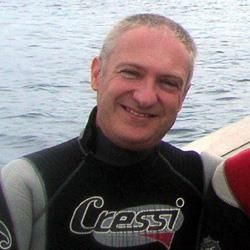
Preliminary schedule

Thursday         08/10/2020 morning                 Participants arrivals (transport Manado - Bangka)
                            afternoon               Check dive1
                                                    Course presentation and organisation
                            evening                 Introduction to hard corals
                            after dinner            Introduction to Reef Check method
Friday           09/10/2020 morning                 Reef Check method (Fish)
                                                    Fish identification (snorkeling) 1
                                  afternoon         Reef Check method (Invertebrate)
                                                    Invertebrate identification (snorkeling) 1
                            evening                 Reef Check method (Substrate 1st part)
                            after dinner            Coral Watch method
Saturday         10/10/2020 morning                 Reef Check method (Substrate 2nd part)
                                                    Inter-calibration dive1 & debriefing
                            afternoon               Coral taxonomy: using the Coral Finder
                            evening                 1st night dive (group A) 1
                            after dinner            Seminar: North Sulawesi Ecology, Tourism impacts
Sunday           11/10/2020 morning                 1st & 2nd monitoring dives (Kinubuhutang garden & Kahuku)
                            afternoon               Data entry & data analysis
                            evening                 1st night dive (group B) 1
                            after dinner            Seminar: Coral Ecosystems Disruptive Microalgae: Source,
                                                    Distribution, Transfer and Threats
Monday    12/10/2020 morning                        3rd & 4th monitoring dives (Gangga Village & Jetty)
                     afternoon                      Data entry (group A) - Coral Identification (group B) 1
                     evening                        2nd night dive (group A) 1
                     after dinner                   Seminar: Monitoring programs & Coral Diseases
Tuesday   13/10/2020 morning                        5th & 6th monitoring dives (Tanjung Husi II & Bisabora Timur)
                     afternoon                      Data entry (group B) - Coral Identification (group A) 1
                     evening                        2nd night dive (group B) 1
                     after dinner                   Reef Check exams (1st part)
Wednesday 14/10/2020 morning                        1st & 2nd Leisure dives
                                                    Group picture
                            afternoon               Mangrove exploration (snorkeling)
                            evening                 Reef Check exams (2nd part)
                            after dinner            Preparation of student presentations
Thursday         15/10/2020 morning                 3rd & 4th Leisure dives or Coral restoration
                            afternoon               Seminar: Scientific discoveries in North Sulawesi
                                                    Student presentations
                            evening                 Beach party
Friday           16/10/2020 morning                 Delivery of diplomas
                                                    Departures
The activities at sea are indicated in blue
1
  House reef at Coral Eye

Note: program can be changed according to weather conditions, leisure dives may be converted in monitoring/sampling
dives whenever need.
Reef Check Italia – onlus
c/o Dipartimento di Scienze della Vita e dell’Ambiente, Università Politecnica delle Marche, Via Brecce Bianche, Monte Dago, 60131, Ancona.
Web site: www.reefcheckitalia.it         e.mail: postmaster@reefcheckitalia.it
You can also read


