The CMS Tracker Back-End Electronics System for the HL-LHC
←
→
Page content transcription
If your browser does not render page correctly, please read the page content below
The CMS Tracker Back-End Electronics System
for the HL-LHC
Luis Ardila, Matthias Balzer, Oliver Sander, Michael Schleicher, Denis Tcherniakhovski

INSTITUTE FOR DATA PROCESSING AND ELECTRONICS (IPE)

KIT – The Research University in the Helmholtz Association                         www.kit.edu
Agenda
 Introduction: High Luminosity Large Hadron Collider
 (HL-LHC)
   –   CMS Tracker Upgrade
   –   Track Finder Architecture

 Track Finding Algorithms
   –   Tracklet
   –   Time-Multiplexed Track Trigger (TMTT)
   –   Hybrid

 Hardware R&D
   –   Hardware Prototyping Platforms
   –   Integrated Board Management Module

 Summary

2/46                               luis.ardila@kit.edu - Jan 31, 2021   Institute for Data Processing and Electronics (IPE)
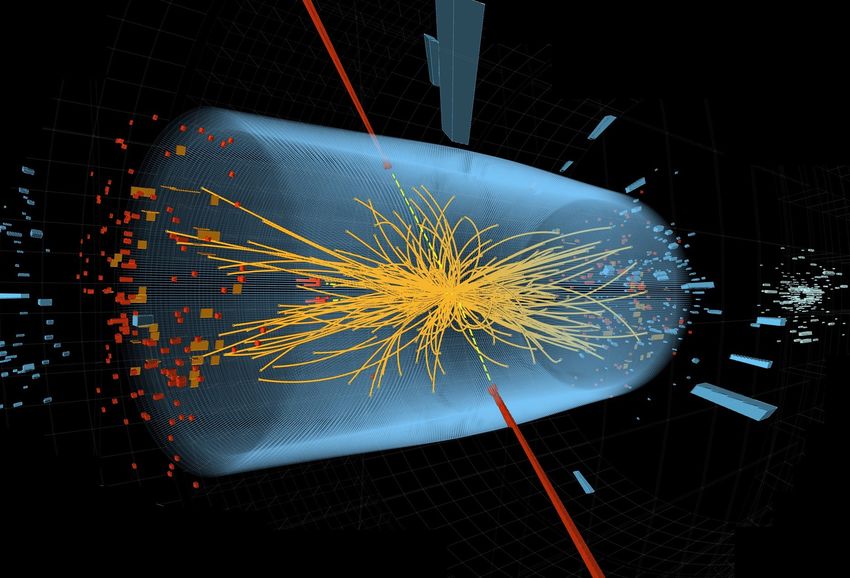
High Luminosity LHC – CMS
 –     By 2026 the LHC will be upgraded in
       luminosity 5-7 x 1034 / cm2 / s
 –     Silicon strip tracker will be replaced
 –     Challenging high occupancy conditions.
       ~10,000 charged particles per bunch
       crossing
 –     Necessary to include tracking information
       at first level of triggering

                                                                                 200                         3000
                                                                                          LHC Design
                                                                                          HL-LHC
                                                                            40
                                                                                                           300
                                                                           Pileup                   Lifetime Integrated
                                                                                                    Luminosity [1/fb]
3/46                                  luis.ardila@kit.edu - Jan 31, 2021   Institute for Data Processing and Electronics (IPE)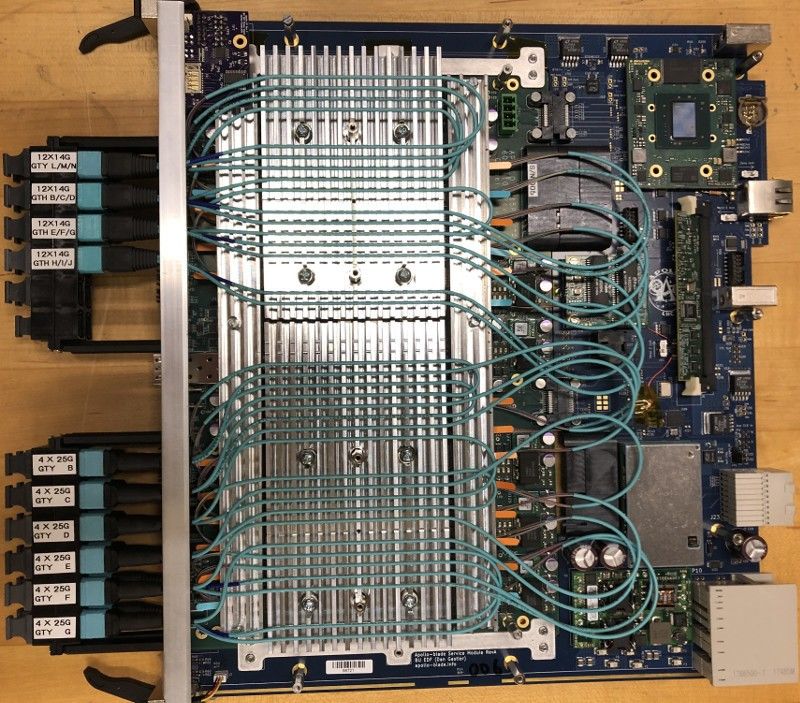
CMS Tracker Upgrade
pT discrimination provided by use of special
modules
  –    Pairs of closely spaced silicon sensors,
       separated 1.6 - 4 mm
  –    Signals from each sensor are correlated
  –    Only hit pairs compatible with pT > 2 – 3 GeV/c
       (“Stubs”) are forwarded off-detector
  –    Factor ~10 data reduction ~15,000 stubs per
       bunch crossing

4/46                               luis.ardila@kit.edu - Jan 31, 2021   Institute for Data Processing and Electronics (IPE)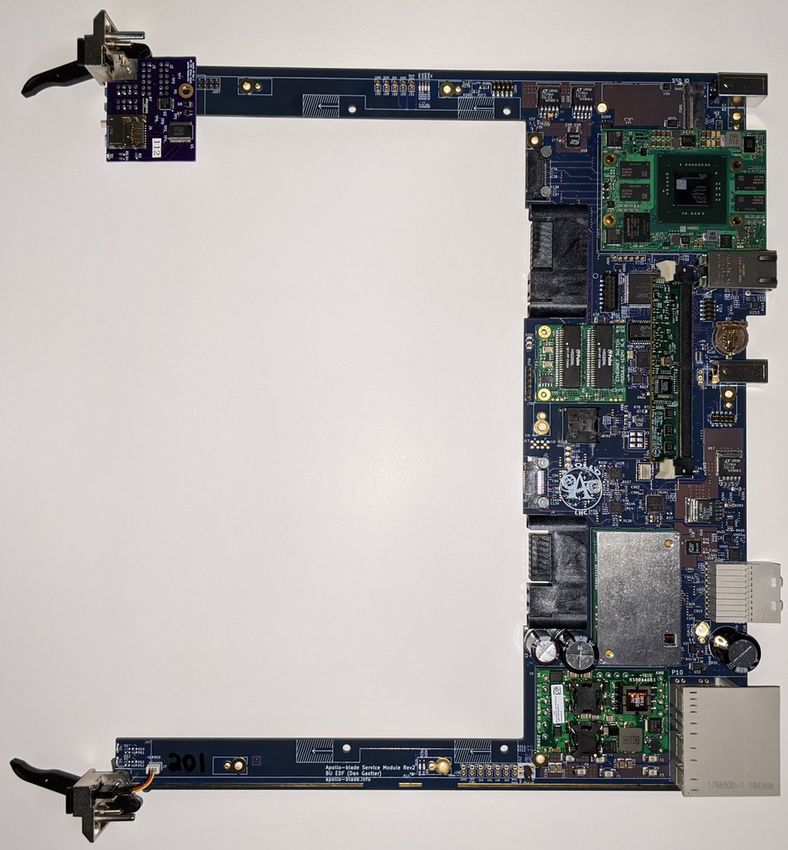
Tracker → Trigger Data Flow

   Average 15,000 stubs every 25ns (200PU) → Stub bandwidth O(20) Tb/s               Transmission of stubs to back-end         1 μs
                                                                                     electronics

   L1 hardware trigger reduces event rate from 40 MHz to < 750 kHz using             Correlation of trigger primitives         3.5 μs
                                                                                     (inc. tracks)
   calorimeter, muon and tracker primitives
                                                                                     Broadcast of L1-Accept to front-end       1 μs
       –   Tracker primitives are all tracks (pT > 2-3 GeV/c) from Outer Tracker     buffers
                                                                                     Safety Margin                             3 μs
       –   L1-Accept triggers all front-end buffers to read out to DAQ → HLT farm
                                                                                      –     Track finding from stubs must
   FE L1 latency buffers limited to 12.5 μs                                                 be performed in 4 μs

5/46                                 luis.ardila@kit.edu - Jan 31, 2021             Institute for Data Processing and Electronics (IPE)
Track Finder Architecture

6/46              luis.ardila@kit.edu - Jan 31, 2021   Institute for Data Processing and Electronics (IPE)

Track Finder Architecture

                                                                                    Outer Tracker cabled into nonants

                                                                           216      Use of time-multiplexing to increase
                                                                           DTC      parallelization
                                                                          boards

                                                                          162 TFP
                                                                                      –     Time-multiplexing directs data
                                                                          boards            from multiple sources to a single
                                                                                            processing node
                                                                                      –     1 bunch crossing per
                                                                                            processing node

                                                                                    Processors are independent entities →
Two stages of data processing
                                                                                    simplifies commissioning and operation
 –     Data, Trigger and Control (DTC) layer
                                                                                    Spare nodes available for redundancy
 –     Track Finding Processor (TFP) layer

 –     All-FPGA processing system

 –     ATCA form factor; CMS standard dual-star
       backplane
7/46                                 luis.ardila@kit.edu - Jan 31, 2021             Institute for Data Processing and Electronics (IPE)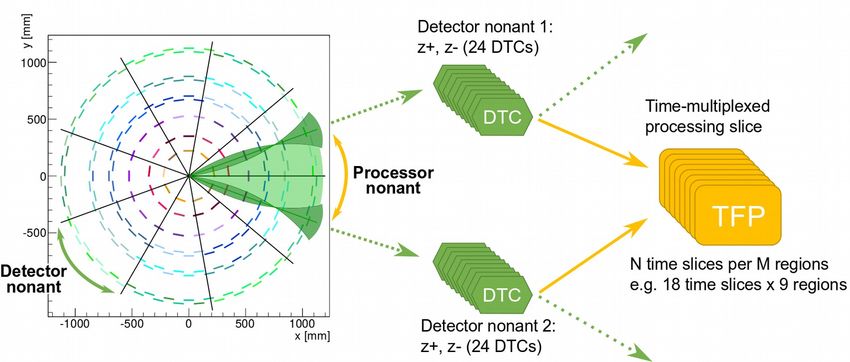
Track Finder Architecture – DTC
                                                           PCIe x 1    DAQ x 2
                                                           @5 Gbps    @25.6 Gbps                         DTC card must handle
                                                                                                           –
Track Finder Architecture – DTC
                                                            C2C x 2    DAQ x 4
                                                           @5 Gbps    @25.6 Gbps                         DTC card must handle
                                                                                                           –
Track Finder Architecture – TFP
                                                            PCIe x 1
                                                            @5 Gbps                                       TFP card must handle
                                                                                                            –      Up to 48 DTCs (25G
                                                                                                                   optical links)
                                          48
                                       @25 Gbps
                                                       6x
                                                                  VU7P
                                                                  KU115
                                                                                                            –      Track Finding from stubs
                                                       12         D1517
                                                       RX
                                                                  64 GTH
                                                                                                            –      Track Fitting
                                                                                                            –      Transmission to L1
                                                                           72
                                                                       @16/25 Gbps                                 Correlator Trigger

                                                                                                          High bandwidth processing card
                                                                                               2
                                                                  VU7P                    @16/25 Gbps
                                                                  KU115
                                                                  D1517
                                                                                     1x
                                                                                     12
                                                                                                            –      ~1 Tb/s processing
                                                                  64 GTH
                                                                                     TX
                                                                                                                   bandwidth
                                                                                                            –      Rate to L1 Correlator much
                                                                                                                   lower < 30 Gb/s
                                                            PCIe x 1
                                                            @5 Gbps

                                 → 162 TF boards, 18 crates (one per time-node)

10/46             luis.ardila@kit.edu - Jan 31, 2021                                              Institute for Data Processing and Electronics (IPE)
Track Finder Architecture – TFP
C2C x 2
@5 Gbps TFP card must handle
– Up to 48 DTCs (25G
optical links)
48
@25 Gbps
6x
– Track Finding from stubs
12
RX
– Track Fitting
VU13P – Transmission to L1
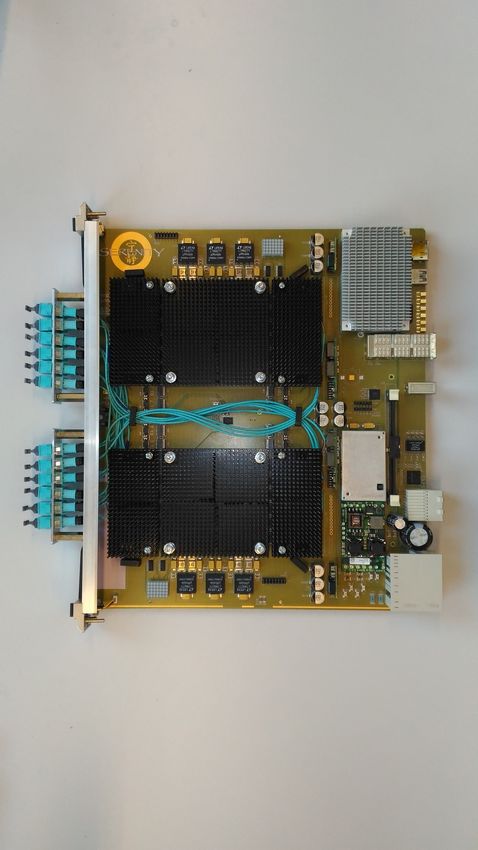
A2577
128
Correlator Trigger
GTY
High bandwidth processing card
2
@16/25 Gbps
1x
12
– ~1 Tb/s processing
TX
bandwidth
– Rate to L1 Correlator much
lower < 30 Gb/s
→ 162 TF boards, 18 crates (one per time-node)
11/46 luis.ardila@kit.edu - Jan 31, 2021 Institute for Data Processing and Electronics (IPE)Track Finding Algorithms
Two main algorithms for reconstructing tracks, plus a number of hybrids, variation and options
TRACKLET + CHI2 FIT APPROACH HOUGH TRANSFORM + KALMAN FILTER APPROACH
– Combinatorial approach using pairs of stubs as seeds – Uses a Hough Transform to detect coarse candidates
– Extrapolation to other layers → hit matching – Candidates are filtered and fitted in a single
subsequent step using a Kalman Filter
– Linearized χ2 fit on candidates
– Combinatorial problem pushed to latter stages of
– Uses full resolution stubs at earliest stage of
processing
processing
– N time-slices x M regions → 6 x 24, 9 x 18
– N time-slices x M regions → 18 x 9
12/46 luis.ardila@kit.edu - Jan 31, 2021 Institute for Data Processing and Electronics (IPE)Hybrid Comparison
Efforts towards merging the two approaches, working on defining a reference algorithm with the best from both.
13/46 luis.ardila@kit.edu - Jan 31, 2021 Institute for Data Processing and Electronics (IPE)Hybrid Performance
– Average track finding efficiency for tt ̄
tracks > 95% (> 3 GeV)
– z0 resolution ~1 mm (barrel)
– pT resolution ~1% (barrel)
– Per event average ~60 tracks (3 GeV)
~200 (2GeV) (tt ̄ at 200 PU)
tt̄
CMS Phase-2 Simulation Preliminary
+ Preliminary
μ μ
CMS Phase-2 Simulation − e+e−
Efficiency
1
ciency
ciency
11
Efficiency
Efficiency
1 1
Effi
Effi
0.8 0.8
0.8 0.8 0.8
0.6 0.6
0.6 0.6 0.6
0.4 0.4
0.4 0.4 0.4
Withtruncation
With truncation With truncation
With truncation With truncation
Without
Withouttruncation
truncation 0.2 Without
Without truncation
truncation Without truncation
0.2
0.2 =0 0.2 =0 =0 0.2 =0
=0
=140 Tracks > 2 GeV in t t events =140=140 =140
Tracks > 2 GeV in t t events =200
=140 =200=200 =200
=250
=200 =250 =250
=300 0 =300 =300
000 0 0 10 20 30 40 50 60 70 80 90 100 0
−2.5 −10 20
2 −1.5 30
− 40
1 −0.5 050 0.5
60 701 1.5 80 290 2.5 100 −2.5 −2 −1.5 −1 −0.5 0 0.5 1Tracking
1.5 particle
2 2.5
p [GeV] −2.5 −2 −1.5 −1 −0.5 0 0.5 1 1.5 2 2.5
Tracking particleparticle
Tracking p [GeV] η Tracking particle η T Tracking particle η
T
14/46 luis.ardila@kit.edu - Jan 31, 2021 Institute for Data Processing and Electronics (IPE)Hardware R&D: ATCA
Advanced Telecommunications Computing
Architecture (ATCA)
280 x 322 mm
board size
All CMS Phase-2 back-end electronics will be ATCA-
based
– Dual-star backplane
Standardized the use of the backplane for Ethernet, clocks,
and timing & throttling signals
– LHC bunch-crossing clock (40.08MHz)
– Precision crossing clock (320.64MHz)
– TTC2 trigger and fast-control stream (from DTH to
back-ends)
– TTS2 throttling stream (from back-ends to DTH)
15/46 luis.ardila@kit.edu - Jan 31, 2021 Institute for Data Processing and Electronics (IPE)The three Back-End Boards
IT-DTC OT-DTC TF
Tracker_EOWorkshop_270618
16/46 luis.ardila@kit.edu - Jan 31, 2021 Institute for Data Processing and Electronics (IPE)HW – R&D: Apollo V1
Apollo uses coplanar PCBs with Back-Plane
Connectors in between
– Flexibility (e.g. FPGA+Optics)
– Modularity; separate complex and
simpler part of the board design
On-board computing and control variety
– Zynq SoC
– CERN-IPMC or UW-IPMC or OpenIPMC
●
PCB Characteristics:
– 16 layers / Megtron-6 / 1.8 mm
– 12 layers / FR4 / 2 mm
– Apollo analogy: Split into “Command”
and “Service” modules
● Boston University, Cornell
University, Rutgers University,
Ohio State University,
University of Notre Dame,
Northwestern University,
University of Colorado
17/46 luis.ardila@kit.edu - Jan 31, 2021 Institute for Data Processing and Electronics (IPE)HW – R&D: Apollo V1
Apollo uses coplanar PCBs with Back-Plane
Connectors in between
– Flexibility (e.g. FPGA+Optics)
– Modularity; separate complex and
simpler part of the board design
On-board computing and control variety
– Zynq SoC
– CERN-IPMC or UW-IPMC or OpenIPMC
●
PCB Characteristics:
– 16 layers / Megtron-6 / 1.8 mm
– 12 layers / FR4 / 2 mm
– Apollo analogy: Split into “Command”
and “Service” modules
● Boston University, Cornell
University, Rutgers University,
Ohio State University,
University of Notre Dame,
Northwestern University,
University of Colorado
18/46 luis.ardila@kit.edu - Jan 31, 2021 Institute for Data Processing and Electronics (IPE)HW – R&D: Apollo V2
Power Supplies
– First revision had a problematic power
supply (IND072) converter-on-module
– Use same supplies as core power
(LGA80D)
– Make pluggable power modules
(improve repairability, greatly decrease
main board parts count)
Clock Distribution
– Provide two GTY “REFCLKs” to every
GTY quad (one from oscillator, other
from SM) to operate DAQ even when
Boston University, Cornell
LHC clock is ramping up
University, Rutgers University,
– All external clocking/timing signals from Ohio State University,
SM University of Notre Dame,
Northwestern University,
University of Colorado
19/46 luis.ardila@kit.edu - Jan 31, 2021 Institute for Data Processing and Electronics (IPE)HW – R&D: Serenity
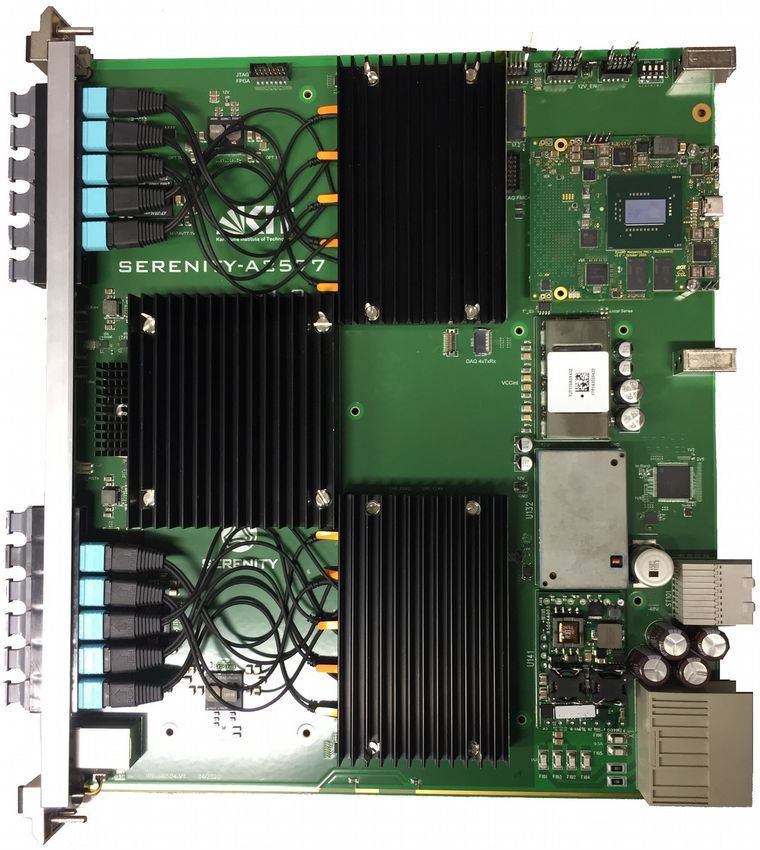
Serenity-Z-V1.2 Serenity-A-V1.0
20/46 luis.ardila@kit.edu - Jan 31, 2021 Institute for Data Processing and Electronics (IPE)Bristol University,
HW – R&D: Serenity-Z Imperial College,
Ioannina, INFN, KIT,
ATCA infrastructure RAL, SACLAY, TIFR
– Systematic thermal studies about air
cross-section and impact on opto-
lifetime
COM Express
– Backplane signal integrity → important or ZynqMP
for DAQ/timing
Samtec Firefly
Use of interposer technology
Samtec Z-RAY x12 RX/TX pairs
– Flexibility (e.g. FPGA)
interposer
– Mitigate losses/costs due to yield issues 133 x 30 mm
– Modularity; separate complex and
simpler part of the board design Clock test
daughtercard CERN-IPMC
On-board computing and control variety
Or OpenIPMC
– Standard on-board PC (COM Express
mini) FPGAs
KU115
– ZynqUS+ SoC
KU15P
– Intelligent Platform Management VU9P
Controller (IPMC) daughtercards
21/46 luis.ardila@kit.edu - Jan 31, 2021 Institute for Data Processing and Electronics (IPE)HW – R&D: Serenity-Z DUAL KU15P
Gbps
16
Gbps
25.6
22/46 luis.ardila@kit.edu - Jan 31, 2021 Institute for Data Processing and Electronics (IPE)2x DUAL
HW – R&D: Serenity-Z KU15P
Gbps
25.6
Gbps
25.6
23/46 luis.ardila@kit.edu - Jan 31, 2021 Institute for Data Processing and Electronics (IPE)HW – R&D: Serenity-A2577
TFP 8/12
TX
8/12
RX
8/12
RX
8/12
TX TFP
20/24 @ 25 Gb/s 12 12 12 12
20/24 @ 25 Gb/s
TX RX Virtex RX TX
Ultrascale+
12 12 VU9P / VU13P 12 12
DET TX
12
RX
12 A2577
RX
12
TX
12
DET
36 LpGBT TX
12
RX
12
RX
12
TX
12
36 LpGBT
TX RX RX TX
120 / 128 GTY
DAQ 4
RX/
2 RX/TX
TCDS
4 @ 25 Gb/s TX 2 RX/TX
C2C to ZynqMP
●
– One FPGA design using VU9P / VU13P with
up to 120/128 GTY links
– TCDS2 backplane signals directly routed to
main FPGA
– 10 Firefly sites with 12x TX or RX and one 4x-
Bidir, all 25 Gbps capable
– FMC+ management module
24/46 luis.ardila@kit.edu - Jan 31, 2021 Institute for Data Processing and Electronics (IPE)HW – R&D: Serenity-A2577
Copper @ 25 Gbps
Optical Firefly Alpha part @ 25 Gbps
25/46 luis.ardila@kit.edu - Jan 31, 2021 Institute for Data Processing and Electronics (IPE)HW R&D: ZynqMP management modules
ZU4EG-B900 CMX-EXT module
12 PL MGTs
Si5395
I2C IPMC I/O
IRPS5401 PMIC
2G DDR4 IRPS5401 PMIC 4 PL MGTs
4 PS MGTs
KSZ9031 ETH QSPI FLASH
PHY
FMC+ module 16 PL MGTs
KSZ9031 ETH 4 PS MGTs
PHY
ZU4EG-B900
Si5395 Highlighted
I2C IPMC I/O
area is
IRPS5401 PMIC common
between
2G them
DDR4 USB PHY
IRPS5401 PMIC
QSPI FLASH
26/46 luis.ardila@kit.edu - Jan 31, 2021 Institute for Data Processing and Electronics (IPE)HW R&D: ZynqMP management modules
Features
– 2mm thickness, 14 layer, impedance controlled traces
– 4 routing layers enclosed by solid GND planes
– 2 power planes
– Fabricated in FR4 with 22.5 degree rotation
Status
– One board was assembled without ZynqMP to test power regulator configurations
– Second board fully assembled yesterday, power rails tested and
27/46 luis.ardila@kit.edu - Jan 31, 2021 Institute for Data Processing and Electronics (IPE)Summary
– CMS needs tracks at L1 trigger to cope with HL-LHC Common infrastructure Hardware R&D
pileup conditions
– Current prototypes showed very good optical
– pT modules provide first layer of efficient data performance, even at 25 Gbps
reduction – Evaluation of other optical drivers is planned in the
– Highly flexible track-finder/pattern recognition future
algorithms were demonstrated in hardware – New interposer technology has proven to be reliable
– Highly scalable, time/physical segmentation could be regarding signal integrity, brings simplification and
as large/small as required based on data rates flexibility to the motherboard
– Proven with currently available hardware, that a
– Soldering reliability of power-on-modules is a
level-1 track-trigger based on FPGAs is feasible concern, its high mass makes them incompatible with
standard processes. PSU with connector could
– Lots of flexibility with an all-FPGA solution alleviate yield concerns
– Integrated IPMC functionality on a single SoC
mezzanine is an attractive possibility, a self-designed
SoC module is an insurance for its future availability
28/46 luis.ardila@kit.edu - Jan 31, 2021 Institute for Data Processing and Electronics (IPE)29/46 luis.ardila@kit.edu - Jan 31, 2021 Institute for Data Processing and Electronics (IPE)
Track Finding Algorithms

30/46             luis.ardila@kit.edu - Jan 31, 2021   Institute for Data Processing and Electronics (IPE)
Hardware Demonstrators - 2016

Half a barrel demonstrator in hardware,                                  Both Demonstrators
verified using emulation software                                        were tested with
                                                                         samples from PU 0→ 200
Hardware demonstrator has been built to validate the
algorithm and measure latency                                                 Demonstrator in hardware and emulation
 –      4 CTP7 boards with Virtex-7 FPGA – 3 CTP7 cover 3                       –   One per time multiplexing and detector nonant
        Ф sectors – 1 CTP7 emulate DTC
                                                                                –   Each box is one MP7 board with Virtex-7 FPGA
 –      1 AMC13 card for clock and synchronization
                                                                                –   Can compare hardware output directly with software
 –      240 MHz internal fabric speed
                                                                                –   240 MHz internal fabric speed
 –      Measured latency of 3.33 μss in agreement with latency
        model – without duplicate removal step                                  –   Latency verified to be 3.5 μss

31/46                               luis.ardila@kit.edu - Jan 31, 2021                         Institute for Data Processing and Electronics (IPE)
Hybrid Algorithm
Tracklet Seeding + Kalman Filter
Coarse
track
parameters
L5L6
D1D2 D3D4
L3L4
L2D1
Precision
L1L2 L1D1
track
parameters
1. Tracklet Seeds formed
in multiple layer
combinations 4. Kalman Filter fits
track and selects best
2. Projection and match
stubs candidates
in other layers
– 9 Ф sectors
– No η division 3. Candidates sharing
– Time-Multiplex Period of 18
stubs are merged
32/46 luis.ardila@kit.edu - Jan 31, 2021 Institute for Data Processing and Electronics (IPE)33/46 luis.ardila@kit.edu - Jan 31, 2021 Institute for Data Processing and Electronics (IPE)
Slow Control at Tracker R&D Boards
           Enclustra ZX1
           - AXI-C2C                                                     Com-Express
           - TCDS                                                        - PCIe
           - Eth                                                         - Eth

                                   CERN-IPMC                                                               CERN-IPMC
                                   - IPMI                                                                  - IPMI
                                   - Eth                                                                   - Eth
                                   - PMBus                                                                 - PMBus

                                                           Artix 7
                                                           - TCDS
                                                           - Eth
                                                           - I2C
                                                           - PMBus

34/46                 luis.ardila@kit.edu - Jan 31, 2021             Institute for Data Processing and Electronics (IPE)
Integrated Board Management
Integrate IPMC, GPP based slow Clks
control functionality and FPGA in a Zynq US+
Mezzanine I2C – SPI
single heterogeneous MPSoC JTAG
RA Flas
(Zynq Ultrascale+) FPGA 1 XVC
M h
PCIe
IPMI
AXI C2C
●
Intelligent Platform Management I2C – SPI
JTAG
Interface (IPMI) in ARM-R5 processor Optics
ATCA
running freeRTOS TCDS
AXI C2C
●
Timing and Control Distribution PCIe
GbE
System (TCDS) in PL-FPGA FPGA 2 Ethernet GbE
Phy
JTAG
●
Xilinx Virtual Cable (XVC) JTAG XVC
PMBus
●
AXI Chip2Chip slow control capable Power
Supplies
35/46 luis.ardila@kit.edu - Jan 31, 2021 Institute for Data Processing and Electronics (IPE)Proof Of Concept: Adapter On Serenity
Power ON
Low Power
Domain
Trenz PMU
Ini
PMUFW
t
ZynqUS+ LD
4EG CSU FSB
L
FSB
R5 L IPMC
Full Power Domain
Adapter v1.3 Power OFF ON
UBo
A53 ot CentOS
CF
PL G PL running
IPMC signals ☑ Test and debug interfaces (ETH, I2C, UART, JTAG)
☑ Pigeon Point IPMC standalone software compiled for
the ARM-R5 processors
– ☑ IPMC boot, ☑ Com with Shelf Manager, ☑ Board
Artix 7 activation/deactivation, ☑ Power-up/power-down
- TCDS sequence, ☑ Read of IPMC sensors, ☑ Cold reset,
☑ Initiating boot of Linux, ☑ Coexistence of Linux &
- Eth
IPMC, ☐ JTAG on Linux (XVC, not integrated)
- I2C
- PMBus ☑ Petalinux & CentOS running on the ARM-A53
Processors
Serenity v1.0 by Imperial College – ☑ SSH to Linux on ZynqUS+
36/46 luis.ardila@kit.edu - Jan 31, 2021 Institute for Data Processing and Electronics (IPE)Integrated Board Management
Low Power Domain – always active:
Intelligent Platform Management Interface
(IPMI) application running in one of the R5 cores.
It uses the On-chip-Memory and the I2C
peripherals
IPMC memory region protected through system
configuration
SPI and PMBus
High Power Domain – active upon request of
full power from the crate:
Runs Yocto/CentOS based Linux
FPGA configuration and monitoring
Slow-control to FPGAs
Test patterns to firmware
37/46 luis.ardila@kit.edu - Jan 31, 2021 Institute for Data Processing and Electronics (IPE)38/46 luis.ardila@kit.edu - Jan 31, 2021 Institute for Data Processing and Electronics (IPE)
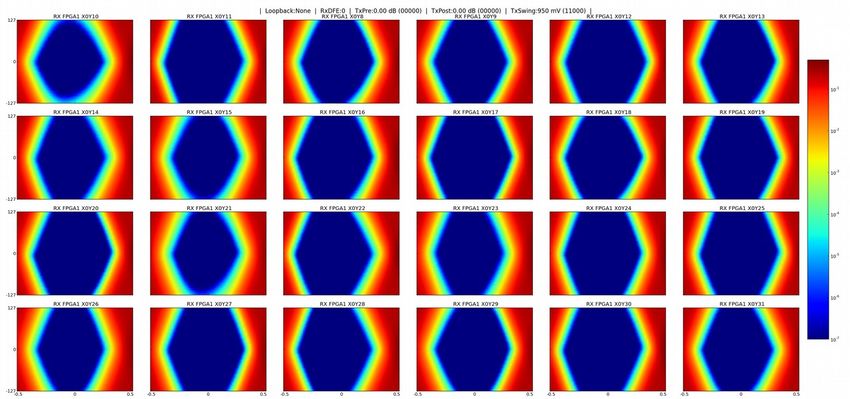
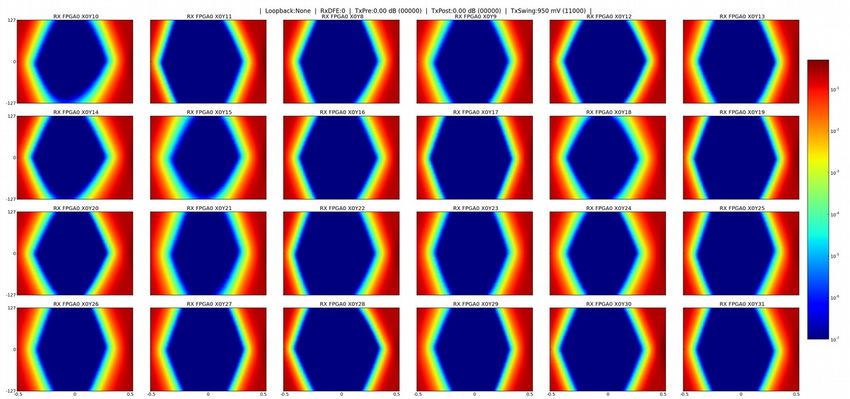
High-Speed Optical Evaluation
●
      FMC+ sized board for evaluation of the
      Finisar BOA 25 Gb/s transceiver

●
      12 TX and 12 RX integrated in the same
      package

●
      4 Electrical loop-back channels
      capacitively coupled with different
      features

●
      Skew < 20 µm

●
      MT ferrule optical interface

●
      Performance of capacitively coupled
      lanes looks good

    39/46                               luis.ardila@kit.edu - Jan 31, 2021   Institute for Data Processing and Electronics (IPE)
Thermal Simulation And Tests
Simulation setup
Test1 (°C)
– PCB imported from PADS 4xFan-block speed=50%
Exhaust temp ~17°C (~amb)
– Placed in a 33 mm deep tunnel
Power on FPGA heaters = 86 W
– 4 m/s airflow from bottom (20 °C) to top Power on Optics heaters = 41 W
Placed components X1FTop = 60.7 X0FTop = 53.7
X1FBottom = 59.1 X0FBottom = 50.1
– KU15P (50 W) doubled θJB to take
X1ORTop = 50.8 X0OFTop = 35.8
interposer into account
X1ORBottom = 49.7 X0OFBottom = 28.2
– Firefly banks 25 G (30W) and 16 G (12 X1OFTop = 43.1 X0ORTop = 37.2
W) X1OFBottom = 41.7 X0ORBottom = 31.1
– Total power 205.4 W
Test setup
– Two heat-pads 45 mm x 45 mm and 12
mm x 70 mm
– Just one mockup board is present, it will
be put in between two additional soon
– ~11 W for 6x block of 16 Gbps optics
– ~10 W for 6x block of 25 Gbps optics
40/46 luis.ardila@kit.edu - Jan 31, 2021 Institute for Data Processing and Electronics (IPE)THERMAL & MECHANICAL TESTS
Thermal simulations
Physical thermal studies at CERN
Mechanical component design studies into stress on
FPGA solder balls and stress on PCBs at IC
41/46 luis.ardila@kit.edu - Jan 31, 2021 Institute for Data Processing and Electronics (IPE)DTC Firmware in VU9P
●
Target single FPGA (VU9P) to avoid side wise communication Taken from
Thomas Schuh
●
Use of EMP framework with 64 bit frames at 320 MHz
●
Input packet structure of 58 data frames + 6 frames gap
●
5 gbps modules send up to 16 stubs per CIC in 8 BX packets
●
10 gbps modules send up to 35 stubs per CIC in 8 BX packets
●
One 64 bit word contains a Stub from CIC0 and a Stub from
CIC1
42/46 luis.ardila@kit.edu - Jan 31, 2021 Institute for Data Processing and Electronics (IPE)ZynqMP-IPMC ATCA Test Board
VCU118 Eva Front Pannel
Board RJ45
Barracuda
PIM400
SATA SSD
Zone1 Conn
Firefly x4
Bidir
ETH SW
ETH PHYs CLOCK
CHIPS
ZynqMP
Module Host USB
43/46 luis.ardila@kit.edu - Jan 31, 2021 Institute for Data Processing and Electronics (IPE)Integrated Management Module Architecture
Clks ●
IPMI (standalone/RTOS)
Zynq US+
Mezzanine I2C – SPI on ARM-R5 processor
JTAG
RA Flas
FPGA XVC
M h
●
Slow Control (Linux)
IPMI
on ARM-A53 Cores
AXI C2C
JTAG
●
Xilinx Virtual Cable (XVC) JTAG
I2C – SPI
Optics ●
2 Links to main FPGAvia PL-MGTs
ATCA
(AXI C2C)
GbE
ETH
●
I2C-SPI to configure Optics/Clocks
Ethernet
Phy SW
GbE ●
PMBus to configure Power Supplies
PMBus
Power
●
Eth and I2C backplane connection
Supplies
RGMII RJ45
44/46 luis.ardila@kit.edu - Jan 31, 2021 Institute for Data Processing and Electronics (IPE)ATCA Layout
●
One FPGA design VU9P / VU13P
– No inter-FPGA communication
●
TCDS backplane signals directly routed to main
FPGA
●
Integrated IPMC slow control solution
●
Monolithic heat sink for all optics
●
Clean Optical Cable management
●
Only one type of Firefly cable x10
45/46 luis.ardila@kit.edu - Jan 31, 2021 Institute for Data Processing and Electronics (IPE)Track Finder Architecture – DTC
DTC card must handle
–You can also read


