ENTERPRISE AI Building Powerful Enterprise AI Infrastructure: How to design enduring infrastructure for AI - Interxion
←
→
Page content transcription
If your browser does not render page correctly, please read the page content below

Whitepaper

                  ENTERPRISE AI
                  Building Powerful Enterprise AI
                  Infrastructure: How to design
                  enduring infrastructure for AI

1   /   www.interxion.com
Patrick Lastennet, Director of Enterprise                                  THE BENEFITS OF AI/DL FOR THE ENTERPRISE
Bryan Hill, Director of Platforms
                                                                           Enterprises today are increasingly gaining value from artificial intelligence (AI) and deep
                                                                           learning (DL) applications that, whether they’re accelerating innovation, increasing
                                                                           efficiency or improving their bottom line, leverage automation to extract useful patterns
                                                                           from data. As a subcategory of AI, DL is a cutting-edge technique conducted through
                                                                           the use and optimisation of neural networks. Even though some of these ideas have
                                                                           been around for a long time, the past decade has seen a major breakthrough in the
                                                                           application of neural networks, due to the digitisation of information, advanced tooling,
                                                                           and the availability of hardware that enables large-scale computation.
In partnership with NVIDIA, Interxion offers everything enterprises need   AI has become a game changer in highly competitive markets like healthcare,
to develop and scale their AI infrastructure, from advanced power and      academic research, supply and logistics, robotics, financial services, media and
                                                                           entertainment, retail, and autonomous vehicles (AVs). By automating repetitive
cooling technology to access to a thriving community of connectivity       processes, delivering new strategic insights, and accelerating innovation, AI has the
and cloud providers.                                                       power to revolutionise business.

                                                                           Take a look at the world of AVs, for example. In order for AVs to become a reality,
                                                                           the software needs to be able to make crucial, real-time decisions. The more data
                                                                           analysed, the safer those decisions – and therefore, AVs – will be. But until the recent
                                                                           application of AI and DL, data analysis wasn’t quick enough or powerful enough.
                                                                           Powered by DL and supported by AI-ready infrastructure, software is making AVs not
                                                                           only possible but smarter and safer than ever before.

                                                                           Across all industries, enterprises adopting AI are already seeing the value it brings,
                                                                           from increased productivity and efficiency to improved customer experience. Early
                                                                           adopters aren’t only gaining value from the technical implications, however. They’re
                                                                           also gaining a competitive business edge over companies not yet incorporating AI.

                                                                           AI adoption helps 44 percent of enterprises reduce costs, particularly in areas like
                                                                           manufacturing and supply-chain management. From predictive maintenance to
                                                                           logistics network optimisation, AI provides the analysis enterprises need to realise
                                                                           savings. AI also helps accelerate time to market, by advancing R&D at a faster pace.

                                                                           At the same time, 63 percent of enterprises report increased revenue as a result of
                                                                           incorporating AI. Marketing and sales teams generate new revenue through AI use
                                                                           cases like customer service analytics, prediction of likelihood to buy, and pricing and
                                                                           promotion. On the product development side, creating new AI-based products and
                                                                           enhancements also brings new opportunities for revenue.

                                                                           As AI use continues to evolve, making sure your enterprise infrastructure is also
                                                                           evolving to properly leverage the technology will be crucial to future success.

2   /   www.interxion.com                                                                                                                                                www.interxion.com   /   3
THE AI INFRASTRUCTURE CHALLENGE                                                           ENABLING AI WORKLOADS WITH A POWERFUL,
                                                                                                                                  HOLISTIC INFRASTRUCTURE
                                        Building the infrastructure needed to support AI deployment at scale is a growing

40%
of enterprises agree that lack of IT
                                        challenge.

                                        Traditional AI as machine learning (ML) doesn’t necessarily require a ton of data. But
                                                                                                                                  Based on these requirements for AI infrastructure, there are a few options for
                                                                                                                                  deployment.

infrastructure is the primary barrier   with DL and the emergence of IoT/5G, there’s going to be a huge amount of data            An on-premises solution may be relatively inexpensive, but there are significant
to AI implementation                    generated from factories, smart cities, driverless cars, edge devices, and so on.         challenges when it comes to power density and scale. Most enterprise data centres
                                                                                                                                  simply aren’t capable of handling the scale required to leverage the benefits of AI.
                                        Designing an infrastructure capable of leveraging that data for AI is complex.
                                        Decision makers need to understand all AI testing and deployments happening               Public cloud, meanwhile, offers the path of least resistance, but it isn’t always the best
                                        in their company in order to choose the infrastructure that provides the scale and        environment to train the models at scale or deploy them in production due to either

89%
of enterprises expect the volume
                                        performance needed for the long-term. There are significant costs – time, money
                                        and resources – involved in having to rearchitect or move the AI deployment, so it’s
                                        important to get the infrastructure right from the start.
                                                                                                                                  high costs or latency issues. Training models at scale requires compute to constantly
                                                                                                                                  process and reprocess large data sets over a long period of time. High utilisation
                                                                                                                                  such as this, coupled with data egress, is not an optimum use case for public cloud,
of data used in AI workloads to         What are the requirements of an ideal infrastructure when it comes to leveraging the
                                                                                                                                  although public cloud will certainly play a part in an enterprise AI world, especially for
increase within the next year                                                                                                     test/dev and inference.
                                        growing volume of data and enabling AI at scale?

                                        Accessing the data                                                                        The importance of reference architectures
                                                                                                                                  Many companies try and fail by going the “build your own” way. A fully-supported
                                        Interconnection is key, especially as some AI applications move to the edge. High
                                                                                                                                  hardware and software stack is essential in keeping the most expensive resource – the
                                        connectivity enables enterprises to bring data from the edge into data centres and
                                                                                                                                  data scientists – doing data science, not data-centre-maintenance and support. This
                                        send models and data back to the edge to optimise inference. This entails:
                                                                                                                                  is where NVIDIA DGX™ systems and its reference architectures become key success
                                            •    Proximity to 5G core nodes in data centres: These nodes bring back               factors.
                                                 data from devices in the field.
                                                                                                                                  There are important challenges outside of Compute, Storage, Fabric, and Software,
                                            •    Proximity to Fixed line core nodes: The nodes bring back data from fixed         such as tools for optimising the resources (orchestration/scheduling). These challenges
                                                 points, from offices to manufacturing facilities.                                need to be addressed, not only in the basic infrastructure plan but also when it comes
                                            •    Direct cloud access: Some workloads and use cases will be optimised for          to data management and data-pipeline. Data science expertise and valuable expertise
                                                 cloud, and this should be managed in a secure performant way.                    within project management for AI-projects is also critical for success.

                                            •    Enterprise data transfer: Connectivity hubs draw in enterprise data for
                                                 processing.
                                                                                                                                  Hyperscalers lead the way
                                            •    Geographic scale: Scalability allows enterprises to enable AI workloads in
                                                 different locations.                                                             Instead of building your own, take a look at how platforms that are already gaining
                                                                                                                                  value from AI have chosen to deploy their infrastructure. Hyperscalers like Google,
                                                                                                                                  Amazon, Facebook, and Microsoft have been successfully deploying AI at scale for
                                                                                                                                  their own use for some time now, with their own core and edge infrastructure often
                                        Computing and processing the data                                                         deployed in highly connected, high-quality data centres. They use colocation heavily
                                        Accessing data is just the first step of enabling AI, however. Once the data enters the   around the globe because they know it can support the scale, high-density and
                                        data centre, here’s what’s needed to support computation for training of models:          connectivity they need.

                                            •    High density support: The data centre must be able to handle high density        By leveraging the knowledge and experience of these AI leaders, enterprises will be
                                                 now, but also in the future – well beyond 15 kW/rack, which is the declared      able to own their own destiny when it comes to AI. Inference happens at the edge, but
                                                 maximum for most enterprises. In fact, 60% of enterprises say their highest      some of that data needs to come into core data centres that are capable of supporting

45%
of enterprises say their current
                                                 density rack is running at 15 kW or less, and they’re unable to manage more.
                                                 NVIDIA has already developed architectures than run beyond 40 kW/rack and
                                                                                                                                  AI and DL at scale. It’s time for enterprises to take a page out of the hyperscalers’
                                                                                                                                  playbook and invest in colocation.
                                                 as technology evolves, densities will accelerate over the next few years.
infrastructure is not capable of
                                            •    Size and scale: Key to leveraging the benefits of AI is doing it at scale.
meeting future demands for AI                    The ability to run at scale hardware (GPU) enables the effect of large-scale
workloads                                        computation.

4   /   www.interxion.com                                                                                                                                                                                                      www.interxion.com   /   5
PARTNERS WITH PROVEN, REAL-WORLD AI                                                                                                                        AI-READY DATA CENTRE SOLUTIONS
EXPERIENCE
                                                                                                                                                           Because most enterprises don’t have the facilities to build the powerful, connected,
There are very few companies that have built AI infrastructure at scale in the real world,                                                                 highly-performant infrastructure needed to support accelerated computing operations,
however. Proven experience building AI infrastructure is a key factor for a successful AI                                                                  they choose to partner with third party colocation data centres instead.
project, which is why Interxion has partnered with providers like CGit, Scan UK, A.P.Y.,
                                                                                                                                                           Interxion is an AI-ready colocation data centre partner for NVIDIA DGX systems,
and Altair Engineering.
                                                                                                                                                           helping enterprises who are held back by the challenges of facilities planning.
For example, CGit, an AI infrastructure leader and NVIDIA Elite Partner, has
                                                                                                                                                           Together with NVIDIA, Interxion provides the scalable and flexible environments
designed, implemented and provided support to some of the largest AI infrastructure
                                                                                                                                                           enterprises need to develop and scale their AI programmes.
projects in Scandinavia, spanning industries like automotive, medical research and
telecommunications. CGit is also recognised as the Core Technology Partner to                                                                              Here’s how Interxion solves some of the major IT infrastructure challenges.
AI Innovation Of Sweden, Sweden’s national AI-centre for applied AI research and
innovation.

NVIDIA launched its DGX-Ready Data Centre Program to help enterprises solve the
                                                                                                                                                           Support for high-performance computing (HPC)
challenges involved in building and deploying an AI-ready infrastructure. Through the
programme, NVIDIA offers a qualified network of AI-ready colocation partners for                                                                           Interxion supports high density workloads with Tier3+ Resilient facilities that already
enterprises running AI infrastructure built on NVIDIA DGX systems. Designed to meet                                                                        serve all the major hyperscale platforms. Interxion is a certified DGX-Ready Data
the demands of AI and analytics, the programme helps enterprises accelerate their                                                                          Centre Partner.
AI mission and see ROI right away. It’s the ideal solution for enterprises who lack the
expertise or resources to build a future-proof data centre for GPU compute at scale.
                                                                                                                                                           Scale
                                                                                                                                                           Interxion operates 53 data centres in 13 cities in 11 countries, with nearly 300 MW of
                                                                                                                                                           equipped capacity across its footprint.

                                                                                                                                                           Connectivity
                                                                                                                                                           Interxion hosts all the major ISPs where 5G core nodes will reside and has over 700
                                                                                                                                                           connectivity partners available across its data centres. In addition, Interxion provides
                                                                                                                                                           an end-to-end AI topology with all the private interconnection points for the clouds.

                                                                                                                                                           Working with Interxion enables enterprises to focus on the activities that drive value for
                                                                                                                                                           them – gaining insights from their data and innovating with AI. Powered by Interxion
                                                                                                                                                           and NVIDIA DGX systems, enterprises can drive their AI initiatives forward.

                                                                                                       © 2020 NVIDIA Corporation. All rights reserved.
                                                                                                                                           Figure A
                                                                                                                                                                   Sweden, and the Nordics, represents one of the most innovative regions in the
Figure A, above, from NVIDIA shows the ideal      1. High density support to enable enterprises to          c. Direct connections to all the public                world and the development and implementation of AI is no exception. Thanks to        Learn more
AI topology from edge-core and outlines the       take advantage of the latest high performance             cloud providers to enable fast, secure,                CGits early adoption, and realization of very complex and high performance AI
key elements enterprises should consider in       GPU cluster architectures                                 performant and cost-effective hybrid cloud                                                                                                  To find out how Interxion helps
order to deploy successful AI initiatives.                                                                  AI environments                                        Infrastructure projects, we are now expanding very fast. Together with Interxion
                                                  2. Dense interconnection and connectivity                                                                                                                                                             enterprises accelerate their AI
Inference will happen at low-latency within the                                                         3. Large highly distributed data centres that              we now have the necessary resources to offer a complete AI solution, no matter
                                                     a. Presence of carrier connectivity to transfer                                                                                                                                                    mission, visit www.interxion.com
edge device or at an Enterprise’s manufacturing                                                         can provide both the infrastructure scale                  the size of project.
facility. The Meso and Macro edge data centres       large amounts of data from the Enterprise          that enterprises will need within the latency
are where deep learning (DL) and training will       edge into the DL clusters and to transfer          requirements outlined
take place for model optimization.                   optimised models back to the fixed edge                                                                       Petter Ahlén, CGit
                                                                                                        Therefore, enterprise AI architects and CIOs
In order to create a seamless enterprise edge-       b. Presence of mobile connectivity                 need to carefully consider their data centre
core AI workflow, it is clear that these data        providers/4 and 5G core nodes to transfer          choice against these criteria to ensure their AI
centres will need to fulfill certain criteria:       data and models from and back to the               workflows are future-proof from the beginning.
                                                     mobile edge

6   /   www.interxion.com                                                                                                                                                                                                                                       www.interxion.com   /   7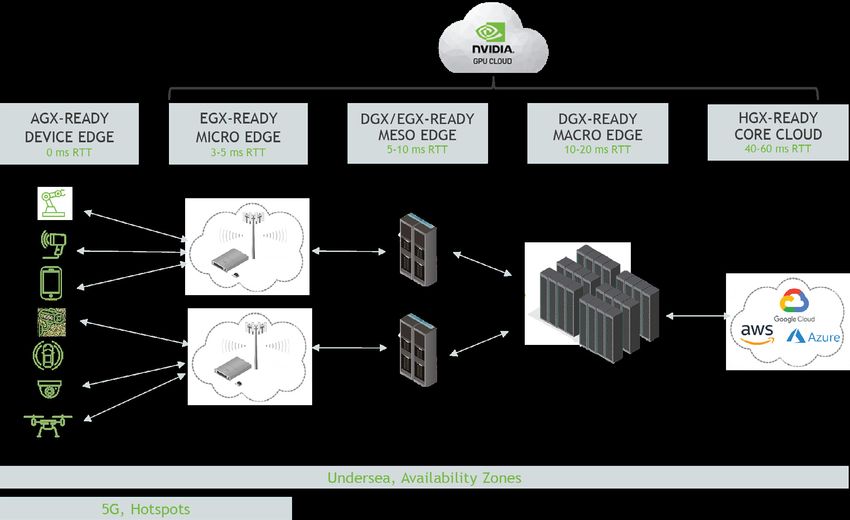
About Interxion
Interxion, a Digital Realty company,
is a leading provider of carrier- and
cloud-neutral colocation data centre
services in Europe, serving a wide
range of customers through more
than 50 data centres in 11 European
countries. Interxion’s uniformly
designed, energy-efficient data
centres offer customers extensive
security and uptime for their mission-
critical applications. With over 700
connectivity providers, 21 European
Internet exchanges, and most leading
cloud and digital media platforms
across its footprint, Interxion has
created connectivity, cloud, content
and finance hubs that foster growing
customer communities of interest. For
more information, please visit www.
interxion.com.

         www.interxion.com
         customer.services@interxion.com

         International Headquarters                                          Cofounder: Uptime Institute EMEA chapter. Founding member: European Data Centre Association.
         Main: + 44 207 375 7070                                             Patron: European Internet Exchange Association. Member: The Green Grid, with role on Advisory Council
         Email: hq.info@interxion.com                                        and Technical Committee. Contributor: EC Joint Research Centre on Sustainability. Member: EuroCloud.
         European Customer Service Centre (ECSC)                             Interxion is compliant with the internationally recognised ISO/IEC 27001 (537141) certification for Information
         Toll free Europe: + 800 00 999 222 / Toll free US: 185 55 999 222   Security Management and ISO 22301 (BCMS 560099) for Business Continuity Management across all our
         Email: customer.services@interxion.com                              European operations. © Copyright 2020 Interxion. WP-ENT-HQ-ENTERPRISEAI-HQ-eng-4/20
8   /   www.interxion.com
You can also read


