Middletown 2021: Keys to Innovation & Equity Strategic Operating Plan 2018-2021 - Unlocking the Potential in ALL Students - Connecticut ...
←
→
Page content transcription
If your browser does not render page correctly, please read the page content below

Middletown 2021:
Keys to Innovation & Equity
                       Strategic Operating Plan 2018-2021

       Unlocking the Potential in ALL Students
Table of Contents

                     Table of Contents									2

                     Letter to the Community								3

                     Introduction										4
                        Theme - Equity, Innovation, & Improvement 					    4
                        Strategic Planning Process							                  5
                        Use of the SOP									                            6
                        Organization of the SOP								                    7

                     Theory of Action 									7
                        Theory of Action									7

                     Goals											8
                        Goal 1: Teaching & Learning							                 8
                        Goal 2: Operations, Systems, & Structures					     8
                        Goal 3: Choice & Innovation Models						           8
                        Goal 4: Collaborative Learning Environments					   8

                     Performance Measures								9

                     Strategies										10
                        Goal 1: Teaching & Learning							                 10
                        Goal 2: Operations, Systems, & Structures					     11
                        Goal 3: Choice & Innovation Models						           14
                        Goal 4: Collaborative Learning Environments					   15

                     Appendix A: Performance Metrics						16

                     Strategic Planning Team								20

                     Glossary										21

                     References										25

2 MIDDLETOWN 2021: KEYS TO INNOVATION & EQUITY
Letter to the Community

                      M
                                  iddletown 2021: Keys to Innovation and Equity will provide our educational
                                  community, stakeholders, and constituents a vision that will unlock the
                                  potential in our students. It will be “the story” that ensures our collective
                                  journey focuses on preparing students for a 21st Century that features new
                                  dimensions in a competitive global market.

                      The Middletown Public Schools journey to achieving its goals requires a learning
                      organization which adopts a collective set of “practice beliefs” focused on continuous
                      growth and improvement. The “practice beliefs” embedded in the strategic operating plan
                      include:

                      •   Ensuring all three and four-year old students are ready for kindergarten;
                      •   Closing the preparation (Pre K) and achievement (K-12) gaps that are persistent in our
                          learning community;
                      •   Personalizing learning experiences for ALL students, despite academic dexterity or
                          level;
                      •   Leadership and teacher development using an executive coaching model;
                      •   Internal and external learning experiences for leaders, teachers, and students through
                          the power of networking;
                      •   Steadfast focus on equity and social/emotional learning;
                      •   Creating relevant family/community partnerships; and,
                      •   Innovation to meet economic and societal trends.

                      Each “belief point” is underscored with the broader notion that we, as a learning
                      organization, will focus on equity, innovation, and continuous improvement. Our work
                      within the strategic operating plan is clear—high expectations for all students and staff of
                      Middletown Public Schools.

                      The ideas and concepts of Middletown 2021: Keys to Innovation and Equity were created
                      by the voices of 1,358 participants of Explore Middletown. Our collective voice represents a
                      critical mass that will work to cement Middletown Public Schools as the most progressive
                      education enterprise in the state of Connecticut. We believe the ambitious goals and
                      strategies of this plan will create environments where students are the constructors of their
                      own learning.

                      I look forward to partnering with you as we look to calibrate our collective mindset on
                      maximizing the opportunities for every student in Middletown Public Schools.

                      					Michael T. Conner, Ed.D.
                      					Superintendent
                      					Middletown Public Schools

3 MIDDLETOWN 2021: KEYS TO INNOVATION & EQUITY
Introduction

        O    ur vision is to improve all schools, and the
             district as a whole, as well as provide all
         students with an innovative and equitable
         education.

Equity, Innovation, and Improvement
To move Middletown forward, we        how we deliver education to our        State School Officers (Leading for
must acknowledge actual practice      students. Our vision is to improve     Equity, 2017) states, “Equity does
(where we are now) and effective      allschools, and the district as        not mean creating equal conditions
practice (where we want to go). As    a whole, as well as provide all        for all students, but rather
a learning organization, we have an   students with an innovative and        targeting resources based on
internal/external achievement gap     equitable education.                   individual student’s needs and
that exceeds state/national norms,                                           circumstances, which includes
and engagement rates below the        Educational equity is embedded         providing differentiated funding
30th percentile (Explore              throughout Middletown 2021:            and supports, and respecting
Middletown Executive Report,          Keys to Innovation and Equity.         student’s voice and agency.” The
2018).                                Understanding and addressing           impetus of “educational equity” is
                                      educational inequity is the lever to   providing students the resources
Middletown Public Schools is          eradicating the achivement gap. A      and supports they need to achieve
ready to take significant steps to    recent publication from the Aspen      — regardless of their starting point.
change how we are structured and      Institute and the Council of Chief

                      The impetus of “educational equity” is providing stu-
                      dents the resources and supports they need to achieve —
                      regardless of their starting point.

4 MIDDLETOWN 2021: KEYS TO INNOVATION & EQUITY
Middletown
community
members refine
goal language
during Strategic
Planning Meeting

Strategic Planning Process
The strategic plan builds on                 with input from 1,358 stakeholders           the support of an external
Explore Middletown Entry Plan                of Middletown.                               consultant to keep our work
and Explore Middletown:                                                                   aligned to practice research. All
Executive Report that                        Middletown 2021: Keys to                     participants in strategic planning
Superintendent Dr. Michael T.                Innovation and Equity is the                 used qualitative/quantitative
Conner utilized to ground his work           result of six months of work                 metrics from Explore Middletown:
in Middletown Public Schools.                structured in phases (Figure 1) that         Executive Report to guide the
Embedded in the process was a                included regular senior                      discussion and development of core
strong commitment to engage the              management team meetings with                elements which are embedded in
community with developing and                district administration, workshops           the plan. Participants also engaged
generating data reports for future           with community stakeholders                  in granular concepts around three
strategic planning sessions. These           around strategic planning, internal          macro-themes—equity,
reports were created over 120 days,          strategic planning meetings, and             innovation, and improvement.

  Figure 1: Phases of Work

   Phase I
   √√   Set the direction and transition in Middletown Public Schools
   √√   Conduct 120 day entry plan (Explore Middletown)
   √√   Analyze Explore Middletown: Executive Report
   √√   Develop internal and external strategic planning team
   √√   Host strategic planning sessions wih internal and external teams

   Phase II
   √√   Develop major elements of the plan (goals, theory of action, strategies, assets/resources, and performance measures)
   √√   Compile stakeholder input for refinement, development, and articulation of core structural components of the
        strategic plan
   √√   Align major components of the plan to Explore Middletown: Executive Report

   Phase III
   √√   Align, articulate, and finalize structural elements of the strategic plan
   √√   Define implementation steps aligned to goals, strategies, and theory of action
   √√   Align community assets/resources with strategic plan goals and strategies
   √√   Review first draft of strategic plan with Board of Education (August 2018)
   √√   Adoption of strategic plan for implemenetation (Board of Education approval on September 11, 2018)

5 MIDDLETOWN 2021: KEYS TO INNOVATION & EQUITY
Middletown 2021: Keys to                      on current data and the changing      (including school districts) to
Innovation and Equity will act as             needs of our district (Step 6).       develop a small set of goals,
our “roadmap” for the next three                                                    identify performance measures,
years. It will take at least three            A handful of nationally-published     strategies for implementation
academic years to accomplish all              materials supported the creation of   (including operational performance
the strategies included in the                Middletown 2021: Keys to              measures), and actions. A recent
strategic plan. Implementation                Innovation and Equity, which          publication by Layland and Corbett
tasks will be created to plan and             grounded our approach in the          (2017) weaves SPM thinking into
prioritize each year’s work (See              leading recommendations of school     the continuous improvement cycle
Step 4, Figure 2 below). The                  and district improvement experts.     and incorporates best practices for
strategic plan also serves as the             We used resources on Strategic        needs assessments and root cause
baseline for every decision that is           Performance Management (SPM)–         analysis. The continuous
made within Middletown Public                 a practice being implemented in       improvement cycle is underscored
Schools. The impact of all                    State Education Agencies and          in many districts, states, and other
strategies and goals are measurable           districts across the country. The     education organizations. The
and will be closely monitored (Step           SPM approach, championed by the       Strategic Performance
5). Each year, mid-course                     federally-funded Building State       Management process is numbered
corrections will be made, based               Capacity and Productivity Center,     in Figure 2.
                                              is designed to support an entity

Use of the SOP
                                                                  Middletown 2021: Keys to Innovation and Equity
                                                                  is a living document that guides the district’s work,
                                                                  provides holistic accountability, serves as a
                                                                  guidepost for the budget process, and can be adapted
                                                                  to the district’s changing needs.

                                                                  Essentially, progress monitoring the strategic plan
                                                                  provides the efficacy of our performance
                                                                  (academics and operations). The implementation
                                                                  progress of the strategic plan becomes the primary
                                                                  focus of the Board of Education, Superintendent,
                                                                  and Senior Management. All major work streams
                                                                  of our learning organization will be aligned to the
                                                                  goals and strategies of the strategic plan.

                                                                  In order to implement the plan to fidelity, mindsets
                                                                  and mental models must be aligned for coherence.
                                                                  First, Middletown 2021: Keys to Innovation and
                                                                  Equity is grounded on a systems-approach.
                                                                  Middletown Public Schools staff must move beyond
Figure 2: Strategic Performance Management Process                coordination and collaboration to working in
                                                                  convergence – truly working together to accomplish

6 MIDDLETOWN 2021: KEYS TO INNOVATION & EQUITY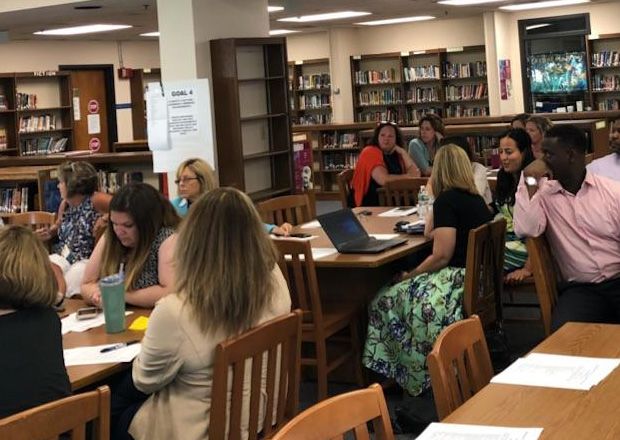
the strategies and goals of the
strategic plan. Second,                Organization of the SOP
communication must be
                                       Our strategic plan is guided by a
transparent, consistent, and aligned
                                       theory of action. The four goals of
for implementation success.
                                       Middletown 2021: Keys to
Change can be uncomfortable,
                                       Innovation and Equity (page 8) are
especially when there is a lack of
                                       the core of the district’s work. These
systems communication.
                                       goals require a set of strategies –
Proactively communicating the
                                       the behaviors and practices of what
process to reach full
                                       we will do – or do differently – to
implementation is needed to create
                                       achieve each goal in the strategic
a smooth transition with any
                                       plan. Strategies in the strategic plan
long-term initiative.
                                       will be scaled into three-year
                                       implementation steps – all viewed
                                       as integral to organizational success.
                                       A number of Performance Measures
                                       (page 16) will be used to monitor
                                       progress towards realizing each goal.

Theory of Action
                                                   A common misconception about “change management” is
                                                   an organization can adopt a linear focus on “outcomes” or
                                                   what we produce. This mindset explicitly negates the most
        IF Middletown provides                     important step in the process—how do our actions make
     equitable opportunities for                   the change happen? An organizational theory of action
                                                   assists in ensuring decisions, information, and investments
      student-centered learning                    are applied strategically to address the goals of Middletown
            in an environment of                   Public Schools. Moreover, we will be able to measure the
                                                   strength of our methods in the context of the instructional
      meaningful relationships,                    core (i.e. teacher, student, and academic content).
     THEN adults will support
                                                   The strategic plan’s theory of action acts as a multi-faceted
      and provide students with                    platform that guides our actions and strategic thinking for
      innovative and accessible                    solutions. Organizational and student progress will be
                                                   measured, so exceptional value is delivered to all students,
          education, AND every                     staff, and families of Middletown Public Schools.
       student will demonstrate
       personalized growth and                     Theory of Action
                                                   IF Middletown provides equitable opportunities for
        achieve at high levels to                  student-centered learning in an environment of meaningful
                    thrive in life.                relationships, THEN adults will support and provide
                                                   students with innovative and accessible education, AND
                                                   every student will demonstrate personalized growth and
                                                   achieve at high levels to thrive in life.

7 MIDDLETOWN 2021: KEYS TO INNOVATION & EQUITY
Goals
  GOAL 1 TEACHING & LEARNING
    Improve student’s ongoing readiness and learning opportunities by creating
    accessible, innovative, and personalized environments to close the preparation,
    opportunity, and performance gaps, to achieve equity in our schools.

  GOAL 2 OPERATIONS, SYSTEMS & STRUCTURES
    Develop a broad community of stakeholders who ensure a high level of efficiency
    and alignment among departments, and systems to improve the delivery of
    instruction and services for students

  GOAL 3 CHOICE & INNOVATION MODELS
    Establish successful education models that promote choice and achievement
    through innovation.

  GOAL 4            COLLABORATIVE LEARNING ENVIRONMENTS

    Create nurturing, healthy, and safe learning environments that are inclusive and
    engaging for all students, families, and staff.

8 MIDDLETOWN 2021: KEYS TO INNOVATION & EQUITY
Performance Measures
Middletown Public Schools will be using a variety of different performance measures to monitor and measure
progress. Each performance measure will serve as an important tool to identify global strengths, growth areas,
and detailed information for mid-course pivots.

Through Middletown 2021: Keys to Innovation and Equity, all performance measures are aligned to the
theory of action, goals, and strategies embedded in the plan. Our educational system is multi-faceted and
robust, thus, the depth and cross-functionality of each goal and strategy. To monitor, measure, and analyze
progress of our learning organization, categories of our performance measures include:

√√     District Performance Index
√√     Student Outcomes
√√     Innovation and Choice Programs
√√     School Climate and Culture
√√     Teacher Effectiveness
√√     District Operating Systems

A complete breakdown of each performance measure, type of analysis, and performance targets can be found
in Appendix A, starting on page 16.

                                                                              INNOVATION
                                                                            Student Centered
                        EQUITY
                                                                          New School Design
                    Transparency                                                   Flexibility
                   Differentiation                                        Cross-Functionality
                 Personalization                                            Career Readiness
              Family Partnerships
                           Choice

                                                                             IMPROVEMENT
                                                                         Achievement Gaps
                                                                            PreK Readiness
                                                                        Talent Development
                                                                 Social Emotional Learning
                                                                          Security & Safety

9 MIDDLETOWN 2021: KEYS TO INNOVATION & EQUITY
Strategies
 GOAL 1 TEACHING & LEARNING
Improve student’s ongoing readiness and learning
opportunities by creating accessible, innovative, and
personalized environments to close the preparation,
opportunity, and performance gaps, to achieve equity in our
schools.

     1.1 Rigor & Relevance
           Increase rigor and relevance by revising and designing a
           comprehensive curriculum so effective instruction is
           provided with access and equity for all students.

     1.2 Personalized Learning
           Using a multi-tiered instructional model, implement a
           learning program that personalizes instruction for all
           students.

     1.3 Accessible Instruction
           Utilize Universal Design for Learning (UDL) principles to
           design and deliver accessible instruction.

    1.4 Instructional Supports
           Ensure students receive appropriate quality tiered
           instructional supports based on their individual needs.

    1.5 Early Childhood Education
           Implement a community-wide early childhood strategic plan
           designed to ensure children are ready for school success and
           have access to early childhood education.

    1.6 Expand High School Options
           Develop high school programs of study, based on a 25-credit
           graduation requirement, including increased rigor and
           equitable access to personalized pathways.

10 MIDDLETOWN 2021: KEYS TO INNOVATION & EQUITY
GOAL 1 TEACHING & LEARNING
1.7 Enhance Literacy Instruction
Implement the Middletown Kindergarten to Grade 5 Literacy
Initiative (MK5LI) in all elementary schools to strengthen
our multi-tiered instructional model and ensure that all
students read well by Grade 5.
1.8 Algebra Readiness
Redesign the middle school math curriculum and sequence to
ensure all students are Algebra-ready by Grade 8.
1.9 Access to the Arts
Create a system that provides equity, access, and enhanced
fine arts opportunities for all students.
OPERATIONS, SYSTEMS &
GOAL 2 STRUCTURES
Develop a broad community of stakeholders who ensure a
high level of efficiency and alignment among departments, and
systems to improve the delivery of instruction and services for
students.
2.1 Talent Office
Redesign the current Human Resources model to a Talent Management &
Benefits Office for performance growth and development.
2.2 Talent Management
Implement a human relations (HR) system to improve efficiency and alignment among
departments to support district goals, including the hiring and training, growth,
appropriate placement, and engagement of a workforce that best supports the stability
of the district and the growth of our students.
11 MIDDLETOWN 2021: KEYS TO INNOVATION & EQUITYOPERATIONS, SYSTEMS &
GOAL 2 STRUCTURES
2.3 Communications
Improve two-way, ongoing, and flexible communication
protocols to inform and engage staff, families, community
members, partners, and students.
2.4 Workplace Injuries
Improve the process for reporting workplace injuries,
increase access to treatment options, and return to work
procedures to reduce costs, limit medical leave, and decrease
lost instructional time.
2.5 Technology
Implement a district technology plan that is aligned to the
Future Ready Schools Framework.
2.6 Finance and Grants
Implement fiscal systems and make decisions that are
equitable, efficient, fiscally-responsible and aligned to the
district’s goals.
2.7 Equity Based Budgeting
Implement a fiscal model that provides equity and autonomy
to schools.
2.8 Special Education Resource
Improve special education outcomes and systems through
the allocation of resources and supports that are anchored in
educationally and fiscally-sound decision-making practices.
12 MIDDLETOWN 2021: KEYS TO INNOVATION & EQUITYOPERATIONS, SYSTEMS &
GOAL 2 STRUCTURES
2.9 Facilities
Develop and implement a five-year district-wide
facilities plan that aligns with the district’s vision and
provides healthy, safe, and positive work and learning
environments
2.10 Meal Services
Improve the dining experience for staff and students,
including customer service, nutritional quality and access to
meals.
2.11 Transportation
Increase the efficiency and effectiveness of the transportation
system for student riders and bus drivers.
13 MIDDLETOWN 2021: KEYS TO INNOVATION & EQUITYCHOICE AND INNOVATION
GOAL 3 MODELS
Establish successful education models that promote choice
and achievement through innovation.
3.1 Expanded Literacy Learning
Maximize, expand, and extend learning opportunities to
underpin student achievement by creating a K-5 literacy
academy.
3.2 Expanded After School Learning
Implement 21st Century After-School Programs to decrease
learning loss and increase enrichment.
3.3 Innovative Models
Implement an innovative learning model that promotes
choice and equity for families with the creation of a STEM
Academy.
3.4 Innovative Models
Implement an innovative learning model that promotes
choice and equity for families with the creation of an
International Baccalaureate (IB) World School.
3.5 Innovative Models
Implement an innovative learning model that promotes rigor
and relevance with the creation of Quad D Learning
Laboratories.
3.6 Grade 6-8 Vertical Alignment
Restructure the middle school model to promote rigor,
innovation, agency, and student relevancy.
3.7 Student Voice
Provide resources, tools, and structures that empower students in their own
learning behaviors to strengthen positive relationships with adults.
14 MIDDLETOWN 2021: KEYS TO INNOVATION & EQUITYCOLLABORATIVE LEARNING
GOAL 4 ENVIRONMENTS
Create nurturing, healthy, and safe learning environments that
are inclusive and engaging for all students, families, and staff.
4.1 Family Partnerships
Strengthen families’ multiple roles as they support, monitor,
and advocate for student success and engagement.
4.2 Climate
Create a positive learning and working environment that
fosters caring and respectful relationships.
4.3 Early Social Emotional Learning
Develop social-emotional learning and intervention
frameworks at elementary schools for students, staff, and
families.
4.4 Wellness
Create healthy, safe, and positive learning environments for
staff, teachers, and students.
4.5 School-Based Autonomy
Develop School Advisory Councils (SACs) at all schools to
increase autonomy and engage the community and families in
the decision-making process.
4.6 Safety and Security
Strengthen school security through professional training,
capital improvements, and technology to ensure staff and
student safety
15 MIDDLETOWN 2021: KEYS TO INNOVATION & EQUITYAppendix A: Performance Measures & Metrics
Abbreviations & Definitions
NWEA: Northwest Evaluation Association AIMSweb (ELA/Math in K-1): Measure to assess
PSAT: Preliminary Scholastic Aptitude Test early foundational skills in ELA and Math
SAT: Scholastic Aptitude Test Fountas and Pinnell: Benchmark Assessment
NGSS: Next Generation Science Standards Systems that are accurate and reliable tools to identify
Smarter Balanced Assessment Consortium: the instructional and independent reading levels of all
Assessment aligned to the Connecticut Core State students and document student progress through
Standards one-on-one formative and summative assessments.
Reading Inventory: A research-based, adaptive
student assessment program that measures reading
skills and longitudinal progress from Kindergarten
BOY: Beginning of Year through college readiness.
MOY: Middle of Year Math Inventory: A research-based, adaptive student
EOY: End of Year assessment program that measures mathematics skills
and longitudinal progress from Kindergarten through
college readiness.
MEED: Middletown’s Educator Evaluation and
Development Plan
Performance Measures
PM # Name Types of Strategic Plan Performance Target(s)
Analysis
District Performance Index
1 District District Wide District-wide accountability index will
Accountability Index increase:
A. Proficiency (Indicator 1)
B. Growth (Indicator 2)
Student Outcomes
2 NWEA By subgroup and A. Decrease the gap between MPS “high
content area needs” students and “non-high needs”students.
B. Decrease the gap between MPS
students and national norms.
16 MIDDLETOWN 2021: KEYS TO INNOVATION & EQUITYPM # Name Types of Strategic Plan Performance Targets
Analysis
3 CT State A. Decrease the reading (ELA) internal gap
Assessments: (Smarter Balanced) between MPS “all
students” and “high needs” subgroup.
Smarter Balanced Smarter B. Decrease the reading (ELA) external gap
Assessment Balanced between MPS and DRG/State.
Reading (ELA) and C. Increase number of students at goal
Math grades 3-8 (Level 4).
SAT All students grade
11
NGSS All students
Science grades 5, 8
& 11
4 AIMSweb & K-1 A. Increase percentage of “all K-1 students”
Intervention All students meeting benchmark on EOY on AIMSweb.
Records B. Increase the percentage of all students
matriculating into Kindergarten “ready to
learn”.
C. 100% of K-1 students not meeting benchmark
AIMSweb will receive appropriate tiered
interventions.
D. Increase percentage of preschool students meeting
EOY benchmark.
5 PSAT Grade 9 A. Increase percentage of “all students” reaching
benchmark.
6 Lexile & Quantile for Grade 6-8 Lexile A. Increase percentage of students achieving growth
Intervention Records and Quantile targets in tier II/tier III structural supports.
B. Increase the number of students qualifying for
Algebra I by grade 8.
C. Increase the percentage of students exceeding their
growth target (Lexile and Quantile)
7 PSAT Grade 10-11 Math A. Decrease gap between MPS students and State
and ERW on ERW (Evidence-Based Reading & Writing).
B. Decrease gap between MPS and State for “all
students”.
17 MIDDLETOWN 2021: KEYS TO INNOVATION & EQUITYPM # Name Types of Strategic Plan Performance Targets
Analysis
8 Connecticut SAT All students A. Decrease gap between MPS and State for “all
Grade 11 students”.
High Needs/ B. Increase percentage of “all students” reaching
Subgroups “College and Career Ready” benchmark.
C. Decrease gap between MPS “high needs” subgroup
students and MPS “non-high needs” students.
D. Decrease gap between “high needs students at MPS
and State “high needs” students.
9 College Attendance All students A. Increase the percentage of a graduating class enrolled
and Readiness 2 and 4-year in 2 or 4 year postsecondary institutions.
colleges and access B. Increase the percentage of underrepresented
to rigorous courses subgroups in Advanced Placement (AP) courses.
C. Increase the percentage of all students passing
Advanced Placement (AP) courses.
10 Graduation Rates All students A. Increaes 4-year graduation rates for “all students”.
High Needs/ B. Increase 4-year graduation rates of “high needs”
Subgroups subgroups.
Innovation and Choice Programs
11 School Design Number of A. Increase the number of pathways options at the high
differentiated/ school level.
high-quality B. Increase the number of innovation schools through
opportunities and choice and equity programs.
choices for families C. Design an innovative middle school aligned to
national research and evidence-based practices.
School Climate
12 Dimensions of School Annual student/ A. Increase level of stakeholder satisfaction measured
Climate parent/staff survey through annual climate survey.
B. Increase the number of students reporting
improved sense of voice, participation, and
agency.
13 School Climate Data All students by A. Decrease discipline instances and chronic
(discipline, subgroup absenteeism for all students.
suspension, B. Decrease the gaps for discipline instances
expulsion, chronic between “high needs” and “non-high needs”
absenteeism rates) students.
C. Decrease the gaps for chronic absenteeism
between “high needs” and “non-high needs”
students.
18 MIDDLETOWN 2021: KEYS TO INNOVATION & EQUITYTeacher Effectiveness
14 Middletown Educator Overall teacher A. Increase the percentage of teachers and
Evaluation and ratings compare administrators rated ‘Exemplary’ by MEED.
Development Plan percent of students B. Improve the correlation of MEED ratings to the
(MEED) meeting growth percent of students meeting growth targets.
targets to MEED C. Implement recommendations from teacher evaluation
ratings committee.
15 Teacher Chronic Overall teacher A. Decrease teacher chronic absenteeism as evidence
Absenteeism chronic absenteeism by daily attendance.
and how it relates to
student achievement
District Operating Systems
16 Implementation of five A. Implement facilities plan recommendations on a
year facilities master yearly basis.
plan B. Develop work order efficiency system.
C. Increase administrator satisfaction with work order
completion rate.
17 Implementation of five A. Implement technology master plan recommendations
year technology master based on “Future Ready Schools” Standards on
plan yearly basis.
B. Provide, maintain and increase necessary technology
to support blended/personalized learning
enviroments.
18 Develop five year food A. Implement yearly components of the meal
services master plan services master plan on a yearly basis.
B. Increase the percentage of student/parent
satisfaction with the quality of food and
customer services.
C. Increase the percentage of access to
nutritious and appetizing meals.
19 Evaluation of School A. Implement School Security Plan aligned to
Security Plan state statutes on a yearly basis.
B. Increase the percentage of schools meeting
safety code/standards.
20 Develop Talent A. Implement phases of Talent Management
Management and Office aligned to the seven dimensions
Benefits Office
19 MIDDLETOWN 2021: KEYS TO INNOVATION & EQUITYStrategic Planning Team
Sara Alberti Meghan Hanley
Monica Belyea Patrick Hubeny
Ed Bonilla Marta Landell
Christine Bourne Mark Langton
Janet Calabro Beverly Lawrence
Jennifer Cannata Lisa Loomis
Crystal Caouette Keri MacLean, Ed.D.
Justin Carbonella Enza Macri, Ed.D.
Amy Clarke Lynda MacPherson
Michael T. Conner, EdD. Silvia Mayo-Molina, Ed.D.
Melaina Cossette Cheryl McClellan
John Cross Ed McKeon
Shelia Daniels Donna Marino
Michele DiMauro Amy Mullen
Damian Dontfraid Janice Pawlak
Christopher Drake Quentin Phipps
Dawn Dubay Precious Price
Lynn Durham Daniel Raucci
Mary Emerling Damian Reardon
Natalie Forbes Julie Sheppard
Marco Gaylord Michaael Skott
Michelle Gohagon Colleen Weiner
Cheryl Gonzalez Kelly Weisenberg
Carri Gosselin-Wilson Sheryl Wolfgram
20 MIDDLETOWN 2021: KEYS TO INNOVATION & EQUITYGlossary
Access In education, the term ‘access’ typically refers to the ways in which
educational institutions and policies ensure—or at least strive to
ensure—that students have equal and equitable opportunities to take
full advantage of their education. Increasing access generally requires
schools to provide additional services or remove any actual or potential
barriers that might prevent some students from equitable participation in
certain courses or academic programs.
Achievement Gap The term achievement gap refers to any significant and persistent
disparity in academic performance or educational attainment between
different groups of students, such as white students and students of color,
for example, or students from higher-income and lower-income
households.
Advanced Advanced Placement is a program run by the College Board (the creators
Placement Courses of the SAT) that allows students to take courses in high school, which
can earn college credit and/or qualify students for more advanced classes
when they begin college.
Algebra Readiness Students have a deep understanding and mastery of the essential skills
and concepts necessary to access an algebra curriculum. Using a quantile
student measure report we will know the skills and concepts that
students are ready to learn and the level of success students are expected
to have with an upcoming skill or concept. The quantile level needed for
Algebra Readiness is 1030Q.
Climate School climate is the quality and character of school life. School climate
is based on patterns of students’, parents’ and school personnel’s
experience of school life; it also reflects norms, goals, values,
interpersonal relationships, teaching and learning practices, and
organizational structures.
Continuous The ongoing, collaborative effort to improve current systems, processes,
Improvement and practices.
Educational Equity Ensures fairness in educational systems to provide access, opportunity,
representation, and high expectations for all students and adults.
21 MIDDLETOWN 2021: KEYS TO INNOVATION & EQUITYGlossary
Equity-Based In an Equity Based Budgeting system (1) budget resources are
Budgeting distributed based on student, school and program need, (2) school l
eaders determine how to use budget resources to drive student
achievement based on their school’s demographics, capacity, needs and
mission/vision and (3) there are clear and transparent rules for the
allocation of budget resources.
Family Engage- Family Engagement is a full, equitable partnership among families,
ment educators and community partners to promote children’s learning and
development from birth through college and career.
Innovation The reinvention or radical impact of a current system, product, or
program to substantially and positively impact effectiveness and quality.
International The aim of all IB programmes is to develop internationally minded
Baccalaureate people who, recognizing their common humanity and shared
guardianship of the planet, help to create a better and more peaceful
world. Informed by these values, an IB education: centres on learners,
develops effective approaches to teaching and learning, works within
global contexts, and explores significant content. Working together, these
four characteristics define an IB education.
Intervention A specific program or set of steps to help a child improve in an area of
need (instructional and/or behavioral).
Kindergarten Physical, academic and social-emotional skills a child needs to be
Readiness prepared for kindergarten.
Multi-Tiered A three-tier (or three-step) model of school supports that uses
Instruction research-based, intentional and targeted academic and/or behavioral
interventions.
Opportunity Gap The term opportunity gap refers to the ways in which race, ethnicity,
socioeconomic status, English proficiency, community wealth, familial
situations, or other factors contribute to or perpetuate lower educational
aspirations, achievement, and attainment for certain groups of students.
22 MIDDLETOWN 2021: KEYS TO INNOVATION & EQUITYGlossary
Personalized Allows students to actively participate in the design of their own
Learning learning, method of instruction, learning experiences, and programs
based on learners’ distinct needs, interest, cultural background and
relevance, and goals.
Pocket Pathways The pathways concept nearly always implies an expansion of
educational options beyond the course sequences historically offered to
students. The concept is most commonly applied to educational
experiences, usually at the high-school level, that occur outside of
traditional classroom settings or school buildings, such as internships,
apprenticeships, independent research projects, online classes, travel,
community-service projects, or dual-enrollment experiences.
Preparation Gap The term preparation gap is the gap between what lower-income families
and students of color actually know and can do versus what they must
know and be able to do in order to meet state academic standards, move
from one grade to the next, and eventually graduate from high school.
Quad D Students have the competence to think in complex ways and apply
(Adaptation) knowledge and skills they have acquired. Even when confronted with
perplexing unknowns, students are able to use extensive knowledge and
skill to create solutions and take action that further develops their skills
and knowledge.
Relationships How people connect, interact, and behave toward one another.
Rigor and The Rigor/Relevance Framework® is a tool developed by staff of the
Relevance International Center for Leadership in Education to examine curriculum,
instruction, and assessment. The Rigor/Relevance Framework is based
on two dimensions of higher standards and student achievement. It is a
fresh approach to looking at college‐ and career‐ready standards and
assessment. It is based on traditional elements of education, yet
encourages movement from acquisition of knowledge to application of
knowledge.
23 MIDDLETOWN 2021: KEYS TO INNOVATION & EQUITYGlossary
STEM (Science, STEM education integrates concepts that are usually taught as separate
Technology, subjects in different classes and emphasizes the application of
Engineering, and knowledge to real-life situations. A lesson or unit in a STEM class is
Mathematics) typically based around finding a solution to a real-world problem and
tends to emphasize project-based learning.
Student Agency The level of control, or autonomy that a student has on his or her
educational experiences including choice in environment, subject matter,
pace, and demonstrated learning outcomes.
UDL (Universal Universal Design for Learning (UDL) is a framework for the design and
Design for implementation of a flexible and responsive curriculum. It reduces
Learning) barriers to learning while maintaining high achievement standards for
all.
21st Century The 21st Century Community Learning Centers (21st CCLC) initiative
After-School is the only federal funding source dedicated exclusively to supporting
Program local after-school, before-school and summer learning programs. The
program was reauthorized in 2015 as part of the Every Student Succeeds
Act (ESSA).
24 MIDDLETOWN 2021: KEYS TO INNOVATION & EQUITYReferences
Corbett, J. & S. Redding. (2017). Using Needs Assessments for School and District
Improvement: A Tactical Guide. Center on School Turnaround at WestEd and Council on Chief
State School Officers. 2017. Useable Worksheets.
Conner, M. (2017). Explore Middletown: Listening, Learning, and Understanding –
Superintendent’s Entry Plan. Middletown Public Schools.
Conner, M. (2017). Explore Middletown: Listening, Learning, and Understanding –Executive
Report. Middletown Public Schools.
Daggett, W. (2014). Rigor/Relevance Framework: A Guide to Focusing Resources to Increase
Student Achievement. International Center for Leadership in Education: A division of
Houghton Mifflin Harcourt.
Layland, A. & J. Corbett. (2017). Utilizing integrated resources to implement the school and
district improvement cycle and supports: Guidance for schools, districts and state education
agencies. Washington DC: The Council of Chief State School Officers.
Layland. A. & S. Redding. (2017). Casting a Statewide Strategic Performance Net: Interlaced
Data and Responsive Supports. Building State Capacity and Productivity Center & Center on
School Turnaround.
Leading for Equity: Opportunities for State Education Chiefs. (2017). Washington DC: The
Aspen Education & Society Program and the Council on Chief State School Officers.
Working Together to Raise the Bar & Close the Gap: 2016-2019 Strategic Operating Plan.
(2016). Norwalk, CT: Norwalk Public Schools.
25 MIDDLETOWN 2021: KEYS TO INNOVATION & EQUITYYou can also read


