Multi-country outbreak of Listeria monocytogenes sequence type 6 infections linked to ready-to-eat meat products - Efsa
←
→
Page content transcription
If your browser does not render page correctly, please read the page content below
JOINT ECDC-EFSA RAPID OUTBREAK ASSESSMENT

Multi-country outbreak of Listeria
m onocytogenes sequence type 6 infections
linked to ready-to-eat meat products
25 November 2019

  Abstract
  Twenty-one cases of Listeria monocytogenes IVb sequence type ST 6 infections have been reported from the
  Netherlands (19 cases) and Belgium (two cases). This outbreak was identified using whole genome sequencing
  (WGS) analysis.
  The patients had onset of illness between 2017 and August 2019. Three patients have died and one suffered a
  miscarriage due to the infection. The close genetic relatedness of the strains (≤3 allelic differences), and the
  temporal distribution of the cases suggest a prolonged, intermittent, common source foodborne outbreak
  which occurred in at least two EU Member States.
  Nine isolates from six sliced ready-to-eat (RTE) meat products, produced between 2017 and 2019 by the
  Dutch Manufacturing Company A, were found to be contaminated with L. monocytogenes strains matching the
  outbreak strain (≤3 allelic differences). Although the exact points of contamination have not been identified
  yet, the results of the investigation suggest that the contamination may have happened at the Dutch
  Manufacturing Company A, which represents the only common manufacturing point of the contaminated
  products. The Dutch Manufacturing Company A distributed products to several EU countries as well as to
  countries outside the EU.
  Following the detection in food of L. monocytogenes isolates matching the outbreak strain, and the discovery
  of the environmental contamination with other L. monocytogenes strains, the Dutch Manufacturing Company A
  stopped the production in October 2019, and finalised the withdrawals and recalls of all RTE meat products.
  This measure decreases the risk of new cases occurring possibly associated with products from this company.
  Pregnant women, the elderly and immunocompromised people are at higher risk of invasive listeriosis, which is
  associated with severe clinical course and potential death. Therefore, specific attention should be paid to the
  administration of RTE meat products to people in hospitals, nursing homes and those belonging to vulnerable
  population groups.

Suggested citation: European Centre for Disease Prevention and Control, European Food Safety Authority, 2019. Multi-country
outbreak of Listeria monocytogenes sequence type 6 infections linked to ready-to-eat meat products – 25 November 2019.
Also published in EFSA Supporting Publications: Technical report approved by EFSA on 25 November 2019;
doi:10.2903/sp.efsa.2019.EN-1745; Key words: Listeria monocytogenes, ready-to-eat, meat products, multi-country outbreak,
Whole Genome Sequencing (WGS). Requestor: European Commission; Question number: EFSA-Q-2019-00649; correspondence:
roa-efsa@efsa.europa.eu ISSN: 2397-8325
© European Centre for Disease Prevention and Control, European Food Safety Authority, 2019

RAPID OUTBREAK ASSESSMENT Multi-country outbreak of L. m onocytogenes infections linked to RTE meat products – 25 Nov 2019

Event background
On 1 August 2019, the Netherlands reported a cluster of 18 invasive listeriosis cases to the Epidemic Intelligence
Information System for Food- and Waterborne Diseases and Zoonoses (EPIS-FWD). The cluster was identified
through whole genome sequencing (WGS) analysis and included one non-human isolate from food. In the
following weeks, Belgium reported two human cases of L. monocytogenes infections to EPIS-FWD, which shared
identical (0 allelic difference) sequences with the Dutch isolates.
This joint ECDC-EFSA outbreak assessment is linked to the EPIS FWD urgent inquiry UI-583 and Rapid Alert
System for Food and Feed (RASFF) notification 2019.3490.

Multi-country investigations
EU outbreak case definition
Outbreak-confirmed case
•   A resident of the European Union/European Economic Area (EU/EEA) with laboratory-confirmed invasive
    listeriosis, with symptoms onset on or after 1 January 2017 (date of sampling or date of receipt by the reference
    laboratory if date of onset is not available).
    AND
•   Fulfilling the additional laboratory criterion: with a L. monocytogenes isolate within 3 cgMLST allelic differences
    (Moura et al. 2016 [1]) from at least one of the 5 representative sequences shared in EPIS-FWD UI-583 by the
    Netherlands (NL2019_29_CT90, NL2019_20_CT5162, NL2017_88_CT90, NL2018_37_CT5162 or
    NL2018_67_CT90), based on the ECDC pipeline.

Epidemiological and microbiological investigations of
humans
Based on the EU case definition as of 14 November 2019, there are 21 confirmed cases associated with this
outbreak, of which 19 are in the Netherlands and two in Belgium. The cases were reported in 2017 (1), 2018 (8)
and 2019 (12) (Figure 1).
Figure 1. Distribution of outbreak-confirmed listeriosis cases by country and month of illness onset*,
EU, 2017–2019, as of 14 November 2019 (n=21)

* Month of sampling or month of receipt by the reference laboratory if month of onset unavailable

Two of the 19 Dutch patients were pregnant women in their 30s. The other 17 patients had a median age of 78
years, ranging from 64 to 94 years, and 10 were men. All patients were hospitalised, three patients died and one
had a miscarriage.
The two patients reported by Belgium were a 97-year-old woman and a perinatal case of a Dutch mother
(diagnosed in Belgium).
The 21 isolates from the outbreak-confirmed cases cluster within ≤3 allelic difference by single linkage clustering,
and belong to serogroup IVb and sequence type (ST) 6. Of the 19 Dutch isolates, 17 were of SeqSphere cluster
type ST6-CT90 and two were ST6-CT5162. Analysis of the LIPI-3 and LIPI-4 pathogenicity island associated with
hypervirulence was performed on the five Dutch representative isolates: all five harboured the LIPI-3 island, but
were LIPI-4 negative [2].
Austria, the Czech Republic, Denmark, Finland, France, Germany, Greece, Ireland, Italy, Luxembourg, Norway,
Spain, the United Kingdom, Switzerland and the United States reported no L. monocytogenes isolates within 3
allelic differences from the Dutch outbreak strain.

                                                            2
RAPID OUTBREAK ASSESSMENT Multi-country outbreak of L. m onocytogenes infections linked to RTE meat products – 25 Nov 2019
Information from patient interviews
In the Dutch investigation, the available information on cases' food exposure could not point towards a specific
source. Of the 19 Dutch patients, 15 reported having consumed cold meat products, three did not reply to the
question and one reported not having eaten any cold meat product. When asked about the type of meat product
consumed, different types of meat products were reported.
No food history information is available for the two cases reported in Belgium.
Microbiological and environmental investigations of food
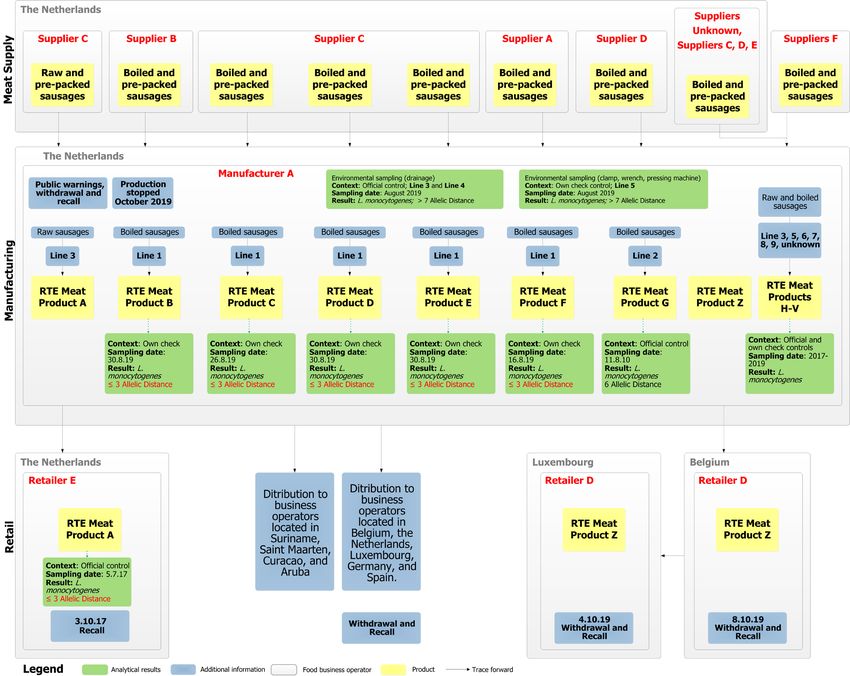
This section summarises country-specific information on food and environmental investigations, and traceability
analyses (Figure 2 in Annex) of products positive for L. monocytogenes, as reported through RASFF notification
2019.3490 (25 follow-ups: last access 18 November 2019).
Overall, nine isolates of L. monocytogenes IVb (PCR-based serotype) and ST 6 (MLST-based sequence type) -
showing less than or equal to 3 allelic differences in cgMLST with the representative outbreak strain (according to
the EU outbreak case definition and the EU WGS analysis), were detected in nine samples of six ready-to-eat (RTE)
meat-based products prepared between 2017 and 2019 by the Dutch Manufacturing Company A:
• one sample of Product A
• one sample of Product B
• four samples of Product C
• one sample of Product D
• one sample of Product E
• one sample of Product F.
In addition, one isolate of L. monocytogenes IVb (PCR-based serotype) and ST 6 (MLST-based sequence type)
showing 6 AD in cgMLST with the closest representative outbreak strain (according to the EU WGS analysis), was
detected in one sample of one additional type of RTE meat-based product prepared in 2010, also by the Dutch
Manufacturing Company A:
• One sample of Product G.
Moreover, other L. monocytogenes isolates from different serogroups and STs, and not clustering with the
representative outbreak strain, were detected in 15 samples of RTE meat products prepared in 2019 and in four
environmental samples collected at two sites within the Dutch Manufacturing Company A in 2019.
Information on the Dutch Manufacturing Company A
The Dutch Manufacturing Company A produces approximately 650 different types of sliced RTE meat products for
the retail market and the catering industry, intended to be stored at a temperature below or equal to 7°C until
consumption. The Dutch Manufacturing Company A receives frozen and pre-packed sausages (about 200 different
meat products) from approximately 60 meat suppliers. Just prior to slicing, the sausages are unpacked.
Subsequently, the frozen sausages enter the RTE production line that consists of the following steps: slicing
(sausages are sliced frozen), portioning, and packaging that are carried out in the ‘high care hall’; they then
undergo the automated labelling that is performed in the ‘low care hall’ of the company. The final RTE meat
products are then transferred to transport boxes.
Information on L. m onocytogenes positive RTE meat-based products
clustering with the representative isolates of the outbreak strain according
to the EU WGS analysis
In October 2019, following the identification on 31 July 2019 of a national cluster of human infections caused by L.
monocytogenes, the Dutch Food Authority reported in RASFF 2019.3490 (4 October 2019) on the outcome of a
national foodborne outbreak investigation that was performed. After the initial signal detection (31 July 2019), one
single sequence from a food isolate was found to cluster with the human isolates from the outbreak cases. This
food isolate originated from a sample of Product A that was prepared in 2017 by the Dutch Manufacturing
Company A and sampled chilled at retail level (Retailer E). The Dutch Food Authority reported that on 3 October
2017 Retailer E implemented a recall. Product A was obtained from raw pre-packed sausages that originated from
a Dutch Supplier C. They were sliced in 2017 by the Dutch Manufacturing Company A along the slicing line 3, and
distributed as RTE meat product to the stores of the group Dutch Retailer A.
3RAPID OUTBREAK ASSESSMENT Multi-country outbreak of L. m onocytogenes infections linked to RTE meat products – 25 Nov 2019
The Dutch Food Authority reported that additional samples of RTE meat-based products (namely the Product B,
Product C, Product D, Product E and Product F), collected in the frame of own-check controls at the Dutch
Manufacturing Company A, tested positive for L. monocytogenes IVb - ST 6 (analyses started between 16 August
and 30 August 2019). The isolates were sent for whole genome sequencing on 20 September 2019 and were
found to cluster with the representative outbreak strain by SNP analyses. Product F and Product B were obtained
from boiled pre-packed sausages which originated from the Dutch meat Supplier A and from the Dutch meat
Supplier B, respectively. Product C, Product D, and Product E were obtained from boiled pre-packed sausages
delivered by the Dutch Supplier C. All the five products were sliced by the Dutch Manufacturing Company A along
the slicing line 1 and were distributed as RTE meat products to the stores of the group Dutch Retailer A. These
RTE sliced foods were produced between 16 July 2019 and 26 August 2019 by the Dutch Manufacturing
Company A.
Furthermore, from the dataset of L. monocytogenes isolates collected from the NRL network, the EURL-Lm
identified one isolate showing less than 7 allelic differences in cgMLST with the representative outbreak strain. The
Dutch Food Authority reported that the isolate originated from the RTE meat Product G which was sampled in the
frame of an official control in 2010 and tested positive on 11 August 2010. Product G was obtained from boiled
pre-packed sausage(s) that originated from the Dutch meat Supplier D, sliced in 2010 by the Dutch Manufacturing
Company A along the slicing line 2 (located in a different building with respect to the other lines involved in
positive products), and was distributed as RTE meat products to the stores of Retailer B.
Information on other L. m onocytogenes positive RTE meat-based products
not clustering with the representative outbreak strain according to the EU
WGS analysis
The Dutch Food Authority reported in RASFF that samples of RTE meat-based products (Annex – Table 1) were
collected in the course of official and own-check controls at the Dutch Manufacturing Company A in 2017 (Product
H), in 2018 (Product I), and between March-October 2019 (Products J to V). They tested positive for different L.
monocytogenes serogroups (e.g. IIa, IIc, IVb) and sequence types (e.g. ST 8, ST 9). The Dutch Food Authority
reported that isolates, for which WGS analysis was performed, did not cluster with the representative outbreak
strain. The trace-back and microbiological analyses of these positive RTE meat-based products is provided in the
Annex, Table 1.
The products were manufactured in different processing lines in the Dutch Manufacturing Company A, where some
of the lines were found to be positive for multiple L. monocytogenes strains. Specifically, one line (line 3) was also
used for manufacturing one product found positive for L. monocytogenes ST 6 clustering with the human isolates
from the outbreak cases. Moreover, the Dutch Food Authority clarified that all food products collected in the frame
of official controls were sampled after the packaging step, and that most of the food products collected in the
frame of own-check controls (by the Dutch Manufacturing Company A) were sampled after the slicing step, with no
available information on the package status of the sample.
Distribution of RTE meat-based products to other countries
On 4 October 2019, the Dutch Food Authority reported in RASFF 2019.3490, that as result of a national foodborne
outbreak investigation, the food product consisting in cooked sliced beef (Product Z) were recalled. Product Z was
produced by the Dutch Manufacturing Company A and delivered to the stores of the Belgian Retailer D. On 8
October 2019 the Belgian Food Authority communicated (fup9) that the Belgian Retailer D initiated a withdrawal
and a recall of all the RTE meat products belonging to Product Z. The Belgian Food Authority reported in RASFF
(fup9) that the RTE meat-based products belonging to Product Z were further distributed to the stores of the same
Retailer D located in Luxembourg. The Food Authority in Luxembourg reported that a recall was initiated on 4
October 2019 and a press release was issued on their website (fup11).
The Dutch Food Authority also reported in RASFF (fup4, fup15) the type and number of RTE meat-based products
that were delivered by the Dutch Manufacturing Company A to several food business operators (i.e. wholesalers,
retailers, and catering industry) located in Belgium (fup10), in Luxembourg (fup15), in Germany (fup1), and
additionally in Suriname, Saint Maarten and Curacao (fup4). The Dutch Food Authority also reported in RASFF
(fup8) an additional list of RTE meat-based products delivered to Belgium. The Belgian Food Authority reported in
RASFF (fup16) that additional withdrawals and recalls of RTE meat-based products originating from the Dutch
Manufacturing Company A were performed as a precautionary measure by the food business operators involved in
the delivery. The German Food Authority requested the single recipient of the RTE meat-based products originating
from the Dutch Manufacturing Company A to apply the control measures (fup25) on 8 October 2019.
On 5 October 2019, the Dutch Food Authority listed the RTE meat-based products that were delivered by the
Dutch Manufacturing Company A in RASFF (fup2) to retailers sited in Spain and in Aruba (fup2). The Spanish Food
Authority (fup19) reported that withdrawals and recalls and/or destruction (fup23) of the RTE meat-based products
related to the RASFF alert were initiated by the food business operators involved. Public warnings were also
displayed at the involved Spanish retailers.
Recipients located in Suriname, Saint Maarten, Curacao (fup4) and Aruba (fup2) were also informed of the event.
4RAPID OUTBREAK ASSESSMENT Multi-country outbreak of L. m onocytogenes infections linked to RTE meat products – 25 Nov 2019
Information on environmental sampling and testing
The Dutch Food Authority reported that hundreds of samples were collected and analysed for L. monocytogenes
during the national foodborne outbreak investigation. In August 2019, four environmental samples collected from
two sites of the Dutch Manufacturing Company A tested positive for L. monocytogenes. Specifically, one swab
sample was collected by the Dutch Food Authority in the context of an official control from a drainage situated
between line 3 and line 4, and the isolate was typed as L. monocytogenes IIa –ST 8. Three samples were collected
in the frame of own-check controls from the equipment (form clamp, wrench, and pressing machine) before the
cleaning in line 5, and the isolates were typed as L. monocytogenes IIc –ST 9.
Control measures implemented by the Dutch Food Authority
The Dutch Food Authority reported that control measures were implemented at the Dutch Manufacturing Company
A before the decision to interrupt the production had been taken. Measures consisted of an increased frequency in
food and environmental samplings, and intensified local inspections performed by the Dutch Food Authority.
The Dutch Food Authority requested that the Dutch Manufacturing Company A stop production (October 2019) and
initiate a consistent withdrawal and recall of all the RTE meat-based products whose use-by-date was not yet
exceeded as a preventive measure. This followed the detection of L. monocytogenes isolates clustering with the
outbreak strain in the food products, the continuous detection of environmental L. monocytogenes isolates
(although not clustering with the representative isolates of the outbreak strain), and the identification of several
gaps in hygienic procedures in the Dutch Manufacturing Company A. Online public warnings were also issued by
the Dutch Manufacturing Company A.
The trace-forward exercise involved the withdrawal and recall of around 400 different type of sliced RTE meat-
based products corresponding to circa 300 tons, and involved circa 10 000 food business operators located mainly
in the Netherlands and Belgium but also across continental (Germany, Luxembourg, and Spain) and non-
continental (Aruba was advised via INFOSAN; Curacao, San Maarten) Europe and Suriname as listed in RASFF
2019.3490 (fup1, fup2, fup4, fup5, fup6, fup8, fup9, and fup10).
The Dutch Food Authority reported that human and non-human isolates of L. monocytogenes are routinely
subjected to WGS (cgMLST and SNP) analyses in the Netherlands, and that isolates are routinely shared across the
two sectors (i.e. human and food). This practice will ensure a faster and more efficient response by both sectors in
the Netherlands.
At the time of publication of this document, the Dutch Manufacturing Company A was still inactive.
European whole genome sequencing analysis of human and
non-human isolates
Initial WGS-based searches for identifying possible outbreak-related L. monocytogenes isolates were performed in
the Member States’ public health institutes and national reference centres using the five Dutch representative
assemblies shared through EPIS FWD and national WGS pipelines. In total, 30 closely related L. monocytogenes
isolates, as reported by countries in EPIS, were identified by the Belgian (2), Danish (1), French (5) and German
(22) public health institutes and national reference centres. Raw sequence data or assemblies of these isolates
were collected by ECDC from national reference laboratories (NRLs)/centres of the FWD network for inclusion in
the multi-country analysis. In addition, ECDC searched for possible outbreak-related isolates in The European
Surveillance System and identified isolates from five additional EU Member States that clustered with the Dutch
reference isolates within 7 cgMLST alleles in single linkage analysis.
The EURL-Lm launched a consultation to Member States for submitting sequences of L. monocytogenes ST 6 from
food, feed and animals. In total five countries submitted 17 genome sequences to EURL-Lm which performed
cgMLST analysis using BioNumerics version 7.6.3 (Applied-Maths, Sint-Martens-Latem, Belgium). A total of 10 non-
human isolates from the Netherlands showed < 7 AD in cgMLST with the representative human isolates of the
outbreak strain and were included in the joint EU WGS analysis.
Sequences were analysed by ECDC with BioNumerics version 7.6.3 (Applied-Maths, Sint-Martens-Latem, Belgium).
The analysis of raw reads included trimming using the default Bionumerics 7.6.3 settings; de novo assembly using
SPAdes v.3.7.1; post-assembly optimisation by mapping reads back onto the assembly and keeping the consensus
(using MismatchCorrector implemented in SPAdes v3.7.1). The default settings of BLAST parameters for allele
calling were used. Assembly-based allele calling was performed using the Institut Pasteur core genome scheme as
implemented in BioNumerics, resulting in a cgMLST allelic profile per isolate. Isolates were excluded from further
analysis if less than 1 661 (95%) of the 1 748 core loci were detected.
5RAPID OUTBREAK ASSESSMENT Multi-country outbreak of L. m onocytogenes infections linked to RTE meat products – 25 Nov 2019
Based on the phylogenetic and temporal distribution of human and non-human isolates, isolates from 2017-2019
within 3 cgMLST allelic differences [1] from at least one of the five representative sequences shared in EPIS-FWD
UI-583 by the Netherlands (NL2019_29_CT90, NL2019_20_CT5162, NL2017_88_CT90, NL2018_37_CT5162 or
NL2018_67_CT90), were defined as part of the outbreak. A sixth Dutch representative sequence
(NL2019_76_CTunk) was left out from the cluster of interest due to a genetic distance of 7-10 allelic differences
from the other representative isolates.
Figure 2 shows the cgMLST-based minimum spanning tree including all human and non-human isolates from 2017-
2019 within 3 cgMLST allelic differences (based on cgMLST pairwise similarity) from at least one of the five Dutch
representative isolates, i.e. 19 human isolates from the Netherlands and two from Belgium, and nine non-human
isolates from the Netherlands.
Figure 2. Minimum spanning tree (cgMLST, Institut Pasteur scheme) including sequences from 21
human L. m onocytogenes isolates and nine non-human isolates from two countries, EU/EEA, 2017 to
2019
2019
2018
2019 2017, 2018, 2019
1 1 2017
2018 1 2
2019 NL representative strain
1 1
2 Non-human
1
1
2018, 2019
3 2019 NL
2019 1
1 2
1 BE
2018
2019
2019 2018 2018
In addition, Figure 1 in the Annex shows the cgMLST-based single-linkage dendrogram as part of the wider ST 6
context, including all available human and non-human isolates clustering within 7 cgMLST allelic differences of the
isolates in Figure 2 (single linkage), i.e. 94 human isolates from Belgium (3), Denmark (3), Finland (2), France (1),
Germany (15), Greece (1), Ireland (1), the Netherlands (42), Poland (1), Spain (11) and the United Kingdom (14),
and 10 non-human isolates from the Netherlands.
Disease background
Disease characteristics
Background information about listeriosis can be found in disease fact sheets from ECDC, CDC and WHO [3-5].
Disease surveillance for invasive listeriosis in the EU
Listeriosis in humans
From 2013 to 2017, between 1 905 and 2 527 listeriosis cases were reported to The European Surveillance System
annually by 30 EU/EEA countries [1]. Germany, France and Spain accounted for 26%, 17% and 10%, respectively,
of the reported cases in this period. Severe L. monocytogenes infections were more common in males (54%) and
in people over 65 years of age (65% of cases) in both genders. The majority of the cases (98%) were of domestic
origin [6].
Food-borne outbreaks caused by pathogen L. m onocytogenes
In accordance with the Zoonoses Directive 2013/99/EC, for the year 2013-2017 a total of 55 foodborne outbreak
(24 strong-evidence outbreaks and 31 weak-evidence outbreaks) caused by L. monocytogenes were reported to
EFSA by 16 countries, namely Austria, Belgium, Germany, Denmark, Spain, Finland, France, United Kingdom,
Greece, Ireland, Italy, Latvia, Malta, the Netherlands, Portugal, and Sweden. Among the 24 strong-evidence
outbreaks, 324 cases and 69 hospitalisations were reported. Eight patients died due or with the disease. Among
the 31 weak-evidence outbreaks, 81 cases and 39 hospitalisations were reported. Four patients died due or with
the disease.
6RAPID OUTBREAK ASSESSMENT Multi-country outbreak of L. m onocytogenes infections linked to RTE meat products – 25 Nov 2019
The food reported as the cause of the strong-evidence and weak-evidence outbreaks belonged to the following
categories ‘Bovine meat and products thereof’, ‘Buffet meals’, ‘Cheese’, ‘Crustaceans, shellfish, molluscs and
products thereof’, ‘Fish and fish products’, ‘Meat and meat products’, ‘Mixed food’, ‘Other food’, ‘Other or mixed red
meat and products thereof’, ‘Pig meat and products thereof’, ‘Vegetables and juices and other products thereof’
and ‘Unknown’.
Occurrence of L. m onocytogenes in RTE food
In accordance with the Zoonoses Directive 2013/99/EC, for the year 2013-2017 a total 27 countries reported data
on the occurrence of L. monocytogenes in RTE foods, with an overall occurrence of 1.93% (514,581 tested units).
The following RTE food categories were reported: ‘fish RTE’ and ‘Fishery, RTE’; ‘Milk, RTE’, ‘Soft and semi-soft
cheese, RTE’, ‘Hard cheese, RTE’, ‘Other dairy products, RTE’; RTE Food intended for infants and for medical
purposes; ‘RTE Products of meat origin, fermented sausage’ and ‘RTE Products of meat origin other than
fermented sausage’; ‘Other RTE products’. Detailed information can be found in the ‘European Union summary
report on trends and sources of zoonoses, zoonotic agents and food‐borne outbreaks in 2017’ [7].
Risk assessment questions
This assessment provides an overview of the cross-border public health risk in EU/EEA related to the outbreak of
L. monocytogenes IVb ST 6 infections in the Netherlands and Belgium with a link to consumption of RTE meat
products.
ECDC and EFSA threat assessment for the
EU/EEA
This report is about a cluster of L. monocytogenes IVb ST 6 cases with illness onset from 2017 to 2019. WGS-
based analyses performed at the national level and confirmed by ECDC identified a total of 21 cases from the
Netherlands (19) and Belgium (two) with isolates clustering within 3 allelic differences using single linkage analysis.
Three cases were related to pregnancies and 18 were in adults older than 60 years of age. At least three patients
died and one had a miscarriage due to or with the disease. All five representative isolates of the outbreak strain
harboured LIPI-3 virulence gene cluster.
The close genetic relatedness suggests a common source of infection. The temporal distribution of cases indicates
a prolonged, intermittent, common-source outbreak took place in at least in two EU Member States. Since disease
onset in the last patient was in August 2019, the source of contamination during this outbreak has been active
until very recently.
Interviews with patients found that a large number (15/19) of the Dutch cases consumed cold meat cuts.
However, patient’s interviews could not point at a single food vehicle, as exposure to several meat products was
reported. At the time of publication of this report there was no specific information on the brands and batches of
these products to verify a direct epidemiological link to a specific food exposure.
L. monocytogenes is ubiquitous in the environment (e.g. moist environments, soil, and water) and it may colonise
and persist in food processing facilities for years, representing a risk for food safety, especially in RTE food
products, and is a serious threat to public health [8,9]. Environmental factors (e.g. hard-to-clean facilities and
equipment) and intrinsic strain characteristics (e.g. biofilm formation capability and better adaptation to
environmental stress) can contribute to the persistence of L. monocytogenes in food processing plants [10].
Furthermore, L. monocytogenes strains may possess virulence genes and thereby increase the risk of invasive
listeriosis [10].
The Dutch food competent authority and the Dutch public health institute jointly found nine L. monocytogenes IVb
ST 6 isolates clustering with those from the outbreak cases in different types of sliced RTE meat products prepared
by the Dutch Manufacturing Company A. The isolates matching the human cluster (according to the EU outbreak
case definition) were obtained from six products which were manufactured between 2017 and August 2019 from
both boiled and raw sausages originating from different suppliers. Official and own-check environmental samplings
performed at the Dutch Manufacturing Company A resulted in the detection of L. monocytogenes ST 8 and ST 9
isolates from the equipment located in, or near the slicing lines, that did not match the outbreak human strains or
any L. monocytogenes isolated from meat products sampled at the Dutch Manufacturing Company A. However,
inspections performed by the Dutch competent authority identified gaps in hygiene procedures in the company,
which could have led to plausible cross-contamination during the production. Although the exact points of
contamination along the RTE production line with L. monocytogenes matching the outbreak strain has not been
identified yet, these findings suggest that the contamination most likely happened during the processes performed
at the Dutch Manufacturing Company A, which represents the only common point of manufacturing of the
contaminated products.
7RAPID OUTBREAK ASSESSMENT Multi-country outbreak of L. m onocytogenes infections linked to RTE meat products – 25 Nov 2019
Based on the results of the national investigation, the Dutch competent Food Authority requested the Dutch
Manufacturing Company A to stop the production, and as a preventive measure, to initiate the withdrawal and
recall of all the meat products whose use-by-date had not yet past. The products have been sold in different
countries within and outside Europe involving more than 10 000 food business operators. At the time of the
publication, the Dutch Manufacturing Company A was still inactive, and the recalls were finalised.
The 21 Belgian and Dutch human isolates and the nine Dutch non-human isolates belong to a larger cluster of
L. monocytogenes ST 6 including a previously reported international groups of isolates classified into the same
cgMLST type (Institut Pasteur cgMLST type L1-SL6-ST6-CT443) [1]. Within this cluster an additional non-human
isolate was identified by the EURL-Lm. This isolate originated from an RTE meat product prepared by the Dutch
Manufacturing Company A in August 2010. There is a possibility that part of the human isolates in the larger
cluster are related to the Dutch Manufacturing Company A; however further information is necessary to assess this
possibility.
Given the long incubation period of invasive listeriosis in some risk groups (up to 70 days), possible delay in
diagnosis and reporting, and any possible delay in returning the contaminated products to the point of sale, new
cases may still be identified in the coming weeks/months. Pregnant women, the elderly and immunocompromised
people are at higher risk of invasive listeriosis, which is associated with severe clinical course and potential death.
Therefore, specific attention should be paid to the administration of RTE meat products to people in hospitals,
nursing homes and to those belonging to vulnerable population groups.
Options for response
Competent authorities are encouraged to report new human cases associated with this event by food consumption
history and WGS (as well as the findings of public health investigations) to EPIS-FWD. They should also consider
interviewing new and recent listeriosis cases that are possibly related to this event. In order to assess exposure
history, interviews should include questions about the consumption of cold meat products, including brand
information. ECDC supports the WGS analysis of human L. monocytogenes isolates from cases possibly related to
this outbreak and reported in countries that are not routinely performing WGS. Countries that routinely perform
WGS are kindly requested to share sequences (reads) from possibly related isolates with ECDC for inclusion in the
multi-country analysis. Sequences from representative human isolates of the outbreak strain are available in EPIS
FWD UI-583.
The European Union Reference Laboratory for L. monocytogenes (EURL-Lm) provides support to Member States
who do not have WGS capacity to perform WGS of non-human isolates for strains possibly related to this outbreak.
In order to identify the source(s) of contamination, the involved Member States are advised to carry out
environmental and food sampling, and testing at critical sites along the production lines in processing plants and
primary production facilities.
Competent public health and food safety authorities in affected EU countries should share further/additional
information at the European level on epidemiological, microbiological and environmental investigations (including
tracing information) and issue relevant notifications through the Early Warning and Response System (EWRS) 1 and
the Rapid Alert System for Food and Feed (RASFF) 2.
Source and date of request
The Directorate General for Health and Food Safety of the European Commission requested the production of an
ECDC-EFSA joint outbreak assessment on 4 October 2019.
1
EWRS is a rapid alert system for notifying alerts at EU level in relation to serious cross-border threats to health of biological,
chemical, environmental or unknown origin. EWRS enables the European Commission and competent authorities of the Member
States to be in permanent communication for the purposes of alerting, assessing public health risks and determining measures
that may be required to protect public health. National competent authorities should notify an alert in EWRS when the
development or emergence of a serious cross-border threat to health fulfils the criteria listed in Article 9 of Decision
1082/2013/EU.
2
RASFF is the official EU system for sharing information on hazards found in food and feed, trade of potentially contaminated
batches between Member States and tracing of such batches. RASFF notifications should be completed with information on
exposure to food for related human cases, as well as traceability information on the suspected food vehicles and analytical results
to support traceability investigations.
8RAPID OUTBREAK ASSESSMENT Multi-country outbreak of L. m onocytogenes infections linked to RTE meat products – 25 Nov 2019
Consulted experts
ECDC experts (in alphabetic order): Erik Alm, Sergio Brusin, Saara Kotila, Daniel Palm, Ettore Severi, Johanna
Takkinen, Ivo Van Walle.
EFSA experts (in alphabetic order): Valentina Rizzi, Mirko Rossi, Eleonora Sarno.
European Union Reference Laboratory for Listeria monocytogenes (EURL-Lm) (in alphabetic order): Karine
Capitaine, Benjamin Felix, Jean-Charles Leblanc, Maroua Sayeb.
Public health experts representing national authorities (in alphabetical order of countries):
• Belgium: Wesley Mattheus, An Van den Bossche, Dieter Van Cauteren, Sarah Denayer (Sciensano)
• Denmark: Laura Espenhain and Susanne Schjørring (Staten Serum Institut)
• Greece: Kassiani Mellou (Hellenic National Public Health Organisation)
• Netherlands: Ingrid Friesema, Eelco Franz (RIVM)
All public health experts have submitted declarations of interest, and a review of these declarations did not reveal
any conflict of interest.
RASFF contact points in Belgium, Germany, Luxembourg, Spain and the Netherlands were consulted by EFSA to
clarify and validate their national data on food and environmental investigations.
Disclaimer
ECDC issued this outbreak assessment document in accordance with Article 10 of Decision No 1082/13/EC and
Article 7(1) of Regulation (EC) No 851/2004 establishing a European Centre for Disease Prevention and Control
(ECDC), and with the contribution of EFSA in accordance with Article 31 of Regulation (EC) No 178/2002 of the
European Parliament and of the Council of 28 January 2002, laying down the general principles and requirements
of food law, establishing the European Food Safety Authority (EFSA) and laying down procedures in matters of
food safety.
In the framework of ECDC’s mandate, the specific purpose of an ECDC-EFSA outbreak assessment is to present
different options on a certain matter. The responsibility on the choice of which option to pursue and which actions
to take, including the adoption of mandatory rules or guidelines, lies exclusively with EU/EEA Member States. In its
activities, ECDC strives to ensure its independence, high scientific quality, transparency and efficiency.
This report was written under the coordination of an internal response team at ECDC, with contributions from
EFSA, at the behest of the European Commission based on a mandate requesting scientific assistance from EFSA in
the investigation of multinational food-borne outbreaks (Ares (2013) 2576387, Mandate M-2013-0119, 7 July
2013).
All data published in this rapid outbreak assessment are correct to the best of ECDC’s and EFSA’s knowledge as of
25 November 2019. Maps and figures published do not represent a statement on the part of ECDC, EFSA or its
partners on the legal or border status of the countries and territories shown.
9RAPID OUTBREAK ASSESSMENT Multi-country outbreak of L. m onocytogenes infections linked to RTE meat products – 25 Nov 2019
References
1. Moura A, Criscuolo A, Pouseele H, Maury MM, Leclercq A, Tarr C, et al. Whole genome-based population biology
and epidemiological surveillance of Listeria monocytogenes. Nature microbiology. 2016;2:16185.
2. Maury MM, Tsai YH, Charlier C, Touchon M, Chenal-Francisque V, Leclercq A, et al. Uncovering Listeria
monocytogenes hypervirulence by harnessing its biodiversity. Nature genetics. 2016;48(3):308-13.
3. Centers for Disease Control and Prevention (CDC). Listeria (Listeriosis) Atlanta (USA): CDC; 2017. Available
from: https://www.cdc.gov/listeria/index.html.
4. European Centre for Diseases Prevention and Control (ECDC). Facts about listeriosis Stockholm: ECDC; 2017.
Available from: https://ecdc.europa.eu/en/listeriosis/facts.
5. World Health Organization (WHO). Listeria infections Geneva, Switzerland: WHO; 2017. Available from:
http://www.searo.who.int/topics/listeria_infections/en/.
6. European Centre for Disease Prevention and Control (ECDC). Surveillance Atlas of Infectious Diseases
Stockholm, Sweden: ECDC; 2017. Available from: http://atlas.ecdc.europa.eu/public/index.aspx.
7. European Food Safety Authority (EFSA) and European Centre for Disease Prevention and Control (ECDC). The
European Union summary report on trends and sources of zoonoses, zoonotic agents and food-borne outbreaks
in 2017. EFSA Journal. 2018;16(12):262.
8. EFSA BIOHAZ Panel (EFSA Panel on Biological Hazards), Ricci A, Allende A, Bolton D, Chemaly M, Davies R, et
al. Scientific Opinion on the Listeria monocytogenes contamination of ready-to-eat foods and the risk for human
health in the EU. EFSA Journal [Internet]. 2018; 16(1):[5134 p.]. Available from:
https://doi.org/10.2903/j.efsa.2018.5134.
9. Fagerlund A, Langsrud S, Schirmer BC, Moretro T, Heir E. Genome Analysis of Listeria monocytogenes Sequence
Type 8 Strains Persisting in Salmon and Poultry Processing Environments and Comparison with Related Strains.
PloS one. 2016;11(3):e0151117.
10. Ferreira V, Wiedmann M, Teixeira P, Stasiewicz MJ. Listeria monocytogenes persistence in food-associated
environments: epidemiology, strain characteristics, and implications for public health. Journal of food
protection. 2014;77(1):150-70.
10RAPID OUTBREAK ASSESSMENT Multi-country outbreak of L. m onocytogenes infections linked to RTE meat products – 25 Nov 2019
Annex
Table 1. Overview of Listeria m onocytogenes positive RTE meat-based products produced by the
Dutch Manufacturing Company A
Type of RTE meat-based Production Meat supplier Slicing line Detection Serogroup EU WGS
Control product sampled year (country) (cfu/g) (Sequence analysis
Type) (AD)
Official Product A 2017 Supplier C (NL) Line 3 Detected IVb (na) ≤3 AD
(na)
Own-check Product B 2019 Supplier B (NL) Line 1 Detected IVb (ST 6) ≤3 AD
(na)
Own-check Product C 2019 Supplier C (NL) Line 1 Detected IVb (ST 6) ≤3 AD
(na)
Own-check Product D 2019 Supplier C (NL) Line 1 Detected IVb (ST 6) ≤3 AD
(na)
Own-check Product E 2019 Supplier C (NL) Line 1 Detected IVb (ST 6) ≤3 AD
(na)
Own-check Product F 2019 Supplier A (NL) Line 1 Detected IVb (ST 6) ≤3 AD
(270 000cfu/
g)
Official Product G 2010 Supplier D (NL) Line 2 Detected na (na) 6 AD
(na)
Own-check Product H 2017 Supplier C (NL) Line unknown Detected na (na) na
(15
000cfu/g)
Official Product N 2019 Supplier E (NL) Line 3 Detected IIa (ST8) na
(na)
Own-check Product O 2019 Supplier D (NL) Line unknown Detected na (na) na
(na)
Own-check Product P 2019 Supplier C (NL)and Line 6 Detected IVb (na) na
Supplier E (NL) (RAPID OUTBREAK ASSESSMENT Multi-country outbreak of L. m onocytogenes infections linked to RTE meat products – 25 Nov 2019
Figure 1. Single-linkage dendrogram (cgMLST, Institut Pasteur scheme) including sequences from 94
human L. m onocytogenes isolates and 10 non-human isolates from eleven countries, EU/EEA, 2003
to 2019.
The figure is split over two pages.
6
5
4
3
2
1
0
UK 2018
UK 2015
UK 2013
UK 2015
DK 2012
DE 2019
DE 2017
DE 2019
DE 2016
DE 2011
DE 2017
DK 2003
DE 2018
DE 2016
UK 2015
ES 2016
ES 2016
ES 2014
ES 2016
ES 2015
BE 2013
NL 2009
ES 2016
NL 2019
ES 2016
ES 2016
ES
NL 2019
NL 2019
FOOD 2017
BE 2018
FOOD 2019
FOOD 2019
FOOD 2019
NL 2019
NL 2019
NL 2019
NL rep 2018
FOOD 2019
NL 2019
NL 2019
NL 2019
NL 2019
FOOD 2019
NL rep 2019
NL rep 2019
BE 2018
FOOD 2019
FOOD 2019
FOOD 2019
NL 2018
NL 2018
12RAPID OUTBREAK ASSESSMENT Multi-country outbreak of L. m onocytogenes infections linked to RTE meat products – 25 Nov 2019
6
5
4
3
2
1
0
NL 2010
NL 2010
NL 2010
DK 2003
NL 2010
NL 2011
NL 2015
NL 2014
NL 2019
NL rep 2017
NL 2018
NL 2010
NL 2010
NL 2018
ES 2016
NL rep 2018
NL 2013
NL 2014
NL 2014
ES 2018
NL 2013
DE 2018
DE 2017
NL 2010
NL 2010
FI 2010
FI 2011
FR 2015
NL 2011
NL 2014
UK 2011
FOOD 2010
UK 2010
DE 2019
IE 2017
NL 2011
DE 2019
DE 2019
NL 2010
DE 2018
EL 2017
NL 2011
UK 2011
UK 2015
UK 2015
UK 2018
DE 2018
PL 2012
UK 2013
NL rep 2019
UK 2013
UK 2018
The cluster including the representative isolates are indicated using a red box.
13RAPID OUTBREAK ASSESSMENT Multi-country outbreak of L. m onocytogenes infections linked to RTE meat products – 25 Nov 2019
Table 2. Distribution of human isolates clustering within 7 allelic differences from the outbreak
cluster (single linkage), by country and time range of detection, EU 2003-2019 (n=94)
Reporting country Time range of detection Number of isolates
Belgium 2013-2018 3
Denmark 2003-2012 3
Finland 2010-2011 2
France 2015 1
Germany 2011-2019 15
Greece 2017 1
Ireland 2017 1
Netherlands 2009-2019 42
Poland 2012 1
Spain 2014-2018 11
United Kingdom 2010-2018 14
Total 2003-2019 94
14RAPID OUTBREAK ASSESSMENT Multi-country outbreak of L. m onocytogenes infections linked to RTE meat products – 25 Nov 2019
Figure 2. Graphical representation of traceability, testing information and control measures reported
by Member States under the RASFF notification 2019.3490, as of 20 November 2019
15You can also read


