NASA COMMERCIAL CREW PROGRAM - Significant Work Remains to Begin Operational Missions to the Space Station - Report to Congressional Committees - GAO
←
→
Page content transcription
If your browser does not render page correctly, please read the page content below
United States Government Accountability Office
               Report to Congressional Committees

               NASA COMMERCIAL
January 2020

               CREW PROGRAM

               Significant Work
               Remains to Begin
               Operational Missions
               to the Space Station

GAO-20-121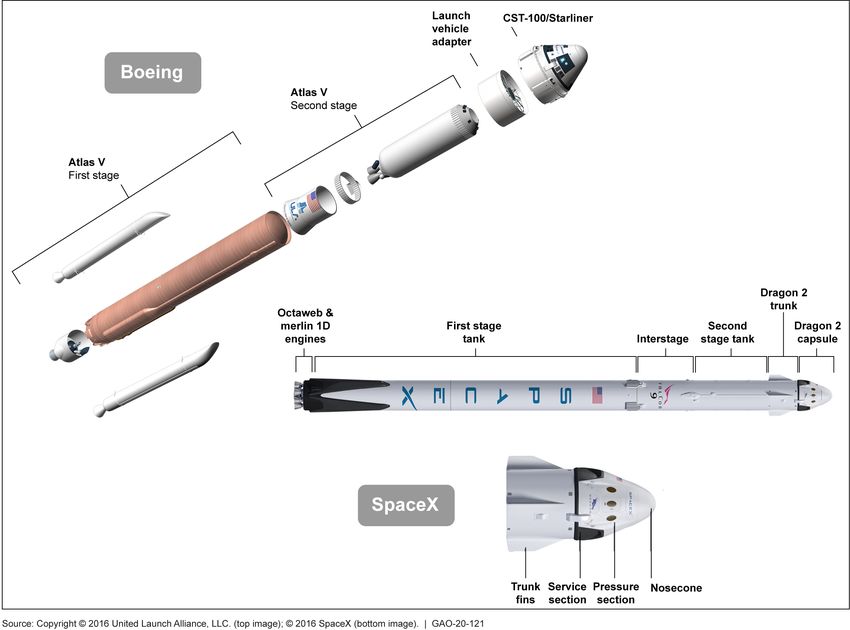
NASA COMMERCIAL CREW PROGRAM

                                   Significant Work Remains to Begin Operational Missions
                                   to the Space Station

                                   January 2020

                                   Highlights of GAO-20-121, a report to congressional committees

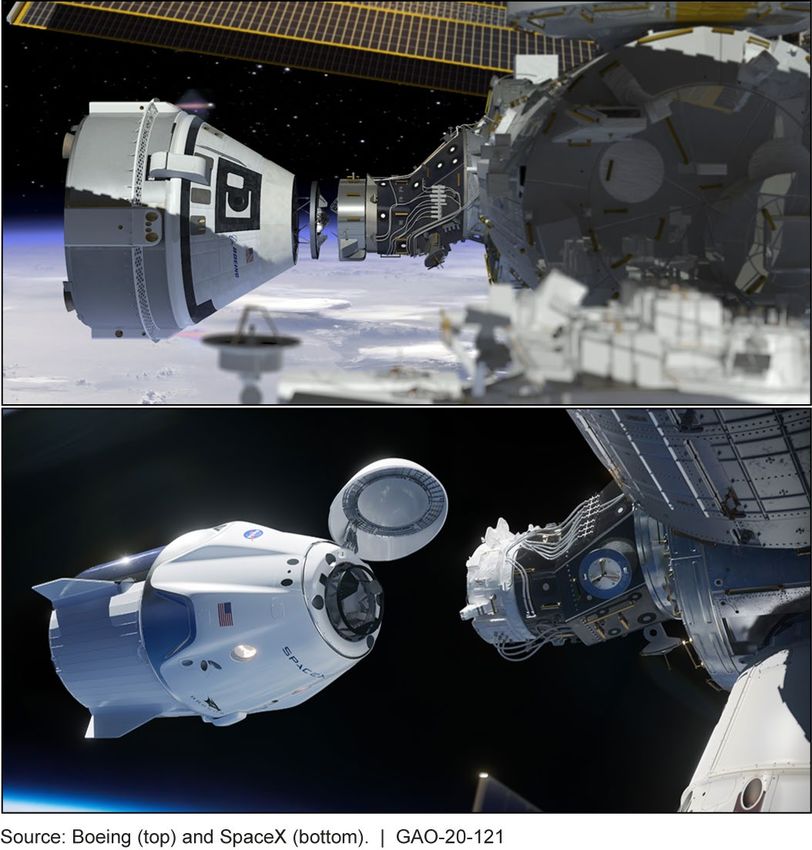
                                                                     Artists’ Depictions of Boeing (top) and SpaceX (bottom)
 Why This Matters                                                    Spacecraft Docking with the International Space Station
 Since retiring the Space Shuttle in 2011, NASA has
 depended on Russia to transport astronauts to the
 International Space Station (ISS). NASA’s
 Commercial Crew Program is a multibillion dollar
 effort to re-establish a U.S. capability to get a crew to
 space, but it is years behind schedule. NASA may
 have to continue to rely on the Russian transport
 option or risk losing access to the ISS in 2020.

Key Takeaways
NASA will have fewer astronauts on the ISS in 2020
unless the Boeing and SpaceX spacecraft are ready to
fly missions, but significant work remains for both. NASA
has few back-up options if delays continue and will have
only one astronaut on the U.S. side by April 2020. Most
of this astronaut’s time will be spent on maintenance
activities rather than on research and development.
To fly as soon as possible, NASA has been planning to
complete its reviews of the contractors’ systems under
aggressive time frames. This approach is risky because
it assumes the contractors will complete multiple
activities on time. Boeing and SpaceX must conduct
additional test flights, train astronauts, and get a license         What GAO Recommends
from the Federal Aviation Administration (FAA).
                                                                     We recommended in 2018 that NASA develop a plan to
FAA licenses cover the contractors’ launch and reentry               maintain access to the ISS; this recommendation has yet
activities. FAA may grant waivers for changes to the                 to be implemented. In this report, we add two
license that do not jeopardize public safety. For                    recommendations to improve communications on
example, FAA may grant waivers for changes in launch                 waivers between NASA and FAA. Both agencies agreed.
trajectory. NASA needs to know when such changes
have been made in case they affect the crew. While                   How GAO Did This Study
NASA and FAA have coordinated on launch licensing for
years, they have not yet decided how they will                       We reviewed NASA and FAA’s memorandum of
communicate about waivers. As a result, NASA may not                 understanding and joint program management plan, and
have all the information it needs for launch decisions.              program and contract documents. We interviewed
                                                                     NASA, FAA, Boeing, and SpaceX officials to understand
                                                                     progress toward the mission and the extent to which
                                                                     NASA and FAA have coordinated.

                                                                            For more information, contact: Cristina T. Chaplain at
                                                                                          (202) 512-4841 or chaplainc@gao.gov
                                                                                  United States Government Accountability Office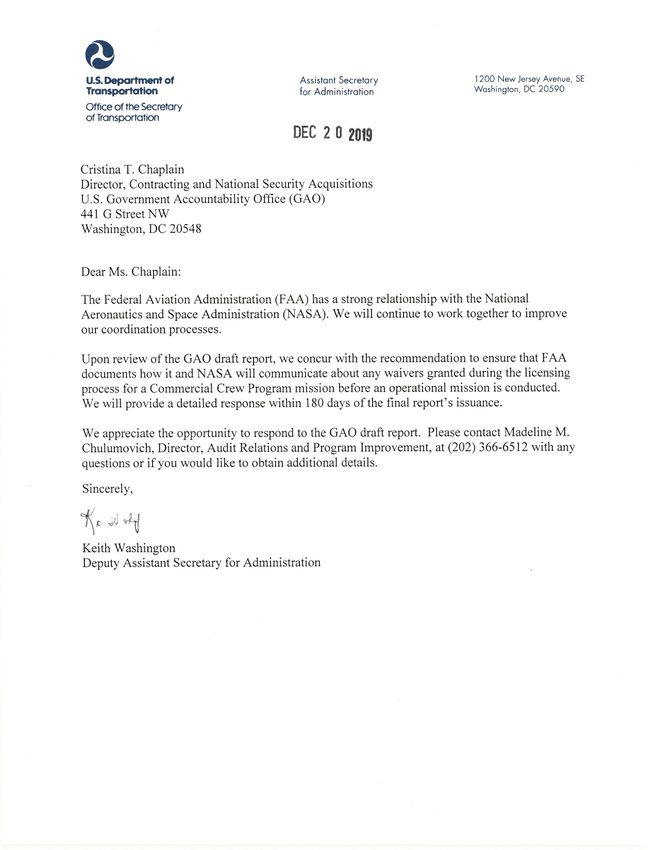
Contents

Letter                                                                                 1
               Background                                                              3
               NASA Is Aggressively Pursuing Transition to First Operational
                 Missions; Contingency Options All Have Limitations                    6
               Collaboration on FAA Licensing Process Has Been Underway for
                 Years, but NASA and FAA Have Yet to Finalize Mechanism to
                 Communicate about Waivers                                           15
               Conclusions                                                           17
               Recommendations for Executive Action                                  17
               Agency Comments and Our Evaluation                                    18

Appendix I     Comments from National Aeronautics and Space Administration           19

Appendix II    Comments from the Department of Transportation                        21

Appendix III   GAO Contact and Staff Acknowledgments                                 22

Tables
               Table 1: Mission Assignment and Current Status of SpaceX’s
                       Spacecraft as of November 2019                                12
               Table 2: Mission Assignment and Current Status of Boeing’s
                       Spacecraft as of November 2019                                14

Figures
               Figure 1: Boeing and SpaceX Crew Transportation Systems                 4
               Figure 2: Notional Commercial Crew Program Path to Operational
                        Missions                                                       5
               Figure 3: Planned Number of Astronauts on the U.S. On-Orbit
                        Segment of the International Space Station Transported
                        on a Russian Soyuz Spacecraft, as of October 2019              8
               Figure 4: Original Schedule of Reviews Compared to Schedule
                        Needed to Support March 2020 Operational Flight              10

               Page i                             GAO-20-121 NASA Commercial Crew Program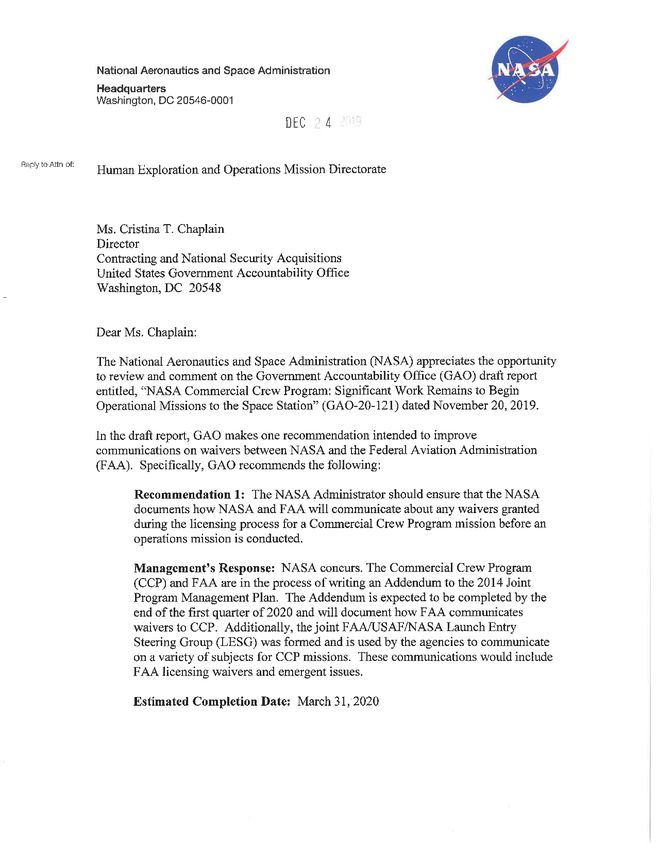
Abbreviations

DOT               Department of Transportation
FAA               Federal Aviation Administration
INKSNA            Iran, North Korea, and Syria Nonproliferation Act
ISS               International Space Station
NASA              National Aeronautics and Space Administration
Roscosmos         Russian Federal Space Agency

This is a work of the U.S. government and is not subject to copyright protection in the
United States. The published product may be reproduced and distributed in its entirety
without further permission from GAO. However, because this work may contain
copyrighted images or other material, permission from the copyright holder may be
necessary if you wish to reproduce this material separately.

Page ii                                       GAO-20-121 NASA Commercial Crew Program
Letter

441 G St. N.W.
Washington, DC 20548

                       January 29, 2020

                       The Honorable Jerry Moran
                       Chairman
                       The Honorable Jeanne Shaheen
                       Ranking Member
                       Subcommittee on Commerce, Justice, Science, and Related Agencies
                       Committee on Appropriations
                       United States Senate

                       The Honorable José Serrano
                       Chairman
                       The Honorable Robert B. Aderholt
                       Ranking Member
                       Subcommittee on Commerce, Justice, Science, and Related Agencies
                       Committee on Appropriations
                       House of Representatives

                       Following the retirement of the Space Shuttle in 2011, the United States
                       was left with no domestic ability to provide crew access to the
                       International Space Station (ISS). Since then, the National Aeronautics
                       and Space Administration (NASA) has relied on obtaining seats on the
                       Russian Soyuz spacecraft to maintain a U.S. presence on the station.
                       NASA’s Commercial Crew Program is facilitating the multibillion dollar
                       commercial development of a crew transportation system that can provide
                       safe, reliable, and cost-effective transportation to and from the ISS and
                       that would end this dependency.

                       NASA’s acquisition strategy for the Commercial Crew Program is similar
                       to the one it used on the Commercial Cargo Program, but different from
                       its strategies for other spacecraft it has built for humans, from Mercury to
                       Gemini and Apollo to the Space Shuttle. Under the Commercial Crew
                       Program, two contractors—Boeing and SpaceX—design, develop, build,
                       own, and will eventually operate their spaceflight systems and
                       infrastructures. The contractors have access to NASA’s expertise and
                       resources throughout the development process, but NASA engineers are
                       not the ones making design decisions, and NASA personnel are less
                       involved in processing, testing, launching, and operating the crew
                       transportation system. In addition, NASA must certify the contractors’
                       spacecraft, launch vehicle, and ground support systems before the
                       contractors can begin operational missions to the ISS. In the end, NASA
                       will buy a crew transportation service—a ride for its astronauts to and

                       Page 1                                 GAO-20-121 NASA Commercial Crew Program
from the ISS. For each operational mission, the contractors are required to obtain and maintain a Federal Aviation Administration (FAA) license for launches and reentries. The House Committee on Appropriations included a provision in its 2017 report for GAO to continue to review NASA’s human space exploration programs, including the Commercial Crew Program. 1 This report is the latest in a series of reports addressing the mandate. This report assesses (1) the extent to which NASA and the contractors are preparing to transition from certification to operations and (2) the extent to which NASA, FAA, and the contractors have made progress towards licensing the first operational missions. To assess NASA and the contractors’ transition to operations, we reviewed program and contract documents, including quarterly progress updates and monthly risk charts. We reviewed the October 2019 ISS flight plan to gain insight into the ISS astronaut rotations through the end of 2020. We reviewed the Commercial Crew Program’s flight readiness process, which outlines how the agency will approve an operational mission, and identified the milestone that begins that process. We compared time frames outlined in the flight readiness plan against the program’s proposed schedule to support a March 2020 operational mission. We reviewed NASA’s contracts with Boeing and SpaceX to determine to what extent NASA has flexibility about when it begins the flight readiness process. We also interviewed program and contractor officials to understand NASA’s process to prepare for each operational mission, as well as progress made by each contractor to complete tasks, such as manufacturing hardware, prior to their first operational missions. For each contractor, we reviewed Commercial Crew Program and contractor documents to identify the current status of the hardware as well as updates to technical risks that we identified in our June 2019 report. 2 We also reviewed the contractors’ training plans and spoke with program and contractor officials to determine the status of astronaut training as well as roles and responsibilities for NASA and the contractor. 1H.R. Rep. No. 115-231, at 62 (2017). 2NASA Commercial Crew Program: Schedule Uncertainty Persists for Start of Operational Missions to the International Space Station, GAO-19-504 (Washington, D.C.: June 20, 2019) Page 2 GAO-20-121 NASA Commercial Crew Program
To assess the extent to which NASA, FAA, and the contractors have
             made progress toward licensing the first operational mission for each
             contractor, we reviewed NASA and FAA’s June 2012 Memorandum of
             Understanding and April 2016 Joint Program Management Plan as well
             as contract documents. Through our review of these documents, we
             identified steps NASA and FAA have taken to document the roles and
             responsibilities of FAA, NASA, and each contractor. We also interviewed
             NASA, FAA, and contractor officials to understand to what extent the
             parties have collaborated and coordinated to date and to obtain a status
             update on the license applications.

             We conducted this performance audit from May 2019 to January 2020 in
             accordance with generally accepted government auditing standards.
             Those standards require that we plan and perform the audit to obtain
             sufficient, appropriate evidence to provide a reasonable basis for our
             findings and conclusions based on our audit objectives. We believe that
             the evidence obtained provides a reasonable basis for our findings and
             conclusions based on our audit objectives.

             In 2014, NASA awarded firm-fixed-price contracts to Boeing and SpaceX
Background   for the development of crew transportation systems that meet NASA
             requirements and for the initial service missions to the ISS. 3

             Boeing’s spacecraft—CST-100 Starliner—is composed of a crew module
             and a service module.

             •    The crew module will carry the crew and cargo. It also includes
                  communication systems, docking mechanisms, and return systems for
                  Earth landing.
             •    The service module provides propulsion on-orbit and in abort
                  scenarios as well as radiators for thermal control.
             SpaceX’s spacecraft—Dragon 2 or Crew Dragon—is composed of a
             capsule, which we refer to as the crew module, and a trunk, which we
             refer to as the support module.

             3A firm-fixed-price contract provides for a price that is not subject to any adjustment on the
             basis of the contractor’s cost experience in performing the contract. This contract type
             places upon the contractor maximum risk and full responsibility for all costs and resulting
             profit or loss. It provides maximum incentive for the contractor to control costs and perform
             effectively and imposes a minimum administration burden upon the contracting parties.
             FAR 16.202-1.

             Page 3                                         GAO-20-121 NASA Commercial Crew Program
• The crew module is composed of a pressure section and a service
section. This module will carry the crew and cargo. It also includes
avionics, docking mechanisms, and return systems for a water
landing.
• The support module includes solar arrays for on-orbit power and
guidance fins for escape abort scenarios.
Figure 1 shows the spacecraft and launch vehicles for Boeing and
SpaceX’s crew transportation systems.
Figure 1: Boeing and SpaceX Crew Transportation Systems
Page 4 GAO-20-121 NASA Commercial Crew ProgramAfter the contractor has successfully completed all of its test flights and
various other activities, NASA determines at the certification milestone
whether the crew transportation system and astronaut training plan meet
the Commercial Crew Program’s requirements. Following this contract
milestone is an agency certification review, which authorizes the use of a
contractor’s system to transport NASA crew to and from the ISS.
After certification, the Commercial Crew Program, the FAA, and the
contractors must complete additional activities prior to an operational
mission to the ISS, as shown in figure 2.
Figure 2: Notional Commercial Crew Program Path to Operational Missions
• The Commercial Crew Program must verify readiness through its
flight readiness process. This process begins with a milestone where
NASA reviews any new or open requirements, among other things.
The program’s flight readiness process ends with the program
manager’s approval to proceed with the operational mission.
• The contractors are required to obtain and maintain FAA commercial
space transportation licenses to authorize launch and reentry
operations. The contractors submit an application for a license to the
FAA, which has 180 days to review the application and decide if it will
grant a license.
• The FAA, within the Department of Transportation (DOT), is
responsible for ensuring the protection of the public, property, and
the national security and foreign policy interests of the United
States during commercial launch and reentry activities. The FAA
executes its public safety responsibility by issuing licenses or
Page 5 GAO-20-121 NASA Commercial Crew Programexperimental permits that authorize those operations in
accordance with applicable regulations and statutory authority.
During FAA-licensed operational missions for Commercial Crew,
NASA retains responsibility for astronaut safety and mission
assurance.
• NASA’s Flight Operations Directorate and the contractors must train
astronauts for the operational missions. The Flight Operations
Directorate provides ISS training, including the use of ISS systems or
spacewalks, while the contractors provide training on their spacecraft
related to launch and ISS docking.
Since NASA retired the Space Shuttle in 2011, it has relied on purchasing
seats from the Russian Federal Space Agency, Roscosmos, on the
Russian Soyuz spacecraft to transport astronauts to and from the ISS. In
order to purchase those seats and conduct onboard required activities to
safely operate the ISS, NASA has requested and obtained an exemption
to Section 6 of the Iran, North Korea, and Syria Nonproliferation Act
(INKSNA), which generally prohibits NASA from making any payments to
Roscosmos in connection to the ISS. 4
At the time of our review, the Commercial Crew Program was on a path to
NASA Is Aggressively compress the remaining schedule activities in order to try to launch the
Pursuing Transition to first operational mission to the ISS by March 2020. Underpinning the
Commercial Crew Program’s proposed schedule to launch an operational
First Operational mission by this date was the assumption that a crewed test flight would
Missions; occur in December 2019, which did not happen. The number of U.S.
astronauts on the ISS is scheduled to begin decreasing at the end of
Contingency Options March 2020. Decreasing the number of U.S. astronauts on the ISS will
All Have Limitations affect NASA’s ability to continue to maintain the station and conduct
research. NASA officials stated they will not fly operational missions until
it is safe to do so. Before they can fly an operational mission, the
contractors will also have to complete testing, finish building hardware,
and train the astronauts. As of November 2019, NASA officials had
identified three options, each with limitations, to ensure a U.S. presence
on the ISS: operate the ISS with one U.S. astronaut, use Boeing’s crewed
test flight as a way to transport astronauts to and from the station for an
4Iran, North Korea, and Syria Nonproliferation Act, Pub. L. No. 106–178 (2000), as
amended by Pub. L. No. 107–228, § 1306 (2002); Pub. L. No. 109–112, §§ 3–4(e)(1)
(2005); Pub. L. No. 109–353, § 3 (2006); Pub. L. No. 110–329, § 125 (2008); Pub. L. No.
112–273, § 4 (2013); Pub. L. No. 116-94, Division I, Title VII, § 701 (2019).
Page 6 GAO-20-121 NASA Commercial Crew Programextended stay, or pursue a statutory exemption to INKSNA to allow the
purchase of additional Soyuz seats. In December 2019, while our report
was with NASA and DOT for review and comment, Congress approved
an extension of 5 years to NASA’s exemption from the INKSNA
prohibition. This extends NASA’s ability to purchase seats from
Roscosmos to December 31, 2025.
NASA Must Complete a Through the course of our review, NASA’s Commercial Crew Program did
Significant Number of not have a publicly available schedule for completing certification and
conducting the first operational mission. In July 2019—following the
Activities before
reassignment of key leadership that oversees the program—the NASA
Conducting First Administrator stated that one of the first tasks once new leadership is in
Operational Missions place would be to reexamine the cost and schedule for the Commercial
Crew Program, among other key programs. In October 2019, the NASA
Administrator had identified new leadership, but a schedule for when
either contractor would be ready to fly an operational mission was still
pending.
We have previously found that the contractors’ schedules regularly
change, and this pattern continues. 5 It is important to have a schedule so
that NASA can gauge the program’s progress and demonstrate
accountability to decision-makers. While the program has an internal
schedule it is working toward, neither contractor has had a publicly
available schedule that reflects that internal schedule.
• As of February 2019, SpaceX planned to conduct an uncrewed test
flight in March 2019—which it successfully completed—and a crewed
test flight in July 2019. As of December 2019, it had not conducted its
crewed test flight and NASA has not announced a new schedule.
SpaceX officials stated that they plan to conduct this crewed test flight
in early 2020.
• As of March 2019, Boeing planned to conduct an uncrewed test flight
in August 2019 and a crewed test flight by late 2019. Boeing
conducted its uncrewed test flight in December 2019. During this test
flight, Boeing successfully launched and landed its spacecraft, but the
spacecraft did not reach the planned orbit and did not dock with the
5GAO, NASA Commercial Crew Program: Schedule Pressure Increases as Contractors
Delay Key Events, GAO-17-137 (Washington, D.C.: Feb. 16, 2017); NASA Commercial
Crew Program: Plan Needed to Ensure Uninterrupted Access to the International Space
Station, GAO-18-476 (Washington, D.C.: July 11, 2018); and GAO-19-504.
Page 7 GAO-20-121 NASA Commercial Crew ProgramISS. NASA officials told us that the spacecraft did not reach the
planned orbit after an anomaly with the mission elapsed timer, and
that the investigation into this anomaly is ongoing. NASA has not
provided an update on a planned date for a crewed test flight.
Even as the program is revisiting its schedule, external schedule pressure
to conduct an operational mission soon is increasing. ISS program
officials told us that they need a Commercial Crew Program contractor to
begin flying operational missions by March 2020. As shown in figure 3,
the NASA presence on the ISS is set to drop to one astronaut in April
2020 and none by October 2020 if a Commercial Crew Program
contractor is not able to begin flying operational missions, unless NASA
purchases a seat on the Russian Soyuz spacecraft. 6
Figure 3: Planned Number of Astronauts on the U.S. On-Orbit Segment of the International Space Station Transported on a
Russian Soyuz Spacecraft, as of October 2019
6NASA’s presence could be maintained by an astronaut from any of the countries that
support the U.S. on-orbit Segment of the ISS, which includes the United States, Canada,
Japan, and participating countries of the European Space Agency.
Page 8 GAO-20-121 NASA Commercial Crew ProgramISS program officials told us that having an operational mission in March 2020 would allow the ISS to continue normal operations, which includes both regular maintenance activities and research and development. If NASA has just one astronaut on the ISS, that astronaut will have to spend more time on required ISS maintenance activities rather than research and development. Further, NASA will have a limited ability to maintain and repair the ISS. For example, spacewalks are often used for preventive and corrective maintenance, and NASA officials told us these require two U.S. astronauts. If there is only one U.S. astronaut on the ISS, NASA officials said they would not plan to conduct any spacewalks. However, in the event of an emergency, officials told us that NASA is training Russian cosmonauts to perform critical contingency spacewalk activities. In light of the need to continue normal operations on the ISS, through the course of our review NASA was planning to support an operational mission by March 2020. To do so, it was planning to conduct several activities concurrently, including the contractors’ test flights. NASA planned to concurrently complete each contractor’s certification—the process NASA uses to ensure the contractors’ systems meet its requirements for spaceflight—with NASA’s flight readiness process—the process NASA uses to approve an operational mission for flight. According to program documents, completion of the contractor’s certification is required prior to starting the flight readiness process. Further, the flight readiness process is required to begin about 4 months before the scheduled launch date for each operational mission. However, in order to support an operational mission in March 2020, the Commercial Crew Program planned to begin the flight readiness process before completing certification (see fig. 4). Underpinning the Commercial Crew Program’s proposed schedule to launch an operational mission by March 2020 was the assumption that a crewed test flight would occur in December 2019, which did not happen. Page 9 GAO-20-121 NASA Commercial Crew Program
Figure 4: Original Schedule of Reviews Compared to Schedule Needed to Support March 2020 Operational Flight

                                        If NASA continues to pursue this path, the overlap of NASA’s two
                                        processes introduces schedule risk because of the compression of
                                        several activities in a 4-month window and the completion of key events—
                                        including the crewed test flight and certification—closer to the first
                                        operational mission than originally planned. Program officials told us that
                                        they believed this concurrent approach was doable because they will
                                        have completed the majority of work to support certification prior to each
                                        contractor’s crewed test flight.

                                        We have previously raised concerns, however, about workload for the
                                        program office. 7 Previously, NASA was able to manage its workload
                                        because the two contractors’ test flights did not overlap. For example,
                                        recently, the program was able to complete work to support SpaceX’s
                                        uncrewed test flight in March 2019, and then it was able to switch focus to
                                        complete work to support Boeing’s uncrewed test flight. Commercial Crew
                                        Program officials stated that their workforce is already working at full
                                        capacity to complete development activities and support certification, and
                                        they are trying to utilize resources, such as additional staff, from across
                                        the agency to complete the higher workload.

                                        7GAO-17-137,   GAO-18-476, and GAO-19-504.

                                        Page 10                                 GAO-20-121 NASA Commercial Crew Program
Contingency Options Have NASA officials have stressed that they will not fly an operational mission
Limited Usefulness to until NASA and the contractors are ready and it is safe to do so. As a
result, NASA is considering alternatives to ensure a U.S. presence on the
Avoid a Reduced
ISS in the event one or both of the Commercial Crew Program
Presence on the ISS If contractors are not ready to fly an operational mission by March 2020, but
Contractors Do Not Fly by these options have limitations. These options include:
March 2020
• Operate the ISS with one U.S. crew member. As previously stated,
NASA would not plan to conduct spacewalks in this scenario, and the
astronaut would spend more time on ISS maintenance activities than
on research and development.
• Use Boeing’s crewed test flight as a way to transport U.S. astronauts
to and from the ISS. In July 2018, we found that NASA modified
Boeing’s contract to allow NASA to add a third crew member and
extend the length of the flight test, if NASA chooses to do so. 8 This
would have limited usefulness, however, if Boeing continues to
experience delays completing its hardware, training the crew, and
conducting test flights.
• Obtain an exemption to INKSNA in order to purchase additional
Soyuz seats from Roscosmos. In December 2019, while our report
was with NASA and DOT for review and comment, Congress
approved an extension of 5 years to NASA’s exemption from the
INKSNA prohibition. This extends NASA’s ability to purchase seats
from Roscosmos to December 31, 2025. There is a Soyuz launch
planned for October 2020 that would return in spring 2021, which
could potentially extend U.S. access to the ISS; however, NASA will
need to negotiate the purchase of that seat with Roscosmos and
NASA would still have to operate the ISS with one astronaut from
April to October 2020.
In July 2018, we recommended that NASA develop and maintain a
contingency plan for ensuring a presence on the ISS until one of the
contractors was certified. 9 NASA agreed with this recommendation. To
fully address this recommendation, NASA would need to provide
documentation regarding planning efforts—for example, those associated
with the options outlined above—to ensure uninterrupted access to the
ISS. A comprehensive plan that captures these planning efforts, including
time frames for taking action, would provide decision makers within NASA
8GAO-18-476.
9GAO-18-476.
Page 11 GAO-20-121 NASA Commercial Crew Programand Congress insight into what options exist, even if they are limited, and
when they may need to be executed.
Contractors Must Significant work remains for the contractors to support first operational
Complete Testing, missions. We have previously reported that the contractors have been
delayed 2 years beyond the original dates in their contract, and that over
Hardware Builds, and
time, both program and contractor officials have told us they struggle to
Astronaut Training to establish stable schedules. 10 Before they can conduct an operational
Support the First mission, Boeing and SpaceX each must complete their remaining test
Operational Missions flights.
Both contractors must also finish preparing the spacecraft for their first
operational missions while addressing ongoing technical issues. More
information follows.
SpaceX. SpaceX has several spacecraft in production and shifted
spacecraft assignments as a result of an April 2019 anomaly, which
destroyed one of its spacecraft during a test event. As seen in table 1,
flight spacecraft 3 was originally assigned to SpaceX’s first operational
mission, but will now be used for its crewed test flight.
Table 1: Mission Assignment and Current Status of SpaceX’s Spacecraft as of November 2019
Mission assignment
Spacecraft Before April 2019 anomaly After April 2019 anomaly Current status
Flight Spacecraft 1 Uncrewed Test Flight Uncrewed Test Flight Flown in March 2019.
In-Flight Abort Testa Destroyed in an April
2019 testing event when
an anomaly occurred.
Flight Spacecraft 2 Crewed Test Flight In-Flight Abort Testa In construction
Flight Spacecraft 3 First Operational Mission Crewed Test Flight In construction
Flight Spacecraft 4 Second Operational Mission First Operational Mission In construction
Source: GAO analysis of Commercial Crew Program and contractor documents. | GAO-20-121
a
The in-flight abort test is used to demonstrate a spacecraft’s ability to safely carry crew away from a
launch vehicle emergency, if necessary.
10GAO-17-137, GAO-18-476, and GAO-19-504.
Page 12 GAO-20-121 NASA Commercial Crew ProgramTo support an operational mission in March 2020, program officials told us that SpaceX plans to complete construction of flight spacecraft 4—now the first operational mission spacecraft—3 months earlier than originally planned. SpaceX and program officials identified two reasons why this acceleration may be possible. First, they told us there will likely be manufacturing efficiencies that could allow SpaceX to meet the accelerated schedule for its first operational mission. Program officials said the spacecraft design for the first operational mission is the same as the other spacecraft, and that this would be SpaceX’s fourth time building the spacecraft. Second, SpaceX officials said they modified their facilities and brought in additional resources. However, SpaceX’s ability to accelerate the hardware builds may be constrained due to additional late rework resulting from the ongoing anomaly investigation and from SpaceX’s remaining test flights. As of September 2019, the SpaceX investigation team, which includes NASA participation, had identified several contributors to the anomaly. For example, a stuck-open valve allowed propellant to migrate within the system. SpaceX has redesigned the system and is implementing the hardware changes on its remaining spacecraft. However, the investigation is still ongoing, so additional hardware changes may be identified. Furthermore, following the in-flight abort test and the crewed test flight, SpaceX may identify new hardware changes, which could require additional late rework. In addition to incorporating hardware changes instituted after the anomaly and accelerating its hardware builds, SpaceX continues to address technical risks identified by program officials. These include (1) SpaceX’s plan to conduct launch vehicle propellant loading procedures after the astronauts are on board and (2) the design of its launch vehicle engine. The propellant loading procedure risk remains open because, as of November 2019, SpaceX still needed to demonstrate the loading process at several upcoming events, including the in-flight abort test. The launch vehicle engine risk remains open because SpaceX needed to complete the required follow-on test campaign of its engines as of November 2019. Boeing. Boeing has 2 spacecraft in production. For its first operational mission, Boeing plans to refurbish the spacecraft it is using for its uncrewed test flight. As shown in table 2, work cannot start on the refurbishment process until the uncrewed test flight is complete. Page 13 GAO-20-121 NASA Commercial Crew Program
Table 2: Mission Assignment and Current Status of Boeing’s Spacecraft as of
November 2019

 Spacecraft                        Mission assignment                           Current status
 Flight Spacecraft 1               Crewed Test Flight                           In construction
 Flight Spacecraft 2               Uncrewed Test Flight                         Constructed
                                   First Operational Mission                    Will need to be refurbished
                                                                                after the uncrewed test flight is
                                                                                complete
Source: GAO analysis of Commercial Crew Program and contractor documents. | GAO-20-121

There is a risk that the refurbishment process for the first operational
mission may take longer than planned, depending on the spacecraft’s
condition after it is used for Boeing’s uncrewed test flight. As of January
2020, NASA officials told us that an assessment of the spacecraft’s
condition was ongoing. Boeing has not completed this refurbishment
process previously. However, officials stated that they expect to gain
experience with the process because some refurbishment work is
required on flight spacecraft 1 between its use for a test event and then
its use for the crewed test flight. Boeing officials estimate that the crew
module refurbishment process will take 4 months. Boeing conducted its
uncrewed test flight in December 2019. Allotting 4 months for the
refurbishment process means that Boeing will not be able to support an
operational mission before April 2020, assuming the crewed test flight is
completed by then as well.

In addition to refurbishing a flown spacecraft for the first time, Boeing
continues to address technical risks identified by program officials. This
includes a risk that the initiators that trigger separation events, such as
the separation of the crew and service module prior to reentry, may
generate debris and damage the spacecraft. In June 2019, we found that
Boeing had identified a solution to contain the debris that was sufficient
for its test flights. 11 Since our last report, program officials said that a
number of problems were found in recent testing and that the
independent engineering technical authority noted that the current initiator
containment design is not acceptable for the crewed flight test. Program
officials told us that they accepted this risk for the uncrewed flight test, but
that additional testing will need to occur before the crewed flight test.

11GAO-19-504.

Page 14                                                       GAO-20-121 NASA Commercial Crew Program
Astronaut Training. While completing hardware builds, both contractors
must also finalize and execute their astronaut training plans to support
their first operational missions. Though NASA has not yet certified the
plans, program officials said they understood the contractors’ training
plans well enough to give the contractors approval to begin training.
Before they can fly an operational mission, the contractors may need
additional time following their crewed test flights to update and complete
the astronauts’ training. NASA officials said that it is not possible to know
how much time will be needed to incorporate lessons learned from the
crewed test flights into the training plans. However, NASA officials
estimated that the program and the contractors could need 3 to 6 months
after their crewed test flights to update and finalize training before the first
operational missions. NASA officials said they and the contractors would
need this time to incorporate lessons learned from the crewed test flight
into the training program, complete astronaut training, and prepare for the
first operational mission flight readiness review.
Boeing and SpaceX each have developed a working relationship with
Collaboration on FAA FAA to facilitate the licensing process. Since 2017, FAA officials have
Licensing Process unofficially observed the contractors’ development activities, including the
test flights, leading up to the first operational missions, to gain awareness
Has Been Underway and familiarity with both contractors’ systems. Contractor officials told us
for Years, but NASA that this has overall been a positive experience since it allows FAA and
the contractors to work on the license application before it is submitted,
and FAA Have Yet to including working through areas that might delay or prevent the license
Finalize Mechanism from being awarded. For example, Boeing officials stated that they
worked with FAA to determine how to provide FAA access to
to Communicate communication channels as the launch progresses in the event FAA
about Waivers loses access to real-time data. Both contractors told us that they do not
foresee an issue in obtaining a license and believe that, if any issues do
arise, they have existing mechanisms that would allow them to resolve
the issues.
Since 2012, NASA and FAA have also worked together to understand the
other agency’s requirements or standards in order to ensure the
contractors will be able to obtain a license. NASA and FAA have
collaborated in a number of ways, including the following:
• NASA and FAA signed a Memorandum of Understanding in 2012 that
outlines the areas of work on which the two agencies agree to
Page 15 GAO-20-121 NASA Commercial Crew Programcollaborate, including the advancement of public and crew safety and
avoiding conflicting requirements and multiple sets of standards. 12
• In 2012, FAA and NASA officials reviewed the other agency’s
requirements to identify potential barriers to FAA licenses for
Commercial Crew Program missions and to avoid duplicating agency
efforts. This exercise resulted in identifying issues needing additional
attention. For example, FAA and NASA identified the need to define a
“government astronaut” to ensure NASA’s astronauts could perform
their expected duties on an FAA licensed mission. Simple clarification
allowed the number of issues to be reduced.
• The agencies expanded on the Memorandum of Understanding
through the Joint Program Management Plan (joint plan) in 2014. The
joint plan defines how NASA and the FAA will collaborate to share
information, analysis, and resources, thereby reducing the burden on
the contractors. The joint plan also documents resolution of many of
the outstanding issues identified in 2012.
• Several working groups were also created to help facilitate
communication between the two agencies. NASA officials told us that
while the working groups are less active now, FAA and NASA officials
continue to collaborate through biweekly meetings. Officials from both
agencies stated that they have strong working relationships with their
counterparts.
One of the remaining open issues is how NASA and FAA will
communicate regarding waivers that FAA could grant during the licensing
process. FAA may grant waivers for changes to the license that do not
jeopardize public safety. NASA officials explained that they want to be
aware of FAA waivers before making a flight readiness decision to ensure
that the waiver does not have an implication for crew safety. For example,
NASA officials told us that FAA could grant a waiver to the contractor’s
launch trajectory lines. NASA officials explained that such a waiver could
affect the crew in the event of an abort.
Both FAA and NASA officials have stated that they have not yet
developed formal channels or mechanisms to share information related to
license waivers for Commercial Crew missions because this has not been
a priority for either organization. As of October 2019, however, NASA and
12The original Memorandum of Understanding expired in 2018. NASA officials told us they
have reviewed and approved it, and that as of July 2019, it was being reviewed and
approved by FAA officials.
Page 16 GAO-20-121 NASA Commercial Crew ProgramFAA officials stated that they have begun to draft an update to the joint
plan that would document how FAA and NASA will communicate about
waivers. FAA officials said that they plan to have a draft completed by the
end of 2019, but it would still need to be reviewed and approved by both
agencies before taking effect. As of October 2019, there was no time
frame for the review and approval process. Two of the primary goals of
the agencies’ joint plan were to outline the roles and responsibilities of
both agencies and to ensure that each agency has the appropriate level
of information and insight to execute its responsibilities under their
respective authorities. Until FAA and NASA finalize the mechanism for
communication about license waivers, NASA is at risk of relying on
informal communication mechanisms when making a flight readiness
decision.
While NASA and the contractors continue to make progress developing
Conclusions crew transportation systems to help the United States re-establish its
domestic ability to provide crew access to the ISS, uncertainty remains
about when operational missions can begin. NASA’s plans to compress
the transition from completing certification to the start of operational
mission may not leave enough time to complete key reviews. It also
remains to be seen whether either contractor can finish manufacturing the
hardware and training the astronauts in order to support NASA’s planned
time frames. In light of this uncertainty regarding when operational
missions can begin, it is even more important that NASA complete action
on our open recommendation to develop a contingency plan, with time
frames, to ensure a presence on the ISS.
NASA and FAA have collaborated since the early phases of the
Commercial Crew Program and addressed a number of issues. However,
time is running out for NASA and FAA to finalize a mechanism to
communicate about waivers; in the meantime, the agencies are relying on
informal lines of communication. Establishing a mechanism for how FAA
will communicate with NASA about license waivers would ensure NASA
is aware of any waivers that might affect its flight readiness decision.
We are making a total of two recommendations, including one to NASA
Recommendations for and one to FAA.
Executive Action
The NASA Administrator should ensure that NASA documents how NASA
and FAA will communicate about any waivers granted during the licensing
Page 17 GAO-20-121 NASA Commercial Crew Programprocess for a Commercial Crew Program mission before an operational
mission is conducted. (Recommendation 1)
The FAA Administrator should ensure that FAA documents how NASA
and FAA will communicate about any waivers granted during the licensing
process for a Commercial Crew Program mission before an operational
mission is conducted. (Recommendation 2)
We provided a copy of this report to NASA and DOT for comment. In
Agency Comments written comments, NASA agreed with our recommendation and estimated
and Our Evaluation it would address the recommendation in the first quarter of calendar year
2020. NASA’s comments are reprinted in appendix I. In written
comments, DOT agreed with our recommendation, and its comments are
reprinted in appendix II.
We are sending copies of this report to the appropriate congressional
committees, the NASA Administrator, and the Secretary of the
Department of Transportation. In addition, the report is available at no
charge on the GAO website at http://www.gao.gov.
If you or your staff have any questions about this report, please contact
me at (202) 512-4841 or chaplainc@gao.gov. Contact points for our
Offices of Congressional Relations and Public Affairs may be found on
the last page of this report. GAO staff who made major contributions to
this report are listed in appendix III.
Cristina T. Chaplain
Director, Contracting and National Security Acquisitions
Page 18 GAO-20-121 NASA Commercial Crew ProgramAppendix I: Comments from National
Appendix I: Comments from National
Aeronautics and Space Administration
Aeronautics and Space Administration
Page 19 GAO-20-121 NASA Commercial Crew ProgramAppendix I: Comments from National Aeronautics and Space Administration Page 20 GAO-20-121 NASA Commercial Crew Program
Appendix II: Comments from the Department
             Appendix II: Comments from the Department
             of Transportation

of Transportation

             Page 21                                     GAO-20-121 NASA Commercial Crew Program
Appendix III: GAO Contact and Staff
Appendix III: GAO Contact and Staff
Acknowledgments
Acknowledgments
Cristina T. Chaplain, (202) 512-4841 or chaplainc@gao.gov.
GAO Contact
In addition to the contact named above, Molly Traci, Assistant Director;
Staff Kristin Van Wychen, Analyst-in-Charge; Laura Greifner; Kurt Gurka; Joy
Acknowledgments Kim; Roxanna T. Sun; and Alyssa Weir made significant contributions to
this report.
(103527)
Page 22 GAO-20-121 NASA Commercial Crew ProgramThe Government Accountability Office, the audit, evaluation, and investigative
GAO’s Mission arm of Congress, exists to support Congress in meeting its constitutional
responsibilities and to help improve the performance and accountability of the
federal government for the American people. GAO examines the use of public
funds; evaluates federal programs and policies; and provides analyses,
recommendations, and other assistance to help Congress make informed
oversight, policy, and funding decisions. GAO’s commitment to good government
is reflected in its core values of accountability, integrity, and reliability.
The fastest and easiest way to obtain copies of GAO documents at no cost is
Obtaining Copies of through our website. Each weekday afternoon, GAO posts on its website newly
GAO Reports and released reports, testimony, and correspondence. You can also subscribe to
GAO’s email updates to receive notification of newly posted products.
Testimony
Order by Phone The price of each GAO publication reflects GAO’s actual cost of production and
distribution and depends on the number of pages in the publication and whether
the publication is printed in color or black and white. Pricing and ordering
information is posted on GAO’s website, https://www.gao.gov/ordering.htm.
Place orders by calling (202) 512-6000, toll free (866) 801-7077, or
TDD (202) 512-2537.
Orders may be paid for using American Express, Discover Card, MasterCard,
Visa, check, or money order. Call for additional information.
Connect with GAO on Facebook, Flickr, Twitter, and YouTube.
Connect with GAO Subscribe to our RSS Feeds or Email Updates. Listen to our Podcasts.
Visit GAO on the web at https://www.gao.gov.
Contact FraudNet:
To Report Fraud,
Website: https://www.gao.gov/fraudnet/fraudnet.htm
Waste, and Abuse in
Automated answering system: (800) 424-5454 or (202) 512-7700
Federal Programs
Orice Williams Brown, Managing Director, WilliamsO@gao.gov, (202) 512-4400,
Congressional U.S. Government Accountability Office, 441 G Street NW, Room 7125,
Relations Washington, DC 20548
Chuck Young, Managing Director, youngc1@gao.gov, (202) 512-4800
Public Affairs U.S. Government Accountability Office, 441 G Street NW, Room 7149
Washington, DC 20548
James-Christian Blockwood, Managing Director, spel@gao.gov, (202) 512-4707
Strategic Planning and U.S. Government Accountability Office, 441 G Street NW, Room 7814,
External Liaison Washington, DC 20548
Please Print on Recycled Paper.You can also read


