Men's Program Updates - with Michael Serra and Marcus Yancey Men's Jr. Olympic Changes How to Start a Boy's Program - USA Gymnastics
←
→
Page content transcription
If your browser does not render page correctly, please read the page content below
Men’s
  Program
  Updates

  with
  Michael
  Serra
  and
  Marcus
  Yancey


  Men’s
  Jr.
  Olympic
  Changes

 How
  to
  Start
  a
  Boy’s
  Program

        EssenAal
  Elements
Major
  Changes
  in
  the
  2017
  Men’s

                Program
  from
  the
  Previous
  Quad.


1.   Age determination date
2.   Introduction of divisions within the compulsory program
3.   Introduction of the Junior Developmental Optional program
4.   Level 8 structural changes
Age
  Group
  CompeAAon
  Program

                        Age
  DeterminaAon


Age Determination and Competition Level:
The Junior Olympic competitive season is defined as September 1st
– May 31st. For all aspects of the Men’s Junior Olympic Age Group
Program, a gymnast’s competitive age throughout the entire
competitive season is determined by the age he will be on May
31st of the current competitive season.

* This also includes competitions through P&G Championships to
September 1st of the next starting season.
Age Group Compulsory Program
3 Developmental Pathways
★ Junior
Elite
Program
–
Future
Stars
★ Levels
4-‐7
Division
I
–
Allows
Bonus
skills
directed
at
Op7onal
Development
★ Levels
4-‐7
Division
II
–
Basic
Compulsory
Rou7nes
aimed
at
fundamental
development
★ No “age bumping” is allowed in the
AGCP
Age Group Competition Program
                Division I & II

★ The two division system for compulsory
  levels developed out of our mission to grow
  the men’s program through accessibility
  and retention.
★ The two division system offers an attractive
  alternative for athletes and programs who
  are not ready to compete the routines with
  all the bonus skills.
★ It keeps them “relevant” in competition by
  establishing a more peer-to-peer
  competitive environment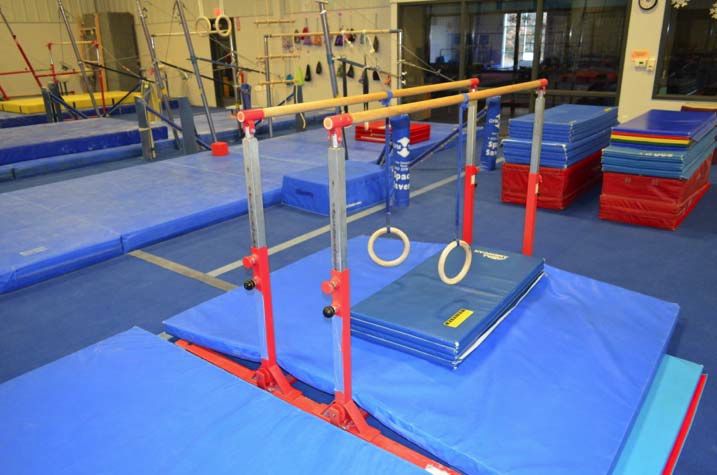
Age Group Competition Program
        Junior Developmental Division II

★ Men’s gymnastics increases in difficulty so
  dramatically it’s important to cultivate the
  stronger base of recreational enjoyment
★ This is similar to the path of growth forged
  in the women’s program but in a construct
  that may work better for the boys program
★ Very important to address the time
  investment and cost of involvement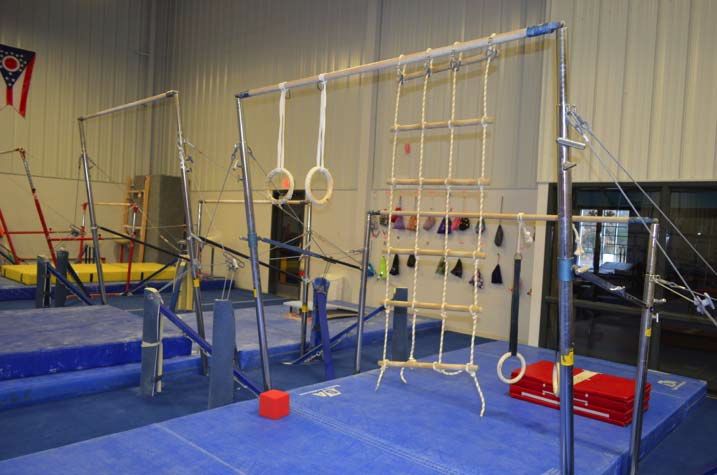
Age Group Competition Program
Junior Developmental Division II
★ All
rou7nes
scored
the
same
way:
§ 9.5
Base
execu7on
+
(.3)
Virtuosity
+
§ (.2)
S7ck
=
10.0
★ Iden7fied
Virtuosity
only
★ Gymnasts
can
be
designated
by
Division
§ Both
Divisions
I
&
II
can
compete
at
same
7me,
the
separa7on
shows
up
only
in
the
scoring
system
you
use
Age Group Competition Program
                     Compulsory Levels: Division I & II

AGE GROUP DESIGNATIONS:

1. Must be 6 years old – Level
   4

2. Level 5 starts at age 7

3. Level 7 starts at age 10-11
   years. Bonus allows
   preparation for optional

4. Two Division system –
   same base routines for
   both.

5. No “Age Bumping” is
   allowed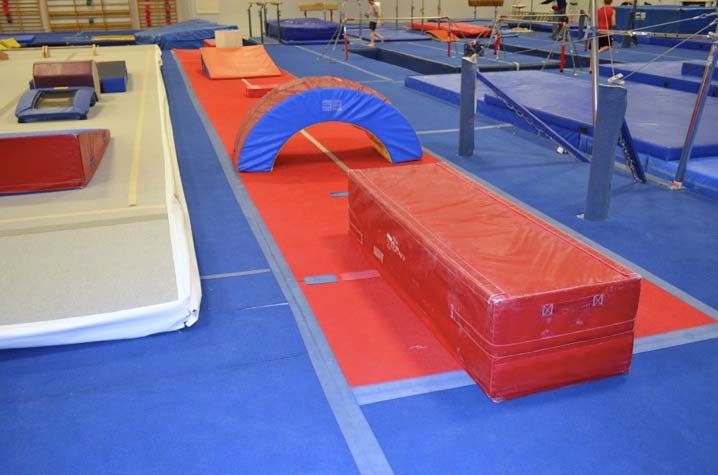
Age Group Competition Program
Junior Developmental Division I & II
★ Each compulsory level offers Division I & II
§ Mobility to go up a Level or up a Division
★ Combined with single age categories this
can offer four different subsets of ability
within each compulsory level.
★ Tailored to fit each community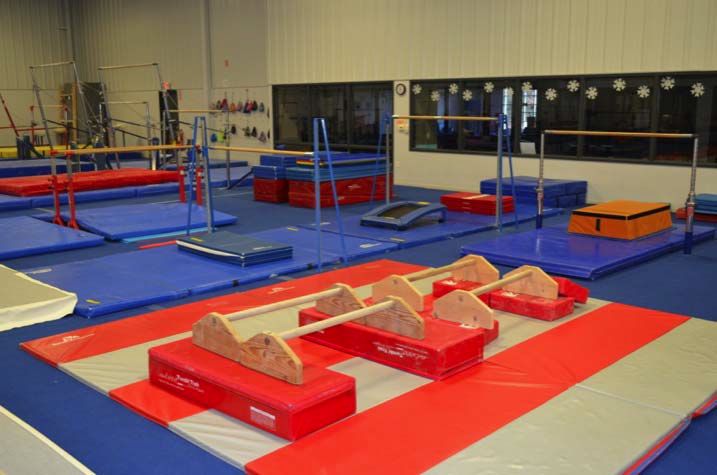
Age Group Competition Program
       Junior Developmental Division I & II

★ Gymnasts can be designated in ProScore by
  level as 5-1 or 5-2 meaning Division I or II
  to tell the judge and the score program
  what division within the level he is.
★ *For Junior Developmental Optional the
  gymnast can be designated as JD
★ Possible to have optional gymnasts in a
  squad that are Level 8, 9, 10 and JD
  designated on your rotation schedule
Age Group Competition Program
Junior Developmental Division I & II
★ Currently USAGym database identifies
gymnasts by numerical numbers indicating
their level … the database format will be
updated in the next few months to include
all divisions
★ You can still download gymnasts into the
program. Go into the program change their
designation manuallyAge Group Competition Program
Junior Olympic Division I
★ Same basic routines as Division II
★ Add any Bonus Skills per level
★ Athletes are higher level talent, stronger,
more capable of advancing skill
★ Program very similar to existing curriculum
★ Levels 6 & 7 begin preparation for optional
with bonus skillsAge Group Competition Program Junior Olympic Division I
Age Group Competition Program
Compulsory Division - Summary
★ Divisional system is our opportunity for growth
§ Junior Development Div. II – ‘recognition’
§ Junior Olympic Div. I – ‘greater ability level’
★ Building Grass root system base
§ “Play the Game” - Essential Elements
★ Recognition by providing a level playing field
Peer vs. Peer competitive field– allows time to
develop, progress, & experience successAge Group CompeAAon Program OpAonal Levels 8-‐9-‐10 & JD
Age
Group
CompeAAon
Program
Junior
Developmental
OpAonal
★ Junior
Developmental
OpAonal
(JD)
§ starts
at
age
12
and
con7nues
to
age
18
§ Simplified
rules
of
rou7ne
construc7on
§ No
FIG
Element
Groups
§ JO
bonus
does
not
apply
§ All
ages
use
pommels
§ Only
competes
through
Regional
level
§ Mobility
between
JD
and
JO
programs
§ A
posi7ve
op7on
for
athletes
to
get
into
or
stay
in
the
sport
at
a
more
recrea7onal
level
of
involvement
Age
Group
CompeAAon
Program
OpAonal
Level
8
★ Junior
Olympic
Level
8
starts
at
Age
12
§ This
age
can
qualify
to
JO
Na5onals
§ Age
11
may
do
op5onal
during
season
in
prepara5on
for
JE
qualifica5on
★ Junior
Elite
=
Age
(11-‐12)
§ Parallels
the
Future
Star
Program
as
determined
by
May
31st
date
§ This
age
can
qualify
to
JO
Na5onals
Age
Group
CompeAAon
Program
OpAonal
Level
9
★ Junior
Olympic
Level
9
=
Age
(13-‐14)
★ Junior
Elite
Level
9
=
Age
(13-‐14)
§ Both
divisions
can
qualify
to
JO
Na7onals
★ Junior
Olympic
Level
9
Age
(15-‐16)
§ Can
only
go
to
Regional
Championships
§ No
17-‐18
division
Age
Group
CompeAAon
Program
OpAonal
Level
10
★ Junior
Olympic
Level
10
=
Age
(17-‐18)
★ JE
&
JO
Level
10
=
Age
(15-‐16)
★ Junior
Elite
Level
10
=
Age
(17-‐18)
§ Can
be
19
in
both
divisions
if
you
are
s7ll
in
High
School
…
refer
to
R&P
Age
Group
CompeAAon
Program
OpAonal
Level
Summary
★ Major
Change
is
adding
Junior
Developmental
Division
–
3rd
pathway
★ Promote
growth
and
reten7on
by
providing
a
legi7mate
division
for
these
athletes
§ Tailored
to
more
recrea7onal
par7cipa7on
§ Less
hour
and
cost
commitment
–
same
benefits
★ Divisional
Con7nuum
is
consistent
with
age
transi7ons
(JE,
JO,
JD)
…
Entry
to
Op7onal
Level
is
at
an
appropriate
7me
for
each
division
Age
Group
CompeAAon
Program
OpAonal
Level
Summary
★ Always
have
mobility
to
divisions
or
levels
★ This
will
be
a
factor
for
each
athlete
§ Where
does
he
belong
on
the
developmental
con7nuum?
§ Where
can
he
have
the
most
success?
§ Coaches
have
choices
…
flexibility
★ Reten7on
of
athletes
&
a
place
for
everyone
within
the
op7onal
program
Notes
Regarding
CompeAAon
HosAng
★ Meet
host
can
keep
levels
together
and
simply
designate
their
division
★ e.g.
Within
the
Level
5
session,
athletes
can
be
designated
as
5-‐1
or
5-‐2
to
reflect
their
division
★ JD
op7onal
age
divisions
can
be
adjusted
by
the
host
as
he
or
she
sees
fit
★ JD
op7onal
athletes
can
compete
in
the
same
session
with
the
JO
op7onal
athletes
of
similar
age
★ There
will
be
more
awards
divisions,
but
perhaps
fewer
awards
given
out
within
each
division
★ We
an7cipate
about
a
25%
increase
in
awards
expenses,
which
should
be
in
the
range
of
2%
of
the
meet
budget.
★ A
small
price
to
pay
for
higher
numbers
in
the
sport.
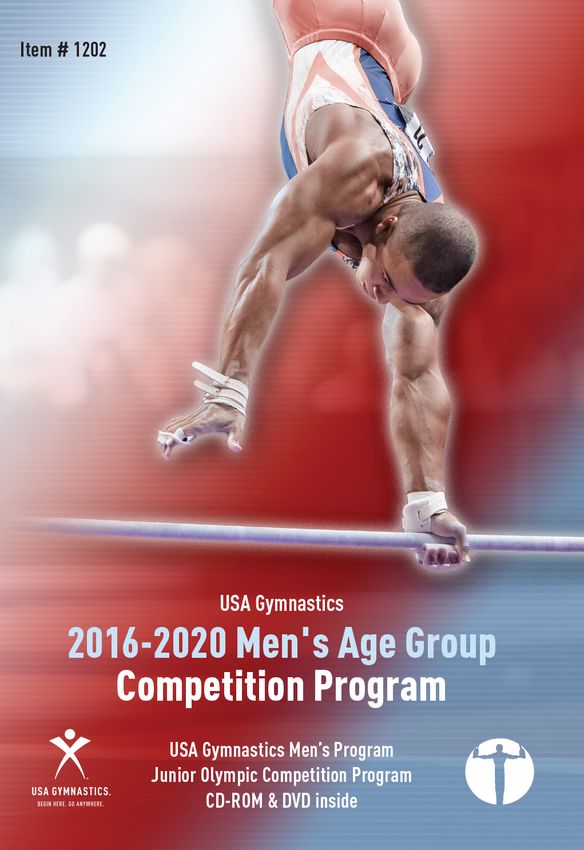
2016-‐2020
Men’s
Jr.
Olympic
Program
Item
Number:
1202
Price:
$69.95
EssenAal
Elements
1-‐2-‐3
StarAng
a
Boys’
Program
And
Training
Instructors
Program Mission The EssenAal Elements program focuses on both athletes and coaches becoming more proficient with their ability to move freely through a number of foundaAonal areas of boys’ gymnasAcs. In other words, this curriculum provides the opportunity for and coach to learn how to set up a program, apply it to a team structure and become well-‐versed in teaching boys gymnas:cs. This can be an invaluable resource for clubs who are always searching for boys coaches or simply would like to start a program but do not have a boys coach. Our mission is to provide the opportunity for clubs to ini:ate and grow a boys’ gymnas:cs program while at the same :me helping to train coaches to the discipline of boys’ gymnas:cs. We are providing an opportunity to do this in a way that is cost effecAve for both the club and the parAcipant, flexible in terms of space and equipment, and at the same Ame interesAng and fun for all!
How
It
Works
Levels
1
&
2
Here
is
how
the
program
works
-‐
each
coach
can
set
up
their
own
lesson
plan
by
choosing
4-‐8
staAons
known
as
‘boxes’
that
coordinate
with
the
14
or
more
key
“EssenAal
Elements”
for
that
level
(Levels
1
&
2).
Week
aher
week,
they
can
select
different
boxes
to
introduce
new
drills,
progressions
and
challenges.
The
boxes
can
be
used
for
individual
staAons
or
included
in
a
circuit
or
obstacle
course.
The
students’
progress
may
be
tracked
daily
or
they
may
perform
skills
every
6,8
or
10
weeks
depending
on
which
Ame
frame
best
fits
with
the
club
program.
Students
may
also
keep
a
record
of
their
own
achievements
in
all
of
these
areas
as
an
ongoing
system
of
peer
recogniAon.
Curriculum


The
  program
  curriculum
  is
  arranged
  in
  a
  ‘plug
  and
  play’
  format
  so
  that

class
  instructors
  can
  combine
  any
  of
  the
  parts
  freely
  and
  keep
  each

class
  different
  and
  interesAng
  from
  one
  day
  to
  the
  next.


An
  effort
  is
  made
  to
  allow
  the
  boys
  to
  have
  as
  much
  play
  Ame
  with
  each

box
  as
  possible
  and
  to
  combine
  them
  in
  a
  way
  that
  is
  fun
  to
  do.


The
  students
  themselves
  sign
  up
  for
  a
  session
  to
  learn
  gymnasAcs.
  Of

course,
  we
  want
  to
  make
  it
  fun,
  interesAng,
  safe
  and
  challenging.
  Thus
  the

program
  is
  designed
  to
  be
  flexible
  and
  creaAve.


The
  instructor
  can
  actually
  change
  the
  environment
  or
  playground

as
  well
  as
  the
  curriculum
  for
  every
  class.
  It
  can
  always
  be
  something

different
  either
  by
  using
  different
  skills
  or
  by
  presenAng
  them
  in
  a

different
  format.
Learning
  through

                               “Play”

     THE
  MAIN
  GOAL
  OF
  THE
  PROGRAM
  IS
  FOR
  THE
  BOYS
  TO
  HAVE
  FUN.


They
  will
  have
  the
  opportunity
  to
  experiment
  with
  and
  learn
  many
  body

posiAons,
  elemental
  fitness
  movements,
  and
  progressions
  to
  foundaAonal

skills
  for
  boys’
  gymnasAcs
  on
  all
  apparatus.


In
  the
  process,
  they
  will
  also
  gain
  fitness,
  strength,
  and
  flexibility
  in
  a

healthy
  acAvity.


        It
  is
  important
  to
  understand
  that
  boys
  learn
  most
  effecAvely
  by


                             “PLAYING
  THE
  GAME”.


Boys
  DO
  NOT
  learn
  effecAvely
  by
  pracAcing
  skills
  unAl
  they
  are
  mastered,

                       and
  then
  performing
  before
  an
  audience.


               THEY
  LEARN
  SKILLS,
  WHILE
  THEY
  “PLAY
  THE
  GAME”!
How
  it
  Works

                            Level
  3
  “Performance”


Once
  the
  students
  achieve
  a
  majority
  of
  the
  EssenAal
  Elements
  they
  have

been
  exposed
  to
  in
  all
  of
  the
  categories
  in
  Levels
  1
  &
  2,
  they
  can
  move
  on
  to

learning
  to
  perform
  sequences
  in
  the
  Level
  3
  performance
  model.


     In
  this
  program,
  two
  different
  approaches
  to
  ‘learning
  a
  rouAne’
  are
  used.


First,
  we
  offer
  a
  whole
  group
  of
  tables
  from
  EssenAal
  Elements
  Program
  from

which
  the
  students
  themselves
  can
  select
  from
  a
  variety
  of
  skills
  that
  they
  can

do
  and
  arrange
  in
  an
  order
  of
  their
  choosing
  to
  create
  a
  performance
  rouAne.


Involving
  the
  boys
  in
  their
  own
  creaAve
  design
  is
  essenAal
  to
  inspiraAon
  and

reinforcing
  their
  understanding
  of
  gymnasAcs.
Level
3
and
Beyond
In
the
second
case,
we
also
provide
the
Level
3
compulsory
rouAne
model
that
is
also
listed
in
the
USA
GymnasAcs
Age
Group
Program
Manual.
These
rouAnes
are
ohen
used
to
establish
pre-‐team
programs
or
simply
to
provide
context
for
exhibiAon
programs
or
‘all-‐comers’
events.
From
Level
2
or
3,
they
can
also
move
to
a
variety
of
different
choices
in
the
developmental
path
that
is
most
interesAng
to
them
including
but
not
limited
to:
§Level
3
(Pre-‐team
programs)
§Age
Group
Compe::on
Level
4
§Trampoline
&
Tumbling
programs
§Sports
Cross-‐Fit
programs
§Recrea:onal
Demo
Team
(In-‐House
League
or
exhibi:on
team)
§Sports
Acroba:c
programs
Program
Mission
Review
Our
mission
is
to
provide
the
opportunity
for
clubs
to
ini:ate
and
grow
a
boys’
gymnas:cs
program
while
at
the
same
:me
helping
to
train
coaches
to
the
discipline
of
boys’
gymnas:cs.
The
EssenAal
Elements
1-‐2-‐3
Program
is
providing
an
opportunity
to
do
this
in
a
way
that
is
cost
effecAve
for
both
the
club
and
the
parAcipant,
flexible
in
terms
of
space
and
equipment,
and
at
the
same
Ame
interesAng
and
fun
for
all!
The
“Essen:al
Elements”
Environment
BOYS
LEVEL
1-‐2-‐3
Equipment
&
Space
Requirements
The
EssenAal
Elements
program
allows
each
environment
to
be
constructed
differently
based
upon
the
boxes
selected
for
the
class,
space
available
and
equipment
available
that
can
be
uAlized
for
the
curriculum.
It
is
a
modular
concept
that
can
be
built
with
available
resources.
Many
of
the
exercises
and
games
are
designed
with
cost
and
space
in
mind
to
make
it
easier
to
introduce
boy’s
gymnasAcs
programs
into
the
business
model.
It
encourages
instructors
to
use
their
imaginaAon
in
building
their
‘playgrounds’
with
safety
and
access
in
mind.
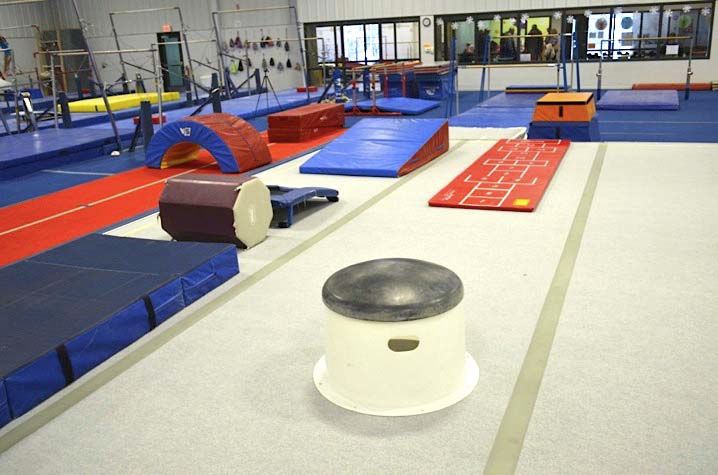
                            SOME
  SAMPLE
  MODULAR
  EQUIPMENT

                                ENVIRONMENTS
  PICTURED


U:lize
  available
  equipment
  and
  space
  and
  be
  crea:ve
  in
  building
  your
  playground
  for

boys
  to
  experience
  the
  various
  movements
  and
  progressions
  in
  each
  category.
ExisAng
  Manng
  and
  Equipment
  Can
  Be

              Used
  for
  the
  Boys’
  Play
  Environment


Panel
  Mats
  for
  Parallel
  Bars
     Single
  Rail
  for
  Horizontal
  Bar
SAMPLE
  FLOOR,
  VAULT,
  OBSTACLE
  COURSE
  CIRCUITS
  SHOWN

Set
  an
  environment
  that
  can
  accommodate
  mul:ple
  boys,
  all

learning
  at
  the
  same
  :me
  u:lizing
  circuits
  and
  obstacle
  course

designs
  that
  are
  fun
  as
  well
  as
  challenging.
  It’s
  important
  that
  the

boys
  have
  the
  chance
  to
  experience
  as
  many
  repe::ons
  as
  possible.
The
  “EssenAal
  Elements”
  Program
  Curriculum
  Model


Element
  Categories

Each
  category
  contains
  up
  to
  12
  or
  more
  EssenAal
  Elements
  of
  boys
  gymnasAcs
  and

contains
  up
  to
  30
  numbered
  boxes
  that
  contain
  skills
  that
  are
  progressions
  to

acquiring
  more
  advanced
  skill
  apAtude.


These
  progressions
  are
  on
  a
  conAnuum
  so
  that
  each
  student
  may
  progress
  at
  his

own
  rate
  and
  tracks
  his
  own
  progress.
  It
  is
  not
  a
  requirement
  that
  they
  be
  achieved

in
  any
  parAcular
  order.


A
  category
  consists
  of
  a
  parAcular
  type
  of
  fitness
  skill
  or
  body
  movement
  that

typically
  is
  a
  foundaAon
  element
  in
  boys
  gymnasAcs.
  The
  student
  will
  build
  a

comprehensive
  foundaAon
  of
  movement
  skills
  through
  this
  approach.


  In
  the
  process,
  the
  student,
  and
  the
  coach
  for
  that
  maoer,
  will
  learn
  along
  the
  way

the
  names
  and
  core
  abiliAes
  that
  are
  important
  in
  gymnasAcs.
The
  “EssenAal
  Elements”
  Program
  Curriculum
  Model


Element
  Categories
  (cont.)


Rather
  than
  following
  gymnasAcs
  events,
  this
  approach
  signifies
  a
  category
  of

movement
  that
  may
  be
  important
  for
  development
  on
  several
  events.


The
  student
  has
  the
  opportunity
  to
  progress
  through
  a
  wider
  variety
  of
  types
  of

skills
  than
  the
  linear
  model
  would
  require.


ExploraAon
  and
  repeAAon
  becomes
  the
  key
  to
  acquiring
  ability.
  These
  abiliAes
  are

then
  applied
  to
  learning
  higher
  level
  skills.


And
  all
  this
  is
  done
  in
  a
  fun,
  free
  and
  adventurous
  environment
  that
  appeals
  to

boys’
  innate
  desire
  to
  challenge
  themselves
  with
  new
  acAviAes.
The
  “EssenAal
  Elements”
  Program
  Curriculum
  Model


Category
  Tables

Similar
  to
  the
  rules
  of
  gymnasAcs
  known
  as
  the
  FIG
  Code
  of
  Points,
  this
  program
  is

arranged
  in
  the
  same
  way
  with
  each
  category
  signifying
  an
  “Element
  Group”
  that
  is

essenAal
  to
  the
  acquisiAon
  of
  gymnasAcs
  skills.
  These
  categories
  are
  listed
  as

follows:


  Category
  1
  –
  Warm
  up,
  Flexibility
  and
  Body
  Shapes


  Category
  2
  –
  Swings
  and
  Hangs


  Category
  3
  –
  Supports
  and
  Strength


  Category
  4
  –
  Runs,
  Jumps,
  and
  Springs


  Category
  5
  –
  Games,
  Races,
  and
  Courses


The
  categories
  can
  be
  summarized
  in
  the
  following
  manner.
  Each
  element
  has
  4

different
  boxes
  associated
  with
  it
  that
  lists
  the
  skills
  for
  Level
  1
  and
  Level
  2.
  In
  most

cases
  they
  represent
  a
  progression
  from
  easy
  to
  moderate
  ability.
  They
  can,

however,

be
  done
  in
  any
  order
  depending
  on
  a
  student’s
  ability.
Category
Tables
CATEGORY
1:
(FLEXIBILITY,
BODY
SHAPES,
STRETCH,
BALANCE)
14
OR
MORE
Essen5al
Element
groups
in
3
different
Tables
with
4
boxes
each
StaAc
Flexibility:
Body
Shapes:
Dynamic
Flexibility
&
Balance:
ØPancake
Tuck/Pick
Wrist/Neck/Shoulders
ØPike
Hollow/Arch
Stomach/Back/Hips
ØBridge/Shoulders
Candle/Straddle
Legs/Ankles/Feet
ØLeg
Flexibility/Splits
Layout/Prone
Scales/Arabesque
ØCenter
Splits
Lunge/Straddle
Stand
Category
Tables
CATEGORY
2:
(SWINGS
&
HANGS
–
RINGS,
P-‐BARS,
LOW
BAR)
14
OR
MORE
Essen5al
Element
groups
in
3
different
Tables
with
4
boxes
each
Rings:
Low
Bar:
P-‐Bars,
Blocks,
or
Mat
Stack:
ØVer7cal
Hangs
Pullovers
Support
Swings
ØInverted
Hangs
Cas7ng
Hanging
Swings
ØSwings
Hip
Circles
Upper
Arm
Swings
ØDismounts
Glides/Sole
Circles
Travels/Dismounts
ØKip/Jams
ØLong
Hang
Swings
Category
Tables
CATEGORY
3:
(SUPPORTS/STRENGTH
–
RINGS,
P-‐BARS,
FLOOR)
14
OR
MORE
Essen5al
Element
groups
in
3
different
Tables
with
4
boxes
each
Low
Rings:
P-‐Bars/Paralleoe:
Floor:
ØSupport
Holds
Support
Holds
Upper
Body
Strength
ØChin-‐ups/Rope
Climb
Support
Walks
Core
Strength
ØPush-‐up/Planche
Straddle
&
V-‐supports
Tripod,
Headstand,
Press
ØHead/Shoulder
Stands
Support
Hops
Handstand,
Wall
Holds
ØPartner
Strength
ØLower
Body/Leg
Strength
Category
Tables
CATEGORY
4:
(RUNS,
JUMPS,
SPRINGS
–
VAULT,
TUMBLE
TRAMP)
14
OR
MORE
Essen5al
Element
groups
in
3
different
Tables
with
4
boxes
each
Vault:
Tumbling/Floor:
Trampoline:
ØRuns
Forward
Rolls
Bounces/Safety
Stop
ØHurdle
Backward
Rolls
Jumps
ØRebounds
Handstands
Seat
Drops
ØJump
Skills
Cartwheels
Doggy/Stomach
Drops
ØRound-‐offs
Back
Drops
ØForward
Head
&
Handsprings
Category
Tables
CATEGORY
5:
(GAMES,
CONTESTS,
COURSES
–
FLOOR
&
EQUIP.)
14
OR
MORE
Essen5al
Element
groups
in
6
different
Tables
with
4
boxes
each
Circuits:
Relays:
Obstacles:
Fitness:
Tramp:
Games:
ØFloor
Speed
Relays
Floor
Course
Push-‐up
Game
Add-‐on
4
Ships
&
Sailor
ØVault
Skill
Relays
Equipment
S7ck
Contest
Add-‐on
6
Mat
Pushes
ØBar
Slider
Races
Rope
Climbs
Add-‐on
8
Soccer
Game
ØChallenges
Category
  Tables


Instructors
  may
  select
  from
  any
  one
  of
  these
  categories
  and
  any
  number
  of

element
  boxes
  to
  schedule
  their
  lesson
  plans.
  Lesson
  plans
  can
  be
  created

for
  daily,
  weekly,
  and
  full
  term
  according
  to
  each
  individual
  club’s
  need.


It
  is
  part
  of
  the
  coaches
  training
  that
  they
  become
  familiar
  with
  the
  names

of
  the
  elements
  and
  element
  groups
  as
  building
  blocks
  for
  a
  boys
  gymnasAcs

foundaAon.
  In
  this
  way,
  they
  can
  also
  begin
  to
  understand
  the
  format
  and

design
  of
  compeAAve
  gymnasAcs
  as
  well
  and
  even
  translate
  that
  to
  the

young
  gymnasts
  in
  their
  care
  for
  future
  development.


The
  category
  system
  makes
  it
  easy
  to
  individualize
  the
  program
  to
  the
  ability

of
  each
  student
  no
  maoer
  what
  the
  body
  type
  or
  ability
  is.
  The
  format
  of
  the

program
  also
  will
  allow
  individual
  programs
  to
  add
  boxes
  for
  further

curriculum
  as
  the
  need
  arises.
  You
  have
  the
  ability
  to
  tailor
  this
  program
  to

your
  club
  structure.
BOYS
  LEVEL
  1
  &
  2
  ELEMENT
  BOX
  FORMAT

   THE
  FOLLOWING
  PAGES
  CONTAIN
  EXAMPLES
  OF
  THE
  ESSENTIAL
  ELEMENTS

PROGRAM
  CATEGORY
  AND
  BOX
  GRIDS
  THAT
  CAN
  BE
  USED
  FOR
  CREATING
  LESSON

                  PLANS
  AND
  PLANNING
  YOUR
  CURRICULUM.
CATEGORY 1 ~ WARM-UPS (FLEXIBILITY/BODY SHAPES/STRETCHES)

         STATIC                    LEVEL 1 SKILL BOXES                        LEVEL 2 SKILL BOXES
      FLEXIBILITY
1. Pancake                1.1.2                  1.1.3                 1.1.4                 1.1.5
(Straddle 90°)            Hands out front        Elbows on ground      Nose on ground        Chest on ground
Video Available

2. Pike (Legs together)   1.2.2                  1.2.3                 1.2.4                 1.2.5
Video Available           Hands on ankles        Hands grasp feet      Nose on knees         Chest on knees

3. Bridges/Shoulders      1.3.2                  1.3.3                 1.3.4                 1.3.5
                          Push up to             Bridge with feet      Sit and rock back     Reverse walk
                          bridge/static          together straight     to bridge on          down wall with
                          shoulder stretch       arms and legs         tootsie roll (BHS     hands to bridge
                                                                       Prep)
Video Available
4. Leg Flexibility        1.4.2                  1.4.3                 1.4.4                 1.4.5
Splits                    Front leg straight,    Bent leg splits (R    Left leg split        Right leg split
 (Right, Left)            back leg bent          & L)
                          (hurdler stretch)
Video Available
5. Center Splits          1.5.2                  1.5.3                 1.5.4                 1.5.5
                          Center split –         Hold with hands       Hold on elbows        Full Center split
                          ‘Froggy’ stretch       out in front on the   Straddle stand
                                                 floor                 stretch
                                                 Straddle stand
                                                 stretch
Video Available
CATEGORY 2 ~ SWINGS/HANGS (RINGS/P-BARS/LOW BAR)
Note: Skills may be performed on low hanging rings attached to bars or mini-ring tower if
available
LOW RINGS LEVEL 1 SKILL BOXES LEVEL 2 SKILL BOXES
1. Vertical Hang 2.1.2 2.1.3 2.1.4 2.1.5
Video Available Straight body hang Tucked “L” hang Piked “L” hang (3 Chin hang hold
(5 seconds) sec.)
2. Inverted Hangs 2.2.2 2.2.3 2.2.4 2.2.5
Inverted hang Piked inverted hang Skin-the-Cat to Tucked inverted
position German hang hang extend to
back lever
Video Available
3. Swings 2.3.2 2.3.3 2.3.4 2.3.5
Small tucked Swings unassisted Swing forward to Turnover Swings
swings with spot (5 swings in a row) inverted hang with rings turned
position out
Video Available
4. Swing 2.4.2 2.4.3 2.4.4 2.4.5
Dismounts Swing to Skin-the- Swing to pike Skin- Swing to tucked Swing to pike back
Cat tucked & the-Cat release to back flip to stand flip to stand
release to stand stand
Video AvailableCATEGORY 3 ~ SUPPORTS/STRENGTH (RINGS/P-BARS/FLOOR)
LOW RINGS LEVEL 1 SKILL BOXES LEVEL 2 SKILL BOXES
1. Support Holds 3.1.2 3.1.3 3.1.4 3.1.5
(Low hanging rings) Support hold Tucked “L” hold “L” hold assisted Tuck hold
tucked assisted unassisted extend to “L”
support and
Video Available return
2. Chin-ups/Rope 3.2.2 3.2.3 3.2.4 3.2.5
Climb Rope Ladder Rope climb with Chin-ups without Rope climb
climb, chin ups feet feet tuck or without feet
with feet straight
Video Available
3. Push-up/Planche 3.3.2 3.3.3 3.3.4 3.3.5
Position (low rings) Push-up position Series of Push-ups Tuck planche hold Tucked planche
(planche) with (planche) with legs assisted on low hold unassisted
legs supported supported rings
Video Available
4. Headstand/Shoulder 3.4.2 3.4.3 3.4.4 3.4.5
Stand (low rings) Headstand Headstand Shoulder stand Press to
assisted on low unassisted on low assisted Shoulder stand
rings with mat and rings with mat and unassisted low
feet supported feet supported rings
inside bars or inside bars or
straps straps
Video AvailableCATEGORY 5 ~ ACTIVITIES (GAMES/CONTEST/COURSES):
This category contains many suggestions or samples of various activities that can be used to stimulate
excitement in the classes and to make gymnastics “fun” for the boys at any level of ability.
These activities can be modified in any way a coach might choose based upon the equipment,
space, and time available. Use your imagination to design more activities and enter them into the boxes below.
These are some samples to get you started.
ACTIVITY ACTIVITY NAME ACTIVITY ACTIVITY ACTIVITY
SUGGESTIONS NAME NAME NAME
1. Circuits 5.1.2 5.1.3 5.1.4 5.1.5
Video Available Basic FX tumbling circuit Basic vaulting circuit Rings circuit Parallel bar and mat
circuit
2. Relay Races 5.2.2 5.2.3 5.2.4
Video Available Skills race (floor) Slider races Running Races
3. Obstacle 5.3.2 5.3.3
Courses Obstacle course Obstacle course
for time (floor only) for time (with
equipment)
Video Available
4. Fitness Contests 5.4.2 5.4.3 5.4.4 5.4.5
Push-up Games Stick Contests Rope climb for ‘Personal best’
time and for time or
Video Available distance repetitions (any)
5. Trampoline 5.5.2 5.5.3 5.5.4
Video Available Add-on game to 4 skills Add-on game to 6 skills Add-on game to 8 skills
6. Games 5.6.2 5.6.3
Video Available Ships & Sailors Mat PushesBOYS
LEVEL
1
&
2
ELEMENT
BOX
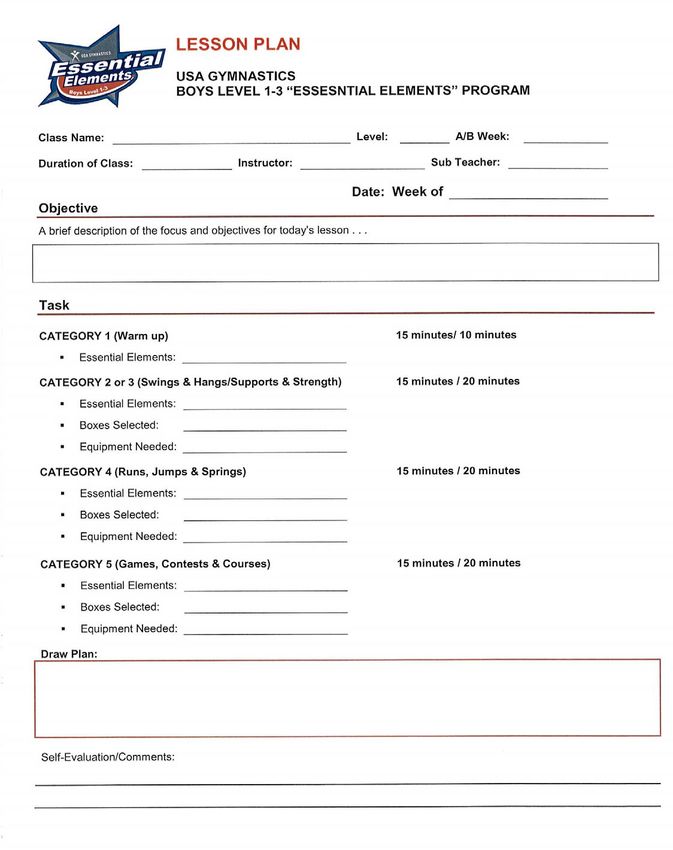
LESSON
PLANS
THE
FOLLOWING
PAGES
OFFER
TEMPLATES
AND
A
SAMPLE
FOR
SUGGESTED
LESSON
PLANS
THAT
CAN
BE
INDIVIDUALIZED
FOR
EACH
CLASS
OR
TERM
HOW TO USE THE PROGRAM TO MANAGE
            WEEKLY CLASSES AND SESSION TERMS


Weekly Class Structures

All programs have different approaches to a system of beginning,
intermediate, advance and pre-team type classes for their students.

The recommended class structure in this manual is a sample for
designing the curriculum program around that class structure. This
may be arranged to fit your particular class time or length of term.

Most recreational students or students with little or no gymnastics
experience sign-up to attend no more than one or two classes per
week. These are usually about one hour in length.
HOW TO USE THE PROGRAM TO MANAGE WEEKLY
CLASSES AND SESSION TERMS
Weekly Class Structures
Our
suggested
template
matches
this
Ame
frame.
Obviously
with
this
approach,
the
more
Ame
that
can
be
scheduled
for
access
to
the
gym
the
more
involved
the
students
will
be
with
the
experience
and
usually
learn
faster.
Providing
access
to
open
gym
Ame
or
addiAonal
training
opportuniAes
is
one
soluAon
to
engaging
and
moAvaAng
boys.
This
is
also
a
way
to
provide
a
“team
atmosphere”
for
the
boys
as
the
social
component
of
their
experience
is
very
important.
Sample
Typical
Essen:al
Elements
Class
(1
hour):
15
minutes
Category
1
(Warm-‐ups)
15
minutes
Category
2
or
Category
3
(Alternate
from
week
to
week)
15
minutes
Category
4
(Runs,
Jumps,
Springs)
15
minutes
Category
5
(Games,
Contests,
Courses)
HOW TO USE THE PROGRAM TO MANAGE WEEKLY
CLASSES AND SESSION TERMS
Weekly Class Structures
How
the
instructor
mixes
the
use
of
his
boxes
from
day-‐to-‐day,
class-‐to-‐class,
or
week-‐
to-‐week
has
a
lot
to
do
with
not
only
providing
the
variety
that
keeps
the
class
interesAng
but
also
adds
to
the
cross-‐training
of
skills
among
the
different
events.
For
instance,
Category
5
may
entail
strength
contests
or
sAck
contests
that
relate
to
the
skill
curriculum
in
the
other
categories
or
they
may
simply
be
games
that
are
fun
and
add
to
the
students
agility
and
coordinaAon.
At
the
same
Ame,
Category
4
which
is
a
staple
of
gymnasAcs,
may
alternate
in
different
fashions
from
Vault
to
Trampoline
to
Tumbling.
In
essence,
there
are
an
unlimited
combinaAon
of
opAons
that
an
instructor
can
uAlize.
HOW TO USE THE PROGRAM TO MANAGE WEEKLY
CLASSES AND SESSION TERMS
Session
or
Term
Structures
As
menAoned,
it
is
preferable
if
boys
are
assigned
to
their
classes
as
part
of
a
“team”
program.
This
could
be
based
upon
the
day
they
aoend
or
simply
the
gym
as
a
whole
if
numbers
are
small.
In
either
case,
the
goal
is
for
the
gymnasts
to
learn
the
sport
and
ulAmately
show
off
their
skills
by
performing
aher
they
have
acquired
sufficient
basic
abiliAes.
Thus,
the
Level
3
opAons
within
the
EssenAal
Elements
program
are
a
goal
for
every
student
just
like
preparing
for
a
compeAAon
is
for
the
team
program.
Whether
the
gym
employs
an
8,
10
or
12
week
term
or
simply
operates
from
month-‐to-‐month,
instructors
should
be
able
to
track
their
students
progress
and
plan
for
acAviAes
that
allow
their
budding
gymnasts
the
opportunity
to
perform.
HOW TO USE THE PROGRAM TO MANAGE WEEKLY
CLASSES AND SESSION TERMS
Performing
can
be
a
Friday
night
exhibiAon,
an
‘All-‐comers’
fun
meet,
a
show
for
parents,
or
simply
a
day
to
observe
classes
that
the
boys
prepare
for
during
the
term.
They
are
going
to
put
their
Level
3
rouAnes
together
on
one
or
two
or
more
events
and
perform
them
at
some
point.
In
this
program,
sponng
and
assistance
is
encouraged.
The
goal
really
is
to
have
fun,
experience
self-‐confidence,
and
learn
the
sa:sfac:on
of
achievement
even
if
achievement
is
measured
by
simply
crea:ng
your
own
rou:ne
and
remembering
it!
Ability
is
not
the
issue.
The
important
aspect
of
the
term
experience
is
being
part
of
something,
being
part
of
the
group,
being
part
of
the
team.
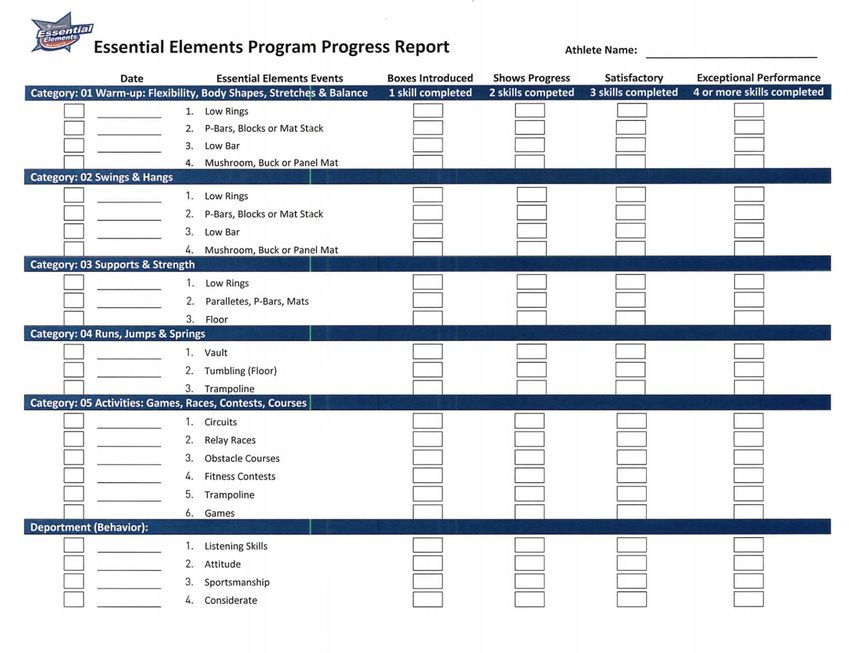
SAMPLE
  PROGRESS
  TRACKER
  TEMPLATE


UTILIZE
  THE
  PROGRESS
  TRACKER
  TO
  RECORD
  STUDENT’S
  LEARNING
HOW
  TO
  BUILD
  THE
  PROGRAM
  AND
  AUGMENT

                                      EXISTING
  EQUIPMENT


One
  of
  the
  biggest
  hurdles
  a
  gym
  owner
  has
  to
  overcome
  is
  jusAfying
  the

expense
  of
  purchasing
  compeAAve
  boys
  equipment.


EssenAal
  Elements
  program
  has
  been
  designed
  to
  uAlize
  exisAng
  equipment

most
  faciliAes
  might
  have
  at
  their

disposal.


A
  good
  strategy
  would
  be
  to
  uAlize
  inexpensive
  equipment
  opAons
  to
  build

numbers
  and
  sAmulate
  excitement
  and
  growth
  in
  the
  program
  unAl

revenue
  can
  support
  buying
  more
  equipment.


To
  assist
  coaches
  and
  gym
  owners
  alike
  we
  have
  idenAfied
  a
  strategy
  for

different
  equipment
  package
  opAons
  that
  can
  fit
  into
  your
  budget.
HOW
  TO
  BUILD
  THE
  PROGRAM
  AND
  AUGMENT

                                     EXISTING
  EQUIPMENT


These
  also
  have
  the
  added
  advantage
  of
  not
  requiring
  a
  lot
  of
  addiAonal

space.


Most
  equipment
  manufacturers
  in
  the
  United
  States
  offer
  very
  similar

equipment
  in
  the
  package
  categories
  listed
  below.
  In
  addiAon,
  they
  are
  also

very
  similar
  in
  price
  and
  affordability.


These
  opAons
  can
  be
  custom
  tailored
  to
  your
  budget
  and
  needs.
  Most

equipment
  companies
  will
  work
  with
  you
  on
  this
  design.


The
  following
  are
  examples
  of
  an
  EssenAal
  Elements
  equipment
  strategy:
HOW
TO
BUILD
THE
PROGRAM
AND
AUGMENT
EXISTING
EQUIPMENT
PACKAGE
#
1:
ACCESSORY
ITEMS
(Low
cost
items
to
supplement
exis:ng
equipment)
§Rings
and
ring
straps
for
hanging
on
an
available
bar
§
Paralleoes
–
can
be
purchased
or
made
from
own
supplies
§P-‐Bar
rails
for
mat
stack
–
offered
for
both
folding
mats
and
P-‐Bar
blocks
§Rope
ladder
–
can
be
hung
from
any
bar
or
wall
mount
§Climbing
rope
–
clamps
are
also
sold
to
aoach
to
beam
§Targets
–
great
for
designaAng
landing
spots
or
organizing
class
PACKAGE
#
2:
MAT
PACKAGES
(Low
cost
mul:-‐use
mats)
§Cartwheel/Round-‐off
mats
–
showing
hand
placements
§ Panel
Mats
–
have
mulAple
uses
on
all
events
§ Blocks
–
can
be
sponng
boxes,
vaulAng
boxes,
etc.
and
come
in
all
sizes
§ Wedges
–
useful
for
obstacle
courses,
circuits
and
basic
tumbling
§ Tootsie
Rolls/Barrel
mats
-‐
useful
for
obstacle
courses
and
basic
tumbling
§ Handspring
trainers
–
specialized
mats
that
make
sponng
easier
§ Swedish
box
mats
–
can
be
placed
in
various
configuraAons
§ Small
4”
safety
mats
(4x6)
–
space
saving
and
more
versaAle
than
larger
mats
§ Small
8”
Safety
cushions
-‐
space
saving
and
more
versaAle
than
larger
mats
§ Tumbling
mat
rolls
6x42
–
economical
and
can
be
used
in
place
of
floor
HOW
TO
BUILD
THE
PROGRAM
AND
AUGMENT
EXISTING
EQUIPMENT
PACKAGE
#
3:
EQUIPMENT
PACKAGES
–
(Build
as
budget
allows)
§Mini
Ring
Tower
–
space
saver
and
great
for
ages
5
through
12
§Mini
P-‐Bars
–
can
be
added
to
exisAng
mat
stacks
or
blocks
§Low
Bar
System
–
any
type
of
rails
are
suitable,
quad
system
or
free-‐standing
bar
§Mini
Tramps
–
many
different
sizes
are
available
in
spring
or
air-‐filled
§Spring
Boards
–
many
different
uses
and
types
available
§Floor
Mushroom
–
can
be
made
from
supplies
or
purchased
§Small
Trampoline
–
enables
you
to
connect
more
than
one
trampoline
together
The
  EssenAal
  Elements
  Performance
  Model


HOW
  TO
  UTILIZE
  YOUR
  BASIC
  ELEMENTS
  TO
  FORM
  ROUTINES


The
  goal
  of
  every
  student,
  coach
  and
  program
  is
  to
  eventually
  matriculate

to
  another
  level.
  Part
  of
  the
  process
  is
  looking
  forward
  to
  the
  next

challenge.


Long
  before
  gymnasAcs
  became
  a
  highly
  regimented
  process,
  boys
  had
  to

make
  up
  their
  own
  rouAnes
  based
  upon
  skills
  that
  they
  acquired
  at
  any

stage
  of
  the
  process.


Part
  of
  doing
  rouAnes
  is
  just
  being
  able
  to
  remember
  them
  along
  with
  the

names
  of
  the
  skills.
  This
  process
  also
  lends
  to
  the
  pride
  of
  the
  gymnast
  in

expressing
  his
  own
  individual
  style
  as
  well
  as
  sAmulaAng
  creaAve
  growth.
The EssenAal Elements Performance Model The EssenAal Elements program can offer two opAons for this in our Level 3 Performance model. One is a template of skill tables that the student can pick from using a few basic rules to create a rouAne sequence. The second is the opAon of “compulsory rouAnes” that are also offered in the USA GymnasAcs Age Group CompeAAon Program Manual. These can be used to build a pre-‐team program or simply to prepare boys to enter the age group compeAAve program at Level 4. The first opAon might be more useful for some of your older boys who simply want to show off their skills and tailor their rouAnes to their own strengths. As an instructor, you can guide each individual boy in the direcAon that best moAvates him.
BOYS
LEVEL
3
ELEMENT
BOX
TABLES
THE
FOLLOWING
PAGES
OFFER
TEMPLATES
FOR
SUGGESTED
SKILL
SELECTION
TO
PUT
TOGETHER
PERFORMANCE
ROUTINES
FOR
EACH
INDIVIDUAL
STUDENT
§May
use
ribbons
to
signify
achievement
–
any
group
of
colors
§Cer5ficate
of
Achievement
or
similar
award
may
be
used
to
recognize
performance
§A
note
about
Performance
Rou:nes
–
Level
3
is
different
than
normal
Age
Group
Compe::ve
rou:nes.
§We
encourage
spodng
where
needed
and
the
gymnast
can
feel
free
to
use
different
pieces
of
equipment
or
mount
and
re-‐mount
as
necessary.
There
are
no
rules
for
pudng
rou:nes
together.
Just
perform!
ESSENTIAL
  ELEMENTS
  FLOOR
  EXERCISE
  &

                                   TUMBLING

                                       .


   Elements          Skill             Skill             Skill           Skill Element        Skill
                   Element           Element           Element                              Element

Positions/Shapes     Candle           Headstand        Straddle              Scale             Lunge
                                                        Stand

   Flexibility      Pancake              Split          Center split        Y-scale                Pike

   Supports         Prone           Rear Support          Bridge           Handstand       “L” or Tuck “L”
                   Support

   Tumbling         Cartwheel        Forward roll      Backward roll      Headspring         Round-off

  Transitions      Choose Transition elements from Category 1 – 15 boxes for change of direction
MATS
–
BLOCKS
–
PARALLEL
BARS
Perform
6
skills
in
a
row
with
at
least
one
from
each
category.
•You
can
stand
on
the
floor,
mat
or
box
in
between
skills
if
necessary
•Finish
the
rou:ne
with
the
last
skill
from
the
dismount
category
and
show
presenta:on.
•Note:
Gymnast
may
be
spoied
on
any
of
the
skills
Elements Skill Element Skill Element Skill Element Skill Element
Swings Support ¾ Handstand Swing to rear Swing to Prone
swing swing support support
Supports Tuck “L” “L” support Straddle “L” or “V” ½ turn support
support
Travels Straddle Shoulder roll Stiff arm walk Hop travel
swings straddle
Hangs Long Hang Glide swing Upper arm Upper arm
(P-Bars)/Upper Arm swing swing uprise
Dismounts Swing to Swing to Shoulder roll to Presentation
dismount Handstand off standAwards and CerAficates Boys crave immediate success and a sense of personal achievement. They will perform and learn in order to gain recogniAon, reward for their efforts, and admiraAon from their peers The EssenAal Elements 1-‐2-‐3 Program provides several templates for award cerAficates to be used to moAvate the athletes and challenge them to learn more.
Technical
  Materials
  Store

     USAGym.org


                    Item
  Number:
  8103

                       Price:
  $39.95
Contact

                   USA
  Gymnas7cs
  Men’s

                     Program
  Manager


                          Lisa
  Mendel

                      lmendel@usagym.org


  Marcus
  Yancey
             Michael
  Serra

mlyancey@sbcglobal.net
         michael.serra@sbcglobal.net
You can also read


