NATIONAL SAFETY INSTRUCTION 8
←
→
Page content transcription
If your browser does not render page correctly, please read the page content below
National Grid UK Electricity Transmission plc                                 NGUK/PM/ETSR/NSI/08/GN Issue 6
         National Safety Instruction and Guidance

               National Grid Electricity Transmission plc
                       NATIONAL SAFETY INSTRUCTION 8
                                   and
                                 Guidance

            MOBILE ELEVATED WORK PLATFORMS,
           LORRY LOADERS, VEHICLES, CRANES AND
                 OBJECTS IN SUBSTATIONS

Copyright National Grid plc 2021 ©, all rights reserved. No part of this publication may be reproduced, stored in a retrieval
system, or transmitted in any form or by any means electronic, mechanical, photocopying, recording or otherwise,
without the written permission of National Grid obtained from the issuing location.

The contents of National Grid documents are based on the needs of National Grid and the conditions under which it
operates. It shall not therefore be assumed that the contents stated therein necessarily meet the particular circumstances
and requirements of other organisations. The principles set out in this document are for information only and therefore
National Grid is not liable to any third party for any loss or damage resulting from reliance on the contents. It is the
responsibility of such external organisations to check that the document is the latest version and is appropriate for their
purpose.

        © National Grid plc 2021 – All Rights Reserved
        Uncontrolled when printed
National Grid UK Electricity Transmission plc NGUK/PM/ETSR/NSI/08/GN Issue 6
National Safety Instruction and Guidance
DOCUMENT HISTORY
Summary of Changes / Approved By
Issue Date Author(s)
Reason (Title)
MDE Manager
New Guidance Document to Les Adams
1 March 2009 follow 3rd edition Electricity NSI Working Group
Safety Rules layout.
MDE Manager
Annual review; document Les Adams
amended as detailed below
2 April 2011 NSI Review Group
and minor text changes as
highlighted in yellow.
Renamed as “National Safety
Instruction and Guidance” ETAM Operations
3 April 2014 which now incorporates and NSI Review Group North Manager
replaces NSI 8 Issue 4 and NSI Mike Dean
8 Guidance Issue 2.
Annual review; document
ETAM Operations
amended as detailed below
4 April 2016 NSI Review Group North Manager
and minor text changes as
Matt Staley
highlighted in yellow.
Clarifiaction of actions required
Electricity Transmission Head of ET
by the recipient of the Safety
5 Oct 2019 Operations Operations
Document during all crane
Safety Rules Team Matt Staley
lifting operations.
Electricity Transmission Head of ET
6 March 2021 Reviewed & Reformatted. Operations Operations
Safety Rules Team Matt Staley
KEY CHANGES
Section Amendments
Section 4.7 Rule & Clarity added with regards to earthing requirements for temporary fencing
Guidance arrangements.
© National Grid plc 2021 – All Rights Reserved Page i of ii
Uncontrolled when printedNational Grid UK Electricity Transmission plc NGUK/PM/ETSR/NSI/08/GN Issue 6
National Safety Instruction and Guidance
MOBILE ELEVATED WORK PLATFORMS, LORRY LOADERS, VEHICLES, CRANES
AND OBJECTS IN SUBSTATIONS
CONTENTS
Page
1 Purpose and Scope 1
2 Definitions 2
3 Dangers 3
4 Storage, Movement and Use of Object(s) 4
5 Planning for the Use of Mobile Elevated Work Platforms, Lorry Loaders, 9
Vehicles and Cranes in Substations
6 Movement of Mobile Elevated Work Platforms, Lorry Loaders and 11
Vehicles in Substations outside the Demarcated Work Areas
7 Movement of Cranes in Substations outside Demarcated Work Areas 13
8 Operation of Mobile Elevated Work Platforms, Lorry Loaders, Vehicles 14
and Cranes in Substations within Demarcated Work Areas
9 Gas Insulated Switchgear Substations 15
Appendix
A Safe Movement of Mobile Elevated Work Platforms, 16
Lorry Loaders, Vehicles, Cranes or Objects in
Substations
B Movement Route Criteria 17
C Proposed Scaffold Location Form 19
D Authorisation Matrix for Personnel 20
© National Grid plc 2021 – All Rights Reserved Page ii of ii
Uncontrolled when printedNational Grid UK Electricity Transmission plc NGUK/PM/ETSR/NSI/08/GN Issue 6
National Safety Instruction and Guidance
1 Purpose and Scope
To apply the principles established by the Safety Rules and provide guidance on National Safety
Instruction 8 when, mobile elevated work platforms, lorry loaders, vehicles, cranes and
Object(s), are being moved or used within substations to achieve Safety from the System for
Personnel working on or near to High Voltage Equipment.
When activities are outside a Location but near to overhead lines the guidance given in the
Health and Safety Executive’s guidance document HSG GS6 ‘Avoidance of Danger from
Overhead Electric Power Lines’ shall be applied.
There are two levels of authorisation to this NSI for a Competent Person(s), limited and full.
Limited authorisation roles and repsonsiblities are:-
• Enacted within the demarcated work area
• Drive vehicles of a Fixed Height on roadways within a HV Compound.
Full authorisation roles and responsibilities are:-
• Extended to encompass the Location.
The layout of this guidance note reflects that of legislative codes of practice, where the rule (or
mandatory obligation) is identified by a green panel on the left-hand side. The guidance follows
after the rule and is identified by a blue panel.
Within National Grid, guidance notes hold equivalent status of an Approved Code of Practice
(ACOP) in law. If not followed, you will be required to demonstrate that your safe system of work
is of an equal or higher standard.
© National Grid plc 2021 – All Rights Reserved Page 1 of 20
Uncontrolled when printedNational Grid UK Electricity Transmission plc NGUK/PM/ETSR/NSI/08/GN Issue 6
National Safety Instruction and Guidance
2 Definitions
Terms printed in bold type are as defined in the Safety Rules.
Title Definition
Field Equipment Earth Connections for bonding items of field or access equipment to
earth in order to manage Impressed Voltage Conditions. The
earths are coloured orange to identify them from Drain Earth(s)
and are not included on an Earthing Schedule. They shall
have a minimum cross sectional area of 25mm 2 copper
equivalent.
Fixed Height Whereby the height of the relevant vehicle cannot be changed.
Object(s) Items of equipment, which if not controlled during handling
could infringe Safety Distance, such as ladders, scaffold poles,
ropes, reinforcing bar, plywood sheets etc.
Operator An individual who has been trained and assessed to use
specific types of mobile elevated work platforms, lorry loaders,
vehicles, or cranes.
Safety Observer A Person selected by the recipient of the Safety Document,
or the Senior Authorised Person, to assist in ensuring the
safe movement, or use, of mobile elevated work platforms, lorry
loaders, vehicles, cranes and Objects within the demarcated
work area.
Appointed Person An individual trained to establish and implement the safe
system of work for the lifting operation in accordance with the
requirements of BS 7121, Safe use of Cranes.
HV Compound A secured area that contains HV Equipment. This excludes
areas that only contain over sailing conductors.
Height Barrier A barrier or boom suitably constructed with a sign denoting the
safe height to control over height vehicular access.
© National Grid plc 2021 – All Rights Reserved Page 2 of 20
Uncontrolled when printedNational Grid UK Electricity Transmission plc NGUK/PM/ETSR/NSI/08/GN Issue 6
National Safety Instruction and Guidance
3 Dangers
The System Danger(s) to personnel during the movement and use of mobile elevated work
platforms, lorry loaders, vehicles, cranes and Objects, in substations containing exposed Live
HV conductors and Equipment operating above atmospheric pressure are electrocution, burns
and effects on eyes arising from:-
• Inadvertent infringement of Safety Distance
• Badly connected or insecure Field Equipment Earth
• Incorrectly identified Field Equipment Earth
• The application of Field Equipment Earth to an inadequate or defective earth system
• Impressed Voltage Conditions
• Uncontrolled release of stored pressure
© National Grid plc 2021 – All Rights Reserved Page 3 of 20
Uncontrolled when printedNational Grid UK Electricity Transmission plc NGUK/PM/ETSR/NSI/08/GN Issue 6
National Safety Instruction and Guidance
NSI 8 4 Storage, Movement and Use of Object(s)
4.1 to 4.4
4.1 Object(s) shall be stored, moved and used in a controlled manner to
ensure that they do not infringe Safety Distance. When moved at
ground level, Object(s) shall be carried in a horizontal position, as
near to the ground as possible
4.2 Substation areas separated from the HV Compound by a palisade
fence or similar fixed division.
(a) When there are no over sailing conductors
No restrictions or authorisation under this NSI
(b) When there are over sailing conductors
The storage, movement and use of Object(s), can be carried out
by:-
(i) A Competent Person with full authorisation under
this NSI
(ii) Individual(s) under the Personal Supervision of a
Competent Person with full authorisation under this
NSI
(iii) Personnel as defined on a designated route diagram
produced by a Senior Authorised Person
4.3 Within a HV Compound
The storage, movement and use of Object(s), can be carried out
without consulting a Senior Authorised Person by:-
(i) A Competent Person with full authorisation under
this NSI
(ii) Individual(s) under the Personal Supervision of a
Competent Person with full authorisation under this
NSI
4.4 Within a demarcated work area
The storage, movement and use of Object(s), can be carried out
without consulting a Senior Authorised Person by:-
(i) A Competent Person with limited authorisation under
this NSI
(ii) An individual(s) under the Personal Supervision of a
Competent Person with limited authorisation under
this NSI
© National Grid plc 2021 – All Rights Reserved Page 4 of 20
Uncontrolled when printedNational Grid UK Electricity Transmission plc NGUK/PM/ETSR/NSI/08/GN Issue 6
National Safety Instruction and Guidance
NSI 8 4.5 Additional Requirements for Ladders
4.5 to 4.7
(a) Ladders used shall be of no greater length than is required for
the work.
(b) When not in use all ladders shall be securely Locked to a
suitable anchorage.
(c) If ladders are moved within a demarcated work area after the
initial placement, the movement shall be carried out in
accordance with the specific instructions of the Competent
Person in charge of the Working Party.
4.6 Additional Requirements for Scaffolding
(a) Before scaffolding is erected or dismantled a Senior
Authorised Person, on site, shall assess the risks from
System derived hazards.
(b) The recipient of the Safety Document shall consider whether
to select a member(s) of his Working Party as a Safety
Observer(s).
(c) Field Equipment Earth(s) shall be applied to scaffolding
erected near to Live HV Equipment by the recipient of the
Safety Document as soon as it is practicable to do so. The
Competent Person, or a Person under his Personal
Supervision may apply and remove Field Equipment
Earth(s). As erection proceeds, Field Equipment Earth(s) shall
be applied at approximately 5m intervals, vertically and
horizontally, or as determined by the Senior Authorised
Person.
When Field Equipment Earth(s) are to be applied the following
sequence shall be undertaken:-
• Earth end clamps shall be applied first
• Equipment end clamps can then be applied
For removal of Field Equipment Earth(s) the following sequence
shall be undertaken:-
• Equipment end clamps shall be removed first
Earth end clamps can then be removed
4.7 Additional Requirements for Temporary Metallic Fences
Field Equipment Earth(s) shall be applied to temporary metallic fences
installed within an HV Compound and hence the main earth system
as soon as it is practicable to do so. As erection proceeds, Field
Equipment Earth(s) shall be applied at a maximum of 50m intervals,
at changes of direction, where busbars or power lines cross overhead.
Additional recommendations may be identified by an Earthing
Specialist report and / or risk assessment by the Senior Authorised
Person.
Where a temporary metallic fence is connected to the main earth
system but abuts an independently earthed fence they shall be
electrically separated.
© National Grid plc 2021 – All Rights Reserved Page 5 of 20
Uncontrolled when printedNational Grid UK Electricity Transmission plc NGUK/PM/ETSR/NSI/08/GN Issue 6
National Safety Instruction and Guidance
Guidance 4 Storage, Movement and Use of Object(s)
NSI 8
4.2 4.2(a) Access to substations areas outside the HV compound where
there are no over sailing conductors and therefore no System
derived hazards, shall be controlled by the Occupier, such
activities controlled by the Occupier may include access / egress
by the cleaner / window cleaner.
4.2(b)(iii) Senior Authorised Person shall decide based on the risk from
over sailing conductors the appropriate level of authorisation and
control measures, e.g. Controls identified within the combined
Risk Assessment & Method Statement (RAMS) produced to
manage the work or a Person issued with a movement F1 form /
designated access route plan, or for a higher risk a Competent
Person.
4.2 Reference should be made to Management Procedure – NSI 30
“Appointment of Persons” for the process to achieve full or limited
authorisation to this NSI.
4.3 The Competent Person shall undertake a risk assessment for the
movement and use of Object(s). The risk assessment shall consider
the following:-
• Loss of control - Number of staff required to ensure control of
Object(s)
• Ground conditions along the route
• Reference to Category 2 RAMS file where required
4.4 The Competent Person shall ensure that the requirements of the
Safety Document and RAMS are complied with at all times.
4.5 (a) Aluminium ladders can be used in substations, including 132 kV,
if the movement and use is controlled as per this NSI. However,
in the hierarchy of controls wood or fibre glass ladders should be
considered for use before aluminium.
(c) To ensure ladders, when not in use are kept secure, the
Competent Person shall ensure they are:-
• Tied off e.g. chained and padlocked to a scaffold
• Locked in a store room or Locked to a suitable anchorage point
In substation areas outside HV Compounds where there are no
over sailing conductors the appropriate individual shall ensure
ladders are kept secure when not in use by:-
• Tied off e.g. chained and padlocked to a scaffold
• Locked in a store room or Locked to a suitable anchorage point
Before use, a Competent Person shall lock in position, portable
ladders provided to give access to fixed ladders which terminate
above ground level. These shall remain Locked in position during the
period the ladders are in use.
© National Grid plc 2021 – All Rights Reserved Page 6 of 20
Uncontrolled when printedNational Grid UK Electricity Transmission plc NGUK/PM/ETSR/NSI/08/GN Issue 6
National Safety Instruction and Guidance
Guidance 4.6 (a) Before scaffolding is erected or dismantled a Senior Authorised
NSI 8 Person shall assess the risks from System derived hazards.
4.6 This assessment needs to take into account, the risk of any
scaffolding equipment encroaching within the specified Safety
Distance to exposed HV conductors and insulators which are
Live. This assessment needs to take into account the risk of loss
of control, which may result in the infringement of Safety
Distance.
Typical aspects to consider in the planning process as part of the
principles of prevention are:
• Elimination of HV hazards. Proximity outages may be
required where there is foreseeable risk of infringing
Safety Distance due to loss of control of scaffolding
equipment.
• Phased elimination of HV hazards. Proximity outages for
a period of time e.g. whilst the scaffold is erected or
dismantled.
• Consider isolating the scaffold from the source of the HV
hazard by a fixed barrier, netting or hoarding. The
installation of this measure may require elimination of the
HV hazard whilst the isolation method is being erected.
• Use of controls and suitable safe systems of work, for
example reduced length components such as poles,
ladders, and use of alternative components such as cup
lock. Consultation with the Scaffolding Company may be
required when considering reduced length or alternative
components.
Below is a non exhaustive list of the items that should be
considered for communication to the scaffold company, to enable
them to develop a safe system of work.
• Confirm the point of work and the work content
• Confirm working platform criteria, e.g. proposed usage of
the scaffold, foot print dimensions and location
• Size of demarcated area
• Proximity of Live Equipment / over sailing conductors
• Ground conditions
• Access / egress to point of work
• Other hazards: duct covers, compressed air, hazard
zones
• Other works on site, National Grid, contractors and CDM
• Storage and lay down areas, including the requirement to
control any surplus scaffolding left on skids, e.g. by
sheeting and banding
• Security issues
• Emergency procedures
• Weather protection / tented areas
• Emergency Restoration Times (ERT)
© National Grid plc 2021 – All Rights Reserved Page 7 of 20
Uncontrolled when printedNational Grid UK Electricity Transmission plc NGUK/PM/ETSR/NSI/08/GN Issue 6
National Safety Instruction and Guidance
Guidance National Grid Senior Authorised Person to provide when
NSI 8 required:-
4.6 Cont: to 4.7
• Scaled diagrams of civil and plant elevations indicating
the proposed demarcated work area
• Details of the distances associated with adjacent Live
HV Equipment
• Access and egress routes to and from the demarcated
work area
The above shall be conveyed to the Scaffold Company via the
Scaffold Location Plan Form F2 or within the RAMS prepared by
the Senior Authorised Person.
Scaffold Company to provide at the site visit:-
• Details of any health and safety issues that may arise due
to the proposed method of work, e.g. length of scaffold
pole selected
• Any limits or restriction associated with the proposed
access scaffold, e.g. duty rating wind loading etc.
• Completed sketch indicating the dimensions of the
scaffold in relation to the specified Safety Distance and
demarcation within a site / job specific risk assessment
and method statement.
If there are any changes prior to the work being executed or
during the course of the scaffold erection, a Senior Authorised
Person is to review the process and the implications of the
changes with regards to Safety from the System.
During the execution phase suitable sensible monitoring is to be
carried out in accordance with the requirements of Asset
Management Business Procedure – AMBP 310.
4.7 Where temporary fencing arrangements are required, and there
is a higher potential for Impressed Voltage Conditions to arise,
e.g SVC’s or Air-Cored Reactors. Consultation with an Earthing
Specialist may be required to determine if an alternate Field
Equipment Earthing arrangement is needed.
The Senior Authorised Person shall ensure the RAMS take into
consideration all the Field Equipment Earth requirements.
The Competent Person shall ensure the Field Equipment
Earth(s) are applied / removed as per the RAMS.
The electrical separation should be by means of a 2 metre
insulation panel as detailed in Technical Specification TS 3.01.02.
© National Grid plc 2021 – All Rights Reserved Page 8 of 20
Uncontrolled when printedNational Grid UK Electricity Transmission plc NGUK/PM/ETSR/NSI/08/GN Issue 6
National Safety Instruction and Guidance
NSI 8 5 Planning for the Use of Mobile Elevated Work
5.1 to 5.3 Platforms, Lorry Loaders, Vehicles and Cranes in
Substations
5.1 A Senior Authorised Person shall assess the risks from System
derived hazards. At no time shall any part of the plant encroach over
exposed Live HV Equipment.
When cranes are to be used in substations, a Senior Authorised
Person shall consult with the Appointed Person. The Appointed
Person shall establish a safe system of work for the lifting operation.
5.2 As part of the planning process a written risk assessment and method
statement shall be produced for the work.
5.3 In normal circumstances only Operator(s) who have been appointed
as a Person should be used. If the Senior Authorised Person
decides to allow an Operator who is not a Person to be used, all use
shall be under the Personal Supervision of a Competent Person.
Guidance 5 Planning for the Use of Mobile Elevated Work
NSI 8 Platforms, Lorry Loaders, Vehicles and Cranes in
5.2
Substations
5.2 The Senior Authorised Person shall consider the following to ensure
Safety from the System is achieved.
• Proximity outages (may be phased)
• Size of demarcated work area
• Equipment (lorry loader, crane etc.) to be used e.g. correct size
crane, access platform etc.
• Potential to infringe Safety Distance if access platform or crane
controls malfunction
• Ground conditions
• Access and egress to demarcated work area (refer to Section 6)
• Third parties e.g. other work areas
• Use of movement limiting devices
• Malfunction of radio/remote controlled equipment
The RAMS also has to include that the correct access platform for
height etc. is selected or the correct size crane for the lift is selected.
This does not have to include the movement of vehicles which is
covered in Section 6.
The Senior Authorised Person shall produce RAMS when National
Grid staff are using equipment.
In CDM areas the Principal Contractor shall produce the risk
assessment and method statement which shall be reviewed by the
Senior Authorised Person to ensure Safety from the System.
The Appointed Person shall produce a written risk assessment and
method statement covering the lifting operation, incorporating any
requirements identified by the Senior Authorised Person to achieve
Safety from the System e.g. limiting devices.
If the Appointed Person decides it’s not a requirement for the
Appointed Person to be at site during the lifting operation this shall be
recorded within the method statement provided.
© National Grid plc 2021 – All Rights Reserved Page 9 of 20
Uncontrolled when printedNational Grid UK Electricity Transmission plc NGUK/PM/ETSR/NSI/08/GN Issue 6
National Safety Instruction and Guidance
Guidance Where it is considered necessary by the risk assessment, and where
NSI 8 it is reasonably practicable to do so, devices shall be fitted to the
5.2 Cont: to 5.3 mobile elevated work platform, lorry loader, vehicle or crane to limit its’
movement. Details on how this is to be achieved shall be incorporated
within the method statement.
The Senior Authorised Person, or in the case of cranes, the
Appointed Person, shall consider whether it is necessary to consult an
appropriately qualified specialist to ensure that safe ground bearing
pressures will not be exceeded.
This is particularly important where wheels, stabilising devices or
outriggers may need to be positioned over ducts or soft ground.
Where necessary load spreading devices shall be used.
Planning access and egress to / from Contractors Demarcated
Work Area
To enable access and egress to and from the Contractors demarcated
work area within a HV Compound, the Senior Authorised Person
shall consider the following options for Contractor staff with limited
authorisation to this NSI:-
(a) Authorise Contractors personnel to Competent Person full NSI
8 as per Management Procedure NSI 30 “Appointment of
Persons”.
(b) Extend demarcated CDM area to incorporate access and
egress where there are no HV hazards within the extended
CDM area.
(c) Issue a Limited Access Certificate and delineating access
and egress to the demarcated work area
Use of Radio / Remote controlled equipment
When using remote / radio controlled equipment it may malfunction
due to external interference. If Safety Distance can be compromised
due to malfunction then the equipment shall not be used.
5.3 Examples where Personal Supervision may be required:-
(i) Emergency work
(ii) Contractor does not have a contract in place with a company
employing staff authorised as a Person (Only acceptable for
small one-off jobs)
(iii) Delivery of plant / spares
© National Grid plc 2021 – All Rights Reserved Page 10 of 20
Uncontrolled when printedNational Grid UK Electricity Transmission plc NGUK/PM/ETSR/NSI/08/GN Issue 6
National Safety Instruction and Guidance
NSI 8 6 Movement of Mobile Elevated Work Platforms, Lorry
6.1 to 6.2 Loaders and Vehicles in Substations outside
Demarcated Work Areas
6.1 Substation access roads outside the HV Compound separated from
HV Equipment by a palisade fence or similar fixed division.
(a) When there are no over sailing conductors
No access restrictions or authorisation required under this NSI
(b) When there are over sailing conductors
No access restrictions providing a Height Barrier is installed that
ensures Safety from the System for vehicles of a Fixed Height.
If a Height Barrier is not installed or the vehicle is not a Fixed
Height the procedure in Section 6.2 shall be applied.
6.2 Movement within HV Compounds
(a) An individual may drive a Fixed Height vehicle below 2.3m in
height on designated roadways to a designated parking position
within a HV Compound provided a Competent Person with full
authorisation under this NSI, provides Personal Supervision to
the whole period of movement.
(b) Personnel may drive a Fixed Height vehicle below 2.3m in height
on a designated roadway within a HV Compound.
If necessary a Competent Person with full authorisation under
this NSI may drive a Fixed Height vehicle below 2.3m in height
off designated roadways. Safety distance shall be maintained
from any structure containing exposed HV Equipment.
(c) Where the highest part of a mobile elevated work platform or lorry
loader in the transport position, is below 2.3m, a Competent
Person with full authorisation under this NSI, will provide
Personal Supervision for the whole period of movement.
(d) Where the highest part of a mobile elevated work platform, lorry
loader or vehicle, in the transport position, is higher than 2.3m, a
Competent Person with full authorisation under this NSI shall
provide Personal Supervision for the whole period of
movement, provided all the conditions in Appendix B are met.
(e) If any of the conditions in Appendix B cannot be met, the Senior
Authorised Person shall assess the risks and identify the safe
route on Form F1, refer to Appendix A. This shall then be
communicated to a Competent Person by the Senior
Authorised Person.
The Senior Authorised Person, when deciding on the route to
be taken, shall confirm all protections on adjacent circuits are in
service.
The Competent Person with full authorisation to this NSI shall
provide Personal Supervision during the whole period of
movement.
© National Grid plc 2021 – All Rights Reserved Page 11 of 20
Uncontrolled when printedNational Grid UK Electricity Transmission plc NGUK/PM/ETSR/NSI/08/GN Issue 6
National Safety Instruction and Guidance
NSI 8 (f) To avoid dangers associated with Impressed Voltage
6.2 Cont: Conditions, contact shall not be made by individuals on the
ground with the mobile elevated work platforms, lorry loaders or
vehicles when it is moving under or adjacent to Live HV
conductors.
(g) The Senior Authorised Person shall specify to a Competent
Person when, Field Equipment Earth(s) are required to bond to
earth mobile elevated work platforms, lorry loaders, and vehicles
during the movement.
Guidance 6 Movement of Mobile Elevated Work Platforms, Lorry
NSI 8 Loaders and Vehicles in Substations outside
6.2
Demarcated Work Areas
6.2(a) A designated roadway is a recognised maintenance access route to
which vehicular access is required and is of tarmac or concrete
construction. Safety clearance from exposed HV conductors has been
designed in accordance with Technical Specification 2.1.
6.2(b) Where vehicles are driven off designated roadways within HV
Compounds the main Danger(s) are from a collision, driving over
trench covers, or parking too close to structures supporting HV
Equipment.
Vehicles are only to be driven over trench crossing points designed for
the weight of the vehicle and the maximum distance possible shall be
maintained from structures supporting HV Equipment when driving to
the point of work.
6.2(c) When assessing the height of the mobile elevated working platform
the height of the operator shall be taken into account. This shall also
apply to the use of dumper trucks etc.
6.2(e) The Senior Authorised Person assessing the risk may decide to
incorporate the F1 form information into combined RAMS produced to
manage the work as explained in AMBP 311, all the information on the
F1 must be provided within the RAMS using drawing or sketches as
appropriate
© National Grid plc 2021 – All Rights Reserved Page 12 of 20
Uncontrolled when printedNational Grid UK Electricity Transmission plc NGUK/PM/ETSR/NSI/08/GN Issue 6
National Safety Instruction and Guidance
NSI 8 7 Movement of Cranes in Substations outside
7.1 to 7.4 Demarcated Work Areas
7.1 When cranes are to be moved within substations a Senior
Authorised Person shall assess the risk from System derived
hazards.
7.2 The Senior Authorised Person shall assess the risks and identify
the safe route on form F1, refer to Appendix A. This shall then be
communicated to a Competent Person by the Senior Authorised
Person.
The Competent Person with full authorisation to this NSI shall
provide Personal Supervision during the whole period of
movement.
7.3 To avoid Danger(s) associated with Impressed Voltage
Conditions contact shall not be made by individuals on the ground
with the crane when it is moving under or adjacent to Live HV
conductors.
7.4 The Senior Authorised Person shall specify to a Competent
Person when, Field Equipment Earth(s) are required to bond to earth
the crane during the movement.
Guidance 7 Movement of Cranes in Substations outside
NSI 8 Demarcated Work Areas
7.2
7.2 The Senior Authorised Person assessing the risk may decide to
identify safe routes to / from work areas within combined RAMS
produced for the work, all the information on the F1 must be provided
within the RAMS using drawing or sketches as appropriate.
The Competent Person providing Personal Supervision for crane
movements shall have the means to communicate immediately with
the Crane Operator, so as to require him to take immediate action to
avoid Danger. This can be accomplished by means of a radio, air
horn or loud hailer if the noise of the crane movement prevents
normal verbal communication.
© National Grid plc 2021 – All Rights Reserved Page 13 of 20
Uncontrolled when printedNational Grid UK Electricity Transmission plc NGUK/PM/ETSR/NSI/08/GN Issue 6
National Safety Instruction and Guidance
NSI 8 8 Operation of Mobile Elevated Work Platforms, Lorry
8.1 to 8.4 Loaders, Vehicles and Cranes within Demarcated
Work Areas
8.1 The recipient of the Safety Document shall ensure that, as soon as
practicable after reaching the demarcated working area, a Field
Equipment Earth is applied.
8.2 The recipient of the Safety Document shall be satisfied that the
Operator knows:-
• What work is to be done
• Controls are operating correctly
8.3 The recipient of the Safety Document shall consider whether to select
a member(s) of the Working Party as a Safety Observer(s).
Where reasonably practicable and when necessary, the Safety
Observer shall be provided with a means of halting the movement to
avoid Danger.
8.4 The recipient of the Safety Document shall give Personal
Supervision during all crane lifting operations and be responsible for
the safe movement of plant within the demarcated work area.
Guidance 8 Operation of Mobile Elevated Work Platforms, Lorry
NSI 8 Loaders, Vehicles and Cranes within Demarcated
8.1 to 8.3
Work Areas
8.1 Equipment provided for personnel access shall be electrically bonded
to the earth system to which the HV Equipment is Earthed, so as to
provide an equipotential zone.
This can be achieved by connecting the access equipment through a
Field Equipment Earth to the same point as the Primary Earth or
Drain Earth attached to the HV Equipment. There shall be an
electrical bond between the access platform and the vehicle chassis,
which shall have a cross section of not less than 25mm2 copper
equivalent.
8.2 The Operator shall ensure that effective use is made of any stabilising
devices or outriggers.
8.3 The recipient of the Safety Document shall assess the risks in relation
to:-
• Work being done
• Equipment being used
• Field of vision of the Operator
• Potential for the equipment to encroach outside the
demarcated work area
• Equipment operating above atmospheric pressure
For the operation and use of cranes within the demarcated work area,
a Safety Observer may be required. The recipient of the Safety
Document will select a member of their Working Party for this role.
The Safety Observer for crane operation shall have the means to
communicate immediately with the Crane Operator, so as to require
him to take immediate action to avoid Danger. This can be
accomplished by means of a radio, air horn or loud hailer if the noise
of the crane movement prevents normal verbal communication.
© National Grid plc 2021 – All Rights Reserved Page 14 of 20
Uncontrolled when printedNational Grid UK Electricity Transmission plc NGUK/PM/ETSR/NSI/08/GN Issue 6
National Safety Instruction and Guidance
NSI 8 9 Gas Insulated Switchgear Substations
9.1 to 9.3
9.1 A Senior Authorised Person shall assess the risks from System
derived hazards when mobile elevated work platforms, lorry loaders,
vehicles, cranes and Object(s) are to be moved or used.
9.2 The rules established in Sections 4 to 8 of this NSI shall be applied in
Gas Insulated Switchgear (GIS) substations that have elements of
exposed HV Equipment within the GIS substation unless additional
control measures are applied.
9.3 Where the main GIS substation contains no exposed HV Equipment:-
(a) Object(s)
The storage, movement and use of Object(s), can be carried out
without consulting a Senior Authorised Person by:-
(i) A Competent Person with limited authorisation under
this NSI
(ii) Individual(s) under the Personal Supervision of a
Competent Person with limited authorisation under
this NSI
(iii) Personnel as defined on a designated route diagram
produced by a Senior Authorised Person
(b) Movement and use of elevated work platforms, lorry loaders,
vehicles, and cranes
The Senior Authorised Person shall ensure that the movement
and use does not have potential to impact on pressurised
Equipment.
The Competent Person holding limited authorisation under this
NSI shall ensure controls established by the Senior Authorised
Person are maintained.
Guidance 9 Gas Insulated Switchgear Substations
NSI 8
9.2 to 9.3 9.2 The rules in Section 9.3 can be applied to GIS substations containing
exposed HV Equipment if additional control measures prohibiting
access to the area of the GIS substation containing exposed HV
Equipment e.g. metallic fencing such as - heras fencing etc. are
applied.
9.3(b) The main Danger(s) associated with the movement and use of mobile
elevated work platforms, lorry loaders, vehicles, cranes in GIS
substations is the potential to damage pressurised Equipment.
Where this is identified the Senior Authorised Person shall issue a
safe movement of mobile elevated work platforms, lorry loaders,
vehicles, cranes or Object(s) Form F1 refer to Appendix A, or
incorporate the information into the combined RAMS produced for the
work, to control the risk. This may include the use physical barriers.
© National Grid plc 2021 – All Rights Reserved Page 15 of 20
Uncontrolled when printedNational Grid UK Electricity Transmission plc NGUK/PM/ETSR/NSI/08/GN Issue 6
National Safety Instruction and Guidance
Appendix A – Safe Movement of Mobile Elevated Work Platforms, Lorry
Loaders, Vehicles, Cranes or Objects in Substations
National Grid UK Electricity Transmission Safety Rule
Safe Movement of Mobile Elevated Work Platforms, Lorry Loaders, Vehicles, Cranes or Objects
Form NSI 8.F1
This form is to be used by Personnel as appropriate to manage the safe movement of Mobile Elevated Work
Platforms, Lorry Loaders, Vehicles, Cranes or Objects in substations and HV Compounds.
Associated Safety
Location
Document Number
Equipment / Circuit *
Work / Movement #
Defined Work Area and / or Route to and from Work Area (Sketch / Attachment)
Signed by Senior Authorised Person Time Date
Issue
Signed by Competent Person Time Date
Recipient
Signed by Competent Person Time Date
Clearance
Signed by Senior Authorised Person Time Date
Cancellation
• Write N/A if Not Applicable
• # Delete as appropriate
© National Grid plc 2021 – All Rights Reserved Page 16 of 20
Uncontrolled when printedNational Grid UK Electricity Transmission plc NGUK/PM/ETSR/NSI/08/GN Issue 6
National Safety Instruction and Guidance
Appendix B – Movement Route Criteria
B.1 All of the vertical and horizontal clearances to HV Equipment have been measured and
confirmed as being equal or greater than those specified in the latest issue of Technical
Standard 2.1, over the full width of all roadways. For designated parking areas adjacent to
roadways, clearances will also be measured. Technical Standard 2.1 specifies minimum
design specifications for Substations.
B.2 A drawing of the site has been produced showing the above roadways and any adjacent
designated parking areas as approved routes. A Senior Authorised Person will approve these
drawings, this drawing may be referred to in RAMS.
B.3 The Competent Person will have a copy of this drawing and will make reference to it during
the movement of the mobile elevated work platform, lorry loader or vehicle. The Competent
Person shall provide Personal Supervision during the whole period of movement.
B.4 Movement is only on approved roadways or approved designated parking areas shown on the
diagram reference B.2 above.
B.5 No part of the mobile elevated work platform, lorry loader or vehicle, in the transport position,
(including radio aerials), is greater than 4 metres from ground level.
B.6 The maximum height of the mobile elevated work platform, lorry loader or vehicle, (including
radio aerials), in the normal transport position, is known.
B.7 During the movement, no part of the vehicle will project outside a vertical line projecting from
the edge of the roadway.
If any of the conditions in B.1 to B.7 cannot be met then a Senior Authorised Person shall be consulted.
Conductor or
Safety Distance + 500mm Busbar
Safety
Distance
4 metres
Roadway
Figure B1 – Example of Vertical and Horizontal Clearances
© National Grid plc 2021 – All Rights Reserved Page 17 of 20
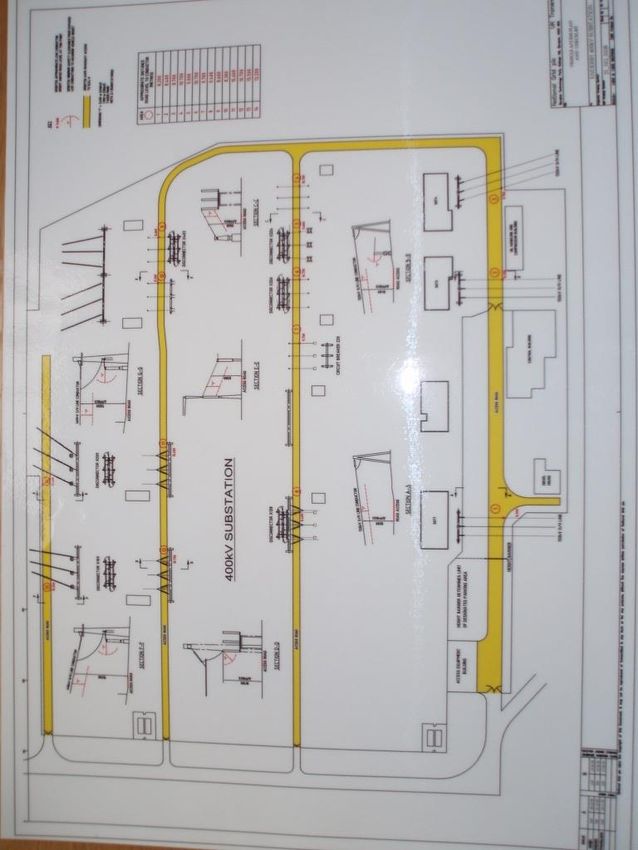
Uncontrolled when printedNational Grid UK Electricity Transmission plc NGUK/PM/ETSR/NSI/08/GN Issue 6 National Safety Instruction and Guidance Example of Safe Movement Route Drawing (B.2) © National Grid plc 2021 – All Rights Reserved Page 18 of 20 Uncontrolled when printed
National Grid UK Electricity Transmission plc                             NGUK/PM/ETSR/NSI/08/GN Issue 6
 National Safety Instruction and Guidance

Appendix C -
                              Proposed Scaffold Location Plan Form F2
 Location

 Equipment to be scaffolded

 Proposed scaffold dates                                       Topam No.

 Prepared by                                                   Where over sailing conductors are present
                                                               identify vertical clearance below
 Contact number

© National Grid plc 2021 – All Rights Reserved                                          Page 19 of 20
Uncontrolled when printed
National Grid UK Electricity Transmission plc NGUK/PM/ETSR/NSI/08/GN Issue 6
National Safety Instruction and Guidance
Appendix D - Authorisation Matrix for Personnel
Contractor Person Competent Competent Senior
Personnel Person Person Authorised
Limited Full Person
Sections 4.1 All Section 4
4.4 5.3
4.5 All Section 6
4.6 7.2
5.3 7.4
All Section 8 All Section 8
9.3 9.3
© National Grid plc 2021 – All Rights Reserved Page 20 of 20
Uncontrolled when printedYou can also read


