NATIONAL SCIENCE FOUNDATION - COVID-19 Affected Ongoing Construction of Major Facilities Projects - Report to Congressional Committees
←
→
Page content transcription
If your browser does not render page correctly, please read the page content below
United States Government Accountability Office
             Report to Congressional Committees

             NATIONAL SCIENCE
June 2021

             FOUNDATION

             COVID-19 Affected
             Ongoing Construction
             of Major Facilities
             Projects

GAO-21-417
June 2021

                                              NATIONAL SCIENCE FOUNDATION
                                              COVID-19 Affected Ongoing Construction of Major
                                              Facilities Projects
Highlights of GAO-21-417, a report to
congressional committees

Why GAO Did This Study                        What GAO Found
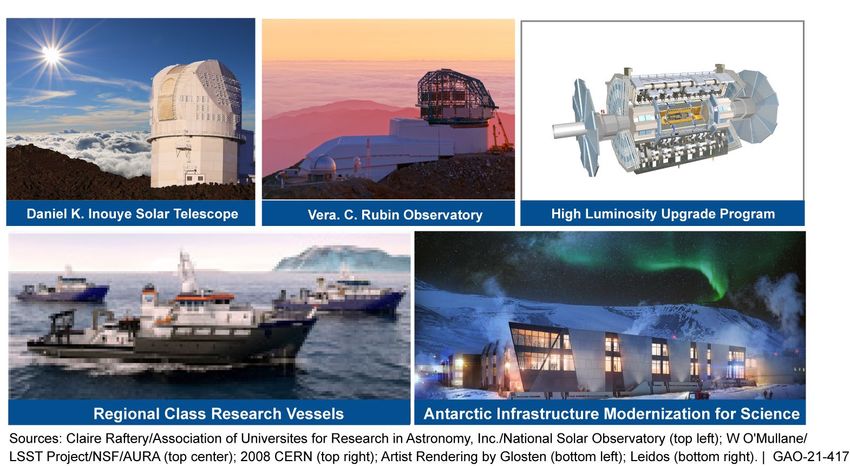
NSF supports the design, construction,        Since GAO’s April 2020 report on the status of the National Science Foundation's
and operations of science and                 (NSF) major facilities projects, the Large Hadron Collider High Luminosity
engineering research infrastructure           Upgrade program began construction, and it along with the four other major
such as telescopes and research               facilities projects in construction (see figure), have weathered schedule delays
vessels. These projects include major         associated with the COVID-19 pandemic. To partially account for increased costs
facilities that cost over $100 million to     associated with the pandemic, such as the cost of paying project staff while work
construct or acquire, and mid-scale           is paused, NSF has authorized $38.9 million in total project cost increases to the
research infrastructure projects. Over        award recipients constructing three of the five projects:
the past 5 fiscal years, NSF has
received over $1 billion in                   •   $18.9 million for the Daniel K. Inouye Solar Telescope,
appropriations for these projects. Prior      •   $10.0 million for the Vera C. Rubin Observatory, and
GAO reports reviewed NSF’s oversight          •   $10.0 million for Regional Class Research Vessels.
of the projects, its cost estimating and
schedule policies, and the project            Because the pandemic is ongoing and its full effects are not yet known, NSF
management expertise of its oversight         expects to make further adjustments to the cost and schedule of all five major
workforce.                                    projects in construction. Design work on an additional major facility project
                                              continued without significant interruption from the pandemic. Further, NSF made
Senate Report 115-275, Senate Report
114-239, and House Report 114-605
                                              awards to begin the agency's first three mid-scale research infrastructure
included provisions for GAO to review         projects.
and report annually on projects funded        National Science Foundation Major Facilities Projects in Construction
from NSF’s Major Research Equipment
and Facilities Construction account.
This report, the fourth, examines (1)
the cost and schedule performance of
NSF’s ongoing major facilities and mid-
scale research infrastructure projects
and (2) the extent to which NSF has
implemented prior GAO
recommendations related to its
management of major facilities. GAO
reviewed NSF and award recipient
documents for the projects. GAO
examined policies and procedures to
identify efforts to implement
recommendations and interviewed
NSF officials for clarifying information.

What GAO Recommends
NSF agreed with and has taken steps
to address three remaining                    NSF has fully implemented GAO’s prior recommendation on information sharing
recommendations from GAO’s prior              among award recipients and has drafted guidance or taken other steps towards
work to improve the project                   addressing GAO’s three remaining recommendations. To enhance information
management skills of its staff and            sharing among award recipients, NSF added a section to its terms and conditions
award recipients and to align schedule        in its major facilities agreements that encourages awardees to share information
guidance to GAO’s best practices.             among awardees and participate in a knowledge management program.
View GAO-21-417. For more information,
contact Candice Wright at (202) 512-6888 or
WrightC@gao.gov.

                                                                                           United States Government Accountability Office
Contents

Letter                                                                                      1
               Background                                                                  3
               NSF Experienced Cost or Schedule Increases on Five of Its Nine
                 Major Projects                                                           10
               NSF Implemented a Recommendation on Information Sharing and
                 Took Steps to Address Others                                             16
               Agency Comments                                                            20

Appendix I     Summaries of the National Science Foundation’s Major Facilities
               Projects under Construction                                                21

Appendix II    Summary of the National Science Foundation’s Future Major Facilities
               Project in Design                                                    33

Appendix III   GAO Contact and Staff Acknowledgments                                      36

Tables
               Table 1: Appropriations for NSF Major Research Equipment and
                       Facilities Construction                                             2
               Table 2: Completion Dates and Additional Estimated Delays to
                       NSF Major Facilities Projects in Construction, as of March
                       2021                                                               12
               Table 3: Not-to-Exceed Cost Changes for NSF Major Facilities
                       Projects in Construction, March 2021                               14
               Table 4: NSF Mid-scale Research Infrastructure Projects, March
                       2021                                                               15

Figures
               Figure 1: Organization of NSF Oversight of Major Research
                        Equipment and Facilities                                           6
               Figure 2: Total Project Cost in Relation to the Not-To-Exceed
                        Award Amount for NSF Construction Projects                        10

               Page i                                   GAO-21-417 National Science Foundation
Abbreviations

AIMS              Antarctic Infrastructure Modernization for Science
ATLAS             A Toroidal Large Hadron Collider Apparatus
CERN              European Organization for Nuclear Research
CMS               Compact Muon Solenoid
COVID-19          Coronavirus Disease 2019
DKIST             Daniel K. Inouye Solar Telescope
DOE               Department of Energy
HL-LHC            Large Hadron Collider High Luminosity Upgrade
LCCF              Leadership Class Computing Facility
LHC               Large Hadron Collider
LSST              Large Synoptic Survey Telescope
MREFC             Major Research Equipment and Facilities Construction
NSF               National Science Foundation
OMB               Office of Management and Budget
RCRV              Regional Class Research Vessels

This is a work of the U.S. government and is not subject to copyright protection in the
United States. The published product may be reproduced and distributed in its entirety
without further permission from GAO. However, because this work may contain
copyrighted images or other material, permission from the copyright holder may be
necessary if you wish to reproduce this material separately.

Page ii                                           GAO-21-417 National Science Foundation
Letter

441 G St. N.W.
Washington, DC 20548

                       June 8, 2021

                       The Honorable Jeanne Shaheen
                       Chair
                       The Honorable Jerry Moran
                       Ranking Member
                       Subcommittee on Commerce, Justice, Science,
                           and Related Agencies
                       Committee on Appropriations
                       United States Senate

                       The Honorable Matt Cartwright
                       Chairman
                       The Honorable Robert Aderholt
                       Ranking Member
                       Subcommittee on Commerce, Justice, Science,
                         and Related Agencies
                       Committee on Appropriations
                       House of Representatives

                       The National Science Foundation (NSF) supports the design,
                       construction, and operations of various research infrastructure projects,
                       which are research tools such as telescopes and research vessels.
                       Research infrastructure projects include both major facilities that cost
                       over $100 million to build and mid-scale research infrastructure projects
                       that cost between $4 million and $100 million to build. 1 These projects are
                       designed, constructed, and operated in collaboration with the scientific
                       community. The longevity of these projects—some may operate for 50
                       years—and complexity of their construction or acquisition heighten the
                       need for NSF to provide rigorous oversight.

                       NSF uses cooperative agreements and contracts to fund and oversee the
                       projects throughout their life cycles. Award recipients of cooperative
                       agreements and contracts—which may include universities, nonprofit
                       associations, and companies—manage the projects’ day-to-day activities.

                       1Mid-scale  research infrastructure projects are those with a total project cost above the
                       upper limit for NSF's Major Research Instrumentation program and below the threshold for
                       a major facility. American Innovation and Competitiveness Act (AICA), Pub. L. No. 114-
                       329, § 109(b)(4), 130 Stat. 2969, 2988 (2017). Major facilities are those that cost over
                       $100 million to construct regardless of the funding account. William M. (Mac) Thornberry
                       National Defense Authorization Act for Fiscal Year 2021, Pub. L. No. 116-283, § 267, 134
                       Stat. 3388, 3502 (amending section 110 of the AICA).

                       Page 1                                            GAO-21-417 National Science Foundation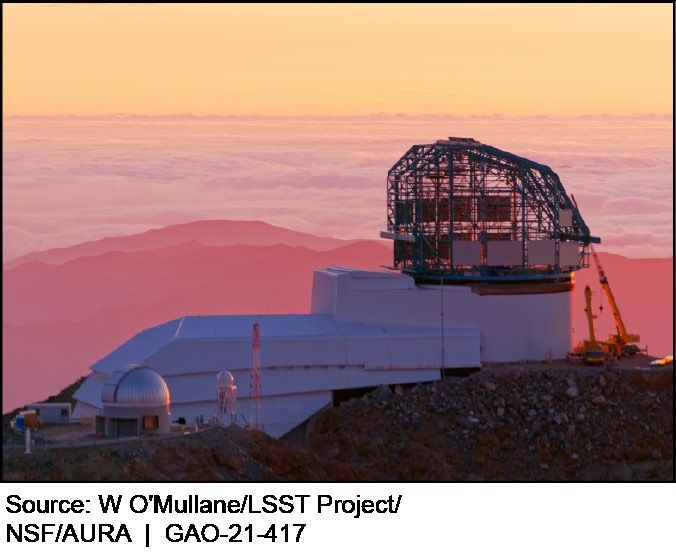
NSF generally funds these construction efforts through its Major
Research Equipment and Facilities Construction (MREFC) account. Over
the past 5 fiscal years, NSF has received over $1 billion in appropriations
to this account, as shown in table 1. In fiscal year 2021, Congress
appropriated $241 million for the MREFC account.

Table 1: Appropriations for NSF Major Research Equipment and Facilities
Construction
Dollars in millions

                                                                     Fiscal year
                                       2017                2018                2019          2020     2021
  Appropriations                         209                 183                296           243      241
Source: National Science Foundation (NSF) and congressional budget documents. | GAO-21-417

Since 2018, we have issued three reports focused on NSF’s oversight of
cost and schedule performance of the agency’s major facilities
construction projects and on NSF’s efforts to ensure the project
management expertise of NSF oversight staff and award recipients for its
major facilities projects. 2 In addition, we also reported on how NSF shares
lessons learned and best practices for the construction of major facilities
projects. We made a total of six recommendations to improve NSF’s
ability to provide oversight over the design and construction of these
major facilities projects. NSF concurred with our recommendations in
these past reports. In April 2020, we reported that NSF had implemented
two of the six recommendations.

Senate Report 115-275, Senate Report 114-239, and House Report 114-
605 included provisions for GAO to review and report on projects funded
from the NSF MREFC account. This report, the fourth of our annual
reports in response to the Senate and House report provisions, (1)
describes the cost and schedule performance of NSF’s ongoing major
facilities and mid-scale research infrastructure projects and (2) assesses

2GAO,  National Science Foundation: Revised Policies on Developing Costs and
Schedules Could Improve Estimates for Large Facilities, GAO-18-370, (Washington, D.C.:
June 1, 2018); GAO, National Science Foundation: Cost and Schedule Performance of
Large Facilities Construction Projects and Opportunities to Improve Project Management,
GAO-19-227, (Washington, D.C.: Mar. 27, 2019); GAO, National Science Foundation:
Cost and Schedule Performance of Major Facilities Construction Projects and Progress on
Prior GAO Recommendations, GAO-20-268, (Washington, D.C.: April 3, 2020).

Page 2                                                               GAO-21-417 National Science Foundation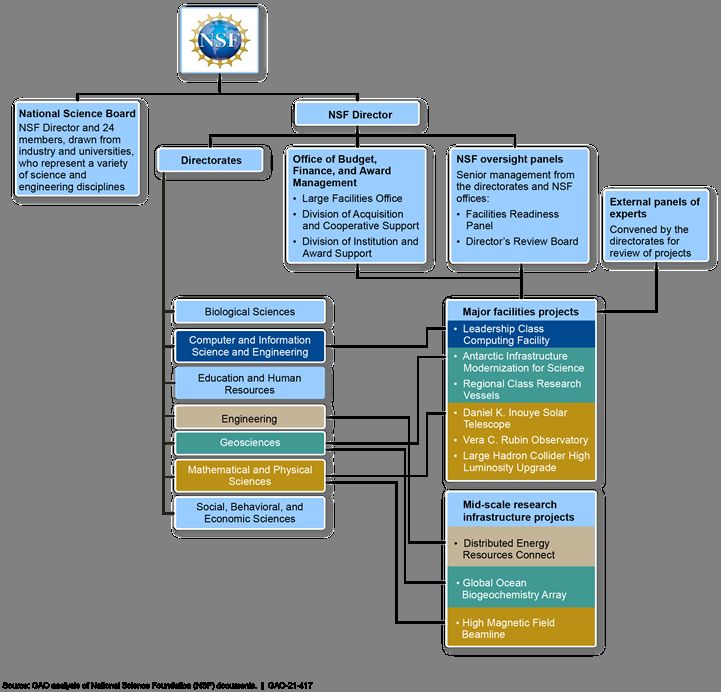
the extent to which NSF has implemented prior GAO recommendations
                            related to its management of major facilities.

                            To describe the cost and schedule performance of NSF’s major facilities
                            projects, we reviewed NSF and award recipient documents that detailed
                            project cost, schedule, and risks for each major facility. We also reviewed
                            initial documents on NSF’s mid-scale research infrastructure projects.
                            Additionally, we interviewed NSF officials to obtain clarifying information
                            about these projects and NSF’s oversight.

                            To assess the extent to which NSF has implemented the four
                            recommendations from two prior GAO reports on NSF major facilities that
                            had not been implemented as of April 2020, we reviewed NSF policies
                            and procedures as well as documentation related to actions the agency
                            took to implement these recommendations. 3 We also interviewed NSF
                            officials to discuss NSF’s ability to implement the recommendations, as
                            well as their estimated time frames for implementation.

                            We conducted this performance audit from September 2020 to June 2021
                            in accordance with generally accepted government auditing standards.
                            Those standards require that we plan and perform the audit to obtain
                            sufficient, appropriate evidence to provide a reasonable basis for our
                            findings and conclusions based on our audit objectives. We believe that
                            the evidence obtained provides a reasonable basis for our findings and
                            conclusions based on our audit objectives.

Background
Stages in the Life Cycles   Each major facility and mid-scale research infrastructure project has a
of NSF’s Major Research     sponsoring organization from within NSF’s seven research directorates. 4
Equipment and Facilities    The sponsoring organization assesses the scientific merit of a potential
                            project, proposes projects for funding through NSF’s MREFC account,
Projects                    and is responsible for overseeing the project during the following five
                            stages of its life cycle.

                            •   Development. Initial project ideas emerge; and a broad consensus is
                                built within the relevant scientific community for the potential long-term
                            3GAO-18-370   and GAO-19-227.
                            4NSF   is divided into the following seven research directorates that support science and
                            engineering research and education: biological sciences; computer and information
                            science and engineering; engineering; geosciences; mathematical and physical sciences;
                            social, behavioral, and economic sciences; and education and human resources.

                            Page 3                                            GAO-21-417 National Science Foundation
needs, priorities, and general requirements for research infrastructure
    that NSF may consider funding.
•   Design. Entrance into this stage occurs when the NSF Director
    approves the proposed research infrastructure as a national priority
    and the sponsoring directorate makes an award (either through a
    cooperative agreement or contract) for developing detailed project
    cost, scope, and schedule for possible construction. This stage is
    divided into conceptual, preliminary, and final design phases. A
    candidate project will exit the design stage and enter the construction
    stage after a successful review by the NSF director and other key
    stakeholders of its project execution plan and authorization of its not-
    to-exceed total project cost by the National Science Board, as
    discussed below.
•   Construction. The construction stage begins when NSF makes
    awards to external recipients for acquisition or construction of
    research infrastructure. 5 The construction stage ends after final
    delivery and acceptance of the defined scope of work and facility
    performance per terms of the award instrument.
•   Operations. The operations stage includes the day-to-day work
    necessary to operate and maintain the research infrastructure
    (including refurbishment or upgrade activities) and to perform
    research.
•   Divestment. Divestment can include the transfer of the research
    infrastructure to another entity’s operational and financial control or
    the decommissioning of the research infrastructure, including its
    complete deconstruction and removal. NSF generally decides to
    divest when the agency or the scientific community determines that

5Awards generally take the form of cooperative agreements, although NSF occasionally
uses contracts, according to agency officials. The policies and procedures in NSF’s Major
Facilities Guide apply to research infrastructure projects regardless of the award
instrument employed. In addition, cooperative agreements with universities, consortia of
universities, or nonprofit organizations are governed by the Office of Management and
Budget’s (OMB) Uniform Administrative Requirements, Cost Principles, and Audit
Requirements for Federal Awards (Uniform Guidance). 78 Fed. Reg. 78,590 (Dec. 26,
2013) (codified as amended at 2 C.F.R. pt. 200). In December 2014, NSF and other
federal awarding agencies issued a joint interim final rule to implement this Uniform
Guidance. 79 Fed. Reg. 75,871 (Dec. 19, 2014). NSF received approval from OMB to
implement the Uniform Guidance using a policy rather than a regulation. Acquisitions by
contract of supplies or services by and for the use of the federal government are governed
by the Federal Acquisition Regulation. See 48 C.F.R. §§ 1.104, 2.101(b); see also chapter
25 of title 48 of the Code of Federal Regulations for NSF-specific provisions. According to
NSF’s Major Facilities Guide, contracts with nonprofit and educational institutions are also
governed by the Uniform Guidance.

Page 4                                             GAO-21-417 National Science Foundation
the facility is no longer considered an operational priority with regard
to advancing science, according to NSF’s Major Facilities Guide.
NSF funding for the development, design, operations, and divestment
stages generally comes from the sponsoring directorate. Funding for the
construction stage generally comes from the MREFC account.
NSF Oversight of Major NSF has established an oversight structure for major facilities projects
Research Equipment and that includes organizations from across the agency (see fig. 1). This
includes the National Science Board, a policy and advisory body that is
Facilities Projects
part of NSF and consists of the NSF Director and 24 members, drawn
from industry and universities, who represent a variety of science and
engineering disciplines. The NSF Office of the Director and the National
Science Board provide high-level, ongoing oversight of major facilities
projects, including the approval of new projects to be included in NSF’s
annual budget request.
Page 5 GAO-21-417 National Science FoundationFigure 1: Organization of NSF Oversight of Major Research Equipment and Facilities
Note: Figure does not include all NSF organizations or interactions between them and includes only
the major facilities projects and mid-scale research infrastructure projects in design or construction at
the time of GAO’s review.
Page 6 GAO-21-417 National Science FoundationWithin NSF’s Office of Budget, Finance, and Award Management, the
Large Facilities Office (1) develops business-related oversight policies for
all life-cycle stages, with a focus on the design and construction stages,
and (2) provides assistance on nonscientific and nontechnical aspects of
project planning, budgeting, implementation, and management. To that
end, the office maintains the Major Facilities Guide, which contains NSF
policies for agency staff and recipients on the planning, management, and
oversight of major facilities. The guide also tailors the policies for
application to mid-scale research infrastructure projects.
NSF also uses external panels of experts to review projects at several
points during their life cycles. An external panel may first review a project
proposal during the development stage. Separate panels then review the
project at the culmination of each of its design phases. In addition, an
external panel periodically reviews each project during both construction
and operations; according to NSF officials, those reviews are generally
annual.
Construction Costs and Under NSF’s major facilities construction process, the recipients of design
Schedules of Major awards develop construction cost and schedule estimates for projects
and submit them to NSF for review. In particular, after a project’s final
Facilities Projects
design review, the National Science Board authorizes a not-to-exceed
award amount and duration. The not-to-exceed award amount that the
National Science Board authorizes is the amount against which NSF
measures cost increases to implement its no cost overrun policy.
NSF’s Major Facilities Guide defines the following components, which
together make up the total project cost and schedule for the construction
of major facilities projects. The total project cost awarded in a project’s
construction agreement may be less than the not-to-exceed cost but it is
not to exceed it. These components of the total project cost and schedule
include the following:
• Performance measurement baseline. During design, the scope,
cost, and schedule are refined and eventually become the project
baseline. Once the baseline has been authorized and included in a
construction award, it is known as the performance measurement
baseline. NSF documents the performance measurement baseline in
the terms and conditions of the award instrument and requires that
any changes to it be made through a formal change control process.
The performance measurement baseline does not include the
project’s budget or schedule contingency.
Page 7 GAO-21-417 National Science Foundation• Contingency. This is an amount of budget or time for covering the
cost increases or delays that would result if foreseen project risks
were to occur, such as price changes of goods in future years. During
development of a total project cost estimate, the timing and impacts of
such risks are uncertain. As a project progresses, the impacts of risks
that materialize may exceed the cost or schedule in the performance
measurement baseline and lead to use of the project’s budget or
schedule contingency. 6 The amount of contingency needed for a
project is typically estimated using statistical analysis or judgment
based on past project experience. According to NSF’s Standard
Operating Guidance on budget contingency, it is likely that no
contingency will be left over by the end of a project because all of it
will have been used during normal execution of the project to manage
known risks and uncertainties. NSF approval is needed when use of
contingency exceeds certain project-specific thresholds, which are
described in the project’s execution plan and codified in the award.
In this report, we identify total project costs for the construction of major
facility and mid-scale research infrastructure projects, which were
developed during the design phase based on the latest estimates
available from NSF officials; those estimates are subject to change before
construction awards are made. For projects under construction, we
identified total project costs based on the amounts awarded in the
cooperative support agreements for construction and the not-to-exceed
amount authorized by the National Science Board. Only at the end of the
project—when construction is complete and the awards have been closed
out—will the final total project costs be known.
In addition to the performance measurement baseline and budget
contingency, a project’s not-to-exceed cost that the National Science
Board authorized may include the following:
• Fee. NSF may provide recipients the opportunity to earn a fee for
major facilities projects.
6Use of budget contingency is governed by OMB’s Uniform Guidance. See 2 C.F.R. §
200.433. OMB’s Uniform Guidance and NSF’s Standard Operating Guidance on budget
contingency define contingency as that part of a budget estimate of future costs (typically
of large construction projects, information technology systems, or other items as approved
by the federal awarding agency) which is associated with possible events or conditions
arising from causes the precise outcome of which is indeterminable at the time of
estimate, and that experience shows will likely result, in aggregate, in additional costs for
the approved activity or project. Amounts for major project scope changes, unforeseen
risks, or extraordinary events may not be included.
Page 8 GAO-21-417 National Science Foundation• Management reserve. NSF, not the award recipient, holds
management reserve to manage budget uncertainties, unforeseeable
events, and risks not manageable by the recipient.
NSF’s No Cost Overrun Since February 2008, NSF has had a policy to manage cost overruns on
Policy for Major Facilities major facilities projects. 7 Under this policy, the cost estimate developed at
Projects the preliminary design review should have adequate contingency to cover
all foreseeable risks. 8 Any cost increases not covered by contingency are
generally to be accommodated by reductions in scope. 9 Figure 2 provides
a breakdown of the total project cost and its relation to the not-to-exceed
award amount.
7See GAO-18-370 for additional details on the history of this policy.
8According to the September 2019 update to NSF’s Major Facilities Guide, while the
policy requires that the total project cost estimate established following the preliminary
design review have adequate contingency to cover all foreseeable risks, NSF will conduct
oversight of major facilities projects against the total project cost authorized by the NSB
following final design review.
9These reductions in scope differ from re-planning actions on a project. NSF’s Major
Facilities Guide defines re-planning as a normal project management process to modify or
re-organize the performance measurement baseline cost and/or schedule plans for future
work without impacting total project cost, project end date, or overall scope objectives or
the implementation of approved de-scoping options.
Page 9 GAO-21-417 National Science FoundationFigure 2: Total Project Cost in Relation to the Not-To-Exceed Award Amount for NSF Construction Projects
Note: Figure does not include other components of the not-to-exceed award amount that the National
Science Board may authorize, such as fees or management reserves.
Since our April 2020 report, NSF has continued construction on four
NSF Experienced major facility projects—the Daniel K. Inouye Solar Telescope (DKIST), the
Cost or Schedule Vera C. Rubin Observatory (Rubin Observatory), Regional Class
Research Vessels (RCRV), and Antarctic Infrastructure Modernization for
Increases on Five of Science (AIMS)—and begun construction of a fifth, the Large Hadron
Its Nine Major Collider High Luminosity Upgrade (HL-LHC) program. The Coronavirus
Disease 2019 (COVID-19) pandemic, however, caused unexpected
Projects delays to each of the projects in construction. As a result of the pandemic
and other factors, all five of these projects have experienced schedule
delay and may cost more than initially budgeted. NSF’s four other
projects, an existing major facility project in design and three newly
announced mid-scale projects proceeded without significant interruption.
Page 10 GAO-21-417 National Science FoundationAll Five Projects in The COVID-19 pandemic has caused unexpected delays to NSF’s five
Construction Had projects that are in construction to varying degrees depending on the
geographic location, level of completion, and technical nature of the
Schedule Delays and
project. NSF considers all five major facility projects that were in
Several Have Requested construction to be behind schedule and intends to increase authorized
Additional Funds not-to-exceed total project costs and supplement awards, or re-evaluate
project scope, if necessary, to account for the pandemic’s effects. Given
Travel and Quarantine Restrictions the pandemic’s on-going domestic and global impacts to personnel and
Enacted Because of the COVID-19
Pandemic Affected Construction of NSF’s
supply chains, NSF officials expect that all of its major facility projects
Major Facilities Projects currently in construction will be extensively re-planned or completely re-
Travel restrictions or quarantines caused baselined to account for the effects of the pandemic. 10
significant work stoppages at three major
facilities projects.
• At Daniel K Inouye Solar Telescope,
Travel restrictions and social distancing requirements during the
Hawaii’s travel restrictions prevented staff pandemic have affected each of the projects in construction (see
from reaching the telescope for sidebar). However, these delays have generally not yet been fully
commissioning activities.
• At the Vera C. Rubin Observatory, the
incorporated into the projects’ performance measurement baselines,
Chilean government’s quarantine because the pandemic is ongoing. As of March 2021, two of the five
measures resulted in work stoppage projects in construction have had their schedules extended (see table 2).
between March and September 2020.
NSF officials approved a schedule extension of 18 months for DKIST and
• On Antarctic Infrastructure Modernization
for Science, NSF suspended work at the a schedule extension of 6 months for RCRV to address COVID-related
project site to avoid the possibility of and other delays. For the three other projects in construction, NSF has
introducing COVID-19 to Antarctica. This
stoppage may continue for another
not yet adjusted the schedules because these projects are earlier in their
season, effectively halting all construction construction and not in immediate need of schedule extensions. Officials
for two years. estimate that the HL-LHC is currently approximately 7 months behind
Source: GAO analysis of National Science Foundation (NSF)
information. | GAO-21-417 schedule, and the Rubin Observatory is 10 months behind schedule.
Having lost a construction season, AIMS is also running behind schedule.
10NSF defines re-planning as a normal project management process to re-organize
without impacting the total project cost, schedule or scope. Re-baselining is a re-planning
that results in a change that is outside the terms set forth in the award for either the total
project cost, the project duration, or the project scope that is not in the approved options
for scope management.
Page 11 GAO-21-417 National Science FoundationTable 2: Completion Dates and Additional Estimated Delays to NSF Major Facilities
Projects in Construction, as of March 2021
Current
scheduled Additional
Social Distancing Restrictions Imposed Original completion estimated
Because of the COVID-19 Pandemic Project Name completion date date delaya
Affected Construction of NSF’s Major
Facilities Projects Daniel K Inouye Solar Telescopeb December 2017 December 2021 0 months
Social distancing requirements, which Vera C. Rubin Observatoryc October 2022 October 2022 10 monthsc
reduced the number of employees that could
work simultaneously, affected four major Regional Class Research Vessels July 2024 January 2025 No estimate
facilities projects. Large Hadron Collider High December 2026 December 2026 7 months
• On Regional Class Research Vessels, Luminosity Upgrade
fewer shipyard workers could be on site
Antarctic Infrastructure January 2028 January 2028 No estimatec
to work on the research vessels.
Modernization for Sciencec
• On the Large Hadron Collider High
Luminosity Upgrade, fewer research Source: GAO analysis of National Science Foundation (NSF) information. | GAO-21-417
employees could conduct lab work a
Estimated delays are based on NSF projections and are not incorporated into the projects current
necessary to advance upgrades to the performance measurement baseline
detector components. b
This project was re-baselined in 2014. Before the Coronavirus Disease 2019 pandemic, its
• At the Daniel K Inouye Solar Telescope scheduled completion date was June 2020. In May 2021, NSF updated its project schedule to reflect
and the Vera C. Rubin Observatory, December 2021 as the completion date.
social distancing requirements limited the c
Re-baseline expected in late 2021.
number of individuals on site for
construction, integration, and testing. In some cases, NSF officials expect that re-baselining will be necessary
Source: GAO analysis of National Science Foundation (NSF)
information. | GAO-21-417
to develop a reliable completion schedule for projects in construction. For
example, NSF officials expect to re-baseline the Rubin Observatory later
in 2021 and develop a new completion date at that time. Shutdown of
work at the Rubin Observatory’s construction site in Cerro Pachón, Chile,
stopped progress on two significant components, the dome that will
house the telescope and the telescope mount assembly that moves and
stabilizes it. Work at McMurdo Station in Antarctica for the AIMS project
was suspended in March 2020 and has not yet resumed. Construction
activities in Antarctica are concentrated over the austral summer with
work beginning in October and concluding in March. With the pandemic
and its effects ongoing, construction work at the site may not resume for
the 2021-2022 season, according to NSF officials. A new estimated
completion date for AIMS will depend on how the project is re-baselined,
including a re-evaluation of the project scope. On April 30, 2021, NSF
determined that it would not be funding additional components of AIMS
due to the significant impacts of the pandemic. Current components of
AIMS include the Vehicle Equipment and Operations Center, the first
lodging unit, and associated utilities.
In addition to the pandemic, other factors contributed to schedule delay
since our April 2020 report. Major facility projects try to identify
foreseeable delays and other schedule risks during design and include
Page 12 GAO-21-417 National Science Foundationschedule contingency to account for these risks as part of the project management process. For example, the DKIST project site used schedule contingency to account for time lost due to an adverse weather event at its construction site in Hawaii, and the RCRV project site in Houma, Louisiana used scheduled contingency when it experienced shipyard performance challenges. However because the pandemic was unforeseen a project’s remaining schedule contingency may not accurately reflect its total schedule risk. The delays and inefficiencies caused by the pandemic will have cost impacts on the projects under construction as well. Some construction costs, such as those associated with project staff waiting for work to resume, continue to accrue even if no or little construction can be performed. Other costs are new, such as the leasing of additional storage space for materials waiting to be shipped to a project site and time added to tasks as a result of social distancing. For example, on HL-LHC NSF officials estimated that the current cumulative effects of COVID-19 totaled between $2 million and $3 million dollars as of January 2021. NSF’s major facilities projects generally use their budget contingency funds to compensate for changes in expected costs resulting from known project risks. Such contingency is built into the total project cost and is estimated at the start of construction. Consistent with NSF policy, NSF does not plan to use budget contingency to offset cost increases related to the pandemic. For unforeseen events beyond the award recipient’s control—like the pandemic—NSF’s Major Facilities Guide allows for the use of management reserve, which is an authorized amount of money in addition to a project’s baseline estimate and contingency to address the additional work associated with unforeseen events. To address costs associated with the pandemic, NSF has sought authorization through the National Science Board or used delegated authority to create management reserves. Prior to the pandemic, none of the projects under construction had management reserves. As of March 2021, however, three projects were authorized management reserves. 11 To create management reserves, the National Science Board and NSF increased the not-to-exceed amounts cumulatively by $38.9 million. The not-to-exceed cost for DKIST has increased by $18.9 million, and the not- 11Since NSF does not normally have management reserves, they must be identified by NSF from available MREFC funds, if needed in the near-term. Long-term additional funds may be appropriated by Congress. Page 13 GAO-21-417 National Science Foundation
to-exceed costs for both the Rubin Observatory and RCRV have
increased by $10 million (see table 3). 12 NSF officials’ adjustments to
account for the pandemic were ongoing as of March 2021 because the
full effects of the pandemic are not yet known. NSF officials told us they
expect to seek authorization for additional reserves through the National
Science Board to account for the unexpected costs the pandemic has
created.

Table 3: Not-to-Exceed Cost Changes for NSF Major Facilities Projects in
Construction, March 2021

Dollars in millions

                                           Original                 Increase in not-to-             Current
                                    authorized not-             exceed cost as a result      authorized not-
                                    to-exceed cost                     of management         to-exceed cost
    Project name                                                              reserves
    Daniel K. Inouye                               297.9                              18.9            363.0a
    Solar Telescopea
    Vera C. Rubin                                  473.0                              10.0             483.0
    Observatoryb
    Regional Class                                 365.0                              10.0             375.0
    Research Vessels
    Large Hadron Collider                          153.0                                0              153.0
    High Luminosity
    Upgradec
    Antarctic                                      410.4                                0              410.4
    Infrastructure
    Modernization for
    Scienceb
    Total                                        1,699.3                              38.9           1,784.4
Source: GAO analysis of National Science Foundation (NSF) information. | GAO-21-417
a
 DKIST has been re-baselined since its original award, so the original authorized not-to-exceed cost
and the increase in not-to-exceed cost as a result of management reserves will not total to the current
authorized not-to-exceed cost. Before the Coronavirus Disease 2019 (COVID-19) pandemic, the
authorized total project cost was $344.1 million.
b
    NSF officials expect to re-baseline this project in late 2021.
c
 This project is in its first year of construction, so NSF officials may adjust its cost to reflect the effects
of the COVID-19 pandemic at a later time.

12NSF was able to authorize $14.1 million in additional management reserve for RCRV
because the project’s construction award was below its not-to-exceed amount.
Considering this, total authorized management reserve was about $43 million as of March
2021.

Page 14                                                                GAO-21-417 National Science Foundation
Work Continued on One A major facility project in design and newly announced mid-scale
Project in Design and NSF research infrastructure projects proceeded without significant interruption.
The Leadership Class Computing Facility (LCCF), which is the only major
Announced Three New
facility project in the design stage, underwent conceptual design review in
Projects June 2020. LCCF’s total project cost is still under development. Under
NSF policy, a major facility’s total project cost is not final until after the
final design review when the National Science Board authorizes a not-to-
exceed cost and an award duration for construction.
Additionally, in 2020 the National Science Board authorized the first mid-
scale research infrastructure projects from the MREFC account and,
following NSF review, awarded funds to three projects. NSF sought
proposals for potential projects with total project costs between $20
million and $70 million. 13 The three new projects funded by NSF have a
combined total cost of $125.1 million and scheduled completion dates in
2025 (see table 4).
Table 4: NSF Mid-scale Research Infrastructure Projects, March 2021
Authorized
award amount Scheduled
(dollars in completion
Project Name Awardee Project description millions) date
Distributed Energy University of To address the long-term challenges of integrating 39.5 October 2025
Resources Connect California, renewable and distributed energy resources into the
(DERConnect) San Diego power grid, DERConnect aims to establish a large-scale
grid-connected experimental research facility. This testbed
will also help to develop a new generation of workforce to
successfully modernize the power grid.
Global Ocean Monterey Bay To better study and monitor the effects of climate change 52.9 October 2025
Biogeochemistry Aquarium on the oceans, this project aims to construct 500
Array Research biogeochemical Argo floats with oxygen, nitrate, pH, and
Institute other sensors to be released into the ocean to collect
chemical and biological data at depths of over a mile. The
network would deliver data in real-time to an established
global data system, where it would be freely available at
no cost.
13Since the initial project solicitation, NSF has increased the upper limit for a mid-scale
research infrastructure project to $100 million to align with the definition of a major facility
project as amended by the William M. (Mac) Thornberry National Defense Authorization
Act for Fiscal Year 2021. NSF received 48 initial proposals and chose award recipients
from 11 full proposals.
Page 15 GAO-21-417 National Science FoundationAuthorized
award amount Scheduled
(dollars in completion
Project Name Awardee Project description millions) date
High Magnetic Field Cornell To enable new science with X-rays, this project will 32.7 December 2025
Beamline University establish a High Magnetic Field Beamline. The beamline
can be used to observe the underlying correlations and
symmetries of new phases of matter induced by high
magnetic fields and obtain insights into electronic
symmetry breaking, unconventional superconductivity, and
quantum magnetism.
Source: GAO analysis of National Science Foundation (NSF) information. | GAO-21-417
NSF issued guidance to improve its process for sharing information and
NSF Implemented a best practices among major facilities projects, which fully implements a
Recommendation on recommendation we made in March 2019. In addition, NSF has taken
preliminary steps such as drafting guidance to address three other
Information Sharing recommendations from our June 2018 and March 2019 reports related to
and Took Steps to its management of its major facilities. 14 Once NSF completes these steps,
we will evaluate its actions to determine whether they are sufficient to fully
Address Others address our recommendations.
NSF Issued Guidance to NSF has updated the terms and conditions of its major facilities
Improve Information agreements to improve collection and sharing of lessons learned and best
practices among major facilities project teams. This action addresses a
Sharing Among Awardees
recommendation in our March 2019 report where we recommended that
NSF ensure, through a requirement or other means, that award recipients
for major facilities projects provide information to NSF on any lessons
learned or best practices. 15 At that time, we found that NSF had a process
to share lessons learned but provided inconsistent direction to projects on
how to participate in this process. For example, the RCRV project had a
requirement in its award terms and conditions to annually share lessons
learned, but the Rubin Observatory’s award did not.
In our April 2020 report, we found that NSF had drafted preliminary award
terms and conditions that would require all recipients to participate in
NSF’s program and that they planned to finalize and publish this guidance
14GAO-18-370, GAO-19-227.
15The process for identifying and sharing lessons learned on major facilities projects,
which NSF refers to as its Knowledge Management program, was designed to respond to
a 2015 recommendation by the National Academy of Public Administration and to the
American Innovation and Competitiveness Act’s requirements that NSF coordinate the
sharing of best management practices and lessons learned from major facilities projects.
Page 16 GAO-21-417 National Science Foundationin fiscal year 2020. 16 NSF implemented the updated terms and conditions
in all its major facilities agreements on October 5, 2020, thereby fully
addressing the recommendation. The updated terms encourage all
awardees to share information on lessons learned and best practices and
participate in NSF’s annual Major Facilities Workshop. 17 According to
NSF officials, the agency chose not to make this a requirement because
other agencies running similar programs found that making participation
voluntary yields more meaningful results. The most recent Major Facilities
Workshop included representatives from all current major facilities.
NSF Has Taken Additional NSF has also taken additional steps since our April 2020 report to
Steps to Address the address the three remaining recommendations from our June 2018 and
March 2019 reports, but has not fully implemented them. 18
Three Remaining
Recommendations Policies for developing project schedules. NSF is in the process of
Related to Its Oversight of issuing guidance that could improve the accuracy and reliability of project
Major Facilities schedules. In our June 2018 report, we found that the majority of NSF’s
scheduling policies did not fully align with GAO’s best practices for
scheduling which could lead to increased costs and schedule delays. We
recommended that NSF revise its policies for developing schedules for
major facilities projects, and for reviewing those schedules, to better
incorporate best practices in GAO’s schedule guide. 19
In April 2020, we reported that NSF had updated internal guidance
documents to include an analysis of project schedules by the Large
Facilities Office as part of the NSF cost analysis process. 20 In addition, we
reported that NSF planned to include additional guidance on scheduling
in its Major Facilities Guide. The guide contains NSF policy on planning
and managing major facilities, including required policies and procedures
16GAO-20-268.
17NSF hosts its major facilities workshop annually to provide a collaborative forum for
continuous learning and information sharing among participants. During the COVID-19
pandemic, NSF transitioned to quarterly virtual webinars. Based on this experience, NSF
may use a combination of an in-person workshop and webinars in the future, according to
NSF officials.
18GAO-18-370, GAO-19-227.
19GAO’s schedule guide develops the scheduling concepts introduced in our cost
estimating guide and presents them as 10 best practices associated with developing and
maintaining a reliable, high-quality schedule. See GAO, Schedule Assessment Guide:
Best Practices for Project Schedules, GAO-16-89G (Washington, D.C.: December 2015).
20GAO-20-268.
Page 17 GAO-21-417 National Science Foundationand related guidance. According to NSF, they revised their pre-award internal guidance to evaluate and document that award recipients develop their schedule estimates in alignment with the four GAO characteristics of a high-quality schedule (comprehensive, well-constructed, credible, and controlled). In February 2021, NSF released a draft for public comment of the Major Facilities Guide that requires award recipients to use GAO's scheduling guide when developing and managing project schedules (a requirement added in 2017) and provides additional guidance for implementation of the GAO guide on NSF-funded projects. According to NSF officials, they expect to issue the updated guide by the end of fiscal year 2021. Once issued, we will review the final version of the guide to determine if the recommendation was met. Project management competencies of NSF’s major facilities oversight workforce. NSF has taken steps to evaluate the project management competencies of its oversight staff and is considering additional actions. The American Innovation and Competitiveness Act directed NSF to determine what project management and financial management expertise NSF staff need to effectively oversee major facilities projects. However, in our March 2019 report, we found that NSF had not assessed NSF major facilities oversight staff for potential competency gaps in these areas of expertise nor taken steps to close any such gaps. We recommended that NSF assess the agency’s oversight workforce to identify any competency gaps, develop a plan to address them and time frames for doing so, and monitor progress in closing them. In April 2020, we reported that NSF had hired a contractor to conduct a proficiency assessment and workforce gap analysis. 21 Since then, the contractor has helped NSF develop a competency model for its staff and complete surveys of NSF staff who oversee major facilities projects to assess their competencies in project management and other professional and technical areas. NSF’s contractor used three surveys to identify any competency gaps. Employees rated their own proficiency in competencies, supervisors rated the proficiency of their employees, and supervisors rated the expected minimum proficiency levels for a 21In addition to responding to our recommendation, this analysis is part of NSF's implementation of the Program Management Improvement Accountability Act. Pub. L. No. 114-264, § 2(b)(1), 103 Stat.1371, 1372 (2016) (codified as amended at 31 U.S.C. § 1126). Page 18 GAO-21-417 National Science Foundation
hypothetical, experienced employee. Using data from these surveys, the
contractor found that certain individuals had gaps in award management,
budget management, financial cost/analysis, project management, and
risk and opportunity management, among others. However, they found
that NSF’s project teams as a single group possessed the competencies
expected. 22

NSF is now planning how to address the identified gaps. According to
NSF officials, supervisors have used the survey results to help staff
create individualized training plans. In addition, NSF commissioned a
study of its training capabilities. In January 2021, the study identified
areas where NSF does not provide the training in-house that employees
need to reach some mid-level proficiencies and most expert level
proficiencies and made recommendations to improve the agency’s
internal and external training opportunities. For example, according to the
study, the agency did not provide sufficient training opportunities in areas
such as award management and risk and opportunity management. The
study recommended that NSF develop new courses and leverage training
resources at other agencies. According to NSF officials, the agency is
now taking steps to implement the recommendations and to determine
how it will monitor staff competencies, such as by performing regular self-
assessment surveys. We will continue to review NSF’s actions as it works
to identify, address, and monitor competency gaps.

Project management expertise of award recipients for major
facilities projects. NSF is in the process of issuing guidance that could
improve the project management expertise of its major facilities award
recipients. In our 2019 report, we recommended that NSF establish
criteria for the project management expertise of major facilities project
recipients and incorporate the criteria in project requirements and external
panel reviews. In response, NSF identified criteria that award recipients
must be able to demonstrate, but these criteria will not be fully integrated
into NSF’s oversight practices until the end of fiscal year 2021.

As we reported in April 2020, NSF established criteria for expertise in
project management, program management, earned value management,
risk management, cost estimating, and other areas in draft updates to its
Major Facilities Guide. As discussed above, the draft guide was released
for public comment in February 2021 and NSF expects to issue the guide

22NSF's  implementation of the Program Management Improvement Accountability Act
looks for the three core members of the NSF Integrated Project Team to hold the
necessary competencies for award oversight, as opposed to a single individual.

Page 19                                       GAO-21-417 National Science Foundation
by the end of fiscal year 2021. Further, according to NSF officials,
                  requirements for expert panels to assess recipients’ project management
                  expertise will be included in internal guidance they plan to complete in the
                  third quarter of fiscal year 2021. Once issued, we will review the final
                  versions of these documents to determine if the recommendation was
                  met.

                  We provided a draft of this report to NSF for review and comment. NSF
Agency Comments   provided technical comments, which we incorporated as appropriate.

                  We are sending copies of this report to the appropriate congressional
                  committees and the Director of the NSF. In addition, the report is
                  available at no charge on the GAO website at https://www.gao.gov.

                  If you or your staff have any questions about this report, please contact
                  me at (202) 512-6888 or WrightC@gao.gov. Contact points for our
                  Offices of Congressional Relations and Public Affairs may be found on
                  the last page of this report. GAO staff who made key contributions to this
                  report are listed in appendix III.

                  Candice N. Wright
                  Acting Director
                  Science, Technology Assessment, and Analytics

                  Page 20                                   GAO-21-417 National Science Foundation
Appendix I: Summaries of the National
Science Foundation’s Major Facilities
Projects under Construction
This appendix provides individual summaries of the National Science
Foundation’s (NSF) five major facilities projects under construction: (1)
the Daniel K. Inouye Solar Telescope, (2) the Vera C. Rubin Observatory,
(3) the Regional Class Research Vessels, (4) the Antarctic Infrastructure
Modernization for Science, and (5) Large Hadron Collider High
Luminosity Upgrade Program.
Each project’s summary is based on project documents and other
information that NSF officials provided and includes the following:
• an overview of the project and its purpose;
• a timeline identifying key project dates, including the date of the
original construction award, which we report as the start of
construction;
• project information, such as the project’s scheduled completion date
for construction (including schedule contingency), the type and latest
amounts of the awards for construction, 1 the responsible NSF
directorate, project partners, and expected duration of operations;
• tables summarizing the project’s current status and its cost and any
cost 2 or schedule 3 increases or scope reductions made under NSF’s
no cost overrun policy and changes since our April 2020 report; 4
• a summary of the project’s cost and schedule performance history;
• a chart depicting the latest construction award’s total project cost for
construction, including the performance measurement baseline and
budget contingency;
1Costs are reported in then-year dollars, which means that NSF or the recipient converted
base-year dollars by applying an inflation index. According to NSF policy, inflation is a part
of NSF’s budgeting and project planning.
2NSF measures cost increases against the not-to-exceed cost that the National Science
Board authorized under the agency’s no cost overrun policy. Therefore, we define cost
increases since starting construction as increases to the not-to-exceed cost that the Board
authorized.
3We identified schedule increases by comparing the project’s scheduled completion date
in the construction award as of December 2020 with the scheduled completion date in the
original construction award. When a project’s scheduled completion date was not
identified in the award, we used the expiration date of the award.
4GAO, National Science Foundation: Cost and Schedule Performance of Major Facilities
Construction Projects and Progress on Prior GAO Recommendations, GAO-20-268
(Washington D.C.: April 3, 2020).
Page 21 GAO-21-417 Natioanl Science Foundation• if applicable, a chart showing the increase in the construction award’s
total project cost since the original construction award; and
• information on remaining project risks and potential for cost or
schedule increases, including the amount of remaining contingency
and scope reduction options. 5
5We report each project’s estimate of remaining risk exposure as weighted by the
recipients for the probability of the risks occurring. According to NSF’s Major Facility
Guide, risk exposure is the quantitative impact of risks. We report the risk exposure as
determined by the Monte Carlo method when available.
Page 22 GAO-21-417 Natioanl Science FoundationDANIEL K. INOUYE SOLAR TELESCOPE
When completed, the National Science Foundation’s (NSF) Daniel K. Inouye Solar
Telescope (DKIST), formerly named the Advanced Technology Solar Telescope, will be
the world’s flagship facility for the study of magnetic phenomena in the solar atmosphere.
It will help answer fundamental questions in solar physics and enable understanding of
solar variability and activity, which can affect Earth through phenomena generally
described as space weather.
Project Information Project Summary
Location: Maui, Hawaii. Construction of NSF’s DKIST project was 98 percent complete, as of
December 2020. The project was in its 11th year of construction and in
the process of testing and commissioning the facility. Since our April 2020
report, which included data from September 2019, the project installed
and aligned a key component of the telescope's optics. However, the
Coronavirus Disease 2019 (COVID-19) pandemic and extreme weather
events in Hawaii in early 2020 delayed the project. As of December 2020,
the estimated end date for construction was June 2021, but in May 2021
NSF staff said they expect the end of construction in December 2021. As
of February 2021, the National Science Board approved a total
management reserve of $18.9 million to cover expenses related to the
pandemic, such as increased labor due to delays or inefficiencies. NSF
Expected construction completion applied $6.7 million of this reserve to the project in December 2020 and
date, including schedule $2.7 million in March 2021.
contingency:
December 2021. Construction Status of the Daniel K. Inouye Solar Telescope, as of March 2021
Construction award: Percentage complete 98
Cooperative support agreements with Dollars in millions
the Association of Universities for Not-to-exceed cost that the National Science Board authorized 363.0
Research in Astronomy, Inc., consisting Total project cost in latest construction awards a 353.4
of 42 U.S. institutional members and
five international affiliates. National Science Foundation (NSF) funding obligated to date 353.4
Responsible NSF directorate:
Mathematical and Physical Sciences. Changes in Cost, Schedule, and Scope
Dollars in millions
Project partners:
Cumulative changes since Changes since
More than 20 U.S. and international original construction award April 2020
organizations. Leibniz-Institut für
Sonnenphysik (Germany) and Queens Not-to-exceed cost that the National +65.1▲ +18.9▲
University Belfast (Northern Ireland) Science Board authorized
are supplying additional equipment for Total project cost +55.5▲ +9.3▲
the project. Scheduled completion date (months) +42▲ +12▲
Expected duration of operations: Scopeb -5.9▼ None
50 years. Legend: ▲ = cost or schedule increase; ▼= scope reduction.
Source: NSF documents and officials. | GAO-21-417 Source: GAO analysis of NSF documents and information from NSF officials. | GAO-21-417
aIncludes an award funded by appropriations under the American Recovery and Reinvestment Act of
2009 and an award funded by NSF’s Major Research Equipment and Facilities Construction account.
bScope changes included are reductions in response to NSF’s policy on cost overruns or as part of a
cost increase.
Page 23 GAO‑21-417 National Science FoundationYou can also read


