Next steps for heat networks in the UK: Digitalisation - Royal Danish Embassy - 4th March 2020 - Alex Fox
←
→
Page content transcription
If your browser does not render page correctly, please read the page content below

Next steps for heat
                                    networks in the UK:
                                           Digitalisation

Royal Danish Embassy – 4th March 2020 – Alex Fox
Overview:
          1)   SSE Group & Enterprise

          2)   Smart Cities
Digital
          3)   PIRI
Energy
          4)   Project DC

          5)   HaaS – a ‘social’ opportunity?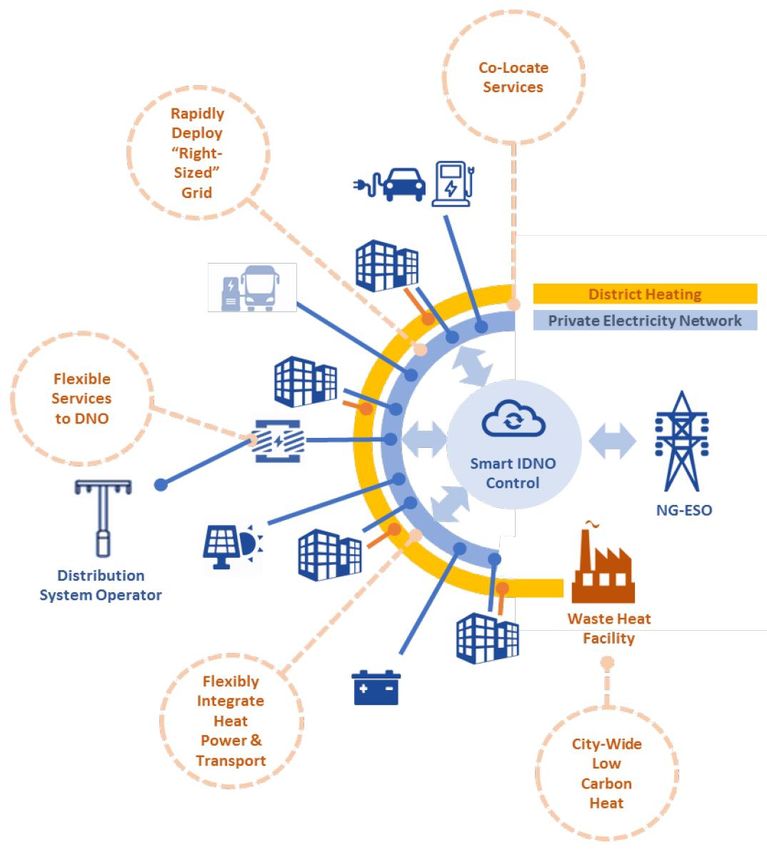
Introduction to the SSE Group
                 Supporting the low-carbon transition
                                                      Our vision
SSEN Transmission        SSE Renewables               To be a leading energy provider in a low carbon world

                                                      Our purpose
                         Energy                       Provide energy needed today and strive for a better
                                          Thermal     world of energy for tomorrow
                       Customer
SSEN Distribution    Solutions (incl       Energy
                     SSE Airtricity)                  Our strategy
                                                      To create value for shareholders and society from
                      Energy Portfolio Management     developing, owning and operating energy and related
    Enterprise              and Investments           infrastructure and services in a sustainable way

                     Distributed Energy      Contracting               Rail                 Telecoms
Digital Services is developing three different platforms,
which will come together under the Smart Cities banner
     Platforms                               Capabilities                                  Partners
                      •   Building on current ESG capabilities (remote monitoring and
   Smart Buildings        control of buildings
     Platform         •   Expanding to provide more insight and action for customers
                          based on Machine Learning and AI

                      •   Building on Mayflower CMS (lighting control)
   Smart Cities and   •   Comms network and power already on a street, building on that
   Places Platform        network to add other sensors, collecting and analysing data
                          through the Mayflower platform

                      •   Building on Smart Grid Solutions capabilities
                      •   Energy control, management and trading platform to allow us to
    EaaS Platform         optimise our customer sites and assets. Being built in phases,
                          increasing automation
Energy as a Service Platform – trading and local grid
stabilisation                                Energy Trading Markets
                                                                      The platform can:
                                              Aggregation Platform
  Building Energy        Site Energy
                                                                      • Collect data from assets
   Optimisation         Optimisation
                                                                      • Remotely control those assets – ie
                                                                         turn on/off, up/down
                                                                      • Group assets (to allow us to control
                                                                         remotely/for trading purposes)
  Building                                                            • Set asset parameters
                                                                      • Automated scheduling and
                    Private network                                      dispatch
                                                                      • Data visualisation, analytics,
                      Distribution Network                               reporting
                                                                      • Integrated with SSE trading desk
                               Transmission Network
Growing a sustainable city -
PIRI
Peterborough Integrated Renewables Infrastructure

                                     Integrating:
                                     • Heat
                                     • Power
                                     • Mobility
Creating impact                                          PIRI delivers value to
                                                    individuals and businesses alike

                         Business As Usual                                            Project PIRI

                                                                      Multi-utility infrastructure delivery means a lower
  Energy Costs     No cost benefits to pass onto consumers.
                                                                      capital cost and therefore lower bills for consumers.
                                                                            .
                                                                      Locally produced energy from Waste. All
                   No low carbon certainty with energy/services       services/energy received low carbon as standard.
    Carbon
                   purchased.                                         No compromises.

                   “Top down” tariff setting without visibility of    Transparent tariff setting using a “bottom up”
 Transparency
                   costing approach and no committed savings.         costing approach to determine long-term % savings.

                   Separate bills and no connection between           “As a Service” integrated billing for heat, electricity
Customer Service                                                      and mobility. Once a customer, each can benefit
                   electricity, heat and EV charging services.
                                                                      from all services e.g. heat, electricity, EV charging.
                   Due to capacity constraints, increasing costs to   Low carbon technology/infrastructure made
 Infrastructure
                   install low carbon technology e.g. EV              available at cost effective connection
                   charging/heat pumps/solar PV.                      cost/cost included within tariffs.
Heat networks data collection – ‘Project DC’
               • Learning; understanding behaviour; & adapting
  Wisdom
               • Allowing us to move on to greater capability.

               • With 15-minute interval data, we’re able to fully understand the demand
 Knowledge       profiles from each of our operational networks

               • Don’t have to rely on potentially out of date benchmarks and design
                 standards when designing new systems
 Information
               • We can also prove, beyond doubt, that networks do not need to be so
                 oversized to the degree they almost always are in the UK !

   Data        • The principal benefit being that we can start to deliver systems which are
                 inherently more efficient and cheaper for the customer.
Digital heat future – Heat as a Service
                                • As mentioned at the top – we’re looking to make
                                  HaaS a fourth ‘digital’ project in SSE Enterprise; &
                                  apply it to a heat network, however…

                                • Heat is the biggest component of a consumers energy
                                  bill – think vulnerable & fuel poor

          HaaS:                 • Concerns regarding HaaS and driving the right
          Purchasing ‘plans’      behaviour
          for warmth by time,
          instead of kWhr’s.    • We have a lot of power through data, & mustn’t be
                                  naïve about how deep that will go

                                • New business models in energy are most commonly
                                  only ‘techno-economic’.
What should we be doing with ‘digital’ in heat (& energy)?
                            • Can’t retrofit the social element to business
                              models – historically this has been over-
                              looked

                            • Might this be around increasing the role and
                              stake that the consumer has?

                            • Is there anything in the Ofgem concept to
                              “stack value”?

                            • To me, the answer – particularly for heat – is
                              in the data of networked systems

                            • This should be seen as an opportunity, not a
                              threat – competitive advantage atm.
In summary
• We’re undoubtedly moving towards ‘as a service’
business models across the entire energy system
• SSE Enterprise is going to trial HaaS on a heat
network
• Can’t retrofit the social element – needs to be built Digital
in at the outset
Energy
• This isn’t a constraint; it’s an advantage
• HaaS is a great opportunity to deliver social value,
but what do you think?
• What should we be doing with ‘digital’ in
heat (& energy)?Thank you – SSE Heat
Networks – our aim is
to be the most
trusted heat supplier
SSE Riverlight | Alex Fox e: alex.fox@sse.com t: 07776 603626You can also read


