Operational Flood Forecasting using Ensemble Weather Forecast- A Review - NCMRWF Workshop
←
→
Page content transcription
If your browser does not render page correctly, please read the page content below
NCMRWF Workshop

 Operational Flood Forecasting using
Ensemble Weather Forecast- A Review

                          Presented By
                        N V Umamahesh
           Professor, Water & Environment Division
               Department of Civil Engineering
        National Institute of Technology Warangal, India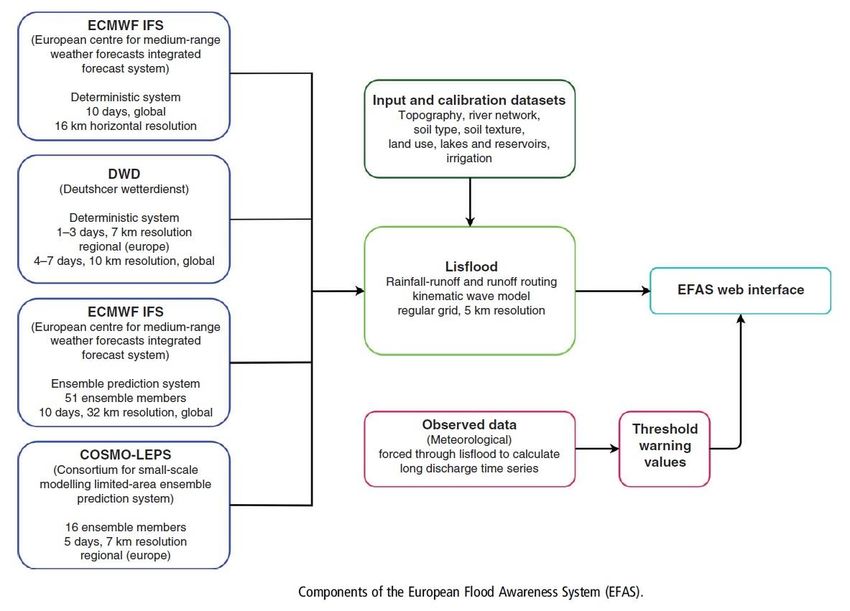
NCMRWF Workshop
                                                Flooding: A Global Challenge
                                                                                             15 Countries Account for 80% of Population Exposed to River Flood Risk Worldwide

                                       Source: OFDA/CRED International Disaster Database                                                                   Source: World Resources Institute

Global GDP Exposed to River Floods on Average Each Year: $96 Billion

                                                                                                                                      Source: OFDA/CRED International Disaster Database (2019)

                                                                                                                                              Source: OFDA/CRED International Disaster Database
                                                         Source: World Resources Institute                                                                        (2016)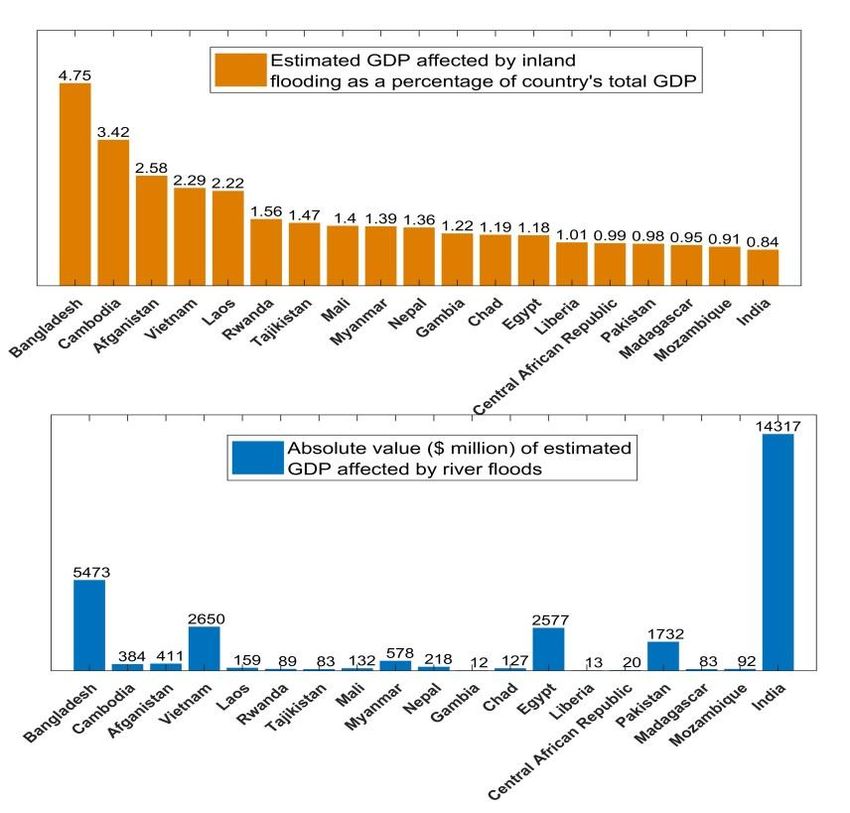
NCMRWF Workshop
                             Flood Forecasting in India

Most of the techniques formulated for real-time flood forecasting in India,
are based on-
     Statistical, and
     Deterministic approach.
Flood Forecasting Methods Presently Used in India are
     Statistical correlations using gauge to gauge;
     Gauge-discharge data;
     Multiple coaxial correlations using gauge, rainfall, and antecedent
     precipitation index (API) data
The models like HEC-HMS, and MIKE-11 are being used by CWC, for
hydrologic (rainfall-runoff) and hydrodynamic modelling for flood
forecasting.
At present, CWC is issuing flood alerts with 3-day lead-time.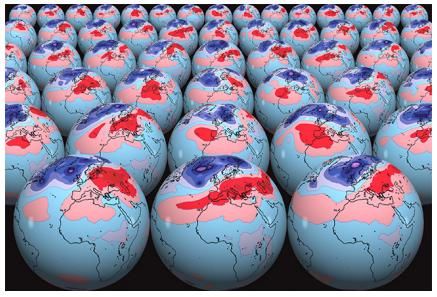
NCMRWF Workshop
Limitations in the Present FF Techniques
Major Limitations:
Lead-time of Deterministic forecasting is very short i.e. up to 72 hrs (i.e. 3
days).
Predicting the flood for a lead-time of >72 hrs with the present FF techniques
doesn’t give satisfactory results.
Errors in the observations (input), model structure, model parameters, and
initial conditions, are not quantified.
Deterministic techniques don’t integrate meteorological models with
hydrological models to generate flood forecasts.
NCMRWF Workshop
Need of the Hour
The techniques that integrates fine-scale weather forecast
models with high-resolution distributed hydrological
models to generate reliable flood forecasts are needed to
be adopted.
Also,
i. identifying the source of uncertainty,
ii. focusing on the cascading nature of uncertainties through the flood
modelling system, and
iii. quantification of uncertainty
is of primary importance in operational flood forecasting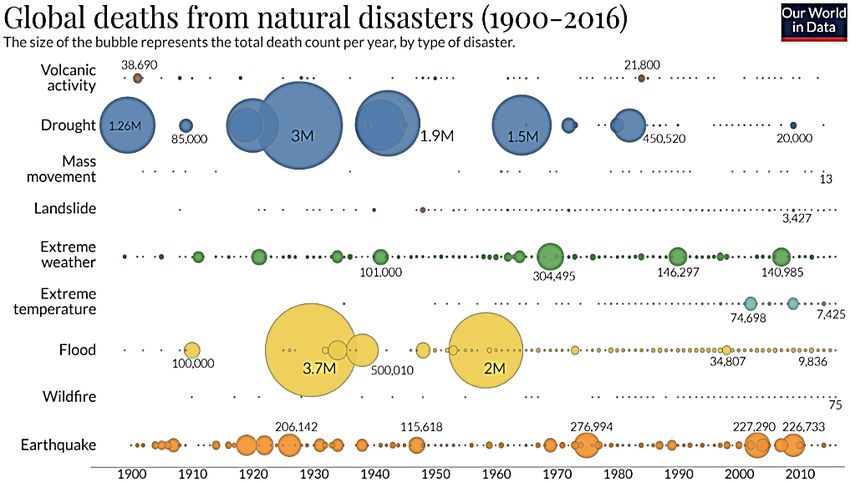
NCMRWF Workshop
                         Motivation

Limitations of Existing Flood Forecasting Systems in India
(provided by CWC)
   Lead time is 12 to 36 hours
   Provide only single deterministic forecast
   Precipitation inputs from rain gauge networks
Advantage of using NWPs
   Provide ensemble forecasts
   Increase in lead time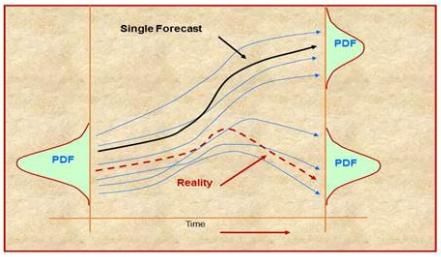
NCMRWF Workshop
Deterministic vs. Ensemble
Deterministic Model
Single forecast from one forecast model or method using a single set of initial
conditions
Deterministic runs usually have more skill than any individual ensemble
member due to superior resolution
Ensemble Model
Collection of “member” forecasts verifying
at the same time created from:
• Different but equally viable initial
conditions
• Different forecasting methods and/or
models that statistically represent
nearly all forecast possibilities
Ensemble mean can be more skillful than a
higher-resolution deterministic run,
especially beyond ~3 days
Source: Blake & Bernnam (2016)
NCMRWF Workshop
                                   Ensemble Flood Forecasting, Why?

                                       Reason                                                    Reference
Operational and research flood forecasting systems around the world are increasingly
moving towards using ensembles of Numerical Weather Predictions (NWPs), known as          Cloke & Pappenberger, 2009
Ensemble Prediction Systems (EPS), rather than single deterministic forecasts, to drive
their flood forecasting systems

The use of meteorological ensembles to produce sets of hydrological predictions                Balint et al., 2006
increased the capability to issue flood warnings

                                                                                                 Roulin, 2007
The hydrological ensemble predictions have greater skills than deterministic ones

The use of EPS in hydrological forecasting proved to be of great added value to a flood
                                                                                            Bartholmes et al., 2009
early warning system, as the EPS-based forecasts showed in general higher skill than
the deterministic-based ones

Even if the flood peak is first forecast with an error of one or two days [...] and is
                                                                                            Regimbeau et al., 2007
underestimated [...], the information given by the ensemble forecast can be of use for
flood warning or water management agencies

A list a large number of case studies and long term evaluations showing the added value
                                                                                          Cloke & Pappenberger , 2009
of EPS.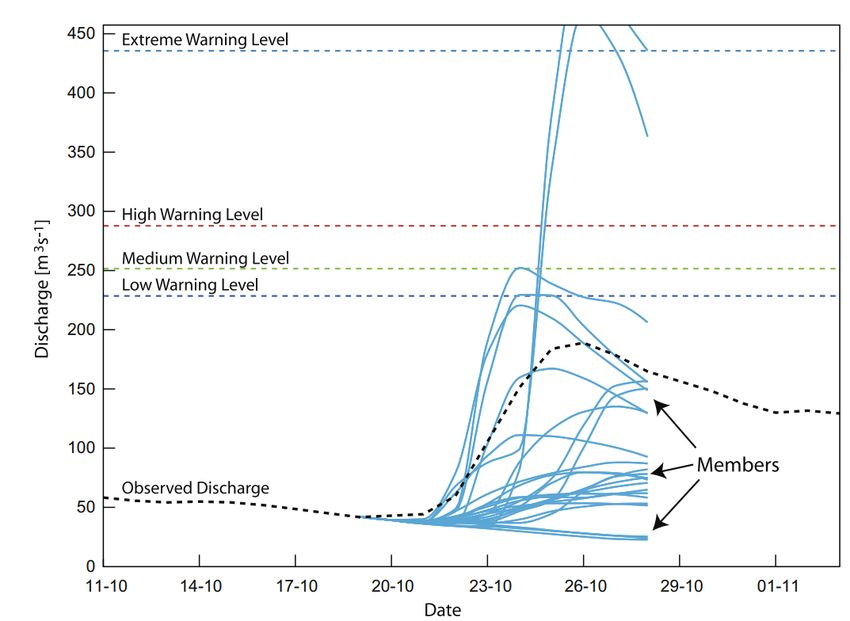
NCMRWF Workshop
Ensemble Flood Forecasting, What?
This usually involves using EPS as input to
a hydrological and/or hydraulic model to
produce river discharge predictions, often
supported by some kind of Decision
Support System.
Multiple inputs (EPS), multiple-model
Probabilistic predictions
Take into account uncertainty
EPS
Pre-processing Cloke & Pappenberger (2009)
Catchment
Hydrology Model
Sub catchment
model High
resolution
Flood inundation
model
Flood warning
decision module
Du et al. (2010)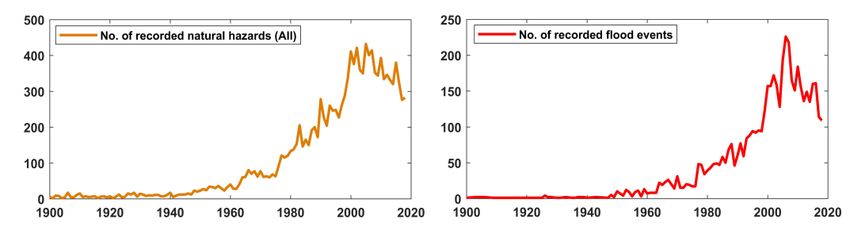
NCMRWF Workshop
                    Forecasting Chain in Ensemble Flood Forecasting

                                                              Hydraulics

                                      Multi-model

      EPS

       Pre-Processing                                       Post-Processing
         Downscaling,                                     Threshold exceedance
      Bias correction, etc.                             (members, probability, etc.)

                                         Hydrology                 Warning

        Feedback to                                                                Flood Watch
         the model

                                                                                  Flood Warning
                               Verification with
                               the real scenario                                   Severe Flood
                                                                                     Warning

Potential for Medium range (2-15 days lead time)
                                                                                       Source: Cloke (2009)
              Early Flood Warning
NCMRWF Workshop
Users of EPS
Forecast Center Ensemble NWP input
European Flood Alert System (EFAS) of the European Commission Joint
ECMWF, COSMO-LEPS
Research Centre
Georgia-Tech/Bangladesh project ECMWF
Finnish Hydrological Service ECMWF
Swedish Hydro-Meteorological Service ECMWF
Advanced Hydrologic Prediction Services (AHPS) from NOAA US National Weather Service (NOAA)
MAP D-PHASE (Alpine region)/Switzerland COSMO-LEPS
Vituki (Hungary) ECMWF
Rijkswaterstaat (The Netherlands) ECMWF, COSMO-LEPS
Royal Meterological Institue of Belgium ECMWF
Vlaamse Milieumaatschappij (Belgium) ECMWF
Météo France ECMWF and Arpege EPS
Land Oberoestereich, Niederoestereich, Salzburg, Tirol (Austria) Integration of ECMWF into Aladin
Bavarian Flood Forecasting Centre COSMO-LEPS
Various centers (mainly in Europe) use EPS mostly from European Centre for Medium-Range Weather
Forecasts (ECMWF) to drive hydrological ensemble prediction systems Cloke & Pappenberger (2009)NCMRWF Workshop
EPS in Hydrology-A Global Review
European Flood Awareness System (EFAS)
• Inputs from European Centre for Medium-Range Weather Forecast
• Lisflood Hydrological Model – forecasts daily discharge up to 15 days in advance
• Operational from 2012
Hydrologic Ensemble Forecasting System – US National Weather Service
• Uses ensemble weather forecasts from Climate Forecast System of NCEP & Global Ensemble
Forecast System
Flood Early Warning System for Po River (FEWSPo)
• Uses meteorological inputs from several models
• Forecasts flood 5 days in advance
• Also forecasts droughts 3 months in advance
Global Flood Awareness System (GloFAS)
• Developed by Joint Research Centre of European Commission and ECMWF
• Provide flood warning maps over global domainNCMRWF Workshop
Role of HEPEX
HEPEX is a global community of researchers and practitioners in hydrological ensemble prediction.
It brings together people contributing and working on specific topics related to hydrological
forecasting and hydro-meteorological ensemble prediction (www.hepex.irstea.fr).
HEPEX seeks to advance the science and practice of hydrological ensemble prediction and its use in
impact- and risk-based decision making.
The HEPEX mission is: To demonstrate the added value of hydrological ensemble prediction for the
following to make decisions that have important consequences for economy, environment, public
health and safety.
The test beds are collections of data and models
for specific basins or sub-basins, where relevant
meteorological and hydrological data has been
archived.
In these test-beds, it is expected that different
forecast approaches and tools can be
demonstrated and inter-compared.
The aim of the test-beds is to create a platform on
which important science questions can be explored
or methods can be developed that improve the
performance of hydrological ensemble predictions
for better decision making.NCMRWF Workshop
Scientific Issues to be Addressed
How can the ensemble forecasts of weather and climate made by NWPs
be used reliably to develop short range to medium range flood
forecasting systems?
How to downscale/ disaggregate the EPS forecasts to hydrological scale
in Hydrological Ensemble Prediction Systems (HEPS)?
How well do the existing hydrological models perform in predicting high
floods?
How can uncertainties (meteorological inputs, parameter uncertainty and
spatial and temporal uncertainties caused due to downscaling) be
represented in the hydrological ensemble prediction?
How to effectively disseminate the probabilistic flood forecasts from
HEPS to the end users?NCMRWF Workshop
Key Challenges in Ensemble Flood Forecasting
• Improvement of NWPs with more number
Challenge 1 of ensembles
Challenge 2 • Understanding the total uncertainty
Challenge 3 • Analysis of more case studies
Challenge 4 • Installation of enough computer power
• Learning how to use it in an operational
Challenge 5 setting
• Communicating the uncertainty &
Challenge 6 probabilistic forecasts
Source: Cloke & Pappenberger (2009)Short and Medium Range Flood Forecasting
System for Godavari River Basin using Ensemble
Weather Forecast
• To develop a flood forecasting system by coupling high resolution
hydrological models with fine scale meteorological models. The
ensemble precipitation forecasting models will be integrated with
distributed hydrological model to provide flood forecast. Godavari
basin will be used as a pilot study area
• To identify suitable pre-processing techniques for downscaling/
disaggregating the ensemble weather forecasts from NWP to
Hydrological Scale
• To develop a multi-model hydrologic system for flow forecasting in a river
basin
• To integrate the weather forecasting system with hydrologic system to
develop an ensemble flood forecasting system
• To develop methodologies and models for communicating the probability
flood forecasts to different levels of decision-making mechanismsGODAVARI BASIN
NCMRWF Workshop
Summary
There is clearly the need both for more theoretical development of flood forecasting systems and a
convincing all encompassing strategy for tackling the cascading of uncertainties in an operational
framework.
EPS are increasingly tested and applied for operational flood forecasting for early warning.
EPS based forecasts allow earlier detection of floods and provide early warning. Decision making for
Civil Protection based on EPS remains difficult.
Uncertainty of EPS based flood forecasts can be reduced significantly through the use of threshold
exceedance, persistency criterion and post-processing.
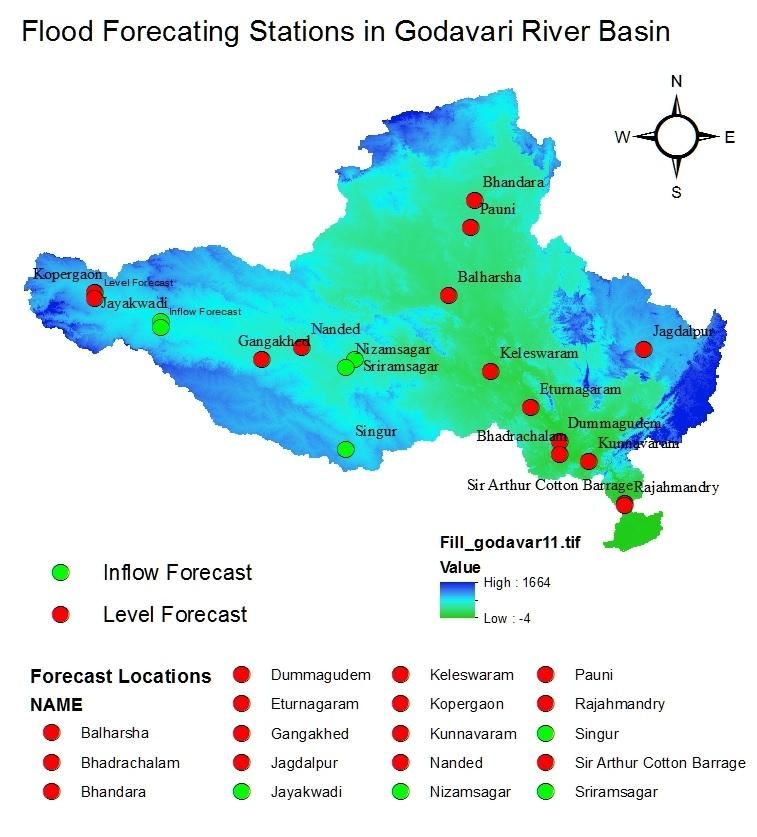
A pilot study on developing an Ensemble Flood Forecasting System for River Godavari is being
undertaken by NITW
Take Home Message
In flood forecasting there is no one-size fits-all.
Integration of different systems and methods is a major challenge.
Any system does not have to be perfect but suitable.
Source: Pappenberger (2010)NCMRWF Workshop
References
Balint, G., Csik, A., Bartha, P., Gauzer, B., Bonta, I., 2006. Application of meterological ensembles for Danube
flood forecasting and warning. In: Marsalek, J., Stancalie, G., Balint, G. (Eds.), Transboundary Floods: Reducing
Risks through Flood Management. Springer, NATO Science Series, Dordecht, The Netherlands, pp. 57–68.
Bartholmes, J., Thielen, J., Ramos, M., Gentilini, S., 2009. The European flood alert system EFAS – Part 2:
statistical skill assessment of probabilistic and deterministic operational forecasts. Hydrology and Earth System
Sciences 13 (2), pp.141–153.
Blake, E.S., Brennan, M.J., 2016. Ensemble prediction systems (Presentation).
Cloke, H.L., Pappenberger, F., 2009. Ensemble flood forecasting: a review. Journal of Hydrology 375(3–4), pp.
613–626.
Cloke, H.L., 2009. Ensemble flood forecasting (Presentation).
Debarati, G.S., 2016. Annual disaster statistical review 2016.
Du, J., Deng, G., 2010. The utility of the transition from deterministic to probabilistic weather forecasts:
verification and application of probabilistic forecasts. Meteorological Monthly, 36(12), pp. 10-18.
Pappenberger, F., 2009. Application in hydrology and real-time flood forecasting (Presentation).
Regimbeau, F.R., Habets, F., Martin, E., Noilhan, J., 2007. Ensemble streamflow forecasts over France.
ECMWF Newsletter 111, pp. 21–27.
Roulin, E., 2007. Skill and relative economic value of medium-range hydrological ensemble predictions.
Hydrology and Earth System Sciences 11 (2), pp. 725–737.
Ritchie, H., Roser, M., 2019. "Natural Disasters". Published online at OurWorldInData.org.NCMRWF Workshop
Acknowledgement
We sincerely acknowledge the financial support given by the Earth System Science Organization,
Ministry of Earth Sciences, Government of India (IITM/MM-II/NIT/2018/IND-6) to conduct this
research under Monsoon Mission.
We also thank the Central Water Commission (CWC) – Krishna Godavari Basin for readily coming
forward for supporting us for undertaking this project
Thank YouYou can also read


