Original Article Community Awareness of Sore Throat And Rhuematic Heart Disease in Northern Ethiopia - Pan-African Society of Cardiology (PASCAR)
←
→
Page content transcription
If your browser does not render page correctly, please read the page content below
Sudan Heart Journal                                  Hailu A, Community Awareness of Sore Throat and Rheuma…
Vol. 7, No. 3, 2020
April 1st, 2020

                                       Original Article
           Community Awareness of Sore Throat And Rhuematic Heart
                        Disease in Northern Ethiopia
           Author(s): Abraha Hailu, MD*^, Temesgen Tsega, MD*, Tesfay Gebregziabher,
          PhD*, Haftom Temesgen Abebe, PhD*, Hagazi Tesfay, MD*, Hagos Kahsay, MD*,
         Mulugeta Naizgi, MD*, Samuel Berhane, MD*, Marta Yemane, MD*, Yonas Berhane,
                          MD*, Christian Leuner, MD#, Gabriele Wehr MD#

       *Mekelle University, College of Health Sciences, Mekelle, Ethiopia
       #Etiopia-Witten
                     Development Aid Association, Auf dem Wellerskamp 5, Witten, Germany
       ^Corresponding Author, abrahahailu45@yahoo.com

        Abstract
        Introduction:
        Early treatment of bacterial sore throat is important in primary prevention of acute rheumatic
        fever (ARF). In Ethiopian population, knowledge about Rheumatic Heart Disease (RHD) and
        its prevention strategies is expected to be limited, but few studies have been done.
        Methods: To determine awareness of RHD prevention in the community in Northern Ethiopia,
        a descriptive, cross-sectional study was conducted. Using structured questionnaire, adults
        more than 18 years of age were interviewed.
        Results:
        A total of 1298 participants were included, 1004 (77.4%) were from rural areas, 978 (75.3%)
        were female. Only 34 (2.6%) of the participants responded that the cause of sore throat is
        due to bacteria/virus and 6.2 % knew the relation between sore throat and heart disease. Of
        the respondents, 43.3% would take children with sore throat to traditional healers, 71.6% had
        history of uvulectomy in their children or themselves. Only 7.8% answered that penicillin
        injection is useful for primary prophylaxis and 8.1% answered that regular penicillin injection
        is useful as secondary prevention in RHD.
        Conclusion:
        We conclude that the community awareness on the cause and the link between bacterial
        pharyngitis and ARF/RHD is almost non-existent and hence concerted efforts to change this
        should be made at different levels.

       Keywords: Rheumatic Heart Disease, Awareness, Prevention, Pharyngitis, Ethiopia
Sudan Heart Journal Hailu A, Community Awareness of Sore Throat and Rheuma…
Vol. 7, No. 3, 2020
April 1st, 2020
Introduction: screening of RHD has shown even a
Acute Rheumatic Fever (ARF) is a higher prevalence in a rural community of
consequence of bacterial sore throat with southwest Ethiopia with an overall
Group A β haemolytic Streptococcus prevalence of 37.5 cases per 1000
(GAS). The progression from ARF to population of definite RHD (95% CI 26.9
Rheumatic Heart Disease (RHD) is – 51.8) (7).
thought to be driven by recurrent Despite the high burden of RHD,
infections resulting in a prolonged the attention given to this disease by
inflammatory response in the cardiac health authorities and the subsequent
valvular tissue (1). resource allocation is low, leading to
ARF and its sequel, RHD, cause repeated calls from different
significant morbidity and mortality in organizations to act to stop RHD (8, 9).
developing countries, yet they are under- Recently, the Ministry of Health of
recognized as major health problems in Ethiopia has developed an RHD
developing countries (1, 2). The most prevention and control program and the
recent estimates of the global burden of Guideline based prevention of
RHD include nine million disability- Rheumatic Heart Disease Program in
adjusted life years lost, 33 million Eastern Zone of Tigray, Northern
prevalent cases and 275,000 deaths Ethiopia (PrevRHD) which is a pilot
each year, with deaths occurring program implemented in the Wukro area,
predominantly in low- and middle-income as part of this national effort.
countries including Ethiopia (1-4). In It has been concerning to note
2016, multisite echocardiography from several reports that the level of
screening in school children in Ethiopia awareness of ARF/RHD is low in the
has shown the prevalence of RHD to be communities most affected by it. People
19 per 1000 (5). Other multisite tertiary most at risk of ARF/RHD tend to be from
hospital based studies have also shown parts of the community with the lowest
that RHD is the leading cause of income and/or education. Reports from
cardiovascular morbidity and mortality in Tanzania and South Africa show that
Ethiopia (6). In 2017, an patients with RHD had poor knowledge of
echocardiography based community the connection between GAS and RHD,Sudan Heart Journal Hailu A, Community Awareness of Sore Throat and Rheuma…
Vol. 7, No. 3, 2020
April 1st, 2020
most patients and their guardians had not these findings in future preventive
yet heard of RHD until they were activities in communities with a similar
diagnosed with the condition, cultural background.
demonstrating a low level of awareness Methods:
in the general community (10). Study area
There are several contributors to This study was done in Northern
the low levels of awareness of ARF/RHD Ethiopia; Eastern zone of Tigray regional
in communities often most affected by state, located about 880 kilometres north
the disease. Inadequate resources and of the capital Addis Ababa. According to
the lack of prioritization of ARF/RHD the Ethiopian Population and Housing
educational programs have effectively Census of 2007, Tigray region has an
maintained a public that is largely estimated total population of 5.24 million
ignorant of the causes, symptoms and of which 50.8% are female, 80% rural
risks associated with ARF/RHD(9). and about 85% of the population are
Comprehensive awareness farmers.
campaigns about pharyngitis and ARF This community based cross-
have been associated with reductions in sectional, descriptive study was carried
ARF (11). Therefore, it is wise and out in January 2018 involving households
economical to work on prevention by residing in the three districts at Wukro
raising awareness of the disease town, Kilte-Awlaelo and Atsbi-Wenberta
particularly under resource-limited rural districts with an estimated
conditions. population of 50,208, 112,788 and
In order to implement the 110,546 inhabitants respectively. There
prevention modalities into the community are two primary hospitals, 11 health
appropriately in a culturally acceptable centres and 36 health posts in the three
manner, we planned to identify the level districts.
of baseline knowledge and practice on Sample size and sampling technique
sore throat and its link with heart disease. Sample size was estimated using
Therefore, this study was carried out to a single population proportion formula.
identify some barriers to improved care of The prevalence of awareness on RHD
RHD in the community and then use among the community was not found inSudan Heart Journal Hailu A, Community Awareness of Sore Throat and Rheuma…
Vol. 7, No. 3, 2020
April 1st, 2020
other studies. Therefore, the researchers context. The questionnaire was imported
decided to take the estimated prevalence to an open data kit (ODK)
as 50%. With the assumption of P = 50%, (opendatakit.org), which is user friendly
Z = 1.96, design effect = 2, and marginal by using a tablet (Samsung company) for
error = 4%, the sample was estimated as easy facilitation of data capturing and to
1200. Then taking 10% non-response avoid errors. Eight trained nurses did
rate, a total of 1320 sample size was data collection, using ODK on November
calculated. 6 – 11, 2017 after the questionnaire was
The three districts of the study pretested. Senior physicians and public
area were purposively selected due to health specialist were assigned as
their proximity to the Demographic supervisors and a total of 1298
Health Surveillance Site (DHS) of household members were interviewed.
Mekelle University. Six Kebeles (small Data analysis
administration units) from rural and two Data was compiled from the ODK,
from urban areas were randomly revised and coded before the data entry.
selected. The number of households The Data Epi program was used for data
from each village was taken through entry, then it was analyzed using SPSS
population proportion sampling version 21. Frequencies, proportions,
distribution at household level. Then the mean and standard deviation were
systematic random sampling technique calculated. Cross tabulation was done on
was used to select the 1320 households, selected variables with the outcome
using the sampling frame, which was variable. The participants’ level of
obtained from the office of the DHS. The knowledge on sore throat and its link with
selected households were marked by RHD were calculated.
DHS, in each household one family Ethical consideration
member (aged >18 years) was Ethical approval for this study was
interviewed. obtained from Mekelle University Ethical
Data collection Review Committee of the College of
A structured questionnaire was Health Sciences, Northern Ethiopia. A
developed from the previous literature letter of permission was issued from the
review and it was customized to the localSudan Heart Journal Hailu A, Community Awareness of Sore Throat and Rheuma…
Vol. 7, No. 3, 2020
April 1st, 2020
Tigray Regional Health Bureau and the district health authorities. Verbal
informed consent from the household heads was obtained.
Results
Socio-demographic characteristics
With a response rate of 98%, a total of 1298 participants were included in this study
with a mean age of 44.68 (Standard Deviation =15.1) and 75.3% were female. 1004
participants (77.4%) were from rural areas, of whom 68.2% were in the age group of 38
years and above.
Characteristics Residence Total (%)
Rural (%) Urban (%)
Male 270 (26·9) 50 (17·0) 320 (24·7)
Female 734 (73·1) 244 (83·0) 978 (75·3)
Family size (1-3 persons) 286 (28·5) 119 (40·5) 405 (31·2)
Family size (>= 4 persons) 718 (71·5) 175 (59·5) 893 (68·8)
Religion
Muslim 10 (1·0) 20 (6·8) 30 (2·3)
Orthodox 993 (98·9) 272 (92·5) 1,265 (97·5)
Others 1 (0·1) 2 (0·7) 3 (0·2)
Monthly Income (Ethiopian Birr) 1000 Birr ≈ 35 USD
< 2000 945 (94·1) 200 (68·0) 1,145 (88·2)
>2000 59 (5·9) 94 (32·0) 153 (11·8)
Do you know what sore throat is?
Yes 968 (98·4) 287 (97·6) 1,255 (96·7)
No 36 (3·6) 7 (2·4) 43 (3·3)
What do you do when children get sore throat?
Go to traditional healer 483 (48·1) 79 (25·9) 562 (43·3)
Go to health institution 370 (36·9) 192 (65·3) 562 (43·3)
Others (herbal remedy, holy water, smelling kerosene, don’t know) 151 (15·0) 23 (7·8) 174 (13·4)
Treatment
Tablets 249 (67·3) 110 (57·3) 359 (63·9)
Injection 32 (8·7) 47 (24·5) 79 (14·1)
Advice only 89 (24·1) 35 (18·2) 124 (32·19
History of uvulectomy in your children
Yes 730 (72·7) 200 (68·0) 930 (71·7)
No 274 (27·3) 94 (32·0) 368 (28·4)
Why uvulectomy was done?
Traditional healer`s recommendation 725 (99·32) 200 (100) 925 (99·5)
Physicians recommendation 5 (0·7) 0 (0·0) 50 (0·5)
Is penicillin injection useful for primary prevention of ARF/RHD?
Yes 77 (7·7) 24 (8·2) 101 (7·8)
No 927 (92·3) 270 (22·7) 1,197 (92·2)
Is penicillin injection useful for secondary prevention of ARF/RHD?
Yes 83 (8·3) 22 (7·5) 105 (8·1)
No 921 (91·7) 272 (92·5) 1193 (91·9)
Do you know the relation between sore throat and heart disease?
Yes 53 (5·3) 27 (9·2) 80 (6·2)
No 951 (94·7) 267 (90·8) 1,218 (93·8)
Table 1: Participants’ Socio-demographic characteristics and awareness on prevention and treatment of sore throat and RHD
in three districts of eastern zone of Tigray, Northern Ethiopia, January 2018Sudan Heart Journal Hailu A, Community Awareness of Sore Throat and Rheuma…
Vol. 7, No. 3, 2020
April 1st, 2020
The majority were Orthodox
Christian religion followers and married
(97.5% and 70.6% respectively). More
than two thirds (68.8%) of respondents
had a family size of more than four and
405 (31.2%) of the respondents had a
family size of one to three persons. The
majority had a monthly income of less
than 2000 Ethiopian Birr equivalent to
approximately 70 USD (Table 1). 832
(60.3%) respondents had no formal
education (illiterate) and of these 703
(85.4) were from rural communities. Only
49 (3.8%) of the participants had
attended college or university.
Level of Awareness
Only 80 (6.2%) of the participants
were aware about the relation between
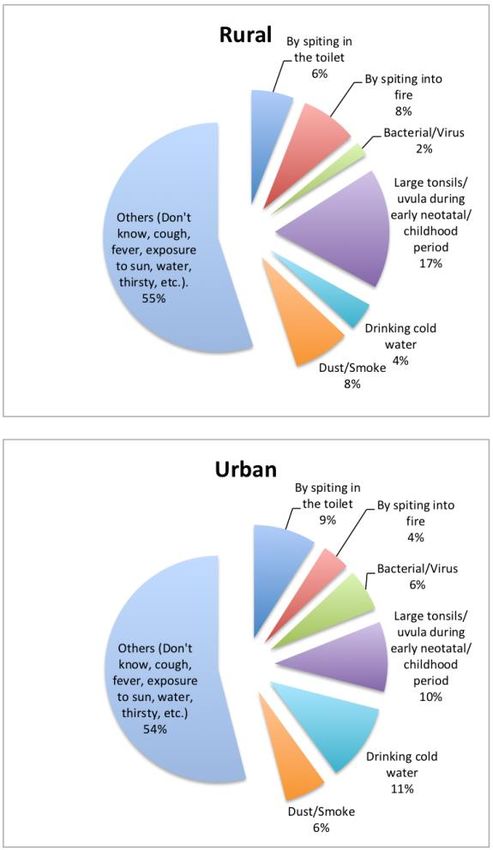
heart disease and sore throat (Table 1). Figure 1: Participants response for causes of sore throat in
three districts of Eastern zone Tigray, Northern Ethiopia,
Thirty-four (2.6%) of the participants said November 2017
that sore throat is caused by bacteria or
When their children get sore throat, 562
virus, 207 (15.9%) by large tonsils/uvula
(43.3%) of the participants said they take
during early neonatal and childhood
them to a traditional healer and the same
period, 92 (7.1%) by spitting into toilet, 69
number (43.3%) take them to a health
(5.3%) by drinking cold water and 97
institution. Most people in rural area
(7.5%) due to dust/smoke (Figure 1).
tended to take their children to traditional
When asked about symptoms of sore
healers while most in urban area tend to
throat, 1235 (95.1%) said difficulty in
take their children to a health institution.
swallowing, 1217 (93.8%) said fever,
Of those who seek medical treatment in
while 339 (26.1%) said rhinorrhea.
health institutions, 359 (63.9%) reported
that they get oral medications as aSudan Heart Journal Hailu A, Community Awareness of Sore Throat and Rheuma…
Vol. 7, No. 3, 2020
April 1st, 2020
treatment for sore throat, 79 (14.1%) causes, symptoms and its link with RHD
injections and 124 (22.1%) advice only. by the general public and health
The majority (73.9%) of the participants professionals. Knowing the level of
have one or more children, of these 311 community awareness and practice on
(32.4%) reported that their children get sore throat is an important step in
sore throat frequently. Of the community education, which is one of the
participants, 930 (71.6%) reported that important components of prevention.
their children had uvulectomy done and The majority (96.7%) of the participants
925 (99.5%) of these reported that the think that they know the reason for sore
uvulectomy done is as per traditional throat, but only a minority (2.6%) know
healer’s recommendation whereas 5 that the causative agent is a bacterial or
(0.5%) reported to be physician’s viral infection. This fact corresponds with
recommendation. another study about awareness on sore
One hundred of the participants (7.8%) throat, ARF and RHD in a rural
answered, that penicillin injection is community in 1992 in India, described by
useful for primary prevention of Arya RK (12).
ARF/RHD and only 105 (8.1%) RHD is considered a preventable
participants answered that regular disease but is still the leading cause of
penicillin injection is important for acquired heart disease and heart failure
secondary prevention of ARF/RHD in children and young adults in
(Table 1). developing regions of the world including
Discussion Ethiopia (6, 13). There are different
The aim of this study was to recommendations to prevent the disease
assess the level of awareness of the including primordial prevention: reducing
study population on ARF and RHD overcrowding, poverty, malnutrition and
prevention. The results show that the improving access to health care; primary
level of awareness on RHD is generally prevention: treating GAS pharyngitis with
very low. antibiotics; secondary prevention:
To identify GAS sore throat early and ARF/RHD register and giving regular
hence prevent its deadly consequences antibiotics for those at risk of recurrence
requires adequate knowledge of the ; and tertiary prevention: medical andSudan Heart Journal Hailu A, Community Awareness of Sore Throat and Rheuma…
Vol. 7, No. 3, 2020
April 1st, 2020
surgical management of symptomatic tended to go to traditional healers rather
RHD (14, 15). than to health institutions for sore throat.
There are several barriers that A study from South Africa, reported that
contribute to the low levels of awareness individuals most affected by ARF and
of ARF/RHD in communities often most RHD know little about the disease,
affected by the disease as is found in including methods for prevention and the
developing nations including Ethiopia. potential long term consequences (16).
One of these barriers arises from the The low level of knowledge or wrong
reality that communities at highest risk for beliefs of the causes of sore throat would
ARF/RHD are also frequently burdened lead to wrong ways of addressing the
with high rates of other major diseases problem, and children will be denied of
such as malaria, HIV/AIDS and the appropriate therapy.
tuberculosis. These diseases inevitably A study from Tanzania
receive higher priority from those in demonstrated that patients do not
charge of distributing scarce resources present to major clinics for GAS
for disease control programs (15). pharyngitis and have limited
Our study shows the community’s understanding of its serious sequelae.
level of awareness on the relationship Even RHD patients and their parents had
between heart disease and sore throat to poor knowledge of the signs or
be very low with only 6.2% of the symptoms of GAS pharyngitis and stated
participants knowing that there is a that they would normally not take a child
relation between sore throat and heart with a sore throat with or without fever to
disease. The majority, 97.4%, of the a professional health care provider. The
participants believed that sore throat is majority of clinicians (87%) disagreed or
caused by either exposure to the sun, strongly disagreed that patients and their
spitting in the fire or toilet, drinking cold families are knowledgeable about the
water, dust or smoke exposure among consequences of untreated GAS
others while only 2.6% mentioned that infection (10).
sore throat is caused by bacteria or Our study found that most of the
viruses. We also found that those in the respondents mentioned difficulty of
rural community as compared to urban swallowing and fever as the symptoms ofSudan Heart Journal Hailu A, Community Awareness of Sore Throat and Rheuma…
Vol. 7, No. 3, 2020
April 1st, 2020
sore throat. The majority (56.7%) of ill poor knowledge of their disease
children do not get appropriate diagnosis condition. Only two of the 15 patients
or treatment (43.3% got to a natural were aware of their disease and neither
healer, 13.4% do not go anywhere). Of of them were on regular secondary
those who go to health institutions, prophylaxis (19). This was also the
63.9% reported that they get tablets scenario in a survey done in the capital
treatment for sore throat, 14.1% get city of Ethiopia, Addis Ababa. Out 9388
injections and 22.1% get advice only. school children, 60 were found to have
This proportion is similar to a study done RHD and the study concluded that
in Cameroon and Zambia where less among the interviewed parents of
than half of those who had a previous children with RHD there was lack of
sore throat received antibiotics (17, 18). awareness of the disease and extremely
Most of our study participants (92.2%) low rate of regular prophylaxis (20). This
didn’t know treatment with antibiotics is is similar to studies done in other African
useful in primary prevention of RHD and countries proving the fact that those
only 8.1% knew that penicillin injection is affected most have little knowledge about
useful for secondary prevention. the disease condition.
Similarly, to our findings, a study done in The other important finding in this
Cameroon showed that most (73%) of study was that, in addition to the
the respondents did not know what misconceptions on the cause of sore
causes sore throat, and most (71.1%) throat, there is a high rate of traditional
were unaware of any complications that malpractices like uvulectomy in the
could arise from poorly treated sore community we surveyed. It was found
throat. More than 70% of the participants that 71.6% of the participants reported
did not know that sore throat could be either themselves or their children had
associated with heart disease. RHD was undergone uvulectomy and most of the
unknown to 82% of the participants and procedures (99.5%) were done by
95% of them did not know what causes traditional healers. The uvulectomy is
RHD (17). A study done in the Ethiopian traditionally performed in early childhood
rural town of Butajirra found that even due to the belief that the uvula is
patients who already have RHD have responsible for myriads of potentialSudan Heart Journal Hailu A, Community Awareness of Sore Throat and Rheuma…
Vol. 7, No. 3, 2020
April 1st, 2020
maladies. Studies on harmful traditional K. Petricca et al from Jimma, Ethiopia,
practices done in Northern Ethiopia where they found that costs associated
showed that uvulectomy was practiced with care play a role in decision making
on 72.8% of children, which was higher process to seek care. The study also
than in our study (21). A study from found that knowledge and education of
Tanzania reported that traditional the disease causality and severity
uvulectomy was associated with influenced patients’ understanding of the
significant morbidity and there was importance to seek follow-up treatment
mortality. They recommended that given (24). Overcrowding, poor hygienic
that the procedure confers no clinical conditions, low socio-economic status,
benefit, emergency care providers illiteracy are known major risk factors for
should advocate for legal and public ARF/RHD. Hence improving the socio-
health interventions to eliminate this economic status of a community is one of
dangerous practice (22). Similarly, in a the pillar strategies for the prevention of
Nigerian study, 86.1% of patients had RHD. The risk of RHD is 1.6 – 2.0 times
uvulectomy at childhood and the greater in women likely due to several
commonest complication was factors including worsening of existing
hemorrhage (n = 29, 17.6%) (23). disease during pregnancy, GAS
Therefore, addressing this issue during exposure during child rearing, limited
the process of awareness creation will access to services and intrinsic hormonal
also be important not only to reduce factors(1). Our study population includes
ARF/RHD prevalence but also to reduce mostly female, rural, illiterate, living in
morbidity and mortality due to this overcrowded homes, having low income
malpractice. and hence is at a very high risk for GAS
In addition, 68·8% of participants pharyngitis, ARF and RHD. This finding
have family size more than four and the supports the need to emphasize this
monthly income is less than 2000 segment of the community during
Ethiopian Birr (≈ 70 USD) in 88·2% of the awareness campaigns and education to
participants. The contribution of the reduce the burden of ARF/RHD.
economic status of patients and care- Public awareness activities are
givers of ARF/RHD has been reported by important for successful RHD controlSudan Heart Journal Hailu A, Community Awareness of Sore Throat and Rheuma…
Vol. 7, No. 3, 2020
April 1st, 2020
programs as recommended by the World to estimate the economic status of
Health Organization and as practiced in participants, but this is far from the reality
Cuba in 1986 – 2001 and in Nepal especially as those in the rural area were
(11,25,26). The Nepalese experience is simply asked to estimate their monthly
a good example where a comprehensive income and no other standard modality
prevention program improved awareness was used to assess their economic
of RHD by 40%. It is critical that public status. The sites selected had been
awareness of the role of GAS and its surveillance sites for long years and they
potential consequences are addressed, perhaps had a better knowledge of
as this will result in increased health- health-related issues as compared to
seeking behaviour. Therefore, the other sites in the country. Hence the level
improvement of public awareness on of awareness on many of the issues
sore throat RHD by the committed mentioned here could potentially be
involvement of governmental health worse than reported here.
institutions, community leaders, Conclusion
community health educators, non- This study concludes that the community
governmental organizations and all awareness on the cause and the link
available public media outlets in the between sore throat and ARF/RHD in
process of awareness creation will be Northern Ethiopia is almost non-existent.
crucial. These results can help understand the
Limitations of the study beliefs and practices about sore throat,
Overcrowding and poor socioeconomic ARF/RHD in the Ethiopian community
status are known risk factors for and can be used to design culturally
acquiring GAS sore throat, ARF/RHD. acceptable and targeted interventions of
We have found that most have family awareness creation programs. These
size more than four members but results show that the combination of high
obtaining a crowding index would have illiteracy rate, low health-seeking
been more helpful which was not done in behaviour and poor socio-economic
this study. We took the salary cut off point status and widespread superstition of the
community are important areas which remain the Achilles heel to the control of
need to be addressed as they would RHD.Sudan Heart Journal Hailu A, Community Awareness of Sore Throat and Rheuma…
Vol. 7, No. 3, 2020
April 1st, 2020
Acknowledgment in Ethiopia: A multisite echocardiography-based
screening. Int J Cardiol. 2016;221:260-3.
We thank Mekelle University 6.Yadeta D, Guteta S, Alemayehu B, Mekonnen
Demographic Health Surveillance (DHS) D, Gedlu E, Benti H, et al. Spectrum of
cardiovascular diseases in six main referral
site coordinator Mr Alemseged Aregay hospitals of Ethiopia. Heart Asia.
and assistant data manager Mr 2017;9(2):e010829.
7.Gemechu T, Mahmoud H, Parry EH, Phillips DI,
Gebrehiwot Gebregziabher for their Yacoub MH. Community-based prevalence
support during the survey. We thank study of rheumatic heart disease in rural
Ethiopia. Eur J Prev Cardiol. 2017;24(7):717-23.
Tigray Regional Health Bureau and 8.Watkins D, Zuhlke L, Engel M, Daniels R,
Etiopia-Witten e. V. association for their Francis V, Shaboodien G, et al. Seven key
actions to eradicate rheumatic heart disease in
support and Dr Rosemary Wyber from Africa: the Addis Ababa communiqué.
Cardiovasc J Afr. 2016;27(3):184-7.
Telethon Kids Institute, Australia, for
9.Remenyi B, Carapetis J, Wyber R, Taubert K,
proofreading this manuscript. Mayosi BM, Federation WH. Position statement
of the World Heart Federation on the
Funding prevention and control of rheumatic heart
Klinikpartnerschaften, Germany, disease. Nat Rev Cardiol. 2013;10(5):284-92.
10.Zühlke LJ, Engel ME. The Importance of
supported the study Awareness and Education in Prevention and
Conflict of Interest Control of RHD. Glob Heart. 2013;8(3):235-9.
11.Nordet P, Lopez R, Dueñas A, Sarmiento L.
None Prevention and control of rheumatic fever and
rheumatic heart disease: the Cuban experience
(1986-1996-2002). Cardiovasc J Afr.
References: 2008;19(3):135-40.
1.Zühlke LJ, Beaton A, Engel ME, Hugo-Hamman 12.Arya RK. Awareness about sore-throat,
CT, Karthikeyan G, Katzenellenbogen JM, et al. rheumatic fever and rheumatic heart disease in
Group A Streptococcus, Acute Rheumatic Fever a rural community. Indian J Public Health.
and Rheumatic Heart Disease: Epidemiology 1992;36(3):63-7.
and Clinical Considerations. Curr Treat Options 13.Zühlke L, Mirabel M, Marijon E. Congenital
Cardiovasc Med. 2017;19(2):15. heart disease and rheumatic heart disease in
2.Carapetis JR, Steer AC, Mulholland EK, Weber Africa: recent advances and current priorities.
M. The global burden of group A streptococcal Heart. 2013;99(21):1554-61.
diseases. Lancet Infect Dis. 2005;5(11):685-94. 14.Wyber R, Grainger Gasser A, Thompson D,
3.Zühlke LJ, Steer AC. Estimates of the global Kennedy D, Johnson T, Taubert, et al. Tools for
burden of rheumatic heart disease. Glob Heart. Implementing RHD Control Programmes, Quick
2013;8(3):189-95. TIPS Summary. Perth, Australia: World Heart
4.Oli K, Asmera J. Rheumatic heart disease in Federation and RhEACH; 2014. Available from:
Ethiopia: could it be more malignant? Ethiop http://rhdaction.org/sites/default/files/QUICK-
Med J. 2004;42(1):1-8. TIPS_World-Heart-Federation_RhEACH.pdf.
5.Yadeta D, Hailu A, Haileamlak A, Gedlu E, 15.Robertson KA, Volmink JA, Mayosi BM.
Guteta S, Tefera E, et al. Prevalence of Towards a uniform plan for the control of
rheumatic heart disease among school children rheumatic fever and rheumatic heart disease in
Africa--the Awareness Surveillance AdvocacySudan Heart Journal Hailu A, Community Awareness of Sore Throat and Rheuma…
Vol. 7, No. 3, 2020
April 1st, 2020
Prevention (A.S.A.P.) Programme. S Afr Med J. Practices among Children Less Than 5 Years of
2006;96(3 Pt 2):241. Age in Axum Town, North Ethiopia, 2013. Int J
16.Robertson KA, Volmink JA, Mayosi BM. Lack Pediatr. 2014;2014:169795.
of adherence to the national guidelines on the 22.Sawe HR, Mfinanga JA, Ringo FH, Mwafongo
prevention of rheumatic fever. S Afr Med J. V, Reynolds TA, Runyon MS. Morbidity and
2005;95(1):52-6. Mortality following Traditional Uvulectomy
17.Nkoke C, Dzudie A, Makoge C, Luchuo EB, among Children Presenting to the Muhimbili
Jingi AM, Kingue S. Rheumatic heart disease in National Hospital Emergency Department in Dar
the South West region of Cameroon: a hospital es Salaam, Tanzania. Emerg Med Int.
based echocardiographic study. BMC Res Notes. 2015;2015:108247.
2018;11(1):221. 23.Adoga AA, Nimkur TL. The Traditionally
18.Musuku J, Lungu JC, Machila E, Jones C, Colin Amputated Uvula amongst Nigerians: Still an
L, Schwaninger S, et al. Epidemiology of Ongoing Practice. ISRN Otolaryngol.
pharyngitis as reported by Zambian school 2011;2011:704924.
children and their families: implications for 24.Petricca K, Mamo Y, Haileamlak A, Seid E,
demand-side interventions to prevent Parry E. Barriers to effective follow-up
rheumatic heart disease. BMC Infect Dis. treatment for rheumatic heart disease in Jimma
2017;17(1):473. , Ethiopia : a grounded theory analysis of the
19.Oli K, Tekle-Haimanot R, Forsgren L, Ekstedt patient experience. Ethiop J Health Sci.
J. Rheumatic heart disease prevalence among 2009;19(1):39-44.
schoolchildren of an Ethiopian rural town. 25.WHO. Rheumatic fever and rheumatic heart
Cardiology. 1992;80(2):152-5. disease: Report of a WHO expert panel. Geneva
20.Oli K, Porteous J. Prevalence of rheumatic 29 October - 1 November 2001. WHO Technical
heart disease among school children in Addis Report Series. 2004.
Ababa. East Afr Med J. 1999;76(11):601-5. 26.Regmi PR, Wyber R. Prevention of rheumatic
21.Gebrekirstos K, Fantahun A, Buruh G. Fever and heart disease: nepalese experience.
Magnitude and Reasons for Harmful Traditional Glob Heart. 2013;8(3):247-52.You can also read


