Overview of the implementation of COVID-19 vaccination strategies and deployment plans in the EU/EEA - ECDC
←
→
Page content transcription
If your browser does not render page correctly, please read the page content below

[Type here]

                                                                                    TECHNICAL REPORT
Overview of the implementation of COVID-19
vaccination strategies and deployment plans
in the EU/EEA
14 June 2021

  Key messages
  This report provides an updated overview of the progress of national COVID-19 vaccination strategies in
  EU/EEA countries, including updates on:
  •      overall vaccine uptake and uptake by target group;
  •      current vaccination phases and priority groups, including adjustments made to priority groups during
         the rollout;
  •      vaccination strategies and policies;
  •      the use of vaccination certificates;
  •      vaccine acceptance and hesitancy; and
  •      challenges and good practice with the rollout.

  Vaccine COVID-19 rollout overview
  •      As of 11 June 2021, a total of 333 678 903 COVID-19 vaccine doses have been distributed by
         manufacturers to European Union/European Economic Area (EU/EEA) countries, including over 39
         million in the last week. Comirnaty (BNT162b2), developed by BioNTech/Pfizer, represents 67.3% of
         all doses distributed to EU/EEA countries via the European Commission’s Vaccine Strategy, followed
         by Vaxzevria (AZD1222), previously called COVID-19 Vaccine AstraZeneca (19.5%), COVID-19
         Vaccine Moderna (9.6%), and COVID-19 Vaccine Janssen (3.3%).
  •      A total of 284 124 689 vaccine doses have been administered in the EU/EEA, including over 25 million
         in the last week. Based on data available from 29 countries, 85% of the doses distributed in the
         EU/EEA since the beginning of the rollout have been administered.
  •      Since the start of COVID-19 vaccine deployment in the EU/EEA in December 2020, the cumulative
         vaccine uptake in the adult population (aged 18 years and older) in the EU/EEA has progressed,
         reaching 51.2% for at least one vaccine dose (range: 14.9-67.7%) and 26.8% for the full vaccination
         course (range: 11.8-55.1%) (30 reporting countries).
  •      Cumulative vaccine uptake is higher in those target groups that have been prioritised since the
         beginning of the vaccine rollout, in particular the elderly and healthcare workers (HCW).

Suggested citation: European Centre for Disease Prevention and Control. Overview of the implementation of COVID-19
vaccination strategies and deployment plans in the EU/EEA14 June 2021. Stockholm: ECDC; 2021.

Stockholm, June 2021

© European Centre for Disease Prevention and Control, 2021. Reproduction is authorised, provided the source is
acknowledged.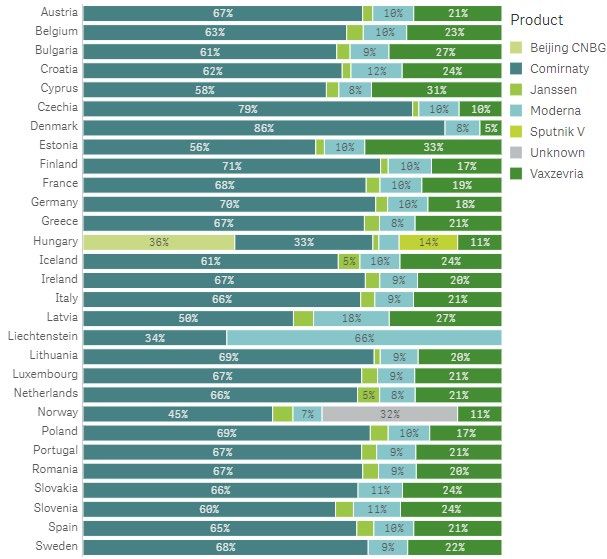
ECDC TECHNICAL REPORT                 Overview of the implementation of COVID-19 vaccination strategies and deployment plans in the EU/EEA

  •       In people aged 80 years and above, the median vaccine uptake was 80.7% (range: 14.6-100%) for at
          least one dose, and 71.6% (range: 10.4-100%) for the full vaccination course (26 countries
          reporting). Ten countries have administered the full vaccination course to more than 80% of the
          population aged 80 years and above.
  •       In HCW, the median vaccine uptake was 83.9% (range: 21.4–100%) for at least one dose, and
          69.9% (range: 20–100%) for the full vaccination course (17 countries reporting). Ten countries have
          administered at least one vaccine dose to more than 80% of healthcare workers.

  Priority groups defined for vaccination
  •       Vaccinations continue to be rolled out in phases through various priority groups. As of 31 May 2021,
          one country is still in the first phase, while 21 countries have progressed to groups in subsequent
          phases (of 22 countries that responded to this question).
  •       Countries have primarily prioritised elderly people, residents and personnel of long-term care facilities
          (LTCFs), healthcare workers, social care personnel, and people with certain comorbidities. Countries
          are currently continuing vaccination of these groups, progressing to vaccination of younger age
          groups and essential workers critical to societal infrastructure. Ten countries have already opened up
          vaccination to any adult individual irrespective of age, underlying condition, or priority group.
  •       Fifteen countries have already fully vaccinated at least one priority group, such as healthcare workers,
          residents and/or personnel in LTCFs, elderly people (with various lower age cut-offs across countries)
          or adults with co-morbidities.
  •       Eighteen countries have further adapted the prioritised groups to be vaccinated, including additional
          age groups, healthcare workers in different settings, educational workers, and other groups with high
          risk of severe disease.

  Vaccination strategies and policies during rollout
  •       Sixteen countries have extended the timing between vaccine doses to provide the first dose to as
          many people in the priority groups as possible. The timing between the first and second dose varies
          by country and by vaccine product.
  •       For individuals previously infected with SARS-CoV-2, eleven countries currently recommend only one
          dose (for vaccines that have a two-dose schedule).
  •       Seventeen countries recommend specific COVID-19 vaccine products for specific population groups.
  •       Most countries have adapted their vaccination guidelines following the report of the very rare side
          effects of thromboembolic events associated with thrombocytopenia following vaccination with
          Vaxzevria and COVID-19 Vaccine Janssen. The adaptation is mainly based on age specific
          recommendations for both the Vaxzeria and COVID-19 Vaccine Janssen.
  •       A minority of countries (n=4) reported that they have adapted their COVID-19 vaccination strategy
          due to the circulation of new variants of concern. Adjustments included providing more vaccine doses
          to areas of high incidence of COVID-19 in general or due to high incidence of variants of concern or a
          redefinition of the priority groups based on the epidemiological situation. No further adjustment has
          been made compared to the previous report.
  •       Fourteen responding countries answered that they do offer vaccination to certain individuals/ target
          groups who live outside of the country (e.g. transnational workers, with certain criteria such as
          working in LTCF, health facilities or essential workers).
  •       All responding countries answered that vaccination will be accessible to any EU citizens in the country,
          but there may be certain conditions.
  •       Five countries are planning to expand vaccination to all adolescents and in 14 countries the vaccination
          of children under the age of 12 years is currently under discussion and decisions will be made at a later
          time if the European Medicines Agency authorises any COVID-19 vaccines for that age group.

  Vaccination certificates
  The majority of responding countries are planning to issue COVID-19 vaccination certificates, and many have
  started discussions regarding the possible use of these certificates in the future, for example for travel,
  tourism, the easing of non-pharmaceutical interventions, or access to specific places/events.

  Vaccine acceptance and hesitancy
  Eleven countries have observed an increase in vaccine hesitancy mostly in relation to lower acceptance of
  the Vaxzevria vaccine.

                                                              2
ECDC TECHNICAL REPORT Overview of the implementation of COVID-19 vaccination strategies and deployment plans in the EU/EEA
Challenges and good practices
• The majority of countries (15/23, 65%) reported that limited vaccine supply is the main challenge
they face with the rollout of vaccines.
• Some countries shared lessons learned so far in the vaccination rollout, such as establishing mass
vaccination centres in cooperation with municipalities to ensure faster and effective vaccine rollout,
using and optimising waiting lists for reduced wastage of doses, and using pedagogical
communication.
• Countries provided information about different measures taken to reach those who are under-served
or vulnerable in the population, such as using the single dose vaccine or mobile vaccination teams.
As countries continue with the rollout of their national vaccination campaigns, strategies and plans will
continue to be adapted. This is a rapidly moving process, and this report provides a snapshot of the progress
to date.
Scope of this document
On 19 January 2021, the European Commission set out actions to step up the response against the pandemic
and accelerate the rollout of vaccination campaigns, with the targets of vaccinating at least 80% of people over
the age of 80 years, and 80% of health and social care professionals in every Member State by March 2021. In
addition, a minimum of 70% of the adult population should be vaccinated by the summer of 2021 [1].
ECDC has previously published technical reports on vaccination strategies and vaccine deployment across EU/EEA
countries, on 2 December 2020 [2], 1 February 2021 [3], 29 March 2021 [4] and 6 May 2021 [5]. This fifth
technical report provides an updated overview of the progress of national COVID-19 vaccination strategies in
EU/EEA countries, including updates on: vaccine uptake overall and by target group; current vaccination phases
and priority groups, as well as any adjustments made to priority groups during the rollout; vaccination strategies
and policies in place; the use of vaccination certificates, vaccine acceptance and hesitancy, and challenges
countries face with the rollout and good practices to mitigate these challenges.
Target audience
Target audiences for this document are the European Commission, the Health Security Committee (HSC), the
EU/EEA National Immunisation Technical Advisory Groups (NITAGs) collaboration and national public health
institutes and ministries of health in the EU/EEA, as well as public health experts and decision-makers at
subnational level in charge of implementing vaccine deployment plans.
Methods
The information provided in this report was collected from the following sources:
The Integrated Situational Awareness and Analysis report
Questions on vaccines are sent by the European Commission to EU/EEA countries via the Integrated Situational
Awareness and Analysis (ISAA) report. The ISAA report is prepared under the Integrated Political Crisis Response
Mechanism (IPCR) of the Council of the European Union [6,7].
• Since 9 December 2020, a weekly set of questions has been sent via the ISAA report to representatives of
countries, as validating authorities of the IPCR, to gather regular information on various topics around
COVID-19. One section of these questions covers vaccination strategies and deployment. The
representatives of countries gather the responses to the questions from different agencies and ministries
in their countries.
• This report is based on the responses from countries to the vaccine-related questions received on 3 May
2021, 10 May 2021, 17 May 2021, 31 May 2021. Where relevant, data are included from responses
provided before May. The response rate from countries to each question is specified in the sections
below.
• On 3 June 2021, a draft version of this report was sent to the Health Security Committee Members for
verification and validation, and to complement any missing information.
3ECDC TECHNICAL REPORT Overview of the implementation of COVID-19 vaccination strategies and deployment plans in the EU/EEA
Data from The European Surveillance System
ECDC, in conjunction with the World Health Organization’s Regional Office for Europe, has implemented a
monitoring system to collect information on vaccine rollout (the number of doses distributed to EU/EEA countries
and administered, including by age groups and other prioritised populations) since mid-January 2021. EU/EEA
countries have been reporting data on the COVID-19 vaccine rollout through The European Surveillance System
(TESSy), which can be viewed on the COVID-19 Vaccine Tracker [8] on ECDC’s website, as well as the weekly
report on the COVID-19 vaccine rollout overview [9]. The information on the COVID-19 vaccine rollout presented
in this report is based on most recent data reported by EU/EEA countries to TESSy and displayed in the Vaccine
Tracker as of 11 June 2021. The Vaccine Tracker may be consulted for additional details and country specific
disclaimers on data.
Results
COVID-19 vaccine rollout overview
By January 2021, all 30 EU/EEA countries had started COVID-19 vaccination campaigns [3], and different COVID-
19 vaccine products have been gradually introduced as they became available through the EU Vaccines Strategy.
The Annex (Table 18) presents an overview of COVID-19 vaccines currently being rolled out in EU/EEA countries
and the dates of their first administration.
Currently, four COVID-19 vaccines have received conditional marketing authorisation in the EU [10], following
evaluation by EMA, and are part of the EU Vaccines Strategy Portfolio: Comirnaty (BNT162b2) developed by
BioNTech/Pfizer, COVID-19 Vaccine Moderna (mRNA-1273), Vaxzevria (AZD1222) previously COVID-19 Vaccine
AstraZeneca, and COVID-19 Vaccine Janssen (Ad26.COV 2.5). Rolling reviews for additional COVID‑19 vaccines
are ongoing: NVX-CoV2373 by Novavax (started 03 February 2021), CVnCoV by CureVac (started 12 February
2021), and Sputnik V (Gam-COVID-Vac) by Gamaleya (started 4 March 2021)[11-13]. All vaccine products
authorised in the EU are registered for use in people aged 18 years and older, with the exception of Comirnaty
which was approved for use in adults and adolescents aged 16 and above and whose indication was recently
extended to include children aged 12 to 15 years [14].
All EU/EEA countries have received and are using Comirnaty, COVID-19 Vaccine Moderna and Vaxzevria,
except for Liechtenstein, where only the first two products are being used and in Denmark Vaxzevria is no
longer used routinely (only in specific situations) and in Norway Vaxzevria is no longer used. By week 20,
2021 (23 May 2021), supplies of COVID-19 Vaccine Janssen have also been distributed to 25 EU/EEA
countries. In addition, Hungary has received supplies of Sputnik V by Gamaleya and Inactivated Beijing CNBG
by Sinopharm through bilateral negotiations with the manufacturers. Slovakia started using Sputnik V by
Gamalya in week 23 2021.
As of 11 June 2021, a total of 333 678 903 vaccine doses have been distributed by manufacturers to EU/EEA
countries, including 39 077 495 in the last week (week 22, 2021) (29 countries reporting; data for Malta not
reported to TESSy).
Figure 1 shows the weekly number of vaccine doses distributed by manufacturers to EU/EEA countries by vaccine
product since the beginning of the rollout and as of 11 June 2021. Overall, Comirnaty represents 67.3% of all
doses distributed to EU/EEA countries via the European Commission’s Vaccine Strategy, followed by Vaxzevria
(19.5%), COVID-19 Moderna (9.6%) and Janssen (3.3%); 1 056 885 vaccine doses distributed to Norway are
reported to TESSy as an unspecified product (0.3%). Sputnik V and Inactivated Beijing CNBG were only supplied
to Hungary. Figure 2 shows the proportion of vaccine doses distributed by manufacturers to each EU/EEA
country by vaccine product as of 11 June 2021.
4ECDC TECHNICAL REPORT Overview of the implementation of COVID-19 vaccination strategies and deployment plans in the EU/EEA
Figure 1. Weekly number of COVID-19 vaccine doses by product, distributed by manufacturers to
EU/EEA countries*
*Source: TESSy; data reported by 29 countries as of 11 June 2021 (missing Malta); partial data for week 23, 2021 not shown.
Figure 2. Proportions of COVID-19 vaccine doses by product, distributed by the manufacturers to
EU/EEA countries*
*Source: TESSy; data reported by 29 countries as of 11 June 2021 (missing Malta).
5ECDC TECHNICAL REPORT Overview of the implementation of COVID-19 vaccination strategies and deployment plans in the EU/EEA
As of 11 June 2021, a total of 284 124 689 vaccine doses have been administered to adults aged 18 years and
above in all EU/EEA countries, 25 437 581 in the last week (week 22, 2021) (30 countries reporting). Based on
data available from 29 EU/EEA countries (missing Malta), 85% of the doses distributed since the beginning of the
rollout have been used. Considering the increase in vaccine supply, the weekly number of doses administered
has also been increasing overtime (Figure 3); an average of 24 650 723 doses have been administered per week
in the last four weeks.
Figure 3. Weekly number of COVID-19 vaccine doses by product, administered in EU/EEA countries*
*Source: TESSy; data reported by 30 countries as of 11 June 2021; partial data for week 23, 2021 not shown.
Overall, Comirnaty represents 71.1% of all doses administered in EU/EEA countries, followed by Vaxzevria
(16.5%), COVID-19 Moderna (8.9%), and Janssen (1.8%); 1.3% others (Sputnik V and Inactivated Beijing
CNBG), and 0.3% unknown vaccine products. Figure 4 shows the proportion of vaccine doses administered in
EU/EEA countries by vaccine product per week as of 11 June 2021.
6ECDC TECHNICAL REPORT Overview of the implementation of COVID-19 vaccination strategies and deployment plans in the EU/EEA
Figure 4. Proportion of COVID-19 vaccine doses administered in EU/EEA countries by vaccine
product per week*
*Source: TESSy; data reported by 30 countries as of 11 June 2021; partial data for week 23, 2021 not shown.
Since the start of the rollout of COVID-19 vaccination campaigns in the EU/EEA in December 2020 and as of 11
June 2021, the cumulative vaccine uptake in the adult population (aged 18 years and older) has reached 51.2%
for at least one vaccine dose (range: 14.9-67.7%) and 26.8% for the full vaccination course (range:
11.8-55.1%) (30 reporting countries) (Figure 5). The cumulative uptake of at least one vaccine dose and full
vaccination in the adult population (18+) in each EU/EEA country is shown in Figure 6.
7ECDC TECHNICAL REPORT Overview of the implementation of COVID-19 vaccination strategies and deployment plans in the EU/EEA
Figure 5. Cumulative uptake of at least one vaccine dose and full vaccination among adults aged 18
years and above in the EU/EEA by reporting week*
*Source: TESSy; data reported by 30 countries as of 11 June 2021; data for week 23, 2021 are preliminary.
8ECDC TECHNICAL REPORT Overview of the implementation of COVID-19 vaccination strategies and deployment plans in the EU/EEA
Figure 6. Cumulative uptake of at least one vaccine dose and full vaccination among adults aged 18
years and above by EU/EEA country*
*Source: TESSy; data reported as of 11 June 2021; uptakes are based on data reported up to week 21, 2021 for Norway; week
22, 2021 for Denmark, Germany, Iceland, Latvia, Liechtenstein, Malta, Romania, and Slovenia; and partial data for week 23,
2021 for all remaining EU/EEA countries.
Cumulative vaccine uptake is higher in those target groups that have been prioritised since the beginning of the
vaccine rollout, in particular the elderly and healthcare workers (see section below on Priority groups defined
for vaccination).
As of 11 June 2021, the median vaccine uptake among people aged 80 years and above was 80.7% (range:
14.6-100%) for at least one dose and 71.6% (range: 10.4–100%) for the full vaccination course (26 countries
reporting). Thirteen countries (Austria, Belgium, Cyprus, Denmark, Finland, Iceland, Ireland, Italy, Malta,
Norway, Portugal, Spain, and Sweden) administered at least one vaccine dose to more than 80% of the
population aged 80 years and above, while 10 (Cyprus, Denmark, Iceland, Ireland, Italy, Malta, Norway,
Portugal, Spain, and Sweden) also administered a full vaccination course to more than 80% of this target
population.
9ECDC TECHNICAL REPORT Overview of the implementation of COVID-19 vaccination strategies and deployment plans in the EU/EEA
Among healthcare workers (HCW), as of 11 June 2021, the median vaccine uptake was 83.9% (range: 21.4–
100%) for at least one dose and 69.9% (range: 20-100%) for the full vaccination course (17 countries
reporting). Ten countries (Czechia, Estonia, France, Hungary, Iceland, Ireland, Latvia, Romania, Spain, and
Sweden) administered at least one vaccine dose to more than 80% of healthcare workers, while six countries
(Czechia, Hungary, Iceland, Ireland, Latvia and Romania) also administered a full vaccination course to more
than 80% in this target group.
Table 1 shows a summary of the cumulative uptake of at least one vaccine dose and full vaccination in adults
(18+), people aged 80 years and above and healthcare workers (EU/EEA median and range). More information
on the COVID-19 vaccine rollout in EU/EEA countries can be found on the ECDC Vaccine Tracker [8] and in the
weekly COVID-19 vaccine rollout overview [9].
Table 1. Summary table of vaccine uptake by target populations
Vaccine uptake Uptake (range) Reporting countries
At least one dose among adults 51.2% (range: 14.9-67.7%) All 30 EU/EEA countries
(18+ years)
Full vaccination among adults 26.8% (range: 11.8-55.1%) All 30 EU/EEA countries
(18+ years)
At least one dose among people 80.7% (range: 14.6–100%) 26 (Austria, Belgium, Bulgaria, Croatia,
80+ years (median) Cyprus, Czechia, Denmark, Estonia,
Finland, France, Greece, Hungary, Iceland,
Ireland, Italy, Latvia, Lithuania,
Luxembourg, Malta, Norway, Poland,
Portugal, Romania, Slovenia, Spain,
Sweden)
Full vaccination among people 71.6% (range: 10.4-100%) 26 (Austria, Belgium, Bulgaria, Croatia,
80+ years (median) Cyprus, Czechia, Denmark, Estonia,
Finland, France, Greece, Hungary, Iceland,
Ireland, Italy, Latvia, Lithuania,
Luxembourg, Malta, Norway, Poland,
Portugal, Romania, Slovenia, Spain,
Sweden)
At least one dose among 83.9% (range: 21.4–100%) 17 (Bulgaria, Croatia, Czechia, Denmark,
healthcare workers (HCW) Estonia, France, Greece, Hungary, Iceland,
(median) Ireland, Latvia, Luxembourg, Malta,
Romania, Slovenia, Spain, Sweden)
Full vaccination among HCW 69.9% (range: 20–100%) 17 (Bulgaria, Croatia, Czechia, Denmark,
(median) Estonia, France, Greece, Hungary, Iceland,
Ireland, Latvia, Luxembourg, Malta,
Romania, Slovenia, Spain, Sweden)
*Source: TESSy; data reported as of 11 June 2021.
Priority groups defined for vaccination
Due to the limited availability of COVID-19 vaccines at the start of vaccination campaigns, most countries opted
to prioritise vaccination for those individuals most at risk of severe disease (e.g. the elderly and residents in long-
term care facilities (LTCFs), as well as healthcare workers. Vaccination phases differ by country, with a range of
two to 16 different phases (Table 2), depending on their specific prioritisation strategies and vaccine availability.
This section of the report focuses on population groups that are being offered vaccination in the current stage of
the rollout. As more vaccines become available, countries can start vaccinating additional groups, such as
younger individuals or workers of essential public services other than healthcare or even open the vaccination to
all adults and adolescents 12 years and above.
10ECDC TECHNICAL REPORT Overview of the implementation of COVID-19 vaccination strategies and deployment plans in the EU/EEA
Table 2. Number of phases to vaccinate prioritised groups in EU/EEA countries (n=30)*#
Number of phases to vaccinate Countries
prioritised target groups
Two Italy, Portugal
Three Austria, Belgium, Croatia, Czechia, Greece, Poland, Romania, Spain
Four Finland, Germany, Malta, Sweden
Five Estonia, France, Slovenia, the Netherlands
Six Cyprus, Luxembourg
Other Denmark (12 phases), Hungary (seven phases), Iceland (10 phases),
Ireland (9 phases), Latvia (eight phases), Lithuania (16 phases), Norway
(nine phases), Slovakia (12 phases), Slovenia (seven phases)
*Information gathered from ISAA reports between 9 February and 29 March 2021; information received from HSC and NITAG
members on 28 January 2021
# Several countries provided detailed information on the description of different vaccination phases:
Belgium : Phase 1A: started on 5 January 2021, involves residents and staff in nursing homes and has been completed by all
healthcare workers. Phase 1B: begins in March and will address people aged 65 years and older, people aged 45 years and
older at risk, and those fulfilling so-called ‘essential’ social or economic functions. Phase 2 will take place in May or June and
will involve the adult population 18 years and older.
Croatia: Phase 1: elderly and staff in long-term care facilities, healthcare workers, primarily those working with COVID-19
patients (ICU, testing-sites). Phase 2: elderly age range > 65 years and adults with chronic diseases, age range < 65. Phase 3:
others.
Czechia: 3 phases (Phase IA, IB, and II). In Phase II, vaccines should already be available to the general public.
Cyprus: Phase 1: since 27 December 2020, residents and staff of LTCFs and healthcare workers. Phase 2: since 26 January
2021, people > 80 years old (priority in vulnerable groups); the age limit is lowered at regular intervals. Phase 3: since 16
February 2021, people > 75 years old (priority in vulnerable groups). Phase 4: since the end of February 2021, people ≥ 16
years with high risk for severe disease. Phase 5: since the end of February 2021, people working in primary healthcare centres,
followed by other health professionals/personnel, and residents in other closed structures, such as prisons and hosting centres
for refugees and migrants. Phase 6: the rest of the population according to age.
Estonia: Phase 1 (since 27 December 2020): healthcare workers and people working in healthcare institutions; Phase 2 (since
January 2021): residents and staff of LTCF; Phase 3 (since end of January 2021): the elderly and risk groups; Phase 4 (started
in mid-February 2021 due to Vaxzevria’s preliminary use-recommendation, continued on a small scale and depending on
available vaccine quantities and recommendations for different vaccines): front-line and essential services providers; Phase 5
(since May 2021): the rest of the population by age-groups. The phases are overlapping in most cases and depend mostly on
available vaccine quantities and recommendations.
Germ any: Four phases: Three phases with priority groups (very high, high, moderate), followed by the remaining population
(not listed in group 1-3).
Italy: Phase 1: healthcare workers and socio-healthcare workers, residents and staff of long-term facilities for the elderly;
elderly > 80. Phase 2 (with six categories of prioritisation): extremely vulnerable people; people aged between 75 and 79
years; people aged between 70 and 74 years; people with increased clinical risk if infected by SARS-CoV-2 aged 16-69 years;
people aged 55-69 years; people aged 18-54 years. Vaxzevria can be administered to school and university staff, to members
of the army and police, in at-risk settings such as prisons, specific communities, and to people working in essential services.
Iceland: The population is divided into 10 priority groups. For information on priority groups, see: https://www.covid.is/covid-
19-vaccine#w-tabs-0-data-w-pane-1
Latvia: The population is divided in eight priority groups.
Spain: Phase 1: elderly and staff in long-term care facilities, healthcare and social care workers, primarily those working with
COVID-19 patients (frontline), non-institutionalized individuals with high level of dependency. Phase 2: elderly age range > 60
years and adults with chronic diseases, age range < 60, essential workers critical to societal infrastructure. Phase 3:ECDC TECHNICAL REPORT Overview of the implementation of COVID-19 vaccination strategies and deployment plans in the EU/EEA
Table 3. Current vaccination phases in EU/EEA countries (n=22)*#
Current vaccination phase Countries
Phase 1 Belgium (phase 1B),
Phase 2 Czechia, Portugal, Spain
Phase 3 Austria, Croatia, Romania
Phase 4 Malta, Finland, Sweden
Other Denmark (phase 10)
Estonia (phase 5)
Germany (all groups)
Hungary (all groups)
Iceland (group 7-10)
Ireland (phase 9)
Latvia (phase 8)
Lithuania
Luxembourg (phase 6)
the Netherlands (phase 5)
Norway (phases 6-8)
Poland (all groups)
Slovakia (all groups)
*Information gathered from ISAA reports on 3, 10, 17, and 31 May 2021. To consider the current vaccination phase latest
information available is displayed in the table.
Countries marked in bold are currently in their final vaccination phase.
#
Several countries provided detailed information on the description of different vaccination phases:
Belgium : Phase 1A started on 5 January 2021 and involves nursing homes (residents and staff), health care staff (hospitals
and first line healthcare workers), healthcare workers and police intervention units. Phase 1B began in March 2021 and
includes people aged 65 and older and those aged 18 and older at risk (due to underlying comorbidities). Phase 2, starting in
May or June 2021, will involve the adult population over 18 years old without registered comorbidities.
Germ any: Phase 1 and 3 are still ongoing, while phase 4 has started in some federal states. On 7 June, opening up the
vaccination to any adult and children older than 12 years.
Latvia: Since 3 May 2021 vaccination of the entire adult population is ongoing. Since 17 May 2021 vaccination is available for
population aged 16+ and from 2 June 2021 age 12+ is available.
Lithuania: Starting from 10 May 2021, a new 10-year age group will be included in the vaccination process every week: from
10 May. population aged 55-64; from 17 May. population aged 45-54; from 24 May. population aged 35-44; from 31 May.
population aged 16-34.
The N etherlands: The phases were slightly modified: Phase 1 (people living in elderly care and their healthcare staff; people
and staff in long term care facilities; acute care and ICU medical staff), phase 2 (people 60 years and older (from old to young)
and healthcare staff delivering home-based care), phase 3 (people (>16 years) with high-risk medical conditions; specified
groups of healthcare professionals (involved in care/treatment of COVID-19 patients)), phase 4 (people between 18 and 60
years with certain underlying medical conditions), phase 5 (people between 18 and 60 years). Currently in the last phase of
prioritisation, people aged 45-55 years are currently being vaccinated.
P oland: Since 9 May 2021 all age groups (adults) are released to sign up for a vaccination.
Sw eden: Phase 3 is still ongoing, while phase 4 has started in some regions.
Twenty-four countries replied to the question which priority groups are currently vaccinated (Table 4). Due to
high vaccine uptake, ten countries have already opened up vaccination to any adult individual irrespective of age,
underlying condition, or priority group (Table 6). All countries that replied are still prioritising the elderly and/or
adults of different age groups. Eight countries report having almost fully vaccinated the elderly (Table 5) and,
considering that in several countries the cumulative vaccine uptake has increased in older age groups, younger
age groups are now also being vaccinated. Sixteen countries (64%) are prioritising residents in LTCFs. Twenty-
one countries (84%) are currently vaccinating adults with comorbidities compared with 96% of countries that
were prioritising this group in April 2021. Healthcare workers, personnel in LTCFS and social care personnel are
considered as priority groups in 17 (68%), 15 (60%) and 15 (60%) countries, respectively. In 23 countries other
groups, including essential workers critical to societal infrastructure, educational staff, people with mental or
physical disabilities, socially vulnerable, and younger people with high risk of severe COVID-19 are also
prioritised for vaccination.
12ECDC TECHNICAL REPORT Overview of the implementation of COVID-19 vaccination strategies and deployment plans in the EU/EEA
Table 4. Overview of priority groups currently being vaccinated in EU/EEA countries (n=25)*
Countries Priority groups currently being vaccinated
Elderly/adults Elderly in Adults with co- Healthcare Personnel Social care Other risk groups
in different LTCFs morbidities workers in LTCFs personnel (i.e. workers of
age groups essential public
services other
than healthcare;
others)
Austria Yes (65+) Yes Yes (regardless Yes Yes Yes Other essential
of age) workers critical to
societal
infrastructure.
Socially vulnerable
groups. Staff in
schools,
kindergartens,
crèches and
childcare facilities.
People below 65
years with increased
risk according to
prioritisation of the
NITAGs. Close
contact persons of
pregnant women.
Selected employees
with direct personal
contact and
increased risk of
infection, especially
in the police, penal
system, federal
army. Total
population under 65
years prioritised by
age and health risks.
Further ranking
based on living and
working conditions.
Belgium Yes (65+) Yes Phase 1B started in
March and includes
people aged 65+
years and those
aged 18+ and years
at risk. The
vaccination strategy
recommends
vaccinating older
adults by decreasing
age categories. In
most regions, the
category 70-75
years is currently
invited to be
vaccinated; in other
regions younger
people with
comorbidities are
already invited.
Croatia Yes Yes Other essential
workers critical to
societal
infrastructure.
Vaccination available
for people of all age
groups for whom
there is a licenced
vaccine (vaccinating
12-15 years under
discussion).
13ECDC TECHNICAL REPORT Overview of the implementation of COVID-19 vaccination strategies and deployment plans in the EU/EEA
Countries Priority groups currently being vaccinated
Elderly/adults Elderly in Adults with co- Healthcare Personnel Social care Other risk groups
in different LTCFs morbidities workers in LTCFs personnel (i.e. workers of
age groups essential public
services other
than healthcare;
others)
Czechia Yes (16+) No system of
prioritisation applies
as for now. From 1
June, registration
will be open to the
last age group (16+
years).
Denmark Yes Vaccination available
for people of all age
groups for whom
there is a licenced
vaccine (vaccinating
12-15 years under
discussion).
Estonia Yes Vaccination available
for people of all age
groups for whom
there is a licenced
vaccine (vaccinating
12-15 years under
discussion).
Finland Yes (70+) Yes Yes Yes Yes Yes Election officers of
the 2021 municipal
elections.
France Yes (18+) Yes Yes Yes Yes People aged 16-17
years with a very
high risk of severe
COVID-19. Relatives
aged 16 years and
over of severely
immunocompromised
persons. Pregnant
women from the
second trimester of
pregnancy.
Germany Yes Yes Yes Yes Yes This group Other essential
was not a workers critical to
priority societal
group. infrastructure.
Socially vulnerable
groups. Educational
staff. On June 7,
vaccination was
opened for those
aged 12 years and
above.
Hungary Yes (60+) Yes Yes Yes Yes Yes Other essential
workers critical to
societal
infrastructure.
Socially vulnerable
groups, anyone
above 16 years
asking for the
vaccination.
Iceland Yes Yes Socially vulnerable
groups.
14ECDC TECHNICAL REPORT Overview of the implementation of COVID-19 vaccination strategies and deployment plans in the EU/EEA
Countries Priority groups currently being vaccinated
Elderly/adults Elderly in Adults with co- Healthcare Personnel Social care Other risk groups
in different LTCFs morbidities workers in LTCFs personnel (i.e. workers of
age groups essential public
services other
than healthcare;
others)
Ireland Yes (40+) Yes Yes Yes Yes Yes Socially vulnerable
groups. People 16-
69 years old at very
high risk of severe
COVID-19.
Latvia Yes Yes Yes Yes Yes Yes Other essential
workers critical to
societal
infrastructure.
Socially vulnerable
groups. Educational
staff. Since 3 June
vaccines are
available to the
entire adult
population;
vaccination is
available for those
12 years and above.
Lithuania Yes Yes Yes Yes Yes Yes Other essential
workers critical to
societal
infrastructure.
Socially vulnerable
groups. Educational
staff.
Luxembourg Yes Yes Yes Yes Yes Other essential
workers critical to
societal
infrastructure. Socially
vulnerable groups. In
phase 6, the general
resident population
between 16 and 54
years, starting with
the oldest, who have
not been previously
vaccinated due to
vulnerability are now
vaccinated.
Malta Yes (16+) Yes Yes Yes Yes Yes Yes, and vaccination
is now available to
those aged 12 years
and above.
The Yes Other essential
Netherlands workers critical to
societal
infrastructure.
Socially vulnerable
groups.
Norway Yes (55+) Yes Yes Certain groups of
healthcare workers.
People 16-64 years
with conditions
leading to a high
risk of severe illness.
Poland Yes Yes Yes Yes Yes Yes Other essential
workers critical to
societal
infrastructure.
Socially vulnerable
groups. Educational
staff.
15ECDC TECHNICAL REPORT Overview of the implementation of COVID-19 vaccination strategies and deployment plans in the EU/EEA
Countries Priority groups currently being vaccinated
Elderly/adults Elderly in Adults with co- Healthcare Personnel Social care Other risk groups
in different LTCFs morbidities workers in LTCFs personnel (i.e. workers of
age groups essential public
services other
than healthcare;
others)
Portugal Yes Yes Yes Other essential
workers critical to
societal
infrastructure.
Socially vulnerable
groups.
Romania Yes Yes Yes Yes Yes Yes Other essential
workers critical to
societal
infrastructure.
Socially vulnerable
groups. Educational
staff.
Slovenia Yes (16+) Yes Yes (16+) Yes Yes Yes Other essential
workers critical to
societal
infrastructure.
Socially vulnerable
groups. Educational
staff. All persons
aged 16 years and
over (with priority
vaccination of
priority groups in
accordance with the
national vaccination
strategy)
Slovakia Yes Yes Yes Yes Yes Yes Other essential
workers critical to
societal
infrastructure.
Socially vulnerable
groups.
Spain Yes (50+) Yes Yes Yes Yes Yes Other essential
workers critical to
societal
infrastructure.
Socially vulnerable
groups. Educational
staff. Non-
institutionalized
individuals with a
high level of
dependency.
Sweden Yes (50+) Yes Yes Yes Yes Yes Close contact
persons of those
living in nursing
homes or receiving
home care. Socially
vulnerable groups.
Pregnant women
with risk factors.
*Information gathered from ISAA reports on 3, 10, 17, and 31 May 2021. To consider the current vaccination phase latest
information available is displayed in the table.
Note: In Germany, all healthcare workers and personnel working in long-term care facilities are eligible for vaccination even if
they live outside Germany.
16ECDC TECHNICAL REPORT Overview of the implementation of COVID-19 vaccination strategies and deployment plans in the EU/EEA
Nineteen countries replied to the question about fully vaccinated priority groups (Table 5). Fully vaccinated does
not necessarily mean that 100% of the respective groups have been vaccinated. Even fully vaccinated groups
can include certain individuals who have not been vaccinated, such as people who refused vaccination or people
who are not eligible for vaccination due to risk factors. Some countries have added further explanations about
what they mean by ‘fully vaccinated’ (e.g. in percentage to define the number of vaccinated persons within one
group). To reflect the full picture, we show fully vaccinated groups as reported by the countries and add further
explanations where available.
Seventeen countries had also replied to the question on 27 April 2021. As of 31 May 2021, 15 countries report at
least one fully vaccinated priority group (compared to 13 countries on 27 April). Thirteen countries reported that
healthcare workers have been fully vaccinated (compared to eleven countries on 27 April). The elderly in LTCFs
and personnel in LTCFs have been fully vaccinated in 11 countries and in eight countries, respectively (compared
to nine and six countries, respectively, on 27 April). Nine countries have fully vaccinated elderly people with
different age-ranges, while four countries have fully vaccinated adults with co-morbidities and five countries have
fully vaccinated social care personnel (compared to four and two countries, respectively, on 27 April). Four
countries have fully vaccinated other priority groups, e.g. essential workers critical to societal infrastructure,
LTCF residents with intellectual disabilities and people in home care (also six countries on 27 April).
Table 5. Fully vaccinated priority groups in EU/EEA countries 1 (n=18)*#
Countries Priority groups fully vaccinated (including comments provided by countries)
Elderly Elderly Adults with Healthcare Personnel Social care Other risk
in LTCFs co- workers in LTCFs personnel groups (i.e.
morbidities workers of
essential
public
services
other than
healthcare;
others)
Austria Yes Yes Yes
(HCW in highly
exposed
settings).
Croatia Yes
(87% of all
HCW with at
least one
dose).
Denmark Yes Yes Yes Yes
(75+) (almost fully
vaccinated).
Estonia Yes Yes Yes Yes
Finland Yes Yes Yes Yes Yes Yes (at least Yes (essential
(60+) (at least one one dose). workers
dose). critical to
societal
infrastructure).
Hungary Yes
Iceland Yes Yes
(HCW in
COVID-19
wards, ICU
and
emergency
rooms).
Lithuania Yes Yes Yes
Malta Yes Yes Yes Yes Yes Yes Yes (essential
(60+) workers
critical to
societal
infrastructure)
1
Depending on how a country defines it, it may mean e.g. >80% of full vaccination coverage
17ECDC TECHNICAL REPORT Overview of the implementation of COVID-19 vaccination strategies and deployment plans in the EU/EEA
Countries Priority groups fully vaccinated (including comments provided by countries)
Elderly Elderly Adults with Healthcare Personnel Social care Other risk
in LTCFs co- workers in LTCFs personnel groups (i.e.
morbidities workers of
essential
public
services
other than
healthcare;
others)
The Yes Yes Yes (HCW Yes Yes (district Yes (residents
Netherlands (60+, directly nurses and of small-scale
partially) involved in the social residential
care and support homes and
treatment of workers) disability care
COVID-19 homes,
patients). nursing homes
for people
with
intellectual
disabilities).
Norway Yes
(65+)
Portugal Yes Yes Yes Yes
(80+)
Slovenia Yes Yes Yes Yes
(70+,
about
60%)
Spain Yes Yes Yes Yes Yes Yes Yes
(70+)
Sweden Yes Yes Yes (87% of
(75+) (94% people in
with first home care
dose, with first dose,
89% 71% with
with second dose).
second
dose).
*Information gathered from ISAA reports on 3, 10, 17, and 31 May 2021. To consider the most recent adjustments of the
priority groups the latest information available is displayed in the table.
#
Countries with no fully vaccinated priority groups: Czechia, Latvia, Poland, Romania (Romania stating there is no fully
vaccinated group as vaccination is not mandatory).
Twenty-two countries replied to the question about opening up the vaccination to any adult individual
irrespective of age, underlying condition or priority group. Ten countries had opened up vaccination to the entire
adult population, while two countries are currently preparing and will open up shortly and nine countries have
not opened up the vaccination outside of the prioritised groups.
Some countries provided additional information on how vaccination for all adults was or is being prepared:
• In Austria, the primary prioritisation is done by age and medical condition. Further prioritisation is based
on living and working conditions. Workplace vaccination is planned to further increase vaccine uptake.
• In Croatia, vaccination sites for mass vaccination have been organised in each county. The online
platform for scheduling vaccination has been developed.
• Czechia reported to continuously open the vaccination for particular age groups (without any prioritisation
regarding i.e. comorbidities).
• Iceland reported that vaccination staff are prepared, and the vaccination clinics are ready to start
vaccinating all adults.
• In Latvia, all vaccination centers are operating; mobile units are operating in rural areas and those aged
over 60 years are served even without prior booking in the morning hours (9:00-10:00).
• In Lithuania, with the introduction of the public vaccination, a unified electronic registration system was
launched. From 17 May, all residents of the country are invited to quickly and conveniently register on the
online platform, which will allow not only to register yourself, but also to register another person.
18ECDC TECHNICAL REPORT Overview of the implementation of COVID-19 vaccination strategies and deployment plans in the EU/EEA
Residents who do not have the ability to register online and who cannot register them can do so by
telephone by calling the Hotline.
• The authorities in Estonia and Romania are opening additional vaccination centres and in Poland they
have increased the number of vaccination sites, including vaccinations in the workplace and also trained
additional staff to administer vaccines such as general practitioners and pharmacists.
Table 6. Countries who have opened up vaccination to any adult individual irrespective of age,
underlying condition or priority group (N=22)*
Opened up vaccination to any adult individual Countries
irrespective of age, underlying condition or priority
group
Yes Bulgaria, Croatia, Estonia, Germany, Latvia, Lithuania, Malta,
Poland, Romania, Slovenia
No Belgium, Czechia, Denmark, Finland, Ireland, Luxembourg,
Spain, the Netherlands, Norway, Sweden
Not yet but preparations are underway, and country plans Austria, Iceland
to open up shortly
*Information gathered from ISAA reports on 17 and 31 May 2021. To consider the most recent adjustments of the priority
groups the latest information available is displayed in the table.
As of 31 May 2021, 18 of 24 countries have adjusted their original plans to efficiently administer COVID-19
vaccines to target groups (Austria, Czechia, Denmark, Estonia, Finland, France, Iceland, Ireland, Lithuania, ,
Malta, the Netherlands, Norway, Poland, Portugal, Romania, Slovenia, Spain, Sweden) (Table 7). Adjustments
were made to prioritise additional age groups (Austria, Denmark, Finland, , Sweden), healthcare workers and
staff in long-term care facilities (Austria, Czechia, the Netherlands), people working in the educational system
(Malta, Romania), people with high exposure to SARS-CoV-2 at work (Finland, Lithuania), and other groups with
high risk of severe disease (Austria, France, Iceland, Ireland, Norway, Sweden).
Table 7. Adjustments made to the original priority groups during the rollout (n=24)*#
Countries Adjustments to original priority Reason for adjustment
groups
Austria Prioritisation of people of 80 years and Slow initial uptake in elderly care homes, more
older, people with additional severe specific definitions of risk groups.
underlying health conditions, people with
special cognitive and physical needs (living
in the community), staff in mobile
(nursing) care, people with disabilities and
with personal assistance and their personal
assistants, people in LTCFs.
Czechia Prioritisation of healthcare workers, social Logistics and need for cold chain as the mRNA
care workers and elderly in long-term care vaccines were the first vaccines available.
facilities over the originally envisaged
people aged 65+ and people with
comorbidities.
Denmark Age is now the primary factor for
prioritisation for vaccination.
Estonia Yes
Finland Prioritisation of election officers of the June
2021 municipality elections in priority
phase 1 and people younger than 70 years
not belonging to any risk group. Areas with
an incidence of over> 100 COVID-19
cases/100 000 inhabitants/14 days will
receive a larger proportion of vaccines than
areas with a lower incidence.
France Inclusion of home care workers,
firefighters, people with serious
comorbidities. Since 12 May 2021, leftover
doses are open to the general public
(appointment < 24h). Since 31 May,
vaccination is open to anyone 18+.
19ECDC TECHNICAL REPORT Overview of the implementation of COVID-19 vaccination strategies and deployment plans in the EU/EEA
Countries Adjustments to original priority Reason for adjustment
groups
Germany Opened up vaccination to any adult
individual /child >12 years irrespective of
age, underlying condition or priority group.
Iceland People of prioritisation group 4, first Part of the group has been vaccinated with doses
responders, have been vaccinated along that would otherwise have gone to waste because
with group 2. of no-shows at vaccination sites.
Ireland Number of priority groups have been
reduced and simplified. People aged 16-69
years at very high risk of severe COVID-19
disease have been prioritised. Age-based
allocation (10-year bands) has been
introduced for the final group.
Latvia Since 3 May vaccination is available to
entire population.
Lithuania Inclusion of workers who have contact with
other people at work in large companies
(>100 employees).
Malta Workers in the educational cohort were
always in the third cohort, but they were
prioritised within that cohort.
The Prioritisation of acute COVID-19 care staff
Netherlands in hospitals and general practitioners.
High-risk groups with a medical indication
have been defined.
Norway More vaccine doses will go to 24 A new distribution key for vaccines to the
municipalities, who have been subject to municipalities based on the number of people
high incidence over time. People aged 18 aged 18 years or older is introduced. High
years and older will be prioritized. infection rate within the age group of 18+.
Poland Yes (adjustments are made according to
current needs).
Portugal Prioritisation by age and of workers in the
educational system. Prioritisation of
additional vulnerable populations, such as
homeless and house-bound patients. The
clinical risk groups were also updated.
Romania Inclusion of workers in the educational
system in the category of essential
workers.
Slovenia Yes
Spain Yes Adverse events following vaccination with
Vaxzevria and the COVID-19 vaccine Janssen.
Sweden Yes. Prioritisation of people with additional
severe underlying health conditions,
including bone marrow or other organ
transplantation, dialysis treatment and
Down’s syndrome. Inclusion of pregnant
women with risk factors.
*
Information gathered from ISAA reports on 3, 10, 17, and 31 May 2021. To consider the most recent adjustments of the
priority groups, the latest information available is displayed in the table.
#
Countries with no adjustments to original priority groups: Belgium, Croatia, Hungary, Luxembourg.
Vaccination strategies and policies during rollout
Countries continue to adapt vaccination strategies and policies based primarily on the changing epidemiological
situation at country and subnational level, vaccine supply, new information regarding different COVID-19
vaccines efficacy, safety, effectiveness and new evidence about the virus and its impact on human health.
The vaccination policies captured in this section include the timing of COVID-19 vaccine doses; vaccination of
individuals previously infected with SARS-CoV-2; extraction of additional doses of vaccine from vials;
recommendations of vaccine products for age or target groups; changes in vaccination strategy due to variants
20ECDC TECHNICAL REPORT Overview of the implementation of COVID-19 vaccination strategies and deployment plans in the EU/EEA
of concern; eligibility for vaccination of individuals who live outside the country and eligibility for vaccination of
citizens from other EU countries, and vaccination of individuals under the age of 18 years.
Extension of timing between the first and second dose of COVID-19
vaccines
Sixteen responding countries have extended the timing between vaccine doses to provide the first dose to as
many people in the priority groups as possible. Romania applied extended timing in special circumstances.
Currently, six countries (Iceland, Latvia, Lithuania, Malta, Slovakia, Slovenia, Spain) have not extended the
timing between the first and second dose of authorised vaccines, although Lithuania and Spain have special
recommendations.
Regarding the timing between first and second dose, policies vary by country and product as follows:
• Comirnaty: 28 days (Ireland, Portugal), 35 days (Belgium, Poland), 42 days (Austria, Croatia, Czechia,
Estonia, France, the Netherlands, Norway), up to 42 days under special circumstances in Romania, 3 to 6
weeks (Denmark, Germany), 7 weeks (Sweden) and up to 12 weeks (Finland, Norway).
• COVID-19 Vaccine Moderna: 28 days (Italy, Portugal), up to 35 days under special circumstances in
Romania, 35 days (Hungary, Poland), 42 days (Austria, Czechia, the Netherlands, Norway,) 7 weeks
(Sweden), 4 to 6 weeks (Denmark), 5 to 7 weeks (France), 6 weeks (Germany) and 12 weeks (Finland,
Norway).
• Vaxzevria: 35 days (Poland), 9-11 weeks (Sweden), 12 weeks (Croatia, Estonia, Finland, Ireland, Poland,
Portugal, Slovenia, Spain), up to 12 weeks (France, Germany, Hungary, Latvia).
Table 8. Extension of timing between the first and second dose of COVID-19 vaccines (n=25)
Has the timing between the first and Countries
second dose of vaccine been extended?
Yes Austria, Belgium, Croatia, Czechia, Denmark, Estonia,
Finland, France, Germany, Ireland, Luxembourg, the
Netherlands, Norway, Poland, Portugal, Romania, Spain,
Sweden
No Iceland, Latvia, Lithuania, Malta, Poland, Slovakia, Slovania,
Spain
Some countries provided further details about timing between doses:
• Lithuania: the second dose of Vaxzeria is recommended 12 weeks after the first dose, but the timing can
be shortened for some population groups (e.g. educational institutions workers). Extension of the second
dose of the Corminaty vaccine under discussion.
• Norway: The Ministry of Health and Care Services has decided to extend the time interval between the
first and second dose of mRNA vaccines from 6 to 12 weeks. Extension of the time interval between
doses 1 and 2 for mRNA vaccines to up to 12 weeks applies to persons under 65 years old without
underlying conditions.
• Romania: under special circumstances.
• Spain: extension of the timing for the second dose of Vaxzeria to 16 weeks only in essential workers agedECDC TECHNICAL REPORT Overview of the implementation of COVID-19 vaccination strategies and deployment plans in the EU/EEA
• France: One dose three months after infection (except for those in residential care homes).
• Germany recommends only a single dose of vaccine in previously infected individuals, even if more than six
months have passed since diagnosis of the infection.
• In the Netherlands, one dose of vaccine is offered to people infected with SARS-CoV-2 in the last six
months, but two doses are recommended for people with primary immunodeficiency.
• Slovenia recommends one dose for all previously infected, if they are vaccinated up to eight months after
infection (for those persons vaccination can be postponed up to six months after infection). If they are
vaccinated more than eight months after infection, they recommend vaccination with the full vaccination
course. For persons who get COVID-19 after vaccination with one dose, they recommend a second dose
after six months.
• Norway recommends one dose three months after recovery.
• Croatia recommends the one dose 3-6 months after being infected.
• In Estonia, vaccination with one dose is recommended on the sixth month after recovery.
• In Spain, one dose after six months following infection with SARS-CoV-2 is recommended.
• In Portugal, one dose six months after infection is recommended.
Full vaccination schedule
• Latvia postpones the full course of vaccination in previously infected persons by at least three months and
then the full course of vaccination is given (two doses).
• Finland reported that individuals infected with SARS-CoV-2 in the last three to six months previously are
recommended to be vaccinated six months after the infection with the full vaccination course.
Docum entation of previous infections
Regarding the question on how documentation of previous infection is performed, Croatia requires a proof of
infection (PCR or rapid antigen test). Finland indicated that a proof of a laboratory test is required (the
information can be accessed through National Patient Healthcare Register). In Iceland, all diagnosed cases and
their test results are logged in the national health care database. In Latvia, self-declaration is sufficient. In
Norway, a previously infected individual must have a proof of infection based on a laboratory test (Norway has a
national registry for all positive lab tests). In the Netherlands, proof of infection is not required. In Romania the
infection status of an individual is available within the integrated health information system. In Slovenia, a
laboratory test (PCR) or a doctor's certificate of past COVID-19 infection is required. Spain indicated that in
people aged 18-65 years, previous infection should be documented with a laboratory test confirming infection or
through available information within the integrated health information system. In Iceland all cases are diagnosed
by testing and test results are logged in the national health care database. In Estonia, the information must be
provided either in the national e-health registry or in a certificate on paper. The current proof of infection
accepted is a positive PCR or antigen test taken by a health-care worker or a diagnosis done by a doctor. In
Portugal, previous infection is provided by the national mandatory disease notification system, which requires a
positive laboratory test.
R ecord of vaccination status in previously infected
Nine countries gave information on how the vaccination status is recorded for previously infected individuals. In
Austria, Croatia, Germany, Portugal, and Slovenia they are recorded as individuals receiving a single dose of the
vaccine. In Germany, status about previous infection is also recorded. In Norway they are also recorded as
individuals receiving a single dose of the vaccine, however in the register, the healthcare practitioner
administering the vaccine to individuals previously infected with COVID-19 can register/make a note in the
journal that a second dose is contraindicated. In Ireland, Spain and in the Netherlands, previously infected
individuals who receive one dose are recorded as an individual receiving both a single dose of the vaccine and
the full course of the vaccine (e.g. two doses). In Estonia the vaccination status is recorded as completed or fully
vaccinated with one dose.
Table 9. Recommendations of COVID-19 vaccination in individuals previously infected with SARS-
CoV-2 (n=25)
COVID-19 vaccine recommendations for Countries
those previously infected
The full vaccine schedule is given Belgium, Czechia, Denmark, Finland, Hungary, Latvia,
Lithuania, Luxembourg, Malta, Poland, Romania, Slovakia,
Sweden
Only one dose of vaccine is recommended (for Austria, Croatia, Estonia, France, Germany, Ireland, the
vaccines that have a two-dose schedule) Netherlands, Norway, Portugal, Slovenia, Spain
No vaccination is recommended Iceland
22You can also read


