PACIFIC SOUTHWEST Forest and Range Experiment Station
←
→
Page content transcription
If your browser does not render page correctly, please read the page content below
PACIFIC SOUTHWEST
                                         Forest and Range
                                         Experiment Station
FOREST SERVICE
U. S. DEPARTMENT OF AGRICULTURE
P.O. BOX 245, BERKELEY, CALIFORNIA 94701

                            SPECIFIC GRAVITY VARIATION
                            IN ROBUSTA EUCALYPTUS
                            grown in Hawaii   R o g er G . S k o l m e n

                                     USDA FOREST SERVICE RESEARCH PAPER PSW- 78 /1972
CONTENTS
Page
Introduction . . . . . . . . . . . . . . . . . . . . . . . . . . . . . . . . . . . . . . . . . . . . . . . . . . . 1
Procedure . . . . . . . . . . . . . . . . . . . . . . . . . . . . . . . . . . . . . . . . . . . . . . . . . . . . . 1
Results and Discussion . . . . . . . . . . . . . . . . . . . . . . . . . . . . . . . . . . . . . . . . . 2
Specific Gravity of the Sample . . . . . . . . . . . . . . . . . . . . . . . . . . . . . . . 2
Specific Gravity of Individual Trees . . . . . . . . . . . . . . . . . . . . . . . . . . 2
Specific Gravity of Stands . . . . . . . . . . . . . . . . . . . . . . . . . . . . . . . . . . . 2
Specific Gravity of Size Classes . . . . . . . . . . . . . . . . . . . . . . . . . . . . . 3
Specific Gravity Variation Within Trees . . . . . . . . . . . . . . . . . . . . . . 3
Specific Gravity Variation Between Young Stands . . . . . . . . . . . . 5
Specific Gravity of Brittleheart and Sound Wood . . . . . . . . . . . . . . 5
Summary and Conclusions . . . . . . . . . . . . . . . . . . . . . . . . . . . . . . . . . . . . . . 6T he Author ROGER G. SKOLMEN is on the staff of the Station's Institute of Pacific Islands Forestry, with headquarters in Honolulu, Hawaii, where he has been investigating the uses, properties, and processing of forest products. Native of San Francisco, he holds B.S. (1958) and M.S. (1959) degrees in forestry from the University of California, Berkeley.
R
obusta eucalyptus (Eucalyptus robusta Sm.) in wood from one tree and even from one part of a
is an important timber species in Hawaii. board to another. Because most other properties of
The density, or specific gravity, of its wood the wood are closely related to density, this variation
has been measured in conjunction with standard causes many manufacturing problems.
physical and mechanical property tests (Gerhards
1963; Youngs 1960). It has also been measured as This paper reports data on specific gravity gath
part of an exploratory investigation of brittleheart ered as part of a larger study to determine the extent
(brash wood near the pith) in the species (Skolmen of brittleheart in robusta. Because brittleheart was
and Gerhards 1964). These tests, as well as the suspected to vary widely in volume from tree to tree,
general observations of most people who have worked a relatively large sample of wood from 50 trees was
with it, indicate that the wood varies widely in gathered. This large sample made possible an intensive
density, not only from one tree to another, but also investigation of specific gravity variation.
PROCEDURE
Ten stands of robusta eucalyptus growing along by 28-centimeter toughness test sticks. Each stick
the northeast coast of the island of Hawaii were represented a certain multiple of 1-1/4 inches
selected for sampling. The stands represented the (1-1/8-inch green dimension and 1/8-inch saw kerf) of
widest available range of age, elevation, and rainfall radius from the pith at a certain height in the tree.
differences. Five trees at least 11 inches diameter
breast height (d.b.h.) and containing at least one The volume measurements for specific gravity
16-foot log were randomly selected from each stand. were made by immersion, but the wood had been
Cross sections 1 foot long were cut from the large end steamed after air-drying to 12 percent moisture
of each 16-foot log in each tree and from just above content, in order to kill an insect infestation in the
the small end of the uppermost log. In some trees the samples. This treatment caused the samples to recover
uppermost log was only 8 or 12 feet long rather than some of the shrinkage that had occurred in drying,
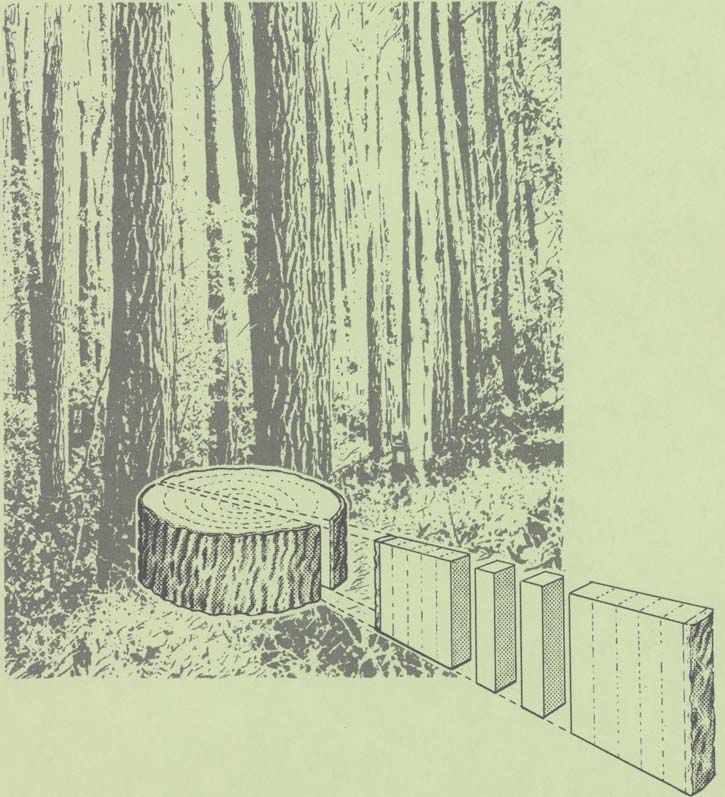
16 feet (fig. 1). In the forest, 2-inch thick flitches and raised their moisture content to an average of
with centered pith were sawn from the cross sections. 14.6 percent. The specific gravity data are therefore a
In the shop, the flitches were sawn in line with the little lower than those determined for wood at 12
pith into 1-1/8 by 1-1/8-inch sticks, which, after percent moisture content that has had normal shrink
air-drying, were further manufactured into 2- by 2- age in drying, but they are valid for comparison.
1Figure 1–Method of preparation
of wood samples for measurement
of specific gravity.
RESULTS AND DISCUSSION
Specific Gravity of the Sample Specific Gravity of Stands
The sample consisted of 1,759 toughness test
Among the 10 stands were several that had
sticks representing various radial segments at several
generally similar site characteristics, but specific
heights in 50 trees. The grand mean specific gravity of
gravity varied considerably between them (table 1).
these sticks was 0.603, with a coefficient of variation
The stand highest in elevation (No. 8), had abnormal
of 18.6 percent and a range among the sticks from
ly short trees and a significantly lower mean specific
0.331 to 0.869. Specific gravity is obviously quite
gravity than the other stands. Stand 9, which had
variable in the species; the usual coefficient of
been planted on infertile, abandoned sugar cane land,
variation, based on tests of 50 United States mainland
was higher in mean specific gravity than the other
species, is 10 percent (U.S. Forest Serv., Forest
stands, but only significantly higher than five of
Products Laboratory 1955).
them. These two stands also had lower coefficients of
Specific Gravity variation than any of the others. The coefficient of
variation between stand means was 8.7 percent.
of Individual Trees
Spacing of trees around the sample trees was also
Mean specific gravity per tree ranged from 0.431 measured and analyzed, but had no obvious relation
to 0.694 with a coefficient of variation between ship to specific gravity. Stands 5 and 9 had a mean
means of 10.4 percent. Only five trees of the 50 had a spacing of 8 by 8 feet. Stand 12 was spaced 14 by 14
mean specific gravity of less than 0.5, and four of feet. The other stands were spaced 10 by 10 to 12 by
these were in one stand. 12 feet.
2Table 1–Specific gravity of robusta, by stand and site rapid growth produces wood of higher mean density
characteristics than slow growth, probably the higher density value
Mean Co- resulted from the greater proportion of dense, outer
Stand merch- Mean efficient wood in the larger trees. The relationship does not
num- Eleva- Rain- Mean antable specific of hold for wood of stand 9, which though slowly grown
ber Age tion fall dbh height gravity1 variation
in comparison to the other stands, had the highest
Years FeetInches Feet Percent
mean specific gravity (table 1). Regression analysis
1 44 1,300 250 18.1 60 0.654 ab 14.8 using the ratio of diameter inside bark at the top of
2 33 2,200 115 19.6 56 .620 abc 16.3
the first log to age of the tree as the dependent
3 33 2,200 75 16.6 40 .591 bc 17.6
4 32 2,600 85 16.4 40 .576 c 18.6 variable and mean specific gravity at the 16-foot
5 34 2,000 100 16.9 48 .562 c 21.4 height for each tree as the independent variable
6 31 1,800 75 17.0 60 .616 abc 18.3 showed only a poor relationship between the two. It
7 33 2,200 85 20.0 60 .578 bc 18.4 yielded a correlation coefficient of only -0.143.
8 30 3,600 75 16.6 24 .480 d 13.7
9 35 1,600 225 16.2 44 .661 a 12.4
10 34 1,500 250 18.5 48 .624 abc 18.2
Specific Gravity
Over-all means 17.6 48 .603 18.6 Variation Within Trees
1
Values followed by the same letters do not differ signifi Within trees, specific gravity was also quite vari
cantly at the 5 percent level of probability.
able. The coefficient of variation ranged from 7.8
percent for the least variable tree to 23.0 percent for
Specific Gravity of Size Classes the most. For only two trees was it below 10 percent.
Within a single tree, the largest range in specific
The sample included trees ranging in d.b.h. from
gravity was 0.357 to 0.817, a difference of 0.460.
12.3 to 25.9 inches and in merchantable height from
The low value was from a sample at the butt of the
16 to 88 feet. To see if specific gravity varied with
first log next to the pith. The high value sample was
tree size, I grouped the trees into four size classes
64 feet up the tree and 3 inches out from the pith. In
based on their diameter inside bark at the top of the
the butt cross section of this same tree, the wood
first log. This measure allowed fairly uniform classes
next to the pith was 0.357, and 6 inches from the
with a more nearly equal representation of stands and
pith it was 0.755, a difference of almost 0.4. This was
trees in each class than did the measurements of
the largest variation in a single cross section.
d.b.h. or the diameter inside bark at the butt.
Most other trees were almost as variable, and
The mean specific gravity of the class of larger
differences of 0.3 and more between the highest and
trees was highly significantly different from the other
lowest value sample in a tree were quite common.
three means (table 2). The other three means were
Variation was usually greatest in individual cross
not different from each other at the 5 percent level.
sections from low in the trees–at the butt and at 16
Except for two from stand 1, the trees in class 4
feet. In many of these cross sections there were
grew most rapidly in diameter, as indicated by the
specific gravity differences of more than 0.3 between
mean annual increment. Although this suggests that
inner and outer wood.
In the consolidated data for all stands, a consistent
trend of increase in specific gravity with distance
Table 2–Specific gravity based on diameter inside bark at top
from the pith and height is indicated (table 3),
of first log, by size class
although somewhat masked. When the data are
Diameter grouped into the four size classes and when values
Size Diameter range growth Specific gravity2
per year1 based on only a very few samples are dropped, the
class
trend is very clear (fig. 2).
Inches
Robusta does not produce growth rings in Hawaii,
1 7.6- 9.9 0.263 0.581 a
and so periodic growth cannot be determined from its
2 10.0-11.9 .322 .595 a
3 12.0-13.9 .390 .595 a wood. General observations, coupled with a few
4 14.0-18.4 .444 .625 b available periodic height and diameter measurements
1 of robusta trees in plantations, indicate that growth is
Diameter at 16 feet divided by stand age.
2
Values followed by the same letter do not differ significant rapid for the first 10 years or so. Growth rate then
ly at the 1 percent level of probability. gradually slows as the trees increase in age.
3Table 3–Specific gravity and sampling frequency, by radius and height in tree
Height Number Mean 1
of specific Specific gravity and number of samples for each 1¼ inch radial increment
in
tree samples gravity
(feet) 1¼ 2½ 3¾ 5 6¼ 7½ 8¾ 10 11¼ 12½
88 7 0.723 0.676(2) 0.706(2) 0.767(2) 0.763(1)
80 18 .715 .666(6) .722(6) .754(5) .771(1)
76 6 .698 .641(2) .684(2) .768(2)
64 101 .696 .635(28) .693(28) .739(26) .735(15) .724(4)
60 12 .649 .531(4) .666(4) .749(4)
56 22 .670 .600(6) .657(6) .727(6) .710(3) .704(1)
48 223 .665 .573(60) .644(60) .719(56) .742(34) .750(13) .662(1)
44 13 .610 .456(2) .555(2) .628(2) .652(2) .656(2) .671(2) .694(1)
40 15 .04 .527(4) .655(4) .694(4) .808(2)
32 354 .636 .538(88) .604(88) .678(85) .712(55) .732(28) .723(10)
24 18 .580 .528(6) .589(6) .646(5) .514(1)
16 438 .594 .492(98) .548(98) .625(98) .664(76) .686(44) .677(17) .662(6) .701(1)
Butt 531 .532 .436(100) .461(100) .527(99) .579(93) .620(70) .632(38) .616(16) .664(10) .644(4) .610(1)
Total
1,759 .603 .517(406) .571(406) .640(394) .658(282) .672(163) .658(68) .631(23) .667(11) .644(4) .610(1)
Mean
1
Distance of outer edge of sample from pith.
Figure 2–Specific gravity along
radii of major cross sections, by
height in tree and distance from
pith, in four size classes deter-
mined by diameter inside bark at
top of first log: Group 1, 7.6-9.9
inches; Group 2, 10.0-11.9 inches;
Group 3, 12.0-13.9 inches; Group
4, 14.0-18.4 inches.
4It is apparent that specific gravity of the wood Table 4–Stand mean specific gravity in descending order, for
produced is related to diameter growth rate. Diameter first three increments of radius at butt and 16-foot cross
sections
growth rate is in turn probably related to cambium
age. When the tree is very young and very fast 1¼ inches 2½ inches 3¾ inches
growing, low density juvenile wood is produced. from pith from pith from pith
Density increases as diameter growth rate decreases Stand specific Stand specific Stand specific
and mature wood is produced. The relation between number gravity 1 number gravity l number gravity l
cambium age and specific gravity increase is not so BUTT CROSS SECTION
clear cut with regards to growth in height, because 9 0.515 a 9 0.587 a 9 0.653 a
density increase with height is much greater than 10 .453 ab 1 .510 b 1 .578 a
2 .452 ab 2 .467 c 10 .553 b
increase with diameter in wood produced by cam
6 .441 ab 10 .459 cd 6 .524 bc
bium of the same age. A 6-inch diameter robusta tree 8 .438 bc 6 .452 cd 3 .524 bc
is usually over 40 feet tall. The specific gravity of 1 .436 bc 3 .443 cd 2 .523 bc
wood 3 inches out from the pith at the butt of such a 3 .423 bcd 4 .435 cd 4 .517 bc
tree is usually less than that of wood at the pith at 32 7 .419 bcd 5 .419 d 5 .486 bc
feet up in the tree, even though the wood at this 5 .393 cd 8 .418 d 8 .459 c
4 .388 d 7 .418 d 7 .456 c
height in the tree was produced by the cambium at
about the same time as the wood at the butt (fig. 2). 16-FOOT CROSS SECTION
This indicates that some of the increase in wood 1 .550 a 9 .661 a 9 .720 a
9 .548 a 1 .624 a 1 .694 ab
density with height is independent of the age, and
2 .506 b 2 .567 b 6 .650 bc
possibly the reproductive rate, of the cambium. 3 .496 b 3 .563 bc 10 .639 bc
6 .490 bc 6 .548 bcd 3 .639 bc
Specific Gravity Variation 10 .487 bc 10 .533 bcd 4 .616 c
7 .483 bc 4 .524 bcd 2 .607 cd
Between Young Stands 4 .468 bc 5 .508 cd 5 .597 cd
5 .449 c 8 .484 d 8 .543 d
To determine if there was any consistent propensi
8 .446 c 7 .477 d 7 .540 d
ty of certain stands to produce high or low density 1
Values followed by the same letters within each group
wood, I compared the mean specific gravity of each do not differ significantly at the 5 percent level of probability.
of the first three radial increments at the butt and
16-foot cross sections (table 4). Any increment from
been limiting in some nutrient essential to lower
one stand should be similar in age and stage of growth
density wood production; stand 9 was obviously
to one from another stand, and the 1-1/4-inch
below normal size for its age. Stand 1, on the other
increment at the butt section should be nearly
hand, had grown at an impressive rate. It was on a
identical in all stands.
shallow soil formed on a pahoehoe lava flow of
Stand 9 produced wood that was significantly
Mauna Loa volcano and thus was different from all
denser, even close to the pith, than the wood of all
the other stands, which were on deep soils formed on
but one of the other stands (table 4). The greater
Mauna Kea cinder deposits. Possibly stand 1 soil also
mean specific gravity of trees in stands 1 and 9, when
had a nutrient makeup different from the others.
harvested (table 1), was already present in the butts
of these trees when they were only about 6 inches in Specific Gravity of
diameter at the butt. It would probably have been
possible to predict that these stands would have Brittleheart and Sound Wood
denser wood on the basis of increment cores taken Brittleheart is a core of brash wood near the pith.
early in their life. There was not, however, a good It is usually made up of rapidly grown, low-density
early indication that stand 8 would have less dense juvenile wood. This wood is crushed by the long-term
wood than any other stand. The trend towards low loading of longitudinal growth stress and is brash
density in stands 4, 5, 7, and 8 is present in most because it is full of minute compression failures. Such
increments, but is not sufficiently consistent to wood is essentially useless for lumber products and is
provide a basis for prediction. usually discarded.
There is no obvious explanation for the initially All the samples of this study were processed
denser wood in stands 1 and 9. As has been through a U.S. Forest Products Laboratory toughness
mentioned, stand 9 was growing on infertile soil of an testing machine. Those samples that had a brash type
abandoned sugar cane plantation. This soil may have of failure were considered to be brittleheart.
5Although brittleheart is formed of low density Table 6–Specific gravity of brittleheart, sound heartwood, and
wood that is readily crushed, all low density wood is part or all sapwood, by size 1 class
not brittleheart. Wood taken from near the pith of Class
very young trees, though of low specific gravity, is Item 1 2 3 4
not abnormally brash (Dadswell and Langlands Diameter range
1934). It only becomes brash as the trees get older (inches) 7.6-9.9 10.0-11.9 12.0-13.9 14.0-18.4
and larger, developing compression failures due to Brittleheart
growth stresses. Specific gravity remains constant. specific
gravity 2 .499 ab .490 a .500 ab .522 b
Nevertheless, one of the best means of segregating
Sound heart
brittleheart from sound, normal wood is by weight, specific
because in sawlog-size trees, there is a very strong gravity 2 .584 c .614 d .608 cd .640 e
relation between low density and brittleheart (table Sapwood
5). There were 577 samples of brittleheart with a and part
mean specific gravity of 0.503. This mean was found sapwood
specific
by the t test to be significantly (1 percent level) gravity 2 .691 f .703 f .707 f .716 f
different from the mean of the 1,182 samples of 1
Based on diameter inside bark at top of first log.
sound heartwood and sapwood, which was 0.651. In 2
Values followed by the same letters within each row and
each stand, brittleheart was significantly less dense column do not differ significantly probability at the 1 percent
than sound wood. But, illustrating that all low level of probability.
Table 5–Mean specific gravity of brittleheart and sound
wood, by stand density wood is not brittleheart, the sound wood of
stand 8 is quite close in specific gravity to the
Specific Gravity
brittleheart of stands 2, 3, 4, 5, 6, 7, and 10.
Stand Sound
All wood1 Brittleheart 1
wood1 If the specific gravity values of brittleheart, sound
number
9 0.661 a 0.572 a 0.693 a heartwood, and sapwood or part sapwood are separ
1 .654 ab .547 a .691 a ated by size class (table 6), it is seen that the relation
10 .624 abc .496 b .674 ab between brittleheart and sound wood specific gravity
2 .620 abc .499 bc .657 b holds for trees of all sizes. Further, sapwood and part
6 .616 abc .514 b .655 bc
3 .591 bc .494 bc .627 d
sapwood is significantly denser than sound heart
7 .578 bc .499 bc .634 cd wood. This is not surprising, since specific gravity has
4 .576 c .487 c .629 d been shown to increase consistently with diameter
5 .562 c .475 c .653 bc and the three types of wood occupy distinct positions
8 .480 d .442 d .496 e with respect to diameter.
Average .603 .503 .651 It should be possible to control a considerable part
1
Figures followed by the same letters within each column of the variation in robusta wood density by sorting
are not significantly different at the 5 percent level of the wood into brittleheart, sound heartwood, and
probability. sapwood or part sapwood.
SUMMARY AND CONCLUSIONS
Skolmen, Roger G.
1972. Specific gravity variation in robusta eucalyptus grown in
Hawaii. Berkeley, Calif., Pacific SW. Forest & Range Exp.
Stn., 7 p., illus. (USDA Forest Serv. Res. Paper PSW-78)
Oxford: 176.1 Eucalyptus robusta: 812.31 [–015.26 + 812.712]
Retrieval Terms: Eucalyptus robusta; wood density; specific gravity;
brittleheart; variation; Hawaii.
Tests on samples from 50 trees indicated that the stands. Mean specific gravity was 0.603; range was
specific gravity of robusta eucalyptus wood varies 0.331 to 0.869 for the entire sample. Most of the
markedly within trees, between trees, and between variation within trees results from a consistent in-
6crease in wood density with diameter and height problems may also result from density variation.
increase. The range within one cross section was To reduce the manufacturing problems, wood
0.357 to 0.755, and the largest range for a single tree should be carefully sorted by weight during grading.
was 0.357 to 0.817. Some of the variation between This is already done to some extent when brittleheart
stands may be caused by site factors, because and suspected brittleheart are removed on the mill
abnormally high or low specific gravity is related to floor and at the green chain. But considerable
the location where grown, or the stand, and shows up variation in wood density still exists in sound
early in the life of the stand. Variation in specific heartwood and sapwood. Because specific gravity
gravity between stands is not obviously related to increases with diameter, sorting sound wood into "all
differences in growth rate between stands, although heartwood" and "part or all sapwood" would further
the slowest growing stand had the highest density decrease variation. Because specific gravity increases
wood. with height, sorting of logs into "butts" and "uppers"
Because robusta wood density is variable, the before sawing would also be a means of reducing
species is difficult to handle in many manufacturing variation. This would also have the effect of separat
operations. In seasoning, the denser wood loses and ing the stronger, high density wood of the upper logs
gains moisture much more slowly than the less dense from the weaker but more easily worked wood of the
wood. Wood cutting tools adjusted for average butt logs. Lastly, logs should be plain- or flat-sawed if
density may gouge low density wood and skip over possible, because boards so sawn contain less density
or jam on high density wood. Gluing and finishing variation than quarter-sawed boards.
LITERATURE CITED
Dadswell, H. E., and I. Langlands. Skolmen, R. G., and C. C. Gerhards.
1934. Brittleheart in Australian timbers: a preliminary 1964. Brittleheart in Eucalyptus robusta grown in
study. J. Counc. Sci. Ind. Res. No. 7, 190-196, Hawaii. Forest Prod. J. 14(12): 549-554, illus.
illus. U.S. Forest Service, Forest Products Laboratory.
Gerhards, C. C. 1955. Wood handbook. Handb. 72. 528 p., illus.
1963. A limited evaluation of a few strength properties Youngs, R. L.
for Acacia koa, Metrosideros collina, and 1960. Physical, mechanical and other properties of five
Eucalyptus robusta grown in Hawaii. U.S. Forest Hawaiian woods. U.S. Forest Serv. Forest Prod.
Serv. Forest Prod. Lab., Madison, Wis. 8 p. Lab. Rep. 2191. 34 p., illus.
7The Forest Service of the U.S. Department of Agriculture
. . . Conducts forest and range research at more than 75 locations from Puerto Rico to
Alaska and Hawaii.
. . . Participates with all State forestry agencies in cooperative programs to protect and im
prove the Nation's 395 million acres of State, local, and private forest lands.
. . . Manages and protects the 187-million-acre National Forest System for sustained yield
of its many products and services.
The Pacific Southwest Forest and Range Experiment Station
represents the research branch of the Forest Service in California and Hawaii.
U.S. Forest Service research in Hawaii
is conducted in cooperation with
Division of Forestry
Hawaii Department of Land and Natural Resources
☼ U.S. Government Printing Office 794-238/4213Skolmen, Roger G. Skolmen, Roger G.
1972. Specific gravity variation in robusta eucalyptus grown in Hawaii. 1972. Specific gravity variation in robusta eucalyptus grown in Hawaii.
Berkeley, Calif., Pacific SW. Forest & Range Exp. Stn., 7 p., Berkeley, Calif., Pacific SW. Forest & Range Exp. Stn., 7 p.,
illus. (USDA Forest Serv. Res. Paper PSW-78) illus. (USDA Forest Serv. Res. Paper PSW-78)
The specific gravity (air-dry volume, ovendry weight) of Eucalyptus The specific gravity (air-dry volume, ovendry weight) of Eucalyptus
robusta wood was tested within and between trees from 10 stands. Mean robusta wood was tested within and between trees from 10 stands. Mean
specific gravity was 0.603, but the range in individual samples for 50 trees specific gravity was 0.603, but the range in individual samples for 50 trees
was 0.331 to 0.869, and was 0.357 to 0.755 within one cross section. A was 0.331 to 0.869, and was 0.357 to 0.755 within one cross section. A
consistent increase was recorded in all trees from pith to cambium and from consistent increase was recorded in all trees from pith to cambium and from
butt to top. Mean for brittleheart (brash wood near the pith) was 0.503, butt to top. Mean for brittleheart (brash wood near the pith) was 0.503,
considerably lower than that for normal wood at 0.651. Manufacturing considerably lower than that for normal wood at 0.651. Manufacturing
problems caused by density variation could be reduced by sorting before problems caused by density variation could be reduced by sorting before
sawing and during grading. sawing and during grading.
Oxford: 176.1 Eucalyptus robusta: 812.31 [–015.26 + 812.7121. Oxford: 176.1 Eucalyptus robusta: 812.31 [–015.26 + 812.7121.
Retrieval Terms: Eucalyptus robusta; wood density; specific gravity; brittle- Retrieval Terms: Eucalyptus robusta; wood density; specific gravity; brittle-
heart; variation; Hawaii. heart; variation; Hawaii.
Skolmen, Roger G. Skolmen, Roger G.
1972. Specific gravity variation in robusta eucalyptus grown in Hawaii. 1972. Specific gravity variation in robusta eucalyptus grown in Hawaii.
Berkeley, Calif., Pacific SW. Forest & Range Exp. Stn., 7 p., Berkeley, Calif., Pacific SW. Forest & Range Exp. Stn., 7 p.,
illus. (USDA Forest Serv. Res. Paper PSW-78) illus. (USDA Forest Serv. Res. Paper PSW-78)
The specific gravity (air-dry volume, ovendry weight) of Eucalyptus The specific gravity (air-dry volume, ovendry weight) of Eucalyptus
robusta wood was tested within and between trees from 10 stands. Mean robusta wood was tested within and between trees from 10 stands. Mean
specific gravity was 0.603, but the range in individual samples for 50 trees specific gravity was 0.603, but the range in individual samples for 50 trees
was 0.331 to 0.869, and was 0.357 to 0.755 within one cross section. A was 0.331 to 0.869, and was 0.357 to 0.755 within one cross section. A
consistent increase was recorded in all trees from pith to cambium and from consistent increase was recorded in all trees from pith to cambium and from
butt to top. Mean for brittleheart (brash wood near the pith) was 0.503, butt to top. Mean for brittleheart (brash wood near the pith) was 0.503,
considerably lower than that for normal wood at 0.651. Manufacturing considerably lower than that for normal wood at 0.651. Manufacturing
problems caused by density variation could be reduced by sorting before problems caused by density variation could be reduced by sorting before
sawing and during grading. sawing and during grading.
Oxford: 176.1 Eucalyptus robusta: 812.31 [–015.26 + 812.7121. Oxford: 176.1 Eucalyptus robusta: 812.31 [–015.26 + 812.7121.
Retrieval Terms: Eucalyptus robusta; wood density; specific gravity; brittle- Retrieval Terms: Eucalyptus robusta; wood density; specific gravity; brittle-
heart; variation; Hawaii. heart; variation; Hawaii.You can also read


