Tree Management Strategy - OUR NEXT GENERATION: BURNSIDE'S URBAN FOREST - City of Burnside
←
→
Page content transcription
If your browser does not render page correctly, please read the page content below
Tree Management
        Strategy

                   OUR NEXT GENERATION:
                   BURNSIDE’S URBAN FOREST
Contents
Foreword......................................................... ii       2.3.3 Street tree residential overhang                       5. Streetscape planting strategy...............40
Summary......................................................... iii       2.4 Overhang from private residential                           5.1 Planting zones within the
Key recommendations................................. iv                           trees and shrubs                                                City of Burnside area
Introduction................................................. viii         2.4.1 Hedges                                                    5.1.1 Residential plains
Objectives of the Strategy                                                 2.4.2 Pruning young trees                                       5.1.2 Residential foothills and hills face
Legislative and corporate                                                  2.4.3 Damages and claims                                        5.1.3 Local historic conservation areas
requirements                                                               2.4.4 Root control and pruning                                  5.2 Second Generation Street Tree
Street tree audits: a strategy for                                         2.4.5 Pruning of remnant tree vegetation                               Replacement Program
future generations                                                         2.4.6 Tree replacement in parks                                 5.3 Professional assistance
Survey results                                                                    and reserves
                                                                           2.5 ETSA Vegetation Line                                     6. Communication and consultation .
1. Key Initiatives arising from .                                                 Clearance Program                                        guidelines..................................................46
    the 2004 survey......................................12                2.5.1 Self-management by Council?                               A3 brochure folded to A6
    1.1 Missing trees                                                                                                                      Residential Notification postcards
    1.2 Verge width                                                    3. Tree removal............................................30       Factsheets
    1.3 Tree planting options                                              3.1 Tree removal: procedures and policy
    1.4 Verge surfaces                                                     3.2 Tree removal notification                                7. Parks and reserves.................................52
    1.5 Verge maintenance/upgrades                                         3.3 Driveway crossover installation                             7.1 Regional parks and reserves
    1.6 Foothills verge strips                                             3.4 Stump removal                                               7.1.1 Hazelwood Park
    1.7 Footpaths                                                          3.5 Removal and excavation under                                7.1.2 Kensington Gardens Reserve
    1.8 Kerbs and gutters                                                         the Second Generation Street Tree                        7.1.3 Kensington Park Reserve
    1.9 Maintenance                                                        		 Replacement Program                                          7.1.4 Tusmore Park
    1.10 Species suitability and selection                                                                                                 7.2 Foothills and hills face reserves
    1.11 Establishment and maintenance                                 4. Tree planting............................................34      7.2.1 Hills face road reserves
            of new stock                                                   4.1 Replanting schedule                                         7.3 Special feature reserves
                                                                           4.2 Size of planting stock                                      7.4 Neighbourhood parks and reserves
2. The Complete Care .                                                     4.3 Inter-plant quota                                           7.5 Pocket parks
    Pruning Program.....................................20                 4.4 Planting and recording                                      7.6 Local sports parks
    2.1 Guidelines and Legislation                                         4.5 Location of services
    2.1.1 Duty of care                                                     4.6 Water basins, staking and mulching                       8. Significant Trees, remnant .
    2.2 Pruning cycle                                                      4.7 GIS location records                                        vegetation and veteran trees...............64
    2.2.1 Notification                                                     4.8 Street intersections and driveway
    2.2.2 Requests for pruning                                                    crossover setbacks                                       Street tree replacement—.
    2.3 Pruning practices and standards                                    4.9 Tree planting or replanting by                              preferred options...................................66
    2.3.1 Emergency pruning                                                       residents without Council approval
    2.3.2 Arterial road pruning standards                                  4.10 Tree planting or replanting by
                                                                                  residents with Council approval

Our next generation: Burnside’s urban forest 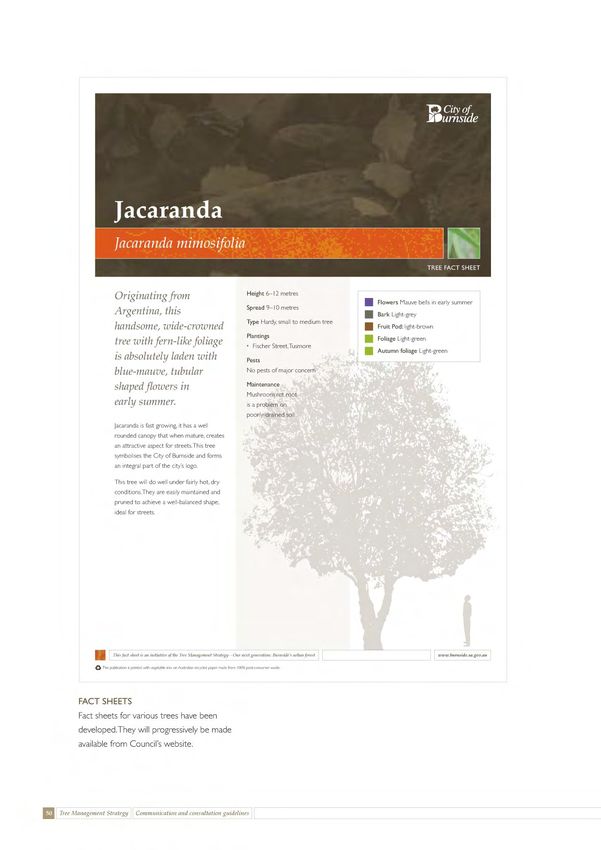
Foreword                                                                                          Further review
                                                                                                  of tree management
                                                                                                  and work practices is
                                                                                                  now needed.

This Tree Management Strategy aims to             determined the health, age, and species of
maintain and develop the tree resources of        the street tree population. The Strategy
the City of Burnside by actively enhancing        includes a breakdown of these results to
and fostering the management of these             inform better planning and management
resources in partnership with the people          practices. It also reviews and summarises
of the City.                                      the street tree audit undertaken in 1991,
                                                  and where possible compares and analyses
It will provide a framework for staff,            the results of both surveys to provide a
residents and professionals to manage trees       historical perspective to Council’s tree-
throughout the City for the long term.            management practices over the last
The Strategy applies to street trees, parks       13 years.
and reserve plantings and privately owned
trees that affect council infrastructure. It      Further review of tree management and
provides generic management plans for             work practices is now needed. It is a
trees within Council-owned reserves, care         requirement under the Local Government
and maintenance standards for ‘significant        Act 1999 that Council have adequate
trees’, and guidelines and future directions      systems in place to reduce Council liability
for replacing street trees.                       regarding trees. We believe that the Strategy
                                                  will lead to proactive tree management for
This is a working document that can be            the benefit of Council, residents, staff and
updated to suit the future needs and              key stakeholders. This will ensure that the
directions of the City. It is closely linked to   City of Burnside remains a leading provider
the City of Burnside’s ‘2020 Strategic Vision’    in urban forest management.
and to the recently completed Community
Land Management Plans. It provides a
straightforward guide to all issues related to
tree management within the City.
A recent audit of street trees has

                                                                                                   Jacaranda is the City’s most common street tree

 ii   Tree Management Strategy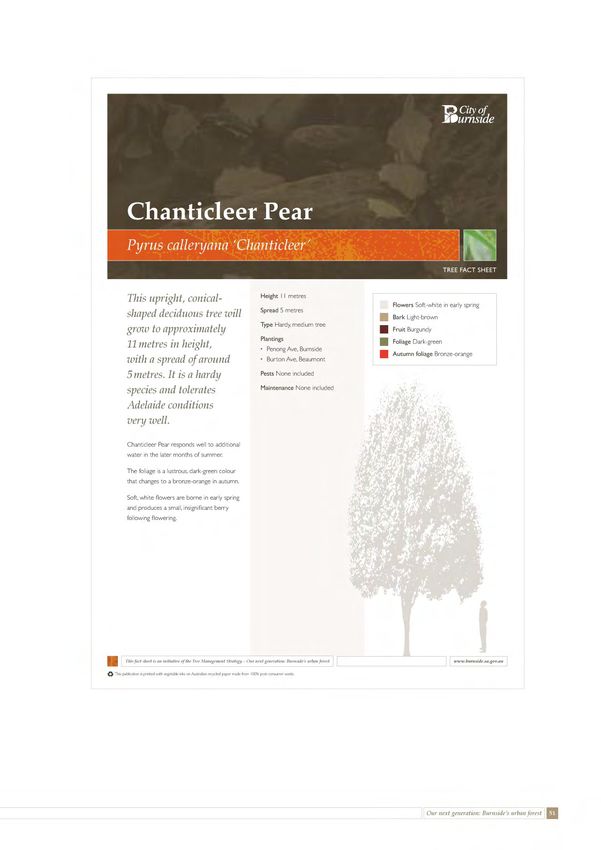
Summary                                                                                            Prolonging the life and
                                                                                                   safety of our ageing trees
                                                                                                   is a high priority for many
                                                                                                   residents of the City.

To a great extent the management of               Council recognises its responsibility to
the City’s trees may be seen as a highly          maintain an asset that is dynamic and subject
successful aspect of Council’s function.          to increasing environmental changes in both
However, demands and community                    built and natural environments. Management
expectations are continually rising, and          systems and practices must be flexible
managing this asset is becoming more              enough to adapt to these changes without
difficult and complex. The City’s street tree     being vague and inconsistent.
population is ageing and nearing the point
where replacement will be necessary. In           This Strategy also includes a communication
some cases this will completely change the        and information program that provides
amenity and character of parts of the City.       quality advice to the community. There
                                                  is a comprehensive list of suggested
Prolonging the life and safety of our ageing      replacement tree species for each street
trees is a high priority for many residents       within the City, as well as suggestions about
of the City. Recognising this, the Strategy       the significance of particular tree species in
includes a broadened approach to street           the history of the local area.
tree care that is more palliative; it aims
to retain as many aged trees as possible,         This Strategy combines all current                Council aims to retain as many aged trees as possible
while its replacement strategy maintains          practices, informal and formal policies into
the character and amenity of the area.            one document that includes a number
The Complete Care Pruning Program,                of recommendations about the way we
for example, creates proactive care of            manage the City’s largest and most valued
street trees that addresses tree care on an       asset. It will complement Council’s new
individual tree basis.                            ‘2020 Strategic Vision’ for the City and
                                                  underpin Council’s intent to be a leader
The basic objective of this Strategy is to        in local government administration. The
re-define tree-management practices               following are key recommendations.
and create policies that will maintain and
improve the quality of the tree stock within
our City for the future. Council policies
and practices need to meet community
expectations, in line with available resources.

                                                                                                          Our next generation: Burnside’s urban forest   iii
Key recommendations

1. EXPLORE PLANTING ALTERNATIVES                     individual stand-alone specimens spread at      3. Additional street tree
Council’s overall tree replacement                   intervals through the streetscape, rather       planting
philosophy is to promote and substantially           than from numerous small trees squeezed         In areas where street tree planting is not
increase the percentage of vegetation,               along a narrow verge. Streets offering          well established it may be appropriate for
where appropriate, by replacing exotic               good opportunities for this approach            Council to supply, at no cost to nearby
or unsuitable Australian species with local          include Grant Avenue, Toorak Gardens            property owners, suitable tree plantings to
native trees and shrubs. However, there is           and Swaine Avenue, Rose Park.                   enhance the streetscape appeal of the area.
also a principle that dominant street tree         ≠ On verges adjacent to parks and reserves,       Ongoing maintenance of the trees would be
species should be maintained wherever                opportunities exist to establish larger         borne by Council. However, there would be
possible.                                            trees than would be appropriate for             strict criteria about where such trees would
                                                     residential street frontages. In these          be positioned and an emphasis should be
Where the dominant street tree species is            situations, where appropriate, local native     placed on expanding the local indigenous
non-local or exotic, it may still be possible to     trees and shrubs could replace existing         tree population, particularly within areas
establish ‘islands’ of local native flora within     exotic tree plantings.                          such as Stonyfell, Burnside, Beaumont,
the streetscape. These can link to existing        ≠ Road intersections with a low volume of         Auldana and Skye.
watercourses and wildlife corridors that             pedestrian and vehicle traffic can continue
provide ‘stepping stones’ for local native           to provide verge space for a blend of           4. Protection of street trees
birds and mammals. Any of the following              exotic and native plantings.                    near development sites
strategies could be used to achieve this                                                             It is recommended that wherever
outcome:                                           2. Alternative verge treatments                   appropriate an advisory note must be
≠ Where the footpath/nature strip is               Council promotes the sustainable use              included within development approval
  narrow in comparison with the width of           of natural resources, and will investigate        (Provisional Planning Consent/Building
  the road itself it may be possible to create     alternative verge treatments that require         Rules Consent) that street trees adjacent
  generous planting islands within large           minimum watering. Water basins will be            to private development must be protected.
  dedicated verges, in this way replacing          installed around the base of each tree. The       This will require all street trees opposite or
  or restoring tree coverage in the overall        type of water basin will vary according to        adjacent to development sites to be fenced
  streetscape.                                     the verge type, but each should be able to        to prevent vehicle movement and storage of
≠ Council may consider reducing car                collect and hold at least 40 litres of water at   materials under or around the base of the
  parking to create discrete areas within          any one time. The basins will be filled with      street tree.
  the verge or road reserve to act as stand-       mulch to a depth of 50–75 mm and will be
  alone planting beds. The percentage of           maintained for at least three years after the
  total tree coverage can be greater from          planting of the tree.

 iv   Tree Management Strategy
It is recommended that watering regimes
                                                 be increased so as to provide at least 40 litres
                                                 of water to every new tree planted, once a week.

5. Watering regimes                              7. Clearance pruning                           9. Young tree pruning
It is recommended that watering regimes be       specifications                                 Young tree maintenance pruning will not
increased so as to provide at least 40 litres    Council’s arboriculture unit will prune        occur on planted trees within the first two
of water to every new tree planted, once         Council-owned vegetation that intrudes         years of planting. Formative pruning will only
a week. Each tree will stay on the watering      into and over all infrastructures within the   be undertaken to address inherent internal
program for a minimum of 12 months.              road reserve to the following minimum          branching deformities that may arise when
The volume of water applied to each new          clearance specifications.                      grown under nursery conditions. Where
tree planting will slowly reduce over the                                                       possible, tree stock should comply with the
three year watering program so that by the       Footpath Clearance:                            National Specification System of Australia
third year most tree plantings will be self-     ≠ Edge of Footpath: 2.4 metres                 (NATSPEC).
sustaining. This water regime is subject to      ≠ Centre of footpath: 2.7 metres (with
environmental conditions and in some cases         variations depending on pedestrian traffic   10. Remnant tree pruning
this may affect the replacement planting           loads, sight line issues and extent of       Current resources are inadequate for the
program.                                           private residential overhang)                appropriate management of Council-owned
                                                                                                remnant tree stocks. Additional resources
6. The Complete Care .                           Road side:                                     may need to be committed to this area of
Pruning Program                                  ≠ Kerb line: 2.7–3 metres (depending           tree management to adequately care for
The Complete Care Pruning Program                  on traffic loads/site line issues)           the ageing remnant tree population. It is
(CCPP) is designed to provide ongoing            ≠ Centre of road (non-arterial): 5 metres      intended to create a database of remnant
maintenance and care for the City’s ageing                                                      trees growing within the road reserve,
tree population. The emphasis is on palliative   8. Resident notification system                detailing structural deficiencies, maintenance
care of the City’s trees so that they can be     Council will introduce a new resident          requirements, and a management plan that
retained in a safe condition. The CCPP also      notification system, using a ‘postcard’ to     indicates what resources are required to
allows for quick response tree management        advise residents about relevant issues of      minimise risk and promote good health.
practices, such as control of low overhanging    tree management. Topics include:
vegetation if it is blocking access or vision.   ≠ tree planting
                                                 ≠ tree removal
The CCPP will be advertised on a quarterly       ≠ private overhanging vegetation
basis to all key stakeholders, residents,        ≠ non-conforming tree planting
property owners and external agencies such       ≠ Complete Care Pruning Program.
as the Electricity Trust of South Australia.

Our next generation: Burnside’s urban forest 
Greater emphasis will be placed on promoting and
planting local indigenous trees in preference to
Australian native trees.

11. Replacement programs for                    ≠ form, i.e. weight distribution, leaders,           dead or alive, the owners/occupiers plus
parks and reserves                                trunk taper/calliper                               four additional residents either side of the
As an initial step towards a detailed and       ≠ safety issues                                      tree and opposite the tree will receive
sustainable strategy, Council endorses          ≠ damage caused or the potential for                 notification, i.e. up to 14 properties. In the
the development of a structured, tree             damage                                             case of live trees, removal requires written
replacement program. This will be based         ≠ historical, cultural and aesthetic                 approval by Council’s Tree Management
on maintaining the current tree coverage          significance                                       Officer, with reference to the Manager,
within each reserve, and will also expand       ≠ contribution to the long-term amenity              Open Space and Recreation. The Tree
total tree coverage over the entire parks         of the streetscape                                 Management Officer will prepare a report
and reserve network by at least 20% within      ≠ likely responses to arboricultural                 and complete a Tree Removal Assessment
the next ten years. Greater emphasis will         intervention                                       Form. Ward Councillors, the Mayor and
be placed on promoting and planting local       ≠ likely success of a replacement planting           CEO will be informed of the tree removal
indigenous trees in preference to Australian      in terms of amenity                                proposal and canvassed for opinions and
native trees. It is also proposed to create     ≠ level of resource commitments to                   recommendations.
links between each reserve to assist in the       maintain the tree in a safe condition.           ≠ Where the tree is a Significant Tree
establishment of wildlife corridors based on                                                         as described under the Development
local indigenous tree species.                  13. Tree removal notification                        Act 1993, standard Category 2 notification
                                                policy                                               applies.
12. Tree removal issues                         ≠ Where the tree proposed for removal
Before removal, any Council-owned tree            is less than five metres in height, the
must be assessed by an arboriculture              owners/occupiers directly adjacent to and
officer, usually with reference to the            opposite the tree will be notified.
Manager of Operation Services through           ≠ Where the tree proposed for removal is
the Tree Management Officer. Each tree            greater than five metres and less than ten
will be assessed according to principles          metres in height, the owners/occupiers
of appropriate tree management and risk           directly adjacent to and opposite, plus
minimisation. These include the following:        those with properties either side of the
≠ health                                          adjacent property and opposite the tree
≠ life expectancy                                 will be notified, i.e. up to six properties.
≠ structure, i.e. fractures, cavities, splits   ≠ Where the tree is greater than ten
  and deadwood content                            metres in height, but not a ‘Significant Tree’
                                                  under the Development Act 1993, whether

 vi   Tree Management Strategy
The total number of tree replacements will be no
                                                  fewer than 400 trees within the current operating
                                                  budget, in any one financial year.

14. Development site: driveway                    16. Tree replacement programs                     the tree(s) or vegetation will be removed by
crossover setbacks                                The total number of tree replacements             Council’s Arboriculture Unit and returned
As a general principle, Council regulations       will be no fewer than 400 trees within            to the adjacent property in an appropriate
require that no new driveway crossover will       the current operating budget, in any one          container. An example of the notification
come within 1.5 metres of any mature street       financial year.                                   card to be used for a non-conforming tree
tree. Proposals for driveway crossovers will                                                        planting is on p. 48 of this Strategy.
consider the maturity and trunk diameter          The Second Generation Street Tree
of any street tree that may be affected.          Replacement Program (SGSTRP) will be              18. Private overhanging
Consequently, driveway crossover setbacks         funded as a capital initiative and will include   vegetation
may need to be substantially greater in           within its budget the cost of tree purchase,      Council agrees in principle to monitor
some cases.                                       tree planting and a three-year watering           private, overhanging vegetation intruding into
                                                  regime. Tree replacements under this              and impeding safe passage and use of the
Alternative arrangements that may include         program will generally take precedence,           footpath, and where appropriate will make
the relocation or removal of a juvenile tree/s,   but may not total more than 200 trees             notification to remove such vegetation.
or a tree species unsuitable for the verge,       in any one financial year unless directed
will be considered. However, in these cases       by Council.                                       19. Footpath replacement
the relocation or removal will be at the                                                            program
discretion of Council. All costs associated       If the total number of replacement plantings      The current footpath replacement program
with the relocation or removal will be borne      exceeds 400, a report will be brought             is having a deleterious effect on certain
by the applicant.                                 to Council by no later than March each            street tree species where the use of block
                                                  year requesting additional funds to cover         paving may be damaging their root zones.
15. Driveway crossover width                      additional replacement plantings and their        Wherever possible an alternative paving
As per Council Policy 4.2.1, section 5, no        ongoing management.                               medium should be used to protect the
new driveway crossover will be more                                                                 health of these trees (see section 1.7).
than six metres in total width across the         17. Non-conforming tree
road reserve verge. All proposals will have       planting
reference to the location and proximity of        Where trees have been planted by residents
the driveway crossover to Council-owned           within the road reserve verge, Council
street trees.                                     will notify the relevant owner/occupier in
                                                  writing that tree planting without Council
                                                  endorsement is not permitted and request
                                                  that the tree be removed as soon as
                                                  possible. If this request is not complied with,

                                                                                                            Our next generation: Burnside’s urban forest   vii
Introduction

A tree is one of the noblest works of                    ≠ aesthetic improvement                            species of urban trees of southern Australia
nature. It has been said, ‘A home without                ≠ climatic modification                            have a natural lifespan of between 50 to
trees is cheerless; a road without trees                 ≠ wildlife habitats                                60 years. However, as the ground beneath
is shadeless; a park without trees is                    ≠ economic benefits                                the tree is covered with asphalt or the tree
purposeless; and a country without trees                 ≠ healthy environment                              is subjected to high levels of air pollutants,
is hopeless.’                                            ≠ social well-being.                               extreme temperatures, restricted water or
                                                                                                            vandalism, its average life as a productively
The appearance and quality of our urban                  Trees can be seen in terms of their                aesthetic tree can be as little as 40 years
environment is improved considerably by                  economic benefit to the City. Using the            before declining.
the presence of trees. Trees soften harsh                modified Burnley Method of tree valuation,
lines of paving and kerbs, screen stobie                 an average tree of medium size (two                Much of the urban forest in Australia
poles and protect water tables. They provide             metres in height by one metre in spread)           still consists of the first crop of planted
welcome shade in summer and vital habitat                at a purchase price of approximately $100          trees. Few people have ever witnessed
for birds and other wildlife. Trees enhance              and with a remaining life expectancy of 30         the wholesale ageing and death of large
architecture. There are few buildings that do            years will reach an overall value at maturity      numbers of trees in our streets and parks.
not look better in the presence of suitable              of approximately $40 000. It is estimated          For this reason people tend to believe
trees. Trees soften the current style of                 that with a street tree population of more         that decisions on tree management or
modern buildings which display plain facades,            than 29 000 the City has an asset valued at        replacement can be deferred to future
narrow eaves and large windows. They can                 over $90 million. If an individual street tree     generations. For some, tree removal triggers
screen unsightly properties, muffle traffic              lives to an average age of 40–50 years and         emotional responses as they may associate
noise and help to purify air polluted by                 develops to its full potential, the asset value    a tree with their childhood memories or
motor vehicles and industry.                             of the entire tree stock rises to over $120        personal links to a particular area.
                                                         million. Arguably, trees are the City’s greatest
The City of Burnside is well endowed                     single asset in monetary terms alone.              Good planning and maintenance is vital
with street and park trees in comparison                                                                    for the safe retention of trees to provide
with most other Adelaide municipalities.                 Council is now concerned with how best             aesthetic, material, environmental and
Streetscape quality is highly valued by                  to maintain and improve this feature of            ecological benefits to the community.
residents and contributes directly to the                the City’s streetscape. Many of the best
amenity of the City through:                             specimens were planted in the early part of
                                                         the last century; they are now past maturity
                                                         and beginning their decline phase. Most

viii Tree Management Strategy   Community Land Management Plans: Tree management
Much of the urban
                                                                                                     forest in Australia still
                                                                                                     consists of the first crop
                                                                                                     of planted trees.

Objectives of the Strategy                         ≠ facilitate the removal of trees considered      Local Government Act 1999
This Strategy provides a framework                   to be pest plants or dangerous, and             Sections 196–199, Community Land
for making structured, consistent and                replace them with well-selected species         Management Plans (CLMP)
environmentally sound management                     that will be aesthetically pleasing and         Section 232, Trees
decisions for all Council-owned or managed           ecologically sustainable                        Section 233, Damage
street and reserve trees. It addresses recent      ≠ provide an educational tool for elected         Section 244, Liability for injury, damage or
trends in the two, closely-linked fields of tree     members, Council employees, residents,          loss on community land
management and risk management.                      community groups, government and                Section 245, Liability for injury, damage or
                                                     other agencies                                  loss by certain trees
The arboriculture industry has advanced            ≠ document procedures for risk                    Section 299, Vegetation clearances
dramatically over the past ten years. Many           management
traditional practices have been replaced by        ≠ outline the tasks and actions that will be      Development Act 1993
newer tree-management techniques. Risk               undertaken by Council to incorporate            Section 26, Significant Trees
management has also become an important              these methods and procedures into
consideration. These changes create a need           daily activities                                Commonwealth Environmental Protection
to review and amend existing practices             ≠ specify what resources are required to          and Biodiversity Conservation Act 1999
and procedures.                                      achieve these objectives.                       Animal and Plant Control Act 1986
                                                                                                     Water Resources Act 1997
The objectives of the City of Burnside Tree        Legislative and corporate                         Environment Protection Act 1993
Management Strategy are to:                        requirements                                      Electricity Act 1996
≠ promote good tree management                     The City of Burnside undertakes all               Heritage Act 1997
  throughout the City                              necessary tree management actions with            Road Traffic Act 1961
≠ retain healthy trees of value                    regard to a number of Acts of Parliament.         Native Vegetation Act 1991
≠ ensure consistency in tree management            It is the responsibility of all staff to act in
  across the organisation                          accordance with the relevant Acts, and if
≠ define Council’s responsibilities with           any conflict arises between this Strategy
  respect to the protection, retention and         and those Acts, then the Acts will have
  replacement of trees throughout the City         precedence. The relevant Acts are listed in
≠ ensure that proper consideration is given        the adjacent table.
  to trees in relation to developments

                                                                                                             Our next generation: Burnside’s urban forest   ix
All relevant, internal City of Burnside policies In 2004 Council carried out a review of that NUMBER of trees within the city
and procedures will complement and be survey, to determine whether the SGSTRP SUBURB TOTAL TREE.
NUMBERS
consistent with the Tree Management and other relevant management techniques
Auldana 2500
Strategy. In some cases a review of current had effectively addressed key objectives. Beaumont 2098
policies and work practices will be required, These key objectives included: Beulah Park 1169
particularly Council’s Development Plan and ≠ addressing the problem of ageing tree Burnside 1916
Dulwich 1083
Communication and Consultation Policy. stock by means of a tree replacement
Eastwood 230
program Erindale 969
In particular, the Strategy has reference to: ≠ improving management programs Frewville 523
≠ increasing and enhancing the quality of Glenside 1002
Glenunga 1216
Open Space and Recreation Policy, 1994 street tree stock
Glen Osmond 978
Community Land Management Plans, 2004 ≠ reducing and managing the risk associated Hazelwood Park 1352
Biodiversity Action Plan, 1997 with street, reserve and park trees Kensington Gardens 1487
Development Plan, 2006 ≠ developing and expanding the flora and Kensington Park 1466
Leabrook 687
Local Agenda 21 fauna of the urban forest of Burnside.
Linden Park 1363
Strategic Action Plan Towards 2006, 1997 Magill 2250
2020 Strategic Vision, 2006 The total area of Council-managed land Rose Park 754
Council Policy 4.2.1, section 5 within the City precinct had not altered Rosslyn Park 735
St Georges 997
significantly since the earlier survey; however,
Skye 523
the suburbs of Auldana and Skye, which
Stonyfell 490
Street tree audits: a strategy . were not part of Burnside Council at the Toorak Gardens 1806
for future generations time of the first survey in 1991, were Tusmore 936
Wattle Park 835
In 1991 Council undertook a survey of included in the 2004 survey.
TOTAL 29365
all streets within the City and rated the
street trees to determine their health, form
and condition. The results of that survey Survey results
led to the Second Generation Street Tree The 2004 survey found that of the total
Replacement Program (SGSTRP), which has number of street trees surveyed, over
directed all replacement programs since. 70% consisted of just seven dominant tree
(The survey did not include trees within species.
Council’s parks and reserves.)
The remaining 30% was a mixture of over
250 exotic and native species, with no
individual species comprising over 4% of the
Tree Management Strategy... a declining River Red
Gum can theoretically
decline for anywhere up
to 150 years ...
total remaining plantings. This result reflects Approximately 66% of the trees did not senescent: one that has begun its decline
the percentage of random plantings made require any form of pruning, with the from maturity. This usually implies that the
by individual residents in the early years of majority of those that did need maintenance tree has reached its maximum growth
urban consolidation at a time when street requiring only dead-wooding and canopy- height and spread, with a receding canopy
tree plantings were less planned. lifting to clear the road and footpath areas. countering any new growth. The overall
result is a canopy width and spread that
Dominant species Over 1500 trees needed immediate begins to reduce in size, with the proportion
Of the total street tree population, the replacement and over 2000 within the of dead wood increasing. For instance a
following species dominated: following ten years. Over 50% of the total declining River Red Gum can theoretically
Jacaranda (Jacaranda mimosifolia) 17% number of trees surveyed at the time did decline for anywhere up to 150 years, given
Queensland Brush Box 15% not need to be replaced for another 20 it has a projected life expectancy of 400
(Lophostemon confertus) years or more. years, and may only reach maturity after
Cherry Plum (Prunus serrulata) 14% 100 years. The 1991 survey implied that a
Desert Ash (Fraxinus oxycarpa) 9% Review of the 2004 survey declining tree is a poor tree and in need of
White Cedar (Melia azedarach) 8% The survey showed that tree management replacement. In fact, over 50% of trees did
Mostly remnants or 7% practices, improved watering regimes, not need to be replaced for over 20 years
post-settlement plantings and proactive juvenile tree maintenance and it can be assumed that the condition of
River Red Gum 4% programs have significantly improved the majority would be sound although with
(Eucalyptus camaldulensis) since the 1991 survey. Improved tree a declining health status.
Willow Myrtle (Agonis flexuosa) 4% management programs have had a positive
effect on overall street tree health. The 2004 survey expanded the criteria for
The 1991 survey indicated that 67% of the judging tree health. The criteria included:
total trees were rated as good, with another The 1991 survey did not undertake an ≠ the percentage of dead wood as opposed
17% rated as fair. Approximately 16% were in-depth review of tree management to live growth
rated in a state of decline, mainly due to techniques and the potential to retain trees ≠ new shoot ratio (new growth compared
age. Over 68% of the total population was in decline. By contrast, the 2004 survey has, to old growth)
considered to be mature. significantly, rated more than 70% of the ≠ structural soundness of the tree
trees as having a projected life expectancy ≠ whether the tree required remedial
Suburbs with the highest numbers of of greater than 20 years. pruning.
trees in decline included Hazelwood Park,
Dulwich, Rosslyn Park and Kensington It is interesting to note that the term In all cases, the assessment of the tree was
Gardens. ‘declining’ is used in the 1991 survey quite based on safety, safe-life expectancy, and a
generally. From a strict arboricultural point projected life expectancy if remedial works
of view, a ‘declining’ tree is a tree that is were undertaken.
Our next generation: Burnside’s urban forest xi1.
Key initiatives
arising from the
2004 survey
The City of Burnside is noted for well 1.1 Missing trees
The 2004 survey indicated that over 4% of
the total number of possible planting sites
established and maintained Parks and did not contain a tree. A review of these
gaps reveals that the majority of the available
Reserves. Hazelwood Park is a listed planting sites were not filled due to:
≠ individual residential preferences, i.e.
Heritage Item; Kensington Park was the adjacent occupier/owner did not
endorse the planting of a tree on a
Council-owned verge
Don Bradman’s ‘backyard’. ≠ excessive private, residential,
overhanging vegetation
≠ increasing urban development and its
effects e.g. more driveway crossovers,
service provisions to new properties,
issues from development of old
properties.
In suburbs such as Beaumont, Burnside and
Stonyfell, clearly defined front property
boundaries are rare. Street tree plantings
tend to be haphazard and informal. The
1991 survey assumed that many gaps had
the potential to be filled by a street tree,
when in fact there was often no real space
12 Tree Management Strategy Key initiatives arising from the 2004 surveyTrees have great aesthetic value
Trees in wider verges are generally healthier
and more vigorous than trees in narrow
verges, or surrounded by paving.
≠ an overall increase in tree population, nature strips altogether, still present an area
which has reduced the percentage of of concern for the long term retention of
gaps within plantings street trees.
≠ increased ongoing management of private
vegetation overhang The width of a verge has a direct effect on
≠ a subsequent judgement that a ‘gap’ is a street tree’s performance. Trees in wider
necessary in the interests of safety on verges are generally healthier and more
the road reserve. vigorous than trees in narrow verges, or
surrounded by paving. Sealed surfaces, such
1.2 Verge width as brick or bitumen paving, significantly
Comparative estimates for neighbouring reduce the percolation of natural moisture
councils indicate that the City is well down to the main feeder roots of the tree.
serviced by wide verges, providing ample A high proportion of trees growing in
opportunity to expand the street tree narrow confined verges are either stunted
species ‘palette’. However, in the future, or under stress, and have a lower tolerance
continued water restrictions will be to prolonged drought.
inevitable and these will have a significant
impact on the nature and quality of verge Streets containing damaged infrastructure
plantings. are generally those with the narrowest verge
width. A high proportion of such streets
The median verge width across the city contain semi-mature street tree plantings.
is as follows: The ongoing maintenance needs of these
≠ 25% were 3 metres wide. Conversely, on those streets where the
The City is well serviced by wide verges verge width is greater, an increased level
The suburbs of Beulah Park, Frewville, of competition from invasive turf grasses,
for one, because of the presence of many Eastwood, Glen Osmond and Kensington such as kikuyu and couch grass, can have
remnant trees within private and public Park contain the highest number of a negative impact on the establishment
road reserves. narrow verges, while Beaumont, Burnside, of young trees in the first five to seven
Hazelwood Park, Kensington Gardens, years. This issue can be addressed with
The 2004 survey indicates that the Magill and Rosslyn Park have the highest appropriate maintenance.
percentage of street tree ‘gaps’ has dropped proportion of verges over three metres in
markedly from the 1991 survey and is now width. There are many streets within Magill, Beulah
down to 1% of the total number of available Park, Auldana and Skye that do not contain
spaces. Reasons for this include: The most common verge width is 1.5–3 any form of verge treatment other than
≠ greater emphasis on replacement metres. This is adequate for good tree a basic fine layer of dolomite or gravel, in
programs planting in most conditions. However, which most street trees have grown very
≠ residents being more willing to maintain verges exceeding three metres in width well in the initial growth period, as long as a
plantings within the nature strip are the most suitable for tree planting, with water bowl was maintained on the tree in
≠ more appropriate tree selection, a relatively generous unpaved area under the first two to three years of development.
increasing residents’ willingness to the main canopy of the tree. Streets with
maintain newly planted trees verges of less than 1.5 metres, or lacking
Our next generation: Burnside’s urban forest 13verge. The actual percentage of total tree 1.4 Verge surfaces
coverage can be greater from individual There is a direct link between verge width
stand-alone specimens growing at intervals and verge treatments, such as turf lawn,
along the streetscape than from numerous gravel dolomite, bitumen and paving. Typically,
small trees squeezed into a narrow verge. many grassed verges are well-watered
Streets offering good opportunities for this and maintained. However, it is unfortunate
approach include Grant Avenue, Toorak that the percentage of unkept grass verges
Gardens and Swaine Avenue, Rose Park. is rising, along with a greater reliance on
Council’s tree watering program as the
Where appropriate, local indigenous tree availability of household water for new
species will be planted in preference to trees reduces.
Australian native trees. This includes
species such as River Red Gum (Eucalyptus In areas where the verge width does
camaldulensis), SA Blue Gum (Eucalyptus not exceed 1.5–2 metres in total width
leucoxylon) and Grey Box Gum (Eucalyptus (boundary fence to kerb) it is suggested that
microcarpa). all areas should be sealed.
Young trees require water bowls
On streets surrounding and leading into Where trees are planted within a verge
Careful planning and improved tree major parks and reserves, opportunities may width of less than 1.5 metres, they should
species selection has reduced the incidence exist to establish larger trees than would be be fitted with either a tree-grate surround
of ongoing and expensive infrastructure appropriate for a typical street frontage. In or water bowl treatment that retains the
damage. This was often caused in the past many cases, local indigenous trees should maximum footpath width but also allows
by the practice of planting trees within the replace existing exotic street tree plantings Council to supply the new tree with at
roadway or parking lanes rather than within expanded verge treatments. It may be least 40 litres of water at any one time.
on verges. possible to widen verge areas adjacent The installation or modification of the
to the park or reserve to accommodate water bowl and protective measures will be
1.3 Tree planting options larger trees. This will also assist in traffic included within the cost of planting. Where
Where insufficient space exists in the calming by slowing down vehicles as they appropriate, ‘water well’ devices should be
footpath/nature strip area, but where the traverse the area. fitted to any new tree located in a verge
actual street or road width is above average, where the creation of a natural earthen
consideration should be given to the Stand-alone floral islands of local indigenous water bowl may be ineffective.
creation of generous planting islands within trees which link watercourses and existing
large dedicated verges. wildlife corridors can be installed within Council promotes the sustainable use
existing street tree plantings to create of natural resources, and will investigate
Council may consider reducing car parking ‘stepping stones’ for local indigenous birds alternative verge treatments that require
to create discrete areas within the verge and mammals throughout the City. Major minimum watering and maintenance. ‘Thirsty’
or road reserve, to form stand-alone intersections with low traffic volumes may exotic turf grasses, such as tall fescues and
garden beds. Alternatively, tree islands suit the expansion of the verge area to bent grass, couch or kikuyu grasses, could be
that contain larger species and which are accommodate these larger tree species. replaced with hardier species of turf grass,
developed along the length of the street or with drought-resistant local native grasses
can contribute more to the streetscape such as ‘Wallaby’ or ‘Kangaroo Grass’. This
than small trees planted along a narrow
14 Tree Management Strategy Key initiatives arising from the 2004 surveyCouncil may consider reducing car parking to
create discrete areas within the verge or road
reserve, to form stand-alone garden beds.
could be achieved while maintaining the high such treatments must be environmentally Individual streets within areas of Wattle Park,
streetscape amenity that is created by grass and economically sustainable. Where Stonyfell and Burnside lend themselves to
verges, and which is an important part of appropriate, Council will consider and streets without formal footpaths. Here, the
the character of the City. promote alternative verge treatments such front nature strip/verge could be developed
as drought-tolerant grass species, structured as open space so that street tree plantings
1.5 Verge maintenance/upgrade soils/gravels and various styles of could occur on both Council and private
Well-manicured, lush green verges are block paving. land. The streetscape could be designed
synonymous with the character and amenity to reflect the native woodland character
of the City. Ongoing maintenance of those 1.6 Foothills verge strips of the area and be actively developed in
turfed verges has always been a shared In many of the newer foothills suburbs consultation with adjoining property owners.
responsibility between Council and the there is no continuity in the treatment
residents, who both benefit. of the verge, (which is often treated as In areas where a formal footpath and
an extension of the private property). streetscape tree planting is not well-
Unfortunately, current trends in summer This produces a streetscape which lacks established or possible, Council may
water restrictions have adversely affected uniformity and often lacks street trees as consider supplying, at no cost to the owner
the overall quality of verges in the last well. A more consistent approach to tree of the property, appropriate tree plantings
ten years. This has led to an increase in planting and verge treatment is required to that create or add to the streetscape appeal
the number of verges un-maintained by achieve a greater integrity and continuity to of the area. Ongoing maintenance of the
the owner/occupier. There is an increasing the streetscape in these suburbs. tree would be borne by Council; there
reliance on Council to maintain verges to
a standard that residents have come to
expect. The resources required to maintain
this standard are significant and are directed
towards a task that could be considered
unsustainable and at odds with sound
environmental principles.
Decreasing levels of streetscape
maintenance have a negative effect on
the health and development of the tree
located within the verge. Poorly-maintained
grassed verges mean that additional water
is required for street trees; overgrown
water bowls also require a higher level of
maintenance to correct.
As a general rule, the costs associated with Drought-resistant local native grasses can be used on verges.
establishing a turf verge, or a street tree
located within that section of verge, must
be borne by the resident or developer.
Council supports the establishment of verge
treatments that enhance the character
of the streetscape, but also believes that
Our next generation: Burnside’s urban forest 15Recycled rubber compound is an alternative to black paving
would, however, be strict criteria for where A developing tree is able to alter its The recycled rubber compound is a
the tree should be positioned, whether secondary feeder root system to exploit the relatively new paving medium, manufactured
within the verge or on an area close to availability of soil moisture within the upper from shredded car tyres and bound by
Council-owned land. Emphasis should be soil horizon or the immediate area beneath polymers that resist pressure. It reduces
placed on expanding the local indigenous the pavement. Given that the majority of the long-term effects of heavily compacted
tree population, particularly within areas surfaces around a particular tree are sealed, subsoils on the feeder roots of the tree, and
such as Stonyfell, Burnside, Beaumont, there is a tendency for increased upward because the tree does not have to ‘search’
Auldana and Skye. pressure by the root system to impact on for water, the potential to cause uplift is
paved surfaces, creating numerous minor significantly reduced.
1.7 Footpaths fractures of the paving. As the feeder roots
Since 1997, Council has initiated an intensive gather more moisture through these Where footpath replacement is required,
footpath replacement program to restore cracks they expand, increasing the level alternative paving options should be
and rejuvenate degraded bitumen footpaths. of fracturing to a point where a trip considered where the closest edge of the
Council is committed to replacing at least hazard exists. proposed pavement comes within 500 mm
one side of every street within the City of the base of the tree, and/or where
with a new, brick-block, paved footpath. The nature and style of block pavement the trunk diameter is equal to or greater
encourages this upper root development than 300 mm at breast height. Within the
The installation and construction of the such that any root disturbance within the immediate area of the tree root system, i.e.
footpath system throughout the city has bedding sand area of the paving will create a 1.5 metres either side of the main trunk,
raised a number of issues regarding the sharper more defined lip or hard-edge trip rubber, soft-fall paving should be considered
impact the program is having on established hazard, as opposed to bitumen paving which as a preference.
trees within narrow verges, particularly tends to fracture and buckle. Brick pavers
where the road reserve is less than can therefore create greater trip hazards. This alternative paving method will add
1.5 metres wide. In some cases the location to the overall paving program budget, but
of the footpath in relation to large mature Recent trials of compressed, recycled, clearly the long-term benefits of better tree
street trees can also be problematic. rubber-paving compounds as an alternative health, combined with subsequent reduction
to block paving have shown an improvement of paving disruption, make this option more
Excavation of the upper layers of old in the effects of tree root impacts in the cost-effective in the longer term.
bitumen pavement and layers of top soil can short term. The paving compound is highly
damage the upper primary and secondary flexible and ‘mounds up’ rather than creating Council recommends that formal plantings
feeder roots of the adjacent street trees. a hard edge of block pavement. This paving in otherwise confined narrow streets, such
Of particular concern is the impact on medium is highly permeable, providing as those within local conservation areas
Queensland Box (Lophostemon confertus) better aeration and stormwater soakage (Beulah Park, Rose Park and Eastwood),
and Jacaranda (Jacaranda mimosifolia) species than traditional block paving. It is highly should be complemented by the installation
within established areas of the City. While durable, soft, and comes in a number of of heritage-style tree grates in preference
every attempt is made to minimise physical colours. It is compatible with block paving, to any form of paving, within one metre of
damage to the root system of the tree, the but is almost twice as expensive.
long-term adverse impact of restricting the
availability of water to the root zone of the
tree is well known.
16 Tree Management Strategy Key initiatives arising from the 2004 surveyALTERNATIVE PAVING METHOD
1.5 m 1.5 mAll new tree species are selected in full
consultation with street residents, and choice of
replacement species is as open as possible.
due to the potential risks associated with growth and minimise subsequent watering.’ are poorly furnished, or are very narrow
nut or fruit production. Where possible, This replacement strategy failed to recognise in verge width, can be replaced with stock
evergreen tree species have been replaced implications for such stock without an that is less damaging to infrastructure and
with evergreen species and deciduous trees integrated and well-resourced maintenance is in keeping with the overall quality of the
with deciduous trees. regime. streetscape.
All new tree species are selected in full As a result, approximately 5% of the All new trees should be fertilised with high
consultation with street residents, and City streets contain trees that are poorly nitrogen-phosphorous liquid fertiliser twice a
choice of replacement species is as open developed, with growth rates significantly year in the first year, reducing in the second
as possible. With our greater knowledge of less than comparative growth rates and third season to at least one application
tree attributes, potential growth rates under expected from trees planted in the last of fertiliser in the spring period, until the
urban cultivation, and potential liability issues, five years. While the concept of using tree comes off the watering program. It is
species selection is now more objective and semi-advanced planting stock as a quick anticipated that this watering and fertilising
well-informed. restorative approach to maintain streetscape regime will provide every opportunity to
amenity is good, the establishment regimes establish deep root growth, trunk calliper
1.11 Establishment and required are intense and rely heavily on a and crown development.
maintenance of new stock watering and fertilising program that may be
Establishment and ongoing maintenance beyond the capacity of a small Council like It is recommended that watering regimes be
of new tree plantings are critical to the Burnside. increased so as to provide at least 40 litres
success of any tree replacement program. of water to every new tree planted, once
Unfortunately, the 2004 survey indicates Council’s replacement programs have been a week. Each tree will stay on the watering
that the replacement of ‘declining trees’ significantly curtailed since 2000. A more program for a minimum of
during the early 1990s has resulted in a balanced replacement program appropriate 12 months.
higher level of poorly performing street to Council’s available resources has been
trees. This includes many streets replaced initiated, and this has been beneficial for The volume of water applied to each new
with poor quality Jacaranda (Jacaranda existing semi-advanced planting stock. tree planting will slowly reduce over the
mimosifolia), SA Red Flower Blue Gums However, as a general rule, Council three year watering program so that by the
(Eucalyptus leucoxylon ‘megalocarpa’) and discourages the use of semi-advanced stock third year most tree plantings will be self-
Golden Ash Trees (Fraxinus excelsior ‘aurea’). unless specifically requested. sustaining. This water regime is subject to
environmental conditions and this may affect
The 1991 survey recommended planting A review of replacement stock size the replacement-planting program. It may be
semi-advanced stock, which would ‘maximise is recommended. Streets with a high appropriate to investigate contract watering
their chances of survival, and to undertake streetscape amenity may be re-planted that could maintain the water regime during
regular monthly watering for a three year with semi-advanced stock, while streets that
period, which would encourage deep root
18 Tree Management Strategy Key initiatives arising from the 2004 surveyperiods of extended drought.
The SGSTRP will be separate from the
interplant program and funded as a capital
initiative. Provision will be made within
the budget for its watering regime to be
separate from the interplant watering
program, so that watering requirements
do not affect the recommended watering
regime for new plantings.
All new trees should be fertilised twice in their first year
Our next generation: Burnside’s urban forest 192.
The Complete Care
Pruning Program
The extent of pruning undertaken The Complete Care Pruning Program
(CCPP) aims to address and complement
previous Council initiatives for street tree
on an individual tree must take into management and replacement. Under the
CCPP, all pruning work is done with due
account the age, condition, shape, and regard for the age, shape, size, character,
condition and position of each tree. Trees
form of the tree, so as to meet statutory are pruned in a manner that is aesthetically
pleasing, so as to maintain the natural shape,
form and character of the individual tree
requirements where possible. within the streetscape.
Many of our mature street trees do not
conform to statutory clearance standards
above footpaths, kerbs and roads. Given the
age of these trees, any attempt to prune to
normal requirements will be detrimental,
leading to heavy canopy loss and large,
intrusive wounds. In accepting that many
trees cannot be properly pruned, Council
acknowledges that damage claims and
liabilities involving such trees may occur.
20 Tree Management Strategy The Complete Care Pruning ProgramCouncil maintenance to an ageing Eucalyptus
A senescent tree is unlikely to decline
so rapidly that it requires pruning outside
a four-year cycle.
2.1 Guidelines and Legislation 2.1.1 Duty of care
Pruning will be carried out in accordance Council has an obligation and duty of care
with Australian Standard 4373, ‘Pruning of to maintain a vegetation-free clear zone on
Amenity Trees’. All staff associated with footpaths, kerb lines, centre of road reserve,
tree management must have the required and traffic zone signage or infrastructure. All
knowledge and skills, or be able to attain pruning will have regard to:
the level of qualifications necessary. Ideally,
Council staff should have, or be able to Electricity Act 1996
attain, as a minimum, a Level 3 Certificate
in Arboriculture. Local Government Act 1999
Section 244, Liability for injury, damage or
The extent of pruning of an individual tree loss on community land
must take into account the age, condition, Section 245, Liability for injury, damage or
shape and form of the tree. Pruning has loss caused by certain trees
to produce a well-balanced, safe tree,
while maintaining its overall amenity and Accordingly, Council’s Arboriculture Unit
significance to the street. Pruning must will prune Council-owned vegetation that
also meet statutory requirements where intrudes into and over all infrastructure
possible. The vast majority of city streets are within the road reserve, to the following
lined with either mature or senescent trees minimum clearance specifications.
that require pruning on a cyclic basis. (The exact amount cleared will depend
on traffic loads and sight-line issues.)
Up to now, work practices have not
always addressed the tree as a whole. Risk Footpath Clearance:
management of failed, split, hanging or ≠ Edge of footpath: 2.4 metres
Power line problems dangerous limbs, and response to specific ≠ Centre of footpath: 2.7 metres
customer requests, have been largely
Risk management and minimisation is uncoordinated and reactive. Road side:
critical, but generally, Council will undertake ≠ Kerb line: 2.7–3 metres
an intensive management program for A regular pruning cycle that addresses all ≠ Centre of road (non-arterial): 5 metres
individual trees before considering their faults within a tree will minimise follow-up
removal. maintenance, produce an aesthetically-
pleasing result that residents can be proud
Council is responsible for the maintenance of and, through regular management, identify
and care of all public trees within the City, inherent structural faults of particular trees.
but is not always responsible for pruning A senescent tree is unlikely to decline so
practices on those trees. Contractors rapidly that it requires pruning outside a
working as agents for ETSA Utilities have a four-year cycle. If this is not the case, the
significant and sometimes adverse impact tree should be listed for removal. When
on the amenity of tree value within the undertaken correctly, canopy restoration
area. Council has policies that address this and rejuvenation under the CCPP will
issue (see ETSA Vegetation Line Clearance enhance and prolong the life expectancy of
Program). a senescent tree.
Our next generation: Burnside’s urban forest 21You can also read


