Pareidolia and the Pitfalls of Subjective Interpretation of Ambiguous Images in Art History - MIT Press
←
→
Page content transcription
If your browser does not render page correctly, please read the page content below
Leonardo Just Accepted MS.
                         https://doi.org/10.1162/ leon_a_02061
                         © 2021 ISAST

                        Pareidolia and the Pitfalls of Subjective Interpretation of
                        Ambiguous Images in Art History
                        Raquel G. Wilner (art historian, independent researcher), Courtauld Institute of Art, Somerset
                        House, Strand London WC2R 0RN, United Kingdom. Email:

                        © ISAST
                        Manuscript received 15 January 2020.

                        Abstract
                        In art history, we sometimes discover hidden images within a picture and conduct a subjective introspective analysis
                        on the painter’s motivation behind these images. I argue that many such highly ambiguous hidden images are better
                        explained by the pareidolia phenomenon: the tendency to find patterns in random stimuli. The arguments brought
                        forth by Sidney Geist and Dario Gamboni illustrate the pitfalls and controversy of subjective visual analysis and
                        how a perceptual phenomenon can mislead our conclusions. This paper proposes that this controversy can be
                        approached by establishing pictorial intent: did the artist deliberately paint the hidden image, or is it merely a
                        perceptual artefact?

                        Sometimes artists make use of perceptual phenomena to create ambiguous images within their
                        pictures. An example is Salvador Dali’s Slave Market with the Disappearing Bust of Voltaire
                        (1940), where two women, a man’s back, and a background archway together form the shape of
                        Voltaire’s head. In psychology, this is called a figure-ground relation of visual perception, or a
                        reversible figure, and our attention is limited to perceiving one image in Slave Market at a time
                        [1]. This face identification relates to a perceptual phenomenon called pareidolia: a tendency to
                        perceive patterns in visual and auditory stimuli when those patterns only coincidentally produce
                        a familiar configuration, such as seeing faces in clouds or animals in rocks (Fig. 1). It is similar
                        to the gestalt phenomenon, which involves seeing wholes based on the sum of its parts.
                        However, unlike gestalt designs, pareidolia effects are always coincidental. The pareidolia
                        phenomenon has become a popular occurrence on the internet, with people finding faces in a
                        variety of objects ranging from bread to sinks [2]. This occurs because our brains are constantly
                        attempting to make sense of our perceived environment, even to the point of creating illusory
                        patterns and connections [3]. Pareidolia occurs because of a tendency to find false positives, a
                        possible survival mechanism that has evolved through natural selection [4].

                                                                                                   Fig. 1. Example of pareidolia: lion’s head in rock formation.
                                                                                                   (Photo by Ivan Marinov, courtesy of Wikimedia Commons.)

                        Raquel G. Wilner, Pareidolia and the Pitfalls of Subjective                                                                       1
                        Interpretation of Ambiguous Images in Art History

Downloaded from http://direct.mit.edu/leon/article-pdf/doi/10.1162/leon_a_02061/1894174/leon_a_02061.pdf by guest on 27 March 2021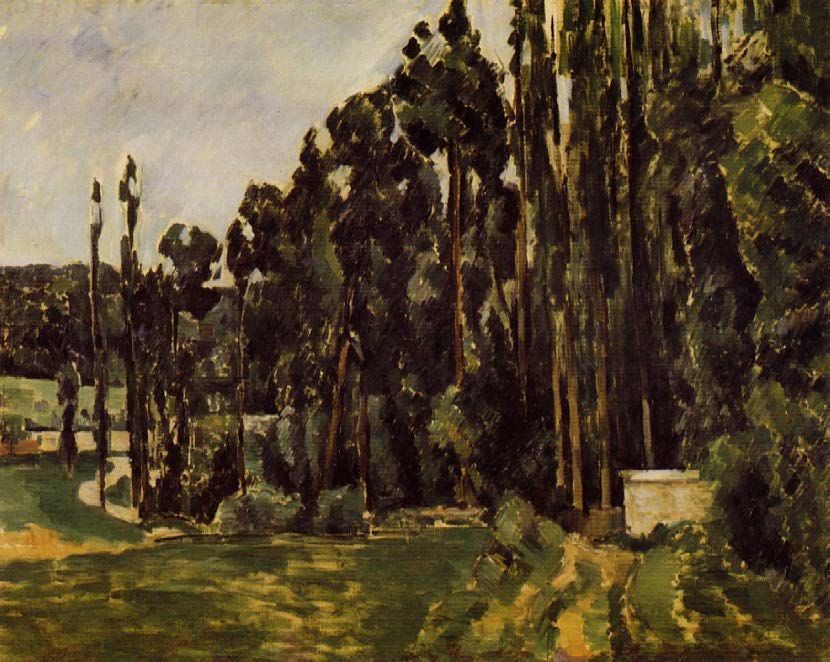
Leonardo Just Accepted MS.
                         https://doi.org/10.1162/ leon_a_02061
                         © 2021 ISAST

                        Pareidolia and Art History

                        Art history is no stranger to illusion, but the concept of pareidolia appears to have largely
                        escaped art historians [5]. The term was first coined by Karl Ludwig Kahlbaum in 1866 [6].
                        Older descriptions of pareidolia can be found in Alberti’s On Painting [7], who writes: ‘They
                        probably occasionally observed in a tree-trunk or clod of earth and other similar inanimate
                        objects certain outlines in which, with slight alterations, something very similar to the real faces
                        of Nature was represented… (p. 9).’ Leonardo da Vinci also described seeing figures and
                        landscapes on wall stains and stone [8] and in Shakespeare’s Hamlet the characters see animals
                        in clouds [9].

                        Pareidolia is most commonly associated with perceiving faces. This occurs because our brains
                        have a unique facial processing system, which has evolved over 30 million years, and anything
                        even remotely face-like will activate it [10]. In fact, an area of the brain called the fusiform gyrus
                        brain area activates both when we see an actual face and when we experience a pareidolia effect
                        [11]. We initially recognize a stimulus as a face by identifying its key features: eyes, mouth and
                        nose, which our perceptual system puts together into a whole [12]. In Arcimboldo paintings,
                        which are pictures of objects such as fruits and vegetables that together create a portrait of a
                        person, spectators focus on the ‘eyes’. [13]. Similarly, focus is on the faces in Ilya Repin’s An
                        Unexpected Visitor (1884-1888), particularly the eyes and mouths [14]. Artists are an interesting
                        exception to this rule, and tend to look more freely around without showing any noticeable
                        emphasis on faces [15]. We also appear to be biased towards finding faces: in one study, 39% of
                        participants claimed to see faces in randomly generated images of static white noise [16].

                        Pareidolia helps explain why we sometimes see a face in a painting and wonder whether the
                        artist put it there deliberately. There is no doubt that the reversible images in Slave Market were
                        put there intentionally, particularly because the title primes the viewer to find them. However,
                        because our brains are tuned to look for such images in all stimuli, it follows that we may also
                        detect patterns or hidden images in ambiguous pictures where the artist’s intention is not known.
                        Sometimes the premise behind discussions on such ambiguous images is the presumption that it
                        was deliberately placed there by the artist. This could potentially lead to wrongful conclusions,
                        as the image may simply be a perceptual artefact. I will illustrate the pitfalls of such
                        interpretations through the approaches to ambiguous images by two authors, Sidney Geist and
                        Dario Gamboni, who proposed that Paul Cézanne and Paul Gauguin, respectively, placed hidden
                        images in their pictures either deliberately or unconsciously.

                        Cézanne’s ‘Cryptomorphs’

                        In his book, Interpreting Cézanne, Geist [17] suggests that the artist unconsciously placed hidden
                        portraits in his paintings, and he often attempts to justify these claims through circumstantial and
                        ambiguous evidence from letters. The hidden images are called ‘cryptomorphs’ and are often
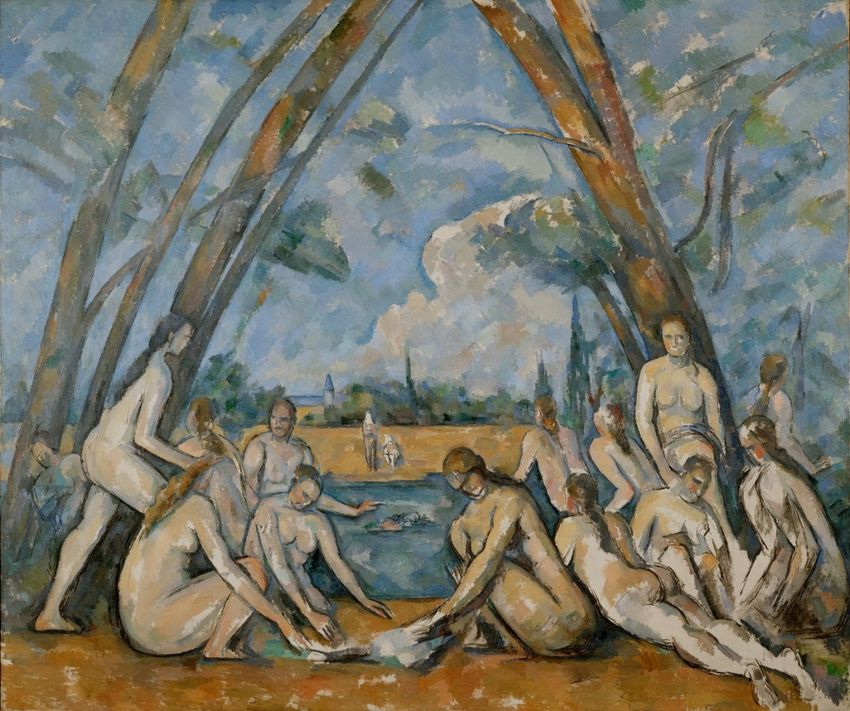
                        hard to detect. A supposed hidden face is found in The Large Bathers (1906, Fig. 2): Geist
                        claims the trees outline the hair, the top of the white cloud forms an eyebrow, with an iris
                        underneath in the foliage, and the shoreline across the river is the mouth. Geist paradoxically
                        believes this image was not consciously placed there, stating that the eye is ‘placed with

                        Raquel G. Wilner, Pareidolia and the Pitfalls of Subjective                                                  1
                        Interpretation of Ambiguous Images in Art History

Downloaded from http://direct.mit.edu/leon/article-pdf/doi/10.1162/leon_a_02061/1894174/leon_a_02061.pdf by guest on 27 March 2021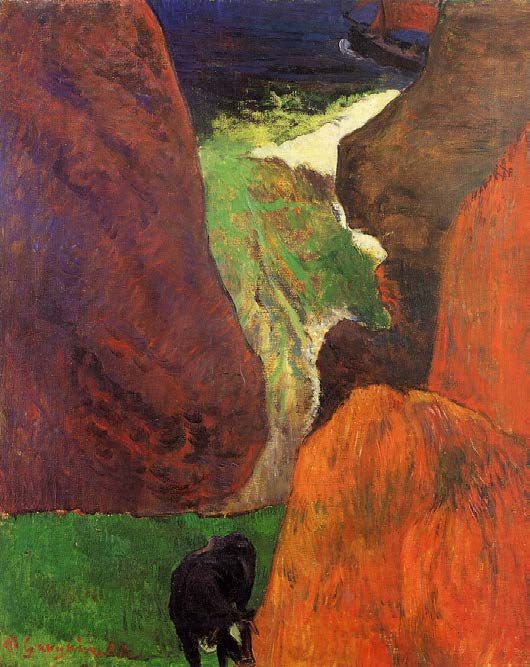
Leonardo Just Accepted MS.
                         https://doi.org/10.1162/ leon_a_02061
                         © 2021 ISAST

                        anatomical precision,’ but also that ‘nothing that we know of Cézanne leads us to think that he
                        willed it or knew that he made it [18].’

                        Fig. 2. Paul Cézanne, The Large Bathers (1906). Oil on canvas, 210.5 cm x 250.8 cm. Philadelphia Museum of
                        Art, Philadelphia, USA. (Photo courtesy of Wikimedia Commons.)

                        The alternative approach is that Geist is simply experiencing pareidolia when viewing Cézanne’s
                        pictures, and that he perceives something face-like in the painting. This leads him to make
                        inferences about the inner workings of Cézanne’s mind, where his unconscious is guiding his
                        hand and planting hidden faces in his paintings without the artist being overtly aware of doing
                        so.

                        There are possible exceptions to Geist’s overanalysis of pareidolia effects, such as Poplars
                        (c.1880, Fig. 3). Geist claims the title is very similar to the French word for people (peuple), and
                        he sees the shapes of several human figures amongst the trees. Even if we accept that this play on
                        words from Cézanne was deliberate, we do not need to find hidden images in the picture for the
                        pun to work: the trees may act as metaphors for people, and not necessarily as literal depictions
                        of them.

                        Raquel G. Wilner, Pareidolia and the Pitfalls of Subjective                                                  2
                        Interpretation of Ambiguous Images in Art History

Downloaded from http://direct.mit.edu/leon/article-pdf/doi/10.1162/leon_a_02061/1894174/leon_a_02061.pdf by guest on 27 March 2021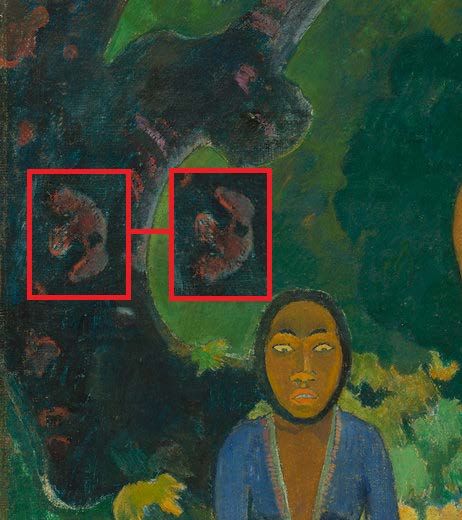
Leonardo Just Accepted MS.
                         https://doi.org/10.1162/ leon_a_02061
                         © 2021 ISAST

                        Fig. 3 Paul Cézanne, Poplars (c.1880). Oil on canvas, 65 cm x 80 cm. Musée d’Orsay, France. (Photo courtesy of
                        WikiMedia Commons)

                        Gauguin’s ‘Aspects’

                        Gamboni, like Geist, uses subjective analysis to find hidden images in Gauguin’s work, and
                        substantiates these claims through letters the artist has written [19]. These ‘aspects’, as Gamboni
                        calls them, allude to ambiguous images within images that take form, and are interpreted, in the
                        spectator’s mind. Gamboni outlines many hidden aspects in Gauguin’s paintings, such as a
                        supposed face between a tree and a bush in an untitled drawing (Woman and Child before a
                        Landscape – c.1888-9), or how the leaves of two trees in View of Pont-Aven from Lézaven
                        (1888-1889) form a face [20]. These hidden faces are best explained as accidental configurations
                        perceived through pareidolia – or, as Gamboni states, in the spectator’s mind.

                        One case of a hidden image is substantiated by technical evidence: the hidden portrait found in
                        Gauguin’s Seascape with Cow on the Edge of a Cliff (1888, Fig. 4). The quasi-flattened
                        foreground of this painting gives room to a confusing space. The hidden image appears to pop-
                        out from the disjointed background, revealing itself in the water wedged between the cliffs. It is
                        allegedly the profile of the artist facing towards our right: there is a long thin neck; a pointy chin
                        (the artist’s beard); his iconic aquiline nose; and lastly, a beret at the top. In addition to its
                        similarity to portraits of Gauguin, an X-ray of the picture implies that the artist had gone over it
                        multiple times, suggesting intent [21]. Nevertheless, Gamboni also mentions that the two cliff
                        sides look like two animal heads. The X-ray of the hidden portrait suggests intent, as the features

                        Raquel G. Wilner, Pareidolia and the Pitfalls of Subjective                                                  3
                        Interpretation of Ambiguous Images in Art History

Downloaded from http://direct.mit.edu/leon/article-pdf/doi/10.1162/leon_a_02061/1894174/leon_a_02061.pdf by guest on 27 March 2021
Leonardo Just Accepted MS.
                         https://doi.org/10.1162/ leon_a_02061
                         © 2021 ISAST

                        have been demarcated, but the same cannot be said of these other two heads. Consequently, the
                        two images found in the cliff-sides are most likely artefacts of pareidolia.

                        Techniques and the Unconscious in the Perception of Hidden Images

                        Pareidolia is a more likely explanation for the ambiguous images in paintings by Cézanne and
                        Gauguin, because most of the ‘cryptomorphs’ and ‘aspects’ are faces, complete with eyes,
                        mouths and often noses. Geist and Gamboni’s unawareness of pareidolia can certainly be
                        forgiven, but it also led them to make speculative claims about their respective artists [22]. The
                        real question is not whether one perceives these hidden images, but rather whether they were
                        intentionally put there or not, because this has consequences for the artist’s biography. By
                        ‘intention’ I mean that the artist was overtly aware of what he painted – this necessarily
                        precludes any unconscious intention. Our perceptual system allows us to perceive gestalt patterns
                        and meaning in any stimuli, and thus any work of art, but these perceptions alone are not
                        necessarily evidence of the artist’s intent.

                        Fig. 4 Paul Gauguin, Seascape with Cow on the Edge of a Cliff (1888). Oil on canvas, 72.5 x 61 cm. Musée
                        d’Orsay, France. (Photo courtesy of WikiMedia Commons.)

                        James Elkins has alluded that ‘aleamorphs’ are images not made by human hands, while
                        cryptomorphs are [23]. However, that something is human-made does not necessarily mean it is
                        made with intent: the perceived image could, for instance, be the accidental result of a
                        combination of brushstrokes. I argue that distinguishing between intention and accident in an

                        Raquel G. Wilner, Pareidolia and the Pitfalls of Subjective                                                  4
                        Interpretation of Ambiguous Images in Art History

Downloaded from http://direct.mit.edu/leon/article-pdf/doi/10.1162/leon_a_02061/1894174/leon_a_02061.pdf by guest on 27 March 2021
Leonardo Just Accepted MS.
https://doi.org/10.1162/ leon_a_02061
© 2021 ISAST
ambiguous image should be done by establishing pictorial intent [24], meaning it has been
deliberately placed there by the artist, and is not a perceptual by-product. Pictorial intent could
be difficult to establish, but can sometimes be reasonably assumed through supporting evidence
such as letters, the title, subject matter and technical analyses. The absence of such evidence does
not exclude the possibility that the image was deliberately placed there, but for the sake of
remaining objective, I recommend a skeptical standpoint: ambiguous images within a picture
should be considered a pareidolia effect (or ‘aleamorphs’) unless evidence suggests otherwise,
else we run the risk of making highly speculative claims.
Geoff Cole [25] argued that consequences are more important than author intent, because we can
never directly see into the mind of the artist. Similarly, Gombrich argues that intent is irrelevant:
what matters is what significance the image carries [26]. The point with ambiguous images
within images, however, is that intent is not known, and our interpretation of the images can end
up prescribing knowledge about the author and their psyche based purely on subjective
perception.
Arguably, pictorial intent is weakened if different people do not perceive the same configuration.
For example, Joyce Medina [27] claims to see a skull in the void between the two figures
depicted in Cézanne’s The Card Players (1894-1895), but due to its highly ambiguous nature it
is likely a pareidolia effect. On other occasions, we might universally perceive the same figure,
but this observation alone does not constitute evidence that the image was placed with pictorial
intent. For example, Roger Caillous’s minerals resemble sceneries or people. The titles aid the
viewer in finding these patterns, e.g. Le Petite Fantome (The Little Ghost). In this case, the
‘artist’ is nature itself, and it would be wrong to assume any intent behind the depiction. In terms
of modern art, the brushstrokes of Cézanne and Gauguin possibly make their pictures more
susceptible to pareidolia, primarily because they leave room for ambiguity. Color modulation is
separate, with visible brushstrokes that create forms in themselves, thus not only do they form
part of a whole, but they can also be viewed individually [28]. Some styles may be more
suggestive in finding hidden images than others, such as abstract expressionism. Jackson
Pollock’s work may evoke a myriad of different elements, where the ambiguity sparks subjective
meaning in the spectator. Pictorial intent still applies: any hidden images should not be assumed
to have been planted by the artist without objective evidence supporting this intention.
Art is often layered with ambiguous meaning [29]. Subjective analysis and intent attribution are
not meant to be discouraged, as they have a place in art history. The proposed concept of
pictorial intent is a recommendation for art historians that encounter ambiguous imagery: it is not
a general approach to art analysis, and should not supersede other art historical methods. Art is
meant to express meaning [30], but it does not necessarily follow that the meaning we identify
also provides autobiographical information about the artist.
The Pitfalls of Subjectivity
David Carrier acknowledged that even though Geist’s analyses were ultimately dismissed, at
least it made art historians rethink Cézanne’s work [31,32]. However, artworks can be discussed
and enjoyed in their own right, without a need to give them additional layers of meaning based
entirely on subjective perception of questionable hidden imagery. As Elkins states: ‘The richness
Raquel G. Wilner, Pareidolia and the Pitfalls of Subjective 5
Interpretation of Ambiguous Images in Art History
Downloaded from http://direct.mit.edu/leon/article-pdf/doi/10.1162/leon_a_02061/1894174/leon_a_02061.pdf by guest on 27 March 2021Leonardo Just Accepted MS.
https://doi.org/10.1162/ leon_a_02061
© 2021 ISAST
and nuance of historical research are excised in favor of violently reductive interpretations, and
the result is artwork that is less interesting than it had been [33]’.
Fig. 5 Paul Gauguin, Parau na te Varua ino (1892). Oil on canvas, 92 cm x 68 cm. National Gallery of Art,
Washington D.C, USA. (Author’s edit. Original photo courtesy of Wikimedia Commons.)
Another danger with a subjective interpretation is confirmation bias: the tendency to look for
evidence to support your own claims, rather than looking for evidence that could potentially
disprove it [34]. Thus, when anyone has a hypothesis about hidden images in paintings, it
becomes increasingly easier to spot such ‘images’, since they are actively looking for examples
to confirm their suspicions. Gauguin’s Parau na te Varua ino (1892) highlights the whimsical
and erratic nature of a person’s subjective interpretation, as there is reputedly a myriad of
different faces in the depicted tree trunk [35]. We almost invariably find hidden images when we
seek them: in the same ‘reptilian’ tree trunk there is a peached-colored patch in the middle that
contains an anthropomorphic sinister face, which is even more prominent once mirrored and
flipped (Fig. 5).
Conclusion
Pareidolia helps explain why we sometimes perceive hidden images within pictures, as
illustrated by Cézanne and Gauguin. In rare cases, technical evidence, documents, the picture’s
title or subject matter can support the suggestion that a hidden image was intentionally painted,
such as in Gauguin’s Seascape. However, a single valid case is not proof that all other
Raquel G. Wilner, Pareidolia and the Pitfalls of Subjective 6
Interpretation of Ambiguous Images in Art History
Downloaded from http://direct.mit.edu/leon/article-pdf/doi/10.1162/leon_a_02061/1894174/leon_a_02061.pdf by guest on 27 March 2021Leonardo Just Accepted MS.
https://doi.org/10.1162/ leon_a_02061
© 2021 ISAST
ambiguous images by the same artist were placed with pictorial intent. Seeing hidden faces or
other figures does not necessarily reveal anything about the intention of the artist, and any
arguments regarding the artist’s motivations are based on the premise that the image was not
accidental (circular reasoning), but such assertions require evidence. Subjective analysis
certainly has a place in art history and it is not my intention to discourage any such endeavor, but
its limitations should be recognized. Hidden and ambiguous images within images, fascinating
though they may be, are plentiful when the artist employs a technique that creates ambiguity.
Any conclusions drawn regarding the motivation or mind of the artist based on a subjective
interpretation should be evoked carefully. Even AI image analysis could be misleading, as the
analysis program was created by humans, although image analyzers could assist in objectively
outlining e.g. demarcation in X-Ray scans. Relying on subjective interpretations of ambiguous
images leads to seeking patterns where none exist, drawing connections with little or no basis,
and building theories based entirely on speculation.
Acknowledgments
This paper is dedicated to my mother, Teresa Esparza Barona. I also wish to thank the following
people for their input and support: Espen Sjoberg, Gavin Parkinson, Chris French, Celia
Bernstein, David Wilner and Lindsay Wilner.
References and Notes
[1] G.M. Long and T.C. Toppino, “Enduring interest in perceptual ambiguity: alternating views
of reversible figures,” Psychological Bulletin 130, No. 5, 748--768 (2004).
[2] J. Lee, “I See Faces; Popular Pareidolia and the Proliferation of Meaning,” in A. Malinowska
and K. Lebek (eds.) Materiality and Popular Culture: The Popular Life of Things (Abingdon:
Routledge, 2016) pp. 103--117, p. 103-105.
[3] J. Whitson and A.D. Galinsky, “Lacking control increases illusory pattern perception,”
Science 322 (2008) pp.115--117.
[4] M.G. Haselton and D. Nettle, “The paranoid optimist: an integrative evolutionary model of
cognitive biases,” Personality and Social Psychology Review 10, No. 1, 47--66 (2006).
[5] While conducting an extensive online search, I have only found four mentions of pareidolia
in English articles written (at least in part) by an art history author: 1) S. Martinez-Conde et al.,
“Marvels of illusions: illusion and perception in the art of Salvador Dali,” Frontiers in Human
Neuroscience 9 (2015) pp. 1--12; 2) D. Melcher and F. Bacci, “The visual system as a constraint
on the survival and success of specific artworks,” Spatial Vision 21, No. 3-5, 347--362 (2008); 3)
E. Monahan, “Drawing pareidolia: journal extracts reflecting on practice-based research,”
Journal of Arts Writing by Students 2, No. 2, 127--140 (2016); 4) S.L. Smith, “Blinding the
viewer: Rembrandt’s 1628 self-portrait,” Kunst og Kultur 3 (2015) pp. 144--155.
[6] K.L. Kahlbaum, “Die Sinnesdelirien," Zeitschrift für Psychiatrie 23 (1866) pp. 1--83.
[7] L.B. Alberti, On Painting, translated by C. Grayson (London: Penguin Books Ltd, 2004) p. 9.
[8] E. MacCurdy, The Notebooks of Leonardo da Vinci (New York: George Braziller, 1954) pp.
873-874.
[9] William Shakespeare, Hamlet (c.1599-1602). Act 3: Scene 2: Lines 339-344.
Raquel G. Wilner, Pareidolia and the Pitfalls of Subjective 7
Interpretation of Ambiguous Images in Art History
Downloaded from http://direct.mit.edu/leon/article-pdf/doi/10.1162/leon_a_02061/1894174/leon_a_02061.pdf by guest on 27 March 2021Leonardo Just Accepted MS.
https://doi.org/10.1162/ leon_a_02061
© 2021 ISAST
[10] I. Adachi, D.P. Chou and R.R. Hampton, “Thatcher effect in monkeys demonstrates
conservation of face perception across primates,” Current Biology 19 (2009) pp. 1270--1273.
[11] J. Liu et al., “Seeing Jesus in toast: neural and behavioral correlates of face pareidolia,”
Cortex 53 (2014) pp. 60--77.
[12] D. Maurer, R. Le Grand and C.J. Mondlock, “The many faces of configural processing,”
TRENDS in Cognitive Sciences 6, No. 6, 255--260 (2002).
[13] A. Bubic, A. Suac and M. Palmovic, “Keeping our eyes on the eyes: the case of
Arcimboldo,” Perception 43 (2014) pp. 465--468.
[14] A.L. Yarbus, Eye Movements and Vision, translated by B. Haigh (New York: Plenum Press,
1967) pp.172 and 178-179.
[15] S. Vogt and S. Magnussen, “Expertise in pictorial perception: eye-movement patterns and
visual memory in artists and laymen,” Perception 36 (2007) pp. 91--100.
[16] C.A. Rieth et al., "Faces in the mist: illusory face and letter detection,” i-Perception 2
(2011) pp. 458--476.
[17] S. Geist, Interpreting Cézanne (Cambridge: Harvard University Press, 1988).
[18] Ibid, p.1.
[19] D. Gamboni, Paul Gauguin: The Mysterious Centre of Thought, translated by C. Miller
(London: Reaktion Books Ltd, 2014).
[20] Ibid, pp. 60--61 and 303.
[21] Ibid, p. 136.
[22] Gamboni has a tendency to use the term ‘anthropomorphism’ instead of ‘pareidolia’, see
e.g. [19] pp. 51-52, and in D. Gamboni, “Anthropomorphism,” The Art Bulletin 94, No. 1, 20--22
(2012). However, ‘anthropomorphism’ is a term that involves giving human attributes, such as
emotion or motivation, to non-human objects. See N. Epley, A. Waytz and J.T. Cacioppo, “On
seeing human: a three-factor theory of anthropomorphism,” Psychological Review 114, No. 4,
864--886 (2007).
[23] J. Elkins, Why Are Our Pictures Puzzles? On the Modern Origins of Pictorial Complexity
(New York: Routledge, 1999) p.184.
[24] I have taken this term from the short story “The Call of Cthulhu”, by H.P. Lovecraft, The
Complete Fiction of H.P. Lovecraft (New York: Race Point Publishing, 2014), pp. 381--407. The
narrator states: ‘Above these apparent hieroglyphics was a figure of evidently pictorial intent,
though its impressionistic execution forbade a very clear idea of its nature (p.383).’
[25] G.G. Cole, “Why the ‘Hoax’ Paper of Baldwin (2018) Should Be Reinstated,” Sociological
Methods & Research (2020) pp. 1--21.
[26] E.H. Gombrich, Art and Illusion (London: Phaidon Press Limited, 1993), p.160.
[27] J. Medina, Cézanne and Modernism: The Poetics of Painting (Albany: State University of
New York Press, 1995) p.9.
[28] G. Parkinson, “Gauguin’s vision, or credulity as method,” Art History 38, No. 5, 970--975
(2015).
Raquel G. Wilner, Pareidolia and the Pitfalls of Subjective 8
Interpretation of Ambiguous Images in Art History
Downloaded from http://direct.mit.edu/leon/article-pdf/doi/10.1162/leon_a_02061/1894174/leon_a_02061.pdf by guest on 27 March 2021Leonardo Just Accepted MS.
https://doi.org/10.1162/ leon_a_02061
© 2021 ISAST
[29] C. Muth and C-C. Carbon, “SeIns: Semantic Instability in Art,” Art & Perception 4 (2016)
pp. 145--184, p. 166.
[30] J. Dewey, Art as Experience (New York: Capricorn Books, 1958) p. 84.
[31] D. Carrier, “Erwin Panofsky, Leo Steinberg, David Carrier: the problem of objectivity in art
historical interpretation,” The Journal of Aesthetics and Art Criticism 47, No. 4, 333--347
(1989).
[32] D. Carrier, “Reply to Jonathan Gilmore,” The Journal of Aesthetics and Art Criticism 53,
No. 4, 426--429 (1995).
[33] J. Elkins, “The failed and the inadvertent: art history and the concept of the unconscious,”
International Journal of Psycho-Analysis 75 (1994) pp. 119--132, p.120.
[34] R.S. Nickerson, “Confirmation bias: a ubiquitous phenomenon in many guises,” Review of
General Psychology 2, No. 2, 175--220 (1998).
[35] See Gamboni [19] p.301.
Raquel G. Wilner is an independent art historian, specializing on interdisciplinary approaches to
art. She lectures at Oslo Metropolitan University and at Kristiania University College. She has an
MA and Graduate Diploma in History of Art from the Courtauld Institute of Art.
Raquel G. Wilner, Pareidolia and the Pitfalls of Subjective 9
Interpretation of Ambiguous Images in Art History
Downloaded from http://direct.mit.edu/leon/article-pdf/doi/10.1162/leon_a_02061/1894174/leon_a_02061.pdf by guest on 27 March 2021You can also read


